|
시장보고서
상품코드
2114055
경장영양제 : 시장 점유율 분석, 업계 동향 및 통계, 성장 예측(2026-2031년)Enteral Feeding Formulas - Market Share Analysis, Industry Trends & Statistics, Growth Forecasts (2026 - 2031) |
||||||
 Mordor Intelligence
Mordor Intelligence에 의하면, 경장영양제 시장 규모는 2025년 92억 2,000만 달러에서 2026년에는 96억 9,000만 달러로 확대되어 2031년까지 124억 4,000만 달러에 이를 것으로 예상되고 있어 2026-2031년 CAGR 5.12%를 기록할 전망입니다.
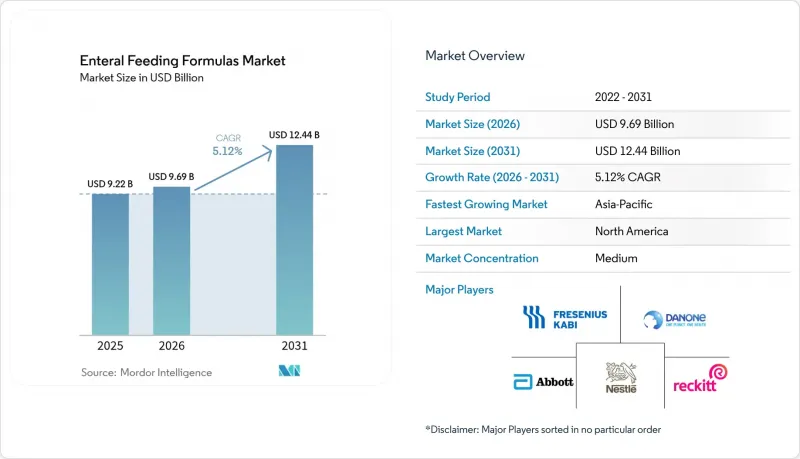
본 보고서는 제품 유형(표준 폴리머 계열 등), 칼로리 밀도(저에너지 등), 최종 사용자(병원, 장기 요양 시설, 재택 장내 영양, 외래 진료소), 연령대(신생아, 소아, 성인, 고령자) 및 지역(북미, 유럽, 아시아태평양 등)별로 분류되어 있습니다. 시장 전망은 금액(달러) 기준으로 제시되어 있습니다.
세계 장내 영양제 시장 동향 및 인사이트
만성 질환 및 노화 관련 질환의 부담 증가
2024년 전 세계 70세 이상 인구는 4억 9,440만 명으로, 평균 수명의 연장과 출산율 감소에 따라 꾸준히 증가하고 있습니다. 뇌졸중, 치매, 암 등의 만성 질환은 종종 연하 기능을 손상시키거나 대사 요구를 높이기 때문에 장기적인 장내 영양 공급이 필수적입니다. 이러한 추세를 여실히 보여주는 곳이 일본입니다. 일본에서는 65세 이상 인구가 전체 인구의 29.1%를 차지하며, 연하 장애 유병률은 50%를 초과하고 있습니다. 중국에는 60세 이상 인구가 2억 8,000만 명 이상이며, 식감을 조절한 영양제를 일상적으로 처방하는 노인 돌봄 센터에 대한 투자가 진행되고 있습니다. 전 세계적으로 볼 때, 현재 비감염성 질환이 사망 원인의 74%를 차지하고 있으며, 합병증 위험을 줄여주는 영양학적으로 완벽한 영양제에 대한 수요가 증가하고 있습니다.
의료 인프라 확충
경량 펌프와 원격 의료를 통한 모니터링 덕분에 간병인이 병원 밖에서도 안전하게 영양 공급을 할 수 있게 되면서, 재택 장내 영양 공급은 연평균 8.54%의 속도로 확대되고 있습니다. 미국의 메디케어 파트 B에서는 영구적인 경관 영양 튜브를 사용하는 환자를 위한 영양제와 소모품이 급여 대상으로 포함되어 있어 조기 퇴원이 촉진되고 있습니다. 독일, 프랑스, 영국 등 유럽 각국의 보험사들도 재택 간호에 대한 급여 범위를 확대하고 있으며, 일본에서는 요양보험이 고령자의 소모품 비용을 보조하고 있습니다. 임상시험을 통해 재택 프로그램은 장기 입소 시설에 비해 감염률을 낮추고, 총 간호 비용을 약 40% 절감하는 것으로 확인되었습니다.
부문 분석
표준 폴리머 블렌드 제품은 2025년 매출의 53.78%를 차지하고 있으며, 이는 임상 현장에서의 폭넓은 인지도와 유리한 지급 여건이 반영된 결과입니다. 그러나 장내 영양제 시장은 변화하고 있으며, 블렌더로 조리된 실제 식품을 원료로 한 제품이 7.54%의 연평균 성장률(CAGR)을 기록하고 있습니다. 이는 배변 규칙성이 향상된다는 증거와 간병인이 인식하기 쉬운 원재료를 선호하는 경향이 뒷받침하고 있습니다. 암 환자 및 중환자 치료 환자를 대상으로 한 고단백 제품 라인이 확대되는 한편, 펩타이드 기반의 반요소식 및 요소식 아미노산 제제는 흡수 불량이나 중증 알레르기 사례에 사용되고 있습니다. 질환 특이적 혁신 제품, 특히 당뇨병 및 신장 질환용 포뮬러는 입증된 대사적 이점으로 인해 프리미엄 가격을 실현하고 있습니다. Kate Farms와 같은 식물성 원료를 사용하는 신생 기업들은 유단백질을 완두콩 분리 단백질로 대체함으로써 시장 점유율을 확대하고 있으며, 알레르겐을 최소화한 성분이 불내증을 완화한다는 인식을 강화하고 있습니다.
아르기닌과 오메가-3가 풍부한 면역 조절 제품 분야가 확대되고 있으며, 수술 후 감염을 30% 감소시키는 것으로 입증되어 단가는 높지만 매력적인 제품으로 자리 잡고 있습니다. 이러한 변화는 장내 영양제 시장이 내약성, 대사 조절, 그리고 환자의 선호도를 동시에 충족시키는 차별화된 처방으로 더 광범위하게 전환되고 있음을 여실히 보여줍니다.
2025년에는 1.0 kcal/ml의 등칼로리 제품이 부문 매출의 45.42%를 차지했으나, 1.2-1.5 kcal/ml의 고칼로리 제품은 임상의들이 수분 제한이 있는 환자의 에너지 목표 달성을 위해 노력함에 따라 연평균 성장률(CAGR) 7.88%로 성장하고 있습니다. 2.0 kcal/ml를 초과하는 초고칼로리 제품은 펌프 막힘을 유발할 수 있는 점도 문제로 인해 여전히 틈새 시장에 머물러 있습니다. 각 제조업체는 설사를 억제하기 위해 삼투압을 낮추어 제품의 수용성을 높이고 있습니다. 이러한 고농도 영양제에 대한 집중은 입원 기간 단축 및 신속한 영양 공급이 필요한 중증 입원 환자 증가 추세와 부합하며, 장내 영양제 시장에서 고농도 혼합 제품의 성장 전망을 뒷받침하고 있습니다.
지역별 분석
북미는 메디케어 파트 B의 적용 범위, 선진적인 재택 간호 네트워크, 그리고 재입원에 벌금을 부과하는 가치 기반 지불 모델 덕분에 2025년에 전 세계 매출의 41.86%를 차지했습니다. 캐나다에서는 주마다 차이가 나타나는 반면, 멕시코의 성장은 공립 병원에 대한 투자와 민간 보험의 보급에 의존하고 있습니다.
아시아태평양은 연평균 성장률(CAGR) 6.43%를 기록하며 가장 빠르게 성장하는 지역입니다. 일본의 초고령 사회와 요양 보험 제도가 고영양가 영양제에 대한 지속적인 수요를 견인하고 있습니다. 중국의 ‘건강 중국 2030’ 로드맵에 따라 3차 의료기관 및 지역 의료시설에서의 의료용 영양제 제공이 확대되고 있습니다. 인도의 도시 지역 사립 병원들은 조기 도입을 추진하고 있으나, 높은 본인 부담 비용으로 인해 농촌 지역에서의 보급은 여전히 저조한 실정입니다.
유럽에서는 병원 및 재택 영양 공급에 대해 보상을 실시하는 종합적인 국민건강보험 제도의 혜택을 받고 있습니다. 독일에서는 건강보험조합을 통해 요금이 협상되며, 프랑스에서는 만성 질환에 대해 100% 급여가 지급되고, 영국에서는 비용 대비 효과가 높은 배합 제품을 우선하는 약제 목록이 채택되어 있습니다. 남유럽 국가들에서는 입원 환자의 부담을 줄이기 위해 재택 지원 프로그램을 확충하고 있습니다.
기타 혜택:
- 엑셀 형식 시장 예측(ME) 시트
- 3개월간의 애널리스트 지원
자주 묻는 질문
목차
제1장 서론
제2장 조사 방법
제3장 주요 요약
제4장 시장 구도
제5장 시장 규모와 성장 예측
제6장 경쟁 구도
제7장 시장 기회와 향후 전망
LSH 26.08.25According to Mordor Intelligence, the enteral feeding formulas market size is expected to increase from USD 9.22 billion in 2025 to USD 9.69 billion in 2026 and reach USD 12.44 billion by 2031, growing at a CAGR of 5.12% over 2026-2031.
This report is Segmented by Product Type (Standard Polymeric, and More), Caloric Density (Low Energy, and More), End-User (Hospitals, Long-Term Care, Home Enteral Nutrition, and Outpatient Clinics), Age Group (Neonates, Pediatrics, Adults, and Geriatrics), and Geography (North America, Europe, Asia-Pacific, and More). The Market Forecasts are Provided in Terms of Value (USD).
Global Enteral Feeding Formulas Market Trends and Insights
Rising Burden of Chronic and Age-Related Diseases
The global population of people aged 70+ in 2024 was 494.4 million and is expanding steadily as life expectancy rises and fertility falls. Chronic ailments such as stroke, dementia, and cancer frequently impair swallowing or elevate metabolic demands, making long-term enteral feeding essential. Japan illustrates this trend, where citizens aged 65 + represent 29.1% of the population and dysphagia prevalence exceeds 50%. China has more than 280 million people aged 60+, and it is investing in geriatric care centers that routinely prescribe texture-modified formulas. Globally, non-communicable diseases now cause 74% of deaths, reinforcing demand for nutritionally complete formulas that lower complication risks.
Expansion of Home Healthcare Infrastructure
Home enteral nutrition is growing at 8.54% as lightweight pumps and telehealth oversight let caregivers administer feeds safely outside hospitals. U.S. Medicare Part B covers formulas and supplies for permanent feeding-tube users, encouraging earlier discharge. European payers in Germany, France, and the United Kingdom have expanded reimbursement for home care, while Japan's long-term care insurance subsidizes supplies for elders. Clinical trials confirm that home programs lower infection rates and reduce total care costs by about 40% compared with long-term facilities.
Other drivers and restraints analyzed in the detailed report include:
- Cost Advantage of Enteral Versus Parenteral Nutrition
- Technological Advancements in Enteral Pumps and Closed Systems
- Variable Reimbursement and Insurance Coverage Globally
- Clinical Complications Such as Aspiration Pneumonia and GI Intolerance
For complete list of drivers and restraints, kindly check the Table Of Contents.
Segment Analysis
Standard polymeric blends controlled 53.78% of 2025 revenue, reflecting broad clinical familiarity and favorable payment status. Yet the enteral feeding formulas market is shifting as blenderized real-food options post a 7.54% CAGR, propelled by evidence of better bowel regularity and caregiver preference for recognizable ingredients. High-protein lines aimed at oncology and critical-care patients are rising, while peptide-based semi-elemental and elemental amino-acid variants are used for malabsorption or severe allergy cases. Disease-specific innovations, notably diabetes and renal formulas, command premium pricing through validated metabolic benefits. Plant-based entrants such as Kate Farms are winning share by replacing dairy proteins with pea isolates, reinforcing the perception that allergen-light compositions reduce intolerance.
A growing subset of immune-modulating products enriched with arginine and omega-3s is demonstrating 30% fewer postoperative infections, making them attractive despite higher unit costs. These shifts underscore a broader re-orientation of the enteral feeding formulas market toward differentiated formulations that address tolerance, metabolic control, and patient preferences simultaneously.
Isocaloric offerings at 1.0 kcal/ml held 45.42% of segment revenue in 2025, but hypercaloric formats at 1.2-1.5 kcal/ml are tracking a 7.88% CAGR as clinicians seek to meet energy goals in fluid-restricted patients. Very-high-calorie products above 2.0 kcal/ml remain niche due to viscosity challenges that can occlude pumps. Manufacturers are lowering osmolality to curb diarrhea, broadening acceptance. This focus on concentrated nutrition aligns with shorter hospital stays and sicker inpatients who require rapid repletion, reinforcing growth prospects for dense blends in the enteral feeding formulas market.
Complete Report Scope:
- By Product Type
- Standard Polymeric Formulas
- High-Protein Polymeric Formulas
- Peptide-Based / Semi-Elemental Formulas
- Elemental (Amino-Acid) Formulas
- Disease-Specific Formulas
- Immune-Modulating / Synbiotic Formulas
- Blenderized Real-Food Formulas
- By Caloric Density
- Low Energy (<1.0 kcal/ml)
- Isocaloric (≈1.0 kcal/ml)
- Hypercaloric (1.2-1.5 kcal/ml)
- Very-High Calorie (>=2.0 kcal/ml)
- By End-User
- Hospitals & Acute-Care Centres
- Long-Term Care Facilities
- Home Enteral Nutrition (HEN)
- Out-Patient / Ambulatory Clinics
- By Age Group
- Neonates (0-28 Days)
- Pediatrics (1 Month-17 Yrs)
- Adults (18-64 Yrs)
- Geriatrics (>=65 Yrs)
- Geography
- North America
- United States
- Canada
- Mexico
- Europe
- Germany
- United Kingdom
- France
- Italy
- Spain
- Rest of Europe
- Asia-Pacific
- China
- Japan
- India
- Australia
- South Korea
- Rest of Asia-Pacific
- Middle East & Africa
- GCC
- South Africa
- Rest of Middle East & Africa
- South America
- Brazil
- Argentina
- Rest of South America
- North America
Geography Analysis
North America generated 41.86% of global revenue in 2025 thanks to Medicare Part B coverage, advanced home-care networks, and value-based payment models that penalize readmissions. Canada shows province-level variation, whereas Mexico's growth depends on public hospital investment and private insurance uptake.
Asia-Pacific is the fastest-growing region, with a 6.43% CAGR. Japan's super-aged society and national long-term care insurance drive sustained demand for nutrient-dense formulas. China's Healthy China 2030 roadmap is expanding medical-nutrition offerings across tertiary and community facilities. India's urban private hospitals are early adopters, but high out-of-pocket costs still curb rural penetration.
Europe benefits from comprehensive national health systems that reimburse hospital and home feeds. Germany negotiates rates via sickness funds, France covers 100% for chronic disease, and the United Kingdom uses formularies that increasingly favor cost-effective blends. Southern European countries are broadening home support programs to relieve inpatient pressure.
- Abbott Laboratories
- Ajinomoto Co., Inc.
- B. Braun
- Baxter
- Cambrooke Therapeutics Inc.
- Danone
- DSM-Firmenich
- EA Pharma Co., Ltd.
- Fresenius
- Hormel Foods
- Kate Farms, Inc.
- Meiji Holdings Co., Ltd.
- Nestle S.A.
- Nutritional Medicinals LLC
- Otsuka
- Real Food Blends LLC
- Reckitt Benckiser Group
- Victus
- Yakult Honsha Co., Ltd.
Additional Benefits:
- The market estimate (ME) sheet in Excel format
- 3 months of analyst support
TABLE OF CONTENTS
1 Introduction
- 1.1 Study Assumptions & Market Definition
- 1.2 Scope of the Study
2 Research Methodology
3 Executive Summary
4 Market Landscape
- 4.1 Market Overview
- 4.2 Market Drivers
- 4.2.1 Rising Burden of Chronic and Age-Related Diseases
- 4.2.2 Cost Advantage of Enteral Versus Parenteral Nutrition
- 4.2.3 Expansion of Home Healthcare Infrastructure
- 4.2.4 Technological Advancements in Enteral Pumps and Closed Systems
- 4.2.5 Product Innovation in Disease-Specific and High-Protein Formulas
- 4.2.6 Adoption of Value-Based Care and Outcome-Linked Reimbursement Models
- 4.3 Market Restraints
- 4.3.1 Variable Reimbursement and Insurance Coverage Globally
- 4.3.2 Clinical Complications such as Aspiration Pneumonia and GI Intolerance
- 4.3.3 Supply Chain Volatility for Medical-Grade Macronutrient Inputs
- 4.3.4 Limited Clinical Evidence for Emerging Plant-Based and Blenderized Formulas
- 4.4 Value / Supply-Chain Analysis
- 4.5 Regulatory Landscape
- 4.6 Technological Outlook
- 4.7 Porter's Five Forces Analysis
- 4.7.1 Threat Of New Entrants
- 4.7.2 Bargaining Power Of Buyers
- 4.7.3 Bargaining Power Of Suppliers
- 4.7.4 Threat Of Substitutes
- 4.7.5 Industry Rivalry
5 Market Size & Growth Forecasts (Value, USD)
- 5.1 By Product Type
- 5.1.1 Standard Polymeric Formulas
- 5.1.2 High-Protein Polymeric Formulas
- 5.1.3 Peptide-Based / Semi-Elemental Formulas
- 5.1.4 Elemental (Amino-Acid) Formulas
- 5.1.5 Disease-Specific Formulas
- 5.1.6 Immune-Modulating / Synbiotic Formulas
- 5.1.7 Blenderized Real-Food Formulas
- 5.2 By Caloric Density
- 5.2.1 Low Energy (<1.0 kcal/ml)
- 5.2.2 Isocaloric (≈1.0 kcal/ml)
- 5.2.3 Hypercaloric (1.2-1.5 kcal/ml)
- 5.2.4 Very-High Calorie (>=2.0 kcal/ml)
- 5.3 By End-User
- 5.3.1 Hospitals & Acute-Care Centres
- 5.3.2 Long-Term Care Facilities
- 5.3.3 Home Enteral Nutrition (HEN)
- 5.3.4 Out-Patient / Ambulatory Clinics
- 5.4 By Age Group
- 5.4.1 Neonates (0-28 Days)
- 5.4.2 Pediatrics (1 Month-17 Yrs)
- 5.4.3 Adults (18-64 Yrs)
- 5.4.4 Geriatrics (>=65 Yrs)
- 5.5 Geography
- 5.5.1 North America
- 5.5.1.1 United States
- 5.5.1.2 Canada
- 5.5.1.3 Mexico
- 5.5.2 Europe
- 5.5.2.1 Germany
- 5.5.2.2 United Kingdom
- 5.5.2.3 France
- 5.5.2.4 Italy
- 5.5.2.5 Spain
- 5.5.2.6 Rest of Europe
- 5.5.3 Asia-Pacific
- 5.5.3.1 China
- 5.5.3.2 Japan
- 5.5.3.3 India
- 5.5.3.4 Australia
- 5.5.3.5 South Korea
- 5.5.3.6 Rest of Asia-Pacific
- 5.5.4 Middle East & Africa
- 5.5.4.1 GCC
- 5.5.4.2 South Africa
- 5.5.4.3 Rest of Middle East & Africa
- 5.5.5 South America
- 5.5.5.1 Brazil
- 5.5.5.2 Argentina
- 5.5.5.3 Rest of South America
- 5.5.1 North America
6 Competitive Landscape
- 6.1 Market Concentration
- 6.2 Market Share Analysis
- 6.3 Company Profiles (Includes Global-Level Overview, Market-Level Overview, Core Segments, Financials As Available, Strategic Information, Market Rank/Share For Key Companies, Products & Services, And Recent Developments)
- 6.3.1 Abbott Laboratories
- 6.3.2 Ajinomoto Co., Inc.
- 6.3.3 B. Braun SE
- 6.3.4 Baxter International Inc.
- 6.3.5 Cambrooke Therapeutics Inc.
- 6.3.6 Danone S.A.
- 6.3.7 DSM-Firmenich
- 6.3.8 EA Pharma Co., Ltd.
- 6.3.9 Fresenius SE & Co. KGaA
- 6.3.10 Hormel Foods Corporation
- 6.3.11 Kate Farms, Inc.
- 6.3.12 Meiji Holdings Co., Ltd.
- 6.3.13 Nestle S.A.
- 6.3.14 Nutritional Medicinals LLC
- 6.3.15 Otsuka Pharmaceutical Co., Ltd.
- 6.3.16 Real Food Blends LLC
- 6.3.17 Reckitt Benckiser Group plc. (Mead Johnson)
- 6.3.18 Victus, Inc.
- 6.3.19 Yakult Honsha Co., Ltd.
7 Market Opportunities & Future Outlook
- 7.1 White-Space & Unmet-Need Assessment