

|
시장보고서
상품코드
2114057
농업용 센서 : 시장 점유율 분석, 업계 동향 및 통계, 성장 예측(2026-2031년)Agricultural Sensor - Market Share Analysis, Industry Trends & Statistics, Growth Forecasts (2026 - 2031) |
||||||
 Mordor Intelligence
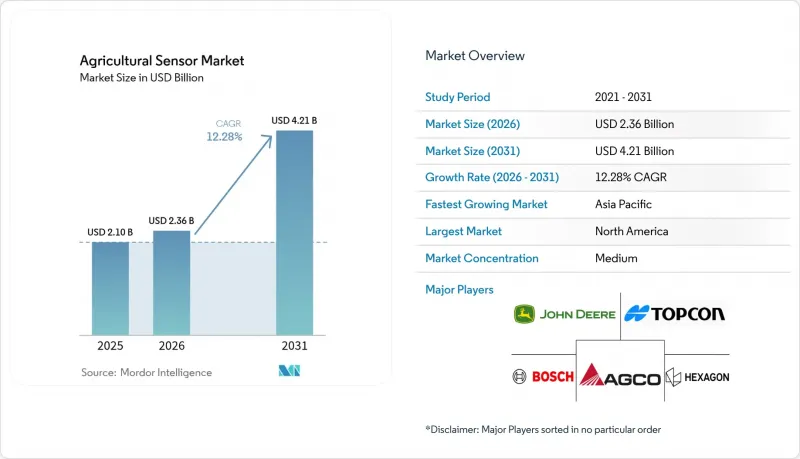
Mordor Intelligence에 의하면, 2026년 농업용 센서 시장 규모는 23억 6,000만 달러로 추정되고 있으며, 2025년 21억 달러에서 2031년에는 42억 1,000만 달러에 달할 것으로 예측됩니다.
2026-2031년 연평균 성장률(CAGR) 12.3%를 기록할 전망입니다.
본 보고서는 유형별(습도 센서, 전기화학 센서, 기계식 센서, 기류 센서, 광학 센서 등), 용도별(낙농 관리, 토양 관리, 기후 관리 등), 지역별(북미, 유럽, 아시아태평양, 남미, 중동 및 아프리카)로 분류되어 있습니다. 시장 전망은 금액(달러) 기준으로 제시되어 있습니다.
전 세계 농업용 센서 시장 동향 및 인사이트
정밀 농업 장비에 대한 보조금
정부가 지원하는 비용 분담 프로그램은 경제적 장벽을 완화함으로써 정밀 농업 도구에 대한 접근성을 개선하고 있습니다. 이러한 노력은 농가에 대한 직접적인 지원이 되어, 첨단 센서 기술의 가격을 합리적으로 만들고, 지역을 불문하고 도입을 촉진하고 있습니다. 주요 농업 경제국들의 장기적인 정책적 약속은 공급업체에게 안정적인 수요와 예측 가능한 수주량을 보장합니다. 장비 구매에 대한 정부의 보조금은 투자 회수 기간을 단축하고 현대적인 농업 인프라에 대한 투자를 촉진합니다. 이러한 지원 덕분에 제조업체는 생산을 확대하고 혁신을 추진할 수 있게 됩니다. 소규모 농가들이 디지털 도구를 활용할 수 있게 됨에 따라 농업 관행은 더욱 효율적이고 지속 가능해지고 있습니다. 이러한 프로그램들은 농업 기술 부문의 성장에 안정성을 부여하며, 기존 방식에서 데이터 기반 의사 결정으로의 전환을 지원하고 있습니다.
실시간 작물 모니터링에 대한 수요 증가
사후 대응형 농업에서 예측형 농업으로의 전환에 따라, 실시간 작물 모니터링 기술에 대한 수요가 증가하고 있습니다. 환경 규제로 인해 생산자들은 상세한 기록을 유지해야 하며, 데이터 수집 및 규정 준수 보고를 자동화하는 센서의 도입이 촉진되고 있습니다. 기후 변동성으로 인해 기존 예측 기법의 신뢰성은 떨어지고 있습니다. 현장 센서 데이터를 활용함으로써 농가는 관개, 농약 살포, 수확 시기를 최적화하여 수확량의 안정성과 자원 효율성을 향상시킬 수 있습니다. 이러한 도구는 예측 불가능한 기상 조건이나 변화하는 토양 조건으로 인한 위험을 관리하는 데 도움이 됩니다. 생산자들이 생산량 안정화와 폐기물 감축에 힘쓰는 가운데, 수익성을 유지하고 품질 기준을 충족하기 위해서는 실시간 모니터링이 필수적입니다. 이러한 기술을 농업 경영에 통합함으로써 스마트하고 회복력 있는 농업이 추진됩니다.
소규모 농가에게 부담되는 높은 초기 비용
높은 초기 비용은 정밀 농업을 도입하려는 소규모 농가에게 여전히 큰 장벽으로 작용하고 있습니다. 센서 시스템에는 막대한 투자가 필요하며, 많은 경우 연간 농업 소득의 상당 부분을 차지합니다. 자금 조달 기회가 제한적이고 투자 회수 기간이 불분명하기 때문에 소규모 농가가 그 비용을 정당화하기는 어렵습니다. 표준화된 성능이나 투자 회수 벤치마크가 존재하지 않아 의사 결정이 지연되고 있습니다. 이러한 주저함은 사업 규모 확대와 비용 절감을 위해 대량 판매에 의존하고 있는 공급업체에게도 영향을 미치고 있습니다. 소규모 농장은 대규모 농장에 비해 도입이 뒤처져 있어 기술 격차를 확대시키고 있습니다. 대출, 리스 또는 공동 구매를 통한 해결책은 접근성 확대와 시장 성장으로 이어질 가능성이 있습니다. 비용은 농업 분야에서의 센서 기술 광범위한 도입에 대한 주요 제약 요인으로 남아 있습니다.
부문 분석
2025년, 토양 수분 센서는 농업용 센서 시장 규모의 27.62%를 차지하며 정밀 관개 시스템에서 그 중요성을 입증했습니다. 이러한 센서를 통해 농가는 토양 수분 수준을 실시간으로 모니터링하고, 물 사용량을 최적화하며, 규제 요건을 준수할 수 있게 됩니다. 특히 물 부족에 직면한 지역에서 농가가 최적의 작물 수확량을 유지하면서 물 소비량을 최소화하려는 가운데, 그 도입은 계속해서 확대되고 있습니다.
가축용 바이오 센서는 자동 군집 관리 시스템의 도입 확대에 힘입어 2031년까지 연평균 성장률(CAGR) 9.35%라는 가장 높은 성장률을 기록하고 있습니다. 이러한 센서는 가축의 생체 신호, 생식 주기, 건강 지표를 모니터링하여 낙농 사업자가 생산성을 향상시키고 수작업 부담을 줄일 수 있도록 지원합니다. 또한, 이 시장에는 온실 모니터링용 광학식 및 전기화학식 센서 외에도, 설비 및 관개 시스템 유지보수를 위한 기계식, 기류, 압력 센서도 포함되어 있습니다. 이러한 다양한 센서 라인업을 통해 공급업체는 농업의 계절적 주기에 영향을 받지 않는 여러 수익원을 확보할 수 있습니다.
지역별 분석
북미는 성숙한 정밀 농업 인프라와 강력한 정부 인센티브에 힘입어 2025년 농업용 센서 시장 점유율 30.55%를 유지했습니다. 공공 프로그램이 지속적으로 갱신 및 확장 주기를 주도하고 있어, 생산자들이 센서를 보다 쉽게 도입할 수 있게 되었습니다. 캐나다의 혁신 촉진 정책이 지역의 성장세를 뒷받침하는 한편, 멕시코에서는 수출 지향적인 원예 농업에 중점을 두고 있어 추적성 도구에 대한 수요가 증가하고 있습니다. 이 지역은 확립된 공급망과 디지털 농업 관행이 널리 보급되어 있다는 이점을 누리고 있습니다. 규제 준수 및 지속가능성 목표가 강화됨에 따라, 북미의 농장에서는 투입 자재 최적화, 환경 조건 모니터링, 그리고 세계 시장에서의 경쟁력 유지를 위해 센서 기술의 활용이 점점 더 확대되고 있습니다.
아시아태평양은 소규모 농가가 많고 기계화 노력이 뒷받침되면서 2031년까지 연평균 성장률(CAGR) 7.44%라는 가장 높은 성장률을 보이고 있습니다. 인도의 디지털 농업 이니셔티브는 서비스가 미치지 못하는 지역에서 센서 접근성을 확대하고 있는 반면, 중국에서는 센서를 자율형 농업 기계 및 축산 시스템에 통합하고 있습니다. 일본의 온실 시설은 고부가가치 가격 전략을 뒷받침하고 있으며, 호주의 수자원 관리에서는 센서 데이터를 활용하여 건조 지대의 농업을 관리하고 있습니다. 이 지역의 다양한 농업 관행과 기후 조건은 특수한 센서 활용 기회를 창출하고 있습니다. 인프라가 정비됨에 따라 아시아태평양은 농업용 센서 도입의 주요 성장 동력이 되고 있습니다.
유럽의 성장은 보조금 수령 자격과 관련된 환경 모니터링 요건에 힘입어 견조한 추세를 보이고 있습니다. 정밀 기술은 농업 운영에 필수적이며, 독일은 가축용 센서에 주력하고, 프랑스는 포도밭 모니터링을 전문으로 하며, 네덜란드는 전 세계적으로 온실 재배에 대한 전문 지식을 제공합니다. 남미에서는 대규모 곡물 생산이 중시되고 있으며, 특히 브라질과 아르헨티나에서는 센서가 수확량 최적화와 자원 관리를 개선하고 있습니다. 중동 및 아프리카에서는 통신 환경의 제약이 있음에도 불구하고, 수자원 효율화와 수출 규제 준수가 수요의 핵심을 이루고 있습니다. 이러한 신흥 시장에서 센서의 보급을 위해서는 농촌 지역의 네트워크 확충과 저전력 프로토콜이 여전히 필수적입니다.
기타 혜택:
- 엑셀 형식 시장 예측(ME) 시트
- 3개월간의 애널리스트 지원
자주 묻는 질문
목차
제1장 서론
제2장 조사 방법
제3장 주요 요약
제4장 시장 구도
제5장 시장 규모와 성장 예측
제6장 경쟁 구도
제7장 시장 기회와 향후 전망
LSH 26.08.25According to Mordor Intelligence, agricultural sensor market size in 2026 is estimated at USD 2.36 billion, growing from 2025 value of USD 2.1 billion with 2031 projections showing USD 4.21 billion, growing at 12.3% CAGR over 2026-2031.
This report is Segmented by Type (Humidity Sensor, Electrochemical Sensor, Mechanical Sensor, Airflow Sensor, Optical Sensor, and More), by Application (Dairy Management, Soil Management, Climate Management, and More), and by Geography (North America, Europe, Asia-Pacific, South America, Middle East, and Africa). The Market Forecasts are Provided in Terms of Value (USD).
Global Agricultural Sensor Market Trends and Insights
Subsidies for Precision-agriculture Equipment
Government-backed cost-share programs are improving access to precision-agriculture tools by reducing financial barriers. These initiatives provide direct support to farmers, making advanced sensor technologies more affordable and increasing adoption across regions. Long-term policy commitments from major agricultural economies ensure consistent demand and predictable order volumes for vendors. Government subsidies for equipment purchases reduce payback periods and encourage investment in modern farming infrastructure. This support enables manufacturers to expand production and advance innovation. As small-scale farmers gain access to digital tools, farming practices become more efficient and sustainable. These programs provide stability for growth in the agricultural technology sector, supporting the transition from conventional methods to data-driven decision-making.
Rising Demand for Real-time Crop Monitoring
The transition from reactive to predictive farming is increasing demand for real-time crop monitoring technologies. Environmental regulations require growers to maintain detailed records, driving adoption of sensors that automate data collection and compliance reporting. Climate volatility makes traditional forecasting methods less reliable. Local sensor data enables farmers to optimize irrigation, spraying, and harvesting decisions, improving yield consistency and resource efficiency. These tools help manage risks from unpredictable weather and changing soil conditions. As producers work to stabilize output and reduce waste, real-time monitoring becomes crucial for maintaining profitability and meeting quality standards. The integration of these technologies into farm operations advances smart, resilient agriculture.
High Upfront Cost for Smallholders
High initial costs remain a significant obstacle for small-scale farmers adopting precision agriculture. Sensor systems require substantial investment, often representing a large portion of annual farm income. Limited credit access and unclear return-on-investment periods make it difficult for smallholders to justify the expense. The absence of standardized performance and payback benchmarks slows decision-making. This hesitation impacts vendors who depend on volume sales to scale operations and reduce costs. Small farms lag behind larger operations in adoption, increasing the technology gap. Solutions through financing, leasing, or cooperative purchasing could expand access and market growth. Cost remains a primary constraint on widespread sensor technology deployment in agriculture.
Other drivers and restraints analyzed in the detailed report include:
- Growing Adoption of IoT in Agriculture
- Climate Change Driving Micro-environment Data Needs
- Limited Rural Connectivity
For complete list of drivers and restraints, kindly check the Table Of Contents.
Segment Analysis
Soil-moisture sensors maintained a 27.62% of the agricultural sensor market size in 2025, demonstrating their importance in precision irrigation systems. These sensors enable farmers to monitor soil moisture levels in real time, optimize water usage, and comply with regulatory requirements. Their adoption continues to grow as farmers seek to minimize water consumption while maintaining optimal crop yields, particularly in regions experiencing water scarcity.
Livestock biosensors are experiencing the highest growth rate at 9.35% CAGR through 2031, driven by increased adoption of automated herd management systems. These sensors monitor animal vital signs, reproductive cycles, and health parameters, enabling dairy operators to enhance productivity and reduce manual labor requirements. The market also includes optical and electrochemical sensors for greenhouse monitoring, along with mechanical, airflow, and pressure sensors for equipment and irrigation system maintenance. This diverse sensor portfolio provides vendors with multiple revenue streams independent of seasonal agricultural cycles.
Complete Report Scope:
- By Type
- Humidity Sensor
- Electrochemical Sensor
- Mechanical Sensor
- Airflow Sensor
- Optical Sensor
- Pressure Sensor
- Water Sensor
- Soil-moisture Sensor
- Livestock Biosensor
- Other Types (pH Sensor, EC Sensor, Leaf Wetness Sensor, and More)
- By Application
- Dairy Management
- Soil Management
- Climate Management
- Water Management
- Smart Greenhouse Monitoring
- Crop Scouting
- By Geography
- North America
- United States
- Canada
- Mexico
- Rest of North America
- Europe
- Germany
- United Kingdom
- France
- Spain
- Italy
- Russia
- Rest of Europe
- Asia-Pacific
- China
- India
- Japan
- Australia
- Thailand
- South Korea
- Rest of Asia-Pacific
- South America
- Brazil
- Argentina
- Rest of South America
- Middle East
- Saudi Arabia
- Turkey
- Rest of Middle East
- Africa
- South Africa
- Kenya
- Rest of Africa
- North America
Geography Analysis
North America retained 30.55% agricultural sensor market share in 2025, supported by mature precision-agriculture infrastructure and strong government incentives. Public programs continue to drive replacement and expansion cycles, making sensor adoption more accessible for producers. Canada's innovation initiatives reinforce regional momentum, while Mexico's focus on export-oriented horticulture increases demand for traceability tools. The region benefits from established supply chains and widespread adoption of digital farming practices. With regulatory compliance and sustainability goals rising, North American farms increasingly use sensor technologies to optimize inputs, monitor environmental conditions, and maintain competitiveness in global markets.
Asia-Pacific demonstrates the fastest 7.44% CAGR through 2031, driven by large smallholder populations and mechanization efforts. India's digital agriculture initiatives expand sensor access in underserved districts, while China integrates sensors into autonomous machinery and livestock systems. Japan's greenhouse installations support premium pricing strategies, and Australia's water accounting practices use sensor data to manage arid-zone farming. The region's diverse farming practices and climate conditions create opportunities for specialized sensor applications. As infrastructure improves, the Asia-Pacific region becomes a primary growth driver for agricultural sensor deployment.
Europe's growth remains steady, driven by environmental monitoring requirements linked to subsidy eligibility. Precision technologies are integral to farm operations, with Germany focusing on livestock sensors, France specializing in vineyard monitoring, and the Netherlands providing greenhouse expertise globally. South America emphasizes large-scale grain production, particularly in Brazil and Argentina, where sensors enhance yield optimization and resource management. In the Middle East and Africa, demand focuses on water efficiency and export compliance, despite connectivity limitations. Rural network expansion and low-power protocols remain crucial for sensor adoption in these emerging markets.
- Deere & Company
- AGCO Corporation (Trimble Inc.)
- Topcon Corporation
- Sentek Technologies
- CropX Inc.
- Hexagon AB
- Robert Bosch GmbH
- Libelium Comunicaciones Distribuidas S.L.
- Auroras S.r.l.
- Pycno Industries, Inc.
- Acclima, Inc.
- The Toro Company
- METER Group
- Irrometer Company, Inc.
- Moocall Limited
- Yara International ASA
Additional Benefits:
- The market estimate (ME) sheet in Excel format
- 3 months of analyst support
TABLE OF CONTENTS
1 Introduction
- 1.1 Study Assumptions and Market Definition
- 1.2 Scope of the Study
2 Research Methodology
3 Executive Summary
4 Market Landscape
- 4.1 Market Overview
- 4.2 Market Drivers
- 4.2.1 Subsidies for Precision-agriculture Equipment
- 4.2.2 Rising Demand for Real-time Crop Monitoring
- 4.2.3 Growing Adoption of IoT in Agriculture
- 4.2.4 Climate Change Driving Micro-environment Data Needs
- 4.2.5 Sensor-as-a-service Financing Bundles
- 4.2.6 Agri-drones as Flying Sensor Platforms
- 4.3 Market Restraints
- 4.3.1 High Upfront Cost for Smallholders
- 4.3.2 Limited Rural Connectivity
- 4.3.3 Farm-data Privacy Concerns
- 4.3.4 Fragmented Aftermarket Support
- 4.4 Regulatory Landscape
- 4.5 Technological Outlook
- 4.6 Porter's Five Forces Analysis
- 4.6.1 Bargaining Power of Buyers
- 4.6.2 Bargaining Power of Suppliers
- 4.6.3 Threat of New Entrants
- 4.6.4 Threat of Substitutes
- 4.6.5 Intensity of Competitive Rivalry
5 Market Size and Growth Forecasts (Value)
- 5.1 By Type
- 5.1.1 Humidity Sensor
- 5.1.2 Electrochemical Sensor
- 5.1.3 Mechanical Sensor
- 5.1.4 Airflow Sensor
- 5.1.5 Optical Sensor
- 5.1.6 Pressure Sensor
- 5.1.7 Water Sensor
- 5.1.8 Soil-moisture Sensor
- 5.1.9 Livestock Biosensor
- 5.1.10 Other Types (pH Sensor, EC Sensor, Leaf Wetness Sensor, and More)
- 5.2 By Application
- 5.2.1 Dairy Management
- 5.2.2 Soil Management
- 5.2.3 Climate Management
- 5.2.4 Water Management
- 5.2.5 Smart Greenhouse Monitoring
- 5.2.6 Crop Scouting
- 5.3 By Geography
- 5.3.1 North America
- 5.3.1.1 United States
- 5.3.1.2 Canada
- 5.3.1.3 Mexico
- 5.3.1.4 Rest of North America
- 5.3.2 Europe
- 5.3.2.1 Germany
- 5.3.2.2 United Kingdom
- 5.3.2.3 France
- 5.3.2.4 Spain
- 5.3.2.5 Italy
- 5.3.2.6 Russia
- 5.3.2.7 Rest of Europe
- 5.3.3 Asia-Pacific
- 5.3.3.1 China
- 5.3.3.2 India
- 5.3.3.3 Japan
- 5.3.3.4 Australia
- 5.3.3.5 Thailand
- 5.3.3.6 South Korea
- 5.3.3.7 Rest of Asia-Pacific
- 5.3.4 South America
- 5.3.4.1 Brazil
- 5.3.4.2 Argentina
- 5.3.4.3 Rest of South America
- 5.3.5 Middle East
- 5.3.5.1 Saudi Arabia
- 5.3.5.2 Turkey
- 5.3.5.3 Rest of Middle East
- 5.3.6 Africa
- 5.3.6.1 South Africa
- 5.3.6.2 Kenya
- 5.3.6.3 Rest of Africa
- 5.3.1 North America
6 Competitive Landscape
- 6.1 Market Concentration
- 6.2 Strategic Moves
- 6.3 Market Share Analysis
- 6.4 Company Profiles (Includes Global Level Overview, Market Level Overview, Core Segments, Financials as Available, Strategic Information, Market Rank/Share for Key Companies, Products and Services, and Recent Developments)
- 6.4.1 Deere & Company
- 6.4.2 AGCO Corporation (Trimble Inc.)
- 6.4.3 Topcon Corporation
- 6.4.4 Sentek Technologies
- 6.4.5 CropX Inc.
- 6.4.6 Hexagon AB
- 6.4.7 Robert Bosch GmbH
- 6.4.8 Libelium Comunicaciones Distribuidas S.L.
- 6.4.9 Auroras S.r.l.
- 6.4.10 Pycno Industries, Inc.
- 6.4.11 Acclima, Inc.
- 6.4.12 The Toro Company
- 6.4.13 METER Group
- 6.4.14 Irrometer Company, Inc.
- 6.4.15 Moocall Limited
- 6.4.16 Yara International ASA


