|
시장보고서
상품코드
2114058
인증 서비스 : 시장 점유율 분석, 업계 동향 및 통계, 성장 예측(2026-2031년)Authentication Services - Market Share Analysis, Industry Trends & Statistics, Growth Forecasts (2026 - 2031) |
||||||
 Mordor Intelligence
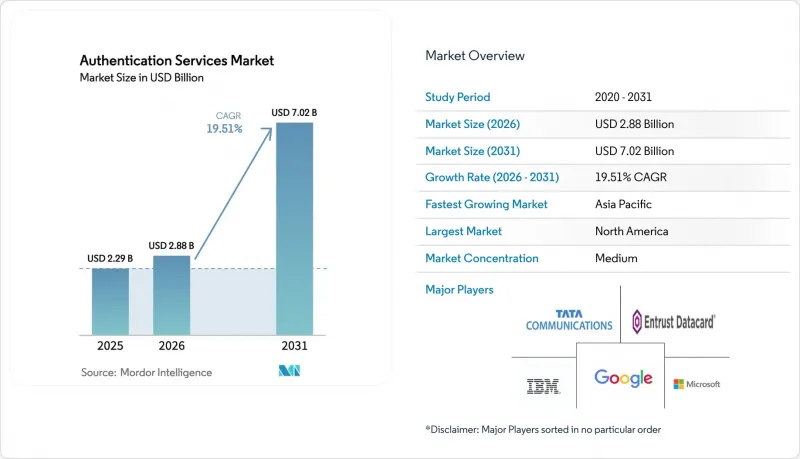
Mordor Intelligence에 의하면, 인증 서비스 시장 규모는 2025년 22억 9,000만 달러에서 2026년에는 28억 8,000만 달러에 이르고, 2026-2031년 CAGR 19.51%로 성장을 지속하여 2031년까지 70억 2,000만 달러에 달할 것으로 예측됩니다.
본 보고서는 인증 유형(비밀번호 없는 인증 등), 서비스 유형(규정 준수 관리 등), 배포 모드(On-Premise, 퍼블릭 클라우드, 프라이빗 클라우드, 하이브리드), 최종 사용자 산업(의료, 제조 등), 조직 규모(중소기업, 대기업) 및 지역별로 분류되어 있습니다. 시장 전망은 금액(미화) 기준으로 제시되어 있습니다.
세계 인증 서비스 시장 동향 및 인사이트
제로 트러스트 이니셔티브를 위한 사이버 보안 지출 증가
연방 정부의 지침에 따라 2027 회계연도까지 미국의 모든 민간 기관에서 피싱 공격에 내성이 있는 다중 요소 인증의 도입이 의무화되어, FIDO2 인증 토큰 및 위험 관리 엔진의 즉각적인 조달이 촉진되고 있습니다. 유럽의 은행들은 ‘디지털 운영 복원력 법(Digital Operational Resilience Act)’에 따른 감독 대상이며, 이 법에서 ID 시스템이 중요 인프라로 분류됨에 따라 2025년도 예산은 적응형 제어에 대한 투자에 중점을 두고 있습니다. 제로 트러스트 도입으로 인해 침해된 계정을 감지하는 데 걸리는 평균 시간이 3분의 1로 단축되었으며, 기업들은 인증 정보의 부정 사용에 대해 보다 명확한 가시성을 확보하고 있다고 보고하고 있습니다. 그러나 레거시 디렉토리에는 실시간 정책 연동 기능이 부족하기 때문에 하이브리드 아키텍처는 여전히 복잡합니다. 각 벤더사는 보안 어설션 마크업 언어(SAML)를 최신 RESTful 호출로 변환하는 클라우드 게이트웨이를 제공함으로써 이에 대응하고, 마이그레이션 위험을 줄이고 있습니다. 이러한 요인으로 인해 예측 성장률에 4.5퍼센트 포인트가 추가되어, 여러 규제 기한이 겹치는 2028년에 정점을 찍을 것으로 보입니다.
패스키와 FIDO2 표준의 부상으로 인한 사용자 경험(UX) 마찰 감소
Apple, Google, Microsoft는 2025년에 21억 대의 기기에서 패스키 지원을 시작했으며, 운영 체제의 인증 정보 관리자에 암호화 인증 기능을 통합함으로써 일상적인 로그인 시 비밀번호 입력의 번거로움을 해소했습니다. WebAuthn 레벨 3 사양에 따라 클라우드상에서 암호화된 인증 정보의 백업이 가능해져, 과거 도입을 지연시켰던 기기 분실이라는 장벽이 해소되었습니다. 전자상거래 사이트에서는 SMS 코드에서 패스키로 전환한 후 장바구니 포기율이 41% 감소했다고 보고되고 있습니다. 일본과 한국의 금융 규제 당국은 현재 패스키를 소비자용 앱의 표준 제어 수단으로 자리매김하고 있으며, 은행에 기존 인증 정보의 단계적 폐지를 촉구하고 있습니다. 이 표준에 따른 편의성 향상은 기업이 헬프데스크 체계를 재검토하고 인증 정보 저장소를 이전함에 따라 연평균 성장률(CAGR)을 3.6포인트 끌어올리는 결과로 이어질 것입니다.
성숙한 인증 방식에 따른 높은 비용
FIDO2 하드웨어 토큰은 사용자 1인당 25-55달러의 비용이 들며, 가격에 민감한 중소기업에게는 장벽이 되고 있습니다. 노트북이나 스마트폰에 내장된 생체 인증 센서는 장기적으로는 비용을 절감할 수 있지만, 초기 업그레이드에는 여전히 설비 투자가 필요하며, 이는 인건비나 마케팅 비용과 경쟁하게 됩니다. 신흥 시장의 구매자들은 보안 모듈에 대한 수입 관세에 직면하고 있으며, 이로 인해 총 소유 비용이 두 자릿수 비율로 상승합니다. 벤더 측은월3달러부터 시작하는 사용자당 구독 모델로 대응하고 있지만, 예산 담당자들은 보험사나 규제 당국으로부터 대응을 요구받기 전까지는 갱신 주기를 미루는 경향이 있습니다. 이러한 비용 측면의 역풍으로 인해, 규모의 경제에 따라 단가가 대중 시장의 임계값 아래로 떨어질 때까지 예상 연평균 성장률(CAGR)은 1.9포인트 하락할 것입니다.
부문 분석
2025년, 다중 요소 인증(MFA)은 인증 서비스 시장 점유율의 57.24%를 차지하며, 고부가가치 워크플로우에서 규제상 최소 요건으로서의 역할을 강조했습니다. 그러나 비밀번호 없는 방식은 2031년까지 연평균 성장률(CAGR) 20.29%로 다른 모든 카테고리를 능가하는 성장을 보일 것으로 예상되며, 이는 비밀번호 재설정 요청 건수 및 피싱 피해 위험을 줄이려는 경영진의 노력을 반영한 것입니다. Google Workspace가 1억 8,000만 명의 사용자를 대상으로 비밀번호 없는 계정을 도입함에 따라, 2025년에는 3억 4,000만 건의 패스키가 등록되어 인증 서비스 시장이 혜택을 볼 것으로 예측됩니다.
비밀번호 없는 기술의 성장은 균일하지 않습니다. 미국 의료 분야의 시범 프로젝트에서는 임상의 1인당 로그인 시간이 18초 단축되어, 주당 약 2.3시간을 환자 진료에 할애할 수 있게 되었습니다. 유럽의 은행들은 개정된 ‘결제 서비스 지침’의 예외 규정을 활용하고 있습니다. 이 규정에 따르면, 기기가 인증 정보를 연동하고 행동 분석을 통해 신원이 확인되는 것을 조건으로, 500유로 미만의 거래에서 생체 인증만을 통한 절차가 허용됩니다. 패스키를 도입한 소매업체에서는 결제 경험이 원활해짐에 따라 고객 충성도가 높아져 재구매율이 29% 증가했습니다. 반면, 제조업 및 에너지 기업에서는 에어갭이 적용된 운영 기술(OT)이 빈번한 펌웨어 업데이트에 대응할 수 없어 여전히 하드웨어 토큰에 의존하고 있어, 이러한 산업 분야에서의 패스워드 없는 인증의 광범위한 도입이 지연되고 있습니다.
관리형 공개 키 인프라(MKI)는 2025년 매출의 39.16%를 차지할 것으로 예상되며, 이는 WebTrust 및 ETSI 감사 대상인 인증서 수명 주기 업무를 외부에 위탁하고자 하는 기업의 의향을 반영합니다. 한편, 리스크 기반 인증 오케스트레이션은 상황에 따른 신뢰 판단을 요구하는 보험사 및 은행 수요를 배경으로 연평균 성장률(CAGR) 20.63%를 달성할 것으로 예측됩니다. 현재 적응형 엔진은 기기의 건전성, 지리적 위치 정보의 이상, 키 입력 리듬과 같은 미세한 행동 패턴을 평가하여, 위험 지표가 급격히 상승한 경우에만 인증을 강화합니다.
구독형 키 관리를 통해 마이크로서비스에 저장된 시크릿의 수동 로테이션에 소요되는 시간이 단축됩니다. 이 작업은 2025년에 매월 14시간의 엔지니어링 시간이 소요되었습니다. 보고 및 분석 모듈은 SOC 2 및 ISO 27001 보고 패키지에 증거 데이터를 통합하여 감사 준비 부담을 40% 경감시킵니다. 싱가포르 및 홍콩의 금융 규제 당국은 금융 기관에 이상 현상을 실시간으로 모니터링하도록 지시하고 있으며, 이에 따라 인증 서비스 시장은 사용자,기기, 지역별 위험 지표를 표시하는 SaaS 대시보드로 전환되고 있습니다. 미국의 에너지 사업자들은 CISA의 부문 간 성과 목표를 달성하기 위해 감시 제어 및 데이터 수집(SCADA) 계층에 적응형 제어를 통합하고 있습니다.
지역별 분석
북미는 2025년 매출의 36.71%를 차지했습니다. 이는 대통령령에 따라 연방 기관 전체에 제로 트러스트 도입이 의무화되었고, 피싱 방지 기능을 갖춘 인증 도구에 4억 2,000만 달러가 투입되었기 때문입니다. 캐나다 재정위원회 사무국은 연방 정부의 지침을 ‘팬-캐나다 트러스트 프레임워크’와 조화시켜 주를 아우르는 공통 인증 기반을 구축했습니다. 멕시코의 ‘국가 디지털 전략’은 금융 포용을 위한 신원 확인을 중시했으나, 백엔드 현대화가 지연되면서 즉각적인 성과는 제한적이었습니다.
아시아태평양은 2031년까지 연평균 성장률(CAGR) 20.57%를 나타낼 것으로 예측됩니다. 그 원동력은 2025년에 1,020억 건의 인증 요청을 기록한 인도의 ‘통합 결제 인터페이스(UPI)’와, 중요 인프라의 IoT 게이트웨이에 하드웨어 보안 모듈(HSM) 탑재를 의무화한 중국의 지침입니다. 일본과 한국에서는 현재 모바일 뱅킹에서 패스키 지원을 의무화하고 있으며, 싱가포르에서는 리스크 가이드라인을 실시간 스코어링과 연계하고 있습니다. 싱가포르, 태국, 말레이시아가 참여하는 아세안(ASEAN) 상호운용성 시범 프로젝트는 지역 전체의 인증 정보 연맹 실현을 목표로 하고 있으나, 속성 스키마의 정교화가 여전히 요구되고 있습니다.
유럽에서는 eIDAS 2.0 추진이 진행 중이며, 2030년까지 시민의 80%에게 디지털 지갑을 보급하는 것을 목표로 하고 있습니다. 독일의 BSI(연방정보보안청)는 제공업체에 대해 유럽경제지역(EEA) 내에서 데이터를 호스팅하고 연례 감사를 받도록 의무화하고 있습니다. 영국이 상호 인정 체계에서 탈퇴함에 따라 기업들은 고객 흐름을 별도로 관리할 수밖에 없게 되어 비용이 증가하고 있습니다. 중동 및 아프리카의 도입 현황은 제각각입니다. 걸프 국가들에서는 은행 서비스와 연계된 국민 ID 도입이 진행되고 있는 반면, 사하라 이남 아프리카 국가들에서는 통신 환경의 불안정성으로 어려움을 겪고 있습니다. 라틴아메리카에서는 브라질이 Pix 결제에 대해 강력한 고객 인증을 의무화하고 있어 도입이 완만하게 진행되고 있습니다. 다만, 기타 지역에서는 통화 변동으로 인해 소비가 위축되고 있습니다.
기타 혜택:
- 엑셀 형식 시장 예측(ME) 시트
- 3개월간의 애널리스트 지원
자주 묻는 질문
목차
제1장 서론
제2장 조사 방법
제3장 주요 요약
제4장 시장 구도
제5장 시장 규모와 성장 예측
제6장 경쟁 구도
제7장 시장 기회와 향후 전망
LSH 26.08.25According to Mordor Intelligence, the authentication services market size is expected to grow from USD 2.29 billion in 2025 to USD 2.88 billion in 2026 and is forecast to reach USD 7.02 billion by 2031 at 19.51% CAGR over 2026-2031.
This report is Segmented by Authentication Type (Passwordless Authentication, and More), Service Type (Compliance Management, and More), Deployment Mode (On-Premises, Public Cloud, Private Cloud, Hybrid), End-User Industry (Healthcare, Manufacturing, and More), Organization Size (Small and Medium Enterprises, and Large Enterprises), and Geography. Market Forecasts are Provided in Terms of Value (USD).
Global Authentication Services Market Trends and Insights
Increasing Cybersecurity Spending for Zero-Trust Initiatives
Federal directives now require phishing-resistant multi-factor authentication for all United States civilian agencies by fiscal 2027, sparking immediate procurement of FIDO2-certified tokens and risk engines. European banks face oversight under the Digital Operational Resilience Act, which classifies identity systems as critical, driving 2025 budgets toward adaptive controls. Enterprises report sharper visibility into credential misuse as zero-trust rollouts cut mean-time-to-detect compromised accounts by one-third, yet hybrid architectures remain complex because legacy directories lack real-time policy hooks. Vendors respond with cloud gateways that translate Security Assertion Markup Language into modern RESTful calls, thereby lowering the migration risk. The driver adds 4.5 percentage points to forecast growth and peaks through 2028 as multiple regulatory deadlines converge.
Emergence of Passkeys and FIDO2 Standards Reducing UX Friction
Apple, Google, and Microsoft activated passkey support on 2.1 billion devices in 2025, embedding cryptographic authenticators inside operating-system credential managers and erasing password fatigue for everyday logins. The WebAuthn Level 3 specification enables cloud-encrypted credential backup, solving the device-loss hurdle that once slowed adoption. E-commerce sites report a 41% decline in cart abandonment after switching from SMS codes to passkeys. Financial regulators in Japan and South Korea now classify passkeys as baseline controls for consumer apps, nudging banks to sunset legacy credentials. The standard's usability boost translates into a 3.6-point lift in CAGR as enterprises retool help desks and migrate credential stores.
High Cost Involved with Matured Authentication Methods
FIDO2 hardware tokens run USD 25-55 per user, a hurdle for price-sensitive small businesses. Biometric sensors embedded in laptops or smartphones can lower costs over time, but early upgrades still require capital expenditure that competes with payroll and marketing expenses. Emerging-market buyers face import tariffs on security modules, which raise the total cost of ownership by double digits. Vendors respond with per-user subscription models starting at USD 3 monthly, yet budget holders often delay refresh cycles until insurance underwriters or regulators force the issue. The cost headwind reduces the anticipated CAGR by 1.9 points until economies of scale drive unit prices below mass-market thresholds.
Other drivers and restraints analyzed in the detailed report include:
- Growth in the Number of Digital Identities
- Integration of Authentication APIs into Embedded IoT Modules Enabling Device-Level Revenue Streams
- User Fatigue and Login Abandonment Due to MFA Complexity
For complete list of drivers and restraints, kindly check the Table Of Contents.
Segment Analysis
Multi-Factor Authentication retained 57.24% of the authentication services market share in 2025, underscoring its role as the regulatory minimum for high-value workflows. Passwordless approaches, however, are projected to outpace every other category at a 20.29% CAGR to 2031, signaling management's drive to cut reset tickets and phishing exposure. The authentication services market is expected to benefit from 340 million passkeys registered in 2025, following Google Workspace's introduction of passwordless accounts for 180 million users.
Passwordless growth is not uniform. Healthcare pilots in the United States shaved 18 seconds off each clinician's login time, freeing almost 2.3 hours weekly for patient care. European banks exploit exemptions in the revised Payment Services Directive that allow biometric-only flows below EUR 500, provided devices bind credentials and behavioral analytics confirm identity. Retailers that deploy passkeys have seen a 29% increase in repeat purchases, as smoother checkout experiences foster loyalty. Manufacturing and energy firms still rely on hardware tokens because air-gapped operational technology cannot support frequent firmware updates, thereby delaying widespread passwordless adoption in these verticals.
Managed Public Key Infrastructure generated 39.16% of 2025 revenue, indicating enterprises' desire to outsource certificate lifecycle tasks subject to WebTrust and ETSI audits. Yet Risk-Based Authentication Orchestration is forecast to deliver a 20.63% CAGR, riding insurer and bank appetite for context-aware trust decisions. Adaptive engines now score device health, geolocation anomalies, and micro-behavioral inputs such as keystroke cadence, stepping up verification only when risk indicators spike.
Subscription key management reduces manual rotation time for secrets stored in microservices, a task that consumed 14 engineering hours per month in 2025. Reporting and analytics modules integrate evidence into SOC 2 and ISO 27001 packages, reducing audit preparation by 40%. Financial regulators in Singapore and Hong Kong direct institutions to monitor anomalies in real time, pushing the authentication services market toward SaaS dashboards that expose risk metrics by user, device, and geography. U.S. energy utilities incorporate adaptive controls into their supervisory control and data acquisition (SCADA) layers to meet CISA's cross-sector performance goals.
Complete Report Scope:
- By Authentication Type
- Single Factor Authentication
- Multi Factor Authentication
- Passwordless Authentication
- By Service Type
- Compliance Management
- Managed Public Key Infrastructure
- Subscription Keys Management
- Reporting and Analytics
- Risk-Based Authentication Orchestration
- By Deployment Mode
- On-Premises
- Public Cloud
- Private Cloud
- Hybrid
- By End-User Industry
- IT and Telecommunications
- BFSI
- Government and Defense
- Healthcare
- Retail and E-Commerce
- Energy and Utilities
- Manufacturing
- Education
- Other End-User Industries
- By Organization Size
- Small and Medium Enterprises
- Large Enterprises
- By Geography
- North America
- United States
- Canada
- Mexico
- Europe
- Germany
- United Kingdom
- France
- Russia
- Rest of Europe
- Asia-Pacific
- China
- Japan
- India
- South Korea
- Australia
- Rest of Asia-Pacific
- Middle East and Africa
- Middle East
- Saudi Arabia
- United Arab Emirates
- Rest of Middle East
- Africa
- South Africa
- Egypt
- Rest of Africa
- Middle East
- South America
- Brazil
- Argentina
- Rest of South America
- North America
Geography Analysis
North America accounted for 36.71% of 2025 revenue, as an executive order mandated zero-trust adoption across federal agencies, unlocking USD 420 million for phishing-resistant authenticators. Canada's Treasury Board Secretariat synchronized federal guidance with the Pan-Canadian Trust Framework, creating a common credential backbone across provinces. Mexico's National Digital Strategy emphasized identity for financial inclusion, yet slow backend modernization capped quick wins.
The Asia-Pacific region is forecast to deliver a 20.57% CAGR through 2031, driven by India's Unified Payments Interface, which logged 102 billion authentication calls in 2025, and China's directive that IoT gateways in critical infrastructure be shipped with hardware security modules. Japan and South Korea now require passkey support in mobile banking, and Singapore aligns risk guidelines with real-time scoring. ASEAN's interoperability pilot, involving Singapore, Thailand, and Malaysia, aims for a region-wide credential federation but must still refine attribute schemas.
Europe advances on eIDAS 2.0, aiming to equip digital wallets for 80% of citizens by 2030. Germany's BSI requires providers to host data within the European Economic Area and undergo annual audits. The United Kingdom's exit from the mutual recognition framework forces companies to maintain separate customer flows, which increases costs. Adoption in the Middle East and Africa is mixed: Gulf states are rolling out national IDs linked to banking, while sub-Saharan countries struggle with patchy connectivity. Latin America experiences a moderate uptake as Brazil enforces strong customer authentication for Pix payments, although currency volatility elsewhere moderates spending.
- Okta Inc.
- Microsoft Corporation
- IBM Corporation
- Thales Group
- Cisco Systems Inc.
- Entrust Datacard Corporation
- Broadcom Inc.
- Ping Identity Holding Corp.
- Google LLC
- OneLogin Inc.
- CyberArk Software Ltd.
- Yubico AB
- ForgeRock Inc.
- HID Global Corporation
- SailPoint Technologies Holdings Inc.
- Trustwave Holdings Inc.
- Wipro Limited
- Tata Communications Limited
- Verizon Communications Inc.
- Amazon Web Services Inc.
Additional Benefits:
- The market estimate (ME) sheet in Excel format
- 3 months of analyst support
TABLE OF CONTENTS
1 INTRODUCTION
- 1.1 Study Assumptions and Market Definition
- 1.2 Scope of the Study
2 RESEARCH METHODOLOGY
3 EXECUTIVE SUMMARY
4 MARKET LANDSCAPE
- 4.1 Market Overview
- 4.2 Market Drivers
- 4.2.1 Growth in the Number of Digital Identities
- 4.2.2 Authentication Needed for Security Compliances and Regulations
- 4.2.3 Growing Adoption of Bring Your Own Device (BYOD)
- 4.2.4 Increasing Cybersecurity Spending by Enterprises for Zero-Trust Initiatives
- 4.2.5 Emergence of Passkeys and FIDO2 Standards Reducing UX Friction
- 4.2.6 Integration of Authentication APIs into Embedded IoT Modules Enabling Device-Level Revenue Streams
- 4.3 Market Restraints
- 4.3.1 High Cost Involved with Matured Authentication Methods
- 4.3.2 User Fatigue and Login Abandonment due to MFA Complexity
- 4.3.3 Chip Supply Constraints for Hardware Security Modules Post-2025 Tariffs
- 4.3.4 Fragmentation of National Digital Identity Schemes Hindering Cross-Border Authentication
- 4.4 Impact of Macroeconomic Factors on the Market
- 4.5 Industry Value Chain Analysis
- 4.6 Regulatory Landscape
- 4.7 Technological Outlook
- 4.8 Porter's Five Forces Analysis
- 4.8.1 Bargaining Power of Suppliers
- 4.8.2 Bargaining Power of Buyers
- 4.8.3 Threat of New Entrants
- 4.8.4 Threat of Substitute Products
- 4.8.5 Intensity of Competitive Rivalry
5 MARKET SIZE AND GROWTH FORECASTS (VALUE)
- 5.1 By Authentication Type
- 5.1.1 Single Factor Authentication
- 5.1.2 Multi Factor Authentication
- 5.1.3 Passwordless Authentication
- 5.2 By Service Type
- 5.2.1 Compliance Management
- 5.2.2 Managed Public Key Infrastructure
- 5.2.3 Subscription Keys Management
- 5.2.4 Reporting and Analytics
- 5.2.5 Risk-Based Authentication Orchestration
- 5.3 By Deployment Mode
- 5.3.1 On-Premises
- 5.3.2 Public Cloud
- 5.3.3 Private Cloud
- 5.3.4 Hybrid
- 5.4 By End-User Industry
- 5.4.1 IT and Telecommunications
- 5.4.2 BFSI
- 5.4.3 Government and Defense
- 5.4.4 Healthcare
- 5.4.5 Retail and E-Commerce
- 5.4.6 Energy and Utilities
- 5.4.7 Manufacturing
- 5.4.8 Education
- 5.4.9 Other End-User Industries
- 5.5 By Organization Size
- 5.5.1 Small and Medium Enterprises
- 5.5.2 Large Enterprises
- 5.6 By Geography
- 5.6.1 North America
- 5.6.1.1 United States
- 5.6.1.2 Canada
- 5.6.1.3 Mexico
- 5.6.2 Europe
- 5.6.2.1 Germany
- 5.6.2.2 United Kingdom
- 5.6.2.3 France
- 5.6.2.4 Russia
- 5.6.2.5 Rest of Europe
- 5.6.3 Asia-Pacific
- 5.6.3.1 China
- 5.6.3.2 Japan
- 5.6.3.3 India
- 5.6.3.4 South Korea
- 5.6.3.5 Australia
- 5.6.3.6 Rest of Asia-Pacific
- 5.6.4 Middle East and Africa
- 5.6.4.1 Middle East
- 5.6.4.1.1 Saudi Arabia
- 5.6.4.1.2 United Arab Emirates
- 5.6.4.1.3 Rest of Middle East
- 5.6.4.2 Africa
- 5.6.4.2.1 South Africa
- 5.6.4.2.2 Egypt
- 5.6.4.2.3 Rest of Africa
- 5.6.4.1 Middle East
- 5.6.5 South America
- 5.6.5.1 Brazil
- 5.6.5.2 Argentina
- 5.6.5.3 Rest of South America
- 5.6.1 North America
6 COMPETITIVE LANDSCAPE
- 6.1 Market Concentration
- 6.2 Strategic Moves
- 6.3 Market Share Analysis
- 6.4 Company Profiles (includes Global Level Overview, Market Level Overview, Core Segments, Financials as available, Strategic Information, Market Rank/Share for key companies, Products and Services, and Recent Developments)
- 6.4.1 Okta Inc.
- 6.4.2 Microsoft Corporation
- 6.4.3 IBM Corporation
- 6.4.4 Thales Group
- 6.4.5 Cisco Systems Inc.
- 6.4.6 Entrust Datacard Corporation
- 6.4.7 Broadcom Inc.
- 6.4.8 Ping Identity Holding Corp.
- 6.4.9 Google LLC
- 6.4.10 OneLogin Inc.
- 6.4.11 CyberArk Software Ltd.
- 6.4.12 Yubico AB
- 6.4.13 ForgeRock Inc.
- 6.4.14 HID Global Corporation
- 6.4.15 SailPoint Technologies Holdings Inc.
- 6.4.16 Trustwave Holdings Inc.
- 6.4.17 Wipro Limited
- 6.4.18 Tata Communications Limited
- 6.4.19 Verizon Communications Inc.
- 6.4.20 Amazon Web Services Inc.
7 MARKET OPPORTUNITIES AND FUTURE OUTLOOK
- 7.1 White-Space and Unmet-Need Assessment