|
시장보고서
상품코드
2114059
분말야금 : 시장 점유율 분석, 업계 동향 및 통계, 성장 예측(2026-2031년)Powder Metallurgy - Market Share Analysis, Industry Trends & Statistics, Growth Forecasts (2026 - 2031) |
||||||
 Mordor Intelligence
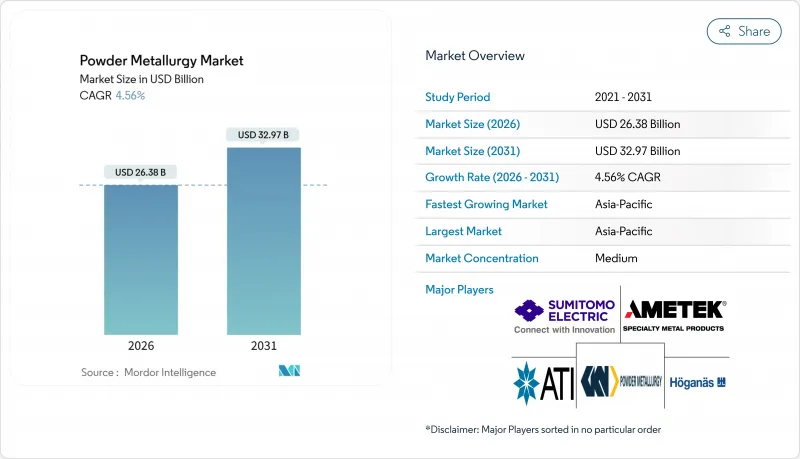
Mordor Intelligence에 의하면, 분말야금 시장 규모는 2026년에 263억 8,000만 달러로 추정되고 있어 예측 기간(2026-2031년)에 CAGR 4.56%로 성장을 지속하여 2031년에는 329억 7,000만 달러에 이를 전망입니다.
본 보고서는 재료 유형(철계 및 비철계), 제조 기술(프레스·소결, 금속 사출 성형 등), 용도(자동차, 산업기계, 전기 및 전자, 기타 용도), 지역(아시아태평양, 북미, 유럽, 남미, 중동 및 아프리카)별로 분류되어 있습니다. 시장 예측은 금액(달러)으로 표시되어 있습니다.
세계 분말 야금 시장 동향 및 인사이트
북미에서 경량 전기 파워트레인 부품에 대한 분말 야금(PM) 적용 확대
미국의 전기차(EV) 개발 프로그램으로 인해 분말 야금 기술의 중요성이 높아졌습니다. 이는 연자성 복합재료가 10kHz에서 500을 초과하는 비투과율을 달성하여, 토크 손실 없이 모터의 고정자 코어를 15-20% 소형화할 수 있기 때문입니다. 제너럴 모터스(GM)와 포드는 2024년, Ultium 및 BlueCruise 플랫폼을 위해 국내 소결 공급업체와 연간 총 12만 톤 규모의 다년 계약을 체결했습니다. 이러한 계약은 ‘인플레이션 억제법’의 국내 조달 요건을 준수하는 북미의 스프레이 성형 능력을 우선시하는 것입니다. 20만 km라는 부품 수명 목표를 달성하려면 180℃에서 ±0.02mm 이내의 치수 안정성이 요구되지만, 이는 알루미늄 다이캐스팅으로는 충족할 수 없는 조건입니다.
유럽 전역에서 넷쉐이프형 금속 적층 가공 부품 수요가 급증
2025년, 에어버스사가 A320neo 1대당 14개의 티타늄 브래킷을 통합하여 각 기체당 180kg의 경량화를 실현함에 따라, 파우더 베드 퓨전 기술은 양산 단계에 도달했습니다. 재료 구매 효율은 15%에서 95%로 향상되었으며, 기계 가공에 따른 스크랩 감소와 사이클 타임 단축이 이루어졌습니다. 산드빅(Sandvik) 및 GKN과 같은 공급업체들은 2024년부터 2025년에 걸쳐 4억 5,500만 달러를 투자하여, 15-45µm 크기의 구형 분말을 공급하는 가스 분무 라인을 확장했습니다. EASA Part 21 및 NADCAP 개정으로 인해 인증 주기가 48개월에서 28개월로 단축되어 설계 동결이 가속화되었습니다.
중요 광물 공급 리스크를 배경으로 한 고순도 분말 가격 변동
런던 금속 거래소(LME)의 니켈 가격은 2024년 1월부터 2025년 12월 사이에 33% 변동하여, 고정 가격 계약으로는 감당할 수 없는 원자재 비용 상승을 초래했습니다. 인도네시아의 광석 수출 금지 조치로 인해, 아토마이저 제조업체들은 비용이 높은 캐나다나 호주공급원으로 전환할 수밖에 없게 되었으며, 니켈 분말 가격이 톤당 2,100-2,800달러 상승했습니다. 코발트의 60%는 여전히 콩고 민주 공화국(DRC)에서 조달되고 있지만, 해당국의 거버넌스 문제로 인해 항공우주 업계의 주요 제조업체들이 실시하는 분쟁 광물 감사가 복잡해지고 있습니다. 중국의 전력 제한으로 악화된 티타늄 스폰지 부족으로 인해 신규 분말의 인증 획득이 최대 9개월 지연되었습니다.
부문별 분석
2025년, 철계 소재는 분말 야금 시장의 79.24%를 차지할 것으로 예상되며, 2031년까지 연평균 4.66%의 성장률로 확대될 것으로 전망되어, 자동차 구동계용 기어, 싱크로나이저 허브 및 베어링 분야에서 이 소재가 수량 면에서 우위를 점하고 있음을 뒷받침합니다. 상대적인 가격 경쟁력(1kg당 1.80-2.40달러, 반면 티타늄은 8.50-12달러) 덕분에, 전동화로 인해 엔진 전체의 사용량이 감소하고 있음에도 불구하고 철계 소재의 주도적 지위는 유지되고 있습니다. 이 분야에서는 20kHz에서 1.8테슬라의 자속 밀도를 달성하는 연자성 복합 소재로의 전환이 진행되고 있습니다. 이는 와전류에 의한 손실 없이 기존의 적층판으로는 도달할 수 없는 수준입니다. Hoganas사 등공급업체는 2024년에 인 코팅이 적용된 ‘Somaloy 3P’를 출시하여 코어 손실을 18% 줄인 결과, 2027년형 유럽산 EV 모터 설계에서 3건의 채택 실적을 거두었습니다.
2025년에는 티타늄, 알루미늄, 니켈 초합금 분말이 항공우주, 의료, 에너지 저장 프로그램에서 양산 단계에 도달함에 따라 비철금속 등급이 분말 야금 시장 점유율의 20.76%를 차지했습니다. 재활용 원료가 원자재 가격 변동을 완화하고 있습니다. 2024년 FAA의 승인을 받은 카이메라의 ‘RecycTi’ 분말은 30%의 비용 절감을 실현했으며, 현재 이 회사의 티타늄 출하량의 12%를 차지하고 있습니다. 용도에 특화된 합금화를 통해 성능의 폭이 넓어지고 있으며, 철계 공급업체는 자기 특성 향상을 위해 실리콘이나 알루미늄을 첨가하는 반면, 비철계 공급업체는 상품 가격 리스크를 헤지하기 위해 재생 칩을 혼합하고 있습니다. 이러한 변화는 전략적 분기점을 부각시키고 있습니다. 즉, 대량 생산되는 철계 부문에서는 부품 1개당 비용(센트 단위)으로 경쟁이 벌어지는 반면, 소량 생산되는 티타늄이나 니켈과 같은 틈새 시장에서는 인증 획득 속도로 경쟁이 펼쳐지고 있습니다.
지역별 분석
2025년, 아시아태평양은 전 세계 매출의 40.44%를 차지했습니다. 이는 중국의 연간 생산 능력 140만 톤과 인도의 정책 주도형 의료기기 현지 생산이 견인한 결과입니다. 중국의 생산업체인 CNPC 파우더는 8개의 물분무식 제조 공장을 운영하고 있으며, 유럽 평균 가격보다 20-25% 저렴한 가격으로 국내 OEM 제조업체에 공급하고 있습니다. 일본은 스미토모 전기공업과 레조낙의 유통망을 통해 동남아시아 전역에 정밀 기어와 연자성 복합재료를 수출하고 있습니다. 인도의 우대 조치에 따라 2024년부터 2025년에 걸쳐 6개의 새로운 MIM 공장이 설립되었으며, 태국 등 아세안(ASEAN) 국가들은 소결 부품 공장을 위해 8,700만 달러의 외국인 직접 투자(FDI)를 확보했습니다.
북미에서는 리쇼어링과 e-액슬에 대한 투자가 가속화되고 있습니다. GKN이 American Axle의 시설을 14억 4,000만 달러에 인수함에 따라 미시간주와 노스캐롤라이나주에 7만 8,000톤의 생산 능력이 추가되었으며, Ultium용 기어 계약이 확정되었습니다. Phoenix Sintered Metals는 국내 커넥팅로드 수요에 대응하기 위해 2024년 테네시주에 4,200만 달러를 투자하여 온간 압축 라인을 도입했습니다.
유럽에서는 독일, 영국, 프랑스가 항공우주 분야의 적층 가공를 우선시함에 따라 시장이 확대되고 있습니다. 샌드빅(Sandvik)사의 니스 공장 확장으로 티타늄 및 니켈 분말 생산량이 40% 증가하여 에어버스(Airbus) 및 롤스로이스(Rolls-Royce)사의 프로그램을 지원하고 있습니다. 남미 시장 점유율 확대는 여전히 소결 기어에 의존하고 있는 브라질의 플렉스 연료 엔진에 의해 주도되고 있습니다. 중동 및 아프리카의 성장은 사우디아라비아의 방위 관련 계약과 남아프리카공화국의 광산기계 개조를 통해 뒷받침되고 있습니다.
기타 혜택:
- 엑셀 형식 시장 예측(ME) 시트
- 3개월간의 애널리스트 지원
자주 묻는 질문
목차
제1장 서론
제2장 조사 방법
제3장 주요 요약
제4장 시장 구도
제5장 시장 규모와 성장 예측
제6장 경쟁 구도
제7장 시장 기회와 향후 전망
LSH 26.08.25According to Mordor Intelligence, the powder metallurgy market size is estimated at USD 26.38 billion in 2026, and is expected to reach USD 32.97 billion by 2031, at a CAGR of 4.56% during the forecast period (2026-2031).
This report is Segmented by Material Type (Ferrous and Non-Ferrous), Manufacturing Technology (Press and Sinter, Metal Injection Molding, and More), Application (Automotive, Industrial Machinery, Electrical and Electronics, and Other Applications), and Geography (Asia-Pacific, North America, Europe, South America, and Middle East and Africa). The Market Forecasts are Provided in Terms of Value (USD).
Global Powder Metallurgy Market Trends and Insights
Increasing Preference for PM in Lightweight E-Powertrain Components In North America
Electric-vehicle programs in the United States elevated powder metallurgy because soft-magnetic composites achieve relative permeabilities above 500 at 10 kHz, allowing motor-stator cores to shrink 15-20% without torque loss. General Motors and Ford locked multi-year agreements totaling 120,000 tons annually with domestic sintering suppliers for Ultium and BlueCruise platforms in 2024. These contracts favor North American atomization capacity that complies with the Inflation Reduction Act content rules. Component life targets of 200,000 km require dimensional stability within +-0.02 mm at 180 °C, conditions that die-cast aluminum cannot meet.
Surge in Demand for Net-Shape Additive Metal Components Across Europe
Powder bed fusion reached serial production when Airbus integrated 14 titanium brackets per A320neo in 2025, trimming 180 kg from each airframe. Material-buy efficiency rose from 15% to 95%, saving machining scrap and cycle time. Suppliers such as Sandvik and GKN invested USD 455 million between 2024-25 to expand gas-atomization lines that deliver 15-45 µm spherical powders. EASA Part 21 and NADCAP changes cut certification loops from 48 to 28 months, accelerating design freezes.
Volatile High-Purity Powder Prices Amid Critical-Mineral Supply Risk
London Metal Exchange nickel prices swung 33% between January 2024 and December 2025, raising feedstock costs that fixed-price contracts cannot absorb. Indonesia's ore export ban compelled atomizers to pivot to higher-cost Canadian and Australian supply, adding USD 2,100-2,800 per ton to nickel powder. Cobalt remains 60% sourced from the DRC, where governance challenges complicate conflict-minerals audits for aerospace primes. Titanium sponge shortages amplified by Chinese power curbs delayed new powder qualifications by up to nine months.
Other drivers and restraints analyzed in the detailed report include:
- Localization of Precision Medical-Implant Manufacturing in Asia-Pacific
- Defense Modernization Boosting Refractory Metal Powders In Middle East
- Limited Aerospace Part Qualification Standards
For complete list of drivers and restraints, kindly check the Table Of Contents.
Segment Analysis
Ferrous accounted for 79.24% of powder metallurgy market share in 2025 and is forecast to compound at a 4.66% rate to 2031, underscoring the material's volume leverage in automotive drivetrain gears, synchronizer hubs, and bearings. Relative affordability-USD 1.80-2.40 per kg versus USD 8.50-12.00 for titanium-sustains ferrous leadership even as electrification trims total engine content. The segment is pivoting toward soft-magnetic composites that achieve 1.8 Tesla flux density at 20 kHz, a level conventional laminations cannot reach without eddy-current penalties. Suppliers such as Hoganas launched phosphorus-coated Somaloy 3P in 2024, cutting core losses 18% and earning three European EV-motor design wins for the 2027 model year.
Non-ferrous grades held 20.76% of powder metallurgy market share in 2025 as titanium, aluminum, and nickel-superalloy powders reach serial production in aerospace, medical, and energy storage programs. Recycled feedstocks soften raw-material volatility: Kymera's RecycTi powder, approved by the FAA in 2024, offers 30% cost savings and now represents 12% of the firm's titanium shipments. Application-specific alloying is widening the performance envelope, with ferrous suppliers adding silicon and aluminum for magnetics, while non-ferrous counterparts blend reclaimed chips to hedge commodity risk. The shift underscores a strategic divide: high-volume ferrous segments compete on cents per part, whereas low-volume titanium and nickel niches compete on certification speed.
Complete Report Scope:
- By Material Type
- Ferrous
- Non-Ferrous
- By Manufacturing Technology
- Press and Sinter
- Metal Injection Molding (MIM)
- Additive Manufacturing / Powder Bed Fusion
- Isostatic Pressing
- By Application
- Automotive
- Industrial Machinery
- Electrical and Electronics
- Aerospace
- Other Applications
- By Geography
- Asia-Pacific
- China
- Japan
- India
- South Korea
- ASEAN Countries
- Rest of Asia-Pacific
- North America
- United States
- Canada
- Mexico
- Europe
- Germany
- United Kingdom
- France
- Italy
- Spain
- Rest of Europe
- South America
- Brazil
- Argentina
- Rest of South America
- Middle East and Africa
- Saudi Arabia
- South Africa
- Egypt
- Rest of Middle East and Africa
- Asia-Pacific
Geography Analysis
Asia-Pacific contributed 40.44% of global revenue in 2025, anchored by China's 1.4 million-ton annual production capacity and India's policy-driven medical-device localization. Chinese producer CNPC Powder operates eight water-atomization plants supplying domestic OEMs at prices 20-25% below European averages. Japan is exporting precision gears and soft-magnetic composites across Southeast Asia through Sumitomo Electric and Resonac distribution networks. India's incentives triggered six new MIM plants between 2024-25, and ASEAN nations such as Thailand secured USD 87 million in FDI for sintered-component factories.
North America's reshoring and e-axle investments are accelerating. GKN's USD 1.44 billion buyout of American Axle's facilities added 78,000 tons of capacity across Michigan and North Carolina, locking in contracts for Ultium gears. Phoenix Sintered Metals deployed a USD 42 million warm-compaction line in Tennessee in 2024 to meet domestic connecting-rod demand.
Europe is advancing as Germany, the United Kingdom, and France prioritize additive manufacturing for aerospace. Sandvik's Neath expansion raised titanium and nickel-powder output by 40%, underpinning Airbus and Rolls-Royce programs. South America's share is driven by Brazil's flex-fuel engines that still rely on sintered gears. The Middle East and Africa's growth is supported by Saudi defense contracts and South African mining-equipment refurbishment.
- AMETEK Inc.
- ATI
- CNPC Powder
- CRS Holdings, LLC
- Elementum
- Elmet Technologies
- ERASTEEL
- Fine Sinter Co., Ltd.
- GKN Powder Metallurgy
- Granges
- Hoganas AB
- Kymera International
- LIBERTY Steel Group
- Metalysis
- Miba AG
- Phoenix Sintered Metals, LLC
- Plansee Group
- POSCO
- Powder Alloy Corporation (PAC)
- Resonac Holdings Corporation
- Rio Tinto
- Runaya
- Sandvik AB
- Sumitomo Electric Industries, Ltd.
Additional Benefits:
- The market estimate (ME) sheet in Excel format
- 3 months of analyst support
TABLE OF CONTENTS
1 Introduction
- 1.1 Study Assumptions and Market Definition
- 1.2 Scope of the Study
2 Research Methodology
3 Executive Summary
4 Market Landscape
- 4.1 Market Overview
- 4.2 Market Drivers
- 4.2.1 Increasing Preference for PM in Lightweight E-Powertrain Components in North America
- 4.2.2 Surge in Demand for Net-Shape Additive Metal Components Across Europe
- 4.2.3 Localization Of Precision Medical-Implant Manufacturing in Asia-Pacific
- 4.2.4 Defense Modernization Boosting Refractory Metal Powders in Middle East
- 4.2.5 Carbon-Border Adjustment Mechanism Reshaping EU Ferrous Powder Trade
- 4.3 Market Restraints
- 4.3.1 Volatile High-Purity Powder Prices Amid Critical-Mineral Supply Risk
- 4.3.2 Limited Aerospace Part Qualification Standards
- 4.3.3 Competitive Threat from Advanced Casting of Complex Al Components
- 4.4 Value Chain Analysis
- 4.5 Porter's Five Forces
- 4.5.1 Bargaining Power of Suppliers
- 4.5.2 Bargaining Power of Buyers
- 4.5.3 Threat of New Entrants
- 4.5.4 Threat of Substitute Products
- 4.5.5 Intensity of Competitive Rivalry
5 Market Size and Growth Forecasts (Value)
- 5.1 By Material Type
- 5.1.1 Ferrous
- 5.1.2 Non-Ferrous
- 5.2 By Manufacturing Technology
- 5.2.1 Press and Sinter
- 5.2.2 Metal Injection Molding (MIM)
- 5.2.3 Additive Manufacturing / Powder Bed Fusion
- 5.2.4 Isostatic Pressing
- 5.3 By Application
- 5.3.1 Automotive
- 5.3.2 Industrial Machinery
- 5.3.3 Electrical and Electronics
- 5.3.4 Aerospace
- 5.3.5 Other Applications
- 5.4 By Geography
- 5.4.1 Asia-Pacific
- 5.4.1.1 China
- 5.4.1.2 Japan
- 5.4.1.3 India
- 5.4.1.4 South Korea
- 5.4.1.5 ASEAN Countries
- 5.4.1.6 Rest of Asia-Pacific
- 5.4.2 North America
- 5.4.2.1 United States
- 5.4.2.2 Canada
- 5.4.2.3 Mexico
- 5.4.3 Europe
- 5.4.3.1 Germany
- 5.4.3.2 United Kingdom
- 5.4.3.3 France
- 5.4.3.4 Italy
- 5.4.3.5 Spain
- 5.4.3.6 Rest of Europe
- 5.4.4 South America
- 5.4.4.1 Brazil
- 5.4.4.2 Argentina
- 5.4.4.3 Rest of South America
- 5.4.5 Middle East and Africa
- 5.4.5.1 Saudi Arabia
- 5.4.5.2 South Africa
- 5.4.5.3 Egypt
- 5.4.5.4 Rest of Middle East and Africa
- 5.4.1 Asia-Pacific
6 Competitive Landscape
- 6.1 Market Concentration
- 6.2 Strategic Moves
- 6.3 Market Share / Ranking Analysis
- 6.4 Company Profiles (includes Global-level Overview, Market-level Overview, Core Segments, Financials as available, Strategic Information, Market Rank/Share, Products and Services, Recent Developments)
- 6.4.1 AMETEK Inc.
- 6.4.2 ATI
- 6.4.3 CNPC Powder
- 6.4.4 CRS Holdings, LLC
- 6.4.5 Elementum
- 6.4.6 Elmet Technologies
- 6.4.7 ERASTEEL
- 6.4.8 Fine Sinter Co., Ltd.
- 6.4.9 GKN Powder Metallurgy
- 6.4.10 Granges
- 6.4.11 Hoganas AB
- 6.4.12 Kymera International
- 6.4.13 LIBERTY Steel Group
- 6.4.14 Metalysis
- 6.4.15 Miba AG
- 6.4.16 Phoenix Sintered Metals, LLC
- 6.4.17 Plansee Group
- 6.4.18 POSCO
- 6.4.19 Powder Alloy Corporation (PAC)
- 6.4.20 Resonac Holdings Corporation
- 6.4.21 Rio Tinto
- 6.4.22 Runaya
- 6.4.23 Sandvik AB
- 6.4.24 Sumitomo Electric Industries, Ltd.
7 Market Opportunities and Future Outlook
- 7.1 White-Space and Unmet-Need Assessment