|
시장보고서
상품코드
2114060
드론 물류 및 운송 : 시장 점유율 분석, 업계 동향 및 통계, 성장 예측(2026-2031년)Drone Logistics And Transportation - Market Share Analysis, Industry Trends & Statistics, Growth Forecasts (2026 - 2031) |
||||||
 Mordor Intelligence
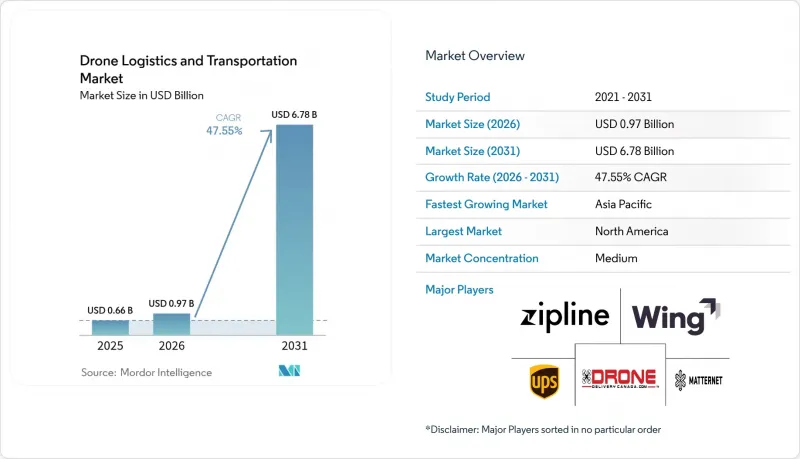
Mordor Intelligence에 의하면, 2026년 드론 물류 및 운송 시장 규모는 9억 7,000만 달러로 추정되고 있으며, 2025년 6억 6,000만 달러에서 성장하여 2031년에는 67억 8,000만 달러에 달할 것으로 예측됩니다.
또한 2026-2031년 연평균 성장률(CAGR) 47.55%를 기록할 전망입니다.
본 보고서는 서비스 유형(드론 서비스, 온디맨드 배송, 정기 배송, 의료·구조용 기체 서비스), 용도(소매·물류, 식품 배송, 의료 물자), 적재 중량(5kg 미만, 5kg 이상), 항속 거리(단거리, 중거리, 장거리),지역(북미, 유럽, 기타)별로 분류되어 있습니다. 시장 예측은 금액(달러) 기준으로 제시되어 있습니다.
전 세계 드론 물류 및 운송 시장 동향 및 인사이트
증가하는 전자상거래 수요와 라스트 마일 항공 배송 솔루션
온라인 소매 처리량은 계속해서 사상 최고치를 경신하고 있으며, 도시 지역의 교통 체증이 심해 밴이나 자전거만으로는 1시간 이내 배송을 실현하기 어려워지고 있습니다. 드론은 허브에서 집 앞까지 직행함으로써 교통 체증을 피할 수 있으며, Wing사와 월마트사가 실시한 시범 운영에서는 10마일 왕복 배송에 소요되는 시간을 20분 미만으로 단축했습니다. 또한, 배터리 구동 멀티로터 드론을 활용함으로써 사업자는 디젤 연료에 대한 추가 비용을 피할 수 있습니다. 이는 배기가스 규제가 엄격해지고 있는 시장에서 특히 매력적인 점입니다. 쇼핑객들이 주문부터 도착까지의 신속한 주기에 익숙해짐에 따라, 사업자 플랫폼은 항공 물류를 단순한 실험적인 혜택이 아닌 핵심 서비스로 인식하기 시작했습니다. 댈러스-포트워스, 선전, 캔버라에서의 초기 상용화 사례는 드론 배송이 도입될 때마다 주문 밀도가 상승함을 보여주고 있으며, 이는 고객의 지불 의지가 확고하고 재현 가능함을 시사합니다. 이러한 동향을 종합해 보면, 네트워크 효과로 인해 건당 배송 비용이 절감되고, 드론 운송 서비스 시장 솔루션이 더욱 확산되는 선순환이 형성되고 있음을 알 수 있습니다.
BVLOS 규제 및 자율 비행 승인 동향
규제 당국은 신중한 샌드박스 시험 단계에서 무인 항공기를 일상적인 공역의 일부로 취급하는 법제화된 국내 규제로 전환하고 있습니다. FAA(연방항공청)가 제안한 ‘파트 108’에서는 규정 준수 책임을 개별 조종사에서 운영 주체로 이전하는 기업 감독 모델이 적용되고 있으며, 이를 통해 규모 확대가 가능해져 인건비 비율을 낮출 수 있게 되었습니다. 2025년 11월에 발효될 캐나다의 ‘레벨 1 복합 운항 인증’은 제휴하는 관할 구역의 운항 사업자에게 상호 인정을 제공하여, 국경을 넘는 임무 수행 시 행정 절차의 부담을 경감시킵니다. 유럽 EASA(유럽항공안전청)의 ‘표준 시나리오’ 프레임워크는 사례별로 전면적인 면제 조치가 필요 없는 위험 기반 인가를 가능하게 하여, 예외적인 허가에서 일상적인 승인으로의 전환을 보여줍니다. 이러한 변화로 인해, 과거에는 운영 사업자에게 항공기 1대당 1명의 감시원을 배치하도록 의무화하고 운항을 주간으로만 제한했던 정책상의 공백이 해소되었습니다. 승인 절차의 가속화는 드론 운송 서비스 시장의 세계적 확장을 직접적으로 뒷받침하고 있습니다.
상업적 규모 확장을 제한하는 규제 및 공역 통합 과제
미국에서도 운영 사업자는 여러 대의 드론을 동시에 비행시킬 때 여전히 면제 조치가 필요하며, 감지 및 회피 장치는 비용과 중량 증가로 이어지고 있습니다. 항공 교통 당국은 그러한 밀도를 가정하여 설계되지 않은 UTM(무인 항공기 교통 관리) 시스템에 수천 대의 자율 비행기를 통합하려는 과정에서 대역폭 제약에 직면하고 있습니다. 주파수 대역 할당이 파편화되어 있어 국경을 넘는 원격 측정 통신이 복잡해지고, 전 세계적인 항공기 배치 비용이 증가하고 있습니다. 임시 규정이 존재하는 경우, 규정 준수 기간이 스타트업의 자금 조달 주기를 넘어 길어질 가능성이 있어 초기 단계의 기업들은 도입 및 노선 확장을 늦출 수밖에 없게 됩니다. 대규모 시장의 규정을 그대로 도입하는 소규모 경제국들은 인증 비용을 상각하는 데 필요한 교통량이 없는 상태에서 규정 준수라는 장벽을 만들 위험이 있습니다. 이러한 현실로 인해, 정책 조화와 UTM 인프라가 완전히 정비될 때까지 드론 운송 서비스 시장의 성장 곡선은 몇 포인트 하락하게 될 것입니다.
부문 분석
현재 드론-어즈-어-서비스(DaaS)는 드론 운송 서비스 시장 점유율의 42.15%를 차지하고 있으며, 이는 기체 구매나 인증보다 비행 운항을 외부에 위탁하는 것을 선호하는 소매업체와 진료소가 자본 효율성을 중시하고 있음을 보여줍니다. 자산 보유형 제공업체는 규정 준수 위험을 흡수하고, 감가상각이 완료된 하드웨어를 여러 고객에게 걸쳐 활용함으로써 단일 화주가 달성할 수 있는 것보다 더 높은 기체 가동률을 실현하고 있습니다. 이 모델의 매력은 인증 보유자가 지속적인 비행 적합성을 증명해야 하는 규제 환경에서 더욱 커집니다. 수십 개의 화주 간에 비용을 분산함으로써 1회당 배송 요금을 낮게 유지할 수 있습니다. 이와 병행하여, 주문 후 몇 분 이내에 발송되는 임시 소포를 취급하는 온디맨드 배송은 대형 전자상거래 기업들이 교외 우편번호 지역에도 1시간 이내 배송을 약속함에 따라 연평균 성장률(CAGR) 50.10%라는 가장 빠른 성장 궤도를 그리고 있습니다. 이러한 속도에 대한 요구는 풀필먼트 센터의 입지 선정 방식을 변화시켜, 비행 구간 거리를 단축할 수 있는 소규모의 분산형 거점이 선호되는 추세입니다.
정기 배송은 캠퍼스 내 우편 배달, 임상 검체 수거, 마이크로 창고 간 재고 운송 등 예측 가능한 노선에서 여전히 중요한 역할을 수행하고 있습니다. 이러한 반복적인 노선은 안정적인 수익을 가져다주며, 소비자 수요의 급증에 따른 변동으로부터 사업자를 보호합니다. 의료·구급용 드론 서비스는 운송량 측면에서 틈새 시장이지만, 운용 시간이 인명과 직결되는 중요한 지표이기 때문에 프리미엄 가격이 책정되어 있습니다. 이러한 전용 기체에는 대개 이중화된 전원 공급 장치와 항공 전자 장비가 탑재되어 있어, 1대당 설비 투자액은 소매용 드론을 크게 상회합니다. 그러나 보건부나 NGO는 외딴 지역 사회를 지원하기 위해 그 비용을 부담할 의향이 있어, 이 하위 부문이 드론 운송 서비스 시장에서 확고한 입지를 유지할 수 있도록 보장하고 있습니다.
소매 및 물류 배송은 주문 밀도와 기존 ‘클릭 투 도어(click-to-door)’ 배송 경로의 구축에 힘입어 2025년 드론 운송 서비스 시장 규모에서 45.60%의 매출 점유율을 유지하고 있습니다. 그러나 성장의 중심은 의료 임무로 이동하고 있으며, 인명 구조를 우선시하는 규제상의 우대 조치 덕분에 연평균 성장률(CAGR) 51.35%로 확대되고 있습니다. 각 주 보건 당국은 혈액, 백신, 검사 시료 운송에 대해 종합적인 BVLOS(시야 외 비행) 통로를 빈번히 승인하고 있으며, 이를 통해 Zipline과 같은 사업자는 아프리카의 농촌 지역이나 솔트레이크시티 교외의 진료소까지 몇 분 단위의 리드 타임으로 배송을 실현하고 있습니다. 병원 측은 드론이 운반할 수 있는 온도 조절형 포드를 높이 평가하고 있으며, 이를 통해 식품의 부패를 방지하고 재고 부족률을 낮출 수 있으므로 더 높은 서비스 요금 책정이 정당화되고 있습니다.
음식 배달 앱 역시 전자상거래 배송에 활용되는 것과 동일한 도시 지역의 옥상을 활용하여 적극적으로 실험을 진행하고 있습니다. 『MIT Technology Review』는 2022년 선전에서 이루어진 10만 건 이상의 자율형 테이크아웃 배송을 추적 조사했습니다. 이는 하늘을 통한 편의성에 대한 소비자 수요가 단순한 일시적인 신기함의 관심에 그치지 않음을 보여줍니다. 따뜻한 음식의 보온성과 적재 중량의 균형을 맞추는 것은 사업자에게 여전히 해결해야 할 설계 과제입니다. 그럼에도 불구하고, 이러한 활용 사례들은 전반적으로 대상 고객층을 확대하며, 드론 운송 서비스 시장의 다방면에 걸친 매력을 강화하고 있습니다.
지역별 분석
북미는 성숙한 물류 네트워크와 FAA(연방항공청)에 의한 BVLOS(시야 밖 비행) 권한의 착실한 법적 제도화를 바탕으로, 2025년에도 37.85%의 점유율을 차지하며 매출 측면에서 선두를 유지하고 있습니다. 소매업체 주도의 도입이 성장 속도를 이끌고 있으며, 월마트는 5개 주에 걸쳐 있는 100개 매장에서 드론 배송을 전개하여 반경 6마일 이내의 수백만 가구에 서비스를 제공합니다. 의료 관련 노선도 추가적인 수요를 견인하고 있으며, UPS는 인증을 받은 Flight Forward의 항공기를 이용해 CVS에서 처방약을 배송하고 있습니다. 또한, 미국은 국방 주도의 이중용도 연구개발의 혜택을 받고 있어 기술의 상용화로의 전환이 가속화되고 있습니다. 캐나다에서는 2025년 11월에 시행될 규정에 따라 최대 150kg까지의 중량급 인증이 추가되고, 주를 넘나드는 화물 운송 노선이 정비됨에 따라 북미 드론 운송 서비스 시장 규모가 더욱 확대될 전망입니다.
연평균 성장률(CAGR) 51.90%로 성장하고 있는 아시아태평양은 이미 도시 지역의 주문 밀도가 가장 높으며, 이 지역은 항공 운송을 대체할 최적의 후보지로 떠오르고 있습니다. 중국의 저고도 경제 정책은 2030년까지 GDP에 2조 위안(2,780억 달러)을 기여할 것으로 예상되며, 이를 통해 수요를 촉진하고 있습니다. 선전시의 허가 제도에서는 드론이 고층 빌딩군 상공을 비행하는 것이 허용되어, 다른 지역에서는 찾아볼 수 없는 규제상의 관용이 드러나고 있습니다. 일본의 야간 비행 규제에 대한 단계적 완화나, 인도의 구릉 지대인 북동부 여러 주에서 진행 중인 백신 배송 시범 사업은 이용 사례의 다양성을 보여주고 있습니다. 광둥성과 나고야에 위치한 하드웨어 제조 클러스터는 공급망을 단축하고 신속한 제품 개선을 가능하게 함으로써 드론 운송 서비스 시장의 추가 성장을 가속화하고 있습니다.
유럽은 안전성과 소음 관리를 우선시하며 보다 신중한 입장을 취하고 있습니다. 유럽항공안전청(EASA)의 통일된 규정에 따라 EU 내 국경을 넘는 운항은 용이해졌지만, 지방 자치 단체는 여전히 엄격한 고도 제한을 부과하고 있어 드론 기단의 활용을 제약할 가능성이 있습니다. 그럼에도 불구하고 유럽 대륙에는 160만 명 이상의 등록 운영자가 존재하여, 탄탄한 인력 공급원이 있음을 보여줍니다. 지속가능성에 대한 노력도 보급을 뒷받침하고 있습니다. 많은 도시에서는 공중 배송 목표 달성을 약속한 기업에 대해 도로 혼잡세를 면제하고 있어, 이로 인해 총 소유 비용(TCO) 측면에서 드론이 유리한 선택지가 되고 있습니다. 사하라 사막 이남의 아프리카와 같은 신흥 지역에서는 이 기술이 가져다주는 비약적인 발전의 가능성을 활용하고 있으며, Zipline이 운영하는 르완다의 전국적인 혈액 배송 네트워크가 그 대표적인 예입니다. 미비한 도로 인프라와 의료적 긴급성이 높은 상황이 결합되어 확고한 틈새 시장이 형성되고 있으며, 전 세계 드론 운송 서비스 시장의 발자취는 선진국 경제권을 넘어 확장되고 있습니다.
기타 혜택:
- 엑셀 형식 시장 예측(ME) 시트
- 3개월간의 애널리스트 지원
자주 묻는 질문
목차
제1장 서론
제2장 조사 방법
제3장 주요 요약
제4장 시장 구도
제5장 시장 규모와 성장 예측
제6장 경쟁 구도
제7장 시장 기회와 향후 전망
LSH 26.08.25According to Mordor Intelligence, the drone logistics and transportation market size in 2026 is estimated at USD 0.97 billion, growing from 2025 value of USD 0.66 billion with 2031 projections showing USD 6.78 billion, growing at 47.55% CAGR over 2026-2031.
This report is Segmented by Service Type (Drone-As-A-Service, On-Demand Delivery, Scheduled Delivery, and Medical/Rescue Fleet Services), Application (Retail and Logistics, Food Delivery, and Medical Supply), Payload Weight (Less Than 5 Kg, and More), Range (Short, Medium, and Long), and Geography (North America, Europe, and More). The Market Forecasts are Provided in Terms of Value (USD).
Global Drone Logistics And Transportation Market Trends and Insights
Rising E-commerce Demand and Last-Mile Aerial Delivery Solutions
Online retail volumes continue to set new records, and dense urban traffic makes sub-hour fulfillment harder to achieve with vans and bikes alone. Drones sidestep congestion by flying direct lines from hub to doorstep, compressing delivery windows to under 20 minutes for a 10-mile round trip in trials run by Wing and Walmart. Battery-powered multirotors also enable merchants to avoid diesel surcharges, which is especially attractive in markets with tightening emission caps. As shoppers grow accustomed to fast checkout-to-arrival cycles, merchant platforms increasingly view aerial logistics as a core service rather than an experimental perk. Early commercialization in Dallas-Fort Worth, Shenzhen, and Canberra shows that order density climbs whenever drone delivery is switched on, implying that customer willingness to pay is authentic and repeatable. Together, these dynamics point to a positive feedback loop in which network effects cut per-drop costs, fueling further adoption of drone transportation services market solutions.
Progress in BVLOS Regulations and Autonomous Flight Approvals
Regulators have moved from cautious sandbox pilots toward codified national rules that treat uncrewed aircraft as part of everyday airspace. The FAA's proposed Part 108 applies a corporate oversight model that shifts compliance responsibility from the individual pilot to the operating entity, unlocking scale and lowering labor ratios. Canada's Level 1 Complex Operations certificate, effective November 2025, offers reciprocal recognition to operators in allied jurisdictions, reducing paperwork friction for cross-border missions. EASA's Standard Scenario framework in Europe allows risk-based authorizations without full case-by-case waivers, signaling a shift from exceptional permissions to routine approvals. These changes close the policy gap that once forced operators to staff one observer per aircraft and restrict operations to daylight hours. The acceleration in approvals directly supports the global expansion of the drone transportation services market.
Regulatory and Airspace Integration Challenges Limiting Commercial Scaling
Even in the United States, operators still need waivers for multiple simultaneous flights, and detect-and-avoid hardware adds cost and weight. Air-traffic authorities face bandwidth constraints as they seek to integrate thousands of autonomous vehicles into UTM systems that were never designed for such density. Fragmented spectrum allocations complicate cross-border telemetry links, increasing the cost of global fleet deployment. Where provisional rules exist, compliance timelines can stretch beyond start-up funding cycles, forcing early-stage firms to slow hiring and route expansion. Smaller economies that copy-paste large-market rules risk creating compliance hurdles without the traffic volumes needed to amortize certification costs. These realities shave several points from the growth curve of the drone transportation services market until harmonized policy and UTM infrastructure come fully online.
Other drivers and restraints analyzed in the detailed report include:
- Accelerating Improvements in Drone Battery Energy Density
- Global Sustainability Mandates Promoting Low-Carbon Logistics
- Public Concerns Over Safety, Noise and Aerial Privacy Infringement
For complete list of drivers and restraints, kindly check the Table Of Contents.
Segment Analysis
Drone-as-a-Service (DaaS) currently accounts for 42.15% of the drone transportation services market share, underscoring the capital-light preference of retailers and clinics that would rather outsource flight operations than purchase and certify fleets. Asset-based providers absorb compliance risk and use amortized hardware across multiple clients, achieving better aircraft utilization rates than any single shipper could reach. The model's appeal is magnified in regulated environments where the certificate holder must prove continuous airworthiness; spreading costs across dozens of shippers lowers the per-delivery charge. In tandem, on-demand delivery-covering ad-hoc parcels dispatched within minutes of order-sports the fastest trajectory at 50.10% CAGR as e-commerce giants extend promises of sub-hour drop-offs to suburban zip codes. That speed imperative reshapes how fulfillment centers are sited, favoring smaller, distributed nodes that reduce flight leg distance.
Scheduled services remain relevant for predictable routes such as campus mail runs, clinical sample pickups, and inventory shuttles between micro-warehouses. These repetitive lanes provide steady revenue that cushions operators against the volatility of consumer demand surges. Medical-and-rescue fleet offerings, though niche in volume terms, fetch premium pricing because uptime is a life-critical metric. Their specialized airframes often carry redundant power and avionics, pushing capex per aircraft well above retail-focused drones. Yet health ministries and NGOs are willing to foot the bill to cover remote communities, ensuring this sub-segment sustains a durable place within the drone transportation services market.
Retail and logistics deliveries retain a 45.60% revenue slice of the 2025 drone transportation services market size, driven by dense order clustering and pre-existing click-to-door pipelines. However, growth vectors are shifting toward medical missions, which are rising at a 51.35% CAGR thanks to regulatory fast-lanes prioritizing life-saving transport. State health departments often grant blanket BVLOS corridors for blood, vaccines, and lab specimens, enabling operators like Zipline to achieve minutes-level lead times to clinics in rural Africa and suburban Salt Lake City. Hospitals value the temperature-controlled pods that drones can carry, reducing spoilage and cutting stock-out rates, which justifies higher service fees.
Food delivery apps also experiment vigorously, piggybacking on the same urban rooftops used for e-commerce drop-offs. MIT Technology Review tracked over 100,000 autonomous take-out runs in Shenzhen in 2022, indicating that consumer appetite for aerial convenience extends beyond impulse gadgets. Balancing payload weight against thermal insulation for hot meals is a design challenge still in flux for operators. Nevertheless, these use cases collectively expand the addressable base, reinforcing the multi-segment appeal of the drone transportation services market.
Complete Report Scope:
- By Service Type
- Drone-as-a-Service (DaaS)
- On-Demand Delivery
- Scheduled Delivery
- Medical/Rescue Fleet Services
- By Application
- Retail and Logistics
- Food Delivery
- Medical Supply
- By Payload Weight
- Less than 5 kg
- 5 to 25 kg
- More than 25 kg
- By Range
- Short Range
- Medium Range
- Long Range
- By Geography
- North America
- United States
- Canada
- Europe
- United Kingdom
- France
- Germany
- Russia
- Rest of Europe
- Asia-Pacific
- China
- India
- Japan
- South Korea
- Rest of Asia-Pacific
- South America
- Brazil
- Rest of South America
- Middle East and Africa
- Middle East
- United Arab Emirates
- Saudi Arabia
- Rest of Middle East
- Africa
- South Africa
- Rest of Africa
- Middle East
- North America
Geography Analysis
North America remains the revenue leader with 37.85% share in 2025, anchored by mature distribution networks and an FAA steadily codifying BVLOS privileges. Retailer-led adoption sets the pace; Walmart operates drone dispatch from 100 stores across five states, serving millions of households within a six-mile radius. Health-care corridors add further volume, with UPS delivering prescriptions from CVS using certified Flight Forward aircraft. The United States also benefits from defense-led dual-use R&D, accelerating tech transfer into commercial frames. Canada's November 2025 rules will add up to 150 kg of medium-weight certifications, setting the stage for inter-provincial cargo lanes that further enlarge North America's drone transportation services market size.
Asia-Pacific, expanding at a 51.90% CAGR, already hosts the highest urban order densities, making the region a prime candidate for aerial substitutes. China's low-altitude economy policy primes demand by earmarking CNY 2 trillion (USD 278 billion) worth of GDP contribution by 2030. Shenzhen's municipal permitting allows drones to traverse skyscraper clusters, a regulatory leniency unmatched elsewhere. Japan's phased easing of night-time flights and India's vaccine-delivery pilots in hilly North-East states illustrate the diversity of use cases. Hardware manufacturing clusters in Guangdong and Nagoya shorten supply chains, permitting rapid iteration that further accelerates the drone transportation services market.
Europe adopts a more measured stance, prioritizing safety and noise management. EASA's harmonized rulebook eases cross-border operations within the EU, but local municipalities still impose tight altitude caps that can constrain fleet utilization. Nonetheless, the continent houses over 1.6 million registered operators, signaling a robust talent pipeline. Sustainability agendas also boost uptake: many cities waive road congestion taxes for companies that commit to aerial delivery targets, tilting total-cost-of-ownership models in favor of drones. Emerging regions such as Sub-Saharan Africa leverage the technology's leapfrog potential, exemplified by Rwanda's national blood-delivery network run by Zipline. The recipe of sparse road infrastructure plus high medical urgency creates a defensible niche, expanding the global drone transportation services market footprint beyond industrialized economies.
- Zipline International Inc.
- Wing Aviation LLC (Alphabet Inc.)
- Amazon.com, Inc.
- United Parcel Service of America, Inc.
- Drone Delivery Canada Corp.
- Matternet Inc.
- Flytrex Inc.
- Dronamics Global Limited
- Airbus SE
- FedEx Corporation
- Skyports Drone Services
- Manna Drone Delivery
- JDLogistics, Inc.
Additional Benefits:
- The market estimate (ME) sheet in Excel format
- 3 months of analyst support
TABLE OF CONTENTS
1 INTRODUCTION
- 1.1 Study Assumptions and Market Definition
- 1.2 Scope of the Study
2 RESEARCH METHODOLOGY
3 EXECUTIVE SUMMARY
4 MARKET LANDSCAPE
- 4.1 Market Overview
- 4.2 Market Drivers
- 4.2.1 Rising demand for e-commerce and last-mile aerial delivery solutions
- 4.2.2 Progress in BVLOS regulations and autonomous flight approvals
- 4.2.3 Accelerating improvements in drone battery energy density
- 4.2.4 Global sustainability mandates promoting low-carbon logistics
- 4.2.5 Expansion of drone-based medical delivery corridors in underserved regions
- 4.2.6 Integration of AI-powered drones with autonomous warehouse systems
- 4.3 Market Restraints
- 4.3.1 Regulatory and airspace integration challenges limiting commercial scaling
- 4.3.2 Public concerns over safety, noise, and aerial privacy infringement
- 4.3.3 Economic constraints due to limited payload capacity and operational range
- 4.3.4 Volatile supply chains for lithium and other battery-critical minerals
- 4.4 Value Chain Analysis
- 4.5 Regulatory Landscape
- 4.6 Technological Outlook
- 4.7 Porter's Five Forces Analysis
- 4.7.1 Bargaining Power of Buyers
- 4.7.2 Bargaining Power of Suppliers
- 4.7.3 Threat of New Entrants
- 4.7.4 Threat of Substitutes
- 4.7.5 Intensity of Competitive Rivalry
5 MARKET SIZE AND GROWTH FORECASTS
- 5.1 By Service Type
- 5.1.1 Drone-as-a-Service (DaaS)
- 5.1.2 On-Demand Delivery
- 5.1.3 Scheduled Delivery
- 5.1.4 Medical/Rescue Fleet Services
- 5.2 By Application
- 5.2.1 Retail and Logistics
- 5.2.2 Food Delivery
- 5.2.3 Medical Supply
- 5.3 By Payload Weight
- 5.3.1 Less than 5 kg
- 5.3.2 5 to 25 kg
- 5.3.3 More than 25 kg
- 5.4 By Range
- 5.4.1 Short Range
- 5.4.2 Medium Range
- 5.4.3 Long Range
- 5.5 By Geography
- 5.5.1 North America
- 5.5.1.1 United States
- 5.5.1.2 Canada
- 5.5.2 Europe
- 5.5.2.1 United Kingdom
- 5.5.2.2 France
- 5.5.2.3 Germany
- 5.5.2.4 Russia
- 5.5.2.5 Rest of Europe
- 5.5.3 Asia-Pacific
- 5.5.3.1 China
- 5.5.3.2 India
- 5.5.3.3 Japan
- 5.5.3.4 South Korea
- 5.5.3.5 Rest of Asia-Pacific
- 5.5.4 South America
- 5.5.4.1 Brazil
- 5.5.4.2 Rest of South America
- 5.5.5 Middle East and Africa
- 5.5.5.1 Middle East
- 5.5.5.1.1 United Arab Emirates
- 5.5.5.1.2 Saudi Arabia
- 5.5.5.1.3 Rest of Middle East
- 5.5.5.2 Africa
- 5.5.5.2.1 South Africa
- 5.5.5.2.2 Rest of Africa
- 5.5.5.1 Middle East
- 5.5.1 North America
6 COMPETITIVE LANDSCAPE
- 6.1 Market Concentration
- 6.2 Strategic Moves
- 6.3 Market Share Analysis
- 6.4 Company Profiles (includes Global level Overview, Market level overview, Core Segments, Financials as available, Strategic Information, Market Rank/Share for key companies, Products and Services, and Recent Developments)
- 6.4.1 Zipline International Inc.
- 6.4.2 Wing Aviation LLC (Alphabet Inc.)
- 6.4.3 Amazon.com, Inc.
- 6.4.4 United Parcel Service of America, Inc.
- 6.4.5 Drone Delivery Canada Corp.
- 6.4.6 Matternet Inc.
- 6.4.7 Flytrex Inc.
- 6.4.8 Dronamics Global Limited
- 6.4.9 Airbus SE
- 6.4.10 FedEx Corporation
- 6.4.11 Skyports Drone Services
- 6.4.12 Manna Drone Delivery
- 6.4.13 JDLogistics, Inc.
7 MARKET OPPORTUNITIES AND FUTURE OUTLOOK
- 7.1 White-space and Unmet-Need Assessment