

|
시장보고서
상품코드
2114065
도정 기계 : 시장 점유율 분석, 업계 동향 및 통계, 성장 예측(2026-2031년)Rice Milling Machinery - Market Share Analysis, Industry Trends & Statistics, Growth Forecasts (2026 - 2031) |
||||||
 Mordor Intelligence
Mordor Intelligence에 의하면, 도정 기계 시장 규모는 2025년 12억 달러에서 2026년에는 12억 7,000만 달러에 이르고, 2026-2031년 CAGR 6.21%로 성장을 지속하여 2031년에는 17억 2,000만 달러에 달할 것으로 예측됩니다.
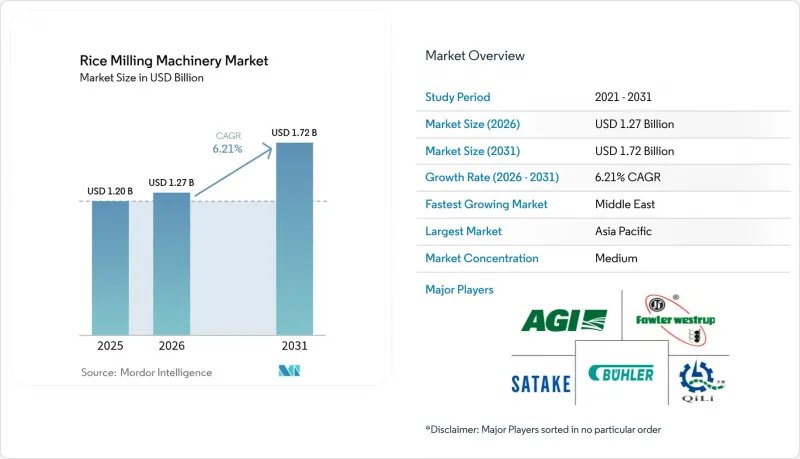
본 보고서는 기계 유형별(분리식 정미기 및 분쇄식 정미기), 공정별(전처리기, 선별기, 등급 선별기 등), 지역별(북미, 유럽, 아시아태평양, 남미, 중동 및 아프리카)로 분류되어 있습니다. 시장 예측은 금액(달러) 기준으로 제시되어 있습니다.
세계 정미 기계 시장 동향 및 인사이트
생산량 및 벼 재배 면적 증가
인도, 베트남, 나이지리아의 재배 면적 확대가 전 세계 벼 생산량을 끌어올리고 있으며, 헥타르당 4-6미터톤의 곡물이 생산되고 있어 즉각적인 도정 능력이 요구되고 있습니다. 사하라 사막 이남 아프리카의 관개 프로젝트와 개량 종자 도입은 품질을 저하시키지 않으면서 계절적인 생산량 급증을 감당할 수 있는 자동화 공장에 대한 장기적인 수요를 부각시키고 있습니다. 오람(Olam)사의 시간당 16-24 메트르톤의 처리 능력을 갖춘 시설로 대표되는 베트남의 수출 지향형 정미 업체들은 업스트림 생산 증가가 어떻게 현대적인 생산 라인에 대한 설비 투자 확대로 이어지는지를 보여주고 있습니다. 자급자족을 향한 움직임은 경작 면적의 확대에 따라 확장 가능한 선별 및 정미 설비에 대한 수요를 두 배로 늘리고 있습니다. 자동화된 이송, 탈곡, 연마 모듈은 인력 부족으로 인한 병목 현상을 해소하여 생산자가 수확 성수기를 신속하게 활용할 수 있게 해줍니다. 따라서 경작 면적의 지속적인 확대는 더 크고 효율적인 정미 기계 시장 도입에 대한 구조적인 수요를 확고히 하고 있습니다.
정미에 대한 수출 수요 증가
고급 쌀을 취급하는 수입업체들은 70% 이상의 양질 곡물률을 요구하고 있으며, 이는 유럽 및 중동 바이어들이 요구하는 엄격한 등급 기준을 충족하는 광학 선별기, 컬러 카메라 및 다파장 근적외선(NIR) 감지기에 대한 투자를 촉진하고 있습니다. 태국과 베트남은 여전히 공급의 핵심이지만, 나이지리아와 브라질로부터 새로운 문제에 직면해 있습니다. 이들 국가는 현미 가격보다 톤당 최대 200달러가 추가되는 영양 강화 프리미엄을 확보하기 위해 생산 라인 업그레이드를 추진하고 있습니다. 미량 영양소 프리믹스를 균일하게 혼합할 수 있는 설비는 현재 기관 급식 프로그램에 쌀을 공급하는 수출업체에게 필수 요소가 되었습니다. 관세 격차가 축소되는 가운데, 정밀한 가공이 결정적인 경쟁 우위가 되며, 고성능 선별 기계가 정미 기계 시장의 중심에 자리 잡고 있습니다.
정미 공장에 대한 막대한 초기 투자
본격적인 자동화 플랜트의 가격은 시간당 2MT 규모의 라인 기준 50만 달러부터 시간당 10MT 규모의 통합 복합 시설 기준 500만 달러까지 폭이 넓으며, 그 금액은 대부분의 가족 경영 정미소의 유동 자금을 훨씬 초과합니다. 인도의 은행들은 대개 25-50%의 계약금을 요구하며, 대출 금액의 절반에 해당하는 담보를 요구합니다. 그 결과, 많은 신청자들이 경쟁에서 탈락하고 있습니다. 7년에 걸친 대출 상환 기간은 수확 주기에 따른 수입 변동과 양립할 수 없어, 많은 확장 계획을 좌절시키고 있습니다. 보다 충실한 리스 옵션이 없다면, 높은 자본 요건이 계속해서 단기 지출을 억제하여 쌀 도정 기계 시장에 큰 부담으로 작용할 것입니다.
부문 분석
2025년, 등급 분류식 정미기는 고급 수출용 장립종을 보호하는 적응성이 높은 처리 공정에 힘입어 정미 기계 시장 점유율 52.60%를 유지했습니다. 이러한 기계들은 생산 능력과 곡물 품질 유지의 균형을 맞추려는 인도, 베트남, 브라질의 중규모 공장에서 핵심적인 역할을 담당하고 있습니다. 등급 분류식 정미기 시장 규모는 브랜딩 관점에서 곡물의 길이를 유지해야 하는 향미미나 유기농 쌀의 수출 증가에 따라 확대될 것으로 예측됩니다.
그라인드식 정미기는 7.54%라는 가장 높은 연평균 성장률(CAGR)을 기록하고 있습니다. 이는 대규모 복합 시설이 영양 강화 쌀이나 깨진 쌀 등의 파생 제품을 위해 더욱 엄격한 백도 관리와 균일한 생산량을 추구하고 있기 때문입니다. 예측 제어식 연마 휠은 곡물 손상을 억제하고, 진공 이송은 오염을 줄임으로써 수출 기준 적합성을 높입니다. 실시간 대시보드는 수분 데이터를 통합하고 현장에서 롤러 간격을 미세 조정할 수 있게 해주며, 이 기능은 습도가 높은 열대 기후에서 매우 높이 평가받고 있습니다. 시스템 통합사업자들은 현재 인건비 절감을 위해 로봇을 활용한 자루 포장 시스템을 도입하고 있으며, 이는 정미 기계 업계에서 그라인드식 정미기 업그레이드의 비용 효율성을 높이는 데 기여하고 있습니다.
지역별 분석
2025년에는 아시아태평양이 시장 규모의 71.35%를 차지할 것으로 예상되며, 중동은 2031년까지 연평균 성장률(CAGR) 7.55%로 시장을 주도하며 성장할 것으로 전망됩니다. 인도와 중국에서는 보조금 제도를 통해 실질적인 구매 비용이 절감되고 있습니다. 광둥성과 장쑤성의 지방 정부 보조금 덕분에 AI 탑재 색상 선별기로의 업그레이드가 신속하게 진행되어, 엄격한 국내 식품 안전 기준 준수가 보장되고 있습니다. 베트남과 태국 등 동남아시아의 수출업체들은 일본과 유럽의 바이어들이 설정한 70% 이상의 정미 회수율 목표를 초과 달성하기 위해 민간 자본을 최첨단 광학 선별기에 투자하고 있습니다. 인도네시아는 국가 식량 안보 목표에 따라 베트남산 정미 수입에 대한 의존도를 낮추기 위해 기존 설비의 개조를 추진하고 있습니다. 이러한 동향들이 맞물려 정미 기계 시장에서 아시아태평양의 우위를 더욱 공고히 하고 있습니다.
북미 및 유럽에서는 에너지 효율 최적화에 중점을 둔 성숙한 공장이 가동되고 있습니다. 미국의 정미소에서는 유기농 식품 소매업체에 대한 공급에 대응하기 위해 가변 주파수 드라이브 개조 및 블록체인 기반 추적 시스템 도입이 진행되고 있습니다. 유럽의 가공업체들은 엄격한 근로자 안전 지침을 충족하는 방진 인클로저를 통합하고, 반숙미 제품의 유통 기한을 연장하기 위한 질소 충전 시스템에 투자하고 있습니다. 그 결과, 이 지역에서 수요는 신규 건설보다는 기존 설비의 갱신이 주류를 이루고 있습니다. 전 세계 쌀 생산은 계속 확대되고 있으며, 미국 농무부(USDA)는 특히 식량 안보에 대한 우려와 인구 증가에 대응하여 주요 생산 지역 전반에서 경작 면적이 증가할 것으로 예측했습니다. 중동 및 아프리카는 장기적인 성장 잠재력을 지니고 있습니다. 중동 소비자들은 바스마티 라이스이나 자스민 쌀 수입으로 전환하고 있으며, 이에 따라 걸프 지역 투자자들은 최첨단 선별기 및 도정기를 도입한 파키스탄과 태국의 가공 거점에 대한 공동 투자를 추진하고 있습니다. 남미에서는 완만한 성장이 나타나고 있습니다. 브라질에서는 정미 설비의 현대화와 에탄올을 이용한 열병합 발전을 연계하여, 볏짚 보일러를 활용해 잉여 전력을 전력망에 공급함으로써 순 운영 비용을 절감하고 있습니다. 아르헨티나에서는 안데스 지역의 프리미엄 시장을 개척하기 위해 파보일드 쌀의 생산 능력 확대를 추진하고 있으며, 기존 시설에 통합된 수열식 예열기 및 온도 조절 건조기에 대한 투자를 진행하고 있습니다.
기타 혜택:
- 엑셀 형식 시장 예측(ME) 시트
- 3개월간의 애널리스트 지원
자주 묻는 질문
목차
제1장 서론
제2장 조사 방법
제3장 주요 요약
제4장 시장 구도
제5장 시장 규모와 성장 예측
제6장 경쟁 구도
제7장 시장 기회와 향후 전망
LSH 26.08.25According to Mordor Intelligence, the rice milling machinery market size is expected to grow from USD 1.20 billion in 2025 to USD 1.27 billion in 2026 and is forecast to reach USD 1.72 billion by 2031 at 6.21% CAGR over 2026-2031.
This report is Segmented by Mechanism (Fraction Rice Milling Machines, and Grind Rice Milling Machines), by Operations (Pre-Cleaning Machinery, Separating Machinery, Grading Machinery, and More), and by Geography (North America, Europe, Asia-Pacific, South America, Middle East, and Africa). The Market Forecasts are Provided in Terms of Value (USD).
Global Rice Milling Machinery Market Trends and Insights
Rising Production and Area Under Rice Cultivation
Expanded planting areas in India, Vietnam, and Nigeria are boosting global paddy output, and each hectare generates 4-6 metric tons of grain that requires immediate milling capacity. Sub-Saharan African irrigation projects and the adoption of improved seeds underscore the long-term need for automated plants that can handle seasonal surges without compromising quality. Vietnam's export-oriented processors, exemplified by Olam's 16-24 metric tons per hour facility, demonstrate how upstream production gains translate into higher capital expenditures on modern lines . The push toward self-sufficiency multiplies demand for scalable cleaning and whitening units that can be expanded as acreage rises. Automated conveying, husking, and polishing modules eliminate labor bottlenecks, enabling producers to capitalize on harvest peaks quickly. Continuous crop growth, therefore, locks in a structural requirement for larger, more efficient rice milling machinery market installations.
Growing Export Demand for Milled Rice
Premium importers insist on head-rice recovery above 70%, catalyzing investments in optical sorters, color cameras, and multi-wavelength Near-Infrared (NIR) detectors that meet the stringent grades demanded by European and Middle Eastern buyers . Thailand and Vietnam remain supply pivots but face new challenges from Nigeria and Brazil, which are upgrading lines to capture fortification premiums that can top USD 200 per metric ton over rough rice. Equipment capable of blending micronutrient premixes uniformly is now a must-have for exporters serving institutional feeding programs. As tariff differentials shrink, precision processing becomes the decisive competitive edge, placing high-performance grading machinery at the center of the rice milling machinery market.
High Initial Investment in Rice Mills
Full-scale automated plants range from USD 0.5 million for 2 MT-hour lines to USD 5 million for 10 MT-hour integrated complexes, figures well beyond the cash holdings of most family-run mills. Indian banks often demand 25-50% down payment and collateral equal to half the loan value, which pushes many applicants out of contention. Loan amortization over 7 years clashes with income volatility tied to harvest cycles, derailing many expansion plans. Without stronger leasing options, high capital thresholds will continue to curb near-term outlays and weigh on the rice milling machinery market.
Other drivers and restraints analyzed in the detailed report include:
- Increasing Technology Advancements in Rice Mills
- Government Mechanization Subsidies
- Competition from Imported Rice
For complete list of drivers and restraints, kindly check the Table Of Contents.
Segment Analysis
Fraction rice milling machines retained 52.60% of the rice milling machinery market share in 2025, supported by their adaptable flow paths that protect long-grain varieties destined for premium export slots. They anchor mid-sized plants across India, Vietnam, and Brazil, where processors balance capacity and grain integrity. The rice milling machinery market size for fraction units is projected to widen along with rising exports of aromatic and organic rice, which must maintain kernel length for branding purposes.
Grind rice milling machines post the highest 7.54% CAGR as high-volume complexes chase tighter whiteness control and uniform output for fortified and broken-rice derivatives. Predictive abrasion wheels limit kernel damage, while vacuum transport cuts contamination, boosting export compliance. Real-time dashboards integrate moisture data to tweak roller gaps on the fly, a capability highly prized in humid tropical climates. Integrators now bundle robotic bagging to lower labor costs, strengthening the cost argument for grind-machine upgrades inside the rice milling machinery industry.
Complete Report Scope:
- By Mechanism
- Fraction rice milling machines
- Grind rice milling machines
- By Operations
- Pre-cleaning machinery
- Separating machinery
- Grading machinery
- Rice whitening machinery
- Other operations
- By Geography
- North America
- United States
- Canada
- Mexico
- Rest of North America
- Europe
- Germany
- United Kingdom
- France
- Italy
- Spain
- Rest of Europe
- Asia-Pacific
- India
- China
- Japan
- Rest of Asia-Pacific
- South America
- Brazil
- Argentina
- Rest of South America
- Middle East
- Saudi Arabia
- United Arab Emirates
- Rest of Middle East
- Africa
- South Africa
- Egypt
- Rest of Africa
- North America
Geography Analysis
Asia-Pacific captured 71.35% of the market size in 2025 and the Middle East is anticipated to expand at a market-leading 7.55% CAGR to 2031. India and China, whose subsidy packages reduce effective purchase costs. Provincial grants in Guangdong and Jiangsu fast-track upgrades to AI-enabled color sorters, ensuring compliance with stringent domestic food safety norms. Southeast Asian exporters such as Vietnam and Thailand channel private capital into cutting-edge optical sorters to exceed 70% head-rice recovery targets set by Japanese and European buyers. Indonesia follows with brownfield retrofits to curb reliance on imported Vietnamese finished rice, aligning with national food security targets. These trends collectively fortify Asia-Pacific's primacy within the rice milling machinery market.
North America and Europe operate mature plants focused on energy optimization. United States mills retrofit variable-frequency drives and adopt blockchain traceability to serve organic retailers. European processors integrate dust-control enclosures that meet stringent worker safety directives and invest in nitrogen flushing systems to prolong the shelf life of parboiled variants. Replacements rather than new builds therefore govern demand in these regions. Global rice production continues expanding, with the United States Department of Agriculture (USDA) projecting increased cultivation area across major producing regions, particularly in response to food security concerns and population growth . Africa and the Middle East provide long-run upside. Middle East consumers shift to basmati and jasmine imports, prompting Gulf investors to co-fund processing hubs in Pakistan and Thailand that deploy cutting-edge graders and whiteners. South America showcases moderate growth. Brazil aligns milling upgrades with ethanol cogeneration by using rice husk boilers that feed residue power to the grid, lowering net operating costs. Argentina pursues expanded parboiled capacity to tap premium Andean markets, investing in hydrothermal pre-heaters and tempered dryers integrated into existing facilities.
- Buhler Group
- Satake Corporation
- AG Growth International Inc.
- Fowler Westrup India Pvt. Ltd.
- Zhejiang QiLi Machinery Co. Ltd. (QiLi Group)
- Hubei Bishan Machinery Co. Ltd. (Bishan Group)
- Mill Master Machinery Pvt. Ltd.
- G S International
- G.G. Dandekar Machine Works Ltd.
- Leshan Dongya Machinery Co. Ltd.
- PETKUS Technologie GmbH
- Koolmill Systems Ltd.
- Ricetec Machinery Pvt. Ltd.
- Henan Huatai Machinery
- Perfect Equipments Pvt. Ltd. (PEPL)
Additional Benefits:
- The market estimate (ME) sheet in Excel format
- 3 months of analyst support
TABLE OF CONTENTS
1 Introduction
- 1.1 Study Assumptions and Market Definition
- 1.2 Scope of the Study
2 Research Methodology
3 Executive Summary
4 Market Landscape
- 4.1 Market Overview
- 4.2 Market Drivers
- 4.2.1 Rising production and area under rice cultivation
- 4.2.2 Growing export demand for milled rice
- 4.2.3 Increasing technology advancements in rice mills
- 4.2.4 Government mechanization subsidies
- 4.2.5 Digital retro-fits for SME mills cut energy use
- 4.2.6 Pay-as-you-mill business models improve access
- 4.3 Market Restraints
- 4.3.1 High initial investment in rice mills
- 4.3.2 Competition from imported rice
- 4.3.3 Volatility of paddy prices affects cap-ex cycles
- 4.3.4 Fragmented after-sales service in emerging markets
- 4.4 Regulatory Landscape
- 4.5 Technological Outlook
- 4.6 Porter's Five Forces Analysis
- 4.6.1 Threat of New Entrants
- 4.6.2 Bargaining Power of Buyers
- 4.6.3 Bargaining Power of Suppliers
- 4.6.4 Threat of Substitute Products
- 4.6.5 Intensity of Competitive Rivalry
5 Market Size and Growth Forecasts (Value)
- 5.1 By Mechanism
- 5.1.1 Fraction rice milling machines
- 5.1.2 Grind rice milling machines
- 5.2 By Operations
- 5.2.1 Pre-cleaning machinery
- 5.2.2 Separating machinery
- 5.2.3 Grading machinery
- 5.2.4 Rice whitening machinery
- 5.2.5 Other operations
- 5.3 By Geography
- 5.3.1 North America
- 5.3.1.1 United States
- 5.3.1.2 Canada
- 5.3.1.3 Mexico
- 5.3.1.4 Rest of North America
- 5.3.2 Europe
- 5.3.2.1 Germany
- 5.3.2.2 United Kingdom
- 5.3.2.3 France
- 5.3.2.4 Italy
- 5.3.2.5 Spain
- 5.3.2.6 Rest of Europe
- 5.3.3 Asia-Pacific
- 5.3.3.1 India
- 5.3.3.2 China
- 5.3.3.3 Japan
- 5.3.3.4 Rest of Asia-Pacific
- 5.3.4 South America
- 5.3.4.1 Brazil
- 5.3.4.2 Argentina
- 5.3.4.3 Rest of South America
- 5.3.5 Middle East
- 5.3.5.1 Saudi Arabia
- 5.3.5.2 United Arab Emirates
- 5.3.5.3 Rest of Middle East
- 5.3.6 Africa
- 5.3.6.1 South Africa
- 5.3.6.2 Egypt
- 5.3.6.3 Rest of Africa
- 5.3.1 North America
6 Competitive Landscape
- 6.1 Market Concentration
- 6.2 Strategic Moves
- 6.3 Market Share Analysis
- 6.4 Company Profiles (Includes Global level Overview, Market Level Overview, Core Segments, Financials as Available, Strategic Information, Market Rank/Share, Products and Services, Recent Developments)
- 6.4.1 Buhler Group
- 6.4.2 Satake Corporation
- 6.4.3 AG Growth International Inc.
- 6.4.4 Fowler Westrup India Pvt. Ltd.
- 6.4.5 Zhejiang QiLi Machinery Co. Ltd. (QiLi Group)
- 6.4.6 Hubei Bishan Machinery Co. Ltd. (Bishan Group)
- 6.4.7 Mill Master Machinery Pvt. Ltd.
- 6.4.8 G S International
- 6.4.9 G.G. Dandekar Machine Works Ltd.
- 6.4.10 Leshan Dongya Machinery Co. Ltd.
- 6.4.11 PETKUS Technologie GmbH
- 6.4.12 Koolmill Systems Ltd.
- 6.4.13 Ricetec Machinery Pvt. Ltd.
- 6.4.14 Henan Huatai Machinery
- 6.4.15 Perfect Equipments Pvt. Ltd. (PEPL)


