|
시장보고서
상품코드
2114066
폴리우레탄(PU) 코팅 : 시장 점유율 분석, 업계 동향 및 통계, 성장 예측(2026-2031년)Polyurethane (PU) Coatings - Market Share Analysis, Industry Trends & Statistics, Growth Forecasts (2026 - 2031) |
||||||
 Mordor Intelligence
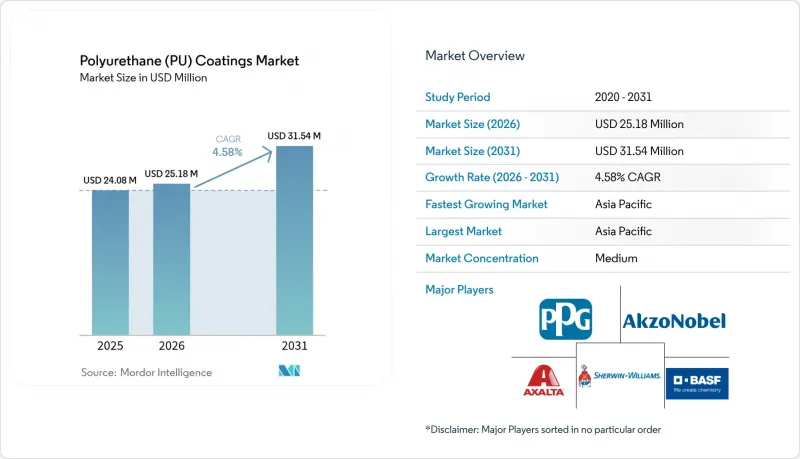
Mordor Intelligence에 의하면, 2026년 폴리우레탄 페인트 시장 규모는 2,518만 달러로 추정되고 있으며, 2025년 2,408만 달러에서 2031년에는 3,154만 달러에 달할 것으로 예측됩니다.
또한 2026-2031년 연평균 성장률(CAGR) 4.58%를 기록할 전망입니다.
본 보고서는 기술별(분체, 용제형, 수성, 방사선 경화/UV), 최종 사용자 산업별(자동차, 운송, 건설, 전기 및 전자, 목재 및 가구, 기타 최종 사용자 산업), 지역별(아시아태평양, 북미, 유럽, 남미, 중동 및 아프리카)로 분류되어 있습니다. 시장 전망은 금액(달러) 기준으로 제시되어 있습니다.
세계 폴리우레탄(PU) 코팅 시장 동향 및 인사이트
팬데믹 이후 인프라 부양책에 따른 건설업의 재활성화
세계 인프라 구축 계획에 따라, 가혹한 기상 조건과 화학 물질 노출을 견딜 수 있는 보호용 폴리우레탄 마감재에 대한 안정적인 수주가 발생하고 있습니다. ‘미국 인프라 투자 및 고용법’에 더해 중국의 대규모 지방 프로젝트까지 맞물리면서, 건축 및 토목 공학 분야 수요는 높은 수준을 유지하고 있습니다. 또한, 이 분야에서는 친환경 건축물 인증으로의 전환이 진행되고 있어, 건축가들은 저배출형 폴리우레탄 분산형 제품의 채택을 지정하고 있습니다. 아시아태평양이 최대 판매량을 차지하는 반면, 북미 및 유럽에서는 뛰어난 내구성과 빠른 경화 성능이 중시되고 있습니다. 모듈식 건축의 성장에 따라, 현장에서의 노동력을 줄여주는 공장 도장 시스템이 선호되고 있습니다. 프로젝트 파이프라인이 장기화됨에 따라 공급업체에게는 예측 가능한 수요가 발생하고, 중단 없는 공급이 보장되고 있습니다.
자동차 OEM의 경량 복합재료로의 전환: 높은 유연성을 갖춘 탑코트가 요구됨
전동화 목표와 연비 규제로 인해 각 OEM 업체들은 금속을 동적 하중 하에서 변형되는 탄소섬유 및 유리섬유 복합재료로 대체할 수밖에 없습니다. 기존 도료는 이러한 기판 위에서 균열이나 박리 현상이 발생하기 때문에 제조업체들은 높은 성장률과 내치핑성을 갖춘 엘라스토머계 폴리우레탄 화학제품에 주목하고 있습니다. 일본 및 한국의 자동차 제조업체들은 이미 사내 도장 기준을 갱신했으며, 미국 및 유럽 브랜드들도 사양서를 조정해 나가고 있습니다. 자율주행차용 센서를 다수 탑재한 차체 패널에는 전자기 차폐 요건이 부과되지만, 이는 고고형분 폴리우레탄 배합을 통해 효과적으로 대응할 수 있습니다. 사내에 도포 설비 실험실을 보유한 공급업체는 새로운 차체 구조에 맞는 스프레이 매개변수를 공동 개발함으로써 경쟁 우위를 확보할 수 있습니다.
변동이 심한 이소시아네이트 및 폴리올 원자재 가격
경질 및 연질 MDI/TDI의 가격 동향은 여전히 원유 가격 변동과 전 세계 여러 곳의 반응로에서 발생하는 계획적·예기치 못한 가동 중단에 좌우되고 있습니다. 리욘나르바셀의 연례 보고서에서는 2024년에 스프레드가 좁아질 것이라고 지적하고 있으며, 이 회사의 정유시설 철수는 석유 유래 원료에 수반되는 위험 프로파일을 부각시키고 있습니다. 금호미쓰이의 여수 신규 생산 능력은 어느 정도 도움이 되겠지만, 불가항력적인 사태로부터 구매자를 완전히 보호할 수는 없습니다. 대형 배합 제조업체들은 다년 계약이나 후방 통합을 통해 리스크를 헤지하고 있지만, 많은 틈새 시장 생산자들은 이러한 선택지가 없어 가격 전가를 할 수밖에 없거나 이익률 하락을 감수해야 합니다. 고성능 첨가제 함유 비율이 높은 특수 등급은 가장 심각한 원가 급등의 영향을 가장 크게 받고 있습니다.
부문 분석
용제형 배합은 기존 설비, 풍부한 제품 라인업, 그리고 OEM 라인에 대한 숙련도 덕분에 2025년에도 폴리우레탄 도료 시장 점유율 47.20%를 유지했습니다. 연평균 성장률(CAGR) 6.67%로 확대되고 있는 수성 대체 제품은 광택을 손상시키지 않으면서 VOC 배출량 감축을 목표로 하는 자동차, 전자기기, 목재 가구 제조 공장에서 투자를 받고 있습니다. 분체 도료는 정전기 도장 라인이 이미 도입된 분야에 가장 적합하며, 폐기물이 거의 없고 저에너지로 경화가 가능합니다. UV 경화 부문은 처리 속도가 설비 비용을 상쇄하는 전자기기 및 자동차 클리어 코트 분야에서 틈새 시장을 개척하고 있습니다.
자가가교성 폴리우레탄 골격을 채택함으로써, 수성 분산액은 내식성 면에서 용제계 도료에 점점 더 근접하고 있습니다. 코베스트로(Covestro)는 상하이에 분산액 생산 라인을 가동하여 아시아 내 생산 능력을 두 배로 늘리고, 운송비 절감과 리드타임 단축을 실현했습니다. 또한, 연구팀은 가수분해 저항성을 높이기 위해 폴리카보네이트 디올을 배합하여, 그동안 용제계가 주류를 이루던 선박 용도로의 진출 길을 열었습니다. 실리콘 및 불소 수지 부문을 통합한 하이브리드 화학 기술은 고급 주방 캐비닛과 스마트폰 케이스에 오염 방지 기능을 제공합니다. 이 분야는 단일 제품 지표가 아닌 공장 전체의 배출량을 평가하는 고객 공장의 ISO 14001 인센티브의 혜택을 받고 있습니다.
지역별 분석
2025년, 아시아태평양은 자동차 조립, 가전제품 수출 및 인프라 구축 계획의 가속화에 힘입어 폴리우레탄 도료 시장의 42.75%를 차지했습니다. 이 지역 수요는 2031년까지 연평균 성장률(CAGR) 5.36%로 증가하여 다른 모든 지역을 앞지르는 속도를 보일 것으로 전망됩니다. 중국에서는 창화화학(Changhua Chemical)의 CO2를 원료로 하는 폴리올 프로젝트가 탄소 강도를 낮추고 현지 원료 확보를 실현하고 있습니다. 베트남의 펄 그룹(Pearl Group)은 동남아시아 공장에 유연한 로트 크기로 공급하는 다섯 번째 시스템 하우스를 신설하여 납기 기간을 단축하는 동시에 환율 리스크를 경감하고 있습니다. 일본의 각 OEM 기업들은 수성 화학 분야에서의 연구 개발 리더십을 유지하고 있으며, 한국의 MDI 생산 확대에 힘입어 국내 도료 제조업체에는 경쟁력 있는 비용으로 안정적인 공급이 이루어지고 있습니다.
북미는 성숙했으나 수익성이 높은 시장으로, 산업용 바닥 도장 프로젝트와 항공우주용 특수 도료가 판매량 증가 둔화를 상쇄하고 있습니다. 연방 및 주 정부의 대규모 인프라 정비 계획에 따라 교량 및 고속도로의 재도장 주기가 유지되고 있습니다. 저VOC 규제로 인해 분산형 도료 및 2K 고고형분 도료에 대한 투자가 촉진되어, 1리터당 평균 판매 가격이 상승하고 있습니다.
유럽은 전 세계 배합 기준을 형성하는 규제 체계의 핵심을 담당하고 있습니다. REACH 규제에 따른 특정 디이소시아네이트의 단계적 폐지는 선제적인 배합 재검토를 불가피하게 만들고 있습니다. 헝가리에 위치한 MOL-티센크루프의 폴리올 생산 거점은 지역 내 원료의 안정적인 공급을 확보하고, 중부 유럽의 OEM 제조업체에 대한 공급 경로를 단축하고 있습니다. 동유럽의 자동차 산업 클러스터는 해상 운송비 변동 위험을 헤지하기 위해 이 공장에 의존하고 있습니다.
라틴아메리카, 중동 및 아프리카는 인프라, 광업, 석유 및 가스 시설에서 내구성이 높고 내화학성이 뛰어난 코팅이 요구되므로 장기적인 성장이 예상됩니다. 현지 생산자들은 고도의 연구개발 체계를 갖추지 못한 경우가 많기 때문에 국제적인 공급업체들은 라이선싱이나 합작 투자를 통해 제휴하고 있습니다. 생산량이 적고 환율이 변동하기 쉬운 특성상 모듈식 배치 플랜트가 유리하며, 세계적인 대기업들은 선택적인 자본 투자를 검토하고 있습니다.
기타 혜택:
- 엑셀 형식 시장 예측(ME) 시트
- 3개월간의 애널리스트 지원
자주 묻는 질문
목차
제1장 서론
제2장 조사 방법
제3장 주요 요약
제4장 시장 구도
제5장 시장 규모와 성장 예측
제6장 경쟁 구도
제7장 시장 기회와 향후 전망
LSH 26.08.25According to Mordor Intelligence, polyurethane coatings market size in 2026 is estimated at USD 25.18 million, growing from 2025 value of USD 24.08 million with 2031 projections showing USD 31.54 million, growing at 4.58% CAGR over 2026-2031.
This report is Segmented by Technology (Powder, Solvent-Borne, Water-Borne, and Radiation-cured/UV), End-User Industry (Automotive, Transportation, Construction, Electrical and Electronics, Wood and Furniture, and Other End-User Industries), and Geography (Asia-Pacific, North America, Europe, South America, and Middle-East and Africa). The Market Forecasts are Provided in Terms of Value (USD).
Global Polyurethane (PU) Coatings Market Trends and Insights
Construction Reboot in Post-Pandemic Infrastructure Stimulus
Global infrastructure packages are unlocking steady orders for protective polyurethane finishes that endure harsh weather and chemical exposure. The United States Infrastructure Investment and Jobs Act, combined with large provincial projects in China, keeps architectural and civil engineering demand elevated. The sector also pivots toward green-building certifications, pushing architects to specify low-emission polyurethane dispersion products. Asia-Pacific contributes the highest volume, while North America and Europe emphasize premium resilience and rapid-cure performance. Modular construction growth favors factory-applied systems that reduce onsite labor. Longer project pipelines create predictable demand for suppliers, which can guarantee an uninterrupted supply.
Automotive OEM Shift to Lightweight Composites Needing High-Flex Top-Coats
Electrification targets and fuel-efficiency rules force OEMs to replace metal with carbon-fiber and glass-fiber composites that flex under dynamic loads. Conventional coatings crack or delaminate on these substrates, so manufacturers turn to elastomeric polyurethane chemistries with high elongation and chip resistance. Japanese and South Korean automakers have already updated internal paint standards, and US and European brands are aligning specification sheets. Sensor-laden body panels for autonomous vehicles introduce electromagnetic shielding requirements that high-solids polyurethane formulas can effectively address. Suppliers with in-house application-equipment labs gain an edge by co-developing spray parameters for new body architectures.
Volatile Isocyanate and Polyol Feedstock Prices
Rigid and flexible MDI/TDI chains remain tied to crude-oil swings and planned or unplanned outages at a handful of global reactors. LyondellBasell's annual report flagged thin spreads in 2024, and its refinery exit highlights the risk profile associated with oil-derived inputs. New capacity in Yeosu from Kumho Mitsui provides relief but cannot fully insulate buyers from force-majeure events. Larger formulators hedge their risks via multi-year contracts or backward integration, whereas many niche producers lack these options, forcing them to pass through prices or experience margin erosion. Specialty grades, which contain higher proportions of performance additives, are the most affected by the most profound cost spikes.
Other drivers and restraints analyzed in the detailed report include:
- Regulatory Pivot to Low-VOC Water-Borne and High-Solids Systems
- E-Commerce Logistics Boom Raising Demand for Industrial Floor Coatings
- Tightening Worker-Safety Rules on Di-Isocyanates
For complete list of drivers and restraints, kindly check the Table Of Contents.
Segment Analysis
Solvent-borne formulations retained 47.20% of the polyurethane coatings market share in 2025 owing to legacy installations, extensive product catalogs, and familiarity with OEM lines. Water-borne alternatives, advancing at a 6.67% CAGR, receive investment from automotive, electronics, and wood-furniture plants seeking to reduce VOC emissions without compromising gloss. Powder coatings are ideal for areas where electrostatic lines are already installed, leveraging near-zero waste and low-energy curing. UV-curing segments carve out niches in electronics and automotive clear-outs where throughput speed offsets equipment costs.
Water-borne dispersions are increasingly comparable to solvent systems in terms of corrosion resistance after the adoption of self-cross-linking polyurethane backbones. Covestro commissioned a dispersion line in Shanghai that doubles its Asian capacity, lowering freight charges and shortening lead times. Research teams are also blending polycarbonate diols to enhance hydrolysis resistance, opening doors to marine applications previously dominated by solvent systems. Hybrid chemistries that integrate silicone or fluoropolymer segments offer stain resistance for premium kitchen cabinets and smartphone casings. The segment benefits from ISO 14001 incentives at customer factories, which weigh entire plant emissions rather than single product metrics.
Complete Report Scope:
- By Technology
- Powder
- Solvent-borne
- Water-borne
- Radiation-cured / UV
- By End-user Industry
- Automotive
- Transportation
- Construction
- Electrical and Electronics
- Wood and Furniture
- Other End-user Industries
- By Geography
- Asia-Pacific
- China
- India
- Japan
- South Korea
- ASEAN Countries
- Rest of Asia-Pacific
- North America
- United States
- Canada
- Mexico
- Europe
- Germany
- United Kingdom
- France
- Italy
- Spain
- Russia
- NORDIC Countries
- Rest of Europe
- South America
- Brazil
- Argentina
- Rest of South America
- Middle-East and Africa
- Saudi Arabia
- United Arab Emirates
- Qatar
- Egypt
- South Africa
- Rest of Middle-East and Africa
- Asia-Pacific
Geography Analysis
The Asia-Pacific region controlled 42.75% of the polyurethane coatings market in 2025, driven by automotive assembly, consumer electronics exports, and accelerated infrastructure programs. Regional demand will climb at a 5.36% CAGR through 2031, outpacing every other territory. China's CO2-based polyol project by Changhua Chemical reduces carbon intensity and secures local feedstock. Vietnam's Pearl Group has added a fifth system house that supplies flexible batch sizes to Southeast Asian plants, improving delivery times and mitigating currency risks. Japanese OEMs maintain R&D leadership in water-borne chemistry, and South Korea's MDI expansion offers domestic paint makers stable supply at competitive cost.
North America represents a mature yet lucrative market, where industrial floor projects and specialty aerospace coatings help offset slower volume growth. Major federal-state infrastructure packages sustain bridge and highway repaint cycles. Low-VOC mandates shepherd investment into dispersion and 2K high-solids chemistries, providing higher average selling prices per liter.
Europe anchors regulatory frameworks that shape global formulation norms. REACH phase-outs of certain di-isocyanates force proactive reformulation. The MOL-thyssenkrupp polyol unit in Hungary improves regional input security and shortens supply lines for Central European OEMs. Eastern European automotive clusters rely on this plant to hedge against maritime freight volatility.
Latin America, the Middle East, and Africa together represent a long-run upswing where infrastructure, mining, and oil & gas facilities demand durable, chemical-resistant coatings. Local producers often lack advanced R&D, so international suppliers partner through licensing or joint ventures. Smaller volumes and fluctuating currencies make modular batch plants advantageous, and large global players weigh selective capital deployment.
- Akzo Nobel N.V.
- Asian Paints
- Axalta Coating Systems
- BASF
- Evonik Industries AG
- Hempel A/S
- IVM Chemicals SRL
- Jotun
- Kansai Paint Co. Ltd.
- Nippon Paint Holdings
- Polycoat Products
- PPG Industries Inc.
- RPM International Inc.
- Sika AG
- The Sherwin-Williams Company
Additional Benefits:
- The market estimate (ME) sheet in Excel format
- 3 months of analyst support
TABLE OF CONTENTS
1 Introduction
- 1.1 Study Assumptions & Market Definition
- 1.2 Scope of the Study
2 Research Methodology
3 Executive Summary
4 Market Landscape
- 4.1 Market Overview
- 4.2 Market Drivers
- 4.2.1 Construction reboot in post-pandemic infrastructure stimulus
- 4.2.2 Automotive OEM shift to lightweight composites needing high-flex PU top-coats
- 4.2.3 Regulatory pivot to low-VOC water-borne and high-solids systems
- 4.2.4 E-commerce logistics boom raising demand for industrial floor PU coatings
- 4.2.5 Emergence of nano-enabled self-healing PU coatings extending repaint cycles
- 4.3 Market Restraints
- 4.3.1 Volatile isocyanate and polyol feedstock prices
- 4.3.2 Tightening worker-safety rules on di-isocyanates
- 4.3.3 Carbon-border tariffs raising import costs of precursors
- 4.4 Value Chain Analysis
- 4.5 Porter's Five Forces
- 4.5.1 Bargaining Power of Suppliers
- 4.5.2 Bargaining Power of Buyers
- 4.5.3 Threat of New Entrants
- 4.5.4 Threat of Substitutes
- 4.5.5 Competitive Rivalry
5 Market Size & Growth Forecasts (Value)
- 5.1 By Technology
- 5.1.1 Powder
- 5.1.2 Solvent-borne
- 5.1.3 Water-borne
- 5.1.4 Radiation-cured / UV
- 5.2 By End-user Industry
- 5.2.1 Automotive
- 5.2.2 Transportation
- 5.2.3 Construction
- 5.2.4 Electrical and Electronics
- 5.2.5 Wood and Furniture
- 5.2.6 Other End-user Industries
- 5.3 By Geography
- 5.3.1 Asia-Pacific
- 5.3.1.1 China
- 5.3.1.2 India
- 5.3.1.3 Japan
- 5.3.1.4 South Korea
- 5.3.1.5 ASEAN Countries
- 5.3.1.6 Rest of Asia-Pacific
- 5.3.2 North America
- 5.3.2.1 United States
- 5.3.2.2 Canada
- 5.3.2.3 Mexico
- 5.3.3 Europe
- 5.3.3.1 Germany
- 5.3.3.2 United Kingdom
- 5.3.3.3 France
- 5.3.3.4 Italy
- 5.3.3.5 Spain
- 5.3.3.6 Russia
- 5.3.3.7 NORDIC Countries
- 5.3.3.8 Rest of Europe
- 5.3.4 South America
- 5.3.4.1 Brazil
- 5.3.4.2 Argentina
- 5.3.4.3 Rest of South America
- 5.3.5 Middle-East and Africa
- 5.3.5.1 Saudi Arabia
- 5.3.5.2 United Arab Emirates
- 5.3.5.3 Qatar
- 5.3.5.4 Egypt
- 5.3.5.5 South Africa
- 5.3.5.6 Rest of Middle-East and Africa
- 5.3.1 Asia-Pacific
6 Competitive Landscape
- 6.1 Market Concentration
- 6.2 Strategic Moves
- 6.3 Market Share/Ranking Analysis
- 6.4 Company Profiles (includes Global level Overview, Market level overview, Core Segments, Financials as available, Strategic Information, Market Rank/Share, Products & Services, Recent Developments)
- 6.4.1 Akzo Nobel N.V.
- 6.4.2 Asian Paints
- 6.4.3 Axalta Coating Systems
- 6.4.4 BASF
- 6.4.5 Evonik Industries AG
- 6.4.6 Hempel A/S
- 6.4.7 IVM Chemicals SRL
- 6.4.8 Jotun
- 6.4.9 Kansai Paint Co. Ltd.
- 6.4.10 Nippon Paint Holdings
- 6.4.11 Polycoat Products
- 6.4.12 PPG Industries Inc.
- 6.4.13 RPM International Inc.
- 6.4.14 Sika AG
- 6.4.15 The Sherwin-Williams Company
7 Market Opportunities & Future Outlook
- 7.1 White-space and Unmet-Need Assessment