

|
시장보고서
상품코드
2114068
민간 항공기 충돌 방지 시스템 : 시장 점유율 분석, 업계 동향 및 통계, 성장 예측(2026-2031년)Commercial Aircraft Collision Avoidance System - Market Share Analysis, Industry Trends & Statistics, Growth Forecasts (2026 - 2031) |
||||||
 Mordor Intelligence
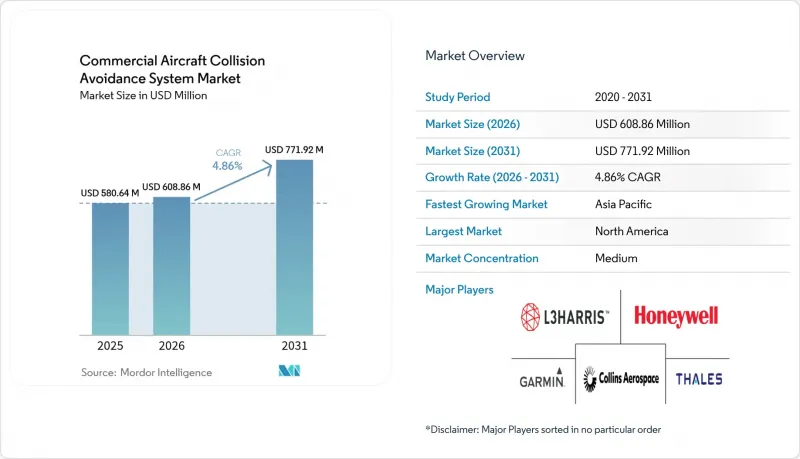
Mordor Intelligence에 의하면, 2026년 민간 항공기 충돌 방지 시스템 시장 규모는 6억 886만 달러로 추정되고 있으며, 2025년 5억 8,064만 달러에서 성장하여 2031년에는 7억 7,192만 달러에 달할 것으로 예측됩니다.
또한 2026-2031년 연평균 성장률(CAGR)은 4.86%를 나타낼 것으로 전망됩니다.
본 보고서는 시스템 유형(레이더, 교통 경보 및 충돌 방지 시스템(TACAS) 등), 플랫폼(민간 항공, 일반 항공, 드론),구성 요소(프로세서, 모드 S 트랜스폰더, 안테나 및 센서 등), 최종 사용자(OEM 및 애프터마켓), 지역(북미 등)별로 분류되어 있습니다. 시장 전망은 금액(달러) 기준으로 제시되어 있습니다.
전 세계 상업용 항공기 충돌 방지 시스템 시장 동향 및 인사이트
TCAS II 및 ACAS X 개조에 관한 규제 요건
ICAO 및 FAA의 업그레이드 주기로 인해, 항공사들은 표준 정비 기간보다 훨씬 이른 시점에 기존 TCAS 소프트웨어 및 하드웨어를 교체해야만 합니다. 대서양 횡단 노선을 운항하는 항공사는 버전 6.04a 및 7.1 준수를 충족해야 하며, 이로 인해 듀얼 인증 솔루션의 도입이 촉진되고 하이브리드 감시 기능에 대한 수요가 증가하고 있습니다. 전체 기단의 장비 밀도가 높아짐에 따라 해결 권고 사항의 조정이 개선되고, 안전성과 효율성이 증대되어 네트워크 효과에 따른 이점이 발생합니다. 각 OEM 업체들은 이러한 의무화를 활용하여 모드 S 트랜스폰더와 ADS-B-In 프로세서를 번들 패키지로 교차 판매함으로써 수익성을 강화하는 동시에 고객의 인증 절차를 간소화하고 있습니다. 그 결과로 예상되는 수주 전망은 항공전자 장비 공급업체에게 수년에 걸친 생산 계획 수립과 안정적인 수익원 확보를 뒷받침하고 있습니다.
나로우드 항공기 인도 대수의 급증
아시아태평양의 LCC(저가 항공사)는 A320neo 및 B737 MAX 제품군을 중심으로 지속적인 조달 붐을 주도하고 있으며, 이들 기종 모두 TCAS II가 표준 장비로 라인 피팅되어 있습니다. 협폭기(narrow-body)는 노선 밀도가 높은 국내 네트워크에서 경제적으로 유리하지만, 한편으로 운항사는 혼잡한 터미널 공역에 노출되어 있으며, 그곳에서는 충돌 방지의 신뢰성이 최우선 과제가 됩니다. 많은 항공사가 세일 앤 리스백 방식을 통해 신형 항공기 자금을 조달하고 있기 때문에 리스 회사는 자산의 유동성을 보호하기 위해 최신 감시용 항공 전자 장비의 탑재를 요구하고 있으며, 이로 인해 기단 전체의 시스템 탑재율이 더욱 높아지고 있습니다. 또한, 협폭기(나로우바디)의 붐은 중동 및 아프리카, 남미에서도 유사한 규제 조치를 촉발하고 있으며, 이 지역 당국은 지역 간 연결성을 촉진하기 위해 ICAO 부속서 10과의 지침 조화를 도모하고 있습니다. 그 결과, 상업용 항공기 충돌 방지 시스템 시장은 OEM의 생산 슬롯과 직결된 안정적인 도입 속도를 유지하고 있습니다.
높은 도입 비용과 수명 주기 비용
TCAS 또는 ACAS X의 완전한 개조 키트(프로세서, 안테나, 배선, 조종실 디스플레이)의 장비 가격은 15만 달러에 달할 전망입니다. 설치 비용, 비행 시험을 통한 인증, 그리고 운항 중단 기간을 합치면 10년 동안의 총 소유 비용은 20만 달러에 가까워집니다. 남미나 사하라 이남 아프리카와 같이 수익성이 낮은 지역 항공사들은 규제 마감 시한 직전까지 이러한 업그레이드를 미루는 경우가 많아, 그 결과 공급업체의 판매 주기가 장기화되고 있습니다. OEM이나 리스 회사가 제공하는 금융 패키지는 현금 흐름의 압박을 완화하는 한편, 이자 비용이 발생하여 예상되는 연료 효율을 통한 투자 회수를 저해합니다. 따라서 비용에 민감한 항공사들은 정기적인 대규모 점검에 맞추어 기능을 단계적으로 도입할 수 있는 모듈식 설계를 선호하는 경향이 있지만, 이러한 단계적 도입은 공급업체의 즉각적인 수익 계상을 지연시키는 결과를 초래합니다. 이러한 경제적 장벽으로 인해 수익성이 낮은 시장에서의 단기적인 보급이 제한되고, 상업용 항공기 충돌 방지 시스템 시장의 성장 여지가 축소되고 있습니다.
부문 분석
TCAS는 2025년에 상업용 항공기 충돌 방지 시스템 시장 점유율의 32.15%를 차지할 것으로 예상되며, 2031년까지 연평균 성장률(CAGR) 5.46%를 나타낼 것으로 전망됩니다. 도입의 모멘텀은 ADS-B In 감시 기능을 통합하고 1090 MHz의 쿼리 혼잡을 최소화하는 버전 7.1 소프트웨어로의 의무적인 업그레이드에 기인합니다. TAWS는 산악 지대 인근을 비행하는 터빈 항공기를 지속적으로 보호하고 있는 반면, 합성 시야 오버레이는 최신 글래스 콕핏에서 조종사의 상황 인식을 단순화하고 있습니다. 레이더 기반 감시는 ADS-B 커버리지가 고르지 않은 2차 공역에서 여전히 중요하며, 신호 상태가 악화된 상황에서도 시스템의 이중화를 보장합니다. OCAS 및 회전익기 전용 충돌 경보 제품은 저고도 비행 영역을 지원하며, 상업용 헬리콥터 및 응급 의료 서비스와 같은 틈새 시장에서 교차 판매 기회를 창출하고 있습니다.
시장 진출기업들은 TCAS 로직을 프로세서 및 디스플레이를 공유하는 통합 감시 제품군과 번들로 제공함으로써 기체 탑재 중량을 줄이고 총 전력 소비량을 절감하고 있습니다. 이러한 통합을 통해 조종실의 설치 면적이 축소되어 연결성 업그레이드를 위한 패널 공간이 확보됩니다. AI 분석 기술이 ACAS Xa의 연구 프로그램에서 주류 TCAS 제품으로 보급됨에 따라, 기존 기체들은 하드웨어 교체 없이도 향후 성능 기준을 충족하는 소프트웨어만의 기능 강화 혜택을 누리게 될 것입니다. 그 결과, TCAS는 공급업체가 부가가치 제안을 구축하기 위한 핵심 제품 라인으로 계속 자리매김하며, 상업용 항공기 충돌 방지 시스템 시장의 장기적인 수익 전망을 뒷받침하고 있습니다.
2025년에는 상업용 항공기 플랫폼이 매출 점유율의 80.55%를 차지했습니다. 이는 단일 통로 항공기 생산 라인에서의 표준화된 라인 핏 설치와 데이터 링크 구독 및 정기적인 소프트웨어 업데이트를 포함한 견고한 애프터마켓 서비스 계약에 힘입은 결과입니다. 와이드바디 항공기의 개조에 대해서는 듀얼 아일(dual-aisle)의 배선 경로와 인증 서류 정비가 복잡하기 때문에 기체당 수익은 높지만, 도입 주기는 길어집니다. 일반 항공 운항 사업자들은 항공사 수준의 비용을 들이지 않고 안전성을 향상시키기 위해 소형화된 프로세서 보드와 통합형 교통 상황 표시 장치를 채택하고 있으며, 이를 통해 비즈니스 제트기 기단에서 안정적인 교체 수요가 뒷받침되고 있습니다.
드론 시장은 BVLOS(시야 외 비행) 규제 체계와 유인 항공기와 동등한 ‘감지·회피’ 기능을 필요로 하는 도심항공모빌리티(UAM)(UAM) 프로토타입에 힘입어 연평균 성장률(CAGR) 6.04%를 기록할 전망입니다. 소형화된 프로세서와 경량 위상 배열 안테나가 이러한 성장을 뒷받침하고 있지만, 인증 절차는 여전히 초기 단계에 머물러 있어 수익화까지의 기간을 길게 만들고 있습니다. 항공 전자 장비 분야의 기존 기업과 로봇 공학 스타트업 간의 산업 간 협력을 통해 제품의 성숙도가 가속화되고 있으며, 2030년 이후 상업용 항공기 충돌 방지 시스템 시장에서 상당한 규모의 추가적인 잠재적 시장 기회가 창출될 가능성이 있습니다.
지역별 분석
북미는 2025년 상용 항공기 충돌 방지 시스템 시장에서 38.20%의 점유율을 유지했습니다. 이는 FAA(연방항공청)의 개조 의무화 및 미국 주요 항공사에 뿌리내린 기술 갱신 문화에 힘입은 결과입니다. 이 지역은 성숙한 MRO(정비·수리·오버홀) 인프라와 OEM(원천 장비 제조업체)과의 근접성이라는 이점을 가지고 있어, 이를 통해 인증 리드타임이 단축되고 ACAS Xa 비행 시험 프로그램의 조기 도입이 촉진되고 있습니다. 캐나다 당국은 미국 기준을 준수하고 있으며, 국경을 초월한 통일된 규제 환경을 제공함으로써 항공기 전체의 업그레이드 결정을 원활하게 하고 있습니다.
아시아태평양은 인도 및 동남아시아의 두 자릿수 여객 수송량 성장과 나로우드바디 항공기 인도 잔고가 지속되고 있는 것을 배경으로, 2031년까지 연평균 성장률(CAGR) 5.68%를 나타낼 것으로 예측됩니다. ICAO 부속서 10에 기반한 규제 조화는 국제 운항권 확보를 열망하는 LCC(저비용 항공사)의 장비 도입 가속화를 촉진하고 있습니다. 국내 전자상거래(e-커머스) 수요 또한 드론 감지·회피 기술에 대한 투자를 뒷받침하고 있으며, 이는 기존의 유인 항공기 운용량을 능가하는 규모에 이르렀습니다. 그러나 5G 구축 일정에 편차가 있어 고도계의 상호 운용성에 문제가 발생하고 있으며, 사업자는 충돌 방지 기능 업그레이드를 완료하기 전에 지역별 기술 지침에 따라 이 문제를 해결해야 합니다.
유럽에서는 SESAR에 의한 충돌 관리 시험이 조기에 실시된 덕분에 확고한 도입 기반이 마련되었습니다. ADS-B In 데이터를 TCAS 로직에 통합하는 노력이 진행 중이며, 추가적인 성능 향상이 기대됨에 따라 항공사들은 의무화 기한에 앞서 투자를 단행할 인센티브를 얻고 있습니다. 반면, 남미, 중동 및 아프리카에서는 여전히 ADS-B 지상 인프라가 제한적이기 때문에 당분간은 레이더 기반의 TCAS 솔루션이 더 매력적인 선택지로 떠오르고 있습니다. 그 결과, 감시 능력에 편차가 발생하고 있으며, 이는 공급업체 시장 진출 전략에 영향을 미쳐 상업용 항공기 충돌 방지 시스템 시장에서 지역 밀착형 파트너십 모델이 강화되고 있습니다.
기타 혜택:
- 엑셀 형식 시장 예측(ME) 시트
- 3개월간의 애널리스트 지원
자주 묻는 질문
목차
제1장 서론
제2장 조사 방법
제3장 주요 요약
제4장 시장 구도
제5장 시장 규모와 성장 예측
제6장 경쟁 구도
제7장 시장 기회와 향후 전망
LSH 26.08.25According to Mordor Intelligence, the commercial aircraft collision avoidance systems market size in 2026 is estimated at USD 608.86 million, growing from 2025 value of USD 580.64 million with 2031 projections showing USD 771.92 million, growing at 4.86% CAGR over 2026-2031.
This report is Segmented by System Type (Radars, Traffic Alert and Collision Avoidance System, and More), Platform (Commercial Aviation, General Aviation, and Drones), Component (Processors, Mode S Transponders, Antennas and Sensors, and More), End User (OEM and Aftermarket), and Geography (North America, and More). The Market Forecasts are Provided in Terms of Value (USD).
Global Commercial Aircraft Collision Avoidance System Market Trends and Insights
Regulatory mandates for TCAS II and ACAS X retrofits
ICAO and FAA upgrade cycles compel airlines to replace legacy TCAS software and hardware well ahead of standard maintenance windows. Trans-Atlantic route operators must accommodate version 6.04a and 7.1 compliance, prompting dual-certified solutions and stimulating demand for hybrid surveillance capability. Network-effect benefits arise because higher fleet-wide equipage densities improve resolution-advisory coordination, amplifying safety and efficiency gains. OEMs leverage the mandate to cross-sell Mode S transponders and ADS-B-In processors as bundled packages, strengthening margins while simplifying customer certification paperwork. The resulting order visibility supports multi-year production planning and insulated earnings streams for avionics suppliers.
Rapid growth in narrowbody aircraft deliveries
LCCs in Asia-Pacific fuel a sustained procurement wave focused on A320neo and B737 MAX families, each line-fit with TCAS II as standard. Narrowbody airframes deliver favorable economics for route-dense domestic networks yet expose operators to congested terminal airspace where collision-avoidance integrity is paramount. Because many airlines finance new aircraft via sale-leaseback structures, lessors insist on up-to-date surveillance avionics to protect asset liquidity, reinforcing system-equippage rates across fleets. The narrowbody boom also spurs copycat regulatory action in the Middle East, Africa, and South America, where authorities harmonize guidance with ICAO Annex 10 to facilitate inter-regional connectivity. As a result, the commercial aircraft collision avoidance systems market enjoys a steady installation cadence tied directly to OEM production slots.
High installation and lifecycle costs
Complete TCAS or ACAS X retrofit kits-processors, antennas, wiring, and cockpit displays-carry equipment pricing near USD 150,000; installation labor, flight-test certification, and downtime increase total ownership toward USD 200,000 over 10 years. Thin-margin regional airlines in South America and sub-Saharan Africa often defer such upgrades until just before regulatory deadlines, elongating supplier sales cycles. Financing packages offered by OEMs and lessors alleviate cash-flow strain yet add interest costs that erode projected fuel-efficiency paybacks. Cost-sensitive operators therefore gravitate to modular designs that enable phased functionality roll-outs aligned to scheduled heavy checks, but this staged adoption slows immediate revenue recognition for vendors. The economic hurdle restricts near-term penetration in low-yield markets, trimming upside for the commercial aircraft collision avoidance systems market.
Other drivers and restraints analyzed in the detailed report include:
- Airspace-modernization programs (NextGen and SESAR)
- AI-enabled ACAS Xa deployment
- Semiconductor supply-chain disruptions
For complete list of drivers and restraints, kindly check the Table Of Contents.
Segment Analysis
TCAS held 32.15% of the commercial aircraft collision avoidance systems market share in 2025 and is forecasted to post a 5.46% CAGR through 2031. Adoption momentum stems from mandatory upgrades to version 7.1 software, which integrates ADS-B In surveillance and minimizes 1090 MHz interrogation congestion. TAWS continues to protect turbine fleets operating near mountainous terrain, while synthetic-vision overlays simplify pilot situational awareness on modern glass cockpits. Radar-based surveillance remains critical in secondary airspaces lacking uniform ADS-B coverage, ensuring system redundancy under degraded-signal conditions. OCAS and rotorcraft-specific collision warning products address low-altitude flight envelopes, opening cross-selling channels in commercial-helicopter and emergency-medical-service niches.
Market participants bundle TCAS logic with integrated surveillance suites that share processors and displays, lowering ship-set weight and reducing total power draw. This convergence shrinks cockpit footprint and frees panel space for connectivity upgrades. As AI analytics propagate from ACAS Xa research programs into mainstream TCAS products, legacy fleets benefit from software-only enhancements that meet upcoming performance standards without hardware swaps. Consequently, TCAS remains the anchor product line around which suppliers craft incremental value propositions, underpinning long-run revenue visibility in the commercial aircraft collision avoidance systems market.
Commercial aviation platforms commanded 80.55% revenue share in 2025, supported by standardized linefit installations on single-aisle production lines and robust aftermarket service agreements that include data-link subscriptions and periodic software updates. Widebody retrofits involve more complex integration owing to dual-aisle wiring runs and extended certification documentation, yielding higher per-aircraft revenue but longer installation cycles. General aviation operators adopt scaled-down processor boards and integrated traffic displays to upgrade safety without incurring airline-grade costs, bolstering stable replacement demand in the business jet fleet.
Drones are set to register a 6.04% CAGR, fueled by BVLOS regulatory frameworks and urban air mobility (UAM) prototypes that demand detect-and-avoid parity with manned aircraft. Miniaturized processors and lightweight phased-array antennas underpin this expansion, although certification pathways remain nascent and prolong revenue conversion. Cross-industry collaborations between avionics incumbents and robotics start-ups accelerate product maturation, potentially unlocking a sizable incremental addressable opportunity for the commercial aircraft collision avoidance systems market beyond 2030.
Complete Report Scope:
- By System Type
- Radars
- Traffic Alert and Collision Avoidance System (TCAS)
- Terrain Awareness and Warning System (TAWS)
- Collision Warning System (CWS)
- Obstacle Collision Avoidance System (OCAS)
- Synthetic Vision Systems
- By Platform
- Commercial Aviation
- Narrowbody
- Widebody
- Regional Jets
- General Aviation
- Business Jets
- Commercial Helicopters
- Drones
- Commercial Aviation
- By Component
- Processors
- Mode S Transponders
- Antennas and Sensors
- Display/Warning Units
- By End User
- Original Equipment Manufacturer (OEM)
- Aftermarket
- By Geography
- North America
- United States
- Canada
- Mexico
- Europe
- United Kingdom
- France
- Germany
- Italy
- Rest of Europe
- Asia-Pacific
- China
- India
- Japan
- South Korea
- Rest of Asia-Pacific
- South America
- Brazil
- Rest of South America
- Middle East and Africa
- Middle East
- Saudi Arabia
- United Arab Emirates
- Rest of Middle East
- Africa
- South Africa
- Rest of Africa
- Middle East
- North America
Geography Analysis
North America maintained a 38.20% share of the commercial aircraft collision avoidance systems market in 2025, supported by FAA retrofit mandates and the embedded culture of technology refresh in US mainline carriers. The region benefits from mature MRO infrastructure and original equipment proximity that compress certification lead times and facilitate early adoption of ACAS Xa flight-test programs. Canadian authorities align with US standards, providing a unified cross-border regulatory environment that streamlines fleet-wide upgrade decisions.
Asia-Pacific is projected to post a 5.68% CAGR through 2031, propelled by double-digit traffic growth in India and Southeast Asia and a sustained backlog of narrowbody deliveries. Regulatory harmonization under ICAO Annex 10 fosters accelerated equipage among LCCs eager to secure international traffic rights. Domestic e-commerce demand also catalyzes drone detect-and-avoid investments, augmenting traditional manned-aircraft volume. However, divergent 5G rollout schedules create altitude-meter interoperability challenges that operators must navigate via regional technical directives before completing collision-avoidance upgrades.
Europe holds a solid installed base thanks to early SESAR conflict-management trials. Ongoing integration of ADS-B In data into TCAS logic promises further performance gains, incentivizing carriers to invest ahead of mandated deadlines. Conversely, South America, the Middle East, and Africa still contend with limited ADS-B ground infrastructure, making radar-backed TCAS solutions more attractive in the interim. The resulting patchwork of surveillance capabilities shapes supplier go-to-market strategies, reinforcing localized partnership models in the commercial aircraft collision avoidance systems market.
- Honeywell International Inc.
- Thales Group
- L3Harris Technologies, Inc.
- BAE Systems plc
- Garmin Ltd.
- Collins Aerospace (RTX Corporation)
- Saab AB
- FLARM Technology AG
- Avidyne Corporation
- Elbit Systems Ltd.
- Indra Sistemas S.A.
- Leonardo S.p.A.
- Airbus SE
- uAvionix Corporation
Additional Benefits:
- The market estimate (ME) sheet in Excel format
- 3 months of analyst support
TABLE OF CONTENTS
1 INTRODUCTION
- 1.1 Study Assumptions and Market Definition
- 1.2 Scope of the Study
2 RESEARCH METHODOLOGY
3 EXECUTIVE SUMMARY
4 MARKET LANDSCAPE
- 4.1 Market Overview
- 4.2 Market Drivers
- 4.2.1 Regulatory mandates by ICAO and FAA for TCAS II and ACAS X retrofits
- 4.2.2 Growth in narrowbody aircraft deliveries driven by low-cost carrier (LCC) expansion
- 4.2.3 Advancements in global airspace modernization programs such as NextGen and SESAR
- 4.2.4 Deployment of AI-enabled ACAS Xa systems to reduce nuisance alerts
- 4.2.5 Rising pressure on airlines to improve passenger safety ratings
- 4.2.6 Increasing R&D in collision avoidance systems for drone traffic integration
- 4.3 Market Restraints
- 4.3.1 High installation and lifecycle costs for regional and low-margin carriers
- 4.3.2 Semiconductor supply chain disruptions affecting avionics systems
- 4.3.3 Risk of 5G C-band interference with radar altimeter frequencies
- 4.3.4 Regulatory delays in system rollout across emerging economies
- 4.4 Value Chain Analysis
- 4.5 Regulatory Landscape
- 4.6 Technological Outlook
- 4.7 Porter's Five Forces Analysis
- 4.7.1 Threat of New Entrants
- 4.7.2 Bargaining Power of Buyers
- 4.7.3 Bargaining Power of Suppliers
- 4.7.4 Threat of Substitutes
- 4.7.5 Intensity of Competitive Rivalry
5 MARKET SIZE AND GROWTH FORECASTS (VALUE)
- 5.1 By System Type
- 5.1.1 Radars
- 5.1.2 Traffic Alert and Collision Avoidance System (TCAS)
- 5.1.3 Terrain Awareness and Warning System (TAWS)
- 5.1.4 Collision Warning System (CWS)
- 5.1.5 Obstacle Collision Avoidance System (OCAS)
- 5.1.6 Synthetic Vision Systems
- 5.2 By Platform
- 5.2.1 Commercial Aviation
- 5.2.1.1 Narrowbody
- 5.2.1.2 Widebody
- 5.2.1.3 Regional Jets
- 5.2.2 General Aviation
- 5.2.2.1 Business Jets
- 5.2.2.2 Commercial Helicopters
- 5.2.3 Drones
- 5.2.1 Commercial Aviation
- 5.3 By Component
- 5.3.1 Processors
- 5.3.2 Mode S Transponders
- 5.3.3 Antennas and Sensors
- 5.3.4 Display/Warning Units
- 5.4 By End User
- 5.4.1 Original Equipment Manufacturer (OEM)
- 5.4.2 Aftermarket
- 5.5 By Geography
- 5.5.1 North America
- 5.5.1.1 United States
- 5.5.1.2 Canada
- 5.5.1.3 Mexico
- 5.5.2 Europe
- 5.5.2.1 United Kingdom
- 5.5.2.2 France
- 5.5.2.3 Germany
- 5.5.2.4 Italy
- 5.5.2.5 Rest of Europe
- 5.5.3 Asia-Pacific
- 5.5.3.1 China
- 5.5.3.2 India
- 5.5.3.3 Japan
- 5.5.3.4 South Korea
- 5.5.3.5 Rest of Asia-Pacific
- 5.5.4 South America
- 5.5.4.1 Brazil
- 5.5.4.2 Rest of South America
- 5.5.5 Middle East and Africa
- 5.5.5.1 Middle East
- 5.5.5.1.1 Saudi Arabia
- 5.5.5.1.2 United Arab Emirates
- 5.5.5.1.3 Rest of Middle East
- 5.5.5.2 Africa
- 5.5.5.2.1 South Africa
- 5.5.5.2.2 Rest of Africa
- 5.5.5.1 Middle East
- 5.5.1 North America
6 COMPETITIVE LANDSCAPE
- 6.1 Market Concentration
- 6.2 Strategic Moves
- 6.3 Market Share Analysis
- 6.4 Company Profiles (includes Global level Overview, Market level overview, Core Segments, Financials as available, Strategic Information, Market Rank/Share for key companies, Products and Services, and Recent Developments)
- 6.4.1 Honeywell International Inc.
- 6.4.2 Thales Group
- 6.4.3 L3Harris Technologies, Inc.
- 6.4.4 BAE Systems plc
- 6.4.5 Garmin Ltd.
- 6.4.6 Collins Aerospace (RTX Corporation)
- 6.4.7 Saab AB
- 6.4.8 FLARM Technology AG
- 6.4.9 Avidyne Corporation
- 6.4.10 Elbit Systems Ltd.
- 6.4.11 Indra Sistemas S.A.
- 6.4.12 Leonardo S.p.A.
- 6.4.13 Airbus SE
- 6.4.14 uAvionix Corporation
7 MARKET OPPORTUNITIES AND FUTURE OUTLOOK
- 7.1 White-space and Unmet-Need Assessment


