|
시장보고서
상품코드
2114075
항정신병 약물 : 시장 점유율 분석, 업계 동향 및 통계, 성장 예측(2026-2031년)Antipsychotic Drugs - Market Share Analysis, Industry Trends & Statistics, Growth Forecasts (2026 - 2031) |
||||||
 Mordor Intelligence
Mordor Intelligence에 의하면, 항정신병 약물 시장 규모는 2025년 201억 달러에서 2026년에는 213억 5,000만 달러에 이르고, 2026-2031년 CAGR 6.22%로 성장을 지속하여 2031년까지 288억 8,000만 달러에 달할 것으로 예측됩니다.
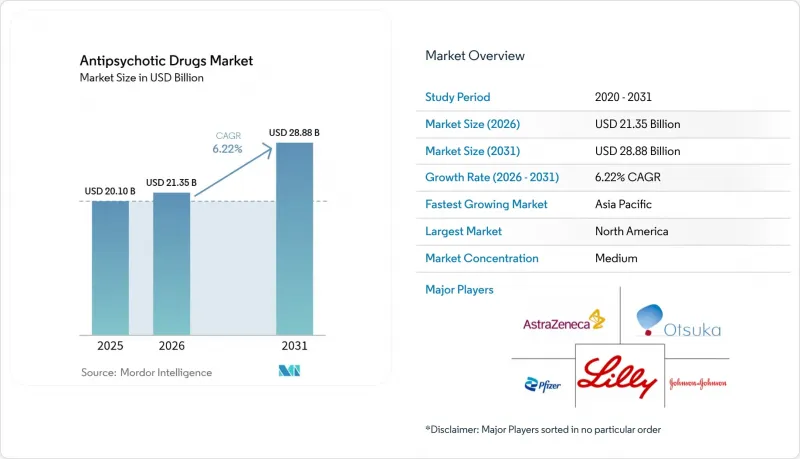
본 보고서는 약물 분류별(1세대, 2세대, 3세대), 적응증별(조현병, 양극성 장애, 주요 우울 장애 등), 투여 경로별(경구제 및 주사제), 지역별(북미, 유럽 등)로 분류되어 있습니다. 시장 예측은 금액(달러) 기준으로 제시되어 있습니다.
전 세계 항정신병 약물 시장 동향 및 인사이트
지역 정신건강 프로그램에서 LAI 채택 확대
장시간 작용형 주사용 항정신병 약물(LAI)은 경구 요법의 유효성을 저해하는 50%의 복약 순응도 격차를 메우고 있습니다. 『Journal of Clinical Psychopharmacology』 지에 실린 2024년 연구에 따르면, 30일 재입원율은 LAI가 1.9%인 반면 경구용 약물은 8.3%로, 조기 재입원이 77% 감소한 것으로 나타났습니다. 진단 후 12개월 이내에 LAI를 조기에 시작하면 응급실 이용이 감소하여 환자 1인당 연간 7,195달러의 의료비 절감으로 이어집니다. 이러한 연구 결과를 바탕으로 보험사들은 치료 알고리즘의 더 초기 단계에서 LAI 비용을 보상하기 시작했으며, 이에 따라 지역 클리닉에서의 LAI 보급이 가속화되고 있습니다.
조기 정신질환 개입 센터의 확대
‘협조형 전문 의료(Coordinated Specialty Care)’ 프로그램이 급속히 확대되고 있습니다. 전미정신질환연합(NAMI)의 추산에 따르면, 이 프로그램의 추가 확대를 통해 60만-80만 명의 환자가 추가로 혜택을 받게 되어, 10년 동안 1,150억-1,400억 달러의 의료비 절감 효과가 기대됩니다. 2024년 『JAMA Network Open』에 게재된 홍콩의 연구에서는 EASY Plus 모델의 도입과 26-44세 성인의 자해 발생 건수의 급격한 감소 사이의 연관성이 밝혀졌습니다. 이러한 센터에서는 유효성과 내약성의 균형이 잘 잡힌 신약이 우선적으로 채택되고 있어, 3세대 약물에 대한 수요를 뒷받침하고 있습니다.
주요 비정형 항정신병 약물의 특허 만료
주요 브랜드의 독점권 만료가 임박해 있습니다. 아빌리파이 메인테나(Abilify Maintena)의 특허가 2025년 6월에 만료됨에 따라, 해당 약물의 처방량 기준 44%가 위협받고 있습니다. 존슨앤드존슨의 인베가 서스테나(Invega Sustenna)는 2023년 미국에서 29억 달러의 매출을 기록했으나, 테바(Teva)와 비아트리스(Viatris)의 제네릭 의약품 출시가 임박해 있습니다. 가격 하락으로 인해 브랜드 의약품의 수익이 압박을 받고 있으며, 항정신병 약물 시장 전체의 이익률이 축소되고 있습니다.
부문 분석
2025년에는 비정형 제제가 항정신병 약물 시장에서 가장 큰 비중을 차지했으며, 폭넓은 적응증과 보험사 측의 높은 인지도에 힘입어 매출의 72.38%를 차지했습니다. 3세대 약물은 절대액으로는 작지만, 2031년까지의 연평균 성장률(CAGR)이 6.96%에 달하여 시장 전체를 상회하는 성장이 예상됩니다. 이러한 약물이 가진 도파민 부분 작용제로서의 작용과 무스카린 수용체에 대한 이중 작용으로 인해, 피라미드 외계 부위의 부작용이 경감된다는 명확한 장점이 임상의들의 신뢰를 높이고 있습니다. 브리스톨-마이어스 스퀴브사의 ‘코벤피’(자노메린·트로스피움)는 70년 만에 등장한 새로운 작용기전을 가진 약물로, 이러한 변화를 뒷받침하고 있습니다.
대사 프로파일의 개선과 지연성 운동장애의 위험 감소는 지불 주체에 대한 가치 제안을 강화하고 있습니다. 3세대 제품과 관련된 항정신병 약물 시장 규모는 롤페리돈 등 개발 중인 신약들이 승인을 향해 나아가면서 꾸준히 확대될 것으로 예측됩니다. 1세대 약물은 급성 흥분 상태나 의료 자원이 제한된 환경에서 여전히 유용하지만, 내약성에 대한 우려로 인해 그 시장 점유율은 해마다 감소하고 있습니다.
지역별 분석
북미는 2025년에 전 세계 매출의 39.22%를 차지할 것으로 예상되며, 이는 3세대 약물의 조기 도입과 메디케어 파트 D(cms.gov) 하에서 환자의 연간 본인 부담금을 2,000달러로 상한을 설정하는 지불자 개혁에 힘입은 것입니다. 무스카린 수용체 요법 및 2개월에 한 번 투여하면 되는 장기 작용형 주사제(LAI)에 대한 FDA의 승인이 임상 현장의 기대를 뒷받침하는 한편, 캐나다와 멕시코에서는 정신 건강에 대한 투자 정책을 통해 점진적인 성장이 예상됩니다.
아시아태평양은 2031년까지 연평균 성장률(CAGR)이 7.61%로 가장 빠르게 성장하는 지역입니다. 2024년, 중국의 국내 제약사가 중국에서 개발된 팔리페리돈 팔미테이트 LAI에 대해 미국에서 첫 승인을 획득하면서, 이 지역의 연구 개발 역량 부상이 주목받고 있습니다. 인도 및 동남아시아에서의 보험 적용 범위 확대와 낙인 해소 캠페인으로 인해 치료를 받는 환자 수가 증가하여 항정신병 약물 시장을 더욱 견인하고 있습니다.
유럽은 국민건강보험 제도와 실세계 데이터(REW)에 중점을 둔 규제 환경의 뒷받침을 받아 견실한 시장 점유율을 유지하고 있습니다. 2025년에 사춘기 조현병 치료제인 ‘Rxulti’가 승인됨에 따라 이 민감한 연령층에 대한 접근성이 확대되었습니다. 가격·수량 협정에 따라 정가 상승은 억제되고 있으나, 새로운 치료법의 보급이 이를 상쇄하며 꾸준한 가치 성장을 뒷받침하고 있습니다. 남미 및 중동 및 아프리카는 규모는 작지만, 각국 정부가 정신 건강 서비스를 국민 건강 보험 제도에 포함시키고 있어 과거 평균을 상회하는 성장이 예상됩니다.
기타 혜택:
- 엑셀 형식 시장 예측(ME) 시트
- 3개월간의 애널리스트 지원
자주 묻는 질문
목차
제1장 서론
제2장 조사 방법
제3장 주요 요약
제4장 시장 구도
제5장 시장 규모와 성장 예측
제6장 경쟁 구도
제7장 시장 기회와 향후 전망
LSH 26.08.25According to Mordor Intelligence, the antipsychotic drugs market size is expected to grow from USD 20.10 billion in 2025 to USD 21.35 billion in 2026 and is forecast to reach USD 28.88 billion by 2031 at 6.22% CAGR over 2026-2031.
This report is Segmented by Drug Class (First Generation, Second Generation, and Third Generation), Application (Schizophrenia, Bipolar Disorder, Major Depressive Disorder, and More), Route of Administration (Oral and Injectables), and Geography (North America, Europe, and More). The Market Forecasts are Provided in Terms of Value (USD).
Global Antipsychotic Drugs Market Trends and Insights
Rising LAI Adoption in Community Mental-Health Programs
Long-acting injectable antipsychotics are closing the 50% non-adherence gap that undermines oral therapy. A 2024 Journal of Clinical Psychopharmacology study reported 30-day readmission rates of 1.9% for LAIs versus 8.3% for oral drugs, translating to a 77% reduction in early rehospitalizations. Early initiation of LAIs within 12 months of diagnosis yields annual healthcare savings of USD 7,195 per patient by reducing emergency department utilization. These findings persuade payers to reimburse LAIs earlier in treatment algorithms, accelerating penetration across community clinics.
Expanding Early-Psychosis Intervention Centers
Coordinated Specialty Care programs are scaling rapidly. The National Alliance on Mental Illness estimates that broader roll-out could reach 600,000-800,000 additional patients and generate USD 115-140 billion in system savings over a decade . A 2024 Hong Kong study in JAMA Network Open linked implementation of the EASY Plus model to steep declines in self-harm episodes among adults aged 26-44 years. These centers favor newer agents with balanced efficacy and tolerability profiles, fuelling demand for third-generation options.
Patent Cliffs of Key Atypical Molecules
Major brands face imminent loss of exclusivity. Abilify Maintena's patent expiry in June 2025 threatens 44% of its prescription base. Johnson & Johnson's Invega Sustenna posted USD 2.9 billion in 2023 U.S. sales, yet generics from Teva and Viatris loom. Price erosion depresses branded revenue and compresses margins across the antipsychotic drugs market.
Other drivers and restraints analyzed in the detailed report include:
- Surge in Medicaid/Medicare Coverage for Third-Generation Agents
- Digital-Therapeutic Companion Apps Boosting Medication Adherence
- Addiction Caused Due to the Antipsychotic Drugs
For complete list of drivers and restraints, kindly check the Table Of Contents.
Segment Analysis
Atypical formulations generated the largest antipsychotic drugs market size in 2025, capturing 72.38% revenue on the back of broad indications and payer familiarity. Third-generation agents, though smaller in absolute dollars, are forecast to outpace the overall market with a 6.96% CAGR through 2031. Their dopamine-partial-agonist or dual muscarinic activity mitigates extrapyramidal side effects, a clear advantage that bolsters clinician confidence. Bristol Myers Squibb's Cobenfy (xanomeline-trospium), the first new mechanistic class in 70 years, underscores this pivot.
Improved metabolic profiles and reduced tardive-dyskinesia risk strengthen payer value propositions. The antipsychotic drugs market size attached to third-generation products is predicted to expand steadily as pipeline entrants such as roluperidone advance toward possible approval. First-generation agents remain useful in acute agitation and resource-strained settings, yet their share declines annually due to tolerability concerns.
Complete Report Scope:
- By Drug Class
- Typical (First-Generation) Antipsychotics
- Atypical (Second-Generation) Antipsychotics
- Dopamine Partial Agonists (Third-Generation)
- By Therapeutic Application
- Schizophrenia
- Bipolar Disorder
- Major Depressive Disorder
- Dementia-Related Psychosis
- Others
- By Route of Administration
- Oral
- Injectables
- Long-Acting Injectables (LAIs)
- Short-Acting Injectables
- By Geography
- North America
- United States
- Canada
- Mexico
- Europe
- Germany
- United Kingdom
- France
- Italy
- Spain
- Rest of Europe
- Asia-Pacific
- China
- Japan
- India
- Australia
- South Korea
- Rest of Asia-Pacific
- Middle East & Africa
- GCC
- South Africa
- Rest of Middle East & Africa
- South America
- Brazil
- Argentina
- Rest of South America
- North America
Geography Analysis
North America generated 39.22% of global revenue in 2025, buoyed by early adoption of third-generation agents and payer reforms that cap annual patient out-of-pocket spend at USD 2,000 under Medicare Part D cms.gov. FDA approvals for muscarinic-receptor therapies and once-bimonthly LAIs sustain clinical enthusiasm, while Canada and Mexico add incremental growth through mental-health investment schemes.
Asia-Pacific is the fastest-growing territory at a 7.61% CAGR through 2031. China's domestic innovators secured the first U.S. nod for a Chinese-developed paliperidone palmitate LAI in 2024, spotlighting the region's research ascent. Improved insurance penetration and destigmatization campaigns in India and Southeast Asia enlarge the treated population, further propelling the antipsychotic drugs market.
Europe retains solid share anchored by universal health coverage and a regulatory focus on real-world evidence. The 2025 approval of Rxulti for adolescent schizophrenia widens access in a sensitive demographic. Price-volume agreements temper list-price inflation, yet offsetting uptake of novel therapies supports steady value growth. South America and the Middle East & Africa, though smaller, are forecast to out-perform historic averages as governments integrate mental-health services into national benefit packages.
- Eli Lilly and Company
- AstraZeneca
- Johnson & Johnson
- Abbott Laboratories
- Pfizer
- Nova Biomedical
- Otsuka
- Luye Pharma
- Nihon Kohden
- Bristol-Myers Squibb
- Grifols
- Arkray
- Acadia Pharmaceuticals
- Convergent Technologies
- EKF Diagnostics
- PHC Holdings (Ascensia)
- WerfenLife Diagnostics China
- Edan Instruments
- Sphere Medical
- Brolis Sensor Technology
Additional Benefits:
- The market estimate (ME) sheet in Excel format
- 3 months of analyst support
TABLE OF CONTENTS
1 Introduction
- 1.1 Study Assumptions & Market Definition
- 1.2 Scope of the Study
2 Research Methodology
3 Executive Summary
4 Market Landscape
- 4.1 Market Overview
- 4.2 Market Drivers
- 4.2.1 Rising LAI Adoption in Community Mental-Health Programs
- 4.2.2 Expanding Early-Psychosis Intervention Centers
- 4.2.3 Surge in Medicaid/Medicare Coverage for Third-Generation Agents
- 4.2.4 Increasing Focus of Governments and Health Care Organizations on Mental Health
- 4.2.5 Digital-Therapeutic Companion Apps Boosting Medication Adherence
- 4.2.6 Robust R&D Pipeline and FDA Approvals for Novel Formulations
- 4.3 Market Restraints
- 4.3.1 Patent Cliffs of Key Atypical Molecules
- 4.3.2 Addiction Caused Due to the Antipsychotic Drugs
- 4.3.3 Black-Box Warnings Limiting Pediatric Prescriptions
- 4.3.4 Price-Control Expansion Under China's NRDL
- 4.4 Technological Outlook
- 4.5 Porter's Five Forces Analysis
- 4.5.1 Bargaining Power of Suppliers
- 4.5.2 Bargaining Power of Buyers
- 4.5.3 Threat of New Entrants
- 4.5.4 Threat of Substitutes
- 4.5.5 Intensity of Competitive Rivalry
5 Market Size & Growth Forecasts (Value in USD)
- 5.1 By Drug Class
- 5.1.1 Typical (First-Generation) Antipsychotics
- 5.1.2 Atypical (Second-Generation) Antipsychotics
- 5.1.3 Dopamine Partial Agonists (Third-Generation)
- 5.2 By Therapeutic Application
- 5.2.1 Schizophrenia
- 5.2.2 Bipolar Disorder
- 5.2.3 Major Depressive Disorder
- 5.2.4 Dementia-Related Psychosis
- 5.2.5 Others
- 5.3 By Route of Administration
- 5.3.1 Oral
- 5.3.2 Injectables
- 5.3.2.1 Long-Acting Injectables (LAIs)
- 5.3.2.2 Short-Acting Injectables
- 5.4 By Geography
- 5.4.1 North America
- 5.4.1.1 United States
- 5.4.1.2 Canada
- 5.4.1.3 Mexico
- 5.4.2 Europe
- 5.4.2.1 Germany
- 5.4.2.2 United Kingdom
- 5.4.2.3 France
- 5.4.2.4 Italy
- 5.4.2.5 Spain
- 5.4.2.6 Rest of Europe
- 5.4.3 Asia-Pacific
- 5.4.3.1 China
- 5.4.3.2 Japan
- 5.4.3.3 India
- 5.4.3.4 Australia
- 5.4.3.5 South Korea
- 5.4.3.6 Rest of Asia-Pacific
- 5.4.4 Middle East & Africa
- 5.4.4.1 GCC
- 5.4.4.2 South Africa
- 5.4.4.3 Rest of Middle East & Africa
- 5.4.5 South America
- 5.4.5.1 Brazil
- 5.4.5.2 Argentina
- 5.4.5.3 Rest of South America
- 5.4.1 North America
6 Competitive Landscape
- 6.1 Market Concentration
- 6.2 Strategic Moves
- 6.3 Market Share Analysis
- 6.4 Company Profiles (includes Global level Overview, Market Level Overview, Core Segments, Financials as Available, Strategic Information, Market Rank/Share for Key Companies, Products & Services, and Recent Developments)
- 6.4.1 Eli Lily and Company
- 6.4.2 AstraZeneca plc
- 6.4.3 Johnson and Johnson
- 6.4.4 Abbott Laboratories
- 6.4.5 Pfizer Inc.
- 6.4.6 Nova Biomedical
- 6.4.7 Otsuka Pharmaceutical Co, Ltd.
- 6.4.8 Luye Pharma
- 6.4.9 Nihon Kohden
- 6.4.10 Bristol Myers Squibb
- 6.4.11 Grifols
- 6.4.12 ARKRAY Inc.
- 6.4.13 Acadia Pharmaceuticals
- 6.4.14 Convergent Technologies
- 6.4.15 EKF Diagnostics
- 6.4.16 PHC Holdings (Ascensia)
- 6.4.17 WerfenLife Diagnostics China
- 6.4.18 Edan Instruments
- 6.4.19 Sphere Medical
- 6.4.20 Brolis Sensor Technology
7 Market Opportunities & Future Outlook
- 7.1 White-space & Unmet-need Assessment