
|
시장보고서
상품코드
2114079
빅데이터 보안 : 시장 점유율 분석, 업계 동향 및 통계, 성장 예측(2026-2031년)Big Data Security - Market Share Analysis, Industry Trends & Statistics, Growth Forecasts (2026 - 2031) |
||||||
 Mordor Intelligence
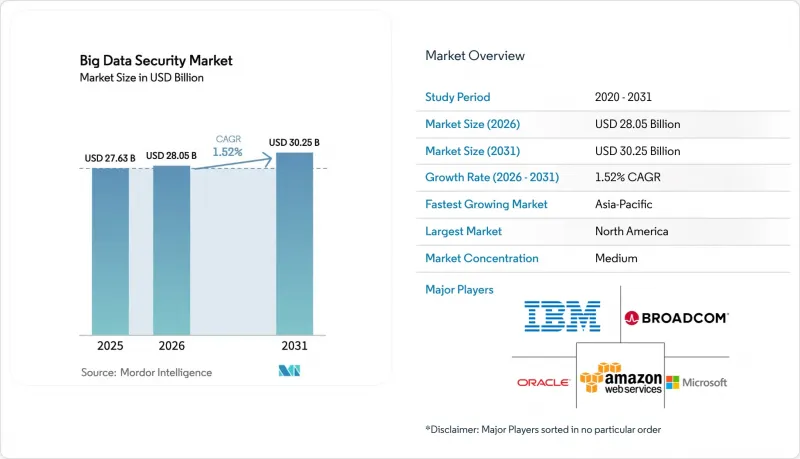
Mordor Intelligence에 의하면, 빅데이터 보안 시장 규모는 2025년 276억 3,000만 달러에서 2026년에는 280억 5,000만 달러에 이르고, 2026-2031년 CAGR 1.52%로 성장을 지속하여 2031년에는 302억 5,000만 달러에 달할 것으로 예측됩니다.
본 보고서는 구성 요소(솔루션 및 서비스), 기업 규모(중소기업 및 대기업), 최종 사용자 산업(은행 및 금융 서비스·보험 (BFSI), IT 및 통신, 제조, 헬스케어 및 생명과학, 항공우주 및 방위 등), 도입 형태(On-Premise 및 클라우드), 그리고 지역별로 분류되어 있습니다.
세계 빅데이터 보안 시장 동향 및 인사이트
AI를 활용한 공격으로 인해 기업의 보안 예산 재분배가 진행되고 있습니다.
랜섬웨어 그룹은 현재 생성형 AI를 악용하여 기존 방어 체계를 우회하는 신속한 인증 정보 탈취 및 사회공학적 공격을 전개하고 있습니다. 대규모 사고 발생 시, 제조업의 가동 중단으로 인한 손실은 1분당 2만 2,000달러를 초과하며, 이에 따라 이사회는 보안 예산을 기존 배분액보다 대폭 상향 조정하고 있습니다. 2024년, 산업 분야의 데이터 유출로 인한 비용은 556만 달러에 달하고, 일반 IT 지출 증가율을 상회하며, 횡방향 이동을 감지하는 실시간 분석에 대한 수요를 촉진하고 있습니다. 금융 기관들은 IT 지출의 불과 13%만이 방어에 할당되어 있는 현 상황에서는 자금이 부족하다고 인정하고 있으며, 전문가들은 공격자의 자동화에 대응하기 위해 이 비율을 20%로 높일 것을 요구하고 있습니다. 전체 중요 인프라에서 AI를 활용한 보안 운영 센터(SOC)는 수동 트리아지를 머신러닝을 통한 상관 분석으로 대체함으로써 사고 해결 속도가 30% 향상되었다고 보고되고 있습니다. 그 결과, 기업들이 자금 배분 우선순위를 재검토함에 따라 빅데이터 보안 시장에서는 매출의 지속적인 확대가 예상됩니다.
GDPR(EU 개인정보보호규정) 및 각국의 데이터 보호법에 따라 페타바이트 규모의 규정 준수 인프라가 의무화되고 있습니다.
유럽의 GDPR(EU 개인정보보호규정), 캘리포니아주의 CCPA, 그리고 아시아태평양의 유사한 법규에 따라, 점점 더 대규모화되는 데이터 세트 전체에 걸친 암호화, 마스킹, 감사 추적이 의무화되고 있습니다. 중국의 ‘2025년 계획’ 강화 조치에서는 금융 및 보험사에 대한 실시간 규정 준수 감사가 추가되었으며, 관리 체제의 미비에 대한 처벌이 엄격해졌습니다. 유럽의 조직들은 NIS2 지침에 따라 정보 보안 예산을 IT 총지출의 9%까지 늘렸지만, 2025년 지역 평균 데이터 침해로 인한 비용은 440만 유로에 달했습니다. 미국에서는 보건복지부가 2026 회계연도 계획에서 업계 전반의 사이버 보안 조정을 위해 1억 달러의 예산을 제안했습니다. 규정 준수가 정책 수준에서 기술적 이행으로 전환됨에 따라, 빅데이터 보안 시장의 주요 수익원인 확장 가능한 암호화, 토큰화 및 불변 로그 기록에 대한 수요가 증가하고 있습니다.
사이버 보안 인력 부족이 시장 성장을 저해하고 있습니다.
EU 기관의 32%가 사이버 보안 필수 직무를 충원하지 못해, 관리형 보안 서비스 제공업체에 대한 의존도가 높아지고 있습니다. 일본의 통신 사업자는 Cloudflare와 제휴하여 중소기업의 인력 부족을 보완하는 턴키 방식의 제로 트러스트 서비스를 제공합니다. 마이크로소프트의 ‘Secure Future Initiative’는 3만 4,000명의 엔지니어를 AI 기반 자동화에 투입하여 사고 대응 능력을 30% 향상시켰으며, 이는 하이퍼스케일러가 전문 지식 부족을 어떻게 보완하고 있는지를 보여줍니다. 자동화를 통해 업무 부담은 줄어들지만, 만성적인 인력 부족이 도입을 지연시켜 빅데이터 보안 시장의 단기적인 성장을 제한하고 있습니다.
부문 분석
솔루션 부문은 암호화, 토큰화 및 SIEM 제품군에 대한 견조한 수요에 힘입어 2025년 매출의 62.35%를 차지했습니다. 한편, 서비스 부문은 조직이 연중무휴 24시간 모니터링 및 규정 준수 통합을 외부에 위탁하는 추세에 따라 연평균 성장률(CAGR) 18.72%를 나타낼 것으로 예측됩니다. 인력 부족과 플랫폼의 복잡성으로 인해 기업들은 관리형 감지 및 대응(MDR), 컨설팅 및 통합 계약으로 눈을 돌리고 있습니다. 벤더들은 이러한 서비스를 클라우드 구독과 번들로 제공함으로써 예측 가능한 운영 비용(OpEx)과 신속한 도입 주기를 실현하고 있습니다. 그 결과, 빅데이터 보안 시장은 예측 기간 동안 서비스 주도형 가치 창출을 지속적으로 반영할 것입니다.
관리형 보안 서비스가 가장 큰 성장세를 보이는 한편, 기업들이 클라우드 기반 위에서 데이터 레이크를 재구축함에 따라 자문 및 통합 프로젝트가 급증하고 있습니다. 솔루션 분야에서는 규제 요건의 영향으로 데이터 암호화 및 토큰화 소프트웨어가 계속해서 판매량의 견인차 역할을 하고 있습니다. SIEM 플랫폼은 알림 피로를 완화하는 AI 추론 기능과 함께 진화하고 있으며, IAM 업그레이드가 제로 트러스트 도입의 기반이 되고 있습니다. 플랫폼 기능의 융합은 각 기업이 엔드투엔드 제어 지점을 추구하는 가운데, 빅데이터 보안 시장에서 통합이 진행되고 있음을 보여줍니다.
2025년에는 다지역에 걸친 사업 전개와 엄격한 규정 준수 의무를 배경으로 대기업이 매출의 68.75%를 차지하며 시장을 독점했습니다. 그러나 중소기업(SME)은 연평균 성장률(CAGR) 19.55%를 나타낼 것으로 예측되어, 진입 장벽을 낮추는 클라우드 구독 모델의 중요성이 부각되고 있습니다. 각 하이퍼스케일러 기업들은 현재 엔터프라이즈급 암호화, 키 관리, 행동 분석을 기본 플랜에 포함시키고 있어, 자원이 제한된 기업도 과거에는 포춘 500대 기업에만 국한되었던 기능을 이용할 수 있게 되었습니다. 이러한 변화로 고객 기반이 확대되면서 빅데이터 보안 시장은 두 자릿수 성장을 지속하고 있습니다.
대기업의 경우, 고도화된 분석, 동형 암호화의 시범 도입, 그리고 페타바이트 규모의 로그를 분석하는 AI 기반 SOC에 대한 투자가 주를 이루고 있습니다. 일부 조직에서는 1,000명이 넘는 보안 전문가로 구성된 팀을 운영하고 있어, 사내 전문 지식의 깊이가 두드러집니다. 대조적으로, 중소기업은 복잡한 업무를 대행해 주는 턴키 방식의 관리형 서비스를 중시하고 있습니다. 빅데이터 보안 산업이 성숙해짐에 따라, 이 부문에 맞추어 가격 책정 및 자동화 기능을 최적화하는 벤더는 시장에서 큰 점유율을 확보할 것으로 전망됩니다.
지역별 분석
북미는 제로 트러스트의 조기 도입, 탄탄한 벤더 생태계, 그리고 성숙한 정보 유출 통지법의 혜택을 받아 2025년 매출의 40.95%를 차지했습니다. 대기업의 초기 클라우드 전환이 완료됨에 따라 성장은 둔화되고 있지만, 지속적인 AI 보안 시범 도입이 지출의 모멘텀을 유지하고 있습니다. 유럽은 GDPR(EU 개인정보보호규정) 시행과 NIS2 지침의 후원을 받아 정보 보안에 대한 예산 배분이 현재 전체 IT 예산의 9%를 차지하며, 북미에 이어 두 번째로 높은 성장세를 보이고 있습니다. 경제적 역풍이 재량적 IT 프로젝트에 큰 부담으로 작용하고 있음에도 불구하고, 규제의 명확성이 수요를 뒷받침하고 있습니다.
아시아태평양은 2031년까지 연평균 성장률(CAGR)이 20.15%를 나타낼 것으로 예측되며, 이는 주권 클라우드에 대한 투자와 국산 기술 채택 의무화를 반영한 것입니다. AWS가 2027년까지 일본 리전을 확장하기 위해 2조 2,600억 엔(153억 달러)을 투자하겠다고 약속한 것은 이 회사의 하이퍼스케일 추진 의지를 여실히 보여줍니다. 한편, Oracle은 경제 안보 지침을 충족하기 위해 별도로 80억 달러를 투자해 현지 데이터센터를 구축할 계획입니다. 중국의 정보 보안 시장은 정부 기관이 국산 도구를 우선적으로 채택하는 추세를 배경으로 2027년까지 37조 위안에 달할 가능성이 있습니다. 이 지역 각국 정부는 보안 제품 채택을 촉진하기 위해 현지 데이터 처리를 장려하고 있으며, 이는 신흥 경제국 내 빅데이터 보안 시장 규모를 확대시키고 있습니다.
중동 및 아프리카, 라틴아메리카는 시장 규모는 작지만, 클라우드 보급이 진전되고 금융 부문의 현대화 정책이 추진됨에 따라 도입이 확대되고 있습니다. 걸프협력회의(GCC) 회원국들은 ‘비전 2030’의 과제와 관련된 새로운 사이버 규제를 제정하고 있으며, 브라질의 LGPD(개인정보보호법)는 주변 국가들의 법 제정을 촉진하고 있습니다. 인프라 격차가 성장을 저해하고 있지만, 디지털 뱅킹 보급률 상승으로 잠재적 수요가 발생하고 있으며, 연결 환경 개선에 따라 빅데이터 보안 시장은 이러한 수요를 흡수할 수 있을 것입니다.
기타 혜택:
- 엑셀 형식 시장 예측(ME) 시트
- 3개월간의 애널리스트 지원
자주 묻는 질문
목차
제1장 서론
제2장 조사 방법
제3장 주요 요약
제4장 시장 구도
제5장 시장 규모와 성장 예측
제6장 경쟁 구도
제7장 시장 기회와 향후 전망
LSH 26.08.25According to Mordor Intelligence, the big data security market size market is expected to grow from USD 27.63 billion in 2025 to USD 28.05 billion in 2026 and is forecast to reach USD 30.25 billion by 2031 at 1.52% CAGR over 2026-2031.
This report is Segmented by Component (Solutions and Services), Organization Size (Small and Medium Enterprises and Large Enterprises), End-User Industry (Banking, Financial Services, and Insurance [BFSI], IT and Telecommunication, Manufacturing, Healthcare and Life Sciences, Aerospace and Defense, and More), Deployment Mode (On-Premise and Cloud), and Geography.
Global Big Data Security Market Trends and Insights
AI-enabled breaches drive enterprise security budget reallocations
Ransomware groups now weaponize generative AI for rapid credential theft and social-engineering campaigns that bypass legacy defenses. Manufacturing downtime has surpassed USD 22,000 per minute during major incidents, prompting boards to lift security budgets well above prior allocations. Data-breach costs in industrial domains climbed to USD 5.56 million in 2024, eclipsing general IT-spending growth and fueling demand for real-time analytics that detect lateral movement. Financial institutions concede that current allocations of only 13% of IT spend underfund defenses, with experts urging a shift toward 20% to keep pace with attacker automation. Across critical infrastructure, AI-powered security operations centers report 30% faster incident resolution once machine-learning correlation replaces manual triage. The result is sustained top-line expansion for the big data security market as enterprises reprioritize funding.
GDPR and national data laws mandate petabyte-scale compliance infrastructure
Europe's GDPR, California's CCPA, and similar statutes in Asia Pacific now obligate encryption, masking, and audit trails across ever-larger datasets. China's 2025 enhancements add real-time compliance audits for finance and insurance firms, tightening penalties for lax controls. European organizations have raised information-security budgets to 9% of total IT outlays under the NIS2 Directive, while average regional breach costs reached EUR 4.4 million in 2025. In the United States, the Department of Health and Human Services proposed USD 100 million for sector-wide cybersecurity coordination in its FY 2026 plan. As compliance moves from policy to technical enforcement, demand increases for scalable encryption, tokenization, and immutable logging key revenue streams within the big data security market.
Cybersecurity talent shortage constrains market growth
Thirty-two percent of EU organizations cannot fill essential cybersecurity roles, driving reliance on managed security service providers. Japan's operators collaborate with Cloudflare to supply turnkey zero-trust services that offset staffing gaps for SMEs. Microsoft's Secure Future Initiative applies 34,000 engineers to AI-driven automation, improving incident response by 30% and showcasing how hyperscalers compensate for scarce expertise. Although automation eases workloads, chronic shortages slow deployment and limit the near-term scale-up of the big data security market.
Other drivers and restraints analyzed in the detailed report include:
- Cloud data lakes accelerate zero-trust architecture adoption
- LLM training in data protection becomes a strategic imperative
- Tool-orchestration complexity strains enterprise budgets
For complete list of drivers and restraints, kindly check the Table Of Contents.
Segment Analysis
Solutions held 62.35% of 2025 revenue, driven by robust demand for encryption, tokenization, and SIEM suites. At the same time, Services is set to grow at 18.72% CAGR as organizations outsource 24/7 monitoring and compliance integration. Talent scarcity and platform complexity push enterprises toward managed detection and response, consulting, and integration contracts. Vendors bundle these offerings with cloud subscriptions, enabling predictable OpEx and faster implementation cycles. As a result, the big data security market will continue to reflect service-led value creation throughout the forecast period.
Managed Security Services show the highest traction, while Advisory and Integration engagements surge as firms re-architect data lakes on cloud foundations. Data encryption and tokenization software remains the volume driver within Solutions, propelled by regulatory mandates. SIEM platforms evolve with AI inference that reduces alert fatigue, and IAM upgrades underpin zero-trust rollouts. The convergence of platform features signals ongoing consolidation in the big data security market as players chase end-to-end control points.
Large Enterprises dominated in 2025 with 68.75% revenue, reflecting multi-region operations and stringent compliance obligations. Yet SMEs are forecast to post a 19.55% CAGR, highlighting cloud subscription models that lower entry barriers. Hyperscalers now embed enterprise-grade encryption, key management, and behavior analytics into baseline plans, letting resource-constrained firms access capabilities once exclusive to Fortune 500 peers. This shift broadens the customer base, sustaining double-digit expansion in the big data security market.
For large organizations, investments focus on advanced analytics, homomorphic encryption pilots, and AI-powered SOCs that mine petabyte-scale logs. Some institutions maintain teams exceeding 1,000 security specialists, underscoring the depth of in-house expertise. SMEs, by contrast, emphasize turnkey managed services that offload complexity. Vendors tailoring price points and automation to this segment stand to capture an outsized share as the big data security industry matures.
Complete Report Scope:
- By Component
- Solutions
- Data Encryption and Tokenization
- Security Intelligence/SIEM
- IAM and PAM
- Intrusion Detection/Prevention
- Data Masking and Obfuscation
- Services
- Consulting and Integration
- Managed Security Services
- Training and Support
- Solutions
- By Organization Size
- Small and Medium Enterprises
- Large Enterprises
- By End-user Industry
- Banking, Financial Services and Insurance (BFSI)
- IT and Telecommunication
- Manufacturing
- Healthcare and Life Sciences
- Aerospace and Defense
- Government and Public Sector
- Retail and E-commerce
- By Deployment Mode
- On-premise
- Cloud
- By Geography
- North America
- United States
- Canada
- South America
- Brazil
- Mexico
- Rest of South America
- Europe
- United Kingdom
- Germany
- France
- Russia
- Rest of Europe
- Asia-Pacific
- China
- India
- Japan
- Rest of Asia-Pacific
- Middle East
- Saudi Arabia
- United Arab Emirates
- Turkey
- Rest of Middle East
- Africa
- South Africa
- Nigeria
- Rest of Africa
- North America
Geography Analysis
North America held 40.95% of 2025 revenue, benefiting from early zero-trust adoption, a dense vendor ecosystem, and mature breach-notification laws. Growth moderates as large enterprises complete initial cloud migrations, yet ongoing AI-security pilots maintain spending momentum. Europe follows, propelled by GDPR enforcement and the NIS2 Directive, with information-security allocations now 9% of total IT budgets. Regulatory certainty fuels demand even as economic headwinds weigh on discretionary IT projects.
Asia Pacific is forecast for a 20.15% CAGR through 2031, reflecting sovereign-cloud investments and domestic-technology mandates. AWS's pledge of 2.26 trillion yen (USD 15.3 billion) to expand Japanese regions by 2027 exemplifies its hyperscale commitment. Oracle separately plans USD 8 billion in local data centers to meet economic-security guidelines. China's information-security market could hit 37 trillion yuan by 2027 as state bodies prioritize indigenous tooling. Governments across the region encourage local data processing to spur security product adoption, enlarging the big data security market size in emerging economies.
The Middle East, Africa, and Latin America represent smaller bases but show rising adoption as cloud coverage widens and financial-sector modernization policies advance. Gulf Cooperation Council states issue new cyber regulations tied to Vision 2030 agendas, while Brazil's LGPD inspires neighbouring countries to legislate. Although infrastructure gaps temper growth, rising digital-banking penetration creates latent demand that the big data security market can tap as connectivity improves.
- Amazon Web Services
- Broadcom (Symantec)
- Check Point Software Technologies
- Cisco Systems
- Cloudera
- CrowdStrike
- Dell Technologies
- Elastic NV
- Fortinet
- Google Cloud (Alphabet)
- Hewlett Packard Enterprise
- IBM Corporation
- Imperva
- McAfee
- Microsoft Corporation
- Oracle Corporation
- Palo Alto Networks
- RSA Security
- Snowflake Inc.
- Splunk Inc.
- Talend SA
- Thales Group
Additional Benefits:
- The market estimate (ME) sheet in Excel format
- 3 months of analyst support
TABLE OF CONTENTS
1 Introduction
- 1.1 Study Assumptions and Market Definition
- 1.2 Scope of the Study
2 RESEARCH METHODOLOGY
3 EXECUTIVE SUMMARY
4 MARKET LANDSCAPE
- 4.1 Market Overview
- 4.2 Market Drivers
- 4.2.1 Surging IoT, mobile and cloud logs overwhelm legacy controls, driving next-gen data-centric security adoption
- 4.2.2 AI-enabled breaches, double-extortion ransomware and supply-chain attacks force bigger budgets for big-data security analytics
- 4.2.3 GDPR, CCPA, PDPA and dozens of new national laws mandate encryption, masking and audit trails at petabyte scale
- 4.2.4 Shift of data lakes to public cloud accelerates demand for cloud-native security, zero-trust and shared-responsibility tooling
- 4.2.5 Enterprises scramble to secure massive proprietary datasets used for LLM training to avoid model leakage and IP loss
- 4.2.6 Retail-media, healthcare and ad-tech firms require encryption-in-use to share insights without exposing raw data
- 4.3 Market Restraints
- 4.3.1 Scarcity of data-security engineers and data scientists inflates project timelines and MSSP costs
- 4.3.2 Orchestrating encryption, SIEM, IAM and data-governance tools across hybrid estates strains CapEx/OpEx budgets
- 4.3.3 Divergent residency laws (e.g., China CSL, Russia FZ-242) block unified global security architectures
- 4.3.4 Federated learning and homomorphic encryption reduce need for centralized data stores, tempering spend on classic big-data security stacks
- 4.4 Value/Supply-Chain Analysis
- 4.5 Regulatory Landscape
- 4.6 Technological Outlook
- 4.7 Porter's Five Forces Analysis
- 4.7.1 Bargaining Power of Buyers
- 4.7.2 Bargaining Power of Suppliers
- 4.7.3 Threat of New Entrants
- 4.7.4 Threat of Substitutes
- 4.7.5 Intensity of Competitive Rivalry
- 4.8 Impact of COVID-19 and Geopolitical Events
5 Market Size and Growth Forecasts (Value)
- 5.1 By Component
- 5.1.1 Solutions
- 5.1.1.1 Data Encryption and Tokenization
- 5.1.1.2 Security Intelligence/SIEM
- 5.1.1.3 IAM and PAM
- 5.1.1.4 Intrusion Detection/Prevention
- 5.1.1.5 Data Masking and Obfuscation
- 5.1.2 Services
- 5.1.2.1 Consulting and Integration
- 5.1.2.2 Managed Security Services
- 5.1.2.3 Training and Support
- 5.1.1 Solutions
- 5.2 By Organization Size
- 5.2.1 Small and Medium Enterprises
- 5.2.2 Large Enterprises
- 5.3 By End-user Industry
- 5.3.1 Banking, Financial Services and Insurance (BFSI)
- 5.3.2 IT and Telecommunication
- 5.3.3 Manufacturing
- 5.3.4 Healthcare and Life Sciences
- 5.3.5 Aerospace and Defense
- 5.3.6 Government and Public Sector
- 5.3.7 Retail and E-commerce
- 5.4 By Deployment Mode
- 5.4.1 On-premise
- 5.4.2 Cloud
- 5.5 By Geography
- 5.5.1 North America
- 5.5.1.1 United States
- 5.5.1.2 Canada
- 5.5.2 South America
- 5.5.2.1 Brazil
- 5.5.2.2 Mexico
- 5.5.2.3 Rest of South America
- 5.5.3 Europe
- 5.5.3.1 United Kingdom
- 5.5.3.2 Germany
- 5.5.3.3 France
- 5.5.3.4 Russia
- 5.5.3.5 Rest of Europe
- 5.5.4 Asia-Pacific
- 5.5.4.1 China
- 5.5.4.2 India
- 5.5.4.3 Japan
- 5.5.4.4 Rest of Asia-Pacific
- 5.5.5 Middle East
- 5.5.5.1 Saudi Arabia
- 5.5.5.2 United Arab Emirates
- 5.5.5.3 Turkey
- 5.5.5.4 Rest of Middle East
- 5.5.6 Africa
- 5.5.6.1 South Africa
- 5.5.6.2 Nigeria
- 5.5.6.3 Rest of Africa
- 5.5.1 North America
6 COMPETITIVE LANDSCAPE
- 6.1 Market Concentration
- 6.2 Strategic Moves
- 6.3 Market Share Analysis
- 6.4 Company Profiles (includes Global level Overview, Market level overview, Core Segments, Financials as available, Strategic Information, Market Rank/Share, Products and Services, Recent Developments)
- 6.4.1 Amazon Web Services
- 6.4.2 Broadcom (Symantec)
- 6.4.3 Check Point Software Technologies
- 6.4.4 Cisco Systems
- 6.4.5 Cloudera
- 6.4.6 CrowdStrike
- 6.4.7 Dell Technologies
- 6.4.8 Elastic NV
- 6.4.9 Fortinet
- 6.4.10 Google Cloud (Alphabet)
- 6.4.11 Hewlett Packard Enterprise
- 6.4.12 IBM Corporation
- 6.4.13 Imperva
- 6.4.14 McAfee
- 6.4.15 Microsoft Corporation
- 6.4.16 Oracle Corporation
- 6.4.17 Palo Alto Networks
- 6.4.18 RSA Security
- 6.4.19 Snowflake Inc.
- 6.4.20 Splunk Inc.
- 6.4.21 Talend SA
- 6.4.22 Thales Group
7 MARKET OPPORTUNITIES AND FUTURE OUTLOOK
- 7.1 White-space and Unmet-need Assessment