|
시장보고서
상품코드
2114111
에틸렌 테트라플루오로에틸렌(ETFE) 시장 : 시장 점유율 분석, 업계 동향 및 통계, 성장 예측(2026-2031년)Ethylene Tetrafluoroethylene (ETFE) - Market Share Analysis, Industry Trends & Statistics, Growth Forecasts (2026 - 2031) |
||||||
 Mordor Intelligence
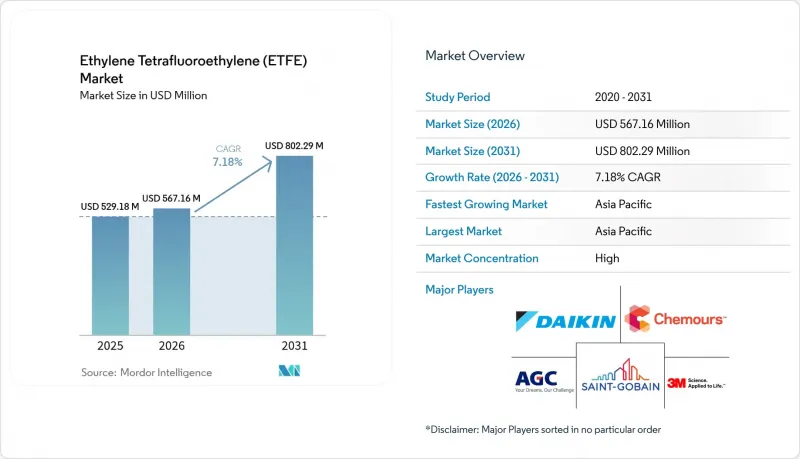
Mordor Intelligence에 의하면, 에틸렌 테트라플루오로에틸렌 시장 규모는 2025년에 5억 2,918만 달러로 평가되었고, 2026년 5억 6,716만 달러에서 2031년까지 8억 229만 달러에 이를 것으로 예측되며, 예측 기간(2026-2031년) 7.18%의 연평균 복합 성장률(CAGR)로 성장할 것으로 추정되고 있습니다.
본 보고서는 기술별(압출 성형 및 사출 성형), 제품 유형별(분말, 과립 등),용도별(코팅, 튜브 등), 최종 이용 산업별(항공우주 및 방위, 태양광 발전 등), 지역별(아시아태평양, 북미, 유럽, 남미, 중동 및 아프리카)로 분류되어 있습니다. 시장 예측은 금액(달러) 기준으로 제시되어 있습니다.
세계의 에틸렌 테트라플루오로에틸렌(ETFE) 시장 동향 및 인사이트
경기장형 구조물의 지붕재로 인기가 높아지고 있습니다.
경기장 설계자들은 기존 유리 캐노피에 수반되는 구조적 하중 부담을 해소하면서도 자연 채광을 실현할 수 있다는 점 때문에 ETFE 지붕 시스템을 점점 더 많이 채택하고 있습니다. 인튜이트 돔(Intuit Dome)의 277,000제곱피트 규모의 다이아그리드 지붕 구조에는 투명한 ETFE 막이 채택되어 있으며, 자연스러운 공기 흐름을 가능하게 함으로써 특정 구역에서는 공조 설비의 필요성을 없애고, 에너지 및 환경 설계 리더십(LEED) 플래티넘 인증을 획득했습니다. 이 소재의 자기 소화성은 그동안 수용 인원이 많은 시설에서 막 구조의 채택을 제한해 온 화재 안전상의 우려를 해소합니다. 기능성 외에도 ETFE는 햇빛을 산란시키는 특성이 있어, 95%의 채광률을 유지하면서도 온실 효과를 방지함으로써 기존 지붕 자재로는 실현할 수 없는 최적의 경기 환경을 조성합니다. 시설 운영자들이 ETFE의 장기적인 비용 측면에서의 우위를 인식함에 따라 이러한 추세는 가속화되고 있습니다. 유지보수는 2-3년마다 청소만으로도 충분한 반면, 유리 패널은 빈번한 교체가 필요하기 때문입니다.
항공우주 분야 배선에서 에틸렌 테트라플루오로에틸렌(ETFE) 케이블 수요 증가
항공우주 제조업체들은 기존의 절연재를 열화시키는 극심한 온도 변화나 화학 물질에 대한 노출을 견딜 수 있는 ETFE 케이블의 채택을 확대되고 있습니다. 『2025년 항공우주 및 방위 산업 전망』에 따르면, 전 세계 항공 여객 수송량은 11.6% 증가하고 방위비는 2조 4,000억 달러를 넘어설 것으로 예측되어, 고성능 배선 솔루션에 대한 지속적인 수요가 발생하고 있습니다. ETFE의 작동유 내성과 열적 안정성은 차세대 항공기 시스템, 특히 경량화가 극히 중요한 전기 수직 이착륙기(eVTOL)에서 필수적인 요소로 자리 잡고 있습니다. ETFE 케이블은 전투기나 우주선의 열 제어와 관련된 엄격한 사양을 충족하고 있어, 군사 용도가 프리미엄 가격의 원동력이 되고 있습니다. 항공기 아키텍처가 점점 더 전동화로 전환됨에 따라, ETFE의 역할은 기존의 배선을 넘어 전력 관리 시스템으로 확대되고 있으며, 그 열적 안정성 덕분에 절연재의 손상을 초래하지 않으면서 더 높은 전류 밀도를 실현하고 있습니다.
환경 문제와 퍼플루오로알킬 물질(PFAS) 및 폴리플루오로알킬 물질(PFAS)/불소 수지에 대한 규제 강화
유럽연합(EU)이 제안한 퍼플루오로알킬 물질 및 폴리플루오로알킬 물질(PFAS) 규제안에서는 ETFE를 포함해 소정의 한도치를 초과하는 농도의 10,000종 이상의 물질이 금지될 가능성이 있으며, 그 시행 일정은 2029년까지 이어질 전망입니다. 이러한 규제 압력으로 인해 제조업체들은 공급망 감사 및 대체품 조달을 포함한 PFAS 관리 전략 수립을 서둘러야 하는 상황이지만, 적절한 대체품은 성능이 떨어지거나 비용이 높아지는 경우가 적지 않습니다. 다이킨은 이에 대응하여 PFAS 배출물 회수에 3억 달러 이상을 투자하고, 2030년까지 지속 가능한 제조 기술로의 전환을 도모하는 한편, 공정 폐수 중 PFAS 회수율 99.9%를 목표로 하고 있습니다. 유럽환경청(EEA)은 PFAS 폴리머가 유럽연합(EU) 시장 내 PFAS 총량의 24-40%를 차지하며, 그 난분해성과 잠재적 독성으로 인해 생산부터 폐기에 이르는 전체 수명 주기 동안 오염을 유발하고 있다고 강조하고 있습니다. 유럽의 중앙집권적인 접근 방식과 미국 내 주별 규제라는 규제 분절화는 규정 준수상의 복잡성을 야기하고 운영 비용을 증가시킬 뿐만 아니라, ETFE 제품 시장 접근을 제한하고 있습니다.
부문 분석
압출 성형은 2025년 매출의 61.36%를 차지했으며, 연속 필름, 시트 및 와이어 코팅 분야에서 뛰어난 효율성을 보이고 있습니다. 사출 성형용 ETFE 제품 시장 규모는 경기장 및 온실 건설 프로젝트의 진행에 따라 꾸준히 확대될 전망입니다. 사출 성형의 연평균 성장률(CAGR) 7.96%는 복잡한 케이블 커넥터나 반도체 챔버 부품 등 정밀 부품에 대한 수요 증가를 반영하고 있습니다. 각 컨버터 업체들이 별도의 설비 투자를 하지 않고도 틈새 시장인 항공우주 및 전자기기 분야의 수주에 대응하고자 하는 가운데, 압출 성형과 사출 성형이 모두 가능한 하이브리드 성형기가 주목받고 있습니다.
NEOFLON ETFE-TX와 같은 최적화된 수지 등급은 두 공정 모두에서 인장 성능을 강화하고, 내구성을 저해하지 않으면서 두께를 얇게 하고 부품 무게를 줄일 수 있게 해줍니다. 가공 장비 제조업체들은 ETFE의 높은 용융 온도에 맞춘 스크류 형상과 핫 러너 시스템을 도입하고 있으며, 이를 통해 가공 업체들은 수지의 열화나 표면 결함을 방지할 수 있습니다.
2025년 시장 가치 점유율 중 과립이 55.62%를 차지했습니다. 이는 펠릿 형태의 소재가 압출 성형 및 사출 성형에서 안정적인 유동성을 확보하기 때문입니다. 전선 및 케이블 제조업체는 유전체 결함을 최소화할 수 있는 정밀한 계량이 가능하기 때문에 과립을 선호하여 사용하고 있습니다. 연평균 성장률(CAGR) 8.41%로 확대되고 있는 분말 등급은 얇고 균일한 층이 필수적인 스프레이 코팅 및 적층 가공 용도에 대응하고 있습니다. 항공우주 업계의 주요 기업들이 분말 침적 용융법이나 콜드 스프레이를 통한 보수 공법을 인증함에 따라, ETFE 시장에서 분말의 점유율은 상승할 전망입니다.
각 제조업체는 공정 배관 및 연료 플랜트의 표면 경도를 높이기 위해 분말 등급에 나노 필러를 배합하고 있습니다. 하이브리드 형태인 마이크로 과립 및 고부피 밀도 분말은 기존의 펠릿과 초미립자 사이의 격차를 메우는 것으로, 가공업체에 최소한의 전환 작업으로 압출 라인과 코팅 라인을 전환할 수 있는 유연성을 제공합니다.
지역별 분석
아시아태평양은 2025년에 세계 시장 매출의 46.90%를 차지했으며, 2031년까지 연평균 성장률(CAGR) 8.54%로 확대되고 있습니다. 이는 중국의 확대되는 에틸렌 생산 능력과 고순도 불소 수지에 대한 일본의 전문 지식의 혜택을 받고 있습니다. 정부가 지원하는 경기장이나 고속철도역에서는 ETFE 지붕이 자주 채택되고 있어, 이 지역의 건설 수요를 뒷받침하고 있습니다. 현지 가공업체들은 반도체 공장 및 리튬 배터리 공장을 위해 분체 도장 라인을 확장하고 있으며, 이를 통해 국내에서 창출되는 부가가치를 더욱 높이고 있습니다.
북미는 여전히 주요 소비 시장이며, 내셔널 풋볼 리그(NFL)와 메이저 리그 사커(MLS) 경기장에서는 선명한 시야와 연중 인조 잔디 보호를 실현하는 ETFE 막이 채택되고 있습니다(Axios). 워싱턴주에서 퀘벡주에 이르는 항공우주 산업 클러스터가 전선 피복재 수요를 견인하는 한편, 멕시코만 연안의 재생 가능 연료 정제소에서는 부식 방지를 위해 ETFE 튜브가 도입되고 있습니다. 지역별 청정 에너지 장려 정책에 따라, ETFE의 광학적 특성을 활용한 건축 일체형 태양광 발전(BIPV) 파사드로 자금이 유입되고 있습니다.
유럽에서는 PFAS 규제에 대응하는 데 어려움을 겪고 있지만, 상징적인 건축물이나 해상 풍력 발전소의 케이블에는 여전히 ETFE가 채택되고 있습니다. 독일의 자동차 제조업체는 800V 구동 시스템에 ETFE 와이어 하네스를 채택하고 있는 반면, 북유럽 국가들에서는 일조 시간이 제한적인 상황에서도 생산 기간을 연장하기 위해 온실 전체에 ETFE 적층형 아그리볼타이크 지붕을 도입하고 있습니다. 에틸렌 생산 합리화로 인해 공급은逼迫하고 있지만, 특수 등급의 ETFE는 가격 결정력을 유지하고 있습니다.
남미 및 중동 및 아프리카에서는 아직 도입 초기 단계이지만, 향후 대회를 대비한 경기장 개보수 및 공항 확장 공사에서 ETFE 파사드의 채택이 서서히 시작되고 있습니다. 현지 수지 부족으로 인해 수입이 증가하고 있지만, 지역 엔지니어링 기업들은 확고한 공급업체와 제휴하여 기술 이전 및 시공 노하우 습득을 가속화하고 있습니다.
기타 혜택 :
- 엑셀 형식 시장 예측(ME) 시트
- 3개월간의 애널리스트 지원
목차
제1장 서론
제2장 조사 방법
제3장 주요 요약
제4장 시장 구도
제5장 시장 규모 및 성장 예측
제6장 경쟁 구도
제7장 시장 기회 및 향후 전망
AJYAccording to Mordor Intelligence, the ethylene tetrafluoroethylene market size was valued at USD 529.18 Million in 2025 and estimated to grow from USD 567.16 Million in 2026 to reach USD 802.29 Million by 2031, at a CAGR of 7.18% during the forecast period (2026-2031).
This report is Segmented by Technology (Extrusion Molding and Injection Molding), Product Type (Powder, Granule, and More), Application (Coatings, Tubes, and More), End-Use Industry (Aerospace and Defense, Solar Photovoltaics, and More), and Geography (Asia-Pacific, North America, Europe, South America, and Middle East and Africa). The Market Forecasts are Provided in Terms of Value (USD).
Global Ethylene Tetrafluoroethylene (ETFE) Market Trends and Insights
Gaining Popularity as Roof-cover Material for Stadium-type Structures
Stadium architects are increasingly specifying ETFE roofing systems because they deliver natural lighting while eliminating the structural weight penalties of traditional glass canopies. The Intuit Dome's 277,000 square foot diagrid roof structure incorporates clear ETFE membranes that allow natural airflow, eliminating air conditioning requirements in certain areas while achieving Leadership in Energy and Environmental Design (LEED) Platinum certification. The material's self-extinguishing properties address fire safety concerns that have historically limited membrane adoption in high-occupancy venues. Beyond functionality, ETFE's ability to scatter sunlight prevents greenhouse effects while maintaining 95% daylight transmission, creating optimal playing conditions that traditional roofing cannot match. This trend is accelerating as venue operators recognize ETFE's long-term cost advantages, with maintenance requirements limited to cleaning every 2-3 years compared to frequent glass panel replacements.
Rising Demand for Ethylene Tetrafluoroethylene (ETFE) Cables in Aerospace Wiring
Aerospace manufacturers are expanding ETFE cable adoption because the material withstands extreme temperature cycles and chemical exposure that would degrade conventional insulation materials. The 2025 Aerospace and Defense Industry Outlook projects 11.6% growth in global air passenger traffic, with defense spending surpassing USD 2.4 Trillion, creating sustained demand for high-performance wiring solutions. ETFE's resistance to hydraulic fluids and thermal stability make it essential for next-generation aircraft systems, particularly in electric vertical takeoff and landing (eVTOL) aircraft where weight reduction is critical. Military applications drive premium pricing, as ETFE cables meet stringent specifications for combat aircraft and spacecraft thermal control surfaces. The shift toward more electric aircraft architectures is expanding ETFE's role beyond traditional wiring to power management systems, where its thermal stability enables higher current densities without insulation failure.
Environmental Concerns and Stricter Per- and Polyfluoroalkyl Substances (PFAS)/Fluoropolymer Regulations
The European Union's proposed Per- and Polyfluoroalkyl Substances (PFAS) restrictions could ban over 10,000 substances, including ETFE, in concentrations exceeding specified limits, with implementation timelines extending to 2029. This regulatory pressure is forcing manufacturers to develop PFAS management strategies, including supply chain audits and sourcing alternatives, though suitable replacements often underperform or carry higher costs. Daikin has responded by investing over USD 300 Million to capture PFAS emissions, targeting a 99.9% capture rate in process water discharges while transitioning to sustainable manufacturing technologies by 2030. The European Environment Agency emphasizes that PFAS polymers constitute 24-40% of total PFAS volume in European Union (EU) markets, with their persistence and potential toxicity creating pollution throughout their lifecycle from production to disposal. The regulatory fragmentation between Europe's centralized approach and the United States' (US) state-by-state restrictions creates compliance complexities that increase operational costs and limit market access for ETFE products.
Other drivers and restraints analyzed in the detailed report include:
- Light-weight, Durable Facades Replacing Conventional Glass
- Emergence of Transparent Ethylene Tetrafluoroethylene (ETFE) Photovoltaic Laminates
- Fire-safety Scrutiny on Single-skin Ethylene Tetrafluoroethylene (ETFE) Cushions
For complete list of drivers and restraints, kindly check the Table Of Contents.
Segment Analysis
Extrusion molding generated 61.36% of 2025 revenue, highlighting its efficiency for continuous films, sheets, and wire coatings. The ETFE market size for extrusion-grade products is set to grow steadily alongside stadium and greenhouse projects. Injection molding's 7.96% CAGR reflects rising demand for precision parts such as complex cable connectors and semiconductor chamber components. Hybrid machines capable of both extrusion and injection are gaining traction as converters aim to serve niche aerospace and electronics orders without multiple capital assets.
Optimized resin grades like NEOFLON ETFE-TX strengthen tensile performance for both processes, enabling thinner walls and lower part weight without sacrificing durability. Processing-equipment makers are introducing screw geometries and hot-runner systems tailored to ETFE's high melt temperature, helping processors avoid degradation and surface defects.
Granules accounted for 55.62% of the 2025 market value share because pelletized form assures consistent flow during extrusion and injection. Wire & cable producers favor granules for precise metering that minimizes dielectric defects. Powder grades, expanding at 8.41% CAGR, cater to spray-coating and additive-manufacturing uses where thin, uniform layers are mandatory. The ETFE market share for powders will rise as aerospace primes qualify powder-bed fusion and cold-spray repairs.
Manufacturers are blending nano-fillers into powder grades to raise surface hardness for process piping and fuel plants. Hybrid formats, micro-granules and high-bulk-density powders bridge the gap between conventional pellets and ultrafine particles, giving converters flexibility to switch between extrusion and coating lines with minimal changeovers.
Complete Report Scope:
- By Technology
- Extrusion Molding
- Injection Molding
- By Product Type
- Powder
- Granule
- Other Product Types (Pellet, etc.)
- By Application
- Film and Sheet
- Wire and Cable
- Tubes
- Coatings
- Other Applications (3D-Printed Components, etc.)
- By End-use Industry
- Building and Construction
- Aerospace and Defense
- Automotive and E-Mobility
- Electrical and Electronics
- Solar Photovoltaics
- Industrial and Chemical Processing
- By Geography
- Asia-Pacific
- China
- Japan
- India
- South Korea
- ASEAN Countries
- Rest of Asia-Pacific
- North America
- United States
- Canada
- Mexico
- Europe
- Germany
- United Kingdom
- France
- Italy
- Spain
- Russia
- NORDIC Countries
- Rest of Europe
- South America
- Brazil
- Argentina
- Rest of South America
- Middle East and Africa
- Saudi Arabia
- South Africa
- Rest of Middle East and Africa
- Asia-Pacific
Geography Analysis
Asia-Pacific generated 46.90% of global market revenue in 2025 and is advancing at an 8.54% CAGR through 2031, benefiting from China's expanding ethylene capacity and Japan's expertise in high-purity fluoropolymers. Government-backed stadium and high-speed-rail stations frequently adopt ETFE roofs, reinforcing regional construction pull. Local converters scale powder-coating lines to serve semiconductor fabs and lithium-battery plants, deepening domestic value capture.
North America remains a prime consumer as National Football League (NFL) and Major League Soccer venues adopt ETFE membranes that deliver clear sightlines and year-round turf protection Axios. The aerospace cluster from Washington State to Quebec drives wire-insulation demand, while renewable-fuel refineries along the Gulf Coast integrate ETFE tubing for corrosion control. Regional clean-energy incentives funnel capital toward Building-Integrated Photovoltaics (BIPV) facades that capitalize on ETFE's optical properties.
Europe grapples with PFAS regulation but still embraces ETFE for iconic structures and offshore wind farm cables. German carmakers deploy ETFE wire harnesses in 800-V drivetrains, whereas Nordic countries integrate ETFE-laminated agrivoltaic roofs across greenhouses to stretch production seasons under limited sunlight. Ethylene rationalization tightens supply, yet specialty ETFE grades retain pricing power.
South America and the Middle East & Africa remain nascent, yet stadium upgrades for upcoming tournaments and airport expansions are beginning to spec ETFE facades. Local resin shortages prompt imports, but regional engineering firms partner with established suppliers to accelerate technology transfer and installation expertise.
- 3M
- AGC Inc.
- Arkema
- DAIKIN INDUSTRIES, Ltd.
- Denise Chemical Co., Limited
- Everflon Fluoropolymers
- Ganzhou Lichang New Materials Co., Ltd.
- Guarniflon S.p.A
- HaloPolymer, OJSC
- NOWOFOL Kunststoffprodukte GmbH & Co. KG
- SABIC
- Saint-Gobain
- The Chemours Company
- Vector Foiltec
- Zeus Company LLC
Additional Benefits:
- The market estimate (ME) sheet in Excel format
- 3 months of analyst support
TABLE OF CONTENTS
1 Introduction
- 1.1 Study Assumptions
- 1.2 Scope of the Study
2 Research Methodology
3 Executive Summary
4 Market Landscape
- 4.1 Market Overview
- 4.2 Market Drivers
- 4.2.1 Gaining Popularity as Roof-cover Material for Stadium-type Structures
- 4.2.2 Rising Demand for Ethylene Tetrafluoroethylene (ETFE) Cables in Aerospace Wiring
- 4.2.3 Light-weight, Durable Facades Replacing Conventional Glass
- 4.2.4 Emergence of Transparent Ethylene Tetrafluoroethylene (ETFE) Photovoltaic Laminates
- 4.2.5 Chemical-resistant Tubing Demand in Renewable Aviation-fuel Plants
- 4.3 Market Restraints
- 4.3.1 Environmental Concerns and Stricter Per- and polyfluoroalkyl substances (PFAS)/fluoropolymer Regulations
- 4.3.2 Fire-safety Scrutiny on Single-skin Ethylene Tetrafluoroethylene (ETFE) Cushions
- 4.3.3 Limited Global Ethylene Tetrafluoroethylene (ETFE)-resin Capacity
- 4.4 Value Chain Analysis
- 4.5 Porter's Five Forces
- 4.5.1 Bargaining Power of Suppliers
- 4.5.2 Bargaining Power of Buyers
- 4.5.3 Threat of New Entrants
- 4.5.4 Threat of Substitutes
- 4.5.5 Degree of Competition
5 Market Size and Growth Forecasts (Value)
- 5.1 By Technology
- 5.1.1 Extrusion Molding
- 5.1.2 Injection Molding
- 5.2 By Product Type
- 5.2.1 Powder
- 5.2.2 Granule
- 5.2.3 Other Product Types (Pellet, etc.)
- 5.3 By Application
- 5.3.1 Film and Sheet
- 5.3.2 Wire and Cable
- 5.3.3 Tubes
- 5.3.4 Coatings
- 5.3.5 Other Applications (3D-Printed Components, etc.)
- 5.4 By End-use Industry
- 5.4.1 Building and Construction
- 5.4.2 Aerospace and Defense
- 5.4.3 Automotive and E-Mobility
- 5.4.4 Electrical and Electronics
- 5.4.5 Solar Photovoltaics
- 5.4.6 Industrial and Chemical Processing
- 5.5 By Geography
- 5.5.1 Asia-Pacific
- 5.5.1.1 China
- 5.5.1.2 Japan
- 5.5.1.3 India
- 5.5.1.4 South Korea
- 5.5.1.5 ASEAN Countries
- 5.5.1.6 Rest of Asia-Pacific
- 5.5.2 North America
- 5.5.2.1 United States
- 5.5.2.2 Canada
- 5.5.2.3 Mexico
- 5.5.3 Europe
- 5.5.3.1 Germany
- 5.5.3.2 United Kingdom
- 5.5.3.3 France
- 5.5.3.4 Italy
- 5.5.3.5 Spain
- 5.5.3.6 Russia
- 5.5.3.7 NORDIC Countries
- 5.5.3.8 Rest of Europe
- 5.5.4 South America
- 5.5.4.1 Brazil
- 5.5.4.2 Argentina
- 5.5.4.3 Rest of South America
- 5.5.5 Middle East and Africa
- 5.5.5.1 Saudi Arabia
- 5.5.5.2 South Africa
- 5.5.5.3 Rest of Middle East and Africa
- 5.5.1 Asia-Pacific
6 Competitive Landscape
- 6.1 Market Concentration
- 6.2 Strategic Moves
- 6.3 Market Share(%)/Ranking Analysis
- 6.4 Company Profiles (includes Global level Overview, Market level overview, Core Segments, Financials as available, Strategic Information, Market Rank/Share, Products and Services, Recent Developments)
- 6.4.1 3M
- 6.4.2 AGC Inc.
- 6.4.3 Arkema
- 6.4.4 DAIKIN INDUSTRIES, Ltd.
- 6.4.5 Denise Chemical Co., Limited
- 6.4.6 Everflon Fluoropolymers
- 6.4.7 Ganzhou Lichang New Materials Co., Ltd.
- 6.4.8 Guarniflon S.p.A
- 6.4.9 HaloPolymer, OJSC
- 6.4.10 NOWOFOL Kunststoffprodukte GmbH & Co. KG
- 6.4.11 SABIC
- 6.4.12 Saint-Gobain
- 6.4.13 The Chemours Company
- 6.4.14 Vector Foiltec
- 6.4.15 Zeus Company LLC
7 Market Opportunities and Future Outlook
- 7.1 White-space and Unmet-Need Assessment
- 7.2 Investment in Ethylene Tetrafluoroethylene (ETFE) Recycling Technologies