
|
시장보고서
상품코드
2114115
산업 미생물학 시장 : 시장 점유율 분석, 업계 동향 및 통계, 성장 예측(2026-2031년)Global Industrial Microbiology - Market Share Analysis, Industry Trends & Statistics, Growth Forecasts (2026 - 2031) |
||||||
 Mordor Intelligence
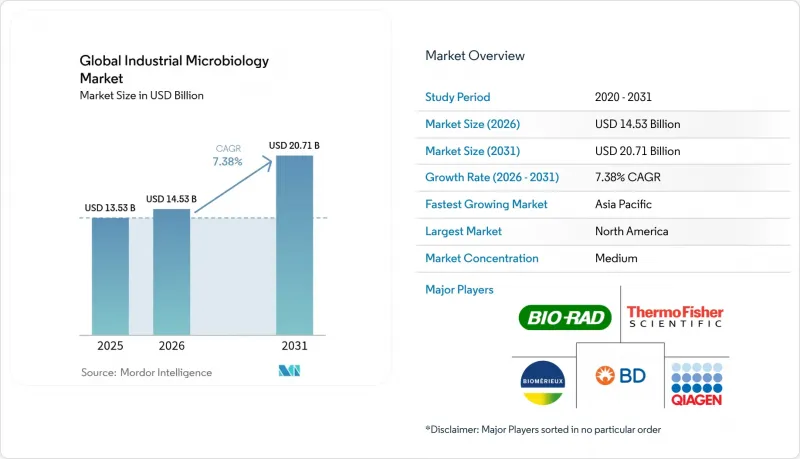
Mordor Intelligence에 의하면, 2026년 산업 미생물학 시장 규모는 145억 3,000만 달러로 추정되고, 2025년 135억 3,000만 달러에서 확대해, 2031년에는 207억 1,000만 달러에 이를 것으로 예측됩니다.
2026-2031년 연평균 성장률(CAGR) 7.38%로 성장할 것으로 전망됩니다.
본 보고서는 제품 유형별(장비·시스템(발효 시스템 등), 소모품별(배지·배양 조제물 등), 시약), 용도 분야별(식품 및 음료 산업, 제약·생명공학 산업 등), 미생물 유형별(세균 등), 시험 유형별(무균 시험 등), 지역별(북미, 유럽, 아시아태평양 등)로 분류되어 있습니다.
세계의 산업 미생물학 시장 동향 및 인사이트
뉴트라슈티컬 및 발효 제품 수요 증가
아시아 전역에서 프로바이오틱스 소비가 급증하고 있으며, 특히 쥴리그 파마(Zulig Pharma)가 인도네시아, 필리핀, 대만에서 OMNi-BiOTiC 균주를 판매하기 위해 10년에 걸친 제휴를 맺은 것이 그 대표적인 예입니다. 이러한 추세로 인해 검사 기관은 대사산물 프로파일링 외에도 지역별 특화된 균주 특성 분석 서비스를 제공해야 할 필요성이 대두되고 있습니다. 그 결과, 산업 미생물학 시장은 병원체 검출에서 생물학적 활성 및 지역별 미각 선호도를 정량화하는 보다 상세한 기능 분석으로 초점을 옮겨가고 있습니다. 또한, 각 제조업체는 현지 규제 요건에 맞추어 배합을 조정하고 있으며, 이는 신흥 경제국에서 신속한 미생물 품질 검사 인프라에 대한 수요를 가속화하고 있습니다. 감칠맛 조미료부터 바이오 유래 감미료에 이르기까지, 발효 유래 원료의 유형가 다양해짐에 따라 오염 물질 및 비표적 대사 산물에 대한 새로운 품질 관리(QC) 점검 항목이 추가되고 있습니다. 이러한 변화들이 맞물려 소모품에 대한 지속적인 수요를 뒷받침하고 있으며, 주요 공급업체와의 장기적인 시약 계약을 공고히 하고 있습니다.
식품 안전에 대한 우려 고조와 엄격한 규제
최근 보충제용 쉐이크와 관련된 리스테리아균으로 인한 리콜 사건을 계기로, 규제 당국은 오염 확인에 소요되는 시간 목표를 더욱 엄격하게 설정했으며, 이로 인해 고처리량 PCR 및 전체 유전체 시퀀싱 워크플로우의 도입이 촉진되었습니다. FDA가 개정된 『의약품 미생물학 매뉴얼』에서는 21 CFR 11을 준수하는 데이터 수집 시스템과 원활하게 통합되는 조화로운 내독소 및 항균 효능 시험이 요구되고 있습니다. bioMerieux와 같은 벤더들은 디지털 환경 모니터링과 감사 대응 전자 기록을 결합한 ‘3P ENTERPRISE’ 플랫폼으로 이에 대응했습니다. 블록체인을 활용한 공급망 투명성은 문서화 단계를 한층 더 추가하여, 품질 관리(QC) 실험실로 하여금 위변조 방지 기능을 갖춘 미생물 시험 보고서를 작성하도록 요구하고 있습니다. 이러한 압박으로 인해, 진화하는 세계 기준을 충족하면서 결과 산출 주기를 단축할 수 있는 자동 배양기, 신속 판독 장치 및 미들웨어에 대한 지출이 증가하고 있습니다.
식품 원료의 GMO를 둘러싼 규제상의 대립
CRISPR 편집 작물을 둘러싼 프레임워크의 차이는 규정 준수 측면에서 복잡성을 야기하고 있습니다. EU는 새로운 유전체 기술에 대해 이중 규제 경로를 제안하는 반면, 미국은 ICH를 통한 조화를 중시하고 있기 때문입니다. 따라서 전 세계 고객에게 서비스를 제공하는 검사 기관은 프로토콜, 인증, 보고 형식을 병행하여 유지해야 하며, 이로 인해 운영 비용이 증가하고 숙련된 인력의 수용 능력이 한계에 다다르고 있습니다. 중국의 생물안전 감독 강화로 인해 수출업체는 유전자 변형 미생물에 대해 균주 계통부터 최종 제품에 이르기까지의 추적성을 입증할 의무가 더욱 강화되었습니다. CRISPR 작물의 특허 건수는 1,900건을 넘어섰지만, 통일된 처리 기준이 부재하기 때문에 산업 미생물학 시장의 품질 관리(QC) 제공업체들은 GMO 전용 분석 플랫폼에 대한 설비 투자를 계획할 때 불확실성에 직면하고 있습니다. 이러한 불일치로 인해 유전자 변형 생물에 맞춘 신속한 미생물 검사법의 국경을 초월한 도입이 지연되고 있습니다.
부문 분석
2025년에는 소모품이 전 세계 매출의 51.84%를 차지했으며, 일상 업무에서 그 중요한 역할이 부각되었습니다. 자동화 주기가 진행됨에 따라 시약 사용량이 증가하고 있으며, 고처리량 장비에서는 로트 인증을 받은 배치가 더 많이 필요하기 때문에 소모품과 관련된 산업 미생물학 시장 규모는 2031년까지 연평균 성장률(CAGR) 7.22%로 확대될 것으로 예측됩니다. 배지 및 배양 조제는 제약용 클린룸에 대한 환경 모니터링 지침이 엄격해짐에 따라 확대되고 있습니다. RFID 지원 바이알 및 플레이트는 재고 관리의 정확도를 높이고 원격 배치 릴리스 검증을 지원하기 때문에 실험실 내 브랜드 일회용 소모품에 대한 의존도가 높아지고 있습니다.
장비·시스템 분야는 세척 검증 절차를 50% 단축하는 일회용 기술의 혜택을 받고 있지만, 설비 투자 예산이 수년에 걸친 주기로 결정되기 때문에 시장 점유율의 성장세는 비교적 완만합니다. 여과 및 원심분리 기술의 혁신으로 인해, 업스트림 공정에서 외부 미생물을 차단하는 폐쇄형 시스템 구성이 선호되고 있습니다. 자동 콜로니 카운터는 분석 담당자의 작업 시간을 단축시켜, 결과적으로 처리량 향상과 공급업체의 시약 소비량 증가로 이어집니다. 이러한 시너지 효과로 인해 경쟁이 치열해지는 상황에서도 공급업체는 이익률을 유지할 수 있게 되었습니다.
식품 및 음료 부문은 전 세계 HACCP 기준을 배경으로 2025년에는 산업 미생물학 시장의 32.05% 점유율을 차지했습니다. 그러나 제약 및 생명공학 분야는 2031년까지 연평균 성장률(CAGR) 9.96%를 나타낼 것으로 예측되며, 내독소, 마이코플라즈마 및 무균성 시험 키트 분야에서 산업 미생물학 시장 규모를 확대할 것으로 보입니다. 성장이 가장 두드러지는 분야는 세포 및 유전자 치료제 제조 분야로, 신속한 출하 전 검사를 통해 제품의 리드타임을 몇 주 단축할 수 있습니다.
ESG를 중시하는 복원 기금이 산업용 토지의 석유, 중금속, PFAS에 대한 미생물군집을 활용한 정화 사업을 지원하고 있어, 환경 검사 수요가 증가하고 있습니다. 농업 분야에서는 식물 성장 촉진 뿌리권 박테리아를 이용한 토양 건강 프로파일링이 점점 더 보편화되고 있는 반면, 화장품 브랜드들은 생균의 안정성 평가가 필요한 마이크로바이옴을 고려한 제형 개발에 대한 투자를 확대되고 있습니다. 이러한 다양한 이용 사례는 서비스 제공업체의 위험을 분산시키는 동시에, 각 산업별 분석 기기의 보급을 촉진하고 있습니다.
지역별 분석
북미가 주도적인 위치를 차지하고 있는 배경에는 성숙한 GMP(우수 제조 기준)의 시행에 더해, 서모피셔사의 20억 달러 규모의 미국 설비 갱신 프로그램 등 지속적인 설비 투자가 있습니다. 이 프로그램을 통해 현지에서 일회용 배지의 생산량이 확대되어 공급 회복력이 강화되고 있습니다. 캐나다의 생명공학 클러스터는 유리한 연구개발 세액 공제를 활용하여 식물성 식품용 미생물 컨소시엄을 개발하고 있는 반면, 멕시코의 생산자들은 USMCA(미국·멕시코·캐나다 협정)의 식품 안전 감사에 대응하기 위한 국경을 초월한 규제 조화에 주력하고 있습니다. 자동화된 데이터 시스템을 대상으로 한 사이버 보안 프레임워크는 역할 기반 접근 제어 및 암호화된 백업 기능을 통합함으로써 지역 공급업체의 차별화를 더욱 촉진하고 있습니다.
아시아태평양의 두 자릿수 성장 배경에는 세계 cGMP 인증을 목표로 하는 중국 정부의 지원을 받는 생물제제 공장, 인도의 백신 및 바이오시밀러 수출업체, 그리고 고도의 균주 안정성 분석이 필요한 일본의 기능성 식품 대기업이 있습니다. 한국과 호주의 mRNA 시설에 대한 정부 지원도 신속한 품질 관리(QC) 솔루션에 대한 수요를 가속화하고 있습니다. 소모품 생산을 현지화하는 지역 공급업체들은 리드 타임을 단축하고 수입 관세를 회피함으로써 기존 다국적 기업들 시장 점유율을 빼앗고 있습니다.
유럽에서는 엄격한 규제와 녹색 전환에 대한 인센티브 간의 균형이 잡혀 있습니다. EU의 ISCC Plus 인증 추진은 재생 가능 플라스틱으로 만든 소모품의 채택을 뒷받침하고 있으며, 살토리아스(Sartorius)사가 화석 유래 플라스틱을 50% 감축했다는 성과가 이를 뒷받침하고 있습니다. 독일과 프랑스는 예측 미생물 분석을 도입한 바이오프로세스 4.0 시범 공장을 주도하고 있는 반면, 영국은 파지 요법의 연구 개발에 공공 자금을 투입하고 있습니다. 그러나 GMO에 관한 규제 차이로 인해 다국적 연구소는 이중 프로토콜을 시행할 수밖에 없어, 국경을 초월한 효율성이 다소 제약받고 있습니다.
기타 혜택 :
- 엑셀 형식 시장 예측(ME) 시트
- 3개월간의 애널리스트 지원
자주 묻는 질문
목차
제1장 서론
제2장 조사 방법
제3장 주요 요약
제4장 시장 구도
제5장 시장 규모 및 성장 예측
제6장 경쟁 구도
제7장 시장 기회 및 향후 전망
AJY 26.08.26According to Mordor Intelligence, industrial microbiology market size in 2026 is estimated at USD 14.53 billion, growing from 2025 value of USD 13.53 billion with 2031 projections showing USD 20.71 billion, growing at 7.38% CAGR over 2026-2031.
This report is Segmented by Product Type (Equipment & Systems [Fermentation Systems, and More], Consumables [Media & Culture Preparations, and More], Reagents), by Application Area (Food & Beverage Industry, Pharmaceutical & Biotechnology Industry, and More), by Microbial Type (Bacteria, and More), by Test Type (Sterility Testing, and More), by Geography (North America, Europe, Asia-Pacific, and More).
Global Industrial Microbiology Market Trends and Insights
Growing Demand for Nutraceuticals & Fermented Products
Surging probiotic consumption across Asia, highlighted by Zuellig Pharma's decade-long alliance to distribute OMNi-BiOTiC strains in Indonesia, Philippines, and Taiwan, is pushing laboratories to offer localized strain-characterization services alongside metabolite profiling. The industrial microbiology market is therefore pivoting from pathogen detection toward deeper functional analytics that quantify bioactivity and regional taste preferences. Manufacturers are also tailoring formulations to match local regulatory requirements, which accelerates demand for rapid microbial-quality testing infrastructure in emerging economies. The widening palette of fermentation-derived ingredients-ranging from umami seasonings to bio-based sweeteners-is adding new QC checkpoints for contaminants and off-target metabolites. These shifts collectively sustain recurring consumable uptake and cement long-term reagent contracts for leading suppliers.
Rising Concern for Food Safety & Stringent Regulations
Recent Listeria-linked recalls involving supplement shakes prompted regulators to enforce tighter turnaround targets for contamination confirmation, spurring adoption of high-throughput PCR and whole-genome-sequencing workflows. The FDA's updated Pharmaceutical Microbiology Manual demands harmonized endotoxin and antimicrobial-effectiveness assays that integrate seamlessly with 21 CFR 11-compliant data-capture systems. Vendors such as bioMerieux responded with the 3P ENTERPRISE platform, pairing digital environmental monitoring with audit-ready electronic records. Blockchain-supported supply-chain transparency adds another documentation layer, compelling QC labs to generate tamper-proof microbial test reports. Collectively, these pressures increase spending on automated incubators, rapid readers, and middleware that can cut result cycles while meeting evolving global benchmarks.
Regulatory Conflicts Over GMOs in Food Sources
Divergent frameworks for CRISPR-edited crops create compliance complexity as the EU proposes dual regulatory pathways for new genomic techniques, while the U.S. leans on harmonization through the ICH. Testing laboratories servicing global clients must therefore maintain parallel protocols, certifications, and reporting formats, increasing operating costs and stretching skilled-labor capacity. China's heightened biosafety oversight further obliges exporters to demonstrate traceability of genetically modified microorganisms from strain lineage to final product. As patent volumes for CRISPR crops exceed 1,900 yet lack uniform treatment, QC providers in the industrial microbiology market face uncertainty when planning capital investments in GMO-specific analytical platforms. These discrepancies slow cross-border adoption of rapid microbial assays tailored to engineered organisms.
Other drivers and restraints analyzed in the detailed report include:
- Increasing R&D Spend & Biopharma Pipeline Expansion
- Expansion of Industrial Fermentation for Biofuels & Enzymes
- Supply-Chain Volatility in Specialty Culture Media Inputs
For complete list of drivers and restraints, kindly check the Table Of Contents.
Segment Analysis
Consumables represented 51.84% of global revenue in 2025, underscoring their vital role in day-to-day operations. Reagent volumes rise with each automation cycle, and the industrial microbiology market size attached to consumables is projected to grow at 7.22% CAGR to 2031 as high-throughput instruments demand larger lot-qualified batches. Media & culture preparations expand in tandem with stricter environmental-monitoring guidelines for pharmaceutical clean rooms. RFID-enabled vials and plates improve inventory accuracy and support remote batch-release verification, deepening laboratory reliance on branded disposables.
The equipment & systems segment benefits from single-use technologies that cut cleaning validation steps by 50%, yet its share grows more gradually because capital budgets follow multi-year cycles. Filtration and centrifugation innovations favor closed-system configurations that block adventitious microbes upstream. Automated colony-counters reduce analyst hours, which translates into higher throughput and greater reagent pull-through for suppliers. Such synergies help vendors defend margins even as competition intensifies.
The food & beverage sector held 32.05% of industrial microbiology market share in 2025 on the back of global HACCP standards. However, the pharmaceutical & biotechnology segment is forecast to deliver a 9.96% CAGR through 2031, expanding the industrial microbiology market size for endotoxin, mycoplasma, and sterility testing kits. Growth is strongest in cell- and gene-therapy manufacturing, where rapid release testing can shave weeks off product lead-times.
Environmental testing is gaining traction as ESG-directed remediation funds sponsor microbiome-based clean-up of oil, heavy metals, and PFAS at industrial sites. Agricultural applications increasingly involve soil-health profiling using plant-growth-promoting rhizobacteria, while cosmetic brands invest in microbiome-friendly formulations that require live-culture stability assessments. These diversified use-cases spread risk for service providers and underpin broader instrument penetration across verticals.
Complete Report Scope:
- By Product Type
- Equipment & Systems
- Fermentation Systems
- Bioreactors & Fermenters
- Filtration & Centrifugation Systems
- Others
- Consumables
- Media & Culture Preparations
- Petri Dishes & Vials
- Other Consumables
- Reagents
- Enzymes & Buffers
- Others
- Equipment & Systems
- By Application Area
- Food & Beverage Industry
- Pharmaceutical & Biotechnology Industry
- Agricultural Industry
- Environmental Industry
- Cosmetic / Personal-Care Industry
- Other Application Areas
- By Microbial Type
- Bacteria
- Yeasts & Molds
- Viruses & Phages
- By Test Type
- Sterility Testing
- Bioburden Testing
- Endotoxin Testing
- Others
- By Geography (Value)
- North America
- United States
- Canada
- Mexico
- Europe
- Germany
- United Kingdom
- France
- Italy
- Spain
- Rest of Europe
- Asia-Pacific
- China
- Japan
- India
- Australia
- South Korea
- Rest of Asia-Pacific
- Middle East and Africa
- GCC
- South Africa
- Rest of Middle East and Africa
- South America
- Brazil
- Argentina
- Rest of South America
- North America
Geography Analysis
North America's leadership stems from mature GMP enforcement and ongoing capital investment such as Thermo Fisher's USD 2 billion U.S. upgrade program, which expands local single-use media output and strengthens supply resilience. Canadian biotech clusters leverage favorable R&D tax credits to develop microbial consortia for plant-based foods, whereas Mexican producers focus on cross-border harmonization to meet USMCA food-safety audits. Cybersecurity frameworks targeting automated data systems further differentiate regional vendors that embed role-based access controls and encrypted backups.
Asia-Pacific's double-digit trajectory arises from China's state-backed biologics plants seeking global cGMP accreditation, India's vaccine and biosimilar exporters, and Japan's functional-food incumbents requiring advanced strain-stability analytics. Government support for mRNA facilities in South Korea and Australia also accelerates demand for rapid QC solutions. Regional suppliers that localize consumable production reduce lead times and skirt import duties, capturing share from established multinationals.
Europe balances regulatory rigor with green-transition incentives. The EU's push for ISCC Plus certification drives uptake of renewable-plastic consumables, as demonstrated by Sartorius' 50% fossil-plastic reduction milestone. Germany and France spearhead bioprocess-4.0 pilot plants deploying predictive microbial analytics, while the UK channels public funding into phage-therapy R&D. Divergent GMO rules, however, oblige multi-national labs to run dual protocols, mildly constraining cross-border efficiencies.
- 3M
- Agilent Technologies
- Thermo Fisher Scientific
- Merck
- Danaher
- bioMerieux
- Bio-Rad Laboratories
- Beckton Dickinson
- Sartorius
- Eppendorf
- QIAGEN
- Novozymes A/S
- Lonza Group
- Charles River
- Pall Corporation (Danaher)
- Shimadzu
- Waters Corporation
- Asiagel
- Bio-Techne
- Grant Instruments
- BD Diagnostic Systems
Additional Benefits:
- The market estimate (ME) sheet in Excel format
- 3 months of analyst support
TABLE OF CONTENTS
1 Introduction
- 1.1 Study Assumptions & Market Definition
- 1.2 Scope of the Study
2 Research Methodology
3 Executive Summary
4 Market Landscape
- 4.1 Market Overview
- 4.2 Market Drivers
- 4.2.1 Growing demand for nutraceuticals & fermented products
- 4.2.2 Rising concern for food safety & stringent regulations
- 4.2.3 Increasing R&D spend & biopharma pipeline expansion
- 4.2.4 Expansion of industrial fermentation for biofuels & enzymes
- 4.2.5 Rapid QC needs in cultivated-meat manufacturing
- 4.2.6 ESG-funded microbiome waste-bioremediation projects
- 4.3 Market Restraints
- 4.3.1 Regulatory conflicts over GMOs in food sources
- 4.3.2 Escalating product recalls heightening scrutiny
- 4.3.3 Supply-chain volatility in specialty culture media inputs
- 4.3.4 Cyber-security risks to automated microbiology data systems
- 4.4 Value / Supply-Chain Analysis
- 4.5 Regulatory Landscape
- 4.6 Technological Outlook
- 4.7 Porter's Five Forces Analysis
- 4.7.1 Threat of New Entrants
- 4.7.2 Bargaining Power of Buyers/Consumers
- 4.7.3 Bargaining Power of Suppliers
- 4.7.4 Threat of Substitute Products
- 4.7.5 Intensity of Competitive Rivalry
5 Market Size & Growth Forecasts (Value)
- 5.1 By Product Type
- 5.1.1 Equipment & Systems
- 5.1.1.1 Fermentation Systems
- 5.1.1.2 Bioreactors & Fermenters
- 5.1.1.3 Filtration & Centrifugation Systems
- 5.1.1.4 Others
- 5.1.2 Consumables
- 5.1.2.1 Media & Culture Preparations
- 5.1.2.2 Petri Dishes & Vials
- 5.1.2.3 Other Consumables
- 5.1.3 Reagents
- 5.1.3.1 Enzymes & Buffers
- 5.1.3.2 Others
- 5.1.1 Equipment & Systems
- 5.2 By Application Area
- 5.2.1 Food & Beverage Industry
- 5.2.2 Pharmaceutical & Biotechnology Industry
- 5.2.3 Agricultural Industry
- 5.2.4 Environmental Industry
- 5.2.5 Cosmetic / Personal-Care Industry
- 5.2.6 Other Application Areas
- 5.3 By Microbial Type
- 5.3.1 Bacteria
- 5.3.2 Yeasts & Molds
- 5.3.3 Viruses & Phages
- 5.4 By Test Type
- 5.4.1 Sterility Testing
- 5.4.2 Bioburden Testing
- 5.4.3 Endotoxin Testing
- 5.4.4 Others
- 5.5 By Geography (Value)
- 5.5.1 North America
- 5.5.1.1 United States
- 5.5.1.2 Canada
- 5.5.1.3 Mexico
- 5.5.2 Europe
- 5.5.2.1 Germany
- 5.5.2.2 United Kingdom
- 5.5.2.3 France
- 5.5.2.4 Italy
- 5.5.2.5 Spain
- 5.5.2.6 Rest of Europe
- 5.5.3 Asia-Pacific
- 5.5.3.1 China
- 5.5.3.2 Japan
- 5.5.3.3 India
- 5.5.3.4 Australia
- 5.5.3.5 South Korea
- 5.5.3.6 Rest of Asia-Pacific
- 5.5.4 Middle East and Africa
- 5.5.4.1 GCC
- 5.5.4.2 South Africa
- 5.5.4.3 Rest of Middle East and Africa
- 5.5.5 South America
- 5.5.5.1 Brazil
- 5.5.5.2 Argentina
- 5.5.5.3 Rest of South America
- 5.5.1 North America
6 Competitive Landscape
- 6.1 Market Concentration
- 6.2 Market Share Analysis
- 6.3 Company Profiles (includes Global level Overview, Market level overview, Core Segments, Financials as available, Strategic Information, Market Rank/Share for key companies, Products & Services, and Recent Developments)
- 6.3.1 3M Company
- 6.3.2 Agilent Technologies
- 6.3.3 Thermo Fisher Scientific Inc.
- 6.3.4 Merck KGaA
- 6.3.5 Danaher Corporation
- 6.3.6 bioMerieux SA
- 6.3.7 Bio-Rad Laboratories Inc.
- 6.3.8 Becton, Dickinson & Company
- 6.3.9 Sartorius AG
- 6.3.10 Eppendorf AG
- 6.3.11 QIAGEN NV
- 6.3.12 Novozymes A/S
- 6.3.13 Lonza Group AG
- 6.3.14 Charles River Laboratories
- 6.3.15 Pall Corporation (Danaher)
- 6.3.16 Shimadzu Corporation
- 6.3.17 Waters Corporation
- 6.3.18 Asiagel Corporation
- 6.3.19 Bio-Techne Corporation
- 6.3.20 Grant Instruments
- 6.3.21 BD Diagnostic Systems
7 Market Opportunities & Future Outlook
- 7.1 White-space & Unmet-Need Assessment