
|
시장보고서
상품코드
2114117
원격 집중치료실(TICU) 시장 : 시장 점유율 분석, 업계 동향 및 통계, 성장 예측(2026-2031년)Tele Intensive Care Unit - Market Share Analysis, Industry Trends & Statistics, Growth Forecasts (2026 - 2031) |
||||||
 Mordor Intelligence
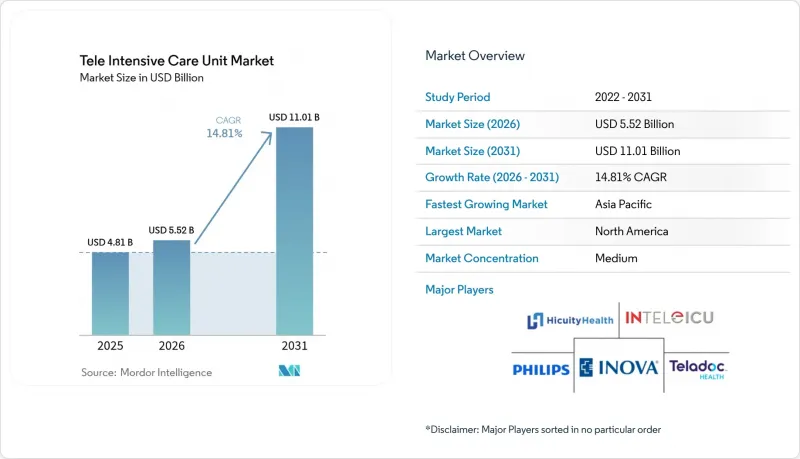
Mordor Intelligence에 의하면, 원격 집중치료실(TICU) 시장 규모는 2025년에 48억 1,000만 달러로 평가되었고, 2026년 55억 2,000만 달러에서 2031년까지 110억 1,000만 달러에 이를 것으로 예측되며, 예측 기간(2026-2031년) CAGR은 14.81%를 나타낼 전망입니다.
본 보고서는 구성 요소별(하드웨어, 소프트웨어, 서비스), 모델 유형별(집중형 모델 및 분산형 모델), 병원 규모별(500병상 이상, 200-499병상, 200병상 미만), 지역별(북미, 유럽,아시아태평양, 중동 및 아프리카, 남미)로 분류되어 있습니다. 본 보고서에서는 상기 각 부문별 시장 규모(달러)를 제시하고 있습니다.
세계의 원격 집중치료실(TICU) 시장 동향 및 인사이트
고령화로 인해 ICU 수요가 증가하고 있습니다.
입원 환자 중 고령자가 차지하는 비율이 증가함에 따라 중환자실 병상에 대한 수요가 높아지고 있습니다. 미국병원협회(AHA)에 따르면, 2030년까지 65세 이상 고령자가 미국 인구의 20%를 초과할 것으로 예측되며, 이러한 변화로 인해 만성 질환의 복잡성이 증가하고 중환자실 이용률도 상승하고 있습니다. 병원 측에서는 인공호흡기 사용 시간이 증가하고 모니터링 기간도 길어지고 있다는 보고가 나오고 있으며, 이에 따라 병원 경영진은 여러 시설에 걸친 시스템 전반에서 원격 집중치료실(Tele-ICU)의 적용 범위를 확대하도록 촉구받고 있습니다. 최근 여러 시설에 걸친 코호트 연구에 따르면, 원격 집중치료실(Tele-ICU) 프로그램으로 인해 사망률이 최대 40% 감소한 것으로 나타났습니다. 이는 원격지에 있는 중환자실 전문의가 환자의 상태가 악화되었을 때 조기에 개입할 수 있기 때문입니다. 이러한 성과는 고령 환자가 집중된 시설에서의 원격 모니터링에 대한 비즈니스 타당성을 강화하며, 보험사 측에 인구 규모에 상응하는 보상 코드를 유지하도록 촉구하고 있습니다.
5G 지원 병원 네트워크 도입 가속화
병원이 소유한 5G 독립형 네트워크는 현재 병상 옆의 영상, 이미지 및 의료기기의 원격 측정 데이터를 10밀리초 미만의 지연 시간으로 전송하고 있습니다. 이 지연 시간은 원격 수술 지도 및 지속적인 컴퓨터 비전 분석을 뒷받침하는 기준치입니다. 핀란드의 ‘Hola 5G Oulu’ 프로젝트에서는 MRI 시퀀싱와 실시간 초음파 영상의 즉각적인 전송이 기록되어, 임상 판단 지연을 단축하고 새로운 품질 기준의 확립으로 이어졌습니다. 싱가포르 국립대학교 의료 시스템(NUHS)은 하이브리드 5G 엔터프라이즈 네트워크에서 1Gbps의 다운링크 속도를 달성하여, 대역폭을 많이 필요로 하는 원격 ICU 대시보드 도입의 길을 열었습니다. 조기 도입 기관의 보고에 따르면, 스마트 카메라와 5G 백본을 통합한 결과 환자 낙상 건수가 44.5% 감소하여, 원활하고 고해상도의 영상 모니터링이 업무에 미치는 영향이 부각되고 있습니다(valleyhealth). 네트워크의 내결함성이 가상 의료 서비스의 필수 조건으로 대두됨에 따라, 5G 업그레이드에 대한 자본 예산 배정이 점점 더 늘어나고 있습니다.
높은 도입 비용
서버, AV 단말기, 통합 소프트웨어, 그리고 연중무휴 24시간 임상 직원 배치를 고려하면, 도입 예산은 모니터링 대상 병상 1개당 여전히 5만-10만 달러에 육박합니다. 한 대학의 시범 사이트에서는 초기 설비 투자가 110만 달러를 초과하고 연간 운영비가 250만 달러에 육박하는 것으로 보고되어, 이러한 수치가 소규모 병원의 본격적인 도입을 저해하고 있습니다. 질 조정 생존년(QALY)당 4만 5,320달러의 증분 비용-효과 비율이 제시되었음에도 불구하고, 재정적 지속가능성은 환자 수에 좌우됩니다. 손익분기점 모델에 따르면, 대규모 의료 센터에서는 3년 이내에 투자를 회수할 수 있는 반면, 병상 수 200개 미만의 시설에서는 설립 비용을 충당하기 위해 보조금 지원이 필요한 경우가 적지 않습니다. 이에 대해 각 벤더사는 진입 장벽을 낮추기 위한 목적으로 구독형 패키지나 공유 서비스 계약을 제안하고 있습니다.
부문 분석
2025년 원격 집중치료실(TICU) 시장 규모 중 소프트웨어 및 서비스가 59.65%를 차지했습니다. 이는 원격으로 중환자 전문의의 대응, 간호 트리아지 및 분석 지원이 지속적인 환자 관리에 필수적이기 때문입니다. 임상 전문 지식을 아웃소싱함으로써 병원 관리자는 지역별 인력 부족을 보완하는 동시에 네트워크 전체에서 진료를 표준화할 수 있습니다. 각 벤더사는 연중무휴 24시간 대응, 품질 지표 보고서, 변경 관리 프로그램을 패키지로 묶어 제공함으로써 전환 비용을 높이고 서비스 수익을 강화하고 있습니다. 동시에, AI를 활용한 워크플로 엔진이 파형 데이터 및 검사 데이터 스트림을 필터링함으로써 알림 피로를 줄여, 한 명의 임상의가 더 많은 환자를 관리할 수 있게 되었습니다.
하드웨어 수익원은 생리 모니터, 천장 설치형 카메라, 그리고 커맨드 센터용 디스플레이입니다. 그중에서도 스마트 카메라가 두드러지는데, 컴퓨터 비전 알고리즘이 자세 분류, 무호흡 이벤트 감지, 그리고 0.92를 초과하는 매크로 F1 점수를 바탕으로 낙상 경보를 발령함으로써 연평균 성장률(CAGR) 13.92%로 시장이 확대되고 있습니다. 소프트웨어 포트폴리오에는 간호 활동 점수를 추정할 수 있는 ‘Multiscale Vision Transformers’와 같은 의사 결정 지원 모듈이 점점 더 통합되고 있어, 이를 통해 인력 배치 담당자는 자원 배분을 미세 조정하기가 더 쉬워졌습니다. 이러한 하드웨어, 소프트웨어 및 서비스의 융합으로 인해 벤더 간의 차별화가 더욱 심화되고 있으며, 원격 집중치료실 시장에서 장기 구독 모델의 성장이 지속되고 있습니다.
지역별 분석
북미는 2025년에 전 세계 매출의 43.10%를 차지했으며, 원격 집중치료실 시장의 상업적 혁신 중심지로서의 위치를 계속 유지하고 있습니다. 미국의 병원 네트워크에서는 전자 의료 기록과 실시간 카메라 영상을 통합한 가상 중환자실 대시보드가 도입되어, 임상의에게 현장 및 원격지의 환자 정보를 일원화하여 제공합니다. 미국병원협회(AHA)는 지리적 제한을 영구적으로 철폐하고 의료 제공업체의 자격 요건을 확대하는 법안을 지지하고 있으며, 이러한 움직임은 보상 제도의 추가적인 안정화로 이어질 것으로 예측됩니다. 재향군인부는 농촌 지역의 의료 접근 지점에 자금을 지원하여, 분산 거주하는 재향군인을 대상으로 전문의의 감독 체계를 구축하고 있습니다.
아시아태평양은 연평균 성장률(CAGR) 15.42%를 나타낼 것으로 예측되며, 이는 모든 지역 중 가장 높은 성장률입니다. 싱가포르, 호주, 한국의 각 보건부는 3차 의료기관 내 5G 전용 네트워크에 보조금을 지급하여, 고대역폭 원격 집중치료실(텔레-ICU) 영상 스트림을 위한 대역폭을 확보하고 있습니다. 태국에서는 혼잡한 도시 지역에서 경증 환자를 우회시키기 위해 원격 의료용 키오스크의 시범 운영이 진행되고 있습니다. 현지 스타트업은 학술 기관과 제휴하여 문화 및 규제의 다양성에 대응하는 다국어 사용자 인터페이스를 제공합니다.
유럽은 40개국에 걸친 국가 차원의 e-헬스 전략과 공적 보험자의 지속적인 투자에 힘입어 견고한 3위 자리를 차지하고 있습니다. ‘Hola 5G Oulu’와 같은 프로젝트는 1초 미만의 데이터 교환이 임상적으로 유용함을 입증하고 있으며, 독일과 스페인에서도 유사한 노력이 이루어지고 있습니다. 유럽 중환자 의학회는 중환자 전문의의 만성적인 부족을 지적하고 있으며, 이로 인해 허브 병원이 국경을 넘어 소규모 스포크 병원을 감독할 수 있도록 e-ICU 인력 배치를 외부에 위탁하는 계약이 촉진되고 있습니다. ‘Thera4Care’와 같은 EU 프로그램은 연구 자금을 AI를 활용한 테라노스틱스에 투자하고 있으며, 이는 원격 ICU 분석과 결합되어 통합된 치료 경로의 구축으로 이어지고 있습니다.
중동 및 아프리카 및 남미 지역은 규모는 작지만 급속히 확대되고 있는 기회를 내포하고 있습니다. 걸프 국가들에서는 ‘디지털 퍼스트’ 병원이 주목을 받고 있으며, ‘Arab Health’와 같은 지역 전시회에서는 수술실과 원격지의 마취과 의사를 연결하는 커맨드 센터의 시연이 이루어지고 있습니다. 라틴아메리카의 각 정부 부처는 인재 양성 목표에 따라 지방 병원에 클라우드 기반 모니터링 플랫폼을 도입하기 위한 민관 파트너십을 협의하고 있습니다.
기타 혜택 :
- 엑셀 형식 시장 예측(ME) 시트
- 3개월간의 애널리스트 지원
목차
제1장 서론
제2장 조사 방법
제3장 주요 요약
제4장 시장 구도
제5장 시장 규모 및 성장 예측
제6장 경쟁 구도
제7장 시장 기회 및 향후 전망
AJYAccording to Mordor Intelligence, the tele intensive care unit market size was valued at USD 4.81 billion in 2025 and estimated to grow from USD 5.52 billion in 2026 to reach USD 11.01 billion by 2031, at a CAGR of 14.81% during the forecast period (2026-2031).
This report is Segmented by Component (Hardware, Software and Services), by Model Type (Centralized Model and Decentralized Model), by Hospital Size (more Than 500 Beds and 200-499 Beds, Less Than 200 Beds) and Geography (North America, Europe, Asia-Pacific, Middle East and Africa, and South America). The Report Offers the Value (USD) for the Above Segments.
Global Tele Intensive Care Unit Market Trends and Insights
Aging Population Intensifies ICU Demand
Demand for critical-care beds climbs as older adults represent a growing share of admissions. The American Hospital Association notes that people aged 65 and older will surpass 20% of the United States population by 2030, a shift that elevates chronic disease complexity and raises ICU utilization . Hospitals report rising ventilation hours and longer monitoring requirements, prompting administrators to add tele-ICU coverage across multisite systems. Tele-ICU programs show mortality reductions of up to 40% in recent multisite cohorts because remote intensivists can intervene earlier during deterioration events criticalcaremedicine. These outcomes strengthen the business case for virtual oversight in geriatric hotspots and encourage payers to maintain reimbursement codes tied to population.
Accelerated Adoption of 5G-Ready Hospital Networks
Hospital-owned 5G stand-alone networks now carry bedside video, imaging, and device telemetry with sub-10 ms latency, a threshold that supports telesurgery guidance and continuous computer-vision analytics. Finland's Hola 5G Oulu project recorded instantaneous transmission of MRI sequences and live ultrasound streams, reducing clinical decision lag and driving new quality benchmarks. Singapore's National University Health System achieved 1 Gbps downlink speeds on a hybrid 5G enterprise network, paving the way for bandwidth-heavy tele-ICU dashboards. Early adopters report 44.5% fewer patient falls after integrating smart cameras and 5G backbones, highlighting the operational impact of seamless, high-definition video monitoring valleyhealth. Capital budgets increasingly earmark 5G upgrades as network resilience becomes a prerequisite for advanced virtual-care services.
High Implementation Cost
Launch budgets still approach USD 50,000 to 100,000 per monitored bed when factoring servers, audiovisual endpoints, integration software, and 24 X 7 clinical staffing. University pilot sites report initial capital outlays above USD 1.1 million and annual operating expenses near USD 2.5 million, figures that deter smaller hospitals from full-scale adoption. Despite an incremental cost-effectiveness ratio of USD 45,320 per quality-adjusted life year, financial sustainability hinges on patient volume. Break-even models show large centers recoup investment within three years, whereas sub-200-bed facilities often require grant support to offset start-up costs. Vendors respond with subscription-based packages and shared-service contracts aimed at lowering the entry barrier.
Other drivers and restraints analyzed in the detailed report include:
- Remote Patient Monitoring Adoption
- Post-COVID Telehealth Waivers Become Permanent
- Limited Reimbursement Variability
For complete list of drivers and restraints, kindly check the Table Of Contents.
Segment Analysis
Software & Services contributed 59.65% of the tele-intensive care unit market size in 2025 because remote intensivist coverage, nursing triage, and analytics support remain indispensable for continuous patient oversight. Outsourcing clinical expertise lets hospital administrators compensate for regional workforce gaps while standardizing practice across networks. Vendors bundle 24 X 7 coverage, quality-metric reporting, and change-management programs, raising switching costs and reinforcing service revenues. At the same time, AI-enabled workflow engines now filter waveform and laboratory streams, reducing alert fatigue and allowing a single clinician to supervise a larger census.
Hardware revenue stems from physiological monitors, ceiling-mounted cameras, and command-center displays. Smart cameras stand out, expanding at a 13.92% CAGR as computer-vision algorithms classify posture, detect apnea events, and trigger fall alerts with macro F1-scores above 0.92. Software portfolios increasingly integrate decision-support modules such as Multiscale Vision Transformers capable of estimating nursing-activity scores, which helps staffing managers fine-tune resource deployment. This convergence of hardware, software, and services heightens differentiation among vendors and sustains long-term subscription growth inside the tele-intensive care unit market.
Complete Report Scope:
- By Component
- Hardware
- Software & Services
- By Model Type
- Centralized Model
- Decentralized Model
- Hybrid / Distributed Hub-and-Spoke Model
- By Hospital Size
- More than 500 Beds
- 200-499 Beds
- Less than 200 Beds
- By Geography
- North America
- United States
- Canada
- Mexico
- Europe
- Germany
- United Kingdom
- France
- Italy
- Spain
- Rest of Europe
- Asia-Pacific
- China
- Japan
- India
- South Korea
- Australia
- Rest of Asia- Pacific
- Middle East and Africa
- GCC
- South Africa
- Rest of Middle East and Africa
- South America
- Brazil
- Argentina
- Rest of South America
- North America
Geography Analysis
North America held 43.10% of global revenue in 2025 and remains the center of commercial innovation in the tele-intensive care unit market. U.S. hospital networks deploy virtual critical-care dashboards that integrate electronic medical records with live camera feeds, providing clinicians unified patient views at local and remote sites. The American Hospital Association supports legislation to eliminate geographic restrictions permanently and to extend provider eligibility, moves that would further stabilize reimbursement. The Department of Veterans Affairs funds access points in rural communities, bringing specialist oversight to dispersed veteran populations.
Asia-Pacific is forecast to grow at 15.42% CAGR, the fastest among all regions. Health ministries in Singapore, Australia, and South Korea subsidize 5G private networks inside tertiary hospitals, clearing capacity for high-bandwidth tele-ICU video streams. Thailand pilots telemedicine kiosks to route non-critical cases away from crowded urban centers. Local start-ups partner with academic centers to deliver multilingual user interfaces that address cultural and regulatory heterogeneity.
Europe occupies a solid third position, supported by national e-health strategies in 40 countries and sustained investment from public payers. Projects like Hola 5G Oulu demonstrate clinical utility for sub-second data exchange, inspiring similar initiatives in Germany and Spain. The European Society of Intensive Care Medicine highlights persistent intensivist shortages, prompting outsourced e-ICU staffing contracts that allow hub hospitals to supervise smaller spokes across borders . EU programs such as Thera4Care channel research funds into AI-enabled theranostics, which dovetail with tele-ICU analytics to create integrated care pathways.
The Middle East and Africa and South America represent smaller but accelerating opportunities. Gulf states showcase digital-first hospitals, and regional exhibitions like Arab Health feature command-center demonstrations that link operating rooms with remote anesthesiologists. Latin American ministries negotiate public-private partnerships that equip provincial hospitals with cloud-based monitoring platforms, aligning with workforce-development goals.
List of Companies Covered in this Report:
- Koninklijke Philips
- GE HealthCare Technologies Inc.
- Hicuity Health
- SOC Telemed (a Patient Square Capital Co.)
- Advanced ICU Care (US Acute Care Solutions)
- Teladoc Health
- Cisco Systems
- eVideo Telemedicine
- AMD Global Telemedicine
- Cerner Corp. (Oracle Health)
- Epic Systems Corp.
- Baxter International (Hillrom Guardian)
- iMDsoft
- CLEW Medical
- Inspiren
- Vitreous Health
- AlertWatch
- Masimo Corp.
- Medtronic
- Nihon Kohden Corp.
- Spacelabs Healthcare
- Mindray Bio-Medical Electronics
Additional Benefits:
- The market estimate (ME) sheet in Excel format
- 3 months of analyst support
TABLE OF CONTENTS
1 Introduction
- 1.1 Study Assumptions & Market Definition
- 1.2 Scope of the Study
2 Research Methodology
3 Executive Summary
4 Market Landscape
- 4.1 Market Overview
- 4.2 Market Drivers
- 4.2.1 Aging Population Driven Critical Care Demand Surge
- 4.2.2 Accelerated Adoption of 5G-Ready Hospital Networks
- 4.2.3 Increasing Demand for Remote Patient Monitoring
- 4.2.4 Large-Scale Public Tele-ICU Grants
- 4.2.5 Post-COVID Remote Monitoring Policies Becoming Permanent
- 4.2.6 Chronic Intensivist Shortage Triggering Outsourced e-ICU Staffing in Europe
- 4.3 Market Restraints
- 4.3.1 Limited Reimbursement
- 4.3.2 High Cost of Treatment and Expensive Setup
- 4.3.3 Data-Integration Silos Between EMR Vendors & Tele-ICU Platforms
- 4.3.4 Nurse & Intensivist Resistance to Remote Oversight in Tier-2 Hospitals
- 4.4 Supply-Chain Analysis
- 4.5 Technological Outlook
- 4.6 Porter's Five Forces
- 4.6.1 Threat of New Entrants
- 4.6.2 Bargaining Power of Suppliers
- 4.6.3 Bargaining Power of Buyers
- 4.6.4 Threat of Substitutes
- 4.6.5 Competitive Rivalry
5 Market Size & Growth Forecasts (value)
- 5.1 By Component
- 5.1.1 Hardware
- 5.1.2 Software & Services
- 5.2 By Model Type
- 5.2.1 Centralized Model
- 5.2.2 Decentralized Model
- 5.2.3 Hybrid / Distributed Hub-and-Spoke Model
- 5.3 By Hospital Size
- 5.3.1 More than 500 Beds
- 5.3.2 200-499 Beds
- 5.3.3 Less than 200 Beds
- 5.4 By Geography
- 5.4.1 North America
- 5.4.1.1 United States
- 5.4.1.2 Canada
- 5.4.1.3 Mexico
- 5.4.2 Europe
- 5.4.2.1 Germany
- 5.4.2.2 United Kingdom
- 5.4.2.3 France
- 5.4.2.4 Italy
- 5.4.2.5 Spain
- 5.4.2.6 Rest of Europe
- 5.4.3 Asia-Pacific
- 5.4.3.1 China
- 5.4.3.2 Japan
- 5.4.3.3 India
- 5.4.3.4 South Korea
- 5.4.3.5 Australia
- 5.4.3.6 Rest of Asia- Pacific
- 5.4.4 Middle East and Africa
- 5.4.4.1 GCC
- 5.4.4.2 South Africa
- 5.4.4.3 Rest of Middle East and Africa
- 5.4.5 South America
- 5.4.5.1 Brazil
- 5.4.5.2 Argentina
- 5.4.5.3 Rest of South America
- 5.4.1 North America
6 Competitive Landscape
- 6.1 Market Concentration
- 6.2 Market Share Analysis
- 6.3 Company Profiles {(includes Global level Overview, Market level overview, Core Segments, Financials as available, Strategic Information, Market Rank/Share for key companies, Products & Services, and Recent Developments)}
- 6.3.1 Koninklijke Philips N.V.
- 6.3.2 GE HealthCare Technologies Inc.
- 6.3.3 Hicuity Health
- 6.3.4 SOC Telemed (a Patient Square Capital Co.)
- 6.3.5 Advanced ICU Care (US Acute Care Solutions)
- 6.3.6 Teladoc Health, Inc.
- 6.3.7 Cisco Systems, Inc.
- 6.3.8 eVideo Telemedicine
- 6.3.9 AMD Global Telemedicine
- 6.3.10 Cerner Corp. (Oracle Health)
- 6.3.11 Epic Systems Corp.
- 6.3.12 Baxter International (Hillrom Guardian)
- 6.3.13 iMDsoft
- 6.3.14 CLEW Medical
- 6.3.15 Inspiren
- 6.3.16 Vitreous Health
- 6.3.17 AlertWatch
- 6.3.18 Masimo Corp.
- 6.3.19 Medtronic PLC
- 6.3.20 Nihon Kohden Corp.
- 6.3.21 Spacelabs Healthcare
- 6.3.22 Mindray Bio-Medical Electronics