

|
시장보고서
상품코드
2114129
바닥 코팅 시장 : 시장 점유율 분석, 업계 동향 및 통계, 성장 예측(2026-2031년)Floor Coatings - Market Share Analysis, Industry Trends & Statistics, Growth Forecasts (2026 - 2031) |
||||||
 Mordor Intelligence
Mordor Intelligence에 의하면, 바닥 코팅 시장 규모는 2026년에 114억 7,000만 달러로 추정되고, 예측 기간(2026-2031년) CAGR 4.52%로 성장을 지속할 전망이며, 2031년에는 143억 1,000만 달러에 이를 전망입니다.
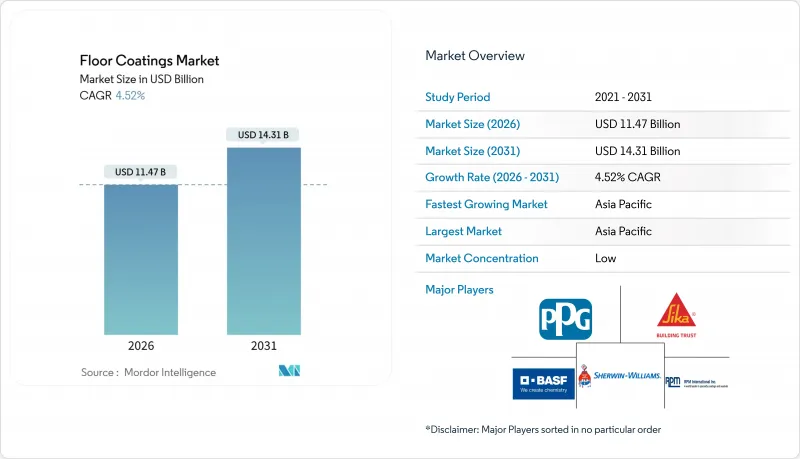
본 보고서는 제품 유형별(에폭시, 폴리우레탄, 폴리아스파라긴산계 등), 기술별(용제형, 수성, 분체, UV 경화형), 바닥재별(콘크리트 등), 최종 이용 산업별(산업·공공시설, 상업시설 등), 지역별(아시아태평양, 북미, 유럽, 남미, 중동 및 아프리카)로 분류되어 있습니다. 시장 예측은 금액(달러) 기준으로 제시되어 있습니다.
세계의 바닥용 코팅 시장 동향 및 인사이트
항균 코팅이 필요한 냉장 창고의 급속한 확대
냉장 창고 운영 사업자들은 동결·해동의 반복 및 고압 세척을 견딜 수 있는 항균성 에폭시 도료를 지정하고 있습니다. 요툰(Jotun)사의 ‘Jotafloor Hygiene’은 24시간 이내에 99.9%의 세균 제거율을 달성하고 있으며, 비다공성 및 세척 가능한 표면에 관한 FDA 식품 코드 §3-304.14를 준수합니다. 플로우크레이트의 ‘플로우프레시’ 폴리우레탄에는 은 이온계 살균제가 배합되어 있어, 바닥의 수명 기간 내내 그 효과를 유지하며, 내습성 구조에 관한 미국 농무부(USDA) 9 CFR Part 416의 요건을 충족합니다. 세계 식품 안전 이니셔티브(GFSI)에 기반한 규제 감사로 인해, 항균제가 포함되지 않은 2020년 이전에 설치된 구형 바닥재의 교체가 가속화되고 있으며, 그 결과 재도장 주기가 단축되고 있습니다. 이러한 추세는 전 세계적인 현상이지만, 식료품 소매업체들이 냉장 보관 용량 확대를 공약하고 있는 북미 및 유럽의 물류 거점에서 특히 두드러집니다. 콜드체인 물류의 통합이 진행됨에 따라 단일 사업자가 여러 거점에 걸친 코팅 계약을 체결하는 사례가 증가하고 있으며, 광범위한 서비스 네트워크를 보유한 공급업체가 우선적으로 선택되고 있습니다.
전자상거래 풀필먼트 센터가 내마모성 에폭시 수지 수요 견인
풀필먼트 센터의 바닥은 하루 10,000회 이상의 지게차 통행, 무인 운반차(AGV), 그리고 5,000 psi를 초과하는 집중 하중을 발생시키는 로봇 분류기에 노출되어 있습니다. 노보락 수지와 골재 경화제를 배합한 에폭시 시스템은 10,000 psi를 초과하는 압축 강도를 발휘하여 반복되는 충격으로 인한 박리를 방지합니다. 셔윈-윌리엄스(Sherwin-Williams)사의 ‘Macropoxy 646 Fast Cure Epoxy’는 70°F 환경에서 16시간 만에 완전 경화에 도달하므로, 운영 중인 통로를 중단하지 않고 단계적으로 시공할 수 있습니다. 온라인 소매업체들이 배송 시간을 단축하기 위해 재고를 지역별로 분산시키는 가운데, 신규 창고나 개보수 공사에서는 가동 시간 손실을 최소화할 수 있는 신속한 시공이 가능한 코팅재가 요구되고 있습니다. 아시아개발은행은 2025년 아시아 개발도상국의 GDP 성장률을 4.9%로 평가했으며, 이는 물류 인프라 확장을 뒷받침하는 요인이 되고 있습니다. 단기적인 경제 변동이 있더라도 자동화 및 높은 처리 능력을 갖춘 바닥재 기준에 대한 장기적인 노력은 변함없이 이어지고 있습니다.
원자재 가격 변동
2025년 1월, 독일의 에폭시 수지 가격이 상승했고, 미국 공급업체들도 같은 달에 가격 인상을 발표했습니다. 이는 주로 비스페놀 A공급 부족과 중국산 수입품에 대한 반덤핑 조사 때문입니다. 동시에 정유시설의 유지보수로 인해 톨루엔 비용이 상승하여 폴리우레탄의 이익률이 압박을 받았습니다. 미국 국제무역위원회는 수입 에폭시에 대해 15-35%의 잠정 관세를 부과하는 절차를 시작했으며, 이로 인해 기본 가격 상승에도 불구하고 판매업체들은 지역 내 공급원으로 전환할 수밖에 없는 상황에 처해 있습니다. BASF가 코팅 사업 부문을 칼라일 그룹에 분할·매각한 것은 통합형 제조업체들이 저수익 사업에서 철수하고 있음을 여실히 보여주며, 하류 배합 제조업체들이 현물 수지 시장에 노출될 위험을 높이고 있습니다. 가격 변동으로 인해 구매 담당자들은 계약 기간을 연장하고 재고를 늘리는 경향을 보이고 있으며, 그 결과 운전 자금이 묶여 차세대 화학 물질로의 사양 변경이 지연되고 있습니다.
부문별 분석
에폭시 수지는 2025년 매출의 50.15%를 차지한 것으로 평가되었으며, 2031년까지 연평균 4.71%의 성장률을 보일 것으로 전망됩니다. 제약 업계의 클린룸에서는 단단하고 세척하기 쉬운 표면에 관한 FDA 21 CFR §211.56의 요건을 충족하기 위해 이음매 없는 에폭시 수지가 지정되어 있습니다. 식품 가공 공장에서는 습기를 차단하는 바닥에 관한 USDA FSIS 9 CFR Part 416의 요건을 충족하기 위해 유사한 시스템이 채택되고 있습니다. 폴리우레탄은 열충격 내성으로 인해 균열을 방지할 수 있어 냉장 창고에서 점유율을 확보하고 있습니다. 다세대 주택 리모델링의 경우, 입주 당일 인도가 가능해져 입주자의 일시 퇴거에 따른 위약금을 피할 수 있기 때문에 장식용 폴리아스파라긴에 대한 수요가 증가하고 있습니다. 아크릴계 및 메틸메타크릴레이트계 제품은 하중이 적은 소매점용으로 틈새 시장 위치를 유지하고 있습니다. 바닥 코팅 시장에서는 고부하 환경에서 비용 대비 성능이 이에 필적할 만한 대체재가 존재하지 않기 때문에 에폭시가 계속해서 지지를 받고 있으며, 2031년까지 이 분야에서 주도적인 지위를 유지할 전망입니다.
에폭시 수지가 바닥 코팅 시장에서 확고한 입지를 다진 배경에는 시공업체들의 폭넓은 숙련도, 충실한 부속품 생태계, 그리고 수십 년에 걸친 시공 가이드의 공개가 있습니다. 탄소나노튜브 전도성 필러나 항균 첨가제 등의 혁신 기술 덕분에 시공업체의 부담을 늘리지 않으면서도 이 수지가 대응할 수 있는 최종 용도가 확대되고 있습니다. 폴리우레탄 수지 배합 제조업체들은 은 이온 항균 등급으로 이에 대응하고 있지만, 원자재 비용이 높기 때문에 보급은 더딘 상황입니다. 전반적으로 고부가가치 배합을 둘러싼 수지 간 경쟁은 격화될 전망이지만, 에폭시 부문은 바닥용 코팅 시장에서 50%의 점유율을 지켜낼 수 있는 유리한 입장에 있습니다.
UV 경화형 코팅은 2025년에 35.22%의 점유율을 확보하고, 2031년까지 연평균 4.82%의 성장률을 보일 전망입니다. LED 램프를 이용한 순간 경화로 인해 오븐의 에너지 비용이 절감되며, ISO 14001 인증 목표 달성에도 기여합니다. 셔윈-윌리엄스(Sherwin-Williams)는 99%의 경화 효율을 입증했으며, 열처리 공정에 비해 에너지 사용량을 최대 70% 절감하고 있습니다. 유럽에서는 용제세 및 VOC 배출 상한선으로 인해 기존 2액형 시스템의 비용이 상승함에 따라 수성 에폭시 도료의 보급이 가속화되고 있습니다. Teknos사의 ‘Teknofloor 7300’은 VOC 배출량이 불과 25 g/L에 불과하며, 수성 도료로도 용제계 도료에 필적하는 내마모성을 실현할 수 있음을 입증하고 있습니다. 분체 도료는 데이터센터 내의 금속 패널로 한정되어 있습니다. 특히 북유럽 국가에서 공공기관의 구매 담당자가 친환경 라벨 준수를 요구함에 따라, UV 경화 및 수성 기술과 관련된 바닥 코팅 시장 규모는 확대될 것입니다.
생산 관리 책임자들은 UV 경화를 채택하는 이유로 장기간의 가동 중단을 해소할 수 있다는 점과 주변 습도에 관계없이 경화 깊이를 예측할 수 있다는 두 가지 요인을 꼽고 있습니다. 포장 라인, 제약 업계의 충전 및 마감 시설, 그리고 식품 병입 공장에서는 이러한 이점을 활용하여 주말 유지보수 기간을 이용해 설비를 업그레이드하고 있습니다. 램프 시스템과 도료를 세트로 판매하는 공급업체들은 추가 수익을 올리고 있습니다. LED 가격 하락에 따라 소규모 위탁 가공업체들도 이동식 UV 장비를 도입할 수 있게 되어, 바닥 코팅 업계의 잠재적 고객 기반이 확대되고 있습니다.
지역별 분석
아시아태평양은 2025년에 전 세계 매출의 38.27%를 차지한 것으로 평가되었으며, 2031년까지 연평균 4.78%의 성장률을 보일 것으로 전망됩니다. 아세안(ASEAN) 국가들은 2024년에 2,260억 달러의 외국인 직접 투자(FDI)를 유치했으며, 그 절반은 산업용 등급의 바닥재가 필요한 제조 시설을 위한 것이었습니다. 중국, 인도, 일본, 한국이 계속해서 핵심 기여국으로 자리매김하는 한편, 인도네시아, 말레이시아, 태국, 베트남은 IEC 61340-5-1 표준을 적용하는 배터리 공급망의 허브로 부상하고 있습니다. 이 하위 지역의 데이터센터용량은 2019년 800MW에서 2023년 1,700MW로 증가하여, 분체 도장 또는 UV 경화 코팅이 적용된 고상식 시스템에 대한 수요를 뒷받침하고 있습니다. 현지 수지 생산에 대한 정부의 우대 조치로 인해 다국적 배합 제조업체들이 수출가공구에 공장을 건설하여 최종 사용자와의 근접성을 확보하고 있습니다.
북미 수요는 새로운 물류 시설 건설과 활발한 아파트 리모델링 공사에 의해 견인되고 있습니다. 2023년에는 창고 건설이 상업용 건축 착공 총수의 절반을 넘어, 사무실 및 소매 시설을 능가하는 속도로 증가하고 있습니다. 백악관이 적응형 재사용(어댑티브 리유즈)을 위한 개보수에 100억 달러를 배정함에 따라, 속경화·저취성 제품이 중시되는 프로젝트가 더욱 증가하고 있습니다. 그러나 숙련된 인력 부족으로 인해 프로젝트 공사 기간이 길어지고 있으며, 노동조합에 가입한 바닥 시공 팀에 대한 추가 보수도 증가하고 있습니다. 캐나다도 미국의 동향과 유사하지만, 나아가 호환 가능한 수성 또는 시멘트계 프라이머가 필요한 저탄소 콘크리트 바탕재로 전환하는 움직임이 가속화되고 있습니다.
유럽에서는 VOC 규제가 강화됨에 따라 기술적 전환이 진행되고 있습니다. 스웨덴은 용제 함유량이 많은 도료에 대한 면제 조치를 폐지했고, 덴마크는 용제세를 부과하고 있으며, EU의 ‘데코페인트 지침’에서는 2액형 시스템에 대해 500 g/L의 상한선이 설정되어 있습니다. 공공 조달에서는 VOC 배출량이 30 g/L 미만인 ‘노르딕 스완(Nordic Swan)’ 인증 제품이 점점 더 우선적으로 채택되고 있습니다. 독일, 프랑스, 이탈리아에서는 에너지 효율이 높은 생산 라인이 추진되고 있으며, 그 결과 자동차 공장이나 포장 공장에서 UV 경화 기술의 도입이 가속화되고 있습니다. 동유럽의 데이터센터 건설은 전도성 레이즈드 플로어 수요 증가로 이어지고 있지만, 서유럽으로의 노동력 유출로 인해 현지 시공 업체의 대응 능력이 제한되고 있습니다.
중동 및 아프리카에서는 정부 주도의 인프라 정비 계획에 힘입어 성장세가 가속화되고 있습니다. ‘사우디 비전 2030’은 NEOM 등의 메가 프로젝트에 자본을 투입하고 있으며, 해당 프로젝트에서 하루 20,000 m³에 달하는 콘크리트 생산량은 에폭시 수지의 대량 소비를 견인하고 있습니다. 국제통화기금(IMF)은 사우디아라비아의 GDP 성장률을 2025년 3.5%, 2026년 3.9%로 예측하고 있으며, 이는 건설업의 지속적인 성장을 뒷받침하고 있습니다. 아랍에미리트, 나이지리아, 이집트는 내화학성 바닥재가 필요한 제조 자유무역지대 조성을 통해 석유 의존에서 벗어나고자 하고 있습니다. 라틴아메리카의 성장은 더욱 꾸준하며, 브라질과 멕시코에서는 수출 검사 제도를 준수하기 위해 항균성 에폭시 수지를 사용하여 농산물 가공 공장의 현대화가 진행되고 있습니다.
기타 혜택 :
- 엑셀 형식 시장 예측(ME) 시트
- 3개월간의 애널리스트 지원
자주 묻는 질문
목차
제1장 서론
제2장 조사 방법
제3장 주요 요약
제4장 시장 구도
제5장 시장 규모 및 성장 예측
제6장 경쟁 구도
제7장 시장 기회 및 향후 전망
AJY 26.08.26According to Mordor Intelligence, the floor coatings market size is estimated at USD 11.47 billion in 2026, and is expected to reach USD 14.31 billion by 2031, at a CAGR of 4.52% during the forecast period (2026-2031).
This report is Segmented by Product Type (Epoxy, Polyurethane, Polyaspartic, and More), Technology (Solvent-Borne, Water-Borne, Powder, and UV Cured), Floor Material (Concrete, and More), End-Use Industry (Industrial/Institutional, Commercial, and More), and Geography (Asia-Pacific, North America, Europe, South America, and Middle East and Africa). The Market Forecasts are Provided in Terms of Value (USD).
Global Floor Coatings Market Trends and Insights
Rapid Expansion of Cold-Storage Warehousing Needing Antimicrobial Coatings
Cold-storage operators specify antimicrobial epoxies that withstand freeze-thaw cycling and high-pressure washdowns. Jotun's Jotafloor Hygiene achieves a 99.9% bacterial reduction within 24 hours, aligning with FDA Food Code §3-304.14 on non-porous, cleanable surfaces. Flowcrete's Flowfresh polyurethane embeds silver-ion biocides that remain active for the life of the floor, satisfying USDA 9 CFR Part 416 on moisture-impervious construction. Regulatory audits under the Global Food Safety Initiative have accelerated the replacement of legacy floors installed before 2020 that lack integrated antimicrobial agents, thereby shortening recoating cycles. The trend is global but most pronounced in North American and European distribution hubs where grocery retailers pledge to expand chilled capacity. As consolidation in cold-chain logistics continues, single operators increasingly award multi-site coating contracts, favoring suppliers with large geographic service networks.
E-Commerce Fulfillment Centers Boosting Abrasion-Resistant Epoxies
Fulfillment centers expose floors to forklift traffic exceeding 10,000 cycles per day, automated guided vehicles, and robotic sorters that generate concentrated loads above 5,000 psi. Epoxy systems formulated with novolac resins and aggregate hardeners deliver compressive strengths above 10,000 psi, preventing delamination under repetitive impacts. Sherwin-Williams' Macropoxy 646 Fast Cure Epoxy reaches full cure in 16 hours at 70°F, allowing phased installations without shutting down active aisles. As online retailers regionalize inventory to cut delivery times, new warehouses and retrofits demand quick-turn coatings that minimize lost operational hours. The Asian Development Bank projects 4.9% GDP growth for developing Asia in 2025, supporting logistics infrastructure expansion. Short-cycle economic fluctuations have not altered long-range commitments to automation and high-throughput flooring standards.
Raw-Material Price Volatility
Epoxy resin prices in Germany rose in January 2025, and the US suppliers posted an increase in the same month, largely due to tighter bisphenol-A availability and anti-dumping investigations on Chinese imports. Concurrent refinery maintenance lifted toluene costs, squeezing polyurethane margins. The US International Trade Commission has initiated provisional duties of 15-35% on imported epoxy, pushing distributors toward regional supply despite higher base prices. BASF's carve-out of its coatings division to the Carlyle Group underscores how integrated producers are exiting lower-margin businesses, heightening exposure of downstream formulators to spot resin markets. Price swings drive purchasing managers to extend contracts and hold higher inventories, which ties up working capital and slows specification shifts toward next-generation chemistries.
Other drivers and restraints analyzed in the detailed report include:
- Renovation Boom in Multifamily Housing Driving Decorative Polyaspartics
- Antistatic Mandates in EV-Battery Gigafactories Stimulating Conductive Floors
- Skilled-Installer Shortage in Emerging Economies
For complete list of drivers and restraints, kindly check the Table Of Contents.
Segment Analysis
Epoxy resins generated 50.15% of 2025 revenue and are forecast to expand at 4.71% to 2031. Pharmaceutical cleanrooms specify seamless epoxy to meet FDA 21 CFR §211.56 for hard, easily cleanable surfaces. Food-processing plants use similar systems to satisfy USDA FSIS 9 CFR Part 416 on moisture-impervious floors. Polyurethane earns a share in cold storage, where thermal-shock resistance prevents cracking. Decorative polyaspartic demand rises in multifamily refurbishments because same-day occupancy avoids tenant displacement penalties. Acrylic and methyl methacrylate variants remain niche for light-duty retail. The floor coatings market continues to favor epoxy because no alternative matches its cost-to-performance ratio for heavy-load environments, preserving the segment's leadership through 2031.
Epoxy's grip on the floor coatings market is also reinforced by extensive installer familiarity, a deep accessories ecosystem, and decades of published application guides. Innovations such as carbon-nanotube conductive fillers and antimicrobial additives extend the chemistry's addressable end uses without raising complexity for contractors. Polyurethane formulators are responding with silver-ion antibacterial grades, but adoption is slower due to higher raw-material costs. Overall, resin competition will intensify around high-value formulations, yet the epoxy segment is well positioned to defend its 50% floor coatings market share.
UV-cured coatings captured a 35.22% share in 2025 and will grow at 4.82% through 2031. Instant curing under LED lamps eliminates oven energy costs and supports ISO 14001 certification goals. Sherwin-Williams documents 99% curing efficiency, trimming energy use by up to 70% compared with thermal processes. Water-borne epoxies are accelerating in Europe as solvent taxes and VOC caps raise costs on traditional two-component systems. Teknos' Teknofloor 7300, emitting just 25 g/L VOC, demonstrates that water-borne options can rival solvent-borne abrasion resistance. Powder coatings are limited to metal panels in data centers. The floor coatings market size tied to UV-cured and water-borne technologies will widen as public buyers require ecolabel compliance, particularly in the Nordics.
Production managers cite two factors for adopting UV-cure: elimination of extended shutdowns and predictable cure depth regardless of ambient humidity. Packaging lines, pharma fill-finish suites, and food bottling halls leverage those benefits to upgrade during weekend maintenance windows. Suppliers that bundle lamp systems with coatings capture incremental revenue. As LED prices fall, smaller job-shops can afford mobile UV units, expanding the addressable floor coatings industry customer base.
Complete Report Scope:
- By Product Type
- Epoxy
- Polyurethane
- Polyaspartic
- Acrylic
- Others
- By Technology
- Solvent-borne
- Water-borne
- Powder
- UV cured
- By Floor Material
- Concrete
- Wood
- Others
- By End-use Industry
- Industrial/Institutional
- Commercial
- Residential
- By Geography
- Asia-Pacific
- China
- India
- Japan
- South Korea
- Malaysia
- Thailand
- Indonesia
- Vietnam
- Rest of Asia-Pacific
- North America
- United States
- Canada
- Mexico
- Europe
- Germany
- United Kingdom
- France
- Italy
- Spain
- Nordic Countries
- Turkey
- Russia
- Rest of Europe
- South America
- Brazil
- Argentina
- Colombia
- Rest of South America
- Middle East and Africa
- Saudi Arabia
- United Arab Emirates
- Nigeria
- Egypt
- South Africa
- Rest of Middle East and Africa
- Asia-Pacific
Geography Analysis
Asia Pacific generated 38.27% of global revenue in 2025 and is forecast to grow at 4.78% through 2031. ASEAN attracted USD 226 billion of foreign direct investment in 2024, with half destined for manufacturing facilities that require industrial-grade flooring. China, India, Japan, and South Korea remain core contributors, while Indonesia, Malaysia, Thailand, and Vietnam emerge as battery-supply-chain hubs enforcing IEC 61340-5-1 standards. Data-center capacity in the sub-region climbed from 800 MW in 2019 to 1,700 MW in 2023, bolstering demand for raised-floor systems finished with powder or UV-cured coatings. Government incentives for local resin production are attracting multinational formulators who build plants in export-processing zones, ensuring proximity to end users.
North American demand is powered by new logistics facilities and high apartment renovation activity. Warehouse construction exceeded half of all commercial starts in 2023 and continues to outpace offices and retail. The White House's USD 10 billion allocation for adaptive-reuse conversions adds a pipeline that values fast-cure, low-odor products. Skilled-labor deficits, however, stretch project timelines and increase the premium paid for unionized flooring crews. Canada mirrors US trends, with an added push toward low-carbon concrete substrates that require compatible water-borne or cementitious primers.
Europe undergoes a technology pivot as VOC limits tighten. Sweden terminated its exemption for solvent-rich coatings, Denmark applies a solvent tax, and the EU Decopaint Directive imposes 500 g/L caps on two-component systems. Public tenders increasingly favor Nordic Swan-certified products emitting fewer than 30 g/L VOC. Germany, France, and Italy promote energy-efficient production lines; consequently, UV-cure adoption accelerates in auto plants and packaging factories. Eastern European data-center builds add conductive raised-floor opportunities, but labor migration to Western Europe constrains local installer capacity.
The Middle East and Africa gain momentum from sovereign infrastructure programs. Saudi Vision 2030 funnels capital into megaprojects such as NEOM, whose 20,000 m3-per-day concrete output drives large-volume epoxy consumption. The International Monetary Fund projects Saudi GDP growth of 3.5% in 2025 and 3.9% in 2026, supporting sustained construction. United Arab Emirates, Nigeria, and Egypt diversify away from oil dependence with manufacturing free-zones that demand chemically resistant floors. Latin America's growth is steadier; Brazil and Mexico modernize agro-processing plants using antimicrobial epoxies to comply with export inspection regimes.
- Akzo Nobel N.V.
- Ardex Group
- Arkema (Bostik)
- Asian Paints
- Axalta Coating Systems
- BASF
- Hempel A/S
- Henkel AG & Co. KGaA
- Jotun
- Kansai Nerolac Paints Limited
- LATICRETE International Inc.
- MAPEI S.p.A
- Nippon Paint Holdings Co., Ltd.
- PPG Industries Inc.
- RPM International Inc.
- Sika AG
- Sto SE & Co. KGaA
- Teknos Group
- Tennant Company
- The Sherwin-Williams Company
- Tikkurila
Additional Benefits:
- The market estimate (ME) sheet in Excel format
- 3 months of analyst support
TABLE OF CONTENTS
1 Introduction
- 1.1 Study Assumptions & Market Definition
- 1.2 Scope of the Study
2 Research Methodology
3 Executive Summary
4 Market Landscape
- 4.1 Market Overview
- 4.2 Market Drivers
- 4.2.1 Rapid expansion of cold-storage warehousing needing antimicrobial coatings
- 4.2.2 E-commerce fulfilment centres boosting abrasion-resistant epoxies
- 4.2.3 Renovation boom in multifamily housing driving decorative polyaspartics
- 4.2.4 Antistatic mandates in EV-battery gigafactories stimulating conductive floors
- 4.2.5 Government incentives for VOC-free water-borne systems in Nordics
- 4.3 Market Restraints
- 4.3.1 Raw-material price volatility
- 4.3.2 Skilled-installer shortage in emerging economies
- 4.3.3 PFAS bans limiting high-performance fluorinated top-coats
- 4.4 Value Chain Analysis
- 4.5 Porter's Five Forces
- 4.5.1 Bargaining Power of Suppliers
- 4.5.2 Bargaining Power of Buyers
- 4.5.3 Threat of New Entrants
- 4.5.4 Threat of Substitutes
- 4.5.5 Degree of Competition
5 Market Size & Growth Forecasts (Value)
- 5.1 By Product Type
- 5.1.1 Epoxy
- 5.1.2 Polyurethane
- 5.1.3 Polyaspartic
- 5.1.4 Acrylic
- 5.1.5 Others
- 5.2 By Technology
- 5.2.1 Solvent-borne
- 5.2.2 Water-borne
- 5.2.3 Powder
- 5.2.4 UV cured
- 5.3 By Floor Material
- 5.3.1 Concrete
- 5.3.2 Wood
- 5.3.3 Others
- 5.4 By End-use Industry
- 5.4.1 Industrial/Institutional
- 5.4.2 Commercial
- 5.4.3 Residential
- 5.5 By Geography
- 5.5.1 Asia-Pacific
- 5.5.1.1 China
- 5.5.1.2 India
- 5.5.1.3 Japan
- 5.5.1.4 South Korea
- 5.5.1.5 Malaysia
- 5.5.1.6 Thailand
- 5.5.1.7 Indonesia
- 5.5.1.8 Vietnam
- 5.5.1.9 Rest of Asia-Pacific
- 5.5.2 North America
- 5.5.2.1 United States
- 5.5.2.2 Canada
- 5.5.2.3 Mexico
- 5.5.3 Europe
- 5.5.3.1 Germany
- 5.5.3.2 United Kingdom
- 5.5.3.3 France
- 5.5.3.4 Italy
- 5.5.3.5 Spain
- 5.5.3.6 Nordic Countries
- 5.5.3.7 Turkey
- 5.5.3.8 Russia
- 5.5.3.9 Rest of Europe
- 5.5.4 South America
- 5.5.4.1 Brazil
- 5.5.4.2 Argentina
- 5.5.4.3 Colombia
- 5.5.4.4 Rest of South America
- 5.5.5 Middle East and Africa
- 5.5.5.1 Saudi Arabia
- 5.5.5.2 United Arab Emirates
- 5.5.5.3 Nigeria
- 5.5.5.4 Egypt
- 5.5.5.5 South Africa
- 5.5.5.6 Rest of Middle East and Africa
- 5.5.1 Asia-Pacific
6 Competitive Landscape
- 6.1 Market Concentration
- 6.2 Strategic Moves
- 6.3 Market Share Analysis
- 6.4 Company Profiles (includes Global Overview, Market-level Overview, Core Segments, Financials, Strategic Info, Products & Services, Recent Developments)
- 6.4.1 Akzo Nobel N.V.
- 6.4.2 Ardex Group
- 6.4.3 Arkema (Bostik)
- 6.4.4 Asian Paints
- 6.4.5 Axalta Coating Systems
- 6.4.6 BASF
- 6.4.7 Hempel A/S
- 6.4.8 Henkel AG & Co. KGaA
- 6.4.9 Jotun
- 6.4.10 Kansai Nerolac Paints Limited
- 6.4.11 LATICRETE International Inc.
- 6.4.12 MAPEI S.p.A
- 6.4.13 Nippon Paint Holdings Co., Ltd.
- 6.4.14 PPG Industries Inc.
- 6.4.15 RPM International Inc.
- 6.4.16 Sika AG
- 6.4.17 Sto SE & Co. KGaA
- 6.4.18 Teknos Group
- 6.4.19 Tennant Company
- 6.4.20 The Sherwin-Williams Company
- 6.4.21 Tikkurila
7 Market Opportunities & Future Outlook
- 7.1 White-space & Unmet-Need Assessment


