

|
시장보고서
상품코드
2114132
이동식 크레인 : 시장 점유율 분석, 산업 동향 및 통계 데이터, 성장 예측(2026-2031년)Mobile Crane - Market Share Analysis, Industry Trends & Statistics, Growth Forecasts (2026 - 2031) |
||||||
 Mordor Intelligence
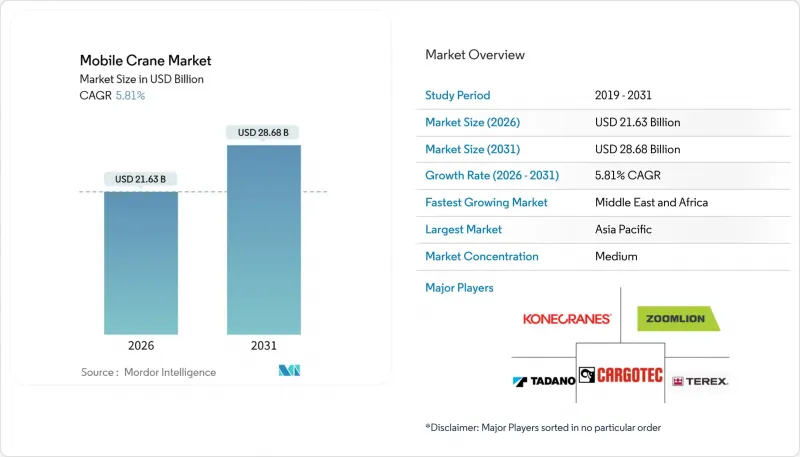
Mordor Intelligence에 따르면 이동식 크레인 시장 규모는 2026년에 216억 3,000만 달러로 추정되고 있으며, 예측 기간(2026-2031년)에 CAGR 5.81%로 추이하며, 2031년에는 286억 8,000만 달러에 달할 것으로 전망되고 있습니다.
이 보고서는 제품 유형(트럭 탑재형 등), 용도(건설, 광업·굴착 등), 최종사용자(렌탈 회사, 도급업체 등), 적재 능력(50톤 미만 등) 및 지역별로 분류되어 있습니다. 시장 전망은 금액(달러) 및 수량(대)으로 제시되어 있습니다.
전 세계 이동식 크레인 시장의 동향 및 인사이트
신흥 아시아 국가들의 건설 붐
중국과 인도는 고속도로, 지하철, 수자원 프로젝트에 사상 최고 수준의 자금을 지속적으로 투입하고 있으며, 이로 인해 이동식 크레인 시장은 향후 수년 동안 안정적인 수요 전망을 확보하고 있습니다. 인도의 경우, 정부가 인프라 개발을 위한 자본 지출을 대폭 늘릴 것이라고 발표했는데, 이는 국내 교통망과 도시 인프라 강화를 위한 노력을 반영한 것입니다. 마찬가지로 중국도 인프라 관련 고정자산 지출에서 꾸준한 성장을 보고하고 있으며, 인프라 네트워크의 확장과 현대화에 주력하고 있음을 보여줍니다. 아시아 인프라 투자 은행(AIIB)은 수많은 프로젝트에 막대한 자금을 투입함으로써 매우 중요한 역할을 수행하고 있으며, 트럭 탑재형 및 전지형 크레인의 수요를 견인하고 있습니다. 이러한 크레인은 인구 밀도가 높은 도시 지역과 접근이 어려운 외딴 지역 모두에서 효율적으로 작업을 수행하는 데 필수적입니다. 숙련된 조작자 부족이나 부품 공급 지연과 같은 과제가 있기는 하지만, 강력한 재정적 의지와 지속적인 인프라 구축 노력 덕분에 중기적으로는 공급망 혼란이 효과적으로 완화되고 있습니다.
5G 및 친환경 에너지 인프라에 대한 민관 차원의 급속한 투자
OECD 회원국에서는 기존의 토목 공사에 더해 디지털화 및 에너지 전환 프로젝트가 잇달아 시행됨에 따라 이동식 크레인 시장의 전망이 밝아지고 있습니다. GSMA의 예측에 따르면 향후 수년간 통신 사업자의 설비 투자는 계속해서 대규모 수준을 유지할 것으로 보이며, 그 주요 요인은 5G 네트워크 고밀도화에 대한 수요입니다. 이에 따라 타워용 및 옥상용 리프트 수요가 대폭 증가할 것으로 예상됩니다. 현재 하이퍼스케일 데이터센터의 확장이 가속화되고 있으며, 전력 소비량은 대폭 증가할 것으로 예측됩니다. 이러한 추세는 해당 시설을 지탱하기 위해 무거운 조립식 모듈을 정확하게 설치하는 것이 극히 중요함을 여실히 보여주고 있습니다. 영국의 ‘국가 인프라 전략’에서는 향후 10년 동안 해상 풍력발전 용량이 대폭 증가할 것에 대비해 송전망 업그레이드에 막대한 자금을 배정하고 있습니다. 이러한 노력으로 인해 시공업체들은 높은 용량과 효율적인 해체 주기를 겸비한 크레인을 우선적으로 선택해야 하는 상황에 놓여 있습니다. 또한 모듈식 건설 방식의 부상으로 인해 점점 더 촉박해지는 프로젝트 일정 속에서 고정밀 리프팅 작업을 반복적으로 수행해야 할 필요성이 커지고 있습니다.
철강 가격 변동이 OEM의 이익률을 압박
최근 수년간 미국 제철소 제품의 생산자물가지수는 큰 변동을 보였으며, 급등한 후 급격한 하락을 거쳐 비로소 안정되었습니다. 전지형 크레인에는 구조용 강재가 상당량 사용되고 있으므로 가격 급등기에 계약을 체결한 OEM(Original Equipment Manufacturer) 각사는 현재 이익률에 막대한 압박을 받고 있습니다. 한 대형 제조사는 원가 상승의 영향을 지적하며, 원자재 가격 변동에 따른 영향을 완화하기 위한 가격 인상이나 생산성 향상과 같은 전략의 중요성을 강조했습니다. 그러나 중소 제조사들은 이러한 변동에 대한 헤지 능력이 부족한 경우가 많아, 비용을 고객에게 전가할 수밖에 없으며, 그 결과 시장 경쟁력이 약화될 가능성이 있습니다. 또한 렌탈 사업자는 상품 가격 동향을 예측하기 어렵기 때문에 잔존 가치 예측에 어려움을 겪고 있습니다.
부문 분석
이동식 크레인 시장 규모를 제품 유형별로 살펴보면, 트럭 탑재형이 2025년 매출의 37.17%를 차지하는 반면, 전지형 크레인은 2031년까지 연평균 성장률(CAGR) 5.83%로 성장할 것으로 예측됩니다. Leupheld사의 ‘LTM 1650-8.1’과 Manitowoc사의 ‘Grove GMK6400-1’은 스테이지 V를 준수하는 단일 엔진 레이아웃이 연료 소비를 최소화하고 유지보수를 간소화하는 좋은 예입니다. 유럽과 북미의 운영업체들은 일반 도로 주행이 가능한 사양과 오프로드에서의 유연성을 겸비한 구성을 높이 평가하고 있으며, 이러한 조합이 차량 기단의 합리화를 촉진하고 있습니다. 신흥 시장에서는 도입 비용이 낮고 서비스 네트워크도 단순하므로 트럭 탑재형 크레인의 인기가 여전히 이어지고 있지만, 배기가스 규제가 강화됨에 따라 구매자들은 점차 최신 설계의 기종으로 전환하고 있습니다.
각 OEM사의 차별화는 모듈식 붐, 텔레매틱스, 하이브리드 구동 시스템에 중점을 두고 있습니다. XCMG의 XCA400L8은 하중 및 모멘트 모니터링과 아웃리거 자동 전개 기능을 통합하여 설치 시간을 단축했습니다. 이 기능 세트는 숙련된 운전자가 부족한 지역을 대상으로 합니다. 크롤러 크레인은 석유화학 및 해양 프로젝트에서 여전히 중요한 역할을 수행하고 있지만, 다양한 토목 공사에서의 가동률이 낮아 시장 점유율 확대는 제한적입니다. 불규칙 지형용 및 트레일러 탑재형 모델은 광업, 공공 시설 유지 관리, 산업 플랜트의 정지 작업을 대상으로 하고 있으나, 수요 증가는 안정적인 인프라 투자보다는 상품 시장의 주기에 좌우되고 있습니다. 이를 종합해 보면, 전지형 대응 부문의 시장 점유율 확대는 이동식 크레인 시장에서 범용성이 높고 배기가스 규제를 준수하는 장비로의 전환이 진행되고 있음을 나타냅니다.
주택, 상업, 공공 공사의 활성화로 인해 건설 분야는 2025년 이동식 크레인 시장 점유율 53.41%를 유지했습니다. 한편, 영국의 50GW 규모 해상 풍력발전, 대만의 멀티 기가와트 규모 입찰, 그리고 미국 대서양 연안의 초기 임대 프로젝트가 가동을 시작함에 따라 해양·오프쇼어 프로젝트는 2031년까지 연평균 성장률(CAGR) 5.88%를 기록할 것으로 예측됩니다. 카데라(Kadeler)사의 ‘윈드 피크(Wind Peak)’와 같이 2,500톤 크레인을 탑재한 설치선은 터빈의 신속한 적재를 가능하게 하여 사이클 타임을 단축할 뿐만 아니라, 집적항에서 피더 크레인에 대한 수요를 높이고 있습니다. 또한 데이터센터 및 반도체 팹의 산업용 모듈 역시 정밀한 중량물 운반을 필요로 하여, 텔레매틱스 기능을 갖춘 전지형 대응 유닛의 가동률 향상으로 이어지고 있습니다.
광업 및 굴착 분야는 여전히 경기 순환의 영향을 받고 있으며, 드래그라인의 교체는 상품 가격 동향에 좌우됩니다. 공공 사업 분야에서는 송전망 강화 예산과 전동 버킷 트럭 도입으로 혜택을 보고 있으며, 이는 보다 광범위한 전기화 정책을 반영하고 있습니다. 사우디아라비아와 아랍에미리트(UAE)에서는 해운 및 항만 인프라가 호황을 누리고 있습니다. NEOM 항구에는 리프헬(Leihhel) 사의 이동식 항만 크레인 10대가 도입되었으며, 물류 허브의 확장에 따라 장기적인 적재 수요가 예상됩니다. 전반적으로 건축 이외의 작업 범위 확대가 이동식 크레인 시장의 다양한 수요 기반을 지원하고 있습니다.
지역별 분석
아시아태평양은 중국의 인프라 지출이 꾸준히 증가하고 인도의 대규모 설비 투자 계획에 힘입어 2025년 이동식 크레인 시장 점유율의 38.86%를 차지했습니다. 오사카 엑스포와 같은 주요 행사와 선형 노선 등 교통 인프라 정비를 포함한 일본의 활발한 건설 활동이 계속해서 수요를 지원하고 있습니다. 한편, 한국의 건설기계 수출 호조는 해당 지역의 높은 제조 역량을 여실히 보여주고 있습니다. 인력 부족이나 공급망 혼란과 같은 과제는 여전히 존재하지만, 진행 중인 차량 교체 주기를 현저히 방해하는 요인은 아닙니다.
북미에서는 건설 활동에 대한 막대한 투자가 호재로 작용하고 있으며, 특히 비건축 구조물에 대한 집중이 두드러지고, 인공지능(AI)의 발전에 힘입어 데이터센터 프로젝트도 증가하고 있습니다. 금리 인상이 리스 시장에 미치는 영향은 있지만, 사업자들은 연방 정부의 세제 혜택과 주 차원의 인프라 보조금을 효과적으로 활용하여 장비 현대화 및 신기술 도입을 추진하고 있습니다. 캐나다에서는 프로젝트 규모가 비교적 작지만, 주요 사업은 여전히 에너지 인프라 및 교통 시스템 확장에 집중되어 있습니다. 유럽에서는 최근 경기 침체에서 회복세를 보이며 건설 활동이 다시 활기를 띠고 있습니다. 영국에서는 장기적인 인프라 정비 계획에 힘입어 꾸준한 성장이 나타나는 반면, 독일에서는 에너지 전환 노력이 육상 풍력 터빈의 교체를 주도하고 있습니다. 유럽연합(EU) 전역에서는 향후 수십년에 걸친 야심찬 인프라 목표에 힘입어 대규모 운송 및 송전망 프로젝트에서 중량물 운반용 중장비 수요가 유지될 것으로 예상됩니다.
남미에서는 발전 속도가 다소 완만하지만, 브라질의 건설 부문은 수많은 양도 사업 및 민관협력(PPP) 구상을 위한 정부 자금의 지원에 힘입어 완만한 성장을 보이고 있습니다. 아르헨티나가 거시경제의 불안정성으로 어려움을 겪고 있음에도 불구하고 BNDES의 대출 승인은 특정 분야에 유동성이 존재함을 보여줍니다. 중동 및 아프리카는 사우디아라비아의 프로젝트 계획과 아랍에미리트(UAE)의 물류 인프라 현대화에 힘입어 5.87%라는 가장 높은 연평균 성장률(CAGR)을 기록하고 있습니다. NEOM의 리프헬(Leihhel)사 항만 크레인 10대 도입은 대규모 토목 공사의 활성화를 상징하는 사례이며, 한편 남아프리카공화국은 인프라 지출을 확대하기 전에 전력 공급의 안정화를 추진하고 있습니다.
기타 혜택:
- Excel 형식의 시장 예측(ME) 시트
- 3개월간의 애널리스트 지원
자주 묻는 질문
목차
제1장 서론
제2장 분석 방법
제3장 개요
제4장 시장 구도
제5장 시장 규모·성장률 예측
제6장 경쟁 구도
제7장 시장 기회와 향후 전망
KSA 26.08.26According to Mordor Intelligence, the mobile crane market size is estimated at USD 21.63 billion in 2026, and is expected to reach USD 28.68 billion by 2031, at a CAGR of 5.81% during the forecast period (2026-2031).
This report is Segmented by Product Type (Truck-Mounted and More), Application (Construction, Mining & Excavation, and More), End User (Rental Companies, Contractors, and More), Lifting Capacity (Below 50 Tons and More), and Geography. The Market Forecasts are in Value (USD) and Volume (Units).
Global Mobile Crane Market Trends and Insights
Construction Boom in Emerging Asia
China and India continue to allocate record capital toward highways, metros, and water projects, ensuring multi-year visibility for the mobile crane market . In India, the government has announced a substantial increase in capital outlays for infrastructure development, reflecting its commitment to enhancing the country's connectivity and urban infrastructure. Similarly, China has reported consistent growth in its fixed-asset infrastructure spending, demonstrating its focus on expanding and modernizing its infrastructure network. The Asian Infrastructure Investment Bank has played a pivotal role by committing substantial funding across numerous projects, driving demand for truck-mounted and all-terrain cranes. These cranes are crucial for efficiently operating in both densely populated urban areas and remote, less accessible regions. Despite challenges such as a shortage of skilled operators and delays in the availability of components, the strong financial commitments and ongoing infrastructure initiatives are effectively mitigating supply-chain disruptions over the medium term.
Rapid Public-Private Spending on 5G & Green-Energy Infrastructure
OECD nations are expanding the mobile crane market's horizons by layering digital and energy-transition projects atop traditional civil works. GSMA forecasts that operator capital expenditures will remain substantial in the coming years, primarily driven by the need for 5G densification, which is expected to significantly increase demand for tower and rooftop lifts . Currently, the expansion of hyperscale data centers is gaining momentum, with electricity consumption projected to grow considerably. This trend highlights the critical need for precise placement of heavy prefabricated modules to support these facilities . The UK's National Infrastructure Strategy has allocated significant funding for grid upgrades, aiming to accommodate a substantial increase in offshore wind capacity over the next decade. This initiative compels contractors to prioritize cranes that offer both high capacity and efficient rig-down cycles. Furthermore, the rise of modular construction methods is intensifying the demand for repeated high-accuracy lifts, all within increasingly compressed project schedules.
Steel Price Volatility Squeezing OEM Margins
In recent years, the Producer Price Index for U.S. steel mill products experienced significant fluctuations, with a sharp increase followed by a notable decline before stabilizing. Since a substantial portion of structural steel is embedded in all-terrain cranes, original equipment manufacturers (OEMs) that entered into contracts during the period of elevated prices are now facing considerable pressure on their profit margins. A leading manufacturer highlighted the impact of rising costs, emphasizing the importance of strategies such as price surcharges and productivity improvements to mitigate the effects of volatile material costs. Smaller brands, however, often lack the ability to hedge against such fluctuations, forcing them to pass on costs to customers, which can undermine their competitiveness in the market. Additionally, rental fleets are encountering difficulties in forecasting residual values due to the unpredictable nature of commodity price trends.
Other drivers and restraints analyzed in the detailed report include:
- Fleet Renewal Driven by Stage V / Tier 4-Final Emission Mandates
- Modular Boom Designs Slashing Transport Time
- Skilled-Operator Shortages in OECD
For complete list of drivers and restraints, kindly check the Table Of Contents.
Segment Analysis
The mobile crane market size attributed to product types shows truck-mounted units capturing 37.17% of 2025 revenue, while all-terrain cranes are projected to grow at a 5.83% CAGR through 2031. Liebherr's LTM 1650-8.1 and Manitowoc's Grove GMK6400-1 demonstrate how Stage V-compliant single-engine layouts cut fuel use by minimal and simplify maintenance. Operators in Europe and North America value the highway-legal configuration paired with off-road flexibility, a combination that encourages fleet rationalization. Emerging markets retain a preference for truck-mounted cranes because of lower acquisition cost and simpler service networks, yet stricter emission rules are slowly nudging buyers toward modern designs.
OEM differentiation is focusing on modular booms, telematics, and hybrid drivetrains. XCMG's XCA400L8 integrates load-moment monitoring and automated outrigger deployment to reduce setup time, a feature set aimed at regions facing skilled-operator shortfalls. Crawler cranes maintain relevance for petrochemical and offshore projects, but their lower utilization rates in diverse civil work limit share gains. Rough-terrain and trailer-mounted models target mining, utility maintenance, and industrial plant shut-downs, yet incremental demand rests on commodity cycles rather than steady infrastructure spending. Taken together, the all-terrain segment's rising share underscores a pivot toward versatile, emission-compliant equipment in the mobile crane market.
Construction retained 53.41% of the 2025 mobile crane market share due to housing, commercial, and public works activity. Marine and offshore projects, however, are forecast to post a 5.88% CAGR to 2031 as 50 GW of U.K. offshore wind, Taiwanese multi-gigawatt rounds, and early U.S. Atlantic leases come online. Installation vessels such as Cadeler's Wind Peak with a 2,500-tonne crane enable rapid turbine stacking, cutting cycle times, and raising demand for feeder cranes at marshaling ports. Industrial modules at data centers and semiconductor fabs also require precise heavy lifts, feeding higher utilization rates for telematics-equipped all-terrain units.
Mining and excavation remain cyclical, with dragline replacements tied to commodity price trends. Utility applications benefit from grid-reinforcement budgets and the roll-out of electric bucket trucks, reflecting broader electrification policies. Shipping and port infrastructure are buoyant in Saudi Arabia and the UAE, where the Port of NEOM deployed ten Liebherr mobile harbor cranes, signaling long-term lift demand as logistics hubs scale up. Collectively, the widening scope of non-building work sustains a diversified demand base within the mobile crane market.
Complete Report Scope:
- By Product Type
- Truck-Mounted Cranes
- Trailer-Mounted Cranes
- Crawler Cranes
- All-Terrain Cranes
- Rough Terrain Cranes
- Others
- By Application
- Construction
- Mining & Excavation
- Industrial Applications
- Marine & Offshore
- Utility
- Shipping & Port Building
- By End User
- Rental Companies
- Construction Contractors
- Government & Municipalities
- Industrial Operators
- By Lifting Capacity
- Below 50 Tons
- 50-150 Tons
- 151-300 Tons
- Above 300 Tons
- By Geography
- North America
- United States
- Canada
- Rest of North America
- South America
- Brazil
- Argentina
- Rest of South America
- Europe
- Germany
- United Kingdom
- France
- Italy
- Spain
- Rest of Europe
- Asia Pacific
- China
- India
- Japan
- South Korea
- Rest of Asia Pacific
- Middle East and Africa
- United Arab Emirates
- Saudi Arabia
- South Africa
- Turkey
- Rest of Middle East and Africa
- North America
Geography Analysis
Asia-Pacific captured 38.86% of the 2025 mobile crane market share, driven by steady growth in infrastructure spending in China and a substantial capital expenditure plan in India. Japan's robust construction activities, including major events like the Osaka Expo and advancements in transportation infrastructure such as maglev routes, continue to sustain demand. Meanwhile, South Korea's strong performance in construction-equipment exports highlights the region's manufacturing capabilities. Although challenges such as labor shortages and supply-chain disruptions persist, they have not significantly hindered the ongoing fleet-renewal cycles.
North America benefits from substantial investments in construction activities, with a notable focus on nonbuilding structures and a growing number of data-center projects fueled by advancements in artificial intelligence. Despite the impact of higher interest rates on leasing markets, operators are effectively leveraging federal tax incentives and state-level infrastructure grants to modernize equipment and adopt newer technologies. In Canada, while the scope of projects is narrower, key initiatives remain centered on energy infrastructure and transit system expansions. Europe, recovering from a recent downturn, is witnessing a resurgence in construction activities. The United Kingdom is experiencing steady growth, supported by a long-term infrastructure roadmap, while Germany's energy transition efforts are driving the repowering of onshore turbines. Across the European Union, ambitious infrastructure goals over the coming decades are expected to sustain demand for heavy-lift equipment in large-scale transport and grid projects.
South America is progressing at a slower pace, with Brazil's construction sector showing gradual growth, supported by government funding directed toward numerous concession and public-private partnership initiatives. BNDES credit approvals underscore selective liquidity pockets even as Argentina wrestles with macro instability. The Middle East & Africa corridor holds the fastest 5.87% CAGR, fueled by Saudi Arabia's project slate and UAE logistics upgrades. NEOM's deployment of ten Liebherr harbor cranes exemplifies the heavy civil tempo, while South Africa pushes to stabilize power supply before scaling infrastructure outlays.
- Liebherr-International AG
- XCMG Construction Machinery Co., Ltd
- Zoomlion Heavy Industry Science & Technology Co., Ltd
- SANY Heavy Industry Co., Ltd
- Tadano Ltd
- The Manitowoc Company, Inc
- Terex Corporation
- Kobelco Construction Machinery Co., Ltd
- Cargotec Corporation
- Konecranes Plc
- Hitachi Sumitomo Heavy Industries Construction Crane Co., Ltd
- Palfinger AG
- Sarens NV
- ZoomBoom Crane Inc
- Manitex International Inc
- Fassi Gru S.p.A.
- Sennebogen Maschinenfabrik GmbH
- Elliott Equipment Company
- Franna
- Furukawa UNIC Corporation
Additional Benefits:
- The market estimate (ME) sheet in Excel format
- 3 months of analyst support
TABLE OF CONTENTS
1 Introduction
- 1.1 Study Assumptions & Market Definition
- 1.2 Scope of the Study
2 Research Methodology
3 Executive Summary
4 Market Landscape
- 4.1 Market Overview
- 4.2 Market Drivers
- 4.2.1 Construction Boom in Emerging Asia
- 4.2.2 Rapid Public-Private Spending on 5G & Green-Energy Infrastructure (OECD Nations)
- 4.2.3 Fleet Renewal Driven by Stage V / Tier 4-Final Emission Mandates (EU & NA)
- 4.2.4 Modular Boom Designs Slashing Transport/Setup Time
- 4.2.5 Accelerating De-Risking of Offshore Wind Installation Through "Feeder" Jack-Ups
- 4.2.6 Growing Demand for Small-Footprint Cranes on Urban Infill Sites
- 4.3 Market Restraints
- 4.3.1 Steel Price Volatility Squeezing OEM Margins
- 4.3.2 Skilled-Operator Shortages in OECD
- 4.3.3 Grid-Carbon-Intensity Rules Delaying Diesel Crane Permits
- 4.3.4 Financing Hurdles for Rental Fleets Amid Rising Interest Rates
- 4.4 Value / Supply-Chain Analysis
- 4.5 Regulatory Landscape
- 4.6 Technological Outlook
- 4.7 Porter's Five Forces
- 4.7.1 Threat of New Entrants
- 4.7.2 Bargaining Power of Suppliers
- 4.7.3 Bargaining Power of Buyers
- 4.7.4 Threat of Substitutes
- 4.7.5 Competitive Rivalry
5 Market Size & Growth Forecasts (Value (USD) and Volume (Units))
- 5.1 By Product Type
- 5.1.1 Truck-Mounted Cranes
- 5.1.2 Trailer-Mounted Cranes
- 5.1.3 Crawler Cranes
- 5.1.4 All-Terrain Cranes
- 5.1.5 Rough Terrain Cranes
- 5.1.6 Others
- 5.2 By Application
- 5.2.1 Construction
- 5.2.2 Mining & Excavation
- 5.2.3 Industrial Applications
- 5.2.4 Marine & Offshore
- 5.2.5 Utility
- 5.2.6 Shipping & Port Building
- 5.3 By End User
- 5.3.1 Rental Companies
- 5.3.2 Construction Contractors
- 5.3.3 Government & Municipalities
- 5.3.4 Industrial Operators
- 5.4 By Lifting Capacity
- 5.4.1 Below 50 Tons
- 5.4.2 50-150 Tons
- 5.4.3 151-300 Tons
- 5.4.4 Above 300 Tons
- 5.5 By Geography
- 5.5.1 North America
- 5.5.1.1 United States
- 5.5.1.2 Canada
- 5.5.1.3 Rest of North America
- 5.5.2 South America
- 5.5.2.1 Brazil
- 5.5.2.2 Argentina
- 5.5.2.3 Rest of South America
- 5.5.3 Europe
- 5.5.3.1 Germany
- 5.5.3.2 United Kingdom
- 5.5.3.3 France
- 5.5.3.4 Italy
- 5.5.3.5 Spain
- 5.5.3.6 Rest of Europe
- 5.5.4 Asia Pacific
- 5.5.4.1 China
- 5.5.4.2 India
- 5.5.4.3 Japan
- 5.5.4.4 South Korea
- 5.5.4.5 Rest of Asia Pacific
- 5.5.5 Middle East and Africa
- 5.5.5.1 United Arab Emirates
- 5.5.5.2 Saudi Arabia
- 5.5.5.3 South Africa
- 5.5.5.4 Turkey
- 5.5.5.5 Rest of Middle East and Africa
- 5.5.1 North America
6 Competitive Landscape
- 6.1 Market Concentration
- 6.2 Strategic Moves
- 6.3 Market Share Analysis
- 6.4 Company Profiles (includes Global Level Overview, Market Level Overview, Core Segments, Financials as Available, Strategic Information, Market Rank/Share for Key Companies, Products and Services, SWOT Analysis, and Recent Developments)
- 6.4.1 Liebherr-International AG
- 6.4.2 XCMG Construction Machinery Co., Ltd
- 6.4.3 Zoomlion Heavy Industry Science & Technology Co., Ltd
- 6.4.4 SANY Heavy Industry Co., Ltd
- 6.4.5 Tadano Ltd
- 6.4.6 The Manitowoc Company, Inc
- 6.4.7 Terex Corporation
- 6.4.8 Kobelco Construction Machinery Co., Ltd
- 6.4.9 Cargotec Corporation
- 6.4.10 Konecranes Plc
- 6.4.11 Hitachi Sumitomo Heavy Industries Construction Crane Co., Ltd
- 6.4.12 Palfinger AG
- 6.4.13 Sarens NV
- 6.4.14 ZoomBoom Crane Inc
- 6.4.15 Manitex International Inc
- 6.4.16 Fassi Gru S.p.A.
- 6.4.17 Sennebogen Maschinenfabrik GmbH
- 6.4.18 Elliott Equipment Company
- 6.4.19 Franna
- 6.4.20 Furukawa UNIC Corporation
7 Market Opportunities & Future Outlook
- 7.1 White-space & Unmet-Need Assessment


