

|
시장보고서
상품코드
2114134
터빈 제어 시스템 : 시장 점유율 분석, 산업 동향 및 통계 데이터, 성장 예측(2026-2031년)Turbine Control System - Market Share Analysis, Industry Trends & Statistics, Growth Forecasts (2026 - 2031) |
||||||
 Mordor Intelligence
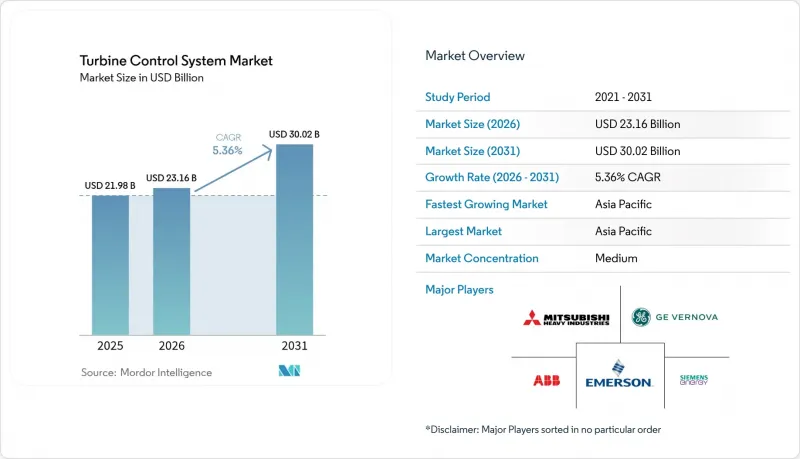
Mordor Intelligence에 따르면 터빈 제어 시스템 시장 규모는 2025년에 219억 8,000만 달러로 평가되며, 2026년 231억 6,000만 달러에서 2031년까지 300억 2,000만 달러에 달할 것으로 예측되고 있으며, 예측 기간(2026-2031년)에 CAGR은 5.36%에 달할 전망입니다.
이 보고서는 유형별(가스 터빈 제어 시스템, 풍력 터빈 제어 시스템 등), 기능별(속도 제어, 부하 제어, 온도 제어, 압력 제어, 기타 기능),구성 요소별(컨트롤러·PLC, 서비스 등), 최종사용자별(발전 사업자, 독립 서비스 제공업체 등) 및 지역별(북미, 유럽, 아시아태평양 등)로 분류되어 있습니다.
전 세계 터빈 제어 시스템 시장의 동향 및 인사이트
풍력발전 용량 확대에 따른 정교한 피치·요 제어의 필요성
최신 15MW급 해상 풍력 터빈은 로터 직경이 240m를 넘는 규모로 가동되고 있으며, 이로 인해 공력 하중과 구조적 피로가 증가하고 있습니다. 따라서 제어 소프트웨어는 20밀리초 주기로 피치, 요, 토크 명령을 통합하여 출력과 블레이드의 변형 균형을 조정하고 있습니다. 유럽 및 중국의 계통 연계 규정에서는 풍력발전소에 주파수 지원 제공이 의무화되어 있으며, 제어 장치는 회전 관성을 시뮬레이션하기 위해 유효 전력을 일시적으로 낮출 수밖에 없습니다. 부유식 설비의 경우, 나셀이 계류 로프의 동적 거동과 실시간으로 조화를 이루어야 하므로 요구 수준은 더욱 높아집니다. 고정밀 공기역학적 탄성 모델과 엣지 컴퓨팅 프로세서를 갖춘 각 공급업체들은 이 급성장하는 터빈 제어 시스템 시장에서 점유율을 확대하고 있습니다.
전 세계 가스 터빈 설비의 신뢰성 향상
복합 사이클 발전 블록이 베이스로드에서 피크 부하 대응으로 전환됨에 따라 고온부 부품은 온도 사이클의 증가와 잠재적인 화염 불안정성에 직면하고 있습니다. 미쓰비시 중공업의 A-CPFM 플랫폼은 연소 루프에 기계학습을 통합하여, 제어 장치가 연료 혼합비를 미세 조정하고 진동에 의한 트립을 방지할 수 있게 합니다. 이 기능은 현재 미시시피주의 600MW 잭슨 발전소에서 실증되고 있습니다. 수소 혼입은 화염 속도나 발열량이 순수 메탄과 다르기 때문에 추가적인 복잡성을 초래합니다. 따라서 자연 발화를 방지하기 위해서는 제어 로직이 이러한 변수들을 추적해야 합니다. 특히 해수 담수화에 열병합 발전 설비에 의존하고 있는 중동 지역의 발전소 소유주들은 99%를 초과하는 가동률을 확보하기 위해 소프트웨어 개량을 최우선 과제로 삼고 있습니다.
재생에너지 확대에 따라 감소하는 화석연료 관련 설비 투자
바텐팔(Vattenfall)과 같은 유럽의 전력 회사들은 해상 풍력발전 및 배터리 저장 프로젝트에 대한 투자 자금을 확보하기 위해 석탄 및 가스 자산을 매각하거나 가동을 중단하고 있습니다. 이러한 자산 매각으로 인해 터빈 제어 시스템을 새로 도입해야 할 시장 규모는 축소되고 있습니다. 남아 있는 화석 연료 사업자들은 제어실의 전면적인 개조보다는 주로 배출 규제 준수 및 유연한 운전을 실현하기 위한 개조 등, 가장 필요한 업그레이드에만 예산을 집중하고 있습니다. 그 결과, 신규 하드웨어 도입 프로젝트에서 기존 설비의 최적화 계약으로 전환되고 있으며, 터빈 제어 시스템 업계에서 소프트웨어 라이선싱 및 현장 서비스에 대한 전문 지식에 대한 수요는 증가하고 있으나, 전반적인 수익 확대는 둔화되고 있습니다.
부문 분석
2025년, 터빈 제어 시스템 시장의 43.40%를 가스 발전 플랫폼이 차지했습니다. 이는 베이스로드의 핵심으로서의 역할과 재생 가능 에너지 출력이 감소했을 때 신속하게 대응하는 유닛으로서의 역할, 이 두 가지 역할에 기반한 우위성 때문입니다. 기계학습을 접목한 연소 제어를 통해 현재 시동시 연료 소비량을 최대 10%까지 절감할 수 있게 되었으며, 변동이 심한 현물 가격에 노출된 상사 계열 발전소 운영사들로부터 이러한 절감 효과가 열렬히 환영받고 있습니다. 한편, 풍력발전용 솔루션은 2026-2031년에 연평균 성장률(CAGR) 7.16%로 확대될 것으로 예측됩니다. 이는 후류 상호작용 및 계통 지원 업무에 대응하기 위한 다축 제어가 필요한, 연간 20GW 규모의 전 세계 해상 풍력발전소 증설이 원동력이 되고 있습니다. 증기 및 수력 발전 분야는 성숙기에 접어들었으나, 특히 양수식 수력 발전이 장기 에너지 저장 용도로 전환되는 분야에서는 여전히 적정한 투자가 이루어지고 있습니다.
가스의 주도적 지위를 지원하는 두 번째 요인은 수소 대응 체계의 구축입니다. 각 OEM 업체들은 혼합 비율이 30%를 초과할 경우, 연소 온도 맵과 희석 가스 유량 곡선을 조정하는 소프트웨어 업데이트를 제공하고 있습니다. 그 결과, GE 7F나 지멘스 SGT-800 기종을 보유한 사업자들은 하드웨어를 전면 교체하는 대신 제어 플랫폼을 단계적으로 업그레이드하는 방안을 선택하고 있습니다. 대조적으로, 풍력발전 분야에서는 제한된 해상 대역폭에도 불구하고 피드백 루프를 5밀리초 미만으로 유지할 수 있도록 나셀에 직접 탑재된 분산형 엣지 프로세서가 채택되고 있습니다. 이러한 아키텍처의 변혁으로 인해 IT 분야를 전문으로 하는 신규 진입 기업이 터빈 제어 시스템 시장에 진입하고 있습니다.
2025년 매출에서 속도 제어의 비중은 31.95%로, 이는 증기, 가스, 수력, 풍력발전 설비 모두에 보편적으로 적용된다는 점을 반영합니다. 그럼에도 불구하고 진동 억제, 연소 배기가스, 사이버 침입 감시 등의 보조 패키지는 합계 연평균 성장률(CAGR) 6.05%를 기록할 전망입니다. 배출가스 제어 모듈은 단순한 룩업 테이블에서 NOx 목표치, 상승률, 연료 혼합비를 실시간으로 균형 있게 조절하는 적응형 신경망 제어기로 전환되는 추세를 보이고 있습니다. 일회통형 증기 발생기에서 매우 중요한 압력 제어 로직도 업그레이드가 진행되고 있으며, 새로운 알고리즘이 가변 속도 급수 펌프를 조정하여 드럼 수위의 진동을 억제하고 있습니다. 모든 기능에 공통적으로 나타나는 경향은 ‘수렴’입니다. 과거에는 개별 컨트롤러가 필요했던 여러 가지 고급 애플리케이션을 단일 고가용성 PLC가 통합하여 처리하게 됨에 따라 설치 공간과 유지보수가 효율화되고 있습니다.
그리드 코드 개정에 따라 관성, 주파수 라이드스루, 블랙 스타트 요건이 엄격해짐에 따라 이러한 새로운 기능에 기인한 터빈 제어 시스템 시장 규모는 2031년까지 61억 8,000만 달러를 넘어설 것으로 예상됩니다. 발전소 운영자에게는 고급 기능을 단일 라이선스로 통합함으로써 규정 준수 감사가 간소화되어, 이에 따라 도입이 더욱 촉진될 것입니다.
지역별 분석
아시아태평양은 2025년 매출의 38.05%를 차지하고 있으며, 2031년까지 연평균 5.78%의 성장률을 보일 것으로 예측됩니다. 현재 중국의 해상 풍력발전 입찰에서는 그리드 포밍 기능이 규정되어 있으며, 개발업자는 입찰 단계부터 다기능 컨트롤러의 채택을 지정해야 합니다. 인도의 약 44GW에 달하는 아임계 석탄 화력 발전 설비의 개보수 및 현대화 프로그램도 터빈 제어 시스템 시장에 새로운 수주를 가져오고 있습니다. 동남아시아 국가들, 특히 태국에서는 5,300MW 규모의 반 파콩(Bang Pakong) CCGT 프로젝트라는 획기적인 성과를 바탕으로, 단일 500 kV 버스 상에서 8기의 유닛을 동기화하는 제어 시스템을 갖춘 고효율 J급 가스 터빈을 조달하고 있습니다.
북미는 텍사스주, 버지니아주, 앨버타주의 데이터센터 집적에 힘입어 여전히 2위 규모의 지역을 자랑하고 있습니다. 현지 전력 회사는 터빈 OEM 제조사와 협력하여 ‘블랙 파크(Black Park)’ 모드를 공동 개발하고 있습니다. 이를 통해 항공기용 터빈 유닛은 송전망 장애시 섬세한 IT 부하를 독립 운전으로 지원할 수 있게 됩니다. 이 기능은 터빈 제어 시스템 업계에서 상당한 서비스 프리미엄을 가져다주고 있습니다. 환경 당국이 메탄에서 수소로의 전환을 중시하고 있는 점도 제어 소프트웨어에 대한 지출을 더욱 가속화하고 있습니다. 이는 기존 터빈에 변동하는 워베 지수의 연료에 대응할 수 있는 로직을 구현해야 하기 때문입니다.
유럽에서는 유연한 운영과 사이버 복원력이 매우 중요하게 여겨지고 있습니다. 독일의 계통 운영 사업자는 현재 2초 미만의 고속 주파수 응답에 대해 인센티브를 지급하고 있으며, 개조된 증기 발전 유닛에 대해 오버파이어 로직 및 고도화된 거버너 밸브 시퀀스의 도입을 장려하고 있습니다. 동시에, EU의 NIS2 규정은 사이버 보안 의무에 법적 구속력을 부여하고 있으며, 발전소 소유주에게 모니터링 기능이 있는 방화벽 및 이상 탐지 분석 시스템의 도입을 촉구하고 있습니다. 이러한 요인들로 인해 화석 연료를 사용하는 신규 발전소 건설은 드물지만, 소프트웨어 및 서비스 수익은 유지되고 있습니다.
중동 및 아프리카에서는 해수 담수화 및 가스 중류 사업을 위한 복합 사이클 및 기계 구동 프로젝트가 계속해서 활발히 진행되고 있습니다. 높은 주변 온도와 먼지로 인해 압축기의 서지 마진을 예측하고 서지를 방지하기 위해 흡기 블리드 냉각 시퀀스를 자동화하는 제어 알고리즘이 필요합니다. 남미 성장의 중심은 브라질의 양수 발전 자산이며, 이곳에서는 발전과 구동을 번갈아 수행하는 4사분면 터빈이 채택되어 있으며, 최신 컨트롤러만이 조정 가능한 고급 전환 제어가 요구됩니다.
기타 혜택:
- Excel 형식의 시장 예측(ME) 시트
- 3개월간의 애널리스트 지원
자주 묻는 질문
목차
제1장 서론
제2장 분석 방법
제3장 개요
제4장 시장 구도
제5장 시장 규모·성장률 예측
제6장 경쟁 구도
제7장 시장 기회와 향후 전망
KSA 26.08.26According to Mordor Intelligence, the turbine control system market size was valued at USD 21.98 billion in 2025 and estimated to grow from USD 23.16 billion in 2026 to reach USD 30.02 billion by 2031, at a CAGR of 5.36% during the forecast period (2026-2031).
This report is Segmented by Type (Gas Turbine Control Systems, Wind Turbine Control Systems, and More), Function (Speed Control, Load Control, Temperature Control, Pressure Control, and Other Functions), Component (Controllers and PLCs, Services, and More), End-User (Power Generation Utilities, Independent Service Providers, and More), and Geography (North America, Europe, Asia-Pacific, and More).
Global Turbine Control System Market Trends and Insights
Expansion of Wind Capacity Requiring Advanced Pitch & Yaw Controls
Modern 15-MW offshore turbines operate with rotor diameters exceeding 240 m, magnifying aerodynamic loads and structural fatigue. Their control software, therefore, blends pitch, yaw, and torque commands in 20-millisecond cycles to balance power extraction against blade strain. Grid codes in Europe and China add another layer by compelling wind farms to contribute frequency support, forcing controllers to momentarily reduce active power to emulate spinning inertia. Floating installations raise the bar again, as the nacelle must coordinate with mooring-line dynamics in real-time. Suppliers armed with high-fidelity aeroelastic models and edge-computing processors are capturing share in this fast-growing slice of the turbine control systems market.
Reliability Push in Global Gas-Turbine Fleet
As combined-cycle blocks transition from baseload to peaker duty, hot-section parts experience increased temperature cycling and potential flame instability. Mitsubishi Heavy Industries' A-CPFM platform integrates machine learning into the combustion loop, enabling the controller to fine-tune fuel splits and eliminate vibration-driven trips -a feature now validated at the 600 MW Jackson facility in Mississippi. Hydrogen blending introduces further complexity because the flame speed and calorific value differ from those of pure methane; therefore, control logic must track these variables to prevent auto-ignition events. Plant owners, especially in the Middle East, where water desalination relies on cogeneration units, are prioritizing software retrofits that ensure greater than 99% availability.
Declining Fossil CAPEX as Renewables Scale
European utilities such as Vattenfall have sold or mothballed coal and gas assets to unlock capital for offshore wind and battery projects. These divestments lower the addressable base for new turbine control installations. Remaining fossil operators funnel budgets into only the most necessary upgrades-chiefly emissions-compliance and flexible-operation retrofits-rather than full control-room overhauls. The net effect is a shift from green-field hardware awards to brown-field optimization contracts, which tempers overall revenue expansion even as it boosts demand for software licensing and field-service expertise within the turbine control systems industry.
Other drivers and restraints analyzed in the detailed report include:
- AI Data-Center Peak-Demand Surges Driving Fast-Ramp Controls
- Digital-Twin-Enabled Predictive Maintenance
- Cyber-Security & Integration Complexity in Brown-Field Retrofits
For complete list of drivers and restraints, kindly check the Table Of Contents.
Segment Analysis
Gas platforms supplied 43.40% of the turbine control systems market in 2025, a lead built on their dual role as baseload anchors and rapid-response units when renewable output sags. Machine-learning-infused combustion control now trims start-up fuel consumption by up to 10%, a saving eagerly adopted by merchant-plant operators exposed to volatile spot prices. Conversely, wind solutions are projected to climb a 7.16% CAGR slope between 2026 and 2031, driven by 20 GW per year of global offshore additions that require multi-axis control to handle wake interactions and grid-support duties. The steam and hydro categories, while mature, continue to experience moderate spending, particularly where pumped-storage hydropower is repurposed for long-duration energy storage.
A second factor sustaining gas leadership is hydrogen readiness. OEMs are shipping software updates that adjust firing-temperature maps and diluent-flow curves if blend ratios exceed 30%. Owners of GE 7F and Siemens SGT-800 fleets are therefore opting for incremental control-platform upgrades rather than full hardware swaps. Wind, by contrast, is embracing distributed-edge processors mounted directly in the nacelle so that feedback loops stay below 5 ms despite limited offshore bandwidth. Those architecture shifts are drawing IT-oriented entrants into the turbine control systems market.
Speed control represented 31.95% of 2025 revenues, reflecting its universality across steam, gas, hydro, and wind machines. Even so, auxiliary packages such as vibration suppression, combustion emissions, and cyber-intrusion monitoring will together post a 6.05% CAGR. Emissions modules are trending from simple lookup tables toward adaptive neural-network regulators that balance NOx targets, ramp rates, and fuel blends in real-time. Pressure-control logic, critical in once-through steam generators, is also being upgraded, with new algorithms coordinating variable-speed feed-water pumps to dampen drum-level oscillations. Across all functions, the guiding pattern is convergence: a single high-availability PLC now hosts multiple advanced applications that once required separate controllers, streamlining footprint and maintenance.
The turbine control systems market size attributed to these emerging functions is poised to surpass USD 6.18 billion by 2031 as grid-code revisions tighten inertia, frequency-ride-through, and black-start requirements. For fleet managers, bundling advanced functions into a single license simplifies compliance audits, thereby further boosting adoption.
Complete Report Scope:
- By Type
- Steam Turbine Control Systems
- Gas Turbine Control Systems
- Wind Turbine Control Systems
- Hydro Turbine Control Systems
- By Function
- Speed Control
- Load Control
- Temperature Control
- Pressure Control
- Other Functions
- By Component
- Controllers and PLCs
- Sensors and Transducers
- HMI and SCADA Software
- Actuators and Valves
- Services (Installation, Retrofit, Cyber-security)
- By End-user
- Power Generation Utilities
- Oil and Gas (Upstream, Midstream, Downstream)
- Process Industries (Chemicals, Paper, Metals)
- Marine and Aviation
- Independent Service Providers
- By Geography
- North America
- United States
- Canada
- Mexico
- Europe
- Germany
- United Kingdom
- France
- Italy
- NORDIC Countries
- Russia
- Rest of Europe
- Asia-Pacific
- China
- India
- Japan
- South Korea
- ASEAN Countries
- Rest of Asia-Pacific
- South America
- Brazil
- Argentina
- Chile
- Rest of South America
- Middle East and Africa
- Saudi Arabia
- United Arab Emirates
- South Africa
- Nigeria
- Rest of Middle East and Africa
- North America
Geography Analysis
The Asia-Pacific region commanded 38.05% of 2025 revenue and is projected to expand at a 5.78% annual rate through 2031. Chinese offshore wind auctions now stipulate grid-forming capability, prompting developers to specify multi-function controllers right at the bidding stage. India's renovation and modernization program for ~44 GW of subcritical coal units also generates new orders for the turbine control systems market. Southeast Asian countries, particularly Thailand, following its 5,300 MW Bang Pakong CCGT milestone, procure high-efficiency J-class gas turbines whose control suites synchronize eight units across a single 500 kV bus.
North America remains the second-largest region, buoyed by data-center clustering in Texas, Virginia, and Alberta. Local utilities collaborate with turbine OEMs to co-develop "black-park" modes so that aeroderivative units can island sensitive IT loads during grid faults, a capability that commands sizeable service premiums in the turbine control systems industry. Environmental agencies' emphasis on the methane-to-hydrogen transition further accelerates control-software spending, as existing turbines must receive logic capable of handling variable Wobbe-index fuels.
Europe places a strong emphasis on flexible operations and cyber-resilience. Germany's grid operator now rewards fast frequency response of less than 2 seconds, encouraging retrofitted steam units to implement over-fire logic plus advanced governor-valve sequencing. Simultaneously, the EU NIS2 regulation adds legal teeth to cybersecurity obligations, prompting plant owners to adopt monitored firewalls and anomaly-detection analytics. These factors sustain software and services revenue even though green-field fossil builds are rare.
In the Middle East and Africa, combined-cycle and mechanical-drive projects for desalination and midstream gas continue to be active. High ambient temperatures and dust necessitate control algorithms that anticipate compressor surge margins and automate inlet-bleed cooling sequences to prevent compressor surge. South American growth centers on Brazil's pumped-storage assets, which now engage four-quadrant turbines that alternate between generation and motoring, requiring sophisticated transitions that only the latest controllers can coordinate.
- ABB Ltd
- Emerson Electric Co.
- General Electric (GE Vernova)
- Siemens Energy AG
- Honeywell International Inc.
- Rockwell Automation Inc.
- Mitsubishi Heavy Industries Ltd
- Rolls-Royce plc
- Schneider Electric SE
- Woodward Inc.
- Yokogawa Electric Corp.
- Baker Hughes Co.
- Mita-Teknik A/S
- Innoway-Sea Group
- Turbine Controls Ltd
- Eaton Corporation
- Hitachi Energy Ltd
- CCC (Compressor Controls Corp.)
- Voith Turbo GmbH
- Bosch Rexroth AG
Additional Benefits:
- The market estimate (ME) sheet in Excel format
- 3 months of analyst support
TABLE OF CONTENTS
1 Introduction
- 1.1 Study Assumptions & Market Definition
- 1.2 Scope of the Study
2 Research Methodology
3 Executive Summary
4 Market Landscape
- 4.1 Market Overview
- 4.2 Market Drivers
- 4.2.1 Modernization of ageing thermal fleets
- 4.2.2 Expansion of wind capacity requiring advanced pitch & yaw controls
- 4.2.3 Reliability push in global gas-turbine fleet
- 4.2.4 AI-data-center peak-demand surges driving fast-ramp controls
- 4.2.5 Digital-twin-enabled predictive maintenance
- 4.3 Market Restraints
- 4.3.1 Declining fossil CAPEX as renewables scale
- 4.3.2 Cyber-security & integration complexity in brown-field retrofits
- 4.3.3 Stricter grid-code inertia limits constraining ramp algorithms
- 4.4 Supply-Chain Analysis
- 4.5 Regulatory Landscape
- 4.6 Technological Outlook
- 4.7 Porter's Five Forces
- 4.7.1 Bargaining Power of Suppliers
- 4.7.2 Bargaining Power of Buyers
- 4.7.3 Threat of New Entrants
- 4.7.4 Threat of Substitutes
- 4.7.5 Intensity of Competitive Rivalry
5 Market Size & Growth Forecasts
- 5.1 By Type
- 5.1.1 Steam Turbine Control Systems
- 5.1.2 Gas Turbine Control Systems
- 5.1.3 Wind Turbine Control Systems
- 5.1.4 Hydro Turbine Control Systems
- 5.2 By Function
- 5.2.1 Speed Control
- 5.2.2 Load Control
- 5.2.3 Temperature Control
- 5.2.4 Pressure Control
- 5.2.5 Other Functions
- 5.3 By Component
- 5.3.1 Controllers and PLCs
- 5.3.2 Sensors and Transducers
- 5.3.3 HMI and SCADA Software
- 5.3.4 Actuators and Valves
- 5.3.5 Services (Installation, Retrofit, Cyber-security)
- 5.4 By End-user
- 5.4.1 Power Generation Utilities
- 5.4.2 Oil and Gas (Upstream, Midstream, Downstream)
- 5.4.3 Process Industries (Chemicals, Paper, Metals)
- 5.4.4 Marine and Aviation
- 5.4.5 Independent Service Providers
- 5.5 By Geography
- 5.5.1 North America
- 5.5.1.1 United States
- 5.5.1.2 Canada
- 5.5.1.3 Mexico
- 5.5.2 Europe
- 5.5.2.1 Germany
- 5.5.2.2 United Kingdom
- 5.5.2.3 France
- 5.5.2.4 Italy
- 5.5.2.5 NORDIC Countries
- 5.5.2.6 Russia
- 5.5.2.7 Rest of Europe
- 5.5.3 Asia-Pacific
- 5.5.3.1 China
- 5.5.3.2 India
- 5.5.3.3 Japan
- 5.5.3.4 South Korea
- 5.5.3.5 ASEAN Countries
- 5.5.3.6 Rest of Asia-Pacific
- 5.5.4 South America
- 5.5.4.1 Brazil
- 5.5.4.2 Argentina
- 5.5.4.3 Chile
- 5.5.4.4 Rest of South America
- 5.5.5 Middle East and Africa
- 5.5.5.1 Saudi Arabia
- 5.5.5.2 United Arab Emirates
- 5.5.5.3 South Africa
- 5.5.5.4 Nigeria
- 5.5.5.5 Rest of Middle East and Africa
- 5.5.1 North America
6 Competitive Landscape
- 6.1 Market Concentration
- 6.2 Strategic Moves (M&A, Partnerships, PPAs)
- 6.3 Market Share Analysis (Market Rank/Share for key companies)
- 6.4 Company Profiles (includes Global level Overview, Market level overview, Core Segments, Financials as available, Strategic Information, Products & Services, and Recent Developments)
- 6.4.1 ABB Ltd
- 6.4.2 Emerson Electric Co.
- 6.4.3 General Electric (GE Vernova)
- 6.4.4 Siemens Energy AG
- 6.4.5 Honeywell International Inc.
- 6.4.6 Rockwell Automation Inc.
- 6.4.7 Mitsubishi Heavy Industries Ltd
- 6.4.8 Rolls-Royce plc
- 6.4.9 Schneider Electric SE
- 6.4.10 Woodward Inc.
- 6.4.11 Yokogawa Electric Corp.
- 6.4.12 Baker Hughes Co.
- 6.4.13 Mita-Teknik A/S
- 6.4.14 Innoway-Sea Group
- 6.4.15 Turbine Controls Ltd
- 6.4.16 Eaton Corporation
- 6.4.17 Hitachi Energy Ltd
- 6.4.18 CCC (Compressor Controls Corp.)
- 6.4.19 Voith Turbo GmbH
- 6.4.20 Bosch Rexroth AG
7 Market Opportunities & Future Outlook
- 7.1 White-space & Unmet-Need Assessment


