|
시장보고서
상품코드
2114135
스마트 조명 : 시장 점유율 분석, 산업 동향 및 통계 데이터, 성장 예측(2026-2031년)Smart Lighting - Market Share Analysis, Industry Trends & Statistics, Growth Forecasts (2026 - 2031) |
||||||
 Mordor Intelligence
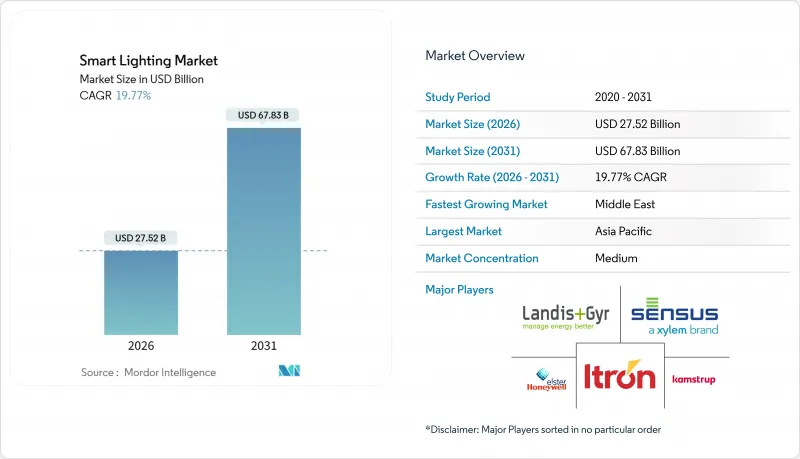
Mordor Intelligence에 따르면 스마트 조명 시장 규모는 2026년에 275억 2,000만 달러에 달하며, 2031년까지 678억 3,000만 달러까지 확대할 것으로 예측됩니다.
이는 예측 기간 전체에 걸쳐 연평균 성장률(CAGR) 19.77%에 해당하며, 이 분야가 얼리 어답터들을 위한 신기함에서 건축물의 성능 향상에 필수적인 주류 기술로 전환되고 있음을 보여줍니다.
이 보고서는 제품 유형(제어 시스템, 스마트 램프·조명 기구), 설치 형태(신축, 리모델링), 연결 기술(블루투스, 지그비 등), 최종사용자(주거, 상업, 산업 등) 및 지역(북미, 유럽, 아시아태평양, 중동 및 아프리카, 남미)별로 분류되어 있습니다. 시장 전망은 금액(달러) 기준으로 제시되어 있습니다.
글로벌 스마트 조명 시장의 동향 및 인사이트
스마트홈 생태계의 통합 확대
음성 어시스턴트 플랫폼과 Matter 1.4 인증을 통해 단일 펌웨어 이미지로 Apple HomeKit, Google Home, Amazon Alexa, Samsung SmartThings와의 상호 운용이 가능해졌으며, 벤더 락인이 해소되고 지원 비용이 절감됨에 따라 구매 장벽이 낮아졌습니다. Thread 1.4의 저전력 메시를 통해 네트워크당 기기 상한선이 250노드로 상향 조정되었을 뿐만 아니라, 자가 복구 기능 덕분에 Zigbee 초기 도입시 문제가 되었던 신뢰성 관련 불만이 완화되었습니다. 아시아의 수탁제조업체들이 생산 규모를 확대함에 따라 2024-2025년에 스마트 전구의 평균 판매 가격이 22% 하락했고, 대상 가구 수가 확대되었습니다. 소비자가 배선 공사 없이 전구를 교체할 수 있으므로 기존 설비에 후속 설치하는 것을 중시하는 비즈니스 모델이 특히 큰 혜택을 보고 있습니다. 상업 분야에서는 호텔 체인이 Matter 인증을 받은 다운라이트와 재실 센서를 세트로 도입하게 되어, 체크인시 객실이 자동으로 선호하는 조명 모드로 조정됨으로써 고객 경험을 향상시키는 동시에 에너지 비용 절감으로도 이어지고 있습니다.
LED의 급속한 비용 절감이 ROI를 향상
창고에 적합한 하이베이 조명 기구의 소매 가격은 불과 3년 전만 해도 250-350달러였으나, 현재는 120-180달러까지 하락했습니다. 반면, 발광 효율은 1와트당 150루멘으로 비약적으로 향상되어 기존 메탈 할라이드 램프의 거의 2배에 달합니다. 매사추세츠주와 코네티컷주의 전력 회사가 제공하는 인센티브 덕분에 자재비가 40-50% 절감되어 투자 회수 기간이 보통 12개월까지 단축되고 있습니다. 중국과 한국의 칩 파운드리 기업은 갈륨 질화물 에피택시 수율 향상에 주력하고 있으며, 다이 비용을 매년 10-15%씩 추가로 절감하고 있습니다. 각 도시들도 이러한 추세를 활용하고 있습니다. 두바이에서는 2024년, 셰이크 라시드 거리에 있는 900개의 조명 기구를 개조하여, 보조금 없이도 60%의 에너지 절감 효과와 4년의 투자 회수 기간을 실현했습니다. 비용 곡선은 점점 더 가파르게 변하고 있으며, 상업, 산업, 지자체 각 부문에서 가격 탄력성을 더욱 높이고 있습니다.
무선 프로토콜의 사이버 보안 취약점
미국 국립표준기술연구소(NIST)는 2024년, Zigbee 및 Bluetooth LE에는 견고한 인증 기능이 부족하여 기본 인증 정보가 변경되지 않은 채로 남아 있을 경우 네트워크가 사칭 공격에 노출될 위험이 있다고 경고했습니다. CVE-2024-41126에서는 악의적인 페어링을 통한 조명 기기의 원격 장악이 입증되었으며, 이에 따라 중요 시설 운영자들은 조명 네트워크를 에어갭 방식으로 전환하거나 유선 DALI-2 버스로 되돌려야 하는 상황에 직면해 있습니다. 이러한 예방 조치로 인해 조명 기구 1대당 8-15달러의 추가 비용이 발생하고, 투자 회수 기간이 길어질 뿐만 아니라 빌딩 자동화 시스템과의 통합도 복잡해집니다. Matter의 기기 인증 기능은 암호화 기술을 활용하여 하드웨어의 출처를 검증함으로써 이러한 위협을 무력화하는 것을 목표로 하고 있지만, 완벽한 대책을 위해서는 여러 번의 제품 수명 주기에 걸쳐 현장에서 기기를 교체해야 합니다.
부문 분석
2025년에는 스마트 램프 및 조명 기구가 스마트 조명 시장의 54.67%를 차지했으나, 제어 시스템은 2031년까지 20.19%라는 가장 높은 연평균 성장률(CAGR)을 기록할 것으로 전망됩니다. 에너지 서비스 기업은 제어 시스템을 수요 반응(demand response)을 통한 수익 창출, 예측 유지보수, 그리고 거주자 중심의 쾌적함을 실현하기 위한 진입점으로 자리매김하는 경향이 강해지고 있습니다. 금액 기준으로는 2025년 매출이 여전히 램프 및 조명 기구가 주도했으나, 상품화로 인해 이익률은 25% 미만의 수준으로 압박받고 있습니다. 볼보 트럭의 스웨덴 공장에서 헬버(Helber)사의 ‘ActiveAhead’ 도입 사례는 제어 중심 전략을 여실히 보여줍니다. 엣지 AI가 작업 셀의 점유 현황, 통로의 사전 조광, 자연광 활용을 학습하여 전력 소비를 추가로 23% 절감했습니다. 한편, 주택 구매자들은 배선 변경이 필요 없는 전구를 선호하는 경향이 있습니다. Matter 인증 램프의 평균 소매 가격은 2025년에 12달러까지 하락하여 누구나 손쉽게 이용할 수 있게 되었습니다. 기술 스택의 변화로 인해 벤더 간의 차별화 요소는 단순한 루멘 수치가 아니라 펌웨어, 분석 기능, 클라우드 대시보드에 의해 결정되게 되었습니다.
그렇지만 스마트 램프와 조명 기구는 여전히 필수적입니다. 시설 관리자들이 광 스펙트럼과 관련된 생산성 향상을 정량화함에 따라 사무실 및 호텔·리조트 업계에서는 일주기 리듬 조절이 주목받고 있는 반면, 소매 업계에서는 장식용 조명 기구가 브랜드 고유의 분위기를 연출하고 있습니다. 그러나 이 분야에서도 제어 기술이 주역으로 부상하고 있습니다. 조광 가능한 조명 기구에는 Matter나 DALI-2 명령을 즉시 수신하는 내장형 드라이버가 기본으로 탑재되어 있습니다. 도입 대수가 포화 상태에 도달함에 따라 소프트웨어 업그레이드를 통해 지속적인 수익이 창출되고, 램프는 자본재에서 디지털 플랫폼으로 변모하게 될 것입니다.
2025년 스마트 조명 시장 점유율 중 62.91%를 레트로핏이 차지했습니다. 이는 전 세계 건축물에서 여전히 사용되고 있는 형광등이나 메탈 할라이드 조명 기구의 수가 막대하다는 점을 반영합니다. 전력 회사의 인센티브가 교체 비용의 상당 부분을 충당하고 있으며, 그 결과 CFO 수준에서도 납득할 수 있는 투자 회수 기간인 12-18개월을 실현하고 있습니다. 그러나 규제 흐름은 변화하고 있습니다. 개정된 에너지 기준에 따라 설계 단계에서 네트워크화된 조명이 의무화됨에 따라 신축 공사는 연평균 성장률(CAGR) 20.13%로 가속화되고 있습니다. 조명의 사양이 조기에 확정되면 시공사는 센서용 배선을 사전에 설치하고 게이트웨이용 저전압 전원을 확보할 수 있으며, 향후 인건비를 대폭 절감할 수 있습니다.
기존 시설의 개보수에서 경제성은 양극화되고 있습니다. 단순한 ‘램프 대 램프’ 교체만으로도 50-60%의 에너지 절감 효과를 얻을 수 있지만, 사람의 재실 여부를 감지하는 조광 기능을 통해 얻을 수 있는 추가적인 20-30%의 에너지 절감 효과는 얻을 수 없습니다. 현재 건물 소유주들은 전력 회사의 성과 기반 인센티브를 활용하기 위해 통합 제어 패키지를 선택하고 있습니다. 지방자치단체의 사례 연구도 이 점을 지원하고 있습니다. 두바이의 2024년 셰이크 라시드 거리 프로젝트에서는 보조금 없이 4년 만에 투자 회수를 달성하고 60%의 에너지 절감을 실현했을 뿐만 아니라, 2차 도로에서 적응형 조광의 시범 운영을 즉시 시작했습니다.
지역별 분석
L37: 2025년, 아시아태평양은 스마트 조명 시장 점유율의 37.38%를 차지했습니다. 이는 중국의 제조 규모, 인도의 도시화, 그리고 일본 기술에 정통한 건설 부문이 주도한 결과입니다. 이 지역의 성장은 견고하지만, 얼리 어답터들이 조명 기구 교체에서 제어 시스템의 단계적 업그레이드로 전환함에 따라 그 속도는 점차 완만해지고 있습니다. 대조적으로, 중동 및 아프리카는 2027년이라는 이른 시점에 LED 전환 기한을 법적으로 정한 스마트 시티 정책에 힘입어 20.71%라는 가장 높은 연평균 성장률(CAGR)을 기록할 전망입니다. 카타르 공공사업청은 2025년 10월, 에너지 소비를 40-50% 감축한다는 목표를 세우고 전국적인 스마트 LED 가로등 도입을 약속했습니다.
북미와 유럽은 여전히 혁신의 중심지입니다. 캘리포니아주의 2025년 ‘타이틀 24’ 개정안과 매사추세츠주의 관대한 수요 측 관리(DSM) 리베이트 제도로 인해 투자 회수 기간이 단축되었으며, 기본 설계 단계에서 조명 제어 시스템이 통합되고 있습니다. 유럽연합(EU)의 ‘니어 제로 에너지’ 지침에 따라 회원국들은 2028년까지 모든 신축 건물에 네트워크화된 조명을 도입해야 할 의무가 있습니다. 이러한 정책 덕분에 표면적인 성장률은 다소 낮은 편이지만, 해당 지역의 총수익 기반은 견고하게 유지되고 있습니다.
남미 및 아프리카에서는 예산 제약과 ROI를 저하시키는 전기 요금 보조금으로 인해 보급률은 여전히 낮은 수준에 머물러 있습니다. 브라질과 남아프리카공화국에서는 지자체 차원에서 시범 도입이 진행되고 있으나, 재정 긴축으로 인해 규모 확대에는 한계가 있습니다. 2026년에 LED 모듈 가격이 1킬로루멘당 1달러 미만으로 떨어지면, 이러한 시장에서는 시범 도입에서 본격적인 도입으로 단계적으로 전환될 것입니다.
기타 혜택:
- Excel 형식의 시장 예측(ME) 시트
- 3개월간의 애널리스트 지원
자주 묻는 질문
목차
제1장 서론
제2장 분석 방법
제3장 개요
제4장 시장 구도
제5장 시장 규모·성장률 예측
제6장 경쟁 구도
제7장 시장 기회와 향후 전망
KSA 26.08.26According to Mordor Intelligence, the smart lighting market size reached USD 27.52 billion in 2026 and is projected to climb to USD 67.83 billion by 2031, translating into a 19.77% CAGR across the forecast horizon, a trajectory that underlines the sector's transition from early-adopter novelty to mainstream building-performance technology.
This report is Segmented by Product Type (Control Systems, and Smart Lamps and Fixtures), Installation Type (New Construction, and Retrofit), Connectivity Technology (Bluetooth, Zigbee, and More), End-User (Residential, Commercial, Industrial, and More), and Geography (North America, Europe, Asia-Pacific, Middle East and Africa, and South America). The Market Forecasts are Provided in Terms of Value (USD).
Global Smart Lighting Market Trends and Insights
Expanding Smart-Home Ecosystem Integration
Voice-assistant platforms and Matter 1.4 certification have reduced purchase friction by enabling a single firmware image to interoperate with Apple HomeKit, Google Home, Amazon Alexa, and Samsung SmartThings, removing vendor lock-in and lowering support costs. Thread 1.4's low-power mesh has raised the device limit to 250 nodes per network, while self-healing routes alleviate reliability complaints that dogged early Zigbee rollouts. Smart-bulb average selling prices fell 22% between 2024 and 2025 as Asian contract manufacturers scaled production, expanding the addressable household base. Retrofit-oriented business models benefit disproportionately because consumers can swap bulbs without rewiring. Commercially, hospitality chains now bundle Matter-certified downlights with occupancy sensors so guestrooms automatically adjust to preferred scenes at check-in, improving the guest experience while shaving energy bills.
Rapid LED Cost Reductions Improve ROI
High-bay fixtures suitable for warehouses now retail at USD 120-180, down from USD 250-350 just three years earlier, while efficacy leapt to 150 lumens per watt, nearly double that of metal-halide incumbents. Utility incentives in Massachusetts and Connecticut shave 40-50% off material costs, routinely compressing payback to 12 months. Chinese and South Korean chip foundries are pushing gallium nitride epitaxy yields higher, cutting die costs by a further 10-15% each year. Cities are capitalizing: Dubai retrofitted 900 luminaires on Sheikh Rashid Street in 2024, netting 60% energy savings and a 4-year payback, even without subsidies. The cost curve keeps steepening, reinforcing price elasticity across commercial, industrial, and municipal segments.
Cyber-Security Vulnerabilities in Wireless Protocols
The National Institute of Standards and Technology warned in 2024 that Zigbee and Bluetooth LE lack robust authentication, exposing networks to spoofing when default credentials persist. CVE-2024-41126 demonstrated remote takeover of luminaires via unauthorized pairing, spurring critical-facility operators to air-gap lighting networks or revert to wired DALI-2 buses. Such precautions add USD 8-15 per fixture, lengthening payback and complicating building-automation integration. Matter's device-attestation aims to neutralize the threat by cryptographically verifying hardware provenance, but full mitigation requires field replacements over several product cycles.
Other drivers and restraints analyzed in the detailed report include:
- Utility-Funded Demand-Side-Management Incentives
- National Net-Zero Building Codes
- Fragmented Inter-Operability Standards
For complete list of drivers and restraints, kindly check the Table Of Contents.
Segment Analysis
Smart lamps and fixtures captured 54.67% of the smart lighting market share in 2025, while control systems are set to register the fastest 20.19% CAGR through 2031. Energy-service companies increasingly position controls as the gateway to demand-response revenue, predictive maintenance, and occupant-centric comfort. In value terms, lamps and fixtures still dominated 2025 sales, but commoditization is squeezing margins below 25%. Helvar's ActiveAhead deployment at Volvo Trucks' Swedish plant illustrates the control-centric thesis: edge AI learned work-cell occupancy, pre-dimmed aisles, and harvested daylight to trim an additional 23% of power. Residential buyers, meanwhile, gravitate toward bulbs that require no wiring changes; average retail pricing for a Matter-certified lamp fell to USD 12 in 2025, democratizing access. The shifting stack means firmware, analytics, and cloud dashboards, not raw lumens, determine vendor differentiation.
Smart lamps and fixtures, nonetheless, remain indispensable. Circadian-tuning is gaining traction in offices and hospitality as facility managers quantify productivity gains tied to light spectra, while decorative luminaires support branded ambience in retail. Yet even here, controls are subsuming the narrative: tunable fixtures ship with embedded drivers that listen for Matter or DALI-2 commands out of the box. As the installed base saturates, software upgrades will extract recurring revenue, transforming lamps from capital goods into digital platforms.
Retrofits accounted for 62.91% of the smart lighting market share in 2025, reflecting the significant inventory of fluorescent and metal-halide luminaires still in use in global building stock. Utility incentives underwrite much of the swap-out cost, translating into 12- to 18-month paybacks that meet even CFO-level hurdle rates. Yet the compliance tide is turning: new construction is accelerating at a 20.13% CAGR because updated energy codes make networked lighting mandatory at the blueprint stage. When lighting is specified early, contractors prewire for sensors and provide low-voltage power for gateways, slashing future labor costs.
Retrofit economics bifurcate. Simple lamp-for-lamp replacements yield 50-60% energy cuts but miss the incremental 20-30% available from occupancy-aware dimming. Building owners now select integrated control packages to unlock utility performance-based incentives. Municipal case studies reinforce the point: Dubai's 2024 Sheikh Rashid Street project realized 60% savings on a four-year unsubsidized payback and immediately initiated trials on secondary roads for adaptive dimming.
Complete Report Scope:
- By Product Type
- Control Systems
- Smart Lamps and Fixtures
- By Installation Type
- New Construction
- Retrofit
- By Connectivity Technology
- Wi-Fi
- Bluetooth
- Zigbee
- Other Connectivity Technologies
- By End-User
- Residential
- Commercial
- Industrial
- Other End-Users
- By Geography
- North America
- United States
- Canada
- Mexico
- Europe
- Germany
- United Kingdom
- France
- Russia
- Rest of Europe
- Asia-Pacific
- China
- Japan
- India
- South Korea
- Australia
- Rest of Asia-Pacific
- Middle East and Africa
- Middle East
- Saudi Arabia
- United Arab Emirates
- Rest of Middle East
- Africa
- South Africa
- Egypt
- Rest of Africa
- Middle East
- South America
- Brazil
- Argentina
- Rest of South America
- North America
Geography Analysis
L37: Asia-Pacific commanded 37.38% of the smart lighting market share in 2025, anchored by China's manufacturing scale, India's urbanization, and Japan's tech-savvy construction sector. The region's growth is steady but moderating as early adopters transition from fixture swaps to incremental control-system upgrades. Middle East and Africa, conversely, will post the quickest 20.71% CAGR because sovereign smart-city mandates hard-code LED conversion deadlines as early as 2027. Qatar's Public Works Authority committed to nationwide smart LED streetlighting in October 2025, aiming for 40-50% energy savings.
North America and Europe remain crucibles of innovation. California's 2025 Title 24 revision and Massachusetts' generous DSM rebates shorten payback cycles, embedding lighting controls during schematic design. The European Union's near-zero-energy directive requires member states to incorporate networked lighting in all new buildings by 2028. These policies keep the regions' aggregate revenue base resilient despite lower headline growth.
South America and Africa still lag in penetration due to budget constraints and electricity tariff subsidies that dilute ROI. Brazil and South Africa are piloting municipal conversions, but fiscal austerity limits scale. As LED module pricing falls below USD 1 per kilolumen in 2026, these markets will gradually migrate from pilot to portfolio execution.
- Signify N.V.
- Acuity Brands Inc.
- Hubbell Inc.
- Eaton Corp.
- Lutron Electronics Co. Inc.
- Legrand SA
- Cree Lighting USA, LLC
- Samsung Electronics Co. Ltd.
- Xiaomi Corp.
- Snap One LLC
- Savant Systems Inc.
- Nanoleaf Canada Ltd.
- Sengled Optoelectronics Co.
- Wyze Labs Inc.
- Feit Electric Company, Inc.
- Panasonic Corp.
- Opple Lighting
- EGLO Leuchten GmbH
- Zumtobel Group
Additional Benefits:
- The market estimate (ME) sheet in Excel format
- 3 months of analyst support
TABLE OF CONTENTS
1 INTRODUCTION
- 1.1 Study Assumptions and Market Definition
- 1.2 Scope of the Study
2 RESEARCH METHODOLOGY
3 EXECUTIVE SUMMARY
4 MARKET LANDSCAPE
- 4.1 Market Overview
- 4.2 Market Drivers
- 4.2.1 Expanding Smart-Home Ecosystem Integration
- 4.2.2 Rapid LED Cost Reductions Improve ROI
- 4.2.3 Utility-Funded Demand-Side-Management Incentives
- 4.2.4 National Net-Zero Building Codes (2025-2030 Roll-outs)
- 4.2.5 Li-Fi-Enabled Lighting Pilots in Warehouses
- 4.2.6 Edge-AI-Powered Adaptive Dimming Algorithms
- 4.3 Market Restraints
- 4.3.1 Cyber-Security Vulnerabilities in Wireless Protocols
- 4.3.2 Fragmented Inter-Operability Standards
- 4.3.3 Supply Chain Volatility in Rare-Earth Phosphors
- 4.3.4 Smart-Home Privacy Regulation Uncertainty
- 4.4 Industry Value Chain Analysis
- 4.5 Regulatory Landscape
- 4.6 Technological Outlook
- 4.7 Porter's Five Forces Analysis
- 4.7.1 Bargaining Power of Suppliers
- 4.7.2 Bargaining Power of Buyers
- 4.7.3 Threat of New Entrants
- 4.7.4 Threat of Substitutes
- 4.7.5 Degree of Competition
- 4.8 Impact of Macroeconomic Factors on the Market
5 MARKET SIZE AND GROWTH FORECASTS (VALUE)
- 5.1 By Product Type
- 5.1.1 Control Systems
- 5.1.2 Smart Lamps and Fixtures
- 5.2 By Installation Type
- 5.2.1 New Construction
- 5.2.2 Retrofit
- 5.3 By Connectivity Technology
- 5.3.1 Wi-Fi
- 5.3.2 Bluetooth
- 5.3.3 Zigbee
- 5.3.4 Other Connectivity Technologies
- 5.4 By End-User
- 5.4.1 Residential
- 5.4.2 Commercial
- 5.4.3 Industrial
- 5.4.4 Other End-Users
- 5.5 By Geography
- 5.5.1 North America
- 5.5.1.1 United States
- 5.5.1.2 Canada
- 5.5.1.3 Mexico
- 5.5.2 Europe
- 5.5.2.1 Germany
- 5.5.2.2 United Kingdom
- 5.5.2.3 France
- 5.5.2.4 Russia
- 5.5.2.5 Rest of Europe
- 5.5.3 Asia-Pacific
- 5.5.3.1 China
- 5.5.3.2 Japan
- 5.5.3.3 India
- 5.5.3.4 South Korea
- 5.5.3.5 Australia
- 5.5.3.6 Rest of Asia-Pacific
- 5.5.4 Middle East and Africa
- 5.5.4.1 Middle East
- 5.5.4.1.1 Saudi Arabia
- 5.5.4.1.2 United Arab Emirates
- 5.5.4.1.3 Rest of Middle East
- 5.5.4.2 Africa
- 5.5.4.2.1 South Africa
- 5.5.4.2.2 Egypt
- 5.5.4.2.3 Rest of Africa
- 5.5.4.1 Middle East
- 5.5.5 South America
- 5.5.5.1 Brazil
- 5.5.5.2 Argentina
- 5.5.5.3 Rest of South America
- 5.5.1 North America
6 COMPETITIVE LANDSCAPE
- 6.1 Market Concentration
- 6.2 Strategic Moves
- 6.3 Market Share Analysis
- 6.4 Company Profiles (includes Global Level Overview, Market Level Overview, Core Segments, Financials as Available, Strategic Information, Market Rank/Share for Key Companies, Products and Services, and Recent Developments)
- 6.4.1 Signify N.V.
- 6.4.2 Acuity Brands Inc.
- 6.4.3 Hubbell Inc.
- 6.4.4 Eaton Corp.
- 6.4.5 Lutron Electronics Co. Inc.
- 6.4.6 Legrand SA
- 6.4.7 Cree Lighting USA, LLC
- 6.4.8 Samsung Electronics Co. Ltd.
- 6.4.9 Xiaomi Corp.
- 6.4.10 Snap One LLC
- 6.4.11 Savant Systems Inc.
- 6.4.12 Nanoleaf Canada Ltd.
- 6.4.13 Sengled Optoelectronics Co.
- 6.4.14 Wyze Labs Inc.
- 6.4.15 Feit Electric Company, Inc.
- 6.4.16 Panasonic Corp.
- 6.4.17 Opple Lighting
- 6.4.18 EGLO Leuchten GmbH
- 6.4.19 Zumtobel Group
7 MARKET OPPORTUNITIES AND FUTURE OUTLOOK
- 7.1 White-Space and Unmet-Need Assessment