

|
시장보고서
상품코드
2114138
IoT 칩 시장 : 시장 점유율 분석, 업계 동향 및 통계, 성장 예측(2026-2031년)IoT Chip - Market Share Analysis, Industry Trends & Statistics, Growth Forecasts (2026 - 2031) |
||||||
 Mordor Intelligence
Mordor Intelligence에 의하면, IoT 칩 시장 규모는 2025년 6,700억 달러로 평가되었고, 2026년에는 7,700억 달러로 추정되고, 2026-2031년 CAGR 14.45%로 성장을 지속할 전망이며, 2031년에는 1조 5,100억 달러에 이를 것으로 예측됩니다.

본 보고서는 제품별(프로세서, 센서 등), 최종 사용자별(헬스케어, 소비자 가전 등), 기술 노드별(90nm 이상 등), 연결 기술별(블루투스/BLE, Wi-Fi 등), 프로세서 아키텍처별(Arm 기반, RISC-V 등),및 지역별(북미, 유럽, 아시아태평양, 남미, 중동 및 아프리카)로 분류되어 있습니다. 시장 예측은 금액(달러) 기준으로 제시되어 있습니다.
세계의 IoT 칩 시장 동향 및 인사이트
연결형 소비자 기기 및 웨어러블 기기의 보급
앰비언트 컴퓨팅 경험에 대한 수요가 높아짐에 따라, 센서 및 무선 기능을 상시 가동하는 초저전력 칩의 출하량이 증가하고 있습니다. 건강 관리를 목적으로 하는 웨어러블 기기에는 현재 의료 등급의 광맥파계, 체온, 심전도(ECG) 센서가 탑재되어 있으며, 엄격해지는 개인정보 보호 규정을 준수하기 위해서는 안전한 데이터 경로가 필요합니다. 퀄컴은 2025년 1분기 IoT 매출이 전년 동기 대비 36% 증가한 15억 달러에 달했다고 보고하며, 소비자 시장의 성장세를 뒷받침하고 있습니다. 5G 모뎀과 온디바이스 AI의 융합이 진행됨에 따라 설계자들은 애플리케이션 프로세서, NPU, 연결 기능을 하나의 다이에 통합한 헤테로제니어스 SoC로 전환하고 있으며, 이는 전 세계 IoT 칩 시장 전체의 실리콘 면적 효율 향상을 주도하고 있습니다.
인더스트리 4.0이 주도하는 저전력 MCU 수요
디지털 트윈 및 예측 유지보수를 도입하는 공장에서는 진동, 온도, 음향 데이터를 로컬에서 수집하고 네트워크 지연을 줄여주는 마이크로컨트롤러가 활용되고 있습니다. 인텔의 스마트 팩토리용 제품 라인은 실시간 리소그래피 보정을 통해 이론치에 가까운 수율을 달성하며, 가혹한 환경 하에서 엣지 분석의 가치를 입증했습니다. 현재 견고한 MCU에는 머신러닝 명령어 세트 외에도 보안 부팅 및 OTA 업데이트 기능이 내장되어 있어, 전 세계 IoT 칩 시장은 향후 10년 동안 산업 분야로부터 지속적인 수주가 예상됩니다.
엔드투엔드 보안 및 개인정보 보호 취약점
백악관의 ‘사이버 트러스트 마크(Cyber Trust Mark)’는 NIST IR 8425 준수를 의무화하고 있어, 자원이 제한된 디바이스에 보안 요소를 통합하는 데 어려움이 커지고 있습니다. 비용에 민감한 OEM 기업들은 실리콘 면적 증가와 펌웨어 검증에 드는 추가 비용 문제에 직면해 있습니다. 양자 컴퓨팅으로 인한 위협이 증가함에 따라 칩 제조업체들은 격자 기반 암호화 기술에 대응해야 하는 압박을 받고 있으며, 이는 제품 출시를 지연시키고 단기적으로 전 세계 IoT 칩 시장의 성장을 둔화시키고 있습니다.
부문 분석
2025년에는 CPU, NPU 및 멀티 프로토콜 무선 기능을 통합한 싱글 다이 콤보를 핵심으로, 프로세서가 매출의 25.10%를 차지하며 최대 점유율을 기록했습니다. 통합성 향상으로 인해 인쇄 회로 기판 면적이 축소되고 인증 주기가 단축됨에 따라, 세계 IoT 칩 시장에서 프로세서의 우위는 더욱 공고해질 것입니다. 제로 트러스트 아키텍처에 따라 하드웨어 신뢰의 근원(Root of Trust)이 IoT 칩 시장의 모든 노드에 내장됨에 따라, 보안 IC는 연평균 성장률(CAGR) 17.55%로 가장 빠른 성장이 예상됩니다. 센서, 커넥티비티, 메모리, 로직, 전원 관리 각 제품 라인은 보다 광범위한 출하량 추세를 따르고 있으며, 특히 저전력 DRAM은 고가 대에서 거래되고 있습니다.
패키지 내 전압 조정 기술의 향상으로 AI 가속기를 위해 0.5V 미만의 레일 전압이 공급되게 되어 웨어러블 기기의 배터리 수명이 연장되고 있습니다. MEMS 제조업체들은 높이 0.8mm 미만의 실용적인 압력 센서 개발을 추진하고 있어, 반지나 이어폰의 설계 자유도를 넓히고 있습니다. SEALSQ사는 영국의 스마트 미터를 보호하는 양자 내성 칩 2,400만 개에 대한 계약을 수주하며, 중요 인프라 전반에 걸친 보안 대책의 전환을 부각시켰습니다.
2025년에는 아시아태평양 공장에서 디지털 트윈 도입이 확대됨에 따라 산업 및 제조 분야의 점유율은 22.20%를 유지했습니다. 상태 모니터링용 MCU 수요는 2030년까지 두 자릿수의 출하량 성장을 유지할 전망입니다. 소프트웨어 정의 차량(SDV)이 컴퓨팅 도메인을 통합함에 따라, 자동차 분야는 연평균 성장률(CAGR) 16.45%로 선두를 달리고 있습니다. 하네스의 경량화와 OTA를 통한 기능 업셀을 가능하게 하는 존형 아키텍처를 배경으로, 자동차용 반도체의 IoT 칩 시장 규모는 급격히 확대될 것으로 예측됩니다.
헬스케어 분야는 원격 모니터링에 그치지 않고 규제 대상 의료기기의 연결 프레임워크로 확대되고 있어, 인증된 보안 요소(Secure Element)에 대한 수요가 증가하고 있습니다. AI를 탑재한 재고 관리 로봇을 활용한 소매 업계의 시범 프로젝트에서는 비전 처리에 최적화된 SoC를 채택해 진열대의 재고를 실시간으로 대조하고 있으며, 이를 통해 IoT 칩 시장의 수익 기반이 다각화되고 있습니다. 패시브 광 네트워크가 단일 광섬유 백본을 통해 HVAC, 조명, 보안 시스템을 연결함에 따라 빌딩 자동화 수주가 증가하고 있습니다.
지역별 분석
2025년, 아시아태평양은 IoT 칩 시장 매출의 34.40%를 차지했습니다. 이는 대만이 전체 반도체 생산량에서 63.8%의 점유율을 차지하고 있으며, 중국의 생산 능력 확대에 힘입은 결과입니다. 웨이퍼에서 패키징에 이르는 수직 통합으로 리드타임이 단축되어, 각 OEM 업체들은 보다 신속하게 제품을 개선할 수 있게 되었습니다. 그러나 수출 규제로 인해 다국적 OEM 업체들은 일본, 인도, 미국으로 생산 능력을 분산할 수밖에 없게 되어, IoT 칩 시장공급 구조가 재편되고 있습니다.
중동 및 아프리카은 연평균 성장률(CAGR) 18.35%로 가장 빠른 성장 궤도를 보이고 있습니다. 걸프 국가들의 스마트 시티 예산에서는 교통 분석, 에너지 대시보드, 공공 안전용 센서 네트워크에 수십억 단위의 자금이 배정되어 있으며, 견고하고 넓은 온도 범위를 지원하는 실리콘 칩이 요구되고 있습니다. 북아프리카 전역에 걸친 5G 구축으로 인해, 항구에서 내륙의 자유무역지대에 이르는 물류 회랑에서 저지연 원격 측정(텔레메트리)이 가능해지면서, IoT 칩 시장의 엔드포인트 기반이 확대되고 있습니다.
북미와 유럽은 여전히 혁신의 중심지입니다. 미국의 ‘CHIPS 법’은 16개 주에 걸쳐 있는 반도체 제조 공장에 500억 달러를 투입하여, 2027년까지 국내 첨단 공정 노드의 생산 능력을 2배인 22%로 끌어올리는 것을 목표로 하고 있습니다. 유럽의 ‘칩스법’은 2030년까지 세계 시장 점유율 20%를 목표로 하고 있으며, 인텔과 ST마이크로일렉트로닉스가 독일과 프랑스의 클러스터에 투자하고 있습니다. 이 지역들은 고부가가치의 자동차용 및 의료용 실리콘을 우선시하고 있으며, 생산량 증가세는 완만하지만 IoT 칩 시장 규모 내에서 수익성이 높은 분야를 형성하고 있습니다.
기타 혜택 :
- 엑셀 형식 시장 예측(ME) 시트
- 3개월간의 애널리스트 지원
자주 묻는 질문
목차
제1장 서론
제2장 조사 방법
제3장 주요 요약
제4장 시장 구도
제5장 시장 규모 및 성장 예측
제6장 경쟁 구도
제7장 시장 기회 및 향후 전망
AJY 26.08.26According to Mordor Intelligence, the ioT chip market size is expected to grow from USD 0.67 trillion in 2025 to USD 0.77 trillion in 2026 and is forecast to reach USD 1.51 trillion by 2031 at 14.45% CAGR over 2026-2031.
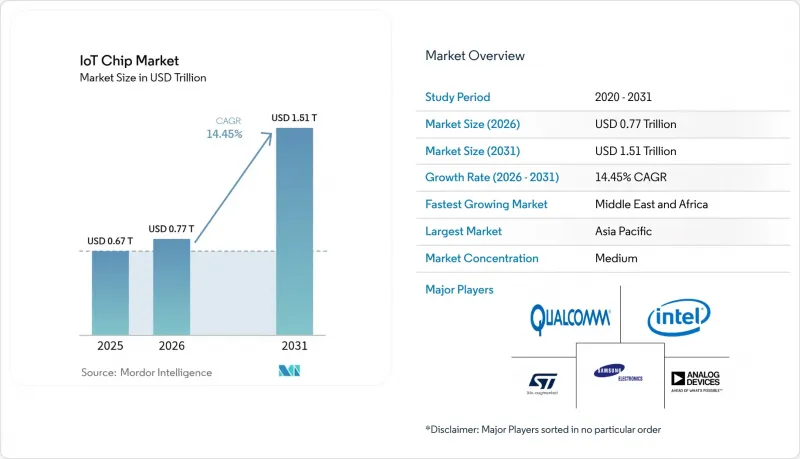
This report is Segmented by Product (Processor, Sensor, and More), End-User (Healthcare, Consumer Electronics, and More), Technology Node ( >=90 Nm, and More), Connectivity Technology (Bluetooth/BLE, Wi-Fi, and More), Processor Architecture (Arm-Based, RISC-V, and More), and Geography (North America, Europe, Asia Pacific, South America, and Middle East and Africa). The Market Forecasts are Provided in Terms of Value (USD).
Global IoT Chip Market Trends and Insights
Proliferation of Connected Consumer and Wearable Devices
Demand for ambient computing experiences is lifting volumes for ultra-low-power chips that keep sensors and radios active at all times. Health-focused wearables now integrate medical-grade photoplethysmography, temperature, and ECG sensors that need secure data paths to comply with tightening privacy rules. Qualcomm reported USD 1.5 billion in IoT revenue for Q1 2025, up 36% year over year, underscoring consumer momentum. As 5G modems converge with on-device AI, designers shift to heterogeneous SoCs that fuse application processors, NPUs, and connectivity on one die, driving silicon-area efficiency across the Global IoT Chip market.
Industry 4.0-Led Demand for Low-Power MCUs
Factories deploying digital twins and predictive maintenance lean on microcontrollers that ingest vibration, thermal, and acoustic data locally, cutting network latency. Intel's smart-factory line achieved near-theoretical yield through real-time lithography calibration, proving the value of edge analytics inside harsh environments. Rugged MCUs now combine machine-learning instruction sets with secure boot and OTA updates, positioning the Global IoT Chip market for sustained industrial orders through the decade.
End-to-End Security and Privacy Vulnerabilities
The White House Cyber Trust Mark requires compliance with NIST IR 8425, raising the bar for secure-element integration in resource-limited devices. Cost-sensitive OEMs face additional silicon area and firmware validation expenses. Rising quantum-computing threats press chipmakers to support lattice-based cryptography, delaying product launches and tempering short-term Global IoT Chip market growth.
Other drivers and restraints analyzed in the detailed report include:
- Automotive ADAS and V2X Silicon Requirements
- Edge-AI Inference Inside IoT SoCs
- Legacy-Node (28/40 nm) Foundry Capacity Crunch
For complete list of drivers and restraints, kindly check the Table Of Contents.
Segment Analysis
Processors generated the largest revenue slice in 2025 at 25.10%, anchored by single-die combos that merge CPU, NPU, and multi-protocol radios. Enhanced integration trims printed-circuit area and shortens certification cycles, fortifying processor dominance in the Global IoT Chip market. Security ICs are poised for the fastest expansion with a 17.55% CAGR as zero-trust architectures embed hardware roots-of-trust into every node of the IoT Chip market. Sensor, connectivity, memory, logic, and power-management lines track broader unit shipment curves, with specialized low-power DRAM commanding premium price points.
Upgrades in in-package voltage regulation now supply sub-0.5 V rails for AI accelerators, extending battery life in wearables. MEMS makers push shippable pressure sensors below 0.8 mm height, opening design space in rings and earbuds. SEALSQ secured contracts for 24 million quantum-resistant chips that protect UK smart meters, showcasing a security shift across critical infrastructure.
Industrial and manufacturing retained a 22.20% share in 2025 as digital-twin rollouts scaled across Asia Pacific plants. Demand for condition-monitoring MCUs sustains double-digit unit growth through 2030. Automotive leads in CAGR at 16.45% as software-defined vehicles centralize compute domains. The IoT Chip market size for automotive silicon is projected to climb sharply on the back of zonal architectures that cut harness weight and enable OTA feature upsells.
Healthcare extends beyond remote monitoring to regulated device connectivity frameworks, strengthening demand for certified secure elements. Retail pilots using AI-powered inventory robots enlist vision-optimized SoCs to reconcile shelf stock in real time, diversifying the IoT Chip market revenue base. Building-automation orders rise as passive optical networks connect HVAC, lighting, and security over a single fibre backbone.
Complete Report Scope:
- By Product
- Processor
- Sensor
- Connectivity IC
- Memory Device
- Logic Device
- Power-Management IC
- Security IC
- By End-user
- Healthcare
- Consumer Electronics
- Industrial and Manufacturing
- Automotive
- BFSI
- Retail
- Building Automation
- Other End-users
- By Technology Node
- >=90 nm
- 65-45 nm
- 40-28 nm
- 22-16 nm
- <=14 nm
- By Connectivity Technology
- Bluetooth / BLE
- Wi-Fi (802.11x)
- NB-IoT / LTE-M
- 5G RedCap
- Ultra-Wideband (UWB)
- Thread / Zigbee
- Satellite IoT
- By Processor Architecture
- Arm-based
- RISC-V
- x86
- Other / Hybrid
- By Geography
- North America
- United States
- Canada
- Mexico
- South America
- Brazil
- Argentina
- Rest of South America
- Europe
- Germany
- United Kingdom
- France
- Italy
- Spain
- Rest of Europe
- Asia-Pacific
- China
- Japan
- South Korea
- India
- Singapore
- Australia
- Rest of Asia-Pacific
- Middle East and Africa
- Middle East
- Saudi Arabia
- United Arab Emirates
- Turkey
- Rest of Middle East
- Africa
- South Africa
- Nigeria
- Egypt
- Rest of Africa
- Middle East
- North America
Geography Analysis
Asia-Pacific contributed 34.40% of the IoT Chip market revenue in 2025, propelled by Taiwan's 63.8% share of total semiconductor output and China's capacity build-out. Vertical integration from wafer to packaging lowers lead times, letting OEMs iterate faster. Yet export controls nudge multinational OEMs toward capacity hedging in Japan, India, and the United States, reshaping the IoT Chip market supply map.
The Middle East and Africa exhibit the fastest trajectory at 18.35% CAGR. Gulf smart-city budgets allocate billions for traffic analytics, energy dashboards, and public-safety sensor grids, demanding robust, wide-temperature-range silicon. 5G rollouts across North Africa unlock low-latency telemetry for logistics corridors stretching from ports to inland free-trade zones, enlarging the endpoint base for the IoT Chip market.
North America and Europe remain innovation centers. The U.S. CHIPS Act channels USD 50 billion into fabs across 16 states, doubling domestic advanced-node capacity to 22% by 2027. Europe's Chips Act targets a 20% global share by 2030, with Intel and STMicroelectronics investing in Germany and France clusters. These regions prioritize high-value automotive and medical silicon, forming lucrative slices of the IoT Chip market size despite moderate unit growth.
- Qualcomm Technologies Inc.
- Intel Corporation
- Texas Instruments Incorporated
- NXP Semiconductors N.V.
- Cypress Semiconductor Corporation (Infineon)
- MediaTek Inc.
- Microchip Technology Inc.
- Samsung Electronics Co., Ltd.
- Silicon Laboratories Inc.
- TDK InvenSense Inc.
- STMicroelectronics N.V.
- Nordic Semiconductor ASA
- Analog Devices, Inc.
- Broadcom Inc.
- Infineon Technologies AG
- Renesas Electronics Corporation
- ON Semiconductor Corporation
- Arm Holdings plc
- NVIDIA Corporation
- Marvell Technology Group Ltd.
Additional Benefits:
- The market estimate (ME) sheet in Excel format
- 3 months of analyst support
TABLE OF CONTENTS
1 INTRODUCTION
- 1.1 Study Assumptions and Market Definition
- 1.2 Scope of the Study
2 RESEARCH METHODOLOGY
3 EXECUTIVE SUMMARY
4 MARKET LANDSCAPE
- 4.1 Market Overview
- 4.2 Market Drivers
- 4.2.1 Proliferation of Connected Consumer and Wearable Devices
- 4.2.2 Industry 4.0-led Demand for low-power MCUs
- 4.2.3 Automotive ADAS and V2X Silicon Requirements
- 4.2.4 Edge-AI Inference Inside IoT SoCs
- 4.2.5 Matter protocol Accelerating Smart-home Refresh Cycles
- 4.2.6 Satellite and Sub-GHz Connectivity for Remote Asset Tracking
- 4.3 Market Restraints
- 4.3.1 End-to-end Security and Privacy Vulnerabilities
- 4.3.2 Fragmented Communications Standards
- 4.3.3 Legacy-node (28/40 nm) Foundry Capacity Crunch
- 4.3.4 Export-control Limits on Advanced RF IP
- 4.4 Industry Value Chain Analysis
- 4.5 Regulatory Landscape
- 4.6 Technological Outlook
- 4.7 Porter's Five Forces Analysis
- 4.7.1 Bargaining Power of Suppliers
- 4.7.2 Bargaining Power of Buyers
- 4.7.3 Threat of New Entrants
- 4.7.4 Threat of Substitute Products
- 4.7.5 Intensity of Competitive Rivalry
- 4.8 Impact of Macroeconomic Trends on the Market
5 MARKET SIZE AND GROWTH FORECASTS (VALUE)
- 5.1 By Product
- 5.1.1 Processor
- 5.1.2 Sensor
- 5.1.3 Connectivity IC
- 5.1.4 Memory Device
- 5.1.5 Logic Device
- 5.1.6 Power-Management IC
- 5.1.7 Security IC
- 5.2 By End-user
- 5.2.1 Healthcare
- 5.2.2 Consumer Electronics
- 5.2.3 Industrial and Manufacturing
- 5.2.4 Automotive
- 5.2.5 BFSI
- 5.2.6 Retail
- 5.2.7 Building Automation
- 5.2.8 Other End-users
- 5.3 By Technology Node
- 5.3.1 >=90 nm
- 5.3.2 65-45 nm
- 5.3.3 40-28 nm
- 5.3.4 22-16 nm
- 5.3.5 <=14 nm
- 5.4 By Connectivity Technology
- 5.4.1 Bluetooth / BLE
- 5.4.2 Wi-Fi (802.11x)
- 5.4.3 NB-IoT / LTE-M
- 5.4.4 5G RedCap
- 5.4.5 Ultra-Wideband (UWB)
- 5.4.6 Thread / Zigbee
- 5.4.7 Satellite IoT
- 5.5 By Processor Architecture
- 5.5.1 Arm-based
- 5.5.2 RISC-V
- 5.5.3 x86
- 5.5.4 Other / Hybrid
- 5.6 By Geography
- 5.6.1 North America
- 5.6.1.1 United States
- 5.6.1.2 Canada
- 5.6.1.3 Mexico
- 5.6.2 South America
- 5.6.2.1 Brazil
- 5.6.2.2 Argentina
- 5.6.2.3 Rest of South America
- 5.6.3 Europe
- 5.6.3.1 Germany
- 5.6.3.2 United Kingdom
- 5.6.3.3 France
- 5.6.3.4 Italy
- 5.6.3.5 Spain
- 5.6.3.6 Rest of Europe
- 5.6.4 Asia-Pacific
- 5.6.4.1 China
- 5.6.4.2 Japan
- 5.6.4.3 South Korea
- 5.6.4.4 India
- 5.6.4.5 Singapore
- 5.6.4.6 Australia
- 5.6.4.7 Rest of Asia-Pacific
- 5.6.5 Middle East and Africa
- 5.6.5.1 Middle East
- 5.6.5.1.1 Saudi Arabia
- 5.6.5.1.2 United Arab Emirates
- 5.6.5.1.3 Turkey
- 5.6.5.1.4 Rest of Middle East
- 5.6.5.2 Africa
- 5.6.5.2.1 South Africa
- 5.6.5.2.2 Nigeria
- 5.6.5.2.3 Egypt
- 5.6.5.2.4 Rest of Africa
- 5.6.5.1 Middle East
- 5.6.1 North America
6 COMPETITIVE LANDSCAPE
- 6.1 Market Concentration
- 6.2 Strategic Moves
- 6.3 Market Share Analysis
- 6.4 Company Profiles (includes Global level Overview, Market level overview, Core Segments, Financials as available, Strategic Information, Market Rank/Share, Products and Services, Recent Developments)
- 6.4.1 Qualcomm Technologies Inc.
- 6.4.2 Intel Corporation
- 6.4.3 Texas Instruments Incorporated
- 6.4.4 NXP Semiconductors N.V.
- 6.4.5 Cypress Semiconductor Corporation (Infineon)
- 6.4.6 MediaTek Inc.
- 6.4.7 Microchip Technology Inc.
- 6.4.8 Samsung Electronics Co., Ltd.
- 6.4.9 Silicon Laboratories Inc.
- 6.4.10 TDK InvenSense Inc.
- 6.4.11 STMicroelectronics N.V.
- 6.4.12 Nordic Semiconductor ASA
- 6.4.13 Analog Devices, Inc.
- 6.4.14 Broadcom Inc.
- 6.4.15 Infineon Technologies AG
- 6.4.16 Renesas Electronics Corporation
- 6.4.17 ON Semiconductor Corporation
- 6.4.18 Arm Holdings plc
- 6.4.19 NVIDIA Corporation
- 6.4.20 Marvell Technology Group Ltd.
7 MARKET OPPORTUNITIES AND FUTURE OUTLOOK
- 7.1 White-space and Unmet-Need Assessment


