

|
시장보고서
상품코드
2114149
자동차 무선도어잠금 액세스 시스템 : 시장 점유율 분석, 업계 동향과 통계, 성장 예측(2026-2031년)Automotive Keyless Entry Access Systems - Market Share Analysis, Industry Trends & Statistics, Growth Forecasts (2026 - 2031) |
||||||
 Mordor Intelligence
Mordor Intelligence에 따르면 자동차 무선도어잠금 액세스 시스템 시장 규모는 2025년 16억 6,000만 달러에서 2026년에는 18억 3,000만 달러로 확대하며, 2026-2031년에 CAGR 10.09%로 추이하며, 2031년에는 29억 6,000만 달러에 달할 것으로 예측됩니다.
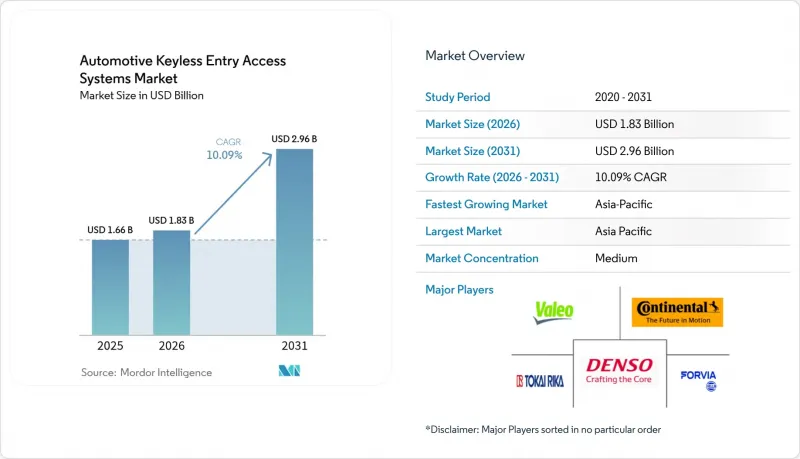
이 보고서는 제품 유형(원격 무선도어잠금(RKE) 시스템 등), 기술(RF(315/433 MHz) 등), 최종사용자(OEM 등), 차종(승용차, 소형 상용차, 대형 상용차) 및 지역별로 분류되어 있습니다. 시장 예측은 금액(달러) 기준으로 제시되어 있습니다.
글로벌 자동차 무선도어잠금 액세스 시스템 시장의 동향 및 인사이트
자동차 도난 건수 증가가 OEM의 보안 강화 촉진
2024년, 미국에서는 자동차 도난 건수가 사상 최고치를 기록하여 제조사들은 접근 제어 방어 체계를 강화할 수밖에 없었습니다. 이모빌라이저가 탑재되지 않은 모델이 주요 표적이 되었으며, 각 OEM 업체들은 신속한 소프트웨어 패치 제공 및 사후 장착 키트 제공을 강요받았습니다. 조직 범죄 집단은 몇 초 만에 리모컨 신호를 복제하는 저가형 릴레이 공격 장치를 사용하고 있으며, 이에 따라 UWB, 모션 센서가 장착된 리모컨, 다중 요소 인증에 대한 투자가 진행되고 있습니다. 보험사는 도난 방지 기술의 수준에 따라 보험료를 조정하고 있으며, 기업의 리스크 관리와 첨단 무선도어잠금 도입이 연동되고 있습니다.
커넥티드 카 및 스마트 카의 보급이 디지털 키 수요를 견인
Apple CarKey 및 Google Digital Car Key의 API는 자동차 제조사가 전용 앱을 개발하지 않고도 스마트폰 기반의 접근 기능을 제공할 수 있는 턴키형 프레임워크를 제공합니다. 테슬라의 원활한 디지털 통합은 업계의 벤치마크가 되어, 모든 가격대에서 소비자의 기대치를 높이고 있습니다. Car Connectivity Consortium의 Digital Key 3.0 사양은 Bluetooth Low Energy와 UWB를 결합하여 암호화 보안을 유지하면서도 운전자가 핸즈프리로 차량 잠금을 해제할 수 있도록 합니다. 따라서 디지털 키는 단순한 고급차의 옵션에서 벗어나, OTA(Over-the-Air)를 통한 차량 업데이트 및 운전자별로 맞춤화된 프로필을 구현하기 위한 기반 인프라로 그 위상을 전환하고 있습니다.
릴레이 공격의 취약성이 소비자의 신뢰를 훼손한다
소셜미디어의 해설 영상에서는 절도범이 중계 증폭기를 사용해 30초도 채 되지 않아 고급차의 문을 여는 모습이 소개되고 있습니다. 이러한 사건 보도는 특히 고급차 구매자들 사이에서 키리스 시스템의 안전성에 대한 신뢰를 훼손하고 있습니다. 제조사 측은 암호화된 UWB 근접 감지나 움직임을 감지하는 슬립 모드 도입 등에 대응하고 있지만, 구형 차량은 여전히 취약한 상태입니다. 소비자들의 주저로 인해 보안 보장이 강화될 때까지 업그레이드가 미뤄질 가능성이 있습니다.
부문 분석
2025년, 원격 무선도어잠금장치은 성숙한 RF 아키텍처와 차량당 매력적인 비용을 바탕으로 자동차 무선도어잠금 액세스 시스템 시장의 59.62%를 차지했습니다. 패시브 무선도어잠금(PKE)는 지속적인 근접 감지를 단순화하는 EV 플랫폼 설계에 힘입어 연평균 성장률(CAGR) 10.58%로 성장하고 있습니다. 현재 원격 무선도어잠금가 성능의 기준으로 자리 잡고 있지만, PKE의 성장은 향후 두 기술이 동등한 수준에 도달할 것임을 시사합니다. 소비자는 핸즈프리 편의성을 중시하는 반면, 차량 운영 사업자는 이 기술을 감사 수준의 운전자 인증을 실현하는 수단으로 간주하고 있습니다.
디지털 키는 현재 시장 점유율이 가장 낮은 편이지만, 스마트폰 보급률이 거의 100%에 가까워짐에 따라 두 자릿수 성장을 기록하고 있습니다. API가 성숙해짐에 따라 애프터마켓에서의 사후 개조가 예상되는 성장에 기여하고 있으며, 설계 변경 없이도 구형 모델에도 최신 접근 제어 기능을 제공할 수 있게 될 것입니다.
2025년에도 기존 RF는 자동차 무선도어잠금 액세스 시스템 시장 규모의 72.98%를 차지하고 있습니다. 저렴한 비용과 전 세계 인증 기준에 대한 대응 능력 덕분에, 특히 가격에 민감한 차종 클래스에서 계속해서 중요한 역할을 수행할 것입니다. 그러나 UWB의 연평균 성장률(CAGR) 10.31%는 신호 중계를 통한 악용에 대한 내성과 정확한 비행 시간 거리 측정에 기인합니다. 애플, 삼성, 구글은 스마트폰에 UWB 칩을 탑재하고 있으며, 이를 통해 OEM 각사는 자동차 전용으로 설계된 반도체가 아닌 소비자용 전자기기의 로드맵을 활용할 수 있게 되었습니다.
블루투스 저에너지(BLE)는 여전히 브리지 프로토콜로서의 역할을 수행하고 있으며, 특히 차량이 UWB 무선 기능을 탑재하지 않은 스마트폰과 통신해야 할 때 유용합니다. NFC는 발렛 서비스나 서비스 모드에서의 접근을 지원하지만, 중국의 NearLink는 지역별 차이를 초래할 가능성이 있습니다. 각 공급업체들은 현재 RF, BLE, UWB를 통합한 멀티 프로토콜 시스템 온 칩(SoC)을 출시하고 있으며, 이를 통해 기판의 복잡성이 줄어들고 전환이 용이해지고 있습니다.
지역별 분석
아시아태평양은 2025년 자동차 무선도어잠금 액세스 시스템 시장 매출의 48.55%를 차지하고 있으며, 연평균 성장률(CAGR)은 11.03%를 기록하고 있습니다. 중국의 전기자동차(EV) 급증으로 인해 중가형 모델에서도 키리스 시스템이 기본 사양으로 장착되면서, 해외 경쟁사들은 이에 상응하는 기능 세트를 갖추지 않을 수 없게 되었습니다. 인도의 생산 연계형 인센티브 제도는 현지 조달 비용을 절감하는 국내 전자기기 공장을 육성하고 있습니다. 덴소(Denso) 등 일본의 공급업체들은 글로벌 플랫폼을 위한 UWB 모듈의 규모를 확대하고 있는 반면, 한국의 OEM 각사는 신형 전기자동차 라인업 전반에 걸쳐 스마트폰 전용 접근 기능을 확대하고 있습니다.
북미는 시장 규모에서 2위를 차지하고 있습니다. 도난 건수 증가와 보험사의 압박으로 인해 첨단 키리스 솔루션은 필수 요건이 되었습니다. 캐나다는 8개의 도난 방지 프로젝트에 자금을 지원하며, 생체 인증 및 AI를 활용한 업그레이드를 추진하고 있습니다. 멕시코의 OEM 거점은 미국 수출 프로그램에 대응하기 위해 규격에 부합하는 모듈을 통합하고 있으며, 이로 인해 보안 요소(Secure Element)에 대한 수요가 지역 전체로 확산되고 있습니다. 높은 스마트폰 보급률이 디지털 키의 수용을 지원하고 있으며, 대규모 애프터마켓이 사후 장착 개조를 지원하고 있습니다.
유럽에서는 엄격한 사이버 보안 규제가 호재로 작용하고 있습니다. 고급차 브랜드가 UWB 도입을 주도하는 한편, 중급 모델에는 암호화된 BLE가 채택되고 있습니다. ‘사이버 복원력 법’에 따른 규제의 명확화로 인해 선도 기업은 규정 준수 측면에서 우위를 점하게 되었으며, 이는 조달 주기내 공급업체 선정에 영향을 미치고 있습니다.
기타 혜택:
- 엑셀 형식의 시장 예측(ME) 시트
- 3개월간의 애널리스트 지원
자주 묻는 질문
목차
제1장 서론
제2장 조사 방법
제3장 개요
제4장 시장 구도
제5장 시장 규모와 성장 예측
제6장 경쟁 구도
제7장 시장 기회와 향후 전망
KSA 26.08.26According to Mordor Intelligence, the automotive keyless entry access systems market size is expected to grow from USD 1.66 billion in 2025 to USD 1.83 billion in 2026 and is forecast to reach USD 2.96 billion by 2031 at 10.09% CAGR over 2026-2031.
This report is Segmented by Product Type (Remote Keyless Entry (RKE) System, and More), Technology ( RF (315/433 MHz), and More), End-User (Original Equipment Manufacturers, and More), Vehicle Type (Passenger Cars, Light Commercial Vehicles, and Heavy Commercial Vehicles), and Geography. The Market Forecasts are Provided in Terms of Value (USD).
Global Automotive Keyless Entry Access Systems Market Trends and Insights
Rising Vehicle-Theft Incidence Driving OEM Security Upgrades
Vehicle theft exceeded in the United States during 2024, pressuring manufacturers to harden access-control defenses. Models without immobilizers became the main targets, forcing OEMs to deliver rapid software patches and retrofit kits. Organized crime employs cheap relay-attack devices that clone fob signals within seconds, prompting investment in UWB, motion-sensing fobs, and multi-factor authentication. Insurers adjust premiums based on anti-theft sophistication, aligning corporate risk management with advanced keyless entry deployment.
Connected and Smart-Car Adoption Boosting Demand for Digital Keys
Apple CarKey and Google Digital Car Key APIs provide turnkey frameworks that let automakers roll out smartphone-based access without bespoke app development. Tesla's seamless digital integration benchmark raises consumer expectations across all price points. The Car Connectivity Consortium's Digital Key 3.0 specification combines Bluetooth Low Energy and UWB, letting drivers unlock vehicles hands-free while maintaining cryptographic security. Digital keys have, therefore,e shifted from luxury add-ons to baseline infrastructure for over-the-air (OTA) vehicle updates and personalized driver profiles.
Relay-Attack Vulnerabilities Eroding Consumer Trust
Social-media tutorials show thieves opening premium vehicles in under 30 seconds using relay amplifiers. Publicized incidents undermine the perceived safety of keyless systems, especially among high-end buyers. Manufacturers respond with encrypted UWB proximity checks and motion-detected sleep modes, yet legacy vehicles remain exposed. Consumer hesitation could delay upgrades until security guarantees strengthen.
Other drivers and restraints analyzed in the detailed report include:
- Premium and EV Penetration Making PKE Standard Equipment
- Insurance-Driven Anti-Theft Regulations in US and EU
- High BOM Cost for Economy-Segment Models
For complete list of drivers and restraints, kindly check the Table Of Contents.
Segment Analysis
Remote Keyless Entry systems held 59.62% of the automotive keyless entry access system market in 2025, leveraging mature RF architecture and attractive cost per vehicle. Passive Keyless Entry is advancing at 10.58% CAGR, aided by EV platform design that simplifies continuous proximity detection. Remote Keyless Entry presently sets the performance baseline, yet PKE's growth suggests eventual parity. Consumers value hands-free convenience, while fleet operators view the technology as a path to audit-level driver authentication.
Digital keys, although the smallest slice today, record double-digit growth as smartphone saturation nears universality. As APIs mature, aftermarket retrofits factor into the projected upswing, granting older models modern access control without redesign.
Traditional RF still accounts for 72.98% of the automotive keyless entry access system market size in 2025. Its low cost and familiarity with global certification ensure continued relevance, particularly in price-sensitive vehicle classes. Yet UWB's 10.31% CAGR stems from its immunity to signal-relay exploits and precise time-of-flight ranging. Apple, Samsung, and Google place UWB chips in phones, enabling OEMs to lean on consumer electronics roadmaps rather than bespoke automotive silicon.
Bluetooth Low Energy remains a bridging protocol, especially useful when vehicles must communicate with phones lacking UWB radios. NFC supports valet and service-mode access, while China's NearLink may introduce regional divergence. Suppliers now release multi-protocol system-on-chips that bundle RF, BLE, and UWB, cutting board complexity and easing migration.
Complete Report Scope:
- By Product Type
- Passive Keyless Entry (PKE) System
- Remote Keyless Entry (RKE) System
- Digital / Phone-as-a-Key System
- By Technology
- RF (315/433 MHz)
- Bluetooth Low Energy (BLE)
- Near-Field Communication (NFC)
- Ultra-Wideband (UWB)
- By End-User
- Original Equipment Manufacturers (OEMs)
- Aftermarket
- By Vehicle Type
- Passenger Cars
- Light Commercial Vehicles
- Heavy Commercial Vehicles
- By Geography
- North America
- United States
- Canada
- Rest of North America
- South America
- Brazil
- Argentina
- Rest of South America
- Europe
- Germany
- United Kingdom
- France
- Spain
- Italy
- Russia
- Rest of Europe
- Asia-Pacific
- China
- Japan
- India
- South Korea
- Indonesia
- Philippines
- Vietnam
- Australia
- New Zealand
- Rest of Asia-Pacific
- Middle East and Africa
- United Arab Emirates
- Saudi Arabia
- Turkey
- Israel
- South Africa
- Egypt
- Rest of Middle East and Africa
- North America
Geography Analysis
Asia-Pacific generated 48.55% of the automotive keyless entry access system market's 2025 revenue and is tracking an 11.03% CAGR. China's EV surge positions keyless systems as standard equipment even on mid-priced models, forcing foreign competitors to match feature sets. India's production-linked incentive schemes nurture domestic electronics plants that lower local procurement costs. Japanese suppliers like Denso scale UWB modules for global platforms, while South Korean OEMs extend smartphone-only access across new electric ranges.
North America ranks second by value. Rising theft statistics and insurance pressure make advanced keyless solutions table stakes. Canada funds eight anti-theft projects, anchoring biometric and AI-based upgrades. Mexico's OEM hubs integrate compliant modules to serve US export programs, spreading secure-element demand across the region. Wide smartphone penetration bolsters digital-key acceptance, and a sizable aftermarket supports retrofits.
Europe benefits from strict cybersecurity mandates. Luxury brands spearhead UWB adoption, while mid-tier models incorporate encrypted BLE. Regulatory clarity under the Cyber Resilience Act grants first movers a compliance edge, shaping supplier shortlists in procurement cycles.
- Continental AG
- Denso Corporation
- Valeo SA
- Hella GmbH & Co. KGaA
- Tokai Rika Co. Ltd.
- Alps Alpine Co. Ltd.
- Mitsubishi Electric Corp.
- Omron Automotive Electronics Co. Ltd.
- Hyundai Mobis Co. Ltd.
- Marquardt GmbH
- Robert Bosch GmbH
- Aisin Seiki Co. Ltd.
- Lear Corporation
- Calsonic Kansei Corp.
- EyeLock LLC
- ZF TRW Automotive
- Microchip Technology (Atmel)
- Alpha Corp
- NXP Semiconductors N.V.
- Texas Instruments Inc.
- Assa Abloy AB
Additional Benefits:
- The market estimate (ME) sheet in Excel format
- 3 months of analyst support
TABLE OF CONTENTS
1 Introduction
- 1.1 Study Assumptions & Market Definition
- 1.2 Scope of the Study
2 Research Methodology
3 Executive Summary
4 Market Landscape
- 4.1 Market Overview
- 4.2 Market Drivers
- 4.2.1 Rising Vehicle-Theft Incidence Driving OEM Security Upgrades
- 4.2.2 Connected & Smart-Car Adoption Boosting Demand for Digital Keys
- 4.2.3 Premium & EV Penetration Making PKE Standard Equipment
- 4.2.4 Big-Tech Phone-as-a-Key" APIs Expanding OEM Ecosystems"
- 4.2.5 Insurance-Driven Anti-Theft Regulations in US and EU
- 4.2.6 UWB-Enabled Car-Sharing Platforms (Fleet and Maas)
- 4.3 Market Restraints
- 4.3.1 Relay-Attack Vulnerabilities Eroding Consumer Trust
- 4.3.2 High BOM Cost for Economy-Segment Models
- 4.3.3 Secure-Chip Shortages Amid Smartphone Demand Peaks
- 4.3.4 EU Draft Law Mandating MFA Could Delay Roll-Outs
- 4.4 Value / Supply-Chain Analysis
- 4.5 Regulatory Landscape
- 4.6 Technological Outlook
- 4.7 Porter's Five Forces
- 4.7.1 Threat of New Entrants
- 4.7.2 Bargaining Power of Buyers
- 4.7.3 Bargaining Power of Suppliers
- 4.7.4 Threat of Substitutes
- 4.7.5 Intensity of Competitive Rivalry
5 Market Size & Growth Forecasts (Value, USD Billion)
- 5.1 By Product Type
- 5.1.1 Passive Keyless Entry (PKE) System
- 5.1.2 Remote Keyless Entry (RKE) System
- 5.1.3 Digital / Phone-as-a-Key System
- 5.2 By Technology
- 5.2.1 RF (315/433 MHz)
- 5.2.2 Bluetooth Low Energy (BLE)
- 5.2.3 Near-Field Communication (NFC)
- 5.2.4 Ultra-Wideband (UWB)
- 5.3 By End-User
- 5.3.1 Original Equipment Manufacturers (OEMs)
- 5.3.2 Aftermarket
- 5.4 By Vehicle Type
- 5.4.1 Passenger Cars
- 5.4.2 Light Commercial Vehicles
- 5.4.3 Heavy Commercial Vehicles
- 5.5 By Geography
- 5.5.1 North America
- 5.5.1.1 United States
- 5.5.1.2 Canada
- 5.5.1.3 Rest of North America
- 5.5.2 South America
- 5.5.2.1 Brazil
- 5.5.2.2 Argentina
- 5.5.2.3 Rest of South America
- 5.5.3 Europe
- 5.5.3.1 Germany
- 5.5.3.2 United Kingdom
- 5.5.3.3 France
- 5.5.3.4 Spain
- 5.5.3.5 Italy
- 5.5.3.6 Russia
- 5.5.3.7 Rest of Europe
- 5.5.4 Asia-Pacific
- 5.5.4.1 China
- 5.5.4.2 Japan
- 5.5.4.3 India
- 5.5.4.4 South Korea
- 5.5.4.5 Indonesia
- 5.5.4.6 Philippines
- 5.5.4.7 Vietnam
- 5.5.4.8 Australia
- 5.5.4.9 New Zealand
- 5.5.4.10 Rest of Asia-Pacific
- 5.5.5 Middle East and Africa
- 5.5.5.1 United Arab Emirates
- 5.5.5.2 Saudi Arabia
- 5.5.5.3 Turkey
- 5.5.5.4 Israel
- 5.5.5.5 South Africa
- 5.5.5.6 Egypt
- 5.5.5.7 Rest of Middle East and Africa
- 5.5.1 North America
6 Competitive Landscape
- 6.1 Market Concentration
- 6.2 Strategic Moves
- 6.3 Market Share Analysis
- 6.4 Company Profiles (includes Global Level Overview, Market Level Overview, Core Segments, Financials as Available, Strategic Information, Market Rank/Share for Key Companies, Products and Services, SWOT Analysis, and Recent Developments)
- 6.4.1 Continental AG
- 6.4.2 Denso Corporation
- 6.4.3 Valeo SA
- 6.4.4 Hella GmbH & Co. KGaA
- 6.4.5 Tokai Rika Co. Ltd.
- 6.4.6 Alps Alpine Co. Ltd.
- 6.4.7 Mitsubishi Electric Corp.
- 6.4.8 Omron Automotive Electronics Co. Ltd.
- 6.4.9 Hyundai Mobis Co. Ltd.
- 6.4.10 Marquardt GmbH
- 6.4.11 Robert Bosch GmbH
- 6.4.12 Aisin Seiki Co. Ltd.
- 6.4.13 Lear Corporation
- 6.4.14 Calsonic Kansei Corp.
- 6.4.15 EyeLock LLC
- 6.4.16 ZF TRW Automotive
- 6.4.17 Microchip Technology (Atmel)
- 6.4.18 Alpha Corp
- 6.4.19 NXP Semiconductors N.V.
- 6.4.20 Texas Instruments Inc.
- 6.4.21 Assa Abloy AB


