

|
시장보고서
상품코드
2114164
양성 전립선 비대증 시장 : 시장 점유율 분석, 업계 동향 및 통계, 성장 예측(2026-2031년)Benign Prostatic Hyperplasia - Market Share Analysis, Industry Trends & Statistics, Growth Forecasts (2026 - 2031) |
||||||
 Mordor Intelligence
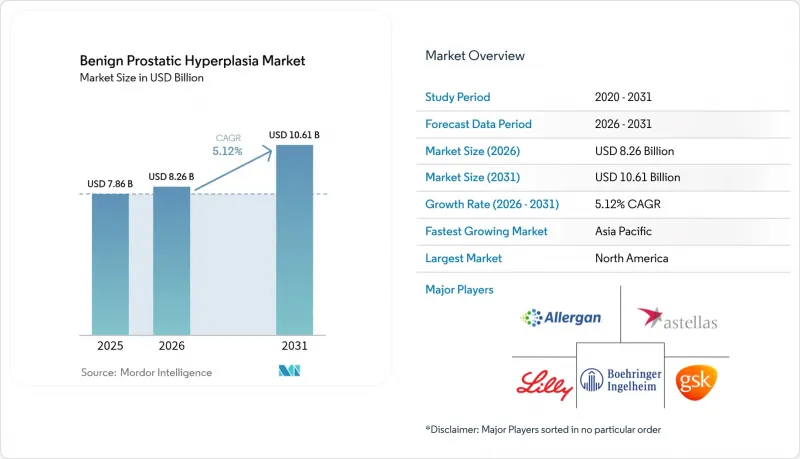
Mordor Intelligence에 의하면, 양성 전립선 비대증(BPH) 시장 규모는 2025년 78억 6,000만 달러로 평가되었고, 2026년에는 82억 6,000만 달러로 추정되고, 2026-2031년 CAGR 5.12%로 성장을 지속할 전망이며, 2031년까지 106억 1,000만 달러에 이를 것으로 예측됩니다.
본 보고서는 약제 유형별(α-차단제, 5-α-환원효소 억제제(5-ARIs) 등), 제형별(경구용 즉시방출정·캡슐, 경구 서방형 정제 등), 유통 채널별(병원 약국, 소매 약국 등), 지역별(북미, 유럽 등)로 분류되어 있습니다. 시장 전망은 금액(달러) 기준으로 제시되어 있습니다.
세계의 양성 전립선 비대증 시장 동향 및 인사이트
북미에서는 원격 비뇨기과 플랫폼의 급증으로 처방량이 확대되고 있습니다.
현재 텔레헬스를 통해 외래 비뇨기과 진료의 최대 30%가 관리되고 있으며, 환자 만족도는 85%를 초과하고 있습니다(Scientific Reports). 특히 혜택을 보고 있는 곳은 지방 지역으로, 조기 의료 접근성 덕분에 전립선 질환과 관련된 도시와 지방 간의 사망률 격차(기존 20%였던)가 축소되었습니다. 통합된 데이터 피드를 통해 임상의는 국제 전립선 증상 점수(IPSS)의 추이를 원격으로 추적할 수 있으며, 단일 요법의 효과가 정체되는 시점에 적시에 병용 요법으로 전환하기가 용이해집니다. 이러한 플랫폼의 자동 처방전 갱신 알림 기능은 성기능 부작용으로 인한 것으로 여겨지던 30%의 치료 중단률을 감소시켜, 결과적으로 평생 처방량을 증가시키고 있습니다.
중국 전역의 전립선 건강 검진 캠페인이 진단율을 향상시켰습니다.
'건강 중국 2030'의 틀 아래, 시립 진료소에서는 정기적인 전립선 검사가 실시되고 있으며, 조기 전립선 비대증(BPH) 발견률이 현저히 향상되고 있습니다(bayer.com). 해외 임상 데이터가 승인됨에 따라 혁신적인 치료법의 출시 기간이 단축되어, 세계 제약 기업들은 세계 최대 규모의 환자층에 더 빠르게 진출할 수 있게 되었습니다. 국가의료보장국의 보험급여액 인상은 의약품 보급을 더욱 촉진하고, 외과적 치료로 전환되기까지의 치료 기간을 연장하는 동시에 누적 의약품 지출을 증가시키고 있습니다.
억제요인의 영향 분석
부문 분석
2025년에는 α-차단제가 최대의 수익 기반이 되어 전립선 비대증 치료제 시장 점유율의 45.02%를 차지했습니다. 탐슬로신 0.4mg은 작용 발현이 빠르고 심혈관계에 미치는 영향이 적기 때문에 여전히 주력 치료제로서의 지위를 유지하고 있습니다. 한편, PDE-5 억제제는 비뇨기과적 적응증과 성기능 개선이라는 이중 적응증으로 인해 복약 순응도가 높아지고 있어 6.74%라는 가장 높은 연평균 성장률(CAGR)을 기록하고 있습니다. 두타스테리드/탐스로신(Jalyn)이나 피나스테리드/타다라필(ENTADFI) 등의 고정용량복합제(FDC)는 전립선 부피 감소와 발기 기능 지원을 통합하여, 성적으로 활발한 환자층에서 대상 환자층을 확대되고 있습니다. 네트워크 메타분석에 따르면, α-차단제와 PDE-5 억제제의 병용 요법은 IPSS 및 삶의 질(QOL) 평가 척도에서 단일 요법을 크게 상회하는 것으로 확인되었습니다.
지역별 분석
북미는 광범위한 보험 적용과 높은 진단 보급률에 힘입어 2025년 매출의 39.55%를 차지했습니다. 미국의 인플레이션 리베이트 프로그램은 정가 상승을 억제하면서도, 하류 수술 치료 비용을 절감하는 것으로 간주되는 병용 제품에 대한 접근성을 유지하고 있습니다. 처방약 목록은 계속해서 유동적인 상태를 보이고 있으며, 2025년 매사추세츠주의 블루크로스 블루쉴드가 자린(Jalin)과 엔타도피(Entadphi)를 목록에서 제외한 것은 정교한 시장 진출 전략의 필요성을 여실히 보여줍니다(bluecrossma.org). 캐나다에서는 전국 규모의 전립선 건강 캠페인이 효과를 거두고 있는 반면, 멕시코에서는 세그로 포플라르(Seguro Popular)의 확대로 제네릭 의약품의 보급이 촉진되고 있습니다.
아시아태평양은 연평균 성장률(CAGR) 6.78%로 가장 빠르게 성장하고 있는 지역입니다. 중국의 ‘건강 중국 2030’ 이니셔티브에 따라 지역 진료소에서의 전립선 검진이 매년 정기적으로 실시되면서 조기 진단률이 3배로 증가했고, 치료 파이프라인이 확충되고 있습니다. 일본에서는 의사의 약물 요법에 대한 이해가 깊어진 것을 반영하여 α-1 차단제의 처방량이 증가했습니다. 인도와 한국에서는 공립 병원이 전문의 대기 시간을 단축하는 원격 비뇨기과 시범 사업을 도입하여 성장세를 보이고 있습니다.
유럽에서는 견고한 도입 기반이 유지되고 있지만, 엄격한 의료 기술 평가로 인해 가격 및 판매량 상승 여지가 제한되고 있습니다. 독일과 프랑스에서는 급성 요폐 완화 효과가 입증된 고정 배합제(FDC)가 선호되는 반면, 영국의 국립보건임상연구소(NICE)는 MIST와 평생 약물 요법의 비용 대비 효과를 재평가했습니다. 중동 및 아프리카에서는 걸프협력회의(GCC) 회원국들이 브랜드 알파 차단제를 수입하는 비뇨기과 센터에 투자하고 있는 반면, 사하라 이남의 대부분의 의료 시스템은 저비용 제네릭 의약품에 의존하고 있어, 미충족 의료 수요가 남아 있는 지역이 있습니다. 남미에서는 브라질을 필두로, 국내 실제 임상 연구에서 치료 지속이 입원율 감소와 관련이 있는 것으로 나타남에 따라 두타스테리드의 보험 적용 범위가 확대되고 있습니다.
기타 혜택 :
- 엑셀 형식 시장 예측(ME) 시트
- 3개월간 애널리스트 지원
자주 묻는 질문
목차
제1장 서론
제2장 조사 방법
제3장 주요 요약
제4장 시장 구도
제5장 시장 규모 및 성장 예측
제6장 경쟁 구도
제7장 시장 기회 및 향후 전망
AJY 26.08.26According to Mordor Intelligence, the benign prostatic hyperplasia market size is expected to grow from USD 7.86 billion in 2025 to USD 8.26 billion in 2026 and is forecast to reach USD 10.61 billion by 2031 at 5.12% CAGR over 2026-2031.
This report Segments Into by Drug Type (Alpha-Blockers, 5- Alpha-Reductase Inhibitors (5-Aris) and More), by Dosage Form (Oral Immediate-Release Tablets/Capsules, Oral Extended-Release Tablets and More) by Distribution Channel (Hospital Pharmacies, Retail Pharmacies, and More), and Geography (North America, Europe, and More). The Market Forecasts are Provided in Terms of Value (USD).
Global Benign Prostatic Hyperplasia Market Trends and Insights
Surge of Tele-urology Platforms Expanding Prescription Volumes in North America
Telehealth now manages up to 30% of outpatient urology visits with patient-satisfaction levels above 85% Scientific Reports. Rural areas benefit most; earlier care access has narrowed the historical 20% urban-rural mortality gap tied to prostate conditions. Integrated data feeds let clinicians track International Prostate Symptom Score (IPSS) trends remotely, facilitating timely shifts to combination therapy once monotherapies plateau. Automated refill alerts on these platforms curtail the 30% discontinuation rate historically linked to adverse sexual effects, thereby elevating lifetime prescription volume.
National Prostate Health Screening Campaigns Elevating Diagnosis Rates in China
Under Healthy China 2030, municipal clinics conduct routine prostate checks, markedly increasing early-stage BPH detection bayer.com. Acceptance of foreign clinical dossiers has shortened launch timelines for innovative therapies, giving global manufacturers faster on-ramp to the world's largest patient pool. Enhanced reimbursement from the National Medical Security Bureau further supports medicine uptake, extending therapy duration before surgical referral and inflating cumulative drug spending.
Restraint Impact Analysis
Other drivers and restraints analyzed in the detailed report include:
- Government Price Caps on Generic Drugs
- Reimbursement Expansion for Dutasteride/Tamsulosin FDC
- Finasteride Sexual-Side-Effect Concerns Dampening Adherence
- Rising Preference for Minimally Invasive Procedures Cannibalizing Drug Revenues
For complete list of drivers and restraints, kindly check the Table Of Contents.
Segment Analysis
Alpha-blockers generated the largest revenue base in 2025, holding 45.02% of benign prostatic hyperplasia drugs market share. Tamsulosin 0.4 mg remains the anchor therapy given its rapid onset and favorable cardiovascular profile. Yet, PDE-5 inhibitors are pacing the highest 6.74% CAGR, benefiting from dual urological and sexual-health indications that enhance compliance. FDCs such as dutasteride/tamsulosin (Jalyn) and finasteride/tadalafil (ENTADFI) integrate prostate-volume reduction with erectile-function support, expanding their addressable audience among sexually active patients. Network meta-analyses confirm that alpha-blocker + PDE-5 inhibitor regimens significantly outscore monotherapies on IPSS and quality-of-life scales.
Complete Report Scope:
- By Drug Class
- Alpha-Blockers
- 5-Alpha Reductase Inhibitors (5-ARIs)
- Phosphodiesterase-5 (PDE-5) Inhibitors
- Combination Therapies (a-Blocker + 5-ARI / PDE-5)
- Others
- By Dosage Form
- Oral Immediate-Release Tablets / Capsules
- Oral Extended-Release Tablets
- Softgel Capsules
- Orally Disintegrating Tablets (ODT)
- By Distribution Channel
- Hospital Pharmacies
- Retail & Community Pharmacies
- E-commerce & Mail-Order Pharmacies
- By Geography
- North America
- United States
- Canada
- Mexico
- Europe
- Germany
- United Kingdom
- France
- Italy
- Spain
- Rest of Europe
- Asia-Pacific
- China
- Japan
- India
- South Korea
- Australia
- Rest of Asia-Pacific
- Middle East and Africa
- GCC
- South Africa
- Rest of Middle East and Africa
- South America
- Brazil
- Argentina
- Rest of South America
- North America
Geography Analysis
North America commanded 39.55% of 2025 revenue, underpinned by broad insurance coverage and high diagnostic penetration. The U.S. Inflation Rebate Program tempers list-price inflation yet sustains access to combination products viewed as reducing downstream surgical costs. Formularies remain fluid; the 2025 Blue Cross Blue Shield of Massachusetts exclusion of Jalyn and Entadfi underscores the need for sophisticated market-access strategies bluecrossma.org. Canada benefits from pan-provincial prostate-health campaigns, while Mexico's Seguro Popular expansion propels generic uptake.
Asia-Pacific is the fastest-growing geography at 6.78% CAGR. China's Healthy China 2030 initiative has normalized annual prostate screening in community clinics, tripling early-stage diagnosis rates and filling the therapy funnel. Japan's prescription volume for alpha-1 blockers increased, reflecting greater physician comfort with pharmacologic management. India and South Korea show momentum as public-sector hospitals integrate tele-urology pilots that shorten specialist waitlists.
Europe maintains a solid installed base, but rigorous health-technology assessments compress price-volume corridors. Germany and France favor FDCs with documented reduction in acute urinary retention, while the UK's National Institute for Health and Care Excellence (NICE) is reassessing cost utility of MISTs versus lifelong medication. In the Middle East & Africa, Gulf Cooperation Council states are investing in urology centers that import branded alpha-blockers, whereas most sub-Saharan systems rely on low-cost generics, leaving pockets of unmet need. South America, led by Brazil, is widening insurance formularies for dutasteride after domestic real-world studies linked therapy persistence to lower hospitalization.
- Abbvie
- Astellas Pharma
- GlaxoSmithKline
- Pfizer
- Eli Lilly and Company
- Viatris
- Merck
- Teva Pharmaceutical Industries
- Sun Pharmaceuticals Industries
- Dr. Reddy's Laboratories Ltd.
- Lupin
- Cipla
- Torrent Pharmaceuticals
- Recordati S.p.A.
- Eisai
- Ferring Pharmaceuticals
- Sandoz (Novartis Division)
- Sanofi
- Alkem Laboratories Ltd.
- Zydus Lifesciences Ltd.
Additional Benefits:
- The market estimate (ME) sheet in Excel format
- 3 months of analyst support
TABLE OF CONTENTS
1 Introduction
- 1.1 Study Assumptions & Market Definition
- 1.2 Scope of the Study
2 Research Methodology
3 Executive Summary
4 Market Landscape
- 4.1 Market Overview
- 4.2 Market Drivers
- 4.2.1 Surge of Tele-urology Platforms Expanding Prescription Volumes in North America
- 4.2.2 National Prostate Health Screening Campaigns Elevating Diagnosis Rates in China
- 4.2.3 Government Price Caps on Generic Drugs
- 4.2.4 Reimbursement Expansion for Dutasteride/Tamsulosin FDC
- 4.2.5 Rising Preference for Combination a-Blocker/5-ARI Fixed-Dose Pills in Europe
- 4.2.6 Accelerated Private Urology Clinic Build-outs Across GCC Nations
- 4.3 Market Restraints
- 4.3.1 Finasteride Sexual-Side-Effect Concerns Dampening Adherence
- 4.3.2 Rising Preference for Minimally Invasive Procedures Cannibalizing Drug Revenues
- 4.3.3 Shortage of Fellowship-Trained Endourologists in Sub-Saharan Africa
- 4.4 Supply-Chain Analysis
- 4.5 Regulatory Outlook
- 4.6 Technological Outlook
- 4.7 Porter's Five Forces
- 4.7.1 Threat of New Entrants
- 4.7.2 Bargaining Power of Suppliers
- 4.7.3 Bargaining Power of Buyers
- 4.7.4 Threat of Substitutes
- 4.7.5 Competitive Rivalry
5 Market Size & Growth Forecasts (Value)
- 5.1 By Drug Class
- 5.1.1 Alpha-Blockers
- 5.1.2 5-Alpha Reductase Inhibitors (5-ARIs)
- 5.1.3 Phosphodiesterase-5 (PDE-5) Inhibitors
- 5.1.4 Combination Therapies (a-Blocker + 5-ARI / PDE-5)
- 5.1.5 Others
- 5.2 By Dosage Form
- 5.2.1 Oral Immediate-Release Tablets / Capsules
- 5.2.2 Oral Extended-Release Tablets
- 5.2.3 Softgel Capsules
- 5.2.4 Orally Disintegrating Tablets (ODT)
- 5.3 By Distribution Channel
- 5.3.1 Hospital Pharmacies
- 5.3.2 Retail & Community Pharmacies
- 5.3.3 E-commerce & Mail-Order Pharmacies
- 5.4 By Geography
- 5.4.1 North America
- 5.4.1.1 United States
- 5.4.1.2 Canada
- 5.4.1.3 Mexico
- 5.4.2 Europe
- 5.4.2.1 Germany
- 5.4.2.2 United Kingdom
- 5.4.2.3 France
- 5.4.2.4 Italy
- 5.4.2.5 Spain
- 5.4.2.6 Rest of Europe
- 5.4.3 Asia-Pacific
- 5.4.3.1 China
- 5.4.3.2 Japan
- 5.4.3.3 India
- 5.4.3.4 South Korea
- 5.4.3.5 Australia
- 5.4.3.6 Rest of Asia-Pacific
- 5.4.4 Middle East and Africa
- 5.4.4.1 GCC
- 5.4.4.2 South Africa
- 5.4.4.3 Rest of Middle East and Africa
- 5.4.5 South America
- 5.4.5.1 Brazil
- 5.4.5.2 Argentina
- 5.4.5.3 Rest of South America
- 5.4.1 North America
6 Competitive Landscape
- 6.1 Market Concentration
- 6.2 Market Share Analysis
- 6.3 Company Profiles {(includes Global level Overview, Market level overview, Core Segments, Financials as available, Strategic Information, Market Rank/Share for key companies, Products & Services, and Recent Developments)}
- 6.3.1 AbbVie Inc.
- 6.3.2 Astellas Pharma Inc.
- 6.3.3 GlaxoSmithKline plc
- 6.3.4 Pfizer Inc.
- 6.3.5 Eli Lilly and Company
- 6.3.6 Viatris Inc.
- 6.3.7 Merck & Co., Inc.
- 6.3.8 Teva Pharmaceutical Industries Ltd.
- 6.3.9 Sun Pharmaceutical Industries Ltd.
- 6.3.10 Dr. Reddy's Laboratories Ltd.
- 6.3.11 Lupin Limited
- 6.3.12 Cipla Ltd.
- 6.3.13 Torrent Pharmaceuticals Ltd.
- 6.3.14 Recordati S.p.A.
- 6.3.15 Eisai Co., Ltd.
- 6.3.16 Ferring Pharmaceuticals
- 6.3.17 Sandoz (Novartis Division)
- 6.3.18 Sanofi
- 6.3.19 Alkem Laboratories Ltd.
- 6.3.20 Zydus Lifesciences Ltd.
7 Market Opportunities & Future Outlook
- 7.1 White-space & Unmet-Need Assessment


