

|
시장보고서
상품코드
2114171
농업용 AI : 시장 점유율 분석, 업계 동향 및 통계, 성장 예측(2026-2031년)AI In Agriculture - Market Share Analysis, Industry Trends & Statistics, Growth Forecasts (2026 - 2031) |
||||||
 Mordor Intelligence
Mordor Intelligence에 의하면, 농업용 AI 시장 규모는 2025년 24억 3,000만 달러로 평가되었습니다. 2026년에는 31억 1,000만 달러로 확대되어 2026년부터 2031년에 걸쳐 CAGR 21.96%로 성장을 지속하여, 2031년에는 83억 9,000만 달러에 이를 것으로 예측됩니다.
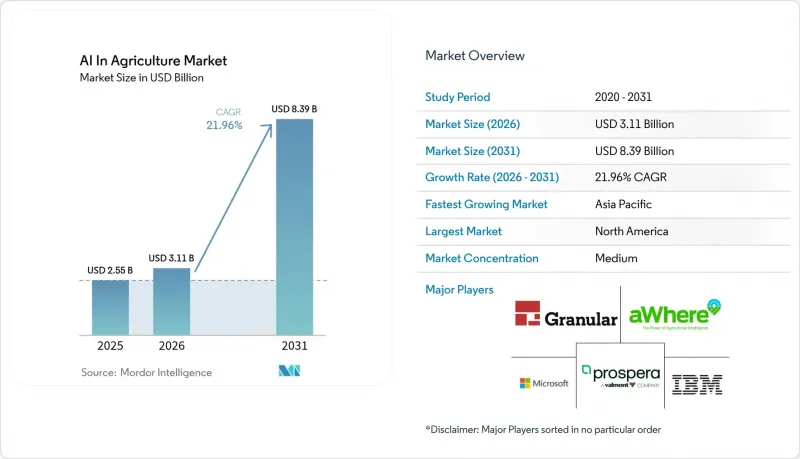
본 보고서는 용도(정밀 농업, 가축 모니터링, 드론 분석, 스마트 온실 관리, 공급망 및 수확 후 공정 최적화), 기술(머신러닝, 컴퓨터 비전 등), 구성 요소(하드웨어, 소프트웨어 플랫폼, 서비스), 도입 형태(클라우드, 하이브리드) 및 지역별로 분류되어 있습니다. 시장 예측은 금액(달러) 기준으로 제시됩니다.
세계의 농업용 AI 시장 동향 및 인사이트
정밀 농업 플랫폼의 급속한 확산
Deere and Company는 2025년 자사의 운영 센터에 머신러닝 알고리즘을 통합했습니다. 이를 통해 플랫폼은 수년에 걸친 수확량 지도와 토양 전도도 측정값을 반영하여 자동으로 파종 처방전을 생성할 수 있게 되었으며, 초기 도입 기업들은 종자 비용을 8-12% 절감할 수 있었습니다. Trimble은 2026년 초에 이에 뒤이어 자사의 농업용 소프트웨어 제품군에 생성형 AI를 활용한 보고서 작성 도구를 추가했습니다. 이를 통해 농장 관리자는 대시보드를 수동으로 작성하지 않고도 자금 제공업체에게 설명할 수 있게 되었습니다. Verra VM0042와 같은 프로토콜에서는 크레딧 발행 전에 구획 단위의 탄소 고정량을 정량화해야 하므로, 탄소 회계 모듈은 현재 표준 애드온으로 자리 잡았습니다. 생산자들이 검증된 탄소 크레딧을 거래함에 따라, 그 수익을 새로운 센서 구매에 재투자하여 데이터 네트워크의 효과를 더욱 강화하고 있습니다. 그 결과, 시즌이 지날수록 플랫폼 활용도가 깊어지고, 타사로의 전환 비용이 점점 더 높아지는 선순환이 형성되고 있습니다.
고해상도 드론 및 위성 이미지 서비스의 확대
PrecisionHawk사는 드론 이미지와 Sentinel-1 합성개구레이더를 융합한 2025년형 서비스 플랜을 시작하여, 전천후 토양 수분 및 바이오매스 지도를 제공합니다. Aerobotics사는 2026년에 컴퓨터 비전 모델을 도입하여 감귤류 과일을 하나하나 세어낼 수 있게 함으로써, 포장 업체들이 기존보다 6주 더 빨리 선물 계약을 체결할 수 있게 되었습니다. Planet Labs의 ‘SuperDove’ 위성군은 현재 모든 농지를 매일 3미터 해상도로 재관측하고 있으며, 농업 전문가들에게 이모작 시스템에 관한 거의 실시간에 가까운 피드백을 제공합니다. 이러한 시간적 고밀도화 덕분에 의사결정 주기가 단축되고, 타이밍 오류로 인한 수확량 손실을 최소화할 수 있습니다.
분산된 농업 데이터 표준
2025년 시점에서 농업 관리 소프트웨어 공급업체 중 AgGateway의 ADAPT 데이터 교환 프레임워크를 채택한 곳은 고작 30%에 불과했으며, 생산자들은 공급업체를 변경할 때 호환되지 않는 파일 형식을 조정해야만 했습니다. 토양 분류 체계도 제각각이어서, 미국 농무부(USDA)는 12개의 토양 순서를 인증하고 있는 반면, 세계 참조 기준(World Reference Base)에서는 32개를 열거하고 있어 모델의 이식성을 저해하고 있습니다. 기상 관측소의 프로토콜과 해충 명명법도 제각각이어서, 데이터 세트를 국제적으로 통합할 때 예측 정확도가 떨어집니다. 벤더는 지역별 모델을 구축하고 유지 관리해야 하므로, 결과적으로 개발 비용이 증가하고 기능 출시가 지연됩니다.
부문별 분석
2025년, 정밀 농업은 농업용 AI 시장 점유율의 43.29%를 차지했으며, 이는 옥수수 및 대두 재배 면적에서 가변 시비 장치가 널리 보급되고 있음을 반영합니다. 그러나 스마트 온실 관리는 2031년까지 22.47%의 성장률로 확대되어 AI 응용 분야의 성장을 주도할 것으로 예측됩니다. 지능형 그로스 솔루션즈(Intelligent Growth Solutions)의 생성형 AI 코파일럿은 몇 분 간격으로 CO2 농도와 LED 스펙트럼을 미세 조정하여, 수직 농장이 수확량 감소 없이 에너지 사용량을 18% 절감할 수 있도록 지원합니다. 컴퓨터 비전 시스템이 며칠 전부터 절뚝거림이나 분만 위험을 감지함으로써 수의사 비용과 사망률을 낮출 수 있기 때문에 가축 모니터링은 빠르게 보급되고 있습니다. 드론 분석은 10%대 중반의 점유율에 머물러 있지만, 규제 당국이 시야 밖 비행을 허용하면 점유율을 확대할 가능성이 있습니다.
수십 가지 변수에 대해 5분마다 센서 측정값이 기록되는 고밀도 온실 데이터셋은 모델의 반복 처리를 가속화하지만, 반면 노지 작물은 데이터가 산발적이어서 알고리즘 개선이 더딘 실정입니다. GlobalGAP 등의 인증에서는 AI를 활용한 추적 가능성이 요구되기 시작했으며, 이에 따라 수확 후 최적화 플랫폼이 주류 예산에 포함되고 있습니다. 그 결과, 제어 환경용 농업용 AI 시장 규모는 2031년까지 주류인 줄 재배와의 격차 일부를 메울 전망입니다.
2025년 지출 중 머신러닝이 48.19%를 차지하며, 농업용 AI 시장 전체를 지탱했습니다. 컴퓨터 비전은 규모는 작지만, 드론 군단 및 엣지 프로세서의 보급에 따라 2026년부터 2031년에 걸쳐 연평균 22.68%의 성장이 예상되며, 다른 기술을 능가하는 속도로 확대될 것으로 예측됩니다. Deere사의 ‘See and Spray’ 시스템은 컨볼루션 신경망을 활용해 초당 20프레임으로 작물과 잡초를 식별하여 제초제 사용량을 최대 90%까지 줄입니다. Taranis사는 1mm 미만의 해상도로 이미지를 촬영하여 곰팡이로 인한 병반을 조기에 발견하고, 살균제의 정밀 살포를 가능하게 함으로써 농약 비용을 30-40% 절감합니다.
NVIDIA Jetson Orin이나 Google Coral과 같은 엣지 추론용 칩은 현재 200달러 미만으로 판매되고 있어, 클라우드에 의한 지연 없이 살포기에서 실시간 처리가 가능해졌습니다. 일부 농업 시스템을 ‘제한적 위험’으로 평가하는 유럽의 AI 법안(AI-Act)은 해석 가능한 알고리즘에 대한 수요를 촉진할 가능성이 있으며, 전 세계 기술의 분열에 지역적 특색을 더하게 될 것입니다. 수치적으로 보면, 머신러닝이 여전히 핵심 워크로드의 대부분을 차지하는 반면, 농업용 AI 규모에서 컴퓨터 비전 분야의 점유율은 꾸준히 상승할 것으로 예측됩니다.
지역별 분석
북미는 GPS 유도형 농업 기계의 높은 보급률, 농촌 지역의 광대역 인프라 구축, 그리고 기후에 적응한 보조금 제도 덕분에 2025년 지출의 38.91%를 차지했습니다. 미국 농무부(USDA)의 ‘보전 관리 프로그램(Conservation Stewardship)’ 개정으로, 비료 시비 계획이 기계를 통해 검증된 경우 AI 센서 및 소프트웨어 비용의 최대 75%가 상환되게 되었습니다. 캐나다의 ‘농업 청정 기술 프로그램(Agricultural Clean Technology Program)’은 2025년에 정밀 농업용 장비에 대해 5,000만 캐나다 달러(3,700만 달러)를 지원했습니다. 멕시코의 아보카도 수출업체들은 현재 미국의 수입 규제를 충족하기 위해 AI를 활용한 추적 시스템을 도입하고 있습니다. 규제 당국의 승인이 내려질 때까지는 인력 제한으로 인해 완전 자율형 로봇의 보급이 여전히 더딘 상황입니다.
아시아태평양은 2031년까지 연평균 성장률(CAGR) 22.98%로 가장 빠르게 성장할 것으로 예측됩니다. 중국의 200개 스마트 농업 구역에서는 지역별 AI 스택 도입이 의무화되어 있으며, 이는 국내 클라우드 파트너십의 기반이 되고 있습니다. 인도의 ‘Kisan Suvidha’는 5,000만 명의 사용자에게 위성을 활용한 농업 자문을 제공합니다. 일본은 농촌 지역의 고령화를 보완하기 위해 2027년까지 자율 주행 트랙터를 도입할 농지 면적을 10만 헥타르로 확대하겠다는 목표를 세웠습니다. 호주는 AI 기반 증발산 모델을 활용하여 머레이-달링 강의 수자원 배분을 관리하고 있습니다. 중국의 데이터 현지화 규제로부터 인도의 동의 기반 제도에 이르기까지, 규제 차이로 인해 공급업체들은 데이터 흐름의 지역화를 피할 수 없게 되었지만, 수요는 이러한 마찰을 상회하고 있습니다.
2025년 기준, 유럽, 남미, 중동 및 아프리카 각 지역의 점유율은 한 자릿수에서 10%대 초반에 그쳤습니다. EU는 농촌 개발 자금의 3분의 1 이상을 디지털 농업에 배정하고 있으며, 독일과 폴란드 전역에서 센서 도입을 뒷받침하고 있습니다. 브라질의 ‘Agro 4.0’ 세제 혜택은 대두 농장에서의 AI 도입을 촉진하고 있습니다. 사우디아라비아 국립농업기술센터는 수입 의존도를 낮추기 위해 AI로 최적화된 수직 농장을 지원하고 있습니다. 남아프리카의 감귤류 포장 업체들은 EU 기준을 충족하기 위해 컴퓨터 비전을 활용한 선별 시스템을 도입하고 있는 반면, 나이지리아의 니제르 델타 지역에서는 벼농사를 위한 위성 기반 작물 모니터링 시범 운영이 진행되고 있습니다. 이러한 노력들이 어우러져, 인프라 격차가 남아 있는 지역에서도 세계의 농업용 AI 시장을 확대되고 있습니다.
기타 혜택 :
- 엑셀 형식 시장 예측(ME) 시트
- 3개월간의 애널리스트 지원
자주 묻는 질문
목차
제1장 서론
제2장 조사 방법
제3장 주요 요약
제4장 시장 구도
제5장 시장 규모 및 성장 예측
제6장 경쟁 구도
제7장 시장 기회 및 향후 전망
KTH 26.08.28According to Mordor Intelligence, the aI in agriculture market size is expected to grow from USD 2.43 billion in 2025 to USD 3.11 billion in 2026 and is forecast to reach USD 8.39 billion by 2031 at a 21.96% CAGR over 2026-2031.
This report is Segmented by Application (Precision Farming, Livestock Monitoring, Drone Analytics, Smart Greenhouse Management, and Supply-Chain and Post-Harvest Optimization), Technology (Machine Learning, Computer Vision, and More), Component (Hardware, Software Platforms, and Services), Deployment Mode (Cloud, and Hybrid), and Geography. The Market Forecasts are Provided in Terms of Value (USD).
Global AI In Agriculture Market Trends and Insights
Rapid Adoption of Precision Agriculture Platforms
Deere and Company embedded machine-learning algorithms into its Operations Center in 2025, allowing the platform to ingest multi-year yield maps and soil conductivity readings, then automatically generate seeding prescriptions that trimmed seed outlays by 8-12% for early adopters. Trimble followed in early 2026 by layering generative-AI report-writing tools onto its Ag Software suite, letting farm managers brief financiers without manually compiling dashboards. Carbon-accounting modules are now standard add-ons because protocols such as Verra VM0042 require plot-level quantification of sequestration before issuing credits. As growers trade verified carbon credits, they reinvest proceeds into additional sensors, reinforcing data network effects. The result is a flywheel in which platform usage deepens each season, making switching increasingly costly.
Expansion of High-Resolution Drone and Satellite Imagery Services
PrecisionHawk launched a 2025 service tier that fuses drone imagery with Sentinel-1 synthetic-aperture radar, providing all-weather soil-moisture and biomass maps. Aerobotics deployed computer-vision models in 2026 to count individual citrus fruit, enabling packers to lock forward contracts six weeks earlier than before. Planet Labs' SuperDove constellation now revisits every field daily at 3-meter resolution, giving agronomists near-real-time feedback for double-cropping systems. Such temporal density compresses decision cycles and minimizes yield penalties caused by timing errors.
Fragmented Agronomic Data Standards
Only 30% of farm-management software vendors had adopted AgGateway's ADAPT data-exchange framework by 2025, forcing growers to reconcile incompatible file formats when switching suppliers. Soil taxonomies diverge; the USDA recognizes 12 soil orders, while the World Reference Base lists 32, confounding model portability. Weather-station protocols and pest nomenclatures vary, degrading forecast accuracy when datasets are pooled internationally. Vendors must build and maintain regional models, inflating development costs and delaying feature launches.
Other drivers and restraints analyzed in the detailed report include:
- Government Digital-Farming Subsidies and Mandates
- Affordable Cloud-Based AI-as-a-Service Offerings
- High Upfront Cost of Sensors and Robotics for Smallholders
For complete list of drivers and restraints, kindly check the Table Of Contents.
Segment Analysis
Precision farming held the largest AI in agriculture market share at 43.29% in 2025, reflecting widespread variable-rate equipment on corn and soybean acres. Smart greenhouse management, however, is projected to lead application growth, expanding at 22.47% through 2031. Intelligent Growth Solutions' generative-AI copilot fine-tunes CO2 levels and LED spectra every few minutes, enabling vertical farms to cut energy use by 18% without yield loss. Livestock monitoring is gaining velocity as computer-vision systems flag lameness and calving risks days in advance, reducing vet costs and mortality. Drone analytics maintains a mid-teens position but can rise once regulators enable beyond-visual-line-of-sight flights.
Dense greenhouse datasets sensor readings every five minutes across dozens of variables accelerate model iteration, whereas open-field crops produce sparser data, slowing algorithm refinement. Certifications such as GlobalGAP are beginning to require AI-enabled traceability, nudging post-harvest optimization platforms into mainstream budgets. As a result, the AI in agriculture market size for controlled-environment applications is on track to close part of the gap with mainstream row crops by 2031.
Machine learning commanded 48.19% of 2025 spending, anchoring the broader AI in agriculture market. Computer vision, though smaller, is forecast to expand at 22.68% over 2026-2031, outpacing other technologies as drone fleets and edge processors proliferate. Deere's See and Spray system uses convolutional networks to differentiate crops from weeds at 20 frames per second, cutting herbicide use by up to 90%. Taranis captures sub-millimeter imagery to spot early fungal lesions, enabling fungicide precision that lowers chemical bills by 30-40%.
Edge-inference chips such as NVIDIA Jetson Orin and Google Coral now retail below USD 200, allowing real-time processing on sprayers without cloud latency. European AI-Act proposals that rate some agricultural systems as "limited risk" could tilt demand toward interpretable algorithms, adding a regional flavour to global technology splits. In numerical terms, the computer-vision segment's share of AI in agriculture market size is projected to climb steadily, even as machine learning retains core workload dominance.
Complete Report Scope:
- By Application
- Precision Farming
- Livestock Monitoring
- Drone Analytics
- Smart Greenhouse Management
- Supply-Chain and Post-Harvest Optimization
- By Technology
- Machine Learning
- Computer Vision
- Predictive Analytics
- Natural-Language Processing (NLP)
- By Component
- Hardware (Sensors, Drones, Robots)
- Software Platforms
- Services (Consulting, Integration, Support)
- By Deployment Mode
- Cloud
- On-Premise
- Hybrid
- By Geography
- North America
- United States
- Canada
- Mexico
- South America
- Brazil
- Argentina
- Rest of South America
- Europe
- Germany
- France
- United Kingdom
- Italy
- Rest of Europe
- Asia-Pacific
- China
- India
- Japan
- Australia
- Rest of Asia-Pacific
- Middle East
- Saudi Arabia
- United Arab Emirates
- Rest of Middle East
- Africa
- South Africa
- Nigeria
- Rest of Africa
- North America
Geography Analysis
North America commanded 38.91% of 2025 spending thanks to high penetration of GPS-guided machinery, broadband coverage in rural counties, and climate-smart subsidies. USDA's Conservation Stewardship revisions reimburse up to 75% of AI sensor and software costs when nutrient plans are machine-verified. Canada's Agricultural Clean Technology Program disbursed CAD 50 million (USD 37 million) in 2025 for precision-farming gear. Mexico's avocado exporters now integrate AI traceability to meet United States import rules. Labor limits still slow fully autonomous robots pending regulatory clearance.
Asia-Pacific is projected to grow fastest at a 22.98% CAGR through 2031. China's 200 smart-farm zones mandate local AI stack deployment, anchoring domestic cloud partnerships. India's Kisan Suvidha serves 50 million users with satellite-based advisories. Japan targets 100,000 hectares under autonomous tractors by 2027 to offset rural aging. Australia leverages AI evapotranspiration models to ration Murray-Darling water. Regulatory divergence from China's data-localization rules to India's consent-based regime forces vendors to regionalize data flows, yet demand outstrips these frictions.
Europe, South America, the Middle East, and Africa each held single-digit to low-teens slices in 2025. The EU earmarks over one-third of rural-development funds for digital farming, spurring sensor rollouts across Germany and Poland. Brazil's Agro 4.0 tax incentives catalyse AI uptake on soybean estates. Saudi Arabia's National Center for Agriculture Technology backs AI-optimized vertical farms to cut import dependency. South Africa's citrus packers deploy computer-vision grading to meet EU standards, while Nigeria pilots satellite crop monitoring for rice in the Niger Delta. Collectively, these initiatives expand the global AI in agriculture market, even where infrastructure gaps persist.
- Microsoft Corporation
- IBM Corporation
- Deere and Company
- Trimble Inc.
- Bayer Crop Science - Climate FieldView
- Granular Inc.
- Prospera Technologies Ltd.
- Gamaya SA
- aWhere Inc.
- CropX Technologies
- Taranis
- Raven Industries
- PrecisionHawk Inc.
- AgEagle Aerial Systems
- Aerobotics
- Syngenta Group
- Topcon Agriculture
- Tule Technologies Inc.
- Intelligent Growth Solutions (IGS)
- Blue River Technology
Additional Benefits:
- The market estimate (ME) sheet in Excel format
- 3 months of analyst support
TABLE OF CONTENTS
1 INTRODUCTION
- 1.1 Study Assumptions and Market Definition
- 1.2 Scope of the Study
2 RESEARCH METHODOLOGY
3 EXECUTIVE SUMMARY
4 MARKET LANDSCAPE
- 4.1 Market Overview
- 4.2 Market Drivers
- 4.2.1 Rapid Adoption of Precision Agriculture Platforms
- 4.2.2 Expansion of High-Resolution Drone and Satellite Imagery Services
- 4.2.3 Government Digital-Farming Subsidies and Mandates
- 4.2.4 Affordable Cloud-Based AI-as-a-Service Offerings
- 4.2.5 On-Farm GenAI Copilots Reducing Agronomist Field Visits
- 4.2.6 5G Open-RAN Sub-Meter Positioning for Autonomous Robots
- 4.3 Market Restraints
- 4.3.1 Fragmented Agronomic Data Standards
- 4.3.2 High Upfront Cost of Sensors and Robotics for Smallholders
- 4.3.3 Limited AI-Ready Agronomic Datasets and Privacy Hurdles
- 4.3.4 Slow Soil-Carbon Credit Verification Cycles
- 4.4 Industry Value-Chain Analysis
- 4.5 Regulatory Landscape
- 4.6 Technological Outlook
- 4.7 Impact of Macroeconomic Factors on the Market
- 4.8 Porter's Five Forces Analysis
- 4.8.1 Bargaining Power of Buyers
- 4.8.2 Bargaining Power of Suppliers
- 4.8.3 Threat of New Entrants
- 4.8.4 Threat of Substitute Products
- 4.8.5 Intensity of Competitive Rivalry
- 4.9 Investment Analysis
5 MARKET SIZE AND GROWTH FORECASTS (VALUE)
- 5.1 By Application
- 5.1.1 Precision Farming
- 5.1.2 Livestock Monitoring
- 5.1.3 Drone Analytics
- 5.1.4 Smart Greenhouse Management
- 5.1.5 Supply-Chain and Post-Harvest Optimization
- 5.2 By Technology
- 5.2.1 Machine Learning
- 5.2.2 Computer Vision
- 5.2.3 Predictive Analytics
- 5.2.4 Natural-Language Processing (NLP)
- 5.3 By Component
- 5.3.1 Hardware (Sensors, Drones, Robots)
- 5.3.2 Software Platforms
- 5.3.3 Services (Consulting, Integration, Support)
- 5.4 By Deployment Mode
- 5.4.1 Cloud
- 5.4.2 On-Premise
- 5.4.3 Hybrid
- 5.5 By Geography
- 5.5.1 North America
- 5.5.1.1 United States
- 5.5.1.2 Canada
- 5.5.1.3 Mexico
- 5.5.2 South America
- 5.5.2.1 Brazil
- 5.5.2.2 Argentina
- 5.5.2.3 Rest of South America
- 5.5.3 Europe
- 5.5.3.1 Germany
- 5.5.3.2 France
- 5.5.3.3 United Kingdom
- 5.5.3.4 Italy
- 5.5.3.5 Rest of Europe
- 5.5.4 Asia-Pacific
- 5.5.4.1 China
- 5.5.4.2 India
- 5.5.4.3 Japan
- 5.5.4.4 Australia
- 5.5.4.5 Rest of Asia-Pacific
- 5.5.5 Middle East
- 5.5.5.1 Saudi Arabia
- 5.5.5.2 United Arab Emirates
- 5.5.5.3 Rest of Middle East
- 5.5.6 Africa
- 5.5.6.1 South Africa
- 5.5.6.2 Nigeria
- 5.5.6.3 Rest of Africa
- 5.5.1 North America
6 COMPETITIVE LANDSCAPE
- 6.1 Market Concentration
- 6.2 Strategic Moves
- 6.3 Market Share Analysis
- 6.4 Company Profiles (includes Global Level Overview, Market Level Overview, Core Segments, Financials as available, Strategic Information, Market Rank/Share, Products and Services, Recent Developments)
- 6.4.1 Microsoft Corporation
- 6.4.2 IBM Corporation
- 6.4.3 Deere and Company
- 6.4.4 Trimble Inc.
- 6.4.5 Bayer Crop Science - Climate FieldView
- 6.4.6 Granular Inc.
- 6.4.7 Prospera Technologies Ltd.
- 6.4.8 Gamaya SA
- 6.4.9 aWhere Inc.
- 6.4.10 CropX Technologies
- 6.4.11 Taranis
- 6.4.12 Raven Industries
- 6.4.13 PrecisionHawk Inc.
- 6.4.14 AgEagle Aerial Systems
- 6.4.15 Aerobotics
- 6.4.16 Syngenta Group
- 6.4.17 Topcon Agriculture
- 6.4.18 Tule Technologies Inc.
- 6.4.19 Intelligent Growth Solutions (IGS)
- 6.4.20 Blue River Technology
7 MARKET OPPORTUNITIES AND FUTURE OUTLOOK
- 7.1 White-Space and Unmet-Need Assessment


