

|
시장보고서
상품코드
2114174
RF 파워 반도체 시장 : 시장 점유율 분석, 업계 동향 및 통계, 성장 예측(2026-2031년)RF Power Semiconductor - Market Share Analysis, Industry Trends & Statistics, Growth Forecasts (2026 - 2031) |
||||||
 Mordor Intelligence
Mordor Intelligence에 의하면, RF 파워 반도체 시장 규모는 2025년 270억 8,000만 달러로 평가되었고, 2026년에는 297억 달러로 추정되고, 2026-2031년 CAGR 9.69%로 성장을 지속할 전망이며, 2031년까지 471억 5,000만 달러에 이를 것으로 예측됩니다.
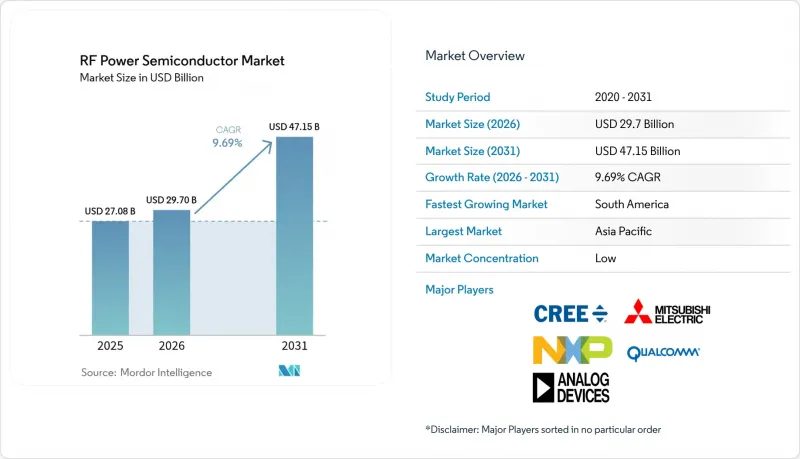
본 보고서는 기술별(LDMOS, GaAs, GaN, Si 기타), 주파수 대역별, 전력 레벨별, 디바이스 유형별(RF 전력 증폭기, RF 프런트엔드 모듈 등), 용도별(통신 인프라, 항공우주 및 방위 등), 지역별로 분류되어 있습니다. 시장 예측은 금액(달러) 기준으로 제시되어 있습니다.
세계의 RF 파워 반도체 시장 동향 및 인사이트
5G 매크로셀의 고밀도화 추세
차세대 매크로 사이트에서는 매시브 MIMO를 통한 커버리지를 실현하기 위해 4G에 비해 3-5배 높은 RF 전력 밀도가 필요합니다. 현재 각 벤더사는 LDMOS가 열적 한계에 직면하는 3.5GHz 이상의 주파수 대역에서 GaN-on-SiC 증폭기를 사양으로 채택하고 있습니다. 에릭슨이 2025년 출시 예정인 AIR 3266 무선 장비는 400 W의 출력을 실현하면서도 에너지 소비를 30% 절감하고 있습니다. 출력 레벨의 상승에 따라 프런트엔드 모듈에는 더 높은 집적도와 더 엄격한 선형성 목표가 요구되고 있으며, 이러한 추세는 기업의 사설 네트워크 구축으로 인해 더욱 강화되고 있습니다.
모바일 RF 프런트엔드의 복잡성 급증
휴대폰 단말기는 최대 15개의 주파수 대역을 통합하고 Wi-Fi 7 및 UWB를 지원하므로, 서로 다른 주파수 대역 전반에 걸쳐 효율을 유지할 수 있는 전력 증폭기가 요구되고 있습니다. 퀄컴의 ‘FastConnect 7900’은 Wi-Fi 7, 블루투스, UWB를 6nm 공정으로 통합하여 전력 소비를 40% 줄였습니다. 위성 백업 링크 및 자동차용 V2X로 인해 주파수 대역의 중복이 더욱 증가함에 따라, 다중 프로토콜을 지원하는 PA 모듈에 대한 수요가 높아지고 있습니다.
높은 다이 비용과 웨이퍼 수준의 수율 관련 과제
GaN-on-SiC의 수율은 60-70%에 그치는 반면, 실리콘의 경우 85-90%입니다. Wolfspeed사의 모호크 밸리 공장은 2024년 초 웨이퍼 가동률이 20%였습니다고 보고했으며, 이는 비용 평준화를 향한 단계적 확장을 보여줍니다. 기판 부족과 에피택시 공정의 복잡성으로 인해 다이 가격은 LDMOS의 3-5배 수준에 머물러 있어, 비용 효율을 중시하는 디바이스에서 GaN의 보급을 제한하고 있습니다.
부문 분석
기술별 시장 세분화에서 RF 파워 반도체 시장 규모는 2025년에 270억 8,000만 달러에 달했으며, 그중 LDMOS가 매출의 35.40%를 차지했습니다. 2031년까지 GaN의 연평균 성장률(CAGR) 14.58%는 3GHz 이상에서 GaN이 보여주는 뛰어난 전력 밀도를 반영하는 반면, GaAs는 초저잡음 링크라는 틈새 시장에서 입지를 유지하고 있습니다. 인피니언의 로드맵은 통신 및 EV 파워트레인 분야에서 GaN의 대량 채택을 시사하고 있습니다.
성장의 모멘텀은 LDMOS가 저비용을 실현하는 6GHz 미만의 주파수 대역에 집중되어 있습니다. 그러나 새로운 고주파 대역 기지국에서는 GaN이 우선시됨에 따라 듀얼 테크놀로지 환경이 가속화되고 있습니다. MACOM이 CHIPS법에 따라 100mm 및 150mm GaN 생산 라인에 3억 4,500만 달러를 투자하여 설비를 업그레이드한 것은 와이드 밴드갭 반도체 공급을 현지화하려는 업계의 노력을 뒷받침합니다. 수율이 향상됨에 따라 2028년까지 신규 매크로 무선 기지국 도입에서 GaN의 점유율이 LDMOS를 앞지를 가능성이 있습니다.
2025년에는 전국적인 5G 구축을 배경으로 서브 6GHz 대역이 RF 파워 반도체 시장 점유율의 60.40%를 차지했습니다. 통신 사업자들이 6G 시범 운영을 진행하고, LEO(저궤도) 위성 군집이 Ku 대역 주파수 대역을 활용함에 따라, 20-40GHz 대역은 연평균 성장률(CAGR) 13.76%로 성장할 전망입니다.
시스템 설계자들은 현재 재고 관리를 간소화하기 위해 여러 대역을 커버하는 증폭기를 요구하고 있습니다. NXP의 Airfast 포트폴리오는 3.6-3.8GHz 대역에서 41%의 PAE를 실현하여 부품 수를 줄이는 데 기여하고 있습니다. 40GHz 이상에서는 이용 사례가 여전히 특수한 분야로 제한되지만, 방위용 레이더 및 백홀 링크에서는 안정적인 수요가 지속되고 있습니다. 멀티밴드 지원 기능은 차기 업그레이드 주기에서 결정적인 사양이 될 것입니다.
지역별 분석
아시아태평양은 중국의 급속한 5G 인프라 구축과 한국의 mm파(mmWave) 시범 사업을 배경으로, 2025년에는 매출 점유율 44.20%를 차지하며 RF 파워 반도체 시장을 주도했습니다. 중국 연구진은 최근 GaN의 결함 밀도를 낮추는 데 성공했으며, 이러한 진전으로 현지 수율이 향상되고 수입 의존도가 완화될 가능성이 있습니다. 일본은 자동차 및 산업 분야를 위한 특수 화합물 반도체 공정을 제공합니다. 제조 클러스터 전역에 걸친 사설 네트워크의 지역적 확대가 중출력 파워 디바이스 수요를 견인하고 있습니다.
북미와 유럽에서는 기술 주도형 성장이 나타나고 있습니다. 통신 사업자들은 현재 4G 매크로 네트워크를 에너지 효율이 높은 GaN PA로 업그레이드하고 있으며, 미국의 CHIPS 법안 등 연방 정부의 인센티브가 국내 팹에 대한 자금 지원을 뒷받침하고 있습니다. MACOM사는 매사추세츠주 및 노스캐롤라이나주 거점을 현대화하기 위해 최대 7,000만 달러의 직접 자금 조달을 예상하고 있습니다. 두 지역의 주요 방위 기업들은 방사선 내성 GaN 부품을 필요로 하고 있으며, 이로 인해 소비자 가격 변동의 영향을 받지 않는 프리미엄 하위 부문이 육성되고 있습니다.
남미는 2031년까지 12.95%라는 가장 높은 연평균 성장률(CAGR)을 기록할 전망입니다. 브라질에서 진행된 470억 레알 규모의 주파수 대역 경매에서는 5G 지원 기기를 우선시하는 네트워크 구축에 420억 레알이 배정되었습니다. 아르헨티나 농촌 지역의 광대역 격차와 칠레의 광업 자동화로 인해 장거리 대응 서브 6GHz 대역 PA에 대한 수요가 증가하고 있습니다. 아프리카 및 중동에서는 선택적인 도입이 진행되고 있으며, 위성 백홀이 통신망의 사각지대를 메우고, 정부의 디지털화 프로그램이 소폭이지만 꾸준한 수요를 뒷받침하고 있습니다.
기타 혜택 :
- 엑셀 형식 시장 예측(ME) 시트
- 3개월간의 애널리스트 지원
자주 묻는 질문
목차
제1장 서론
제2장 조사 방법
제3장 주요 요약
제4장 시장 구도
제5장 시장 규모 및 성장 예측
제6장 경쟁 구도
제7장 시장 기회 및 향후 전망
AJY 26.08.26According to Mordor Intelligence, the rF power semiconductor market size is expected to grow from USD 27.08 billion in 2025 to USD 29.7 billion in 2026 and is forecast to reach USD 47.15 billion by 2031 at 9.69% CAGR over 2026-2031.
This report is Segmented by Technology (LDMOS, Gaas, Gan, Si Other), Frequency Band, Power Level, Device Type (RF Power Amplifiers, RF Front-End Modules and More), Application (Telecom Infrastructure, Aerospace/Defense, and More), and Geography. The Market Forecasts are Provided in Terms of Value (USD).
Global RF Power Semiconductor Market Trends and Insights
5G Macro-Cell Densification Wave
Next-generation macro sites require 3-5 times higher RF power density than 4G to enable massive-MIMO coverage. Vendors now specify GaN-on-SiC amplifiers above 3.5 GHz where LDMOS faces thermal limits. Ericsson's 2025 AIR 3266 radio delivers 400 W output while cutting energy use by 30%. Elevated power levels push front-end modules toward higher integration and tighter linearity targets, a trend amplified by enterprise private-network rollouts.
Surge in Mobile RF Front-End Complexity
Handsets integrate up to 15 bands and support Wi-Fi 7 plus UWB, demanding power amplifiers that keep efficiency across disparate spectra. Qualcomm's FastConnect 7900 merges Wi-Fi 7, Bluetooth, and UWB on 6 nm, shaving power draw by 40%. Satellite back-up links and automotive V2X further raise spectral overlap, intensifying demand for multi-protocol PA modules.
High Die Cost and Wafer-Level Yield Challenges
GaN-on-SiC yields remain 60-70% versus 85-90% for silicon. Wolfspeed's Mohawk Valley plant reported 20% wafer-start utilization in early 2024, illustrating the gradual ramp toward cost parity. Substrate scarcity and complex epitaxy keep die prices 3-5 times higher than LDMOS, limiting GaN's reach in cost-sensitive devices.
Other drivers and restraints analyzed in the detailed report include:
- Rapid GaN Adoption for >3 GHz Base Stations
- Industrial Solid-State RF Heating and Plasma Tools
- Export-Control Headwinds on Wide-Bandgap Devices
For complete list of drivers and restraints, kindly check the Table Of Contents.
Segment Analysis
The RF power semiconductor market size for technology segmentation stood at USD 27.08 billion in 2025, with LDMOS contributing 35.40% revenue. GaN's 14.58% CAGR through 2031 reflects its superior power density at >3 GHz, while GaAs retains niches in ultra-low-noise links. Infineon's roadmap signals mass-market GaN adoption across telecom and EV powertrains.
Growth momentum centers on sub-6 GHz coverage where LDMOS offers low cost. Yet every new high-band site favours GaN, accelerating a dual-technology landscape. MACOM's USD 345 million upgrade to 100 mm and 150 mm GaN lines under the CHIPS Act underscores industry efforts to localize wide-bandgap supply. As yields improve, GaN's share could overtake LDMOS in new macro-radio deployments by 2028.
Sub-6 GHz held 60.40% of RF power semiconductor market share in 2025, riding nationwide 5G rollouts. The 20-40 GHz slice is poised for a 13.76% CAGR as operators trial 6G and LEO constellations tap Ku-band windows.
System designers now demand amplifiers spanning multiple bands to simplify inventory. NXP's Airfast portfolio offers 41% PAE across 3.6-3.8 GHz, cutting component counts. Above 40 GHz, use cases remain specialized, yet defence radar and backhaul links sustain steady demand. Multiband capability will be a decisive spec in the next upgrade cycle.
Complete Report Scope:
- By Technology
- LDMOS
- GaAs
- GaN
- Si (Other)
- By Frequency Band
- Sub-6 GHz
- 6 - 20 GHz
- 20 - 40 GHz
- More than 40 GHz (mmWave)
- By Power Level
- Less than 10 W
- 10 - 50 W
- 50 - 200 W
- More than 200 W
- By Device Type
- RF Power Amplifiers
- RF Front-End Modules
- RF Switches / Tuners
- RF Filters and Multiplexers
- By Application
- Telecom Infrastructure
- Aerospace and Defense
- Wired Broadband
- Satellite Communication
- Industrial and Automotive RF Energy
- Geography
- North America
- United States
- Canada
- Mexico
- Europe
- United Kingdom
- Germany
- France
- Italy
- Rest of Europe
- Asia-Pacific
- China
- Japan
- India
- South Korea
- Rest of Asia
- Middle East
- Israel
- Saudi Arabia
- United Arab Emirates
- Turkey
- Rest of Middle East
- Africa
- South Africa
- Egypt
- Rest of Africa
- South America
- Brazil
- Argentina
- Rest of South America
- North America
Geography Analysis
Asia-Pacific dominated the RF power semiconductor market with a 44.20% revenue share in 2025 on the back of China's rapid 5G construction and South Korea's mmWave pilots. Chinese researchers recently cut GaN defect densities, an advance that may lift local yields and temper import reliance. Japan contributes specialty compound processes for automotive and industrial fields. Regional expansions in private networks across manufacturing clusters propel mid-range power device demand.
North America and Europe display technology-driven growth. Operators now retrofit 4G macro grids with energy-saving GaN PAs, while federal incentives such as the U.S. CHIPS Act bankroll domestic fabs. MACOM expects up to USD 70 million in direct funding to modernize Massachusetts and North Carolina sites. Defense primes in both regions require radiation-hardened GaN parts, fostering premium sub-segments shielded from consumer price swings.
South America posts the fastest 12.95% CAGR through 2031. Brazil's BRL 47 billion spectrum auction earmarked BRL 42 billion for network buildouts that prioritize 5G-ready gear. Rural broadband gaps in Argentina and mining automation in Chile elevate demand for long-reach sub-6 GHz PAs. Middle East and Africa see selective adoption, with satellite backhaul filling coverage voids and government digitization programs stimulating modest but consistent volumes.
- Ampleon Netherlands B.V.
- Analog Devices, Inc.
- Broadcom Inc.
- Cree, Inc. (d/b/a Wolfspeed)
- Infineon Technologies AG
- MACOM Technology Solutions Holdings, Inc.
- Mitsubishi Electric Corporation
- Murata Manufacturing Co., Ltd.
- NXP Semiconductors N.V.
- ON Semiconductor Corporation
- Qorvo, Inc.
- Qualcomm Incorporated
- Renesas Electronics Corporation
- Skyworks Solutions, Inc.
- STMicroelectronics N.V.
- Sumitomo Electric Device Innovations, Inc.
- Tagore Technology, Inc.
- Teledyne e2v Semiconductors SAS
- Toshiba Electronic Devices and Storage Corporation
- UMS - United Monolithic Semiconductors GmbH
Additional Benefits:
- The market estimate (ME) sheet in Excel format
- 3 months of analyst support
TABLE OF CONTENTS
1 INTRODUCTION
- 1.1 Study Assumptions and Market Definition
- 1.2 Scope of the Study
2 RESEARCH METHODOLOGY
3 EXECUTIVE SUMMARY
4 MARKET LANDSCAPE
- 4.1 Market Overview
- 4.2 Market Drivers
- 4.2.1 5G macro-cell densification wave
- 4.2.2 Surge in mobile RF front-end complexity (Wi-Fi 6E/7, UWB, NTN)
- 4.2.3 Rapid GaN adoption for 3 GHz base-stations
- 4.2.4 Industrial solid-state RF heating and plasma tools
- 4.2.5 Proliferation of private 5G/6G campus networks
- 4.2.6 Automotive RF energy applications expansion
- 4.3 Market Restraints
- 4.3.1 High die cost and wafer-level yield challenges
- 4.3.2 Export-control headwinds on wide-bandgap devices
- 4.3.3 Thermal / packaging limits above 40 GHz
- 4.3.4 Fab capacity tightness for SiC/GaN epi-wafers
- 4.4 Value / Supply-Chain Analysis
- 4.5 Regulatory Landscape
- 4.6 Technological Outlook
- 4.7 Porter's Five Forces
- 4.7.1 Bargaining Power of Suppliers
- 4.7.2 Bargaining Power of Buyers/Consumers
- 4.7.3 Threat of New Entrants
- 4.7.4 Threat of Substitute Products
- 4.7.5 Intensity of Competitive Rivalry
5 MARKET SIZE and GROWTH FORECASTS
- 5.1 By Technology
- 5.1.1 LDMOS
- 5.1.2 GaAs
- 5.1.3 GaN
- 5.1.4 Si (Other)
- 5.2 By Frequency Band
- 5.2.1 Sub-6 GHz
- 5.2.2 6 - 20 GHz
- 5.2.3 20 - 40 GHz
- 5.2.4 More than 40 GHz (mmWave)
- 5.3 By Power Level
- 5.3.1 Less than 10 W
- 5.3.2 10 - 50 W
- 5.3.3 50 - 200 W
- 5.3.4 More than 200 W
- 5.4 By Device Type
- 5.4.1 RF Power Amplifiers
- 5.4.2 RF Front-End Modules
- 5.4.3 RF Switches / Tuners
- 5.4.4 RF Filters and Multiplexers
- 5.5 By Application
- 5.5.1 Telecom Infrastructure
- 5.5.2 Aerospace and Defense
- 5.5.3 Wired Broadband
- 5.5.4 Satellite Communication
- 5.5.5 Industrial and Automotive RF Energy
- 5.6 Geography
- 5.6.1 North America
- 5.6.1.1 United States
- 5.6.1.2 Canada
- 5.6.1.3 Mexico
- 5.6.2 Europe
- 5.6.2.1 United Kingdom
- 5.6.2.2 Germany
- 5.6.2.3 France
- 5.6.2.4 Italy
- 5.6.2.5 Rest of Europe
- 5.6.3 Asia-Pacific
- 5.6.3.1 China
- 5.6.3.2 Japan
- 5.6.3.3 India
- 5.6.3.4 South Korea
- 5.6.3.5 Rest of Asia
- 5.6.4 Middle East
- 5.6.4.1 Israel
- 5.6.4.2 Saudi Arabia
- 5.6.4.3 United Arab Emirates
- 5.6.4.4 Turkey
- 5.6.4.5 Rest of Middle East
- 5.6.5 Africa
- 5.6.5.1 South Africa
- 5.6.5.2 Egypt
- 5.6.5.3 Rest of Africa
- 5.6.6 South America
- 5.6.6.1 Brazil
- 5.6.6.2 Argentina
- 5.6.6.3 Rest of South America
- 5.6.1 North America
6 COMPETITIVE LANDSCAPE
- 6.1 Market Concentration
- 6.2 Strategic Moves
- 6.3 Market Share Analysis
- 6.4 Company Profiles (includes Global level Overview, Market level overview, Core Segments, Financials as available, Strategic Information, Market Rank/Share for key companies, Products and Services, and Recent Developments)
- 6.4.1 Ampleon Netherlands B.V.
- 6.4.2 Analog Devices, Inc.
- 6.4.3 Broadcom Inc.
- 6.4.4 Cree, Inc. (d/b/a Wolfspeed)
- 6.4.5 Infineon Technologies AG
- 6.4.6 MACOM Technology Solutions Holdings, Inc.
- 6.4.7 Mitsubishi Electric Corporation
- 6.4.8 Murata Manufacturing Co., Ltd.
- 6.4.9 NXP Semiconductors N.V.
- 6.4.10 ON Semiconductor Corporation
- 6.4.11 Qorvo, Inc.
- 6.4.12 Qualcomm Incorporated
- 6.4.13 Renesas Electronics Corporation
- 6.4.14 Skyworks Solutions, Inc.
- 6.4.15 STMicroelectronics N.V.
- 6.4.16 Sumitomo Electric Device Innovations, Inc.
- 6.4.17 Tagore Technology, Inc.
- 6.4.18 Teledyne e2v Semiconductors SAS
- 6.4.19 Toshiba Electronic Devices and Storage Corporation
- 6.4.20 UMS - United Monolithic Semiconductors GmbH
7 MARKET OPPORTUNITIES and FUTURE OUTLOOK
- 7.1 White-space and unmet-need assessment


