|
시장보고서
상품코드
2114183
프로세스 오일 시장 : 시장 점유율 분석, 업계 동향 및 통계, 성장 예측(2026-2031년)Process Oils - Market Share Analysis, Industry Trends & Statistics, Growth Forecasts (2026 - 2031) |
||||||
 Mordor Intelligence
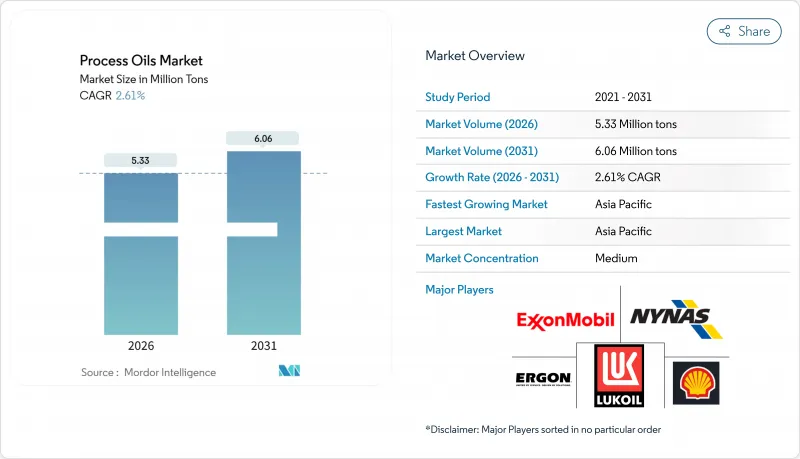
Mordor Intelligence에 의하면, 프로세스 오일 시장 규모는 2026년에 533만 톤으로 추정되고, 예측 기간(2026-2031년) CAGR 2.61%로 성장을 지속할 것으로 예측되며, 2031년에는 606만 톤에 이른다고 전망되고 있습니다.
본 보고서는 유형별(방향족, 파라핀계, 나프텐계), 용도별(고무, 폴리머, 퍼스널케어, 섬유, 기타 용도) 및 지역별(아시아태평양, 북미, 유럽, 남미, 중동 및 아프리카)로 분류되어 있습니다. 시장 예측은 수량(톤) 기준으로 제시됩니다.
세계의 프로세스 오일 시장 동향 및 인사이트
폴리머 및 합성 고무 생산 능력 확충의 진전
에보닉이 상하이에 신설하여 최근 가동을 시작한 폴리부타디엔 제조 플랜트는 저점도 프로세스 오일에 대한 자사 내 수요를 끌어올렸습니다. 한편, 다우의 가동률은 시장 공급 부족을 나타내고 있으며, 이에 따라 통합형 정유업체와의 다년간 공급 계약과 관련된 생산 능력 확대 노력이 진행되고 있습니다. 용액 중합 고무 배합에는 우수한 용해성이 요구되기 때문에 나프텐계 등급의 점유율이 확대되고 있으며, 아시아의 생산자들은 동일한 입지에 있는 원료를 활용하여 이익률을 확보하고 있습니다. 이러한 동향으로 인해 프로세스 오일 시장의 잠재 고객 기반이 확대되어 중기적인 성장이 뒷받침되고 있습니다. 자체 공급 기유 공급망을 보유하지 않은 일반 정유업체들은 스프레드 축소에 직면해 있으며, 특수 틈새 시장 진출이나 수입 전략으로 방향을 전환하고 있습니다.
고성능 타이어 배합에 따른 수요 증가
중국의 타이어 생산은 눈부신 성장을 이루고 있으며, 프리미엄 레이디얼 타이어 부문에서는 컴파운드마다 프로세스 오일이 포함되어 있어 수요의 강세를 보여주고 있습니다. 프리미엄 부문에서는 실리카를 이용하여 구름 저항을 줄이는 ‘친환경’ 타이어가 채택되고 있는데, 이러한 혁신은 처리된 증류 분획 방향족 추출물(TDAE) 또는 바이오 대체재에 의존하고 있습니다. 이러한 대체재는 PAH 상한치를 준수해야 합니다. 이는 현재 전 세계 OEM 업체들이 채택하고 있는 기준입니다. 한편, 남아시아와 아프리카에서는 바이애스 타이어와 오프로드 타이어에 대해 여전히 더 저렴한 방향족 추출물이 선호되고 있습니다. 이러한 선택은 지리적 차익 거래를 부각시킬 뿐만 아니라, 해당 지역의 기존 생산 능력을 강화하는 결과로 이어지고 있습니다. 타이어 배합이 발전함에 따라 더 광범위한 등급 요건이 도입됨에 따라, 프로세스 오일 시장은 자동차 업계 동향과 밀접하게 연계된 상태를 유지하게 될 것입니다.
EU 및 북미의 방향족 추출물에 대한 엄격한 PAH 규제
REACH 부속서 XVII에서 벤조(a)피렌 및 총 PAH가 소정의 임계값을 초과하는 프로세스 오일의 사용이 금지됨에 따라, 각 타이어 제조업체들은 기존 추출물에서 전환할 수밖에 없는 상황에 처해 있습니다. 이러한 조치에 발맞추어 북미 규제 당국도 캘리포니아주 법령을 통해 유사한 임계치를 설정했습니다. 이러한 규제의 통합에 더해, 쉘(Shell)이 2025년에 페르니스(Pernis)의 방향족 부문을 폐쇄하고, 엑슨모빌(ExxonMobil)이 2023년에 보몬트(Beaumont)에서 철수하는 등 여러 요인이 겹치면서, 규정을 준수하는 TDAE공급이 감소했습니다. 그 결과, TDAE의 현물 가격이 상승하여 비용에 민감한 컴파운더들에게 압박을 가하고, 프로세스 오일 시장의 단기적인 성장을 저해하게 되었습니다.
부문 분석
나프텐계 등급은 2025년에 프로세스 오일 시장 점유율의 44.28%를 차지하며 연평균 성장률(CAGR) 6.03%로 성장했으며, 규모와 성장 속도를 모두 갖춘 드문 존재입니다. 그 사이클로파라핀 구조 덕분에 저온 유동성과 높은 용해력을 발휘하여, EV용 금속 가공유 및 초저 PAH 타이어 트레드에서 필수적인 존재가 되고 있습니다. 파라핀계 오일은 고무 및 폴리머 분야의 중급 등급 수요를 충족시키고 있는 반면, 방향족계 오일은 규제가 비교적 완화된 아시아태평양에서 바이어스 스플라이 타이어 및 아스팔트 분야에서 일정한 입지를 유지하고 있습니다.
나이나스, 엘곤, 칼메트 각사는 타이어 제조업체와 공동으로 나프텐계 솔루션을 개발하기 위해 용도 연구소에 대한 투자를 추진하고 있으며, 원유 가격 변동으로부터 보호받을 수 있는 장기 계약을 체결하고 있습니다. 풍부한 그룹 II 및 III의 파라핀계 원료 덕분에 파라핀계 오일의 가격은 경쟁력을 유지하고 있지만, 상품화가 진행되면서 이익률은 하락하고 있습니다. 만약 중국과 인도가 이번 10년 후반에 EU와 동등한 PAH 기준을 채택한다면, 대량의 방향족 수요가 사라져 한국이나 태국의 자산이 유휴화될 우려가 있습니다. 이러한 상반된 동향으로 인해 프로세스 오일 시장은 유동적인 상태가 지속되고 있으며, 이는 유연성을 갖춘 생산자에게 유리하게 작용하고 있습니다.
지역별 분석
아시아태평양은 2025년에 프로세스 오일 시장 규모의 66.06%를 차지했으며, 2031년까지 연평균 성장률(CAGR) 2.94%로 성장할 전망입니다. 모명, 다롄, 진롄에 위치한 통합 복합 시설에서는 기유와 프로세스 오일을 병행 생산하고 있어, 중국석유화공(Sinopec)과 중국석유(PetroChina)에 납품 비용 면에서 우위를 제공합니다. 중국의 타이어 생산에서는 대량의 오일이 소비되고 있습니다. 인도에서는 상용차의 대형화에 따라 수요가 증가하고 있는 반면, 한국과 일본은 전자기기 및 제약 분야용 프리미엄 화이트 오일을 수출하고 있습니다. 해당 지역의 원료 안정 공급과 규모를 고려할 때, 그 점유율은 다소 더 상승하여 세계 프로세스 오일 시장에서 주도적인 지위를 공고히 할 가능성이 있습니다.
보몬트, 엘세군도, 샌프란시스코에 위치한 그룹 I 공장의 폐쇄로 연간 생산 능력이 감소함에 따라, 북미는 구조적인 공급 부족에 직면해 있습니다. 칼메트, HF 싱클레어, 엘곤은 거의 풀가동 중이지만, 현물 시장공급 부족으로 인해 TDAE 가격은 상승하고 있습니다. 한국산 수입이 공급 부족을 일부 메우고 있지만, 막대한 운송비가 발생하여 구매자의 이익률을 압박하고 있습니다. 캐나다는 기유 품목이 제한적이기 때문에 수입 의존도가 앞으로도 지속될 전망이며, 이는 프로세스 오일 시장공급량 증가를 억제하게 될 것입니다.
유럽에서도 유사한 경향이 관찰됩니다. 쉘(Shell)의 페르니스(Pernis) 공장 가동 중단과 토탈(Total)의 곤플레빌(Gonfleville) 공장 전환으로 인해, 미쉐린(Michelin)과 콘티넨탈(Continental)의 타이어 수요가 견조함에도 불구하고 공급이 압박받았습니다. REACH의 PAH 규제에 대응함에 따라 수소 처리 파라핀계 및 나프텐계 등급으로의 전환이 가속화되어 평균 단가가 상승하고 있습니다. 남미, 중동 및 아프리카는 중국 타이어 제조업체들이 브라질과 남아프리카에 공장을 설립한 덕분에, 여전히 규모는 작지만 성장세가 두드러지는 시장으로 자리 잡고 있습니다. 운송 비용 측면에서 현지 공급이 매력적으로 다가오면서, 페트로브라스와 사솔이 프로세스 오일 시장의 지역 점유율을 확보하기 위해 투자를 진행하고 있습니다.
기타 혜택 :
- 엑셀 형식 시장 예측(ME) 시트
- 3개월간의 애널리스트 지원
자주 묻는 질문
목차
제1장 서론
제2장 조사 방법
제3장 주요 요약
제4장 시장 구도
제5장 시장 규모 및 성장 예측
제6장 경쟁 구도
제7장 시장 기회 및 향후 전망
AJY 26.08.26According to Mordor Intelligence, the process oils market size is estimated at 5.33 million tons in 2026, and is expected to reach 6.06 million tons by 2031, at a CAGR of 2.61% during the forecast period (2026-2031).
This report is Segmented by Type (Aromatic, Paraffinic, and Naphthenic), Application (Rubber, Polymers, Personal Care, Textile, and Other Applications), and Geography (Asia-Pacific, North America, Europe, South America, and Middle-East and Africa). The Market Forecasts are Provided in Terms of Volume (Tons).
Global Process Oils Market Trends and Insights
Rising Polymer And Synthetic Rubber Capacity Additions
Evonik's new polybutadiene unit in Shanghai, which came online recently, has boosted the captive demand for low-viscosity process oils. Meanwhile, Dow's utilization rate indicates a tightening market, prompting debottlenecking efforts linked to multi-year supply contracts with integrated refiners. Naphthenic grades gain share as solution-polymerized rubber formulas need superior solvency, and Asian producers leverage co-located feedstock to secure margins. These dynamics enlarge the addressable base for the process oil market, reinforcing mid-term growth. Merchant refiners without captive base oil streams face thinner spreads, pushing them toward specialty niches or import strategies.
Elevated Demand From High-Performance Tire Formulations
China's tire production has seen significant growth, with premium radial categories incorporating process oils per compound, signaling strong demand. While premium segments embrace "green" tires, which utilize silica to reduce rolling resistance, these innovations hinge on treated distillate aromatic extract (TDAE) or bio-based substitutes. These substitutes must adhere to a PAH ceiling, a benchmark now adopted by global OEMs. Meanwhile, in South Asia and Africa, bias-ply and off-road tires continue to favor more affordable aromatic extracts. This choice not only highlights a geographic arbitrage but also bolsters legacy capacities in those regions. As tire formulations evolve, they introduce a broader spectrum of grade requirements, ensuring the process oil market remains closely tied to the automotive industry's rhythms.
Stringent PAH Limits On Aromatic Extracts In EU And North America
In response to REACH Annex XVII's ban on process oils containing benzo[a]pyrene and total PAHs above specified thresholds, tire companies have been forced to move away from conventional extracts. Echoing these measures, North American regulators, via California statutes, set similar thresholds. This regulatory alignment, coupled with Shell's 2025 closure of its Pernis aromatics unit and ExxonMobil's 2023 exit from Beaumont, has led to a diminished supply of compliant TDAE. Consequently, spot TDAE prices increased, putting pressure on cost-sensitive compounders and stifling short-term growth in the process oil market.
Other drivers and restraints analyzed in the detailed report include:
- Growth Of Naphthenic Oils In Metal-Working Fluids For EV Manufacturing
- Surging Personal-Care Formulations Using White Process Oils
- Group I Base-Oil Refinery Shutdowns Tightening Feedstock Supply
For complete list of drivers and restraints, kindly check the Table Of Contents.
Segment Analysis
Naphthenic grades held 44.28% of the process oil market share in 2025 and are growing at a 6.03% CAGR, a rare blend of scale and velocity. Their cycloparaffinic structure delivers low-temperature fluidity and high solvency, making them indispensable in EV metal-working fluids and ultra-low-PAH tire treads. Paraffinic oils fill mid-range needs in rubber and polymers, while aromatic oils retain a foothold in bias-ply tires and asphalt in Asia-Pacific where enforcement is looser.
Nynas, Ergon, and Calumet are investing in application labs to co-develop naphthenic solutions with tire makers, locking in long contracts that buffer them from crude swings. Abundant Group II and III paraffinic feedstock keeps paraffinic prices competitive, yet commoditization erodes margins. Should China and India adopt EU-equivalent PAH norms later this decade, significant aromatic demand could vanish, stranding assets in South Korea and Thailand. These cross-currents keep the process oil market fluid, rewarding flexible producers.
Complete Report Scope:
- By Type
- Aromatic
- Paraffinic
- Naphthenic
- By Application
- Rubber
- Polymers
- Personal Care
- Textile
- Other Applications
- By Geography
- Asia-Pacific
- China
- India
- Japan
- South Korea
- ASEAN Countries
- Rest of Asia-Pacific
- North America
- United States
- Canada
- Mexico
- Europe
- Germany
- United Kingdom
- France
- Italy
- Spain
- Russia
- Rest of Europe
- South America
- Brazil
- Argentina
- Rest of South America
- Middle-East and Africa
- Saudi Arabia
- South Africa
- Rest of Middle-East and Africa
- Asia-Pacific
Geography Analysis
Asia-Pacific held 66.06% of the process oil market size in 2025 and is poised for a 2.94% CAGR through 2031. Integrated complexes at Maoming, Dalian, and Jinling co-produce base oils and process oils, giving Sinopec and PetroChina a delivered-cost edge. China's tire production consumes a significant amount of oil. Indian demand is rising as commercial fleets upsize, while South Korea and Japan export premium white oils for electronics and pharma niches. The region's feedstock security and scale suggest its share could even inch higher, cementing leadership in the global process oil market.
After Group I closures at Beaumont, El Segundo, and San Francisco reduced annual capacity, North America grapples with structural shortages. While Calumet, HF Sinclair, and Ergon operate near full capacity, spot shortfalls have driven TDAE prices up. Although imports from South Korea help fill the void, they come with a hefty freight cost, squeezing buyer margins. With Canada boasting a smaller base-oil slate, its reliance on imports is set to continue, curbing volume growth in the process oil market.
Europe mirrors this pattern: Shell's Pernis shutdown and Total's Gonfreville conversion tightened supply even as tire demand from Michelin and Continental stayed firm. Compliance with REACH PAH limits has accelerated the move to hydro-treated paraffinic and naphthenic grades, lifting average unit values. South America and the Middle-East and Africa remain slender but rising outlets, thanks to Chinese tire manufacturers establishing plants in Brazil and South Africa. Freight economics make localized supply attractive, inviting investments by Petrobras and Sasol to capture regional slices of the process oil market.
- Calumet, Inc.
- Chevron Corporation
- China Petroleum & Chemical Corporation.
- ENEOS Corporation
- Ergon Inc.
- Exxon Mobil Corporation
- H&R GROUP
- HF Sinclair Corporation
- Idemitsu Kosan Co. Ltd.
- LUKOIL
- Neste
- Nynas AB
- ORGKHIM Biochemical Holding
- Panama Petrochem Ltd.
- PetroChina
- PETRONAS Lubricants International
- Phillips 66 Company
- SEOJIN CHEMICAL CO.,LTD.
- Shell plc
- TotalEnergies SE
Additional Benefits:
- The market estimate (ME) sheet in Excel format
- 3 months of analyst support
TABLE OF CONTENTS
1 Introduction
- 1.1 Study Assumptions and Market Definition
- 1.2 Scope of the Study
2 Research Methodology
3 Executive Summary
4 Market Landscape
- 4.1 Market Overview
- 4.2 Market Drivers
- 4.2.1 Rising polymer and synthetic rubber capacity additions
- 4.2.2 Elevated demand from high-performance tire formulations
- 4.2.3 Growth of naphthenic oils in metal-working fluids for EV manufacturing
- 4.2.4 Surging personal-care formulations using white process oils
- 4.2.5 Shift to ultra-low VOC printing inks using hydro-treated process oils
- 4.3 Market Restraints
- 4.3.1 Stringent PAH limits on aromatic extracts in European Union and North America
- 4.3.2 Group I base-oil refinery shutdowns tightening feedstock supply
- 4.3.3 Price volatility linked to crude and base-oil crack spreads
- 4.4 Value Chain Analysis
- 4.5 Porter's Five Forces
- 4.5.1 Bargaining Power of Suppliers
- 4.5.2 Bargaining Power of Buyers
- 4.5.3 Threat of New Entrants
- 4.5.4 Threat of Substitutes
- 4.5.5 Degree of Competition
5 Market Size and Growth Forecasts (Volume)
- 5.1 By Type
- 5.1.1 Aromatic
- 5.1.2 Paraffinic
- 5.1.3 Naphthenic
- 5.2 By Application
- 5.2.1 Rubber
- 5.2.2 Polymers
- 5.2.3 Personal Care
- 5.2.4 Textile
- 5.2.5 Other Applications
- 5.3 By Geography
- 5.3.1 Asia-Pacific
- 5.3.1.1 China
- 5.3.1.2 India
- 5.3.1.3 Japan
- 5.3.1.4 South Korea
- 5.3.1.5 ASEAN Countries
- 5.3.1.6 Rest of Asia-Pacific
- 5.3.2 North America
- 5.3.2.1 United States
- 5.3.2.2 Canada
- 5.3.2.3 Mexico
- 5.3.3 Europe
- 5.3.3.1 Germany
- 5.3.3.2 United Kingdom
- 5.3.3.3 France
- 5.3.3.4 Italy
- 5.3.3.5 Spain
- 5.3.3.6 Russia
- 5.3.3.7 Rest of Europe
- 5.3.4 South America
- 5.3.4.1 Brazil
- 5.3.4.2 Argentina
- 5.3.4.3 Rest of South America
- 5.3.5 Middle-East and Africa
- 5.3.5.1 Saudi Arabia
- 5.3.5.2 South Africa
- 5.3.5.3 Rest of Middle-East and Africa
- 5.3.1 Asia-Pacific
6 Competitive Landscape
- 6.1 Market Concentration
- 6.2 Strategic Moves
- 6.3 Market Share/Ranking Analysis
- 6.4 Company Profiles {(includes Global level Overview, Market level overview, Core Segments, Financials as available, Strategic Information, Market Rank/Share for key companies, Products and Services, and Recent Developments)}
- 6.4.1 Calumet, Inc.
- 6.4.2 Chevron Corporation
- 6.4.3 China Petroleum & Chemical Corporation.
- 6.4.4 ENEOS Corporation
- 6.4.5 Ergon Inc.
- 6.4.6 Exxon Mobil Corporation
- 6.4.7 H&R GROUP
- 6.4.8 HF Sinclair Corporation
- 6.4.9 Idemitsu Kosan Co. Ltd.
- 6.4.10 LUKOIL
- 6.4.11 Neste
- 6.4.12 Nynas AB
- 6.4.13 ORGKHIM Biochemical Holding
- 6.4.14 Panama Petrochem Ltd.
- 6.4.15 PetroChina
- 6.4.16 PETRONAS Lubricants International
- 6.4.17 Phillips 66 Company
- 6.4.18 SEOJIN CHEMICAL CO.,LTD.
- 6.4.19 Shell plc
- 6.4.20 TotalEnergies SE
7 Market Opportunities and Future Outlook
- 7.1 White-space and Unmet-need Assessment