

|
시장보고서
상품코드
2114276
폴리에틸렌 테레프탈레이트(PET) 폼 시장 : 시장 점유율 분석, 업계 동향 및 통계, 성장 예측(2026-2031년)Polyethylene Terephthalate (PET) Foam - Market Share Analysis, Industry Trends & Statistics, Growth Forecasts (2026 - 2031) |
||||||
 Mordor Intelligence
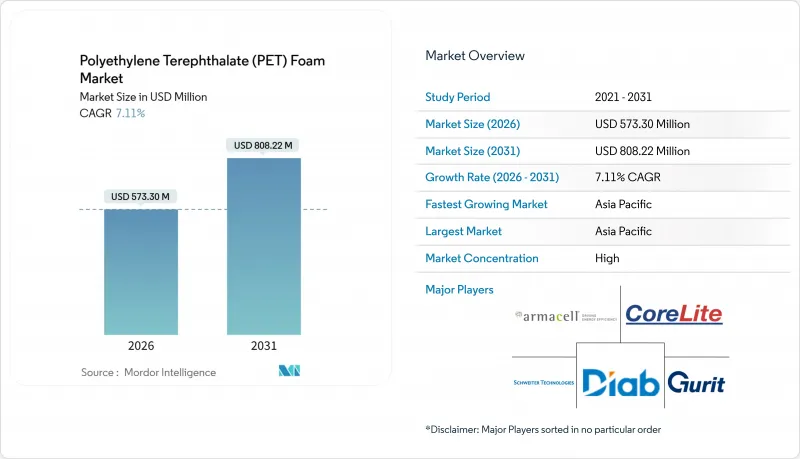
Mordor Intelligence에 의하면, 폴리에틸렌 테레프탈레이트(PET) 폼 시장 규모는 2026년에 5억 7,330만 달러로 추정되고, 예측 기간(2026-2031년) CAGR 7.11%로 확대될 것으로 예측되며, 2031년에는 8억 822만 달러에 이를 전망입니다.
본 보고서는 유형별(저밀도 PET 발포체 및 고밀도 PET 발포체), 최종 사용자 산업별(건축 및 건설, 운송, 선박, 풍력에너지, 포장, 기타 산업), 지역별(아시아태평양, 북미, 유럽, 남미, 중동 및 아프리카)로 분류되어 있습니다. 시장 전망은 금액(달러) 기준으로 제시되어 있습니다.
세계의 폴리에틸렌 테레프탈레이트(PET) 폼 시장 동향 및 인사이트
전체 모빌리티 플랫폼 전반에 걸친 경량화 추진
미국 및 유럽연합(EU)의 연비 및 이산화탄소 배출 규제로 인해 자동차 제조업체들은 충돌 안전성을 확보하면서 차량 중량을 줄여야 하는 압박을 받고 있습니다. 배터리 하우징 내부에 PET 폼 샌드위치 패널을 채택함으로써 알루미늄에 비해 경량화를 달성하고, 전기자동차의 주행 거리를 연장할 수 있습니다. 상용차 제조업체들은 단열성과 구조적 강성을 동시에 확보하기 위해 냉장 트럭 차체에 PET 코어 패널을 사후 장착하고 있습니다. 항공우주 분야의 도입 기업들은 무인항공기(UAV)의 날개 소재로서 이 재료의 적합성 평가를 진행하고 있으나, 인증 절차가 장기화됨에 따라 시장 진출은 2028년 이후가 될 전망입니다. 엔진룸이나 배기 계통 부근에서는 발포체의 특성이 100°C를 넘으면 급격히 저하되기 때문에 보급률은 여전히 제한적입니다.
풍력 발전 용량 확대와 블레이드 대형화
세계 풍력 발전 설비 용량은 2028년까지 매년 증가할 전망입니다. 해상 풍력 발전용 블레이드의 길이는 이미 중요한 임계치를 넘어섰으며, 그 결과 발생하는 원심 하중으로 인해 더 무거운 코어 재료의 사용이 피되고 있습니다. 블레이드 선단부의 바깥쪽 섹션을 주로 구성하는 PET 발포체는 내피로성 면에서 발사 재질을 능가하며, 저밀도에서도 인장 강도를 유지합니다. LM Wind Power사는 코어에 재생 재료를 채택함으로써 블레이드의 수명 주기 동안 탄소 발자국을 줄이는 데 성공했습니다. 전 세계 생산량의 절반 이상을 차지하는 중국의 각 풍력 블레이드 제조업체들은 중국이 2030년까지 대규모 해상 풍력 발전 용량 달성을 목표로 하고 있는 데 발맞추어 노력을 강화하고 있습니다.
성숙한 대체재가 가격 결정력을 제약
바르사 목재, 폴리염화비닐, 스티렌-아크릴로니트릴 발포체는 PET보다 비용을 절감함으로써 풍력 블레이드 뿌리 부분에서 확고한 입지를 다지고 있습니다. 블레이드 제조업체들이 바르사 목재 가공에 익숙해져 있어 그 판매량은 해마다 증가하고 있습니다. 에보닉(Evonik)사의 폴리메타크릴이미드 발포체는 수지 사용량을 줄일 수 있어, 고온 환경 하의 항공우주 분야 틈새 시장을 장악하고 있습니다. 동등한 강성을 실현하기 위해서는 PET의 밀도를 높여야 하지만, 가격에 민감한 선박 용도의 경우 이러한 조치가 비용 상승으로 이어지게 됩니다.
부문 분석
2025년 시점에서 저밀도 등급은 폴리에틸렌 테레프탈레이트(PET) 폼 시장 가치의 66.98%를 차지했으며, 내피로성과 관성 모멘트의 최소화가 중시되는 풍력 발전용 블레이드 선단부에서의 사용에 힘입어 2031년까지 연평균 7.22%의 속도로 확대되고 있습니다. 블레이드 외측이나 선박 갑판에 적합한 압축 강도는 특정 밀도에 의해 달성되며, 적층재의 경량화를 가능하게 합니다. 고밀도 등급은 블레이드의 뿌리 부분이나 선체 하부를 지지하는 데 활용되고 있습니다. 성장은 나타나고 있으나, 그 확대 추세는 소폭에 그치고 있으며, 이는 발사 목재나 PVC와의 경쟁이 원인인 것으로 보입니다. 2024년 5월, Armacell사는 쑤저우에 네 번째 압출 라인을 가동하며, 중국의 해상 프로젝트용으로 맞춤화된 저밀도 제품 생산에 전략적으로 주력하고 있습니다.
계층적인 홈 및 천공 구조를 갖춘 프로토타입은 향후 강도와 경량성의 균형을 실현할 가능성을 보여주고 있습니다. 3A Composites사의 ‘AIREX T92 SealX’와 같은 표면 처리를 통해 수지 흡착량을 줄일 수 있으며, 그 결과 비용과 탄소 배출량을 모두 절감할 수 있습니다. 고밀도 폼은 모두 내압성이 요구되는 보호용 포장재나 평지붕 단열재로 수요가 있지만, 터빈이나 선박 구조물에 사용되는 양과 비교하면 그 사용량은 여전히 미미한 수준입니다.
지역별 분석
아시아태평양은 2025년 매출의 57.67%를 차지했으며, 2031년까지 연평균 8.11%의 성장이 예상됩니다. 이는 중국의 블레이드 제조 집중화와 동남아시아의 해양용 복합재료 허브 부상을 반영한 것입니다. 중국은 2030년까지 해상 풍력 발전 용량 목표를 달성할 전망이며, 블레이드의 코어 부분부터 선단 부분에 이르는 연간 소비량이 추정되고 있습니다. 중국 기업인 창저우 톈셩(Changzhou Tiansheng)과 완카이(Wankai)는 유럽산 수입품보다 저렴한 가격에 제품을 판매하며 경쟁을 심화시키고 있습니다. 인도에서는 매년 풍력 발전 용량이 증가하고 있지만, 국내에서 탈중합 공정이 확립되지 않아 수지 수입 비용이 급등하고 있습니다. 한편, 베트남과 태국은 유리한 노동력과 항만 인프라를 활용하여 PET 코어 재질을 사용한 보트를 유럽으로 수출하고 있습니다.
북미에서는 대서양 연안의 해상 풍력 발전 단지의 성장세와 전기차 의무화 정책에 힘입어 성장이 예상됩니다. 미국은 2024년에 발전 용량을 확대하고, 매사추세츠주와 뉴욕주에서 대규모 해상 풍력 발전소가 가동을 시작함에 따라 100미터 길이의 블레이드가 필요하게 되었습니다. 2026년까지 연비 향상을 요구하는 CAFE 기준에 따라 복합재료 수요가 급증하고 있습니다. 다만, 내열성 제약으로 인해 PET의 용도는 차량 실내 온도 관련 부품으로 한정되어 있습니다. 캐나다의 국가 건축 기준에서는 현재 벽의 단열 성능(R값) 향상이 권장되고 있어, 비록 가격이 비싸긴 하지만 구조용 단열 패널에 PET 코어의 채택이 촉진되고 있습니다.
유럽에서는 북해와 발트해에서의 프로젝트가 진전되고 있으며, 순환형 경제에 관한 지침이 건설 분야에서의 재생 재료 사용을 촉진하고 있어 시장이 확대될 전망입니다. 2024년에는 독일, 덴마크, 영국이 공동으로 해상 풍력 발전 설비를 설치했습니다. 2025년에 시행될 예정인 확대 생산자 책임(EPR) 규정에 따라 재생 재료를 포함한 발포체 수요는 증가하고 있지만, 화학적 재활용 처리 능력이 제한적이어서 공급량 증가는 억제되고 있습니다. 남미는 중동 및 아프리카와 합쳐서 시장의 극히 일부에 불과하지만, 브라질의 육상 풍력 발전 개발과 남아프리카공화국의 선박 산업은 성장의 조짐을 보이고 있습니다.
기타 혜택 :
- 엑셀 형식 시장 예측(ME) 시트
- 3개월간의 애널리스트 지원
자주 묻는 질문
목차
제1장 서론
제2장 조사 방법
제3장 주요 요약
제4장 시장 구도
제5장 시장 규모 및 성장 예측
제6장 경쟁 구도
제7장 시장 기회 및 향후 전망
AJY 26.08.26According to Mordor Intelligence, the polyethylene terephthalate foam market size is estimated at USD 573.30 million in 2026, and is expected to reach USD 808.22 million by 2031, at a CAGR of 7.11% during the forecast period (2026-2031).
This report is Segmented by Type (Low-Density PET Foam and High-Density PET Foam), End-User Industry (Building and Construction, Transportation, Marine, Wind Energy, Packaging, and Other Industries), and Geography (Asia-Pacific, North America, Europe, South America, and Middle-East and Africa). The Market Forecasts are Provided in Terms of Value (USD).
Global Polyethylene Terephthalate (PET) Foam Market Trends and Insights
Light-Weighting Push Across Mobility Platforms
Fuel-economy and carbon-emission regulations in the United States and European Union are forcing automakers to lower vehicle mass while protecting crashworthiness. PET foam sandwich panels inside battery enclosures deliver weight savings against aluminum and extend electric-vehicle range. Commercial-vehicle builders are retrofitting refrigerated truck bodies with PET-cored panels to mix thermal insulation and structural stiffness. Aerospace adopters are qualifying the material for unmanned-aerial-vehicle wings, but certification cycles extend market entry beyond 2028. Penetration is still limited in engine-bay or exhaust-adjacent zones because foam properties fall rapidly above 100 °C.
Wind-Energy Capacity Expansion and Larger Blades
Global wind additions are poised to grow annually through 2028. Offshore blade lengths have now surpassed significant thresholds, leading to centrifugal loads that sidestep the use of heavier core materials. Dominating the outer sections of the tip, PET foam outperforms balsa in fatigue resistance and sustains tensile strength at lower densities. By sourcing recycled content for its cores, LM Wind Power has successfully reduced the blade's life-cycle carbon footprint. China's wind-blade manufacturers, accounting for over half of the global production, are ramping up efforts as the country sets its sights on achieving significant offshore capacity by 2030.
Mature Substitutes Constrain Pricing Power
Balsa wood, polyvinyl-chloride, and styrene-acrylonitrile foams, by undercutting PET on cost, have solidified their foothold in wind-blade root sections. Balsa sales are growing annually, thanks to blade makers' familiarity with its processing. Evonik's polymethacrylimide foam conserves resin and dominates high-temperature aerospace niches. To achieve comparable stiffness, PET needs to increase its density, a move that escalates costs in price-sensitive marine applications.
Other drivers and restraints analyzed in the detailed report include:
- Green-Building Insulation Demand
- Shift to Circular, Recycled PET Feedstocks
- Volatile Recycled-PET Resin Supply and Cost
For complete list of drivers and restraints, kindly check the Table Of Contents.
Segment Analysis
Low-density grades held 66.98% of the Polyethylene Terephthalate (PET) foam market value in 2025 and are expanding at 7.22% a year to 2031, propelled by use in wind-blade tip sections that value fatigue resistance and minimal inertia. Compressive strengths suitable for outer blades and marine decks are achieved with specific densities, allowing for a reduction in laminate weight. High-density grades are utilized for supporting blade roots and hull bottoms. Despite growth, the expansion appears subdued, likely due to competition from balsa and PVC. In May 2024, Armacell inaugurated its fourth extrusion line in Suzhou, with a strategic focus on low-density outputs tailored for China's offshore projects.
Prototypes featuring hierarchical groove-perforation demonstrate a potential future balance between strength and lightweight properties. Surface treatments, such as 3A Composites' AIREX T92 SealX, achieve a reduction in resin uptake, subsequently lowering both cost and carbon metrics. While high-density foam is sought after for protective packaging and flat-roof insulation-both demanding compression resistance-its volumes remain modest when compared to those used in turbines and marine constructions.
Complete Report Scope:
- By Type
- Low-Density PET Foam
- High-Density PET Foam
- By End-User Industry
- Building and Construction
- Transportation
- Marine
- Wind Energy
- Packaging
- Other Industries (Aerospace, Sports, Electronics, Furniture)
- By Geography
- Asia-Pacific
- China
- India
- Japan
- South Korea
- ASEAN Countries
- Rest of Asia-Pacific
- North America
- United States
- Canada
- Mexico
- Europe
- Germany
- United Kingdom
- Italy
- France
- Spain
- Russia
- NORDIC Countries
- Rest of Europe
- South America
- Brazil
- Argentina
- Rest of South America
- Middle-East and Africa
- Saudi Arabia
- South Africa
- Rest of Middle-East and Africa
- Asia-Pacific
Geography Analysis
Asia-Pacific generated 57.67% of 2025 revenue and is expanding 8.11% yearly to 2031, reflecting concentrated blade manufacturing in China and nascent marine-composite hubs in Southeast Asia. China is set to achieve a target of offshore wind capacity by 2030, with an estimated annual consumption of core for tip sections. Domestic players, Changzhou Tiansheng and Wankai, are undercutting European imports, heightening price competition. While India adds wind capacity annually, its absence of domestic depolymerization leads to elevated resin import costs. Meanwhile, Vietnam and Thailand are capitalizing on their advantageous labor and port infrastructure to export PET-cored boats to Europe.
North America is projected to grow, buoyed by the momentum of Atlantic offshore wind farms and electric vehicle mandates. The U.S. bolstered its capacity in 2024, marking the debut of large-scale offshore arrays in Massachusetts and New York, necessitating 100-m blades. With CAFE standards pushing for higher fuel efficiency by 2026, there's a surge in composite demand, even as heat constraints limit PET's application to cabin-temperature components. Canada's national building code is now advocating for elevated wall R-values, driving the adoption of PET cores in structural-insulated panels, albeit at a premium.
Europe is set to grow as projects in the North Sea and Baltic progress, and circular-economy directives push for recycled materials in construction. In 2024, Germany, Denmark, and the U.K. collectively installed offshore wind capacity. While extended-producer-responsibility rules set to take effect in 2025 are boosting demand for recycled-content foam, the limited capacity for chemical recycling is curbing volume growth. South America, along with the Middle East and Africa, collectively represents a small portion of the market; however, Brazil's onshore wind developments and South Africa's marine craft industry signal budding growth.
- 3A Composites (Schweiter Technologies AG)
- Airex AG
- Armacell
- BASF SE
- Carbon-Core Corp.
- Changzhou Tiansheng New Materials Co., Ltd.
- Composites One
- CoreLite
- Diab Group
- Feininger (Nanjing) Energy Saving Technology Co.,ltd.
- Gneuss Kunststofftechnik GmbH
- Gurit Services AG
- Liner
- Longhua Technology Group (Luoyang) Co., Ltd.
- Nanjing Chuangbo Machinery Co., Ltd.
- Nitto Denko Corporation
- Polyumac USA, LLC.
- Sekisui Kasei Co., Ltd.
- Shanghai Yueke New Materials
- TOPOLO
- USEON Technology Limited
- Wankai New Materials Co., Ltd.
Additional Benefits:
- The market estimate (ME) sheet in Excel format
- 3 months of analyst support
TABLE OF CONTENTS
1 Introduction
- 1.1 Study Assumptions and Market Definition
- 1.2 Scope of the Study
2 Research Methodology
3 Executive Summary
4 Market Landscape
- 4.1 Market Overview
- 4.2 Market Drivers
- 4.2.1 Light-weighting push across mobility platforms
- 4.2.2 Wind-energy capacity expansion and larger blades
- 4.2.3 Green-building insulation demand
- 4.2.4 Shift to circular, recycled PET feedstocks
- 4.2.5 Emergence of PET foam cores for UAV/Drone airframes
- 4.3 Market Restraints
- 4.3.1 Mature substitutes (PVC, SAN, balsa) constrain pricing
- 4.3.2 Volatile rPET resin supply and cost
- 4.3.3 Heat-deflection limits above 100 °C for high-temp parts
- 4.4 Value Chain Analysis
- 4.5 Porter's Five Forces
- 4.5.1 Bargaining Power of Suppliers
- 4.5.2 Bargaining Power of Buyers
- 4.5.3 Threat of New Entrants
- 4.5.4 Threat of Substitutes
- 4.5.5 Competitive Rivalry
5 Market Size and Growth Forecasts (Value)
- 5.1 By Type
- 5.1.1 Low-Density PET Foam
- 5.1.2 High-Density PET Foam
- 5.2 By End-User Industry
- 5.2.1 Building and Construction
- 5.2.2 Transportation
- 5.2.3 Marine
- 5.2.4 Wind Energy
- 5.2.5 Packaging
- 5.2.6 Other Industries (Aerospace, Sports, Electronics, Furniture)
- 5.3 By Geography
- 5.3.1 Asia-Pacific
- 5.3.1.1 China
- 5.3.1.2 India
- 5.3.1.3 Japan
- 5.3.1.4 South Korea
- 5.3.1.5 ASEAN Countries
- 5.3.1.6 Rest of Asia-Pacific
- 5.3.2 North America
- 5.3.2.1 United States
- 5.3.2.2 Canada
- 5.3.2.3 Mexico
- 5.3.3 Europe
- 5.3.3.1 Germany
- 5.3.3.2 United Kingdom
- 5.3.3.3 Italy
- 5.3.3.4 France
- 5.3.3.5 Spain
- 5.3.3.6 Russia
- 5.3.3.7 NORDIC Countries
- 5.3.3.8 Rest of Europe
- 5.3.4 South America
- 5.3.4.1 Brazil
- 5.3.4.2 Argentina
- 5.3.4.3 Rest of South America
- 5.3.5 Middle-East and Africa
- 5.3.5.1 Saudi Arabia
- 5.3.5.2 South Africa
- 5.3.5.3 Rest of Middle-East and Africa
- 5.3.1 Asia-Pacific
6 Competitive Landscape
- 6.1 Market Concentration
- 6.2 Strategic Moves
- 6.3 Market Share(%)/Ranking Analysis
- 6.4 Company Profiles {(includes Global level Overview, Market level overview, Core Segments, Financials as available, Strategic Information, Products and Services, and Recent Developments)}
- 6.4.1 3A Composites (Schweiter Technologies AG)
- 6.4.2 Airex AG
- 6.4.3 Armacell
- 6.4.4 BASF SE
- 6.4.5 Carbon-Core Corp.
- 6.4.6 Changzhou Tiansheng New Materials Co., Ltd.
- 6.4.7 Composites One
- 6.4.8 CoreLite
- 6.4.9 Diab Group
- 6.4.10 Feininger (Nanjing) Energy Saving Technology Co.,ltd.
- 6.4.11 Gneuss Kunststofftechnik GmbH
- 6.4.12 Gurit Services AG
- 6.4.13 Liner
- 6.4.14 Longhua Technology Group (Luoyang) Co., Ltd.
- 6.4.15 Nanjing Chuangbo Machinery Co., Ltd.
- 6.4.16 Nitto Denko Corporation
- 6.4.17 Polyumac USA, LLC.
- 6.4.18 Sekisui Kasei Co., Ltd.
- 6.4.19 Shanghai Yueke New Materials
- 6.4.20 TOPOLO
- 6.4.21 USEON Technology Limited
- 6.4.22 Wankai New Materials Co., Ltd.
7 Market Opportunities and Future Outlook
- 7.1 White-space and Unmet-Need Assessment


