

|
시장보고서
상품코드
2114283
볼 클레이 : 시장 점유율 분석, 업계 동향 및 통계, 성장 예측(2026-2031년)Ball Clay - Market Share Analysis, Industry Trends & Statistics, Growth Forecasts (2026 - 2031) |
||||||
 Mordor Intelligence
Mordor Intelligence에 의하면, 볼 클레이 시장 규모는 2026년에 4억 7,773만 달러로 추정되고 예측 기간(2026-2031년) CAGR 4.98%로 확대되어 2031년에는 6억 914만 달러에 이를 전망입니다.
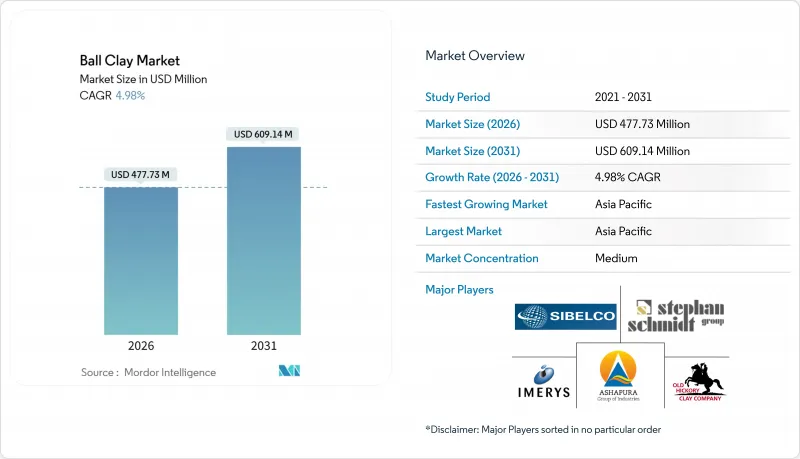
본 보고서는 최종 사용자 산업별(세라믹 (위생 도기, 벽·바닥 타일,식기, 벽돌, 기타 세라믹) 및 비세라믹(접착제 및 실란트, 고무 및 플라스틱, 비료·살충제, 기타 비세라믹)) 및 지역별(아시아태평양, 북미, 유럽, 남미, 중동 및 아프리카)로 분류되어 있습니다. 시장 예측은 금액(달러) 기준으로 제시되어 있습니다.
세계의 볼 클레이 시장 동향 및 인사이트
아시아태평양 고층 주택의 위생 도기 설치 급증
중국과 인도에서 도시화가 가속화됨에 따라, 위생 도기 수요는 단순한 교체에서 초기 설치로 전환되고 있습니다. 개발사들은 현재 다층 타워에 유리질 도기 위생 기구를 설치하고 있으며, 그 얇은 두께의 성형에는 볼 클레이의 가소성이 활용되고 있습니다. 인도의 세라믹 타일 산업은 눈부신 성장을 이루고 있습니다. 동시에, 600제곱피트가 넘는 아파트에서 습식 구역을 분리하도록 의무화하는 건축 기준에 힘입어 위생 도기 생산량도 증가 추세를 보이고 있습니다. 태국의 위생 도기 시장은 주요 기업들이 대부분을 차지하고 있으며, 이들 기업은 대체로 영국산 볼 클레이를 대량으로 조달하고 있습니다. 개발업자들은 현재 프로젝트 인도 수개월 전부터 위생 도기를 사전 주문하여, 건설 일정의 초기 단계에서 볼 클레이 수요를 확보하고 있습니다. 전 세계 유리질 도자기 위생 도기의 절반 이상이 영국산 볼 클레이를 사용하여 생산되고 있습니다. 이 특정 점토는 카올린, 운모, 석영의 비율이 독자적으로 조정되어 있어 저수분 슬립 주조가 가능하며, 소성 수축률이 8% 미만인 것이 특징입니다. 이 지역에서는 얇고 광택이 나는 흰색 표면이 선호되기 때문에 고품질이면서 철분 함량이 낮은 등급에 대한 수요가 증가하고 있습니다.
인도 및 아세안(ASEAN) 지역의 세라믹 타일 생산 능력 확대
2023년, 인도는 세계에서 가장 저렴한 타일 생산국으로서의 입지를 확고히 했습니다. 이는 몰비에 위치한 공장의 생산 활동이 급증하고 가동률이 향상된 데 힘입은 결과입니다. 한편, 베트남에서는 대규모 생산 능력을 자랑하는 공장이 있음에도 불구하고, 2024년 생산량은 잠재 능력을 밑도는 결과를 보였습니다. 이러한 생산 부족은 특히 수출이 회복되기 시작한 상황에서 볼 클레이 수주 확대를 위한 큰 기회가 되고 있습니다. 인도네시아에서는 생산자들이 원자재 물류라는 과제에 직면해 있습니다. 호주와 말레이시아로부터의 수입은 현지산 카올린에 비해 도착 가격을 끌어올리고 있습니다. 게다가 카올린 비용 상승으로 인해 배합 설계자들은 블렌드 원료로의 전환을 추진하고 있습니다. 이러한 블렌드에는 저품위의 볼 클레이가 배합되어 있지만, 이는 백도가 허용 범위 내에 있을 경우에만 해당됩니다. 이 지역 수요 증가를 뒷받침하는 움직임으로, 카자리아(Kajaria)사는 네팔에 8번째 공장을 건설 중입니다. 이에 따라 볼 클레이에 대한 추가 수요가 예상되며, 남아시아 전역의 수입 수요가 더욱 촉진될 것입니다.
대체재의 입수 가능성(카올린, 합성 결합제)
건축용 벽돌이나 경제적인 타일 등 가소성이 낮은 제품의 경우, 카올린이나 합성 결합제를 사용함으로써 비용 절감 효과를 얻을 수 있습니다. 2020년부터 2024년에 걸쳐 인도의 타일 공장들은 볼 클레이의 배합 비율을 줄이고, 더 저렴한 현지산 카올린을 채택하기 시작했습니다. 중국에는 막대한 카올린 매장량이 있기 때문에 카올린의 비율을 높이고 볼 클레이의 비율을 낮춘 배합이 가능해졌습니다. 폴리비닐알코올 등의 결합제는 생강도를 높이는 한편, 소성 수축의 예측 가능성 측면에서 볼 클레이에 미치지 못해 유리질 세라믹への 사용이 제한되고 있습니다. 이러한 제약이 시장의 성장률에 영향을 미치고 있습니다.
부문별 분석
2025년, 세라믹 용도는 볼 클레이 시장 점유율의 93.19%를 차지했으며, 2031년까지 전체 시장의 연평균 성장률(CAGR) 4.98%와 유사한 성장세를 보일 것으로 예측됩니다. 아시아태평양의 건설 붐, 특히 고층 빌딩 건설이 위생 도기 시장을 견인하고 있으며, 현재 유리질 도기 생산에는 영국산 원료를 혼합한 배합이 채택되고 있습니다. 미국에서는 벽·바닥용 타일이 소비의 대부분을 차지하고 있으며, 대형 도자기 타일에는 더 높은 가소성 지수가 요구되고 있습니다. 유럽에서는 고품질이면서 철분 함량이 낮은 등급을 권장하는 EU의 엄격한 전환 규정의 영향으로 식기 시장이 재편되고 있습니다. 업계가 카올린으로 전환함에 따라 벽돌 및 기타 건축용 세라믹 시장 점유율은 감소하고 있습니다. 이러한 변화는 인도 벽돌 제조업체들이 볼 클레이의 배합 비율을 줄이고 있다는 사실에서도 분명하게 드러납니다. 비세라믹 용도를 위한 볼 클레이 시장은 현재로서는 규모가 작지만 성장 잠재력을 지니고 있습니다. 접착제 및 실란트 배합 제조업체들은 흘러내림 저항성을 향상시키기 위해 Amlok 321과 같은 표면 처리 제품을 도입하기 시작했습니다. 한편, 고무 및 플라스틱 분야의 컴파운더들은 치수 안정성을 확보하기 위해 볼 클레이를 배합하고 있습니다. 비료 및 농약의??는 시장의 극히 일부만을 차지하고 있지만, 그 성장은 CEC 값이 높은 점토와의 경쟁으로 인해 저해되고 있습니다. 진정한 성장 잠재력은 3D 프린팅된 산업용 세라믹 분야에 있으며, 이 분야에서는 초가소성 혼합물이 엄격한 입자 규격을 충족할 수 있지만, 이는 표준 카올린으로는 달성하기 어렵습니다.
이러한 추세는 2차적인 요인에 의해 더욱 가속화되고 있습니다. 중국과 인도의 위생 도자기 제조업체들은 현재 선물 계약을 통해 공급을 미리 확보하고 있으며, 그 결과 현물 시장공급량이 부족해지고 있습니다. 독일과 이탈리아에서는 식기 제조업체들이 우크라이나 사태로 인한 공급 차질 위험을 완화하기 위해 조달 전략의 다각화를 추진하고 있으며, 그 결과 인증된 영국산 등급에 대한 수요가 증가하고 있습니다. 미국에서는 인프라 투자가 접착제 부문의 성장을 견인하고 있으며, 특히 주 차원의 ‘바이 아메리칸(Buy American)’ 조항에 따라 국산 원료의 사용이 촉진되고 있습니다. 또한, 적층 가공와 생의학 연구의 융합이 새로운 기회를 창출하고 있어 향후 몇 년간 상당한 성장이 예상됩니다.
지역별 분석
아시아태평양은 2025년에 볼 클레이 시장 점유율의 38.06%를 차지했으며, 연평균 성장률(CAGR) 5.14%로 세계에서 가장 빠른 성장을 보일 것으로 전망됩니다. 타일 생산 능력이 큰 인도의 몰비에서는 연간 상당한 양의 볼 클레이를 소비하고 있으며, 영국 및 태국으로부터의 수입을 확대되고 있습니다. 중국에서는 장석 비용 상승에 따라 생산자들이 가소성을 확보하기 위해 볼 클레이의 배합 비율을 조정하고 있습니다. 한편, 베트남에서는 공장 가동률이 낮아 미개척 수요가 존재할 것으로 보입니다. 태국에서는 주요 위생 도자기 제조업체 8곳이 고품질 유약을 찾아 영국에 주목하고 있어, 영국의 중요성이 부각되고 있습니다.
2025년까지 북미는 상당한 시장 점유율을 확보했습니다. 미국은 국내 시장과 수출 모두를 아우르고 있습니다. 테네시주는 대형 타일에 필수적인 고가소성 등급의 원료를 공급한다는 점에서 두각을 나타내고 있습니다. 주택 착공 주기에 따라 수요 변동은 발생하지만, 욕실 면적 확대 및 리모델링 수요와 같은 동향이 꾸준한 성장을 보장하고 있습니다. 캐나다와 멕시코의 제조업체들은 지역 전문성을 강화하고 운송 비용을 절감하는 효과를 활용해 미국 광산에서 원자재를 조달하고 있습니다.
유럽은 우크라이나의 생산량 감소로 인해 과제에 직면해 있습니다. 그 부족분을 보충하기 위해 영국의 광구, 특히 보베이(Bovey)와 페트로크스토우(Petrockstowe)에서는 유럽 대륙 전역의 고객을 대상으로 대량의 매장량을 공급하고 있습니다. 독일의 스테판 슈미트 KG(Stephan Schmidt KG)는 식기용 인증을 받은 저철분 등급 제품을 공급함으로써 EU 기준을 충족하고 있습니다. 한때 우크라이나의 카올린에 의존하던 스페인과 이탈리아는 영국 및 독일으로부터의 수입으로 공급처를 전환하고 있으며, 그 결과 해당 공급망은 정치적·규제적 변화에 대해 더욱 취약해졌습니다.
남미 및 중동 및 아프리카의 합산 시장 점유율은 미미하지만, 중기적인 성장이 예상됩니다. 타일 생산의 주요국인 브라질은 상파울루주와 파라나주의 광상을 활용하고 있으며, 공급 부족이 발생할 경우 아르헨티나로부터의 수입으로 보충하고 있습니다. 사우디아라비아에서는 건설 붐으로 인해 위생 도기 수입이 증가하고 있습니다. 남아프리카공화국은 제품 라인업을 엄선하고 있으며, 고급 위생 도기에는 유럽에서 고품질 원자재를 조달하는 한편, 보다 기본적인 벽돌 생산에는 현지 카올린을 사용하고 있습니다.
기타 혜택 :
- 엑셀 형식 시장 예측(ME) 시트
- 3개월간의 애널리스트 지원
자주 묻는 질문
목차
제1장 서론
제2장 조사 방법
제3장 주요 요약
제4장 시장 구도
제5장 시장 규모 및 성장 예측
제6장 경쟁 구도
제7장 시장 기회 및 향후 전망
KTH 26.08.28According to Mordor Intelligence, the ball clay market size is estimated at USD 477.73 million in 2026, and is expected to reach USD 609.14 million by 2031, at a CAGR of 4.98% during the forecast period (2026-2031).
This report is Segmented by End-User Industry (Ceramic [Sanitary Ware, Wall and Floor Tiles, Tableware, Bricks, and Other Ceramics] and Non-Ceramic [Adhesives and Sealants, Rubbers and Plastics, Fertilizers and Insecticides, and Other Non-Ceramics]) and Geography (Asia-Pacific, North America, Europe, South America, and Middle-East and Africa). The Market Forecasts are Provided in Terms of Value (USD).
Global Ball Clay Market Trends and Insights
Surge in Sanitary-Ware Installations Across Asia-Pacific High-Rise Housing
As urbanization accelerates in China and India, the demand for sanitary ware has transitioned from mere replacements to initial installations. Developers are now equipping multi-story towers with vitreous china fixtures, which leverage the plasticity of ball clay for their thin-wall casting. India's ceramic tile industry is witnessing significant growth. Concurrently, the output of sanitary ware is on the rise, driven by building codes that mandate separate wet areas in apartments exceeding 600 square feet. Thailand's market for sanitary fixtures is largely dominated by key players, who collectively source substantial volumes of UK ball clay. Developers are now pre-ordering fixtures months prior to project handovers, securing their ball clay demand earlier in the construction timeline. Over half of the world's vitreous china sanitary ware is produced using UK ball clay. This specific clay, with its unique kaolinite-mica-quartz balance, allows for lower-water slip casting and boasts a firing shrinkage of under 8%. The region's affinity for thin, glossy white surfaces heightens the demand for premium, low-iron grades.
Expansion of Ceramic Tile Capacity in India and ASEAN
In 2023, India claimed the title of the world's lowest-cost tile producer, buoyed by a surge in activity at Morbi-based factories, which ramped up their utilization. Meanwhile, Vietnam, with its plants boasting significant capacity, managed to produce less than its potential in 2024. This shortfall presents a significant opportunity for increased ball clay orders, especially as exports begin to pick up. In Indonesia, producers face a challenge: logistics for raw materials. Imports from Australia and Malaysia inflate landed prices compared to locally sourced kaolin. Furthermore, rising kaolin costs are prompting formulators to pivot towards blended bodies. These blends incorporate lower-grade ball clay, but only where the whiteness tolerances permit. In a move underscoring the region's growing demand, Kajaria is constructing its eighth plant in Nepal, projecting an additional need for ball clay, further bolstering import demand across South Asia.
Availability of Substitutes (Kaolin, Synthetic Binders)
Low-plasticity products, including construction bricks and economy tiles, benefit from cost savings when using kaolin and synthetic binders. Between 2020 and 2024, Indian tile plants reduced their ball clay content, opting for locally sourced kaolin that costs less. China's vast kaolin reserves allow for compositions with a higher proportion of kaolin and a lower proportion of ball clay. While binders such as polyvinyl alcohol enhance green strength, they fall short of ball clay in firing-shrinkage predictability, restricting their use in vitreous ceramics. This limitation impacts the market growth rate.
Other drivers and restraints analyzed in the detailed report include:
- Rebound in North-American Residential Remodeling
- Tightening Specifications in European Union Food-Contact Tableware
- Environmental-Impact Permitting Delays at Open-Pit Mines
For complete list of drivers and restraints, kindly check the Table Of Contents.
Segment Analysis
Ceramic applications held 93.19% of the ball clay market share in 2025 and should mirror the overall 4.98% CAGR to 2031. Asia-Pacific's construction boom, particularly in high-rises, is driving the sanitaryware market, with vitreous china output now incorporating blends sourced from the UK. Wall and floor tiles dominate U.S. consumption, and large-format porcelain tiles are now requiring higher plasticity indices. In Europe, tableware is consolidating, influenced by stringent EU migration rules that favor premium, low-iron grades. As the industry shifts towards kaolin, bricks and other construction ceramics are losing market share. This shift is evident as Indian brick manufacturers have reduced their ball clay content. While the ball clay market for non-ceramic applications is currently modest, it shows potential for growth. Formulators of adhesives and sealants are turning to surface-treated products like Amlok 321 for improved sag resistance. Meanwhile, compounders in rubber and plastics are incorporating ball clay to ensure dimensional stability. Although fertilizer and pesticide carriers occupy a small portion of the market, their growth is hampered by competition from higher-CEC clays. The real growth potential lies in 3D-printed technical ceramics, where ultra-plastic blends can meet stringent particle specifications, a feat standard kaolin struggles to achieve.
These trends are further bolstered by secondary effects. Producers of sanitaryware in China and India are now forward-contracting their supplies in advance, leading to tighter spot volumes. In Germany and Italy, tableware manufacturers are diversifying their sourcing strategies to mitigate risks from disruptions in Ukraine, consequently boosting the demand for certified UK grades. In the U.S., infrastructure spending is driving the adhesive sector's growth, especially with state-level "Buy American" clauses promoting domestically mined inputs. Furthermore, the intersection of additive manufacturing and biomedical research is unveiling a fresh opportunity, which is poised to grow significantly in the coming years.
Complete Report Scope:
- By End-User Industry
- Ceramic
- Sanitary Ware
- Wall and Floor Tiles
- Tableware
- Bricks
- Other Ceramics (Construction Ceramics and Refractories)
- Non-ceramic
- Adhesives and Sealants
- Rubbers and Plastics
- Fertilizers and Insecticides
- Other Non-ceramics
- Ceramic
- By Geography
- Asia-Pacific
- China
- India
- Japan
- South Korea
- Australia
- Rest of Asia-Pacific
- North America
- United States
- Canada
- Mexico
- Europe
- Germany
- United Kingdom
- France
- Italy
- Russia
- Rest of Europe
- South America
- Brazil
- Argentina
- Rest of South America
- Middle-East and Africa
- Saudi Arabia
- South Africa
- Rest of Middle-East and Africa
- Asia-Pacific
Geography Analysis
Asia-Pacific retained 38.06% of the ball clay market share in 2025 and is set for a 5.14% CAGR, the fastest worldwide. Morbi, India, with a significant tile capacity, consumes a substantial amount annually and is ramping up imports from the UK and Thailand. In China, producers are adjusting ball clay ratios to ensure plasticity as feldspar costs rise. Meanwhile, Vietnam's under-utilized plants hint at untapped demand. In Thailand, eight leading sanitaryware manufacturers are turning to the UK for premium glazing, underscoring the latter's significance.
By 2025, North America is poised to capture a notable market share. The U.S. caters to both its domestic market and exports. Tennessee stands out, providing high-plasticity grades crucial for large-format tiles. While housing-start cycles introduce demand fluctuations, trends like larger bathroom spaces and remodeling choices ensure steady growth. Manufacturers in Canada and Mexico are sourcing from U.S. mines, capitalizing on freight savings that bolster regional specialization.
Europe faces challenges post-Ukraine's output decline. To fill the gap, UK basins, especially Bovey and Petrockstowe, are dispatching significant reserves to clients across the continent. Germany's Stephan Schmidt KG is meeting EU standards by offering certified low-iron grades for tableware. Spain and Italy, once dependent on Ukrainian kaolin, have shifted their reliance to imports from the UK and Germany, making their supply chains more vulnerable to political and regulatory changes.
South America and the combined regions of the Middle-East and Africa hold a modest share in the market but show promise for medium-term growth. Brazil, standing as a leading tile producer, is leveraging deposits from Sao Paulo and Parana, with Argentine imports filling any supply voids. In Saudi Arabia, a construction surge is driving a rise in sanitaryware imports. South Africa is curating its offerings, sourcing premium materials from Europe for upscale sanitaryware, while using local kaolin for more basic brick production.
- 20 Microns
- Amarnath Industries
- Amarnath Industries
- ASHAPURA GROUP OF INDUSTRIES
- Ashok Alco - chem Limited (AACL)
- Finore Minerals LLP
- G & W Mineral Resources
- Golcha Associated (Associated Soapstone Distribution Company Pvt. Ltd)
- Gujarat Mineral Development Corporation Ltd
- Imerys
- JLD Minerals
- KaMin LLC
- Kentucky-Tennessee Clay Co.
- Mahavir Minerals Ltd.
- Modkha Marine Sdn Bhd
- Mota Ceramic Solutions
- Old Hickory Clay Company
- Sibelco
- Stephan Schmidt KG
Additional Benefits:
- The market estimate (ME) sheet in Excel format
- 3 months of analyst support
TABLE OF CONTENTS
1 Introduction
- 1.1 Study Assumptions and Market Definition
- 1.2 Scope of the Study
2 Research Methodology
3 Executive Summary
4 Market Landscape
- 4.1 Market Overview
- 4.2 Market Drivers
- 4.2.1 Surge in sanitary-ware installations across Asia-Pacific high-rise housing
- 4.2.2 Expansion of ceramic tile capacity in India and ASEAN
- 4.2.3 Rebound in North-American residential remodeling
- 4.2.4 Tightening specifications in European Union food-contact tableware
- 4.2.5 3-D-printed advanced ceramics requiring ultra-plastic blends
- 4.3 Market Restraints
- 4.3.1 Availability of substitutes (kaolin, synthetic binders)
- 4.3.2 Environmental-impact permitting delays at open-pit mines
- 4.3.3 Concentration of Tier-1 deposits in politically sensitive belts
- 4.4 Value Chain Analysis
- 4.5 Porter's Five Forces
- 4.5.1 Bargaining Power of Suppliers
- 4.5.2 Bargaining Power of Consumers
- 4.5.3 Threat of New Entrants
- 4.5.4 Threat of Substitutes
- 4.5.5 Degree of Competition
5 Market Size and Growth Forecasts(Value)
- 5.1 By End-User Industry
- 5.1.1 Ceramic
- 5.1.1.1 Sanitary Ware
- 5.1.1.2 Wall and Floor Tiles
- 5.1.1.3 Tableware
- 5.1.1.4 Bricks
- 5.1.1.5 Other Ceramics (Construction Ceramics and Refractories)
- 5.1.2 Non-ceramic
- 5.1.2.1 Adhesives and Sealants
- 5.1.2.2 Rubbers and Plastics
- 5.1.2.3 Fertilizers and Insecticides
- 5.1.2.4 Other Non-ceramics
- 5.1.1 Ceramic
- 5.2 By Geography
- 5.2.1 Asia-Pacific
- 5.2.1.1 China
- 5.2.1.2 India
- 5.2.1.3 Japan
- 5.2.1.4 South Korea
- 5.2.1.5 Australia
- 5.2.1.6 Rest of Asia-Pacific
- 5.2.2 North America
- 5.2.2.1 United States
- 5.2.2.2 Canada
- 5.2.2.3 Mexico
- 5.2.3 Europe
- 5.2.3.1 Germany
- 5.2.3.2 United Kingdom
- 5.2.3.3 France
- 5.2.3.4 Italy
- 5.2.3.5 Russia
- 5.2.3.6 Rest of Europe
- 5.2.4 South America
- 5.2.4.1 Brazil
- 5.2.4.2 Argentina
- 5.2.4.3 Rest of South America
- 5.2.5 Middle-East and Africa
- 5.2.5.1 Saudi Arabia
- 5.2.5.2 South Africa
- 5.2.5.3 Rest of Middle-East and Africa
- 5.2.1 Asia-Pacific
6 Competitive Landscape
- 6.1 Market Concentration
- 6.2 Strategic Moves
- 6.3 Market Share(%)/Ranking Analysis
- 6.4 Company Profiles (includes Global level Overview, Market level overview, Core Segments, Financials as available, Strategic Information, Products and Services, and Recent Developments)
- 6.4.1 20 Microns
- 6.4.2 Amarnath Industries
- 6.4.3 Amarnath Industries
- 6.4.4 ASHAPURA GROUP OF INDUSTRIES
- 6.4.5 Ashok Alco - chem Limited (AACL)
- 6.4.6 Finore Minerals LLP
- 6.4.7 G & W Mineral Resources
- 6.4.8 Golcha Associated (Associated Soapstone Distribution Company Pvt. Ltd)
- 6.4.9 Gujarat Mineral Development Corporation Ltd
- 6.4.10 Imerys
- 6.4.11 JLD Minerals
- 6.4.12 KaMin LLC
- 6.4.13 Kentucky-Tennessee Clay Co.
- 6.4.14 Mahavir Minerals Ltd.
- 6.4.15 Modkha Marine Sdn Bhd
- 6.4.16 Mota Ceramic Solutions
- 6.4.17 Old Hickory Clay Company
- 6.4.18 Sibelco
- 6.4.19 Stephan Schmidt KG
7 Market Opportunities and Future Outlook
- 7.1 White-space and Unmet-Need Assessment


