

|
시장보고서
상품코드
2114378
필리핀의 지붕재 : 시장 점유율 분석, 업계 동향 및 통계, 성장 예측(2026-2031년)Philippines Roofing - Market Share Analysis, Industry Trends & Statistics, Growth Forecasts (2026 - 2031) |
||||||
 Mordor Intelligence
Mordor Intelligence에 의하면, 2026년 필리핀의 지붕재 시장 규모는 364억 6,000만 평방미터로 추정되고 있으며, 2025년 340억 4,000만 평방미터에서 2031년에는 514억 3,000만 평방미터에 이를 것으로 예측됩니다.
2026-2031년 연평균 성장률(CAGR) 7.12%를 기록할 전망입니다.
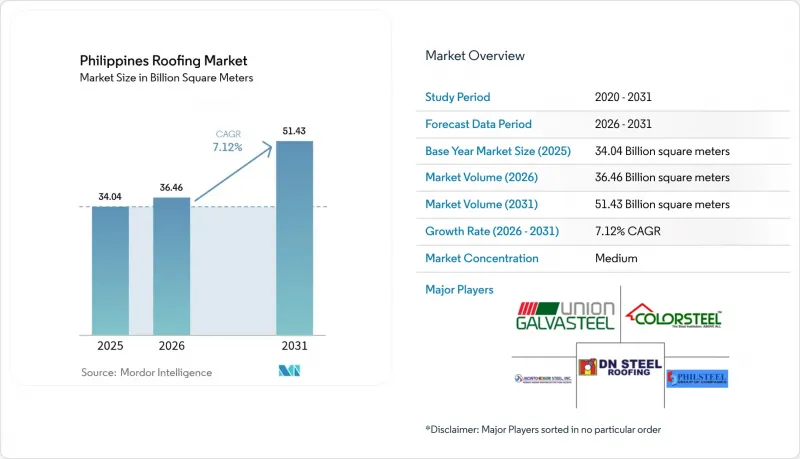
본 보고서는 제품 유형(아스팔트 슁글, 기와 지붕, 금속 지붕, 기타 지붕 자재) 및 최종 사용자 산업(주거용 및 비주거용)별로 분류되어 있습니다. 시장 전망은 수량(제곱미터) 기준으로 제시되어 있습니다.
필리핀 지붕 자재 시장 동향 및 인사이트
정부 주도의 ‘Build Better More’ 인프라 계획의 급증
'Build Better More' 계획에는 공설 시장, 대피소, 교통 허브용 새로운 지붕재를 지정하는 프로젝트를 포함한 주요 프로젝트가 포함되어 있습니다. 장기 보증이 제공되는 조립식 금속 지붕은 이러한 입찰에서 표준 옵션으로 자리 잡고 있으며, 예측 기간 동안 연중 상당한 수요를 확보하고 있습니다. 현재 국가 조달 규정에서는 우수한 내풍 부력 성능을 갖춘 시스템이 우선적으로 고려되고 있으며, 주요 지역의 지방 자치 단체들도 연방 정부의 모델을 따르도록 권장되고 있습니다. 2025 회계연도 예산 1조 5,070억 필리핀 페소로 인해 인프라 지출은 GDP의 5.2%로 유지되고 있으며, 재정 긴축에도 불구하고 프로젝트 파이프라인은 안정적입니다. 이러한 가속화된 일정으로 인해 이용 빈도가 높은 공공시설의 지붕 교체 주기가 단축되어, 현재의 건설 붐을 넘어 필리핀 지붕 자재 시장의 지속가능성을 높이는 데 기여할 것입니다.
해외 근로자(OFW)의 송금이 주도하는 주택 건설 붐
2024년에는 OFW의 송금액이 증가하여 전년 대비 성장세를 보였을 뿐만 아니라 GDP에도 크게 기여했습니다. 조사에 따르면, 이 수입의 상당 부분이 주택 건설에 사용되고 있으며, 그 결과 지붕과 외벽에 대한 지출이 대폭 증가하고 있습니다. Pag-IBIG의 보조금으로 주택 대출의 실질 금리가 인하되어, 구매자들이 특정 금속 브래킷을 선택하도록 유도되고 있습니다. 팡가시난주나 일로일로주 등 해외 근로자 커뮤니티가 큰 비중을 차지하는 주에서는 2024년에 주택 건설 허가 건수가 대폭 증가하여 전국 평균을 상회했습니다. 송금은 지역 경제 사이클이 아닌 전 세계 노동 수요의 영향을 받기 때문에 이러한 자금 흐름은 필리핀 지붕 자재 시장에 장기적이고 확실한 우위를 가져다주고 있습니다.
원자재 가격 변동
2024년, 중국의 수출 제한과 운임 급등으로 인해 아연 도금 강판 가격이 상승했습니다. 국내 철강 사용량의 대부분을 수입이 차지하고 있기 때문에 환율 변동이나 무역 정책은 즉시 지붕 자재의 견적 가격에 반영됩니다. 비투멘 비용의 급등으로 아스팔트 슁글 제품의 이익률이 압박을 받게 되자, 제조업체들은 리모델링 공사용 판촉 활동을 축소할 수밖에 없게 되었습니다. 국내 제철소에서는 철강 수요의 일부만 충당하고 있기 때문에 건설업체들은 가격 유효 기간을 단축하고 있어 프로젝트 예산 편성이 복잡해지고 있습니다. 필리핀 선물 시장에는 헤지 수단이 부족하여 가격 변동이 더욱 확대되고 있으며, 이로 인해 개발업자들이 건설에 앞서 재고를 늘리는 것을 주저하고 있습니다. 필스틸(Philsteel)과 같은 수직 통합형 기업은 가격 변동의 충격을 완화하고 있지만, 필리핀 지붕자재 시장 전체적으로는 여전히 세계 원자재 수급 주기에 민감한 상황이 지속되고 있습니다.
부문 분석
2025년, 필리핀의 지붕재 시장에서 금속 패널의 점유율은 83.72%를 차지할 것으로 보이며, 2031년까지 연평균 7.55%의 성장률이 예상되어 시장 전체를 상회하는 속도로 확대될 것으로 전망됩니다. 도장된 아연 도금 강판은 경량이며, 내풍 기준을 충족하고, 가성비가 뛰어나 널리 사용되고 있어 주요 선택지로 자리 잡고 있습니다. 금속 산업에서는 설치 업체들이 마운트 레일과 넷 미터링의 보급을 결합함에 따라 태양광 발전 대응 제품이 급속히 확대되고 있습니다. 또한, 내식성이 우선시되는 연안 지역을 중심으로 프리미엄 코팅도 주목받고 있습니다.
기와 지붕은 비용이나 구조 하중보다 미관이 우선시되는 역사 지구나 고급 주택지에서 여전히 입지를 유지하고 있습니다. 그러나 무거운 무게로 인해 태풍이 빈번하게 발생하는 지역에서의 사용은 제한되고 있습니다. 아스팔트 슁글은 서까래가 무거운 기와를 지탱할 수 없는 마닐라 수도권 내 오래된 분양 단지에서 진행되는 개보수 공사에 사용되고 있습니다. 비투멘 가격의 급등과 강력한 태풍 이후 연안 지역에서 사실상 시행되고 있는 사용 금지 조치가 이 부문에 영향을 미치고 있습니다. 그 밖에도 아스팔트 시트, 폴리카보네이트, 니파 지붕 등의 자재는 가설 건축물이나 농장에서 사용되고 있지만, 공영 주택에서 금속 지붕의 도입이 확대됨에 따라 그 시장 점유율은 감소하는 추세입니다.
기타 혜택
- 엑셀 형식 시장 예측(ME) 시트
- 3개월간 애널리스트 지원
자주 묻는 질문
목차
제1장 서론
제2장 조사 방법
제3장 주요 요약
제4장 시장 구도
제5장 시장 규모와 성장 예측
제6장 경쟁 구도
제7장 시장 기회와 향후 전망
LSH 26.08.26According to Mordor Intelligence, Philippines roofing market size in 2026 is estimated at 36.46 billion square meters, growing from 2025 value of 34.04 billion square meters with 2031 projections showing 51.43 billion square meters, growing at 7.12% CAGR over 2026-2031.
This report is Segmented by Product Type (Asphalt Shingles, Tile Roofing, Metal Roofing, and Other Roofing) and End-User Industry (Residential and Non-Residential). The Market Forecasts are Provided in Terms of Volume (Square Meters).
Philippines Roofing Market Trends and Insights
Surge in Build Better More Infrastructure Pipeline
The Build Better More plan features flagship projects, including those that specify new roofing for public markets, evacuation centers, and transport hubs. Pre-engineered metal roofs with long-term warranties have become the default option in these tenders, securing significant annual demand throughout the forecast period. National procurement rules now privilege systems with superior wind-uplift ratings, nudging local governments in key regions to copy the federal template. A 2025 budget of PHP 1.507 trillion preserves infrastructure outlays at 5.2% of GDP, smoothing the project pipeline despite fiscal tightening. This accelerated timetable shortens the public-building replacement cycle in high-traffic facilities, helping sustain the Philippines' roofing market beyond the current construction surge.
Residential Construction Boom Driven by OFW Remittances
OFW remittances increased in 2024, demonstrating growth compared to the previous year and making a significant contribution to GDP. Surveys indicate a notable portion of this income is allocated to homebuilding, resulting in substantial spending on roofs and envelopes. Pag-IBIG's subsidy lowers effective interest rates on mortgages, encouraging buyers to opt for specific metal brackets. Provinces with large migrant-worker communities, such as Pangasinan and Iloilo, experienced significant growth in residential permits in 2024, surpassing the national average. Since remittances are influenced by global labor demand rather than local economic cycles, this cash flow provides the Philippines' roofing market with a dependable long-term advantage.
Raw-Material Price Volatility
Galvanized-steel prices rose in 2024 as China limited exports and freight rates climbed. With imports covering a significant portion of domestic steel use, currency shifts and trade policies immediately pass through to roof quoting. Bitumen cost spikes squeezed asphalt-shingle margins, prompting manufacturers to curtail promotions in the retrofit channel. Local mills meet only a portion of steel demand, so contractors now shorten price-validity windows, complicating project budgeting. A lack of hedging tools in the Philippine futures market amplifies volatility, discouraging developers from stockpiling ahead of builds. Although backward-integrated players such as Philsteel cushion shocks, the broader Philippines roofing market remains sensitive to global raw-material cycles.
Other drivers and restraints analyzed in the detailed report include:
- Momentum Toward Green and Energy-Efficient Building Codes
- National Push for Typhoon-Resilient Building Envelopes
- High Upfront Cost of Premium Roofing Systems
For complete list of drivers and restraints, kindly check the Table Of Contents.
Segment Analysis
Metal panels accounted for 83.72% of the Philippines Roofing Market share in 2025 and are expected to grow at a rate of 7.55% through 2031, outpacing the overall market. Pre-painted galvanized steel is widely used due to its low weight, compliance with wind codes, and cost-effectiveness, making it the primary choice. Within the metal industry, solar-ready variants are scaling rapidly as installers pair mounting rails with the net-metering boom. Premium coatings are also gaining traction, particularly in coastal zones where corrosion resistance is a priority.
Tile roofs maintain a presence in heritage districts and luxury estates, where aesthetics are prioritized over cost and structural load. However, their heavier weight limits their use in typhoon-prone areas. Asphalt shingles are used in retrofit jobs for older Metro Manila subdivisions where rafters cannot support heavier tiles. Rising bitumen costs and informal coastal bans after severe typhoons are impacting this segment. Other materials, such as bituminous sheets, polycarbonate, and nipa thatch, are used for temporary structures and farms, but their share is declining as public housing increasingly adopts metal roofing.
Complete Report Scope:
- By Product Type
- Asphalt Shingles
- Tile Roofing
- Metal Roofing
- Other Roofing
- By End-user Industry
- Residential
- Non-residential
List of Companies Covered in this Report:
- Alpha Pro Steel Makers
- BlueScope
- BP Canada
- COH Builders Centre
- Colorsteel Systems Corporation
- DN Steel
- Dura Roof
- GAF Materials LLC
- IKO Industries
- Jacinto Color Steel Inc.
- Marusugi Co. Ltd
- Metalink
- Metroof
- Onduline
- Owens Corning
- Philsteel Holdings Corporation
- Puyat Steel Corporation
- Sanlex Roofmaster Center Co. Inc.
- Sheehan Inc.
- TERREAL
- Union Galvasteel Corporation
Additional Benefits:
- The market estimate (ME) sheet in Excel format
- 3 months of analyst support
TABLE OF CONTENTS
1 Introduction
- 1.1 Study Assumptions and Market Definition
- 1.2 Scope of the Study
2 Research Methodology
3 Executive Summary
4 Market Landscape
- 4.1 Market Overview
- 4.2 Market Drivers
- 4.2.1 Surge in government-led "Build Better More" infrastructure pipeline
- 4.2.2 Residential construction boom driven by OFW remittances
- 4.2.3 Momentum toward green and energy-efficient building codes
- 4.2.4 National push for typhoon-resilient building envelopes
- 4.2.5 Emergence of solar-ready metal roofing systems
- 4.3 Market Restraints
- 4.3.1 Raw-material price volatility (steel, bitumen)
- 4.3.2 High upfront cost of premium roofing systems
- 4.3.3 Shortage of certified roofing installers
- 4.4 Value Chain Analysis
- 4.5 Porter's Five Forces
- 4.5.1 Bargaining Power of Suppliers
- 4.5.2 Bargaining Power of Buyers
- 4.5.3 Threat of New Entrants
- 4.5.4 Threat of Substitutes
- 4.5.5 Degree of Competition
5 Market Size and Growth Forecasts (Value)
- 5.1 By Product Type
- 5.1.1 Asphalt Shingles
- 5.1.2 Tile Roofing
- 5.1.3 Metal Roofing
- 5.1.4 Other Roofing
- 5.2 By End-user Industry
- 5.2.1 Residential
- 5.2.2 Non-residential
6 Competitive Landscape
- 6.1 Market Concentration
- 6.2 Strategic Moves
- 6.3 Market Share (%)/Ranking Analysis
- 6.4 Company Profiles (includes Global level Overview, Market level overview, Core Segments, Financials as available, Strategic Information, Market Rank/Share for key companies, Products and Services, and Recent Developments)
- 6.4.1 Alpha Pro Steel Makers
- 6.4.2 BlueScope
- 6.4.3 BP Canada
- 6.4.4 COH Builders Centre
- 6.4.5 Colorsteel Systems Corporation
- 6.4.6 DN Steel
- 6.4.7 Dura Roof
- 6.4.8 GAF Materials LLC
- 6.4.9 IKO Industries
- 6.4.10 Jacinto Color Steel Inc.
- 6.4.11 Marusugi Co. Ltd
- 6.4.12 Metalink
- 6.4.13 Metroof
- 6.4.14 Onduline
- 6.4.15 Owens Corning
- 6.4.16 Philsteel Holdings Corporation
- 6.4.17 Puyat Steel Corporation
- 6.4.18 Sanlex Roofmaster Center Co. Inc.
- 6.4.19 Sheehan Inc.
- 6.4.20 TERREAL
- 6.4.21 Union Galvasteel Corporation
7 Market Opportunities and Future Outlook
- 7.1 White-space and Unmet-Need Assessment


