|
시장보고서
상품코드
2114398
서아프리카의 정제 석유 제품 시장 : 시장 점유율 분석, 업계 동향 및 통계, 성장 예측(2026-2031년)West Africa Refined Petroleum Products - Market Share Analysis, Industry Trends & Statistics, Growth Forecasts (2026 - 2031) |
||||||
 Mordor Intelligence
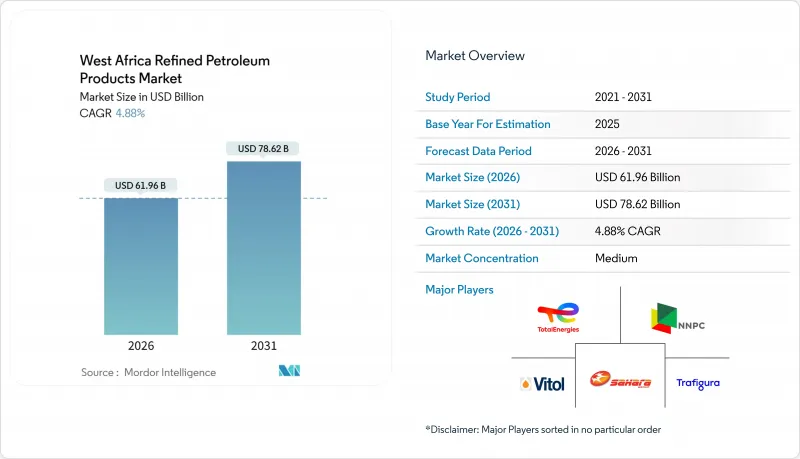
Mordor Intelligence에 의하면, 서아프리카의 정제 석유 제품 시장 규모는 2026년에 619억 6,000만 달러로 추정되고, 예측 기간(2026-2031년) CAGR 4.88%로 성장을 지속할 전망이며, 2031년까지 786억 2,000만 달러에 이를 전망입니다.
본 보고서는 제품 유형별(가솔린, 디젤, LPG, 등유, 항공유, 중유, 기타), 황 함량별(저황 및 고황), 유통 채널별(소매 주유소, 온라인/자동 연료 배송 등), 최종 용도 부문별(운송, 석유화학, 선박 및 벙커링 등), 그리고 지역별(나이지리아, 가나, 베냉, 니제르, 말리 등)로 분류되어 있습니다.
서아프리카의 정제 석유 제품 시장 동향 및 인사이트
차량 보유 대수 증가에 따른 연료 수요 증가
라고스, 아크라, 아비장에서 도시화와 차량 공유 서비스가 확산됨에 따라 자동차 등록 대수는 계속 증가하고 있습니다. 상용차 차량은 2023-2026년 400%가 넘는 디젤 및 휘발유 가격 급등을 겪었지만, 연료비를 최종 사용자에게 전가함으로써 주행 거리를 유지했습니다. 대조적으로, 가격에 민감한 일반 가정은 휘발유에 비해 1킬로미터당 비용을 약 70% 절감해 주는 라고스에서 시작된 연료 전환 제도의 뒷받침을 받아 LPG 및 CNG로의 전환을 추진하고 있습니다. 그 결과, 휘발유 수요 증가세가 둔화되는 가운데에도 서아프리카의 정제 석유 제품 시장은 물류 측면에서 여전히 디젤에 의존하고 있습니다. 2024년 가나의 3억 8,500만 리터 제품 수출은 내륙국인 사헬 국가들에 대한 재수출에서 가나가 차지하는 역할을 부각시켰습니다. 이러한 괴리는 예측 기간 동안 상업적 수요는 지속될 것, 소비자용 휘발유 취급량은 둔화될 가능성을 시사합니다.
규제 완화와 보조금 폐지가 투자를 유치
나이지리아는 2023년 연료 보조금을 폐지한 후, 연간 50억 달러 이상의 재정 절감분을 재분배하여 민간 하류 사업에 투자할 여지를 마련했습니다. 단고테 정유시설는 나이라로 표시된 원유 공급을 확보함으로써, 국영 정유시설 가동을 마비시킨 달러 부족의 영향으로부터 사업을 보호했습니다. 토탈에너지(TotalEnergies) 등 국제적인 판매업체들은 2024년까지 판매망을 약 540곳으로 확대한 반면,모빌 오일 나이지리아(Mobil Oil Nigeria)는 주유소의 자동화와 디지털 결제에 1,000억 나이라를 투자했습니다. 베냉과 니제르의 지역 무역업체들은 단고테사와의 직접적인 오프테이크 계약 체결을 시작하여, 공급망 비용을 최대 20% 절감했습니다. 그러나 투명한 가격 산정 방식이 부재함에 따라 현물 시장의 변동성이 심화되고 있어, 유통업체들은 더 많은 운전자금을 확보할 수밖에 없는 상황에 처해 있습니다.
가격 변동과 통화 약세
나이라 화폐는 2023년 1달러당 460나이라에서 2026년 1월까지 1달러당 1,675나이라로 하락했으며, 휘발유 가격은 리터당 1,030나이라 가까이 치솟아 가계의 구매력이 압박을 받았습니다. NNPC는 2024년 9월까지 약 60억 달러의 미지급 부채를 쌓아올렸으며, 환율을 고정하고 가격 유연성을 제한하는 ‘원유 대 제품 스왑’으로 방침을 전환했습니다. 단고테사는 2024년 리터당 899.50 나이라라는 가격으로 소매 기준 가격을 일시적으로 하회했으나, 이익 마진이 극히 적어 주유소 개보수나 확장이 진전되지 않았습니다. 이와 유사한 통화 약세 압력은 가나의 세디에도 영향을 미쳤으며, 베냉의 CFA 페그제 하에서는 유로와 나이라의 환율 격차가 확대되어 수입업체들의 헤지 전략을 복잡하게 만들었습니다. 이러한 변동성으로 인해 서아프리카의 정제 석유 제품 시장에서 장기 계약 체결이 저해되고 있습니다.
부문별 분석
2025년 시장에서 디젤이 35.5%를 차지했습니다. 이는 물류용 차량과 전력망 신뢰도가 60% 미만인 지역의 비상 발전 수요에 힘입은 결과입니다. 이러한 견조한 수요에 힘입어, 예측 기간 동안 디젤은 서아프리카 정제 석유 제품 시장에서 상업적인 핵심 제품으로 남아 있을 것입니다. 한편, 단고테(Dangote)사는 유럽의 겨울철 수요 정점의 혜택을 받아 수출량의 60% 이상을 디젤 및 연료유에 할당하고 있습니다. 그러나 단고테사가 나이지리아 수요의 60%를 충당함에 따라, 2025년 첫 9개월 동안 오앤드(O&A)사의 휘발유 수입량이 제로가 되면서 국내 휘발유 수요 증가세는 둔화되고 있습니다.
LPG는 나이지리아가 2030년까지 연간 1,500만 메트르톤을 목표로 하고, 가나가 가정 보급률 50%를 목표로 하고 있는 만큼, 제품 유형 중 가장 빠른 연평균 성장률(CAGR) 7.3%로 성장할 전망입니다. 보조금이 지원되는 가스통 공급 프로그램과 푸마 에너지(Puma Energy)의 테마 공장(시간당 1,200개의 가스통 처리)과 같은 새로운 충전 시설이 가정 내 보급을 촉진하고 있습니다. 등유 사용량은 감소 추세를 보이는 반면, 항공 연료는 라고스,아크라, 아비장에서의 신규 노선 개설로 인해 꾸준한 성장세를 보이고 있습니다. 아스팔트와 나프타의 취급량은 인프라 및 석유화학 프로젝트의 확대에 따라 증가하고 있으며, 이는 서아프리카 정제 석유 제품 시장에서 하류 부문의 다각화가 더욱 진행되고 있음을 시사합니다.
2025년 시점에서도 고황연료는 54.9%의 점유율을 유지했으며, 이는 구형 발전기나 간이 토핑 정제소가 여전히 존재하고 있음을 반영합니다. 그러나 IMO 2020 및 ECOWAS 규제에 따라 배출 제한이 강화됨에 따라, 저유황 제품의 점유율은 2031년까지 연평균 성장률(CAGR) 6.2%로 성장할 전망입니다. 2025년까지 전 세계 선박용 연료 수요의 75%가 초저유황 연료유(VLSFO)가 주류를 이루는 구조로 전환됨에 따라, 더 깨끗한 등급의 연료를 처리하기 위해 타코라디와 아비장 지역의 탱크 개보수 작업이 촉진되었습니다. Dangote의 하이드로크래커는 현재 유로 V 규격의 휘발유와 10ppm 디젤을 생산하고 있으며, 국내 품질 기준을 충족하면서 수출을 통한 프리미엄 가격 차이를 누리고 있습니다.
스크러버를 장착한 선박은 여전히 고황분 연료유를 적재하고 있으며, 주요 목적지는 환경 관련 관세가 여전히 낮은 나이지리아와 가나의 발전소입니다. 2차 정제 설비가 없는 모듈식 정유시설에서는 유황 함량이 높은 제품이 생산되어 규제가 완화된 내륙 지역에서 유통되고 있습니다. 시간이 지남에 따라 정책적 압력과 저유황 연료에 대한 접근성 확대로 인해 서아프리카의 정제 석유 제품 시장은 저유황 혼합 연료로 전환될 것입니다. 다만, 기존 설비 상황을 고려할 때 완전한 단계적 폐지에는 아직 몇 년이 더 소요될 전망입니다.
기타 혜택 :
- 엑셀 형식 시장 예측(ME) 시트
- 3개월간의 애널리스트 지원
자주 묻는 질문
목차
제1장 서론
제2장 조사 방법
제3장 주요 요약
제4장 시장 구도
제5장 시장 규모 및 성장 예측
제6장 경쟁 구도
제7장 시장 기회 및 향후 전망
AJY 26.08.26According to Mordor Intelligence, the West Africa refined petroleum products market size is estimated at USD 61.96 billion in 2026, and is expected to reach USD 78.62 billion by 2031, at a CAGR of 4.88% during the forecast period (2026-2031).
This report is Segmented by Product Type (Petrol, Diesel, LPG, Kerosene, Aviation Fuel, Fuel Oil, and Others), Sulfur Content (Low-Sulfur and High-Sulfur), Distribution Channel (Retail Fuel Stations, Online/Automated Fuel Delivery, and More), End-Use Sector (Transportation, Petrochemicals, Marine and Bunkering, and More), and Geography (Nigeria, Ghana, Benin, Niger, Mali, and More).
West Africa Refined Petroleum Products Market Trends and Insights
Rising Vehicle-Fleet Fuel Demand
Vehicle registrations keep climbing as urbanization and ride-hailing services spread across Lagos, Accra, and Abidjan. Commercial fleets endured diesel and petrol price jumps exceeding 400% between 2023 and 2026, yet maintained mileage by passing fuel costs to end users. By contrast, price-sensitive households are switching to LPG and CNG, helped by Lagos-based conversion schemes that cut per-kilometer costs by roughly 70% compared with petrol. As a result, the West Africa refined petroleum products market continues to depend on diesel for logistics even as gasoline growth moderates. Ghana's 385 million-liter product exports in 2024 underscored its re-export role to landlocked Sahel states. This divergence suggests sustained commercial demand but softer consumer gasoline throughput over the forecast horizon.
Deregulation & Subsidy Phase-Out Attracting Investment
Nigeria redirected more than USD 5 billion in yearly fiscal savings after scrapping fuel subsidies in 2023, clearing headroom for private downstream projects. Dangote Refinery secured naira-denominated crude supply, shielding operations from dollar scarcity that stalled state refineries. International marketers such as TotalEnergies lifted their network count to about 540 outlets by 2024, while Mobil Oil Nigeria committed NGN 100 billion to station automation and digital payments. Regional traders in Benin and Niger have begun signing direct Dangote off-take deals, trimming supply-chain costs up to 20%. Nonetheless, the absence of a transparent pricing formula fuels spot-market volatility, obliging distributors to carry larger working-capital buffers.
Price Volatility & Currency Depreciation
The naira weakened from NGN 460 per USD in 2023 to NGN 1,675 per USD by January 2026, pushing petrol prices near NGN 1,030 per liter and compressing household purchasing power. NNPC accrued roughly USD 6 billion in arrears by September 2024, pivoting to crude-for-product swaps that fix exchange rates but curtail price flexibility. Dangote temporarily undercut retail benchmarks at NGN 899.50 per liter in 2024, yet the razor-thin margin discouraged station upgrades and expansions. Similar depreciation pressures shook the Ghanaian cedi and widened euro-naira mismatches under Benin's CFA peg, complicating hedging strategies for importers. Such volatility deters long-term contracting in the West Africa refined petroleum products market.
Other drivers and restraints analyzed in the detailed report include:
- High Import Reliance Due to Refinery Deficits
- Modular Refinery Build-Out Enabling Intra-Regional Trade
- Port, Pipeline & Storage Infrastructure Bottlenecks
For complete list of drivers and restraints, kindly check the Table Of Contents.
Segment Analysis
Diesel accounted for 35.5% of the 2025 market, underpinned by logistics fleets and back-up power generation where grid reliability stands below 60%. Such resilience ensures diesel remains the commercial backbone of the West Africa refined petroleum products market over the forecast horizon. At the same time, Dangote dedicates more than 60% of export barrels to diesel and fuel oil, benefiting from European winter demand peaks. However, domestic gasoline growth is moderating as Oando's petrol imports fell to zero cargoes in the first nine months of 2025 after Dangote met 60% of Nigeria's needs.
LPG is set to expand at a 7.3% CAGR, the fastest among product types, as Nigeria targets 15 million metric tonnes annually by 2030 and Ghana eyes 50% household penetration. Subsidized cylinder programs and new bottling plants, such as Puma Energy's Tema facility processing 1,200 cylinders per hour, are unlocking residential adoption. Kerosene usage is retreating, while aviation fuel enjoys steady uplift from new routes at Lagos, Accra, and Abidjan. Bitumen and naphtha volumes rise in tandem with infrastructure and petrochemical projects, hinting at a broader downstream diversification within the West Africa refined petroleum products market.
High-sulfur fuels retained a 54.9% share in 2025, reflecting legacy generators and simple topping refineries. Yet low-sulfur products are on a 6.2% CAGR trajectory to 2031 as IMO 2020 and ECOWAS rules tighten emission limits. Global marine demand moved to a 75% VLSFO-dominant mix by 2025, stimulating tank upgrades in Takoradi and Abidjan to accommodate cleaner grades. Dangote's hydrocrackers now output Euro-V gasoline and 10-ppm diesel, capturing premium export differentials while meeting domestic quality mandates.
Scrubber-equipped vessels still lift high-sulfur fuel oil, mainly destined for Nigerian and Ghanaian power plants where environmental tariffs remain low. Modular refineries lacking secondary conversion generate higher-sulfur outputs that circulate inland, where enforcement is softer. Over time, policy pressure and rising access to cleaner barrels will tilt the West Africa refined petroleum products market toward lower-sulfur blends, although a complete phase-out remains years away, given installed asset profiles.
Complete Report Scope:
- By Product Type
- Petrol (Gasoline)
- Diesel
- LPG
- Kerosene
- Aviation Fuel
- Fuel Oil (HSFO, VLSFO)
- Others (Bitumen, Naphtha)
- By Sulfur Content
- Low-Sulfur (Up to 10 ppm)
- High-Sulfur (Above 10 ppm)
- By Distribution Channel
- Retail Fuel Stations
- Commercial Bulk Sales
- Direct Supply Contracts
- Online/Automated Fuel Delivery
- By End-Use Sector
- Transportation
- Power Generation
- Industrial Manufacturing
- Petrochemicals
- Residential and Commercial
- Marine and Bunkering
- Agriculture and Mining
- By Geography
- Nigeria
- Ghana
- Benin
- Burkina Faso
- Niger
- Mali
- Rest of West Africa
List of Companies Covered in this Report:
- NNPC Trading Ltd (Duke Oil)
- Trafigura Group Pte Ltd
- Vitol SA
- Sahara Group Ltd
- TotalEnergies Marketing Nigeria PLC
- Dangote Oil Refinery Co.
- Puma Energy Holdings Pte Ltd
- Oando PLC
- Mercuria Energy Trading SA
- Monjasa Holding AS
- Oryx Energies SA
- Gunvor Group Ltd
- Conoil PLC
- 11 PLC (Mobil Oil Nigeria)
- Aiteo Group
- Addax Petroleum Marketing
- Octogone International Gas & Oil Ltd
- FuelSupply Co.
- Zen Petroleum Ltd
- Star Oil & Gas Ltd
Additional Benefits:
- The market estimate (ME) sheet in Excel format
- 3 months of analyst support
TABLE OF CONTENTS
1 Introduction
- 1.1 Study Assumptions & Market Definition
- 1.2 Scope of the Study
2 Research Methodology
3 Executive Summary
4 Market Landscape
- 4.1 Market Overview
- 4.2 Market Drivers
- 4.2.1 Rising vehicle-fleet fuel demand
- 4.2.2 Deregulation & subsidy phase-out attracting investment
- 4.2.3 High import reliance due to refinery deficits
- 4.2.4 Modular refinery build-out enabling intra-regional trade
- 4.2.5 Offshore bunkering hubs growth (Ghana, Cote d'Ivoire)
- 4.2.6 Digital fuel-payment adoption at retail forecourts
- 4.3 Market Restraints
- 4.3.1 Price volatility & currency depreciation
- 4.3.2 Port, pipeline & storage infrastructure bottlenecks
- 4.3.3 Early shift to alternative fuels & e-mobility in capitals
- 4.3.4 Carbon-intensity rules (IMO 2020, ECOWAS drafts)
- 4.4 Supply-Chain Analysis
- 4.5 Regulatory Landscape
- 4.6 Technological Outlook
- 4.7 Porter's Five Forces
- 4.7.1 Threat of New Entrants
- 4.7.2 Bargaining Power of Buyers
- 4.7.3 Bargaining Power of Suppliers
- 4.7.4 Threat of Substitutes
- 4.7.5 Competitive Rivalry
5 Market Size & Growth Forecasts
- 5.1 By Product Type
- 5.1.1 Petrol (Gasoline)
- 5.1.2 Diesel
- 5.1.3 LPG
- 5.1.4 Kerosene
- 5.1.5 Aviation Fuel
- 5.1.6 Fuel Oil (HSFO, VLSFO)
- 5.1.7 Others (Bitumen, Naphtha)
- 5.2 By Sulfur Content
- 5.2.1 Low-Sulfur (Up to 10 ppm)
- 5.2.2 High-Sulfur (Above 10 ppm)
- 5.3 By Distribution Channel
- 5.3.1 Retail Fuel Stations
- 5.3.2 Commercial Bulk Sales
- 5.3.3 Direct Supply Contracts
- 5.3.4 Online/Automated Fuel Delivery
- 5.4 By End-Use Sector
- 5.4.1 Transportation
- 5.4.2 Power Generation
- 5.4.3 Industrial Manufacturing
- 5.4.4 Petrochemicals
- 5.4.5 Residential and Commercial
- 5.4.6 Marine and Bunkering
- 5.4.7 Agriculture and Mining
- 5.5 By Geography
- 5.5.1 Nigeria
- 5.5.2 Ghana
- 5.5.3 Benin
- 5.5.4 Burkina Faso
- 5.5.5 Niger
- 5.5.6 Mali
- 5.5.7 Rest of West Africa
6 Competitive Landscape
- 6.1 Market Concentration
- 6.2 Strategic Moves (M&A, Partnerships, PPAs)
- 6.3 Market Share Analysis (Market Rank/Share for key companies)
- 6.4 Company Profiles (includes Global level Overview, Market level overview, Core Segments, Financials as available, Strategic Information, Products & Services, and Recent Developments)
- 6.4.1 NNPC Trading Ltd (Duke Oil)
- 6.4.2 Trafigura Group Pte Ltd
- 6.4.3 Vitol SA
- 6.4.4 Sahara Group Ltd
- 6.4.5 TotalEnergies Marketing Nigeria PLC
- 6.4.6 Dangote Oil Refinery Co.
- 6.4.7 Puma Energy Holdings Pte Ltd
- 6.4.8 Oando PLC
- 6.4.9 Mercuria Energy Trading SA
- 6.4.10 Monjasa Holding AS
- 6.4.11 Oryx Energies SA
- 6.4.12 Gunvor Group Ltd
- 6.4.13 Conoil PLC
- 6.4.14 11 PLC (Mobil Oil Nigeria)
- 6.4.15 Aiteo Group
- 6.4.16 Addax Petroleum Marketing
- 6.4.17 Octogone International Gas & Oil Ltd
- 6.4.18 FuelSupply Co.
- 6.4.19 Zen Petroleum Ltd
- 6.4.20 Star Oil & Gas Ltd
7 Market Opportunities & Future Outlook
- 7.1 White-space & Unmet-Need Assessment