
|
시장보고서
상품코드
2114402
얼터네이터 : 시장 점유율 분석, 업계 동향 및 통계, 성장 예측(2026-2031년)Alternator - Market Share Analysis, Industry Trends & Statistics, Growth Forecasts (2026 - 2031) |
||||||
 Mordor Intelligence
Mordor Intelligence에 의하면, 얼터네이터 시장 규모는 2025년 184억 9,000만 달러에서 2026년에는 194억 6,000만 달러로 확대되고, 2026-2031년 CAGR 5.22%로 성장을 지속하여 2031년까지 250억 9,000만 달러에 달할 것으로 예측됩니다.
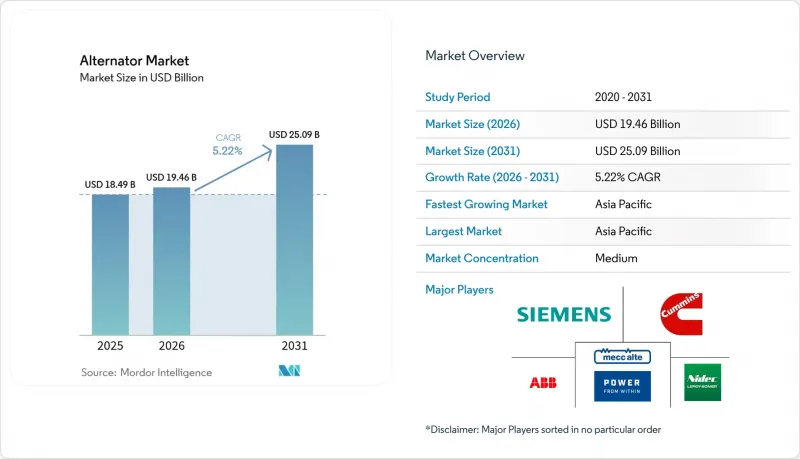
본 보고서는 제품 유형(가스 엔진, 디젤 엔진, 기타), 출력 범위(1kW-60kW, 60kW-300kW, 300kW-1MW, 기타),용도(석유 및 가스, 주전원, 데이터센터, 기타), 전압 범위(저전압, 중전압, 기타), 상(단상, 3상), 지역(북미, 남미, 유럽, 기타)에 따라 분류되어 있습니다. 시장 예측은 금액(달러) 단위로 제시되어 있습니다.
세계 발전기 시장 동향 및 인사이트
신흥 시장의 송전망 인프라 투자
아시아, 아프리카, 라틴아메리카 각국 정부는 2024년에 송전 및 배전망 업그레이드에 총 1,800억 달러 이상을 배정하고 있으며, 아시아개발은행만 해도 재생에너지원의 통합을 지원하는 국경 간 상호 연동에 350억 달러를 출연하고 있습니다. 이러한 프로젝트에서는 일부 지역 송전망에서 태양광 및 풍력 발전 도입률이 30% 이상의 가운데, 관성력을 확보하기 위해 동기기가 활용되고 있습니다. 중국의 국가전망은 브러쉬리스 자극 시스템을 탑재한 500-1,000MVA의 동기 진상기를 각 회선에 갖춘 초고압 송전 회선을 구축했습니다. 인도는 석탄 화력 발전소의 대체 용량에 대해 발전기 대응 합성 관성력의 도입을 의무화하여, 각 주 배전 회사의 중전압 유닛 수요 전망을 뒷받침했습니다. 사하라 이남 아프리카의 산업 단지에서는 2024년에 12GW 규모의 디젤 및 가스 발전기가 추가되었습니다. 이는 취약한 국가 송전망으로 인해 수 메가와트급 교류 발전기를 핵심으로 하는 독립형 마이크로그리드가 필요했기 때문입니다. 진동 센서 및 온도 센서의 보급으로 인해 정비 주기가 15-20년으로 연장되었으며, 그 결과 신규 설치 시 수명 주기 경제성이 향상되고 있습니다.
데이터센터의 신뢰성 높은 백업 전원에 대한 수요 급증
2024년, 전 세계 데이터센터의 총 용량은 12GW를 넘어섰으며, 하이퍼스케일 사업자들은 같은 해 1.2GW 규모의 백업 발전 설비를 도입했습니다. 대당 정격 출력 2-4MW의 디젤 및 천연가스 발전기는 가동률 99.995%가 표준인 Tier IV 사이트에서 주류를 이루고 있습니다. 마이크로소프트는 가동 시간을 희생하지 않고 질소산화물 배출량을 85% 감축하는 선택적 촉매 환원(SCR) 방식의 가스 발전기로 전환했습니다. 지연에 민감한 워크로드가 증가함에 따라 지방 도시의 엣지 시설에서는 500kW에서 1.5MW 용량의 장비에 대한 수요가 높아지고 있습니다. 업타임 인스티튜트의 보고서에 따르면, 사업자의 68%가 2030년까지 수소 또는 듀얼 연료 발전기로의 전환을 계획하고 있지만, 연료 인프라가 제한적이어서 단기적인 도입은 시범 프로젝트 수준에 그치고 있습니다. 여러 대의 유닛으로 구성된 N+1 구성으로 인해 사이트당 유닛 판매량이 최대 60% 증가하여, 공급업체의 수주 잔고가 빠르게 늘어나고 있습니다.
구리 및 희토류 소재의 가격 변동
2024년 구리 가격은 톤당 평균 9,200달러였으며, 칠레와 페루공급 차질로 인해 런던 금속 거래소(LME) 재고가 부족해지면서 1,700달러 범위 내에서 변동했습니다. 알터네이터 권선에는 1MW당 180-220kg의 구리가 소비되므로, 완제품의 이익률은 현물 가격의 영향을 매우 쉽게 받습니다. 중국이 희토류 수출 할당제를 도입한 결과, 네오디뮴·철·붕소 자석의 비용이 22% 상승하여 영구자석 발전기의 수익성을 복잡하게 만들고 있습니다. ABB는 원자재 가격 급등으로 인해 자사의 전기 사업부 영업이익률이 120 베이시스 포인트 하락했다고 밝혔습니다. 헤지 프로그램이 없는 중소 공급업체들은 구리 가격이 톤당 1만 달러를 초과할 때마다 3-5%의 이익률 압박을 받게 됩니다. 알루미늄 권선으로 대체할 경우 저항 손실과 냉각 부하가 증가하기 때문에 재료의 광범위한 대체는 여전히 제한적입니다.
부문별 분석
2025년 알터네이터 시장 매출에서 디젤 엔진이 44.72%로 가장 큰 점유율을 차지했습니다. 이는 연료 공급망이 잘 갖춰져 있고, 빠른 콜드 스타트 능력이 높이 평가되었기 때문입니다. 가스 터빈 모델은 전력 회사들이 60%의 효율 기준을 달성하는 복합 사이클 발전소를 채택함에 따라 2031년까지 연평균 성장률(CAGR) 6.78%를 기록하며, 다른 모든 제품군을 능가할 것으로 예측됩니다. 증기 터빈 세트 발전기 시장 점유율은 지역의 재생에너지 목표를 달성하기 위한 바이오매스 및 지열 프로젝트로 한정되어 있어 여전히 틈새 시장으로 남아 있습니다. 가스 엔진, 특히 5MW 이하의 바이오가스 연소 장치는 모듈식 블록을 통해 설치 면적과 인허가 절차의 복잡성을 모두 줄일 수 있는 분산형 발전 방식에서 시장 점유율을 확대되고 있습니다. 수소 혼소 기술은 발전기 연구를 가속화하고 있으며, OEM 업체들은 더 높은 전압 부하에 대응하기 위해 절연 및 냉각 시스템을 업그레이드해야 하는 상황에 처해 있습니다.
가스 터빈 부문의 성장세는 사우디아라비아, 아랍에미리트, 이집트에서 진행된 발전 용량 입찰에도 반영되어, 2024년에는 총 3.6GW 규모의 신규 터빈이 낙찰되었습니다. 이 입찰들에는 발전기 군을 대상으로 한 장기 서비스 계약이 각각 수반되어 있습니다. 각 장비 공급업체들은 유지보수 주기를 최소화하기 위해 브러쉬리스 자석 패키지의 표준화를 추진하고 있으며, 초기 비용 절감보다 가동 시간을 우선시하는 데이터센터 고객의 요구에 직접 부응하고 있습니다. 디젤 부문에서는 미국 EPA의 Tier 4 등 배기가스 규제로 인해 구매자들이 더 깨끗한 연료 혼합이나 선택적 촉매 환원(SCR) 키트로의 전환을 강요받고 있어 복잡성은 증가하고 있지만, 디젤의 도입 기반이 축소되지는 않았습니다. 제품 카테고리에 관계없이 발전기 산업은 과도기적인 전력 계통 사건 발생 시 권선의 핫스팟을 시뮬레이션하는 디지털 트윈으로의 전환을 계속하고 있으며, 이를 통해 사업자는 열적 한계 내에서 운전을 유지할 수 있게 되었습니다.
60-300kW급은 2025년 출하 대수의 30.05%를 차지하며, 상업용 건물, 소규모 공장, 외딴 지역의 통신 시설에 전력을 공급하고 있습니다. 그와 대조적으로 5-20MW급 장비는 하이퍼스케일 데이터센터가 N+1 또는 2N 구성으로 배치된 모듈식 2-3MW 발전기를 표준화하고 있기 때문에 연평균 7.05%라는 가장 높은 성장률을 보이고 있습니다. 이 등급의 발전기 시장 규모 확대는 블랙 스타트 기능을 위해 동기 진상기가 필요한 전력 회사의 태양광 발전 및 에너지 저장 프로젝트에 의해 더욱 가속화되고 있습니다. 1-5MW 범위에서는 병원이나 지자체 정수장에서 내결함성을 확보하기 위해 여러 대의 유닛을 병렬로 가동하는 방식이 선호됩니다. 이 전략은 유지보수 일정을 원활하게 조정하는 데에도 도움이 됩니다.
20MW를 초과하는 유닛은 재생에너지의 변동성에 대한 헤지 수단으로서 급격한 출력 변동이 요구되는 피크 발전소에 활용되고 있습니다. 다만, 이 틈새 시장에서는 열효율 면에서 유리하기 때문에 가스 터빈 발전기가 주류를 이루고 있습니다. 60kW 이하의 장비는 주택용 백업 전원이나 소규모 사업장 현장에서는 여전히 실용성이 있지만, 4시간 동안 구동이 가능한 리튬 이온 배터리 솔루션에 점차 그 자리를 내주고 있습니다. 각 공급업체는 IEEE 519의 고조파 제한을 준수하고 유럽 및 북미의 에너지 효율 인센티브 적용 요건을 충족하기 위해 모든 출력 범위에 걸쳐 고급 AVR(자동 전압 조정기) 알고리즘을 통합하고 있습니다.
지역별 분석
아시아태평양은 2025년에 전 세계 발전기 매출의 41.05%를 차지할 것으로 예상되며, 2031년까지 연평균 성장률(CAGR) 6.48%로 성장할 것으로 전망됩니다. 이는 중국의 초고압 송전 회랑에 대한 520억 달러 투자와, 동기도 백업 용량을 의무화하는 인도의 50GW 규모 태양광 발전 및 에너지 저장 입찰이 원동력이 되고 있습니다. 베트남과 인도네시아 등 동남아시아 국가들은 2024년에 제조 거점을 뒷받침하기 위해 8GW 규모의 화력 발전 설비를 증설한 반면, 일본과 한국은 주파수 조절을 위한 급속 출력 조절이 가능한 발전기를 탑재한 액화천연가스(LNG) 복합 사이클 발전소를 선택했습니다.
북미는 텍사스주, 캘리포니아주, 남동부 지역에서 12기가와트의 신규 가스 화력 발전 설비가 가동을 시작한 데 힘입어 2025년 시장 규모의 약 27.95%를 차지했습니다. 캐나다에서는 열병합 발전에 28억 캐나다 달러(21억 달러)를 투자함에 따라 증기 터빈 발전기 수요가 견조하게推移한 반면, 멕시코에서는 니어쇼어링 동향에 대응하기 위해 국경 인근 산업단지에 1.2GW의 예비 발전 설비가 추가되었습니다.
유럽에서는 석탄 화력 발전소의 폐쇄에 따라 유럽 송전계통운영자네트워크(ENTSO-E)가 10MW를 초과하는 신규 발전 설비에 대해 동기 관성력 확보를 의무화함에 따라 완만한 성장을 유지했습니다. 남미, 중동 및 아프리카는 합쳐서 점점 더 확대되는 비즈니스 기회의 보고가 되고 있습니다. 브라질은 2024년에 4.5GW 규모의 분산형 발전을 승인했으며,사우디아라비아는 ‘비전 2030’의 일환으로 가스 터빈 프로젝트에 180억 달러를 배정했으며, 나이지리아와 남아프리카공화국은 통신탑 및 광산 시설의 안정화를 도모하기 위해 2.8GW 규모의 디젤 및 가스 발전기를 도입했습니다.
기타 혜택
- 엑셀 형식 시장 예측(ME) 시트
- 3개월간의 애널리스트 지원
목차
제1장 서론
제2장 조사 방법
제3장 주요 요약
제4장 시장 구도
제5장 시장 규모와 성장 예측
제6장 경쟁 구도
제7장 시장 기회와 향후 전망
LSHAccording to Mordor Intelligence, the alternator market size is expected to grow from USD 18.49 billion in 2025 to USD 19.46 billion in 2026 and is forecast to reach USD 25.09 billion by 2031 at 5.22% CAGR over 2026-2031.
This report is Segmented by Product Type (Gas Engine, Diesel Engine, and More), Power Range (1-60 KW, 60-300 KW, 300 KW-1 MW, and More), Application (Oil and Gas, Prime Power, Data Centres, and More), Voltage Range (Low Voltage, Medium Voltage, and More), Phase (Single-Phase, and Three-Phase), and Geography (North America, South America, Europe, and More). Market Forecasts are Provided in Terms of Value (USD).
Global Alternator Market Trends and Insights
Investment in Grid Infrastructure Across Emerging Markets
Governments in Asia, Africa, and Latin America collectively earmarked more than USD 180 billion for transmission and distribution upgrades in 2024, with the Asian Development Bank alone committing USD 35 billion to cross-border interconnections that support the integration of renewable energy sources. These projects utilize synchronous machines to provide inertia as solar and wind penetration exceeds 30% on several regional grids. China's State Grid deployed ultra-high-voltage corridors that each rely on 500-1,000 MVA synchronous condensers fitted with brushless excitation systems. India mandated alternator-ready synthetic inertia for replacement coal capacity, reinforcing prospects for medium-voltage units across provincial distribution companies. Sub-Saharan African industrial parks added 12 GW of diesel and gas generators in 2024, as weak national grids necessitate islanded microgrids anchored by multi-megawatt alternators. The widespread adoption of vibration and thermal sensors is extending overhaul cycles from 15 to 20 years, thereby improving lifecycle economics for new installations.
Surging Demand from Data Centres for Reliable Backup Power
Global data-center capacity exceeded 12 GW in 2024, and hyperscale operators installed 1.2 GW of backup generation during the year. Diesel and natural-gas alternators rated 2-4 MW per set dominate Tier IV sites where 99.995% availability is standard. Microsoft switched to selective catalytic-reduction gas gensets that cut nitrogen-oxide emissions by 85% without sacrificing uptime. Edge facilities in secondary cities are driving demand for machines with capacities ranging from 500 kW to 1.5 MW, as latency-sensitive workloads proliferate. The Uptime Institute reported that 68% of operators plan to transition to hydrogen or dual-fuel alternators by 2030; however, limited fuel infrastructure confines near-term uptake to pilot projects. Multi-unit N+1 configurations increase unit sales per site by up to 60%, accelerating vendor backlogs.
Fluctuating Prices of Copper and Rare-Earth Materials
Copper averaged USD 9,200 per metric ton in 2024 and swung within a USD 1,700 band as supply disruptions in Chile and Peru tightened inventory at the London Metal Exchange. Alternator windings consume 180-220 kg of copper per MW, making finished-goods margins acutely sensitive to spot prices. Neodymium-iron-boron magnet costs climbed 22% after China imposed rare-earth export quotas, complicating permanent-magnet generator economics. ABB disclosed that raw-material inflation clipped operating margins by 120 basis points in its electrification segment. Smaller suppliers without hedging programs absorb a 3-5 percentage-point margin squeeze whenever copper trades above USD 10,000 per ton. Substituting aluminum windings raises resistive losses and cooling loads, so widespread material substitution remains limited.
Other drivers and restraints analyzed in the detailed report include:
- Expansion of Industrial Automation and Manufacturing Sector
- Growing Demand for Engines and Turbines
- Competition from Alternative Power Solutions Such as Battery Storage
For complete list of drivers and restraints, kindly check the Table Of Contents.
Segment Analysis
Diesel engines accounted for the largest share of the alternator market revenue in 2025, at 44.72%, benefiting from the ubiquity of fuel logistics and their rapid cold-start capability. Gas-turbine models are forecast to post a 6.78% CAGR through 2031, outpacing all other product classes as utilities embrace combined-cycle plants that hit 60% efficiency thresholds. The alternator market share for steam-turbine sets remains niche, tied to biomass and geothermal projects that meet local renewable energy targets. Gas engines, particularly biogas-fired units under 5 MW, are carving space in distributed generation schemes where modular blocks reduce both footprint and permitting complexity. Hydrogen co-firing is accelerating alternator research, forcing OEMs to upgrade insulation and cooling to handle higher voltage stress.
Momentum in the gas-turbine segment also reflects capacity auctions in Saudi Arabia, the United Arab Emirates, and Egypt that awarded 3.6 GW of new turbines in 2024, each bundled with long-term service agreements covering the alternator fleet. Equipment vendors are standardizing brushless excitation packages to minimize maintenance intervals, directly responding to data-center clients that prioritize uptime over first-cost discounts. On the diesel side, emissions regulations, such as the U.S. EPA Tier 4, are nudging buyers toward cleaner fuel blends and selective catalytic reduction kits, adding complexity but not yet shrinking the diesel installed base. Across product categories, the alternator industry continues to shift toward digital twins that simulate winding hot spots during transient grid events, enabling operators to stay within thermal limits.
The 60-300 kW bracket commanded 30.05% of 2025 shipments, supplying commercial buildings, small factories, and remote telecom sites. At the other end of the spectrum, 5-20 MW machines are growing at the fastest rate of 7.05% annually, as hyperscale data centers standardize on modular 2-3 MW gensets arranged in N+1 or 2N configurations. Alternator market size growth in this tier is further boosted by utility solar-plus-storage projects that require synchronous condensers for black-start capability. In the 1-5 MW range, hospitals and municipal water treatment plants favor multiple units running in parallel for fault tolerance, a strategy that also facilitates smooth maintenance scheduling.
Units above 20 MW serve peaker plants, where rapid ramp rates hedge against renewable variability; however, gas-turbine alternators dominate that niche thanks to favorable heat-rate economics. Sub-60 kW equipment remains viable in residential backup and small enterprise sites but is beginning to cede ground to lithium-ion solutions with four-hour batteries. Suppliers are integrating advanced AVR (automatic voltage regulator) algorithms across all power ranges to comply with IEEE 519 harmonic limits and to qualify for energy-efficiency incentives in Europe and North America.
Complete Report Scope:
- By Product Type
- Gas Engine
- Diesel Engine
- Gas Turbine
- Steam Turbine
- By Power Range
- 1 kW-60 kW
- 60 kW-300 kW
- 300 kW-1 MW
- 1 MW-5 MW
- 5 MW-20 MW
- 20 MW-40 MW
- By Application
- Oil and Gas
- Prime Power
- Data Centres
- Residential
- Industrial and Commercial
- Other Applications
- By Voltage Range
- Low Voltage (<=1 kV)
- Medium Voltage (1.001-4.160 kV)
- High Voltage (>4.160 kV)
- By Phase
- Single-Phase Alternators
- Three-Phase Alternators
- By Geography
- North America
- United States
- Canada
- Mexico
- South America
- Brazil
- Argentina
- Rest of South America
- Europe
- Germany
- United Kingdom
- France
- Italy
- Spain
- Russia
- Rest of Europe
- Asia-Pacific
- China
- Japan
- India
- South Korea
- South-East Asia
- Rest of Asia-Pacific
- Middle East and Africa
- Middle East
- Saudi Arabia
- United Arab Emirates
- Turkey
- Rest of Middle East
- Africa
- South Africa
- Nigeria
- Rest of Africa
- Middle East
- North America
Geography Analysis
Asia-Pacific contributed 41.05% of global alternator revenue in 2025 and is projected to expand at a 6.48% CAGR through 2031, fueled by China's USD 52 billion investment in ultra-high-voltage corridors and India's 50 GW solar-plus-storage tenders that mandate synchronous backup capacity. Southeast Asian nations such as Vietnam and Indonesia added 8 GW of thermal generation in 2024 to anchor manufacturing zones, while Japan and South Korea opted for liquefied-natural-gas combined-cycle stations that incorporate fast-ramping alternators for frequency regulation.
North America accounted for approximately 27.95% of the 2025 market value, supported by 12 GW of new gas-fired capacity that came online in Texas, California, and the Southeast. Canada's CAD 2.8 billion (USD 2.1 billion) investment in cogeneration kept steam-turbine alternator demand intact, whereas Mexico added 1.2 GW of standby units in border industrial parks to support near-shoring trends.
Europe maintained modest growth as coal retirements prompted the European Network of Transmission System Operators for Electricity to require synchronous inertia from any new generation above 10 MW. South America, the Middle East, and Africa together represent a mounting opportunity pool: Brazil approved 4.5 GW of distributed generation in 2024, Saudi Arabia allocated USD 18 billion for gas-turbine projects under Vision 2030, and Nigeria and South Africa installed 2.8 GW of diesel and gas gensets to stabilize telecom towers and mining sites.
- ABB Ltd.
- Leroy-Somer (Nidec Motor Corporation)
- Cummins Inc.
- Siemens AG
- Mecc Alte SpA
- Marathon Electric (Regal Rexnord Corporation)
- General Electric Power Conversion
- Generac Power Systems Inc.
- WEG Industria e Comercio S.A.
- Jeumont Electric
- Indar (Ingeteam Corporacion S.A.)
- Denyo Co. Ltd.
- T D Power Systems Limited
- Kohler Co.
- DENSO Corporation
- Valeo S.A.
- Robert Bosch GmbH
- Caterpillar Inc.
- Broad-Ocean Motor Co. Ltd.
- Brush Electrical Machines Ltd.
- Rolls-Royce Power Systems AG
- Controlled Power Technologies (SEG Automotive Germany GmbH)
- Kohler Co.
- Meidensha Corporation
- Fuji Electric Co. Ltd.
- Andritz AG
Additional Benefits:
- The market estimate (ME) sheet in Excel format
- 3 months of analyst support
TABLE OF CONTENTS
1 INTRODUCTION
- 1.1 Study Assumptions AND Market Definition
- 1.2 Scope of the Study
2 RESEARCH METHODOLOGY
3 EXECUTIVE SUMMARY
4 MARKET LANDSCAPE
- 4.1 Market Overview
- 4.2 Market Drivers
- 4.2.1 Investment in Grid Infrastructure Across Emerging Markets
- 4.2.2 Growing Demand for Engines and Turbines
- 4.2.3 Expansion of Industrial Automation and Manufacturing Sector
- 4.2.4 Surging Demand from Data Centres for Reliable Backup Power
- 4.2.5 Rapid Adoption of High-Voltage 48V Architectures in Hybrid Off-Highway Equipment
- 4.2.6 Integration of Smart Alternators with IoT-Based Predictive Maintenance Platforms
- 4.3 Market Restraints
- 4.3.1 Volatile Economy
- 4.3.2 Fluctuating Prices of Copper and Rare-Earth Materials
- 4.3.3 Competition from Alternative Power Solutions Such as Battery Storage
- 4.3.4 Proliferation of Brushless Permanent-Magnet Generators Reducing Replacement Revenue
- 4.4 Industry Value Chain Analysis
- 4.5 Impact of Macroeconomic Factors on the Market
- 4.6 Regulatory Landscape
- 4.7 Technological Outlook
- 4.8 Porter's Five Forces Analysis
- 4.8.1 Threat of New Entrants
- 4.8.2 Bargaining Power of Buyers
- 4.8.3 Bargaining Power of Suppliers
- 4.8.4 Threat of Substitute Products
- 4.8.5 Intensity of Competitive Rivalry
5 MARKET SIZE AND GROWTH FORECASTS (VALUE)
- 5.1 By Product Type
- 5.1.1 Gas Engine
- 5.1.2 Diesel Engine
- 5.1.3 Gas Turbine
- 5.1.4 Steam Turbine
- 5.2 By Power Range
- 5.2.1 1 kW-60 kW
- 5.2.2 60 kW-300 kW
- 5.2.3 300 kW-1 MW
- 5.2.4 1 MW-5 MW
- 5.2.5 5 MW-20 MW
- 5.2.6 20 MW-40 MW
- 5.3 By Application
- 5.3.1 Oil and Gas
- 5.3.2 Prime Power
- 5.3.3 Data Centres
- 5.3.4 Residential
- 5.3.5 Industrial and Commercial
- 5.3.6 Other Applications
- 5.4 By Voltage Range
- 5.4.1 Low Voltage (<=1 kV)
- 5.4.2 Medium Voltage (1.001-4.160 kV)
- 5.4.3 High Voltage (>4.160 kV)
- 5.5 By Phase
- 5.5.1 Single-Phase Alternators
- 5.5.2 Three-Phase Alternators
- 5.6 By Geography
- 5.6.1 North America
- 5.6.1.1 United States
- 5.6.1.2 Canada
- 5.6.1.3 Mexico
- 5.6.2 South America
- 5.6.2.1 Brazil
- 5.6.2.2 Argentina
- 5.6.2.3 Rest of South America
- 5.6.3 Europe
- 5.6.3.1 Germany
- 5.6.3.2 United Kingdom
- 5.6.3.3 France
- 5.6.3.4 Italy
- 5.6.3.5 Spain
- 5.6.3.6 Russia
- 5.6.3.7 Rest of Europe
- 5.6.4 Asia-Pacific
- 5.6.4.1 China
- 5.6.4.2 Japan
- 5.6.4.3 India
- 5.6.4.4 South Korea
- 5.6.4.5 South-East Asia
- 5.6.4.6 Rest of Asia-Pacific
- 5.6.5 Middle East and Africa
- 5.6.5.1 Middle East
- 5.6.5.1.1 Saudi Arabia
- 5.6.5.1.2 United Arab Emirates
- 5.6.5.1.3 Turkey
- 5.6.5.1.4 Rest of Middle East
- 5.6.5.2 Africa
- 5.6.5.2.1 South Africa
- 5.6.5.2.2 Nigeria
- 5.6.5.2.3 Rest of Africa
- 5.6.5.1 Middle East
- 5.6.1 North America
6 COMPETITIVE LANDSCAPE
- 6.1 Market Concentration
- 6.2 Strategic Moves
- 6.3 Market Share Analysis
- 6.4 Company Profiles (includes Global Level Overview, Market Level Overview, Core Segments, Financials as Available, Strategic Information, Market Rank/Share for Key Companies, Products & Services, and Recent Developments)
- 6.4.1 ABB Ltd.
- 6.4.2 Leroy-Somer (Nidec Motor Corporation)
- 6.4.3 Cummins Inc.
- 6.4.4 Siemens AG
- 6.4.5 Mecc Alte SpA
- 6.4.6 Marathon Electric (Regal Rexnord Corporation)
- 6.4.7 General Electric Power Conversion
- 6.4.8 Generac Power Systems Inc.
- 6.4.9 WEG Industria e Comercio S.A.
- 6.4.10 Jeumont Electric
- 6.4.11 Indar (Ingeteam Corporacion S.A.)
- 6.4.12 Denyo Co. Ltd.
- 6.4.13 T D Power Systems Limited
- 6.4.14 Kohler Co.
- 6.4.15 DENSO Corporation
- 6.4.16 Valeo S.A.
- 6.4.17 Robert Bosch GmbH
- 6.4.18 Caterpillar Inc.
- 6.4.19 Broad-Ocean Motor Co. Ltd.
- 6.4.20 Brush Electrical Machines Ltd.
- 6.4.21 Rolls-Royce Power Systems AG
- 6.4.22 Controlled Power Technologies (SEG Automotive Germany GmbH)
- 6.4.23 Kohler Co.
- 6.4.24 Meidensha Corporation
- 6.4.25 Fuji Electric Co. Ltd.
- 6.4.26 Andritz AG
7 MARKET OPPORTUNITIES AND FUTURE OUTLOOK
- 7.1 White-Space and Unmet-Need Assessment