

|
시장보고서
상품코드
2114414
클라우드 테스트 시장 : 시장 점유율 분석, 업계 동향 및 통계, 성장 예측(2026-2031년)Cloud Testing - Market Share Analysis, Industry Trends & Statistics, Growth Forecasts (2026 - 2031) |
||||||
 Mordor Intelligence
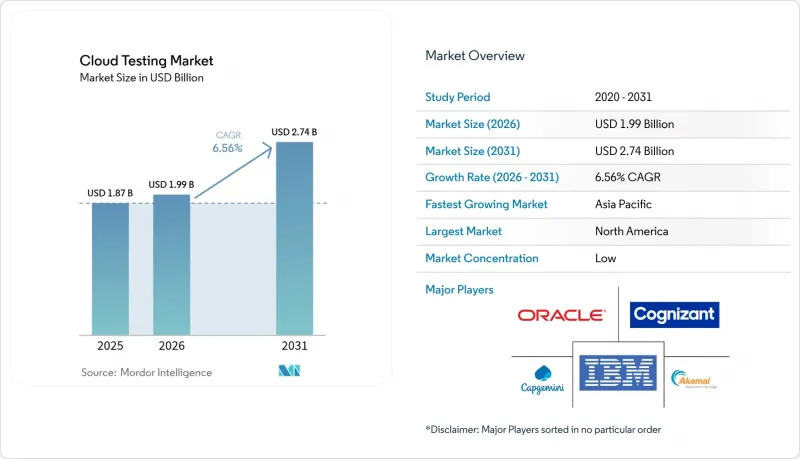
Mordor Intelligence에 의하면, 클라우드 테스트 시장 규모는 2025년에 18억 7,000만 달러로 평가되었고, 2026년 19억 9,000만 달러에서 2031년까지 27억 4,000만 달러에 이를 것으로 예측되며, 예측 기간(2026-2031년) CAGR은 6.56%를 나타낼 전망입니다.
본 보고서는 구성 요소별(도구 유형 및 서비스), 기업 규모별(중소기업 및 대기업), 최종 사용자 산업별(은행, 금융서비스 및 보험(BFSI), 헬스케어, IT 및 통신, 미디어 및 엔터테인먼트, 소매, 기타 최종 사용자 산업), 지역별(북미, 남미, 유럽, 아시아태평양, 중동 및 아프리카)로 분류되어 있습니다. 시장 전망은 금액(달러) 기준으로 제시되어 있습니다.
세계의 클라우드 테스트 시장 동향 및 인사이트
DevOps 및 CI/CD로의 전환 가속화로 지속적인 테스트가 필요해짐
DevOps를 채택한 조직은 기존 팀에 비해 코드 릴리스 빈도가 현저히 높으며, 이러한 속도에 대응하기 위해서는 파이프라인의 각 단계에서 자동화된 검증이 필수적입니다. Continuous Delivery Foundation의 조사에 따르면, DevOps를 성숙하게 실천하고 있는 기업의 배포 빈도는 208배나 높으며, 이러한 차이는 몇 분 만에 리소스를 시작하고 종료할 수 있는 클라우드 호스팅형 테스트 스위트에서 기인합니다. Docker의 2024년 조사에서는 클라우드 환경에서도 여전히 테스트와 디버깅에 많은 시간이 소요되고 있음이 확인되었으며, 통합형 도구에 대한 수요가 증가하고 있음을 뒷받침했습니다. Perforce의 조사에 따르면, 실무자의 75%가 AI 기반 테스트를 매우 중요하게 여기고 있으며, 57%는 이미 클라우드에서 워크로드를 실행하고 있습니다. 출시 속도가 경쟁의 성패를 좌우하는 금융 서비스 및 SaaS 제공업체들은 이러한 플랫폼을 가장 먼저 도입하고 있습니다. ISO/IEC 20000과 같은 세계 서비스 관리 프레임워크에서는 현재 지속적 테스트를 권장하고 있으며, 이는 규정 준수 로드맵에 포함되어 있습니다.
엔드투엔드 검증이 필요한 멀티 클라우드 아키텍처의 복잡화
많은 기업이 멀티클라우드 환경에서 운영되고 있어, 설정 오류가 발생하기 쉬운 상황에 노출되어 있습니다. 이로 인해 비용 낭비가 발생하고 리스크가 높아집니다. 은행 감독 당국은 벤더 종속의 위협으로 인해 금융 기관이 2-3개공급업체를 병행하여 활용하는 전략을 채택하도록 권장하고 있지만, 이러한 접근 방식에서는 장애 전환 메커니즘 및 API 게이트웨이에 대한 엄격한 크로스 플랫폼 테스트가 필요합니다. 유럽의 감독 당국은 현재 시스템상 중요한 금융 기관에 대해 위협 주도형 침투 테스트를 의무화하고 있으며, 보안, 성능, 규정 준수 결과를 통합하는 통합 대시보드 도입을 추진하고 있습니다. 라이선스의 난립을 최소화하면서 전체 환경의 결과를 가시화하는 벤더는 경쟁 우위를 확보할 수 있습니다. 따라서 클라우드 테스트 시장에서는 중립성을 유지하면서도 AWS, Azure, Google Cloud와 네이티브로 통합할 수 있는 플랫폼이 높이 평가받고 있습니다.
테스트 데이터 마이그레이션을 제한하는 데이터 보안 및 규정 준수 관련 우려
유럽중앙은행(ECB)의 지침에 따르면, 금융기관이 클라우드로 아웃소싱할 때 감사권을 보유하며 엑시트 전략을 유지해야 할 의무가 있습니다. ‘디지털 운영 복원력법(DORA)’은 침투 테스트 의무화 및 제3자 등록 제도를 추가로 부과하고 있어, 일부 기업은 프로덕션 환경과 동일한 데이터 세트를 공유 환경으로 이전하는 데 신중을 기하고 있습니다. HIPAA 및 GDPR(EU 개인정보보호규정)은 개인의 건강 정보나 EU 시민의 데이터를 다루는 서비스 제공업체의 위험을 높이고 있습니다. 각 벤더는 암호화 스토리지, 싱글 테넌트 리전, 합성 데이터 도구 등으로 대응하고 있지만, 개인정보 보호 담당자가 추가 심사를 요구할 경우 도입 속도는 여전히 더딘 임베디드니다. 그 결과, 클라우드 테스트 시장의 확대에 따라 데이터 마스킹 및 서브셋화 기술도 부상하고 있어, 팀이 기밀 기록을 노출하지 않고도 기능을 검증할 수 있게 되었습니다.
부문 분석
2025년에는 툴형 플랫폼이 클라우드 테스트 시장에서 가장 큰 점유율을 차지하여 매출의 54.10%를 차지한 것으로 평가되었으며, 2031년까지 연평균 성장률(CAGR) 8.35%로 성장할 것으로 전망됩니다. 수요는 CI/CD 파이프라인에 직접 통합되어 필요할 때만 인프라를 가동함으로써 유휴 시간의 비용을 최소화하는 성능, 부하, 보안 각 모듈에 집중되어 있습니다. 또한 기업들은 멀티 클라우드 환경 전반에 걸쳐 마이크로서비스를 검증하는 상호 운용성 테스트와, 혼란스러운 상황에서 장애 복구 기능을 검증하는 내결함성 테스트에도 주목하고 있습니다. 사용량 기반 과금제로 인해 진입 장벽이 낮아지고 더 광범위한 실험이 촉진됨에 따라, 도구 분야의 클라우드 테스트 시장 규모는 서비스 분야보다 빠르게 확대되고 있습니다. 현재 AI 기능 도입으로 테스트 케이스 생성 및 스크립트 수정이 가능해져 반복적인 작업이 줄어들었고, 경험이 풍부한 엔지니어들은 에지 케이스 검증에 집중할 수 있게 되었습니다.
매니지드 서비스와 프로페셔널 서비스를 결합한 서비스 제공은 2025년에도 45.90%의 점유율을 유지했으며, 성장률 면에서는 뒤처지고 있습니다. 사내에 전문 지식이 없는 고객은 특히 규제 준수 프레임워크에서 공식적인 증명이 요구되는 경우, Cognizant, Wipro, Qualitest 등의 통합 업체가 제공하는 성과 기반 계약에 여전히 의존하고 있습니다. 벤더 포트폴리오에서는 AI 편향 검증, IoT 기기 보안 강화, 데이터 상주 아키텍처에 관한 자문 서비스가 점점 더 중요시되고 있습니다. 그러나 플랫폼의 사용 편의성이 향상되고 사내 DevOps 성숙도가 높아짐에 따라, 많은 기업이 일상적인 회귀 테스트를 다시 사내로 이전하고 있으며, 이러한 추세가 클라우드 테스트 시장 전체의 서비스 수익 확대를 억제하고 있습니다.
지역별 분석
북미는 2025년 매출의 43.20%를 차지했으며, 이는 성숙한 DevOps 관행과 신속한 릴리스 주기를 경쟁 우위로 간주하는 소프트웨어 기업들이 밀집해 있음을 반영합니다. 미국의 금융 기관, 주요 SaaS 제공업체 및 연방 정부 부문은 모두 복원력을 중시하며, 자동 테스트에 대한 지속적인 투자를 추진하고 있습니다. 캐나다의 기술 생태계도 이러한 우선순위를 반영하고 있으며, 각 주의 디지털 정부 프로그램에서는 클라우드 네이티브 QA 프레임워크가 채택되고 있습니다. 멕시코의 니어쇼어 개발 센터는 북미 고객에게 코드를 공급함으로써 지역 내 수요를 더욱 끌어올리고 있습니다.
아시아태평양은 주권 클라우드 구축, 모바일 중심의 소비자 습관, 대규모 공공 부문 디지털화 추진 정책에 힘입어 2031년까지 연평균 성장률(CAGR)이 8.12%를 기록하며 가장 빠르게 성장하는 지역이 될 것으로 예측됩니다. 중국에서 소프트웨어 스택의 현지화 추진은 국내 툴체인에 대한 수요를 불러일으키고 있는 반면, 인도의 퍼블릭 클라우드가 연간 25%의 성장률을 기록하고 있는 것은 스타트업과 정부 기관 모두에서 도입을 촉진하고 있습니다. 동남아시아의 2,630억 달러 규모의 디지털 경제가 확대됨에 따라, 분산된 네트워크 환경에서 성능 테스트를 수행해야 하는 트랜잭션 워크로드가 증가하고 있습니다. 일본과 한국은 미션 크리티컬한 SAP 환경을 프라이빗 클라우드로 전환하는 데 주력하고 있으며, 이를 위해서는 변환된 비즈니스 로직을 검증하기 위한 회귀 테스트 스위트가 필요합니다.
유럽에서는 높은 도입률과 엄격한 감독 간의 균형이 유지되고 있습니다. 2025년 1월에 시행될 ‘디지털 운영 복원력법’에 따라 은행은 클라우드 테스트 절차를 문서화하고, 위협 주도형 침투 테스트 파트너를 확보하며, 엑시트 전략을 유지해야 할 의무가 있습니다. 독일, 프랑스, 영국은 GDPR(EU 개인정보보호규정)의 데이터 주권 규정을 준수하는 멀티테넌트 리전을 활용하여 지출을 주도하고 있습니다. 네덜란드의 밀집된 데이터센터 거점은 하이퍼스케일러와 독립 테스트 벤더를 유치하여 지역적 허브를 형성하고 있습니다. 그 밖의 지역에서는 브라질의 핀테크 붐, 사우디아라비아의 주권 클라우드 도입 의무, 남아프리카공화국의 모바일 뱅킹 급증 등이 맞물려 고객 기반이 확대되고 있으며, 클라우드 테스트 시장은 전 세계적으로 치열한 경쟁이 지속되고 있습니다.
기타 혜택 :
- 엑셀 형식 시장 예측(ME) 시트
- 3개월간의 애널리스트 지원
자주 묻는 질문
목차
제1장 서론
제2장 조사 방법
제3장 주요 요약
제4장 시장 구도
제5장 시장 규모 및 성장 예측
제6장 경쟁 구도
제7장 시장 기회 및 향후 전망
AJY 26.08.26According to Mordor Intelligence, the cloud testing market size was valued at USD 1.87 billion in 2025 and estimated to grow from USD 1.99 billion in 2026 to reach USD 2.74 billion by 2031, at a CAGR of 6.56% during the forecast period (2026-2031).
This report is Segmented by Component (Tool Type and Service), Enterprise Size (Small and Medium Enterprise and Large Enterprise), End-User Industry (BFSI, Healthcare, IT and Telecom, Media and Entertainment, Retail, and Other End-User Industries), and Geography (North America, South America, Europe, Asia-Pacific, Middle East and Africa). The Market Forecasts are Provided in Terms of Value (USD).
Global Cloud Testing Market Trends and Insights
Accelerated Shift to DevOps and CI/CD Demanding Continuous Testing
Organizations that adopt DevOps release code significantly more frequently than traditional teams, and this cadence necessitates automated validation at every pipeline stage. The Continuous Delivery Foundation recorded deployment frequencies 208 times higher among mature practitioners, a gap that hinges on cloud-hosted suites able to spin up and tear down resources in minutes. Docker's 2024 survey confirmed that testing and debugging remain time sinks even in cloud environments, reinforcing demand for integrated tooling. Perforce found that 75% of practitioners view AI-driven testing as pivotal, and 57% already run workloads in the cloud. Financial services and SaaS providers, where release velocity shapes competitiveness, adopt these platforms earliest. Global service-management frameworks such as ISO/IEC 20000 now recommend continuous testing, embedding it into compliance roadmaps.
Growing Complexity of Multi-Cloud Architectures Requiring End-to-End Validation
Most of enterprises operate in multi-cloud settings, exposing them to misconfigurations that waste spend and heighten risk. Banking supervisors warn that vendor lock-in threats prompt institutions to adopt dual- or triple-provider strategies, but this approach requires rigorous cross-platform testing of failover mechanisms and API gateways. Supervisory agencies in Europe now require threat-led penetration tests for systemically important institutions, driving adoption of unified dashboards that consolidate security, performance, and compliance results. Tool vendors that visualize estate-wide results while minimizing license sprawl gain a competitive advantage. The cloud testing market thus rewards platforms that stay neutral yet integrate natively with AWS, Azure, and Google Cloud.
Data Security and Compliance Concerns Restricting Test-Data Movement
European Central Bank guidance obliges financial institutions to retain audit rights and maintain exit strategies when outsourcing to the cloud. The Digital Operational Resilience Act layers on penetration-testing mandates and third-party registries, making some firms wary of moving production-like datasets into shared environments. HIPAA and GDPR heighten risks for providers that handle personal health information or data of EU citizens. Vendors respond with encrypted storage, single-tenant regions and synthetic-data tooling, yet adoption still slows when privacy officers demand extra reviews. Consequently, data-masking and sub-setting technologies are rising in tandem with the cloud testing market, ensuring teams can validate functionality without exposing sensitive records.
Other drivers and restraints analyzed in the detailed report include:
- Cost and Scalability Benefits of Cloud-Based Testing Tools vs On-Premise
- Explosion of Mobile and IoT Applications Needing Higher Test Coverage
- Legacy Infrastructure Inertia in Highly Regulated Sectors
For complete list of drivers and restraints, kindly check the Table Of Contents.
Segment Analysis
Tool Type platforms generated the largest slice of the cloud testing market in 2025, accounting for 54.10% of revenue and positioning the segment to grow at 8.35% CAGR through 2031. Demand concentrates on performance, load and security modules that plug directly into CI/CD pipelines and spin up infrastructure only when needed, minimizing idle spend. Enterprises also gravitate toward interoperability testing that validates microservices across multi-cloud estates and toward resilience tests that prove failover under chaotic conditions. Usage-based pricing lowers entry barriers, encouraging broader experimentation and making the cloud testing market size for tools swell faster than services. AI additions now generate test cases and heal scripts, trimming repetitive labor and letting senior engineers focus on edge conditions.
Service offerings, which combine managed and professional services, retained 45.90% in 2025 but trail in growth. Clients that lack internal expertise still rely on integrators such as Cognizant, Wipro and Qualitest for outcome-based contracts, particularly when regulatory compliance frameworks require formal attestations. Vendor portfolios increasingly emphasize advisory on AI-bias validation, IoT device hardening and data-residency architectures. Even so, as platform usability improves and internal DevOps maturity rises, many enterprises shift routine regression runs back in-house, a trend that restrains service revenue expansion within the broader cloud testing market.
Complete Report Scope:
- By Component
- Tool Type
- Performance and Load Testing
- Interoperability and Compatibility Testing
- Stress and Recovery Testing
- Security Testing
- System Integration and User Acceptance Testing
- Other Tool Types
- Service
- Managed Service
- Professional Service
- Tool Type
- By Enterprise Size
- Small and Medium Enterprise
- Large Enterprise
- By End-user Industry
- BFSI
- Healthcare
- IT and Telecom
- Media and Entertainment
- Retail
- Other End-user Industries
- By Geography
- North America
- United States
- Canada
- Mexico
- South America
- Brazil
- Argentina
- Rest of South America
- Europe
- Germany
- United Kingdom
- France
- Netherlands
- Rest of Europe
- Asia-Pacific
- China
- India
- Japan
- South Korea
- ASEAN
- Rest of Asia-Pacific
- Middle East and Africa
- Middle East
- Saudi Arabia
- United Arab Emirates
- Rest of Middle East
- Africa
- South Africa
- Nigeria
- Rest of Africa
- Middle East
- North America
Geography Analysis
North America generated 43.20% of the 2025 revenue, reflecting mature DevOps practices and a dense concentration of software firms that treat fast release cycles as a competitive advantage. U.S. financial institutions, large SaaS providers, and the federal sector all emphasize resilience, driving continual investment in automated testing. Canada's technology ecosystem reflects these priorities, with provincial digital government programs adopting cloud-native QA frameworks. Mexico's near-shore development centers further boost regional consumption as they supply code to North American clients.
The Asia-Pacific region is expected to be the fastest-growing geography, with a 8.12% CAGR through 2031, driven by sovereign-cloud buildouts, mobile-centric consumer habits, and large public-sector digitalization mandates. China's push to localize software stacks sparks demand for domestic toolchains, while India's 25% annual growth in public cloud fuels uptake among both startups and state agencies. Southeast Asia's USD 263 billion digital economy expansion adds transactional workloads that must be performance-tested across fragmented network conditions. Japan and South Korea focus on private-cloud migrations of mission-critical SAP landscapes, which require regression suites to validate converted business logic.
Europe balances high adoption with rigorous oversight. The Digital Operational Resilience Act, effective January 2025, forces banks to document cloud testing procedures, retain threat-led-penetration partners and maintain exit strategies. Germany, France and the United Kingdom lead spending, leveraging multi-tenant regions that comply with GDPR data-sovereignty rules. The Netherlands' dense data-center footprint attracts hyperscalers and independent testing vendors, forming a regional hub. Elsewhere, Brazil's fintech boom, Saudi Arabia's sovereign-cloud mandates and South Africa's mobile-banking surge collectively widen the customer base, ensuring that the cloud testing market remains globally contested.
- IBM Corporation
- Microsoft Corporation
- Oracle Corporation
- Capgemini SE
- Cognizant Technology Solutions Corp.
- Wipro Limited
- Akamai Technologies Inc.
- Broadcom Inc. (BlazeMeter)
- SmartBear Software Inc.
- Micro Focus International plc
- Tricentis GmbH
- Sauce Labs Inc.
- Google LLC
- Amazon Web Services Inc.
- Keysight Technologies
- Parasoft Corporation
- Cigniti Technologies Ltd
- Invensis Technologies Pvt Ltd
- Cygnet Infotech Pvt Ltd
- Testlio Inc.
- Applause App Quality Inc.
- Qualitest Group
Additional Benefits:
- The market estimate (ME) sheet in Excel format
- 3 months of analyst support
TABLE OF CONTENTS
1 INTRODUCTION
- 1.1 Study Assumptions and Market Definition
- 1.2 Scope of the Study
2 RESEARCH METHODOLOGY
3 EXECUTIVE SUMMARY
4 MARKET LANDSCAPE
- 4.1 Market Overview
- 4.2 Market Drivers
- 4.2.1 Accelerated Shift To DevOps and CI/CD Demanding Continuous Testing
- 4.2.2 Growing Complexity of Multi-Cloud Architectures Requiring End-To-End Validation
- 4.2.3 Cost And Scalability Benefits of Cloud-Based Testing Tools Vs On-Premises
- 4.2.4 Explosion Of Mobile and IoT Applications Needing Higher Test Coverage
- 4.2.5 Usage-Based Pricing Models Democratising Access For Smbs
- 4.2.6 Integration Of AI-Powered Autonomous Testing Within Cloud Platforms
- 4.3 Market Restraints
- 4.3.1 Data Security and Compliance Concerns Restricting Test-Data Movement
- 4.3.2 Legacy Infrastructure Inertia in Highly Regulated Sectors
- 4.3.3 Escalating Cloud Egress Costs For Large Test Datasets
- 4.3.4 Tool sprawl and skill gaps causing orchestration complexity
- 4.4 Industry Value Chain Analysis
- 4.5 Regulatory Landscape
- 4.6 Impact of Macroeconomic Factors on the Market
- 4.7 Technological Outlook
- 4.8 Industry Stakeholder Analysis
- 4.9 Porter's Five Forces Analysis
- 4.9.1 Threat of New Entrants
- 4.9.2 Bargaining Power of Buyers/Consumers
- 4.9.3 Bargaining Power of Suppliers
- 4.9.4 Threat of Substitute Products
- 4.9.5 Intensity of Competitive Rivalry
5 MARKET SIZE AND GROWTH FORECASTS (VALUE)
- 5.1 By Component
- 5.1.1 Tool Type
- 5.1.1.1 Performance and Load Testing
- 5.1.1.2 Interoperability and Compatibility Testing
- 5.1.1.3 Stress and Recovery Testing
- 5.1.1.4 Security Testing
- 5.1.1.5 System Integration and User Acceptance Testing
- 5.1.1.6 Other Tool Types
- 5.1.2 Service
- 5.1.2.1 Managed Service
- 5.1.2.2 Professional Service
- 5.1.1 Tool Type
- 5.2 By Enterprise Size
- 5.2.1 Small and Medium Enterprise
- 5.2.2 Large Enterprise
- 5.3 By End-user Industry
- 5.3.1 BFSI
- 5.3.2 Healthcare
- 5.3.3 IT and Telecom
- 5.3.4 Media and Entertainment
- 5.3.5 Retail
- 5.3.6 Other End-user Industries
- 5.4 By Geography
- 5.4.1 North America
- 5.4.1.1 United States
- 5.4.1.2 Canada
- 5.4.1.3 Mexico
- 5.4.2 South America
- 5.4.2.1 Brazil
- 5.4.2.2 Argentina
- 5.4.2.3 Rest of South America
- 5.4.3 Europe
- 5.4.3.1 Germany
- 5.4.3.2 United Kingdom
- 5.4.3.3 France
- 5.4.3.4 Netherlands
- 5.4.3.5 Rest of Europe
- 5.4.4 Asia-Pacific
- 5.4.4.1 China
- 5.4.4.2 India
- 5.4.4.3 Japan
- 5.4.4.4 South Korea
- 5.4.4.5 ASEAN
- 5.4.4.6 Rest of Asia-Pacific
- 5.4.5 Middle East and Africa
- 5.4.5.1 Middle East
- 5.4.5.1.1 Saudi Arabia
- 5.4.5.1.2 United Arab Emirates
- 5.4.5.1.3 Rest of Middle East
- 5.4.5.2 Africa
- 5.4.5.2.1 South Africa
- 5.4.5.2.2 Nigeria
- 5.4.5.2.3 Rest of Africa
- 5.4.5.1 Middle East
- 5.4.1 North America
6 COMPETITIVE LANDSCAPE
- 6.1 Market Concentration
- 6.2 Strategic Moves
- 6.3 Market Share Analysis
- 6.4 Company Profiles (includes Global level Overview, Market level overview, Core Segments, Financials as available, Strategic Information, Market Rank/Share for key companies, Products and Services, and Recent Developments)
- 6.4.1 IBM Corporation
- 6.4.2 Microsoft Corporation
- 6.4.3 Oracle Corporation
- 6.4.4 Capgemini SE
- 6.4.5 Cognizant Technology Solutions Corp.
- 6.4.6 Wipro Limited
- 6.4.7 Akamai Technologies Inc.
- 6.4.8 Broadcom Inc. (BlazeMeter)
- 6.4.9 SmartBear Software Inc.
- 6.4.10 Micro Focus International plc
- 6.4.11 Tricentis GmbH
- 6.4.12 Sauce Labs Inc.
- 6.4.13 Google LLC
- 6.4.14 Amazon Web Services Inc.
- 6.4.15 Keysight Technologies
- 6.4.16 Parasoft Corporation
- 6.4.17 Cigniti Technologies Ltd
- 6.4.18 Invensis Technologies Pvt Ltd
- 6.4.19 Cygnet Infotech Pvt Ltd
- 6.4.20 Testlio Inc.
- 6.4.21 Applause App Quality Inc.
- 6.4.22 Qualitest Group
7 MARKET OPPORTUNITIES AND FUTURE OUTLOOK
- 7.1 White-space and Unmet-Need Assessment


