|
시장보고서
상품코드
2114417
의료용 IoT : 시장 점유율 분석, 업계 동향 및 통계, 성장 예측(2026-2031년)Internet Of Medical Things - Market Share Analysis, Industry Trends & Statistics, Growth Forecasts (2026 - 2031) |
||||||
 Mordor Intelligence
Mordor Intelligence에 의하면, 의료용 IoT 시장 규모는 2025년 560억 7,000만 달러에서 2026년에는 657억 1,000만 달러로 확대되고, 2026-2031년 CAGR 17.19%로 성장을 지속하여 2031년에는 1,452억 3,000만 달러에 달할 것으로 예측됩니다.
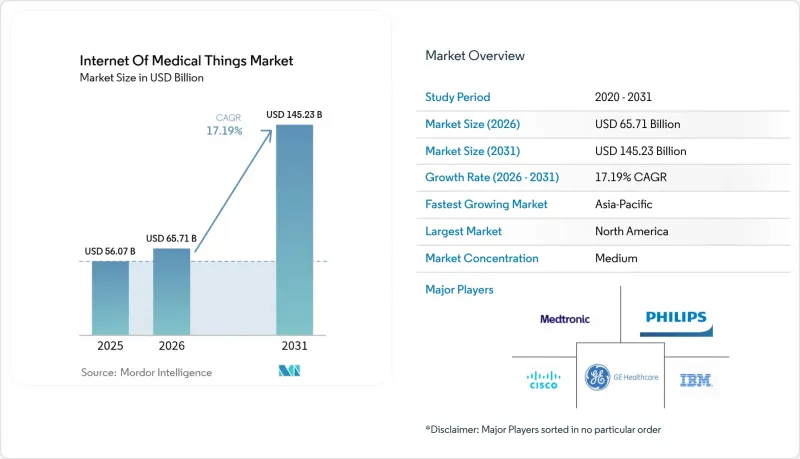
본 보고서는 기기 유형(웨어러블 기기, 고정형·병원용 기기, 이식형 기기, 기타 기기 유형), 제품 유형(생체 신호 모니터링 기기, 이식형 심장 기기, 기타), 최종 사용자(병원, 클리닉, 기타), 연결 기술(Zigbee, Bluetooth, Wi-Fi, 기타), 지역별로 분류되어 있습니다.
전 세계 의료용 IoT 시장 동향 및 인사이트
전 세계 의료 시스템의 비용 절감 압박
의료 서비스 제공업체들은 급격한 비용 상승에 직면해 있으며, 미국공급망 혼란으로 인해 2025년에는 비용이 15% 증가할 것으로 예측됩니다. 커넥티드 기기는 예측 유지보수 및 실시간 자산 추적을 통해 예기치 않은 가동 중지 시간을 줄여줍니다. 그 예로, RWJ 바나바스 헬스(RWJ Barnabas Health)는 기기 분실을 방지하는 위치 추적 시스템을 도입한 결과, 900만 달러의 비용 절감을 달성했습니다. 가치 기반 상환 제도는 병원이 비용 관리와 병행하여 치료 성과 개선을 문서화해야 하므로, IoT 도입을 촉진하고 있습니다. 그 결과, 자본 예산에서 의료용 IoT 시장은 필수적인 인프라로 취급되며, 다년간의 조달 계약이 체결되고 있습니다. 또한, 보험사는 보상액을 문서화된 비용 절감액과 연동함으로써, 운영 자금이 연결형 플랫폼에 배정되는 선순환을 강화하고 있습니다.
연결형 웨어러블 및 임플란트형 기기의 보급
무선 전력 전송 및 소형화된 센서 어레이 분야의 기술적 진보로 인해, 관련 데이터만 전송하여 대역폭과 에너지를 절약하는 배터리 불필요 기기가 실현되었습니다. 브라운 대학교는 두개내압과 혈당 수치를 동시에 모니터링할 수 있는 소금 알갱이 크기의 센서를 시연하여, 재수술이 필요 없는 지속적인 치료를 가능하게 했습니다. 예방 의료 데이터에 대한 소비자 수요로 인해 도입 범위는 임상 현장을 넘어 확대되고 있으며, 의료용 IoT 시장은 질병 관리뿐만 아니라 웰니스 부문에서도 성장이 예상됩니다. 기기 제조업체들은 전송 전에 노이즈를 필터링하는 엣지 AI를 탑재하여 클라우드 처리 비용을 절감하고 있습니다. 실제 환경에서의 성능 데이터가 축적됨에 따라 규제 절차도 원활해지고 있어, 차세대 이식형 기기의 승인 주기가 단축되고 있습니다.
의료 기관의 IoT 전문 인력 부족
의료 기업의 30%가 데이터 보안에 관한 전문 지식 부족을 도입의 장벽으로 꼽고 있습니다. 소규모 병원에서는 사이버 보안에 정통한 엔지니어 채용에 어려움을 겪고 있어, 자원이 풍부한 의료 기관과 지방 시설 간의 격차가 확대되고 있습니다. 매니지드 서비스는 일부 요구를 보완하는 한편, 벤더 종속의 위험이나 구독에 따른 간접 비용을 초래합니다. 동남아시아에서는 투자 의지가 높음에도 불구하고 인력 부족이 두드러집니다. 견고한 사내 팀이 없다면 도입 일정이 장기화되어 ‘의료용 IoT’ 시장의 확산이 지연될 것입니다.
부문 분석
임베디드 기기는 가장 빠르게 성장하는 부문으로, 2031년까지 연평균 성장률(CAGR) 19.04%로 확대될 것으로 예측됩니다. 한편, 웨어러블 기기는 2025년 의료용 IoT 시장 규모의 26.62%를 차지하며 계속해서 주도적인 위치를 유지하고 있습니다. 무선 전력 전송과 서브 mm급 센서를 통해 배터리 교체가 불필요해지며, 지속적인 다중 매개변수 측정이 가능해집니다. 병원 내 고정형 시스템은 네트워크 오케스트레이션에서 연결 허브 역할을 수행하며, 수천 개에 달하는 엔드포인트에 걸친 데이터의 일관성을 보장합니다.
캘리포니아 대학교가 개발한 초음파 구동형 형광 센서는 외부 리드선을 사용하지 않고도 심부 조직 영상화가 암 치료를 어떻게 이끌 수 있는지를 보여줍니다. 웨어러블 기기는 이러한 진보를 반영하여 센서 융합과 엣지 분석을 결합해 적시에 경보를 발령합니다. 신흥 스마트 콘택트렌즈와 생분해성 프로브는 의료용 IoT 시장의 다양화로 이어지는 틈새 기회를 제공합니다. 규제 당국의 승인은 장기적인 안전성과 치료 성과 향상을 입증한 임플란트 제품을 우선시하며, 지속적인 연구개발 투자를 뒷받침하고 있습니다.
생체 신호 모니터링 제품은 2025년에 32.08%의 시장 점유율을 차지하며, 모든 의료 현장에서 필수적인 도구로서의 역할을 수행하고 있습니다. 이식형 심장 기기는 실시간 신경 피드백을 기반으로 치료를 최적화하는 폐쇄 루프 신경 조절 기술의 지원을 받아 연평균 성장률(CAGR) 17.62%로 성장할 것으로 전망됩니다. 만성폐쇄성폐질환(COPD) 유병률 증가에 따라 호흡 모니터의 중요성이 높아지는 한편, 마취기에는 연결형 센서가 내장되어 수술 중 안전성이 향상되고 있습니다.
영상 시스템 및 인공호흡기에 적용되는 예측 유지보수 알고리즘은 가동 중단 시간을 줄이고 자산의 수명을 연장합니다. 스마트 약품 디스펜서 및 커넥티드 재활 기기는 급성기 의료의 범위를 넘어 환자의 참여를 확대하고, 공급업체에 지속적인 수익원을 제공합니다. 이러한 동향들이 결합되어 의료용 IoT(IoMT) 시장을 활성화하고, 기기 간 생태계의 가치를 높이고 있습니다.
지역별 분석
북미는 2025년에 38.22%의 점유율을 차지할 것으로 예상되며, 이는 성숙한 의료 IT 인프라와 상호 운용성을 촉진하는 규제 프레임워크에 힘입은 결과입니다. 민관 협력을 통해 프라이빗 5G 시범 사업과 AI 기반 진단이 가속화되고 있습니다. 캐나다와 멕시코에서는 정부 자금 지원에 의한 원격의료 이니셔티브가 시장에 활력을 불어넣고 있지만, 사이버 보험료 상승과 반도체 부족으로 인해 단기적인 기기 도입은 억제되고 있습니다. 레거시 시스템의 통합은 여전히 자본 집약적인 장벽으로 남아 있지만, 견고한 상환 모델 덕분에 의료용 IoT 시장은 계속해서 전진하고 있습니다.
아시아태평양은 연평균 성장률(CAGR) 20.71%로 가장 빠르게 성장하고 있는 지역입니다. 중국의 2024년 의료 정보화 지출은 8,000억 위안 이상으로, 정부의 강력한 지원을 보여주고 있습니다. 일본과 한국은 첨단 제조 기술을 활용하여 차세대 센서를 제공하고 있으며, 인도의 전국적인 전자건강기록(EHR) 도입은 표준화를 촉진하고 있습니다. 숙련된 인력 부족은 여전히 지속되고 있지만, 국경을 넘는 연수와 클라우드 기반 관리 서비스를 통해 그 격차는 줄어들고 있습니다. 지역 간 협력을 통해 모범 사례가 확산되면서, 확대되는 의료용 IoT 시장에 대한 폭넓은 참여가 보장되고 있습니다.
유럽에서는 커넥티드 기기에 대한 요건을 명확히 한 의료기기 규정(MDR) 준수에 힘입어 꾸준한 성장을 기록하고 있습니다. 독일, 영국, 프랑스는 재정 지원을 받은 현대화 프로그램을 통해 도입을 주도하고 있는 반면, 이탈리아와 스페인은 EU의 경기 부양책을 활용하여 인프라를 업그레이드하고 있습니다. 엄격한 데이터 개인정보 보호법은 도입 비용을 높이는 한편, 환자의 신뢰를 구축하고 있습니다. 스위스의 칸톤스 스피탈 바덴에서는 지멘스(Siemens)사와 협력하여 7,000개 이상의 센서를 도입함으로써 스마트 병원 구상의 확장성을 입증했습니다. 정책의 조화를 통해 소규모 경제권도 지역적 프레임워크에 동참할 수 있게 되었으며, 대륙 전체에서 의료용 IoT 시장의 성장세가 유지되고 있습니다.
기타 혜택
- 엑셀 형식 시장 예측(ME) 시트
- 3개월간의 애널리스트 지원
자주 묻는 질문
목차
제1장 서론
제2장 조사 방법
제3장 주요 요약
제4장 시장 구도
제5장 시장 규모와 성장 예측
제6장 경쟁 구도
제7장 시장 기회와 향후 전망
LSH 26.08.26According to Mordor Intelligence, the internet of Medical Things Market size is expected to grow from USD 56.07 billion in 2025 to USD 65.71 billion in 2026 and is forecast to reach USD 145.23 billion by 2031 at 17.19% CAGR over 2026-2031.
This report is Segmented by Device Type (Wearable Devices, Stationary/In-Hospital Devices, Implantable Devices, and Other Device Types), Product Type (Vital Signs Monitoring Devices, Implantable Cardiac Devices, and More), End Users (Hospitals, Clinics, and More), Connectivity Technology (Zigbee, Bluetooth, Wi-Fi, and More), and Geography.
Global Internet Of Medical Things Market Trends and Insights
Cost-reduction Pressure on Global Healthcare Systems
Healthcare providers face steep cost escalation, with United States supply-chain disruptions pushing expenses up by 15% in 2025. Connected devices cut unplanned downtime through predictive maintenance and real-time asset tracking, as illustrated by RWJBarnabas Health's USD 9 million savings after deploying a location system that eliminated device losses. Value-based reimbursement amplifies adoption because hospitals must document outcome improvements alongside cost controls. Capital budgets consequently treat the Internet of Medical Things market as essential infrastructure, prompting multiyear procurement commitments. Insurers further link reimbursement to documented savings, reinforcing a cycle that channels operating funds to connected platforms.
Proliferation of Connected Wearables and Implantables
Breakthroughs in wireless power and miniaturized sensor arrays now permit battery-free devices that transmit only relevant data, conserving bandwidth and energy. Brown University demonstrated salt-sized sensors capable of monitoring intracranial pressure and glucose simultaneously, enabling continuous care without recurrent surgery. Consumer demand for preventive health data broadens deployment beyond clinical settings, ensuring the Internet of Medical Things market finds growth in wellness as well as disease management. Device makers embed edge AI that filters noise before transmission, reducing cloud-processing costs. Regulatory pathways are smoothing as real-world performance data accumulates, shortening approval cycles for next-generation implants.
Shortage of In-house IoT Skills in Provider Organisations
Thirty percent of healthcare enterprises cite data-security expertise shortages as an adoption hurdle. Smaller hospitals struggle to recruit cyber-literate engineers, widening the gap between resource-rich systems and rural facilities. Managed services bridge some needs but introduce vendor-lock risks and subscription overhead. Talent deficits are pronounced in Southeast Asia despite high investment intent. Without robust in-house teams, deployment timelines extend, slowing Internet of Medical Things market penetration.
Other drivers and restraints analyzed in the detailed report include:
- Shift to Outcomes-based and Remote Patient-Monitoring Models
- Roll-out of Private 5G and Edge Networks in Hospitals
- Escalating Ransomware Premiums Diverting IoMT Budgets
For complete list of drivers and restraints, kindly check the Table Of Contents.
Segment Analysis
Implantable devices represent the fastest-growing segment, projected to expand at 19.04% CAGR through 2031, while wearables maintained leadership with 26.62% share of the Internet of Medical Things market size in 2025. Wireless power transfer and sub-millimeter sensors eliminate battery replacements and support continuous multi-parameter measurement. Stationary in-hospital systems remain connectivity hubs for network orchestration, ensuring data integrity across thousands of endpoints.
The University of California's ultrasound-powered fluorescence sensor shows how deep-tissue imaging can guide cancer therapy without external leads. Wearables absorb these advances, combining sensor fusion with edge analytics to issue timely alerts. Emerging smart contact lenses and biodegradable probes add niche opportunities that diversify the Internet of Medical Things market. Regulatory approvals favor implants that demonstrate longitudinal safety and outcome benefits, encouraging sustained R&D spending.
Vital-sign monitoring products held a 32.08% share in 2025, demonstrating their role as baseline tools across care settings. Implantable cardiac devices are slated to grow at a 17.62% CAGR, supported by closed-loop neuromodulation that optimizes therapy based on real-time neural feedback. Respiratory monitors gain relevance due to rising COPD prevalence, while anaesthesia machines integrate connected sensors to enhance intraoperative safety.
Predictive maintenance algorithms applied to imaging systems and ventilators reduce downtime and extend asset life. Smart pill dispensers and connected rehabilitation gear broaden engagement beyond acute care, adding recurring revenue streams for vendors. Together, these dynamics elevate the Internet of Medical Things market and enhance cross-device ecosystem value.
Complete Report Scope:
- By Device Type
- Wearable Devices
- Stationary/In-Hospital Devices
- Implantable Devices
- Other Device Types
- By Product Type
- Vital Signs Monitoring Devices
- Implantable Cardiac Devices
- Respiratory Devices
- Anaesthetic Machines
- Imaging Systems
- Ventilators
- Other Products
- By End User
- Hospitals
- Clinics
- Nursing Homes
- Long-Term Care Centers
- Home Care Settings
- By Connectivity Technology
- Zigbee
- Bluetooth
- Wi-Fi
- Cellular IoT/LPWAN
- Other Technologies
- By Geography
- North America
- United States
- Canada
- Mexico
- Europe
- Germany
- United Kingdom
- France
- Italy
- Spain
- Rest of Europe
- Asia-Pacific
- China
- Japan
- India
- South Korea
- Rest of Asia-Pacific
- Middle East and Africa
- Middle East
- Saudi Arabia
- United Arab Emirates
- Turkey
- Rest of Middle East
- Africa
- South Africa
- Nigeria
- Kenya
- Rest of Africa
- Middle East
- South America
- Brazil
- Argentina
- Rest of South America
- North America
Geography Analysis
North America commanded a 38.22% share in 2025, propelled by mature health-IT infrastructure and regulatory pathways that encourage interoperability. Public-private alliances fast-track private-5G pilots and AI-enabled diagnostics. Canada and Mexico add momentum through government-funded telehealth initiatives, while rising cyber-insurance premiums and semiconductor shortages temper near-term device rollouts. Legacy system integration remains a capital-intensive obstacle, yet strong reimbursement models keep the Internet of Medical Things market advancing.
Asia Pacific is the fastest-growing region at a 20.71% CAGR. China's 2024 medical-informatization spending surpassed CNY 800 billion, underscoring state support. Japan and South Korea leverage advanced manufacturing to deliver next-generation sensors, and India's national EHR rollout aids standardization. Skilled-personnel shortages persist, but cross-border training and cloud-based managed services lessen the gap. Regional collaboration spreads best practices, ensuring broad participation in the expanding Internet of Medical Things market.
Europe records steady gains supported by Medical Device Regulation compliance that clarifies connected-device requirements. Germany, the United Kingdom, and France lead adoption through funded modernization programs, while Italy and Spain tap EU stimulus to upgrade infrastructure. Strict data-privacy laws elevate implementation costs yet build patient trust. Switzerland's Kantonsspital Baden installed more than 7,000 sensors with Siemens, proving the scalability of smart-hospital visions. Harmonized policies let smaller economies piggyback on regional frameworks, sustaining Internet of Medical Things market momentum across the continent.
- GE Healthcare
- Koninklijke Philips N V
- Medtronic plc
- Cisco Systems Inc.
- IBM Corporation
- Siemens Healthineers
- Hill-Rom /Welch Allyn
- Boston Scientific Corp.
- Johnson and Johnson (JandJ MedTech)
- Biotronik SE
- Abbott Laboratories
- Dexcom Inc.
- ResMed Inc.
- Apple Inc.
- Fitbit (Google LLC)
- Qualcomm Life
- Honeywell International
- Capsule Technologies
- Ordr Inc.
- Armis Security
- Cynerio Ltd.
Additional Benefits:
- The market estimate (ME) sheet in Excel format
- 3 months of analyst support
TABLE OF CONTENTS
1 INTRODUCTION
- 1.1 Study Assumptions and Market Definition
- 1.2 Scope of the Study
2 RESEARCH METHODOLOGY
3 EXECUTIVE SUMMARY
4 MARKET LANDSCAPE
- 4.1 Market Overview
- 4.2 Market Drivers
- 4.2.1 Cost-reduction pressure on global healthcare systems
- 4.2.2 Proliferation of connected wearables and implantables
- 4.2.3 Shift to outcomes-based and remote patient monitoring models
- 4.2.4 Roll-out of private-5G/edge networks in hospitals
- 4.2.5 Ultra-low-power AI sensor chips enabling multi--parameter implantables
- 4.2.6 Mandatory cyber-insurance clauses demanding IoMT visibility
- 4.3 Market Restraints
- 4.3.1 Shortage of in-house IoT skills in provider organisations
- 4.3.2 High upfront infrastructure and device costs
- 4.3.3 Fragmented data-interoperability standards
- 4.3.4 Escalating ransomware premiums diverting IoMT budgets
- 4.4 Value/Supply-Chain Analysis
- 4.5 Regulatory Landscape
- 4.6 Technological Outlook
- 4.7 Porter's Five Forces Analysis
- 4.7.1 Threat of New Entrants
- 4.7.2 Bargaining Power of Buyers
- 4.7.3 Bargaining Power of Suppliers
- 4.7.4 Threat of Substitutes
- 4.7.5 Competitive Rivalry
- 4.8 Investment Analysis
5 MARKET SIZE AND GROWTH FORECASTS (VALUE)
- 5.1 By Device Type
- 5.1.1 Wearable Devices
- 5.1.2 Stationary/In-Hospital Devices
- 5.1.3 Implantable Devices
- 5.1.4 Other Device Types
- 5.2 By Product Type
- 5.2.1 Vital Signs Monitoring Devices
- 5.2.2 Implantable Cardiac Devices
- 5.2.3 Respiratory Devices
- 5.2.4 Anaesthetic Machines
- 5.2.5 Imaging Systems
- 5.2.6 Ventilators
- 5.2.7 Other Products
- 5.3 By End User
- 5.3.1 Hospitals
- 5.3.2 Clinics
- 5.3.3 Nursing Homes
- 5.3.4 Long-Term Care Centers
- 5.3.5 Home Care Settings
- 5.4 By Connectivity Technology
- 5.4.1 Zigbee
- 5.4.2 Bluetooth
- 5.4.3 Wi-Fi
- 5.4.4 Cellular IoT/LPWAN
- 5.4.5 Other Technologies
- 5.5 By Geography
- 5.5.1 North America
- 5.5.1.1 United States
- 5.5.1.2 Canada
- 5.5.1.3 Mexico
- 5.5.2 Europe
- 5.5.2.1 Germany
- 5.5.2.2 United Kingdom
- 5.5.2.3 France
- 5.5.2.4 Italy
- 5.5.2.5 Spain
- 5.5.2.6 Rest of Europe
- 5.5.3 Asia-Pacific
- 5.5.3.1 China
- 5.5.3.2 Japan
- 5.5.3.3 India
- 5.5.3.4 South Korea
- 5.5.3.5 Rest of Asia-Pacific
- 5.5.4 Middle East and Africa
- 5.5.4.1 Middle East
- 5.5.4.1.1 Saudi Arabia
- 5.5.4.1.2 United Arab Emirates
- 5.5.4.1.3 Turkey
- 5.5.4.1.4 Rest of Middle East
- 5.5.4.2 Africa
- 5.5.4.2.1 South Africa
- 5.5.4.2.2 Nigeria
- 5.5.4.2.3 Kenya
- 5.5.4.2.4 Rest of Africa
- 5.5.4.1 Middle East
- 5.5.5 South America
- 5.5.5.1 Brazil
- 5.5.5.2 Argentina
- 5.5.5.3 Rest of South America
- 5.5.1 North America
6 COMPETITIVE LANDSCAPE
- 6.1 Market Concentration
- 6.2 Strategic Moves
- 6.3 Market Share Analysis
- 6.4 Company Profiles (includes Global level Overview, Market level overview, Core Segments, Financials as available, Strategic Information, Market Rank/Share for key companies, Products and Services, and Recent Developments)
- 6.4.1 GE Healthcare
- 6.4.2 Koninklijke Philips N V
- 6.4.3 Medtronic plc
- 6.4.4 Cisco Systems Inc.
- 6.4.5 IBM Corporation
- 6.4.6 Siemens Healthineers
- 6.4.7 Hill-Rom /Welch Allyn
- 6.4.8 Boston Scientific Corp.
- 6.4.9 Johnson and Johnson (JandJ MedTech)
- 6.4.10 Biotronik SE
- 6.4.11 Abbott Laboratories
- 6.4.12 Dexcom Inc.
- 6.4.13 ResMed Inc.
- 6.4.14 Apple Inc.
- 6.4.15 Fitbit (Google LLC)
- 6.4.16 Qualcomm Life
- 6.4.17 Honeywell International
- 6.4.18 Capsule Technologies
- 6.4.19 Ordr Inc.
- 6.4.20 Armis Security
- 6.4.21 Cynerio Ltd.
7 MARKET OPPORTUNITIES AND FUTURE OUTLOOK
- 7.1 White-space and Unmet-Need Assessment