

|
시장보고서
상품코드
2114418
LTE IoT : 시장 점유율 분석, 업계 동향 및 통계, 성장 예측(2026-2031년)LTE IoT - Market Share Analysis, Industry Trends & Statistics, Growth Forecasts (2026 - 2031) |
||||||
 Mordor Intelligence
Mordor Intelligence에 의하면, 2026년 LTE IoT 시장 규모는 21억 5,000만 달러로 추정되고 있으며, 2025년 18억 3,000만 달러에서 성장하여 2031년에는 48억 5,000만 달러에 달할 것으로 예측됩니다.
또한 2026-2031년 연평균 성장률(CAGR) 17.64%를 기록할 전망입니다.
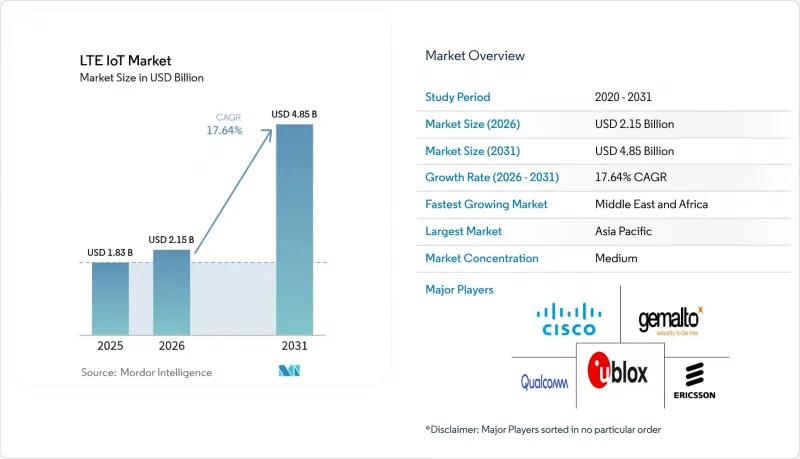
본 보고서는 서비스별(프로페셔널, 매니지드), 제품 유형별(NB-IoT, LTE-M), 최종 사용자 산업별(IT 및 통신, 가전, 소매(디지털 커머스), 헬스케어, 산업, 기타), 지역별로 분류되어 있습니다. 상기 모든 부문에 대해 시장 규모와 전망치는 금액(달러)으로 표시되어 있습니다.
세계 LTE IoT 시장 동향 및 인사이트
저전력 셀룰러 LPWA 모듈 가격이 4달러 미만으로 하락
Nordic Semiconductor의 nRF9151은 64MHz Arm Cortex-M33과 통합 멀티모드 모뎀을 통해 부품 원가를 절감하고 4달러 미만의 가격을 실현할 수 있음을 보여주며, 과거에는 면허가 필요 없는 LPWAN에 의존하던 농업, 물류, 환경 센싱 부문에서의 도입을 촉진하고 있습니다. 중국 공급업체들은 이미 공공요금 계량기용 NB-IoT 모듈을 3달러에 견적하고 있어, 비용 절감 추세를 뒷받침하고 있습니다. 전 세계 카탈로그의 상당수에는 여전히 10-15달러짜리 부품이 게재되어 있지만, 유럽 및 아시아태평양의 통신 사업자들은 LTE IoT 시장의 보급을 가속화하고 네트워크 이용률을 높이기 위해 하드웨어에 대한 보조금 지급을 시작하고 있습니다.
스마트 계량기 도입 의무화가 셀룰러 연결을 뒷받침
60개 이상의 관할 구역에서 가스, 전력 또는 수도 유틸리티자에게 원격 업그레이드가 가능한 통신 기능이 탑재된 계량기 설치를 의무화하는 규정이 제정되었습니다. Telia가 NB-IoT와 LTE-M을 활용해 스웨덴에 200만 대의 전기 계량기를 구축함으로써 현장 출장 비용이 절감되었고, 5G 지원 배전망이 구축되었습니다. Netinium의 SIM 프로파일 오케스트레이션과 Telit Cinterion의 연동을 통해 원격 프로비저닝이 가능해졌으며, 이로 인해 유틸리티자들이 광역 셀룰러 통신 도입을 주저하게 만들었던 기존의 락인 문제가 해결되었습니다. 이러한 노력은 LTE IoT 시장에 향후 몇 년간의 전망을 제시하는 한편, 독자 사양의 메시 네트워크를 대체하고 있습니다.
서브GHz 대역의 주파수 대역 혼잡이 용량을 제한하고 있습니다.
현재, 한정된 700-960MHz 대역 내에서 여러 LPWAN 규격이 경쟁하고 있습니다. 듀티 사이클 규제 및 출력 제한으로 인해 셀 밀도가 억제되고 있으며, 네트워크 측의 간섭 관리 비용은 급격히 상승하고 있습니다. FCC는 2024년에 새로운 6GHz 대역의 실내 할당을 시작했지만, 지하 및 지방 지역의 IoT 커버리지를 확보하기 위해서는 여전히 서브GHz 대역의 전파가 필수적입니다. 이에 따라 통신 사업자들은 동적 스펙트럼 액세스 및 협대역 필터링에 투자하고 있으며, 이는 비용 증가로 이어져 대도시권 내 LTE IoT 시장의 확산을 지연시키고 있습니다.
부문 분석
2025년, 전문 서비스는 컨설팅, 기기 인증, 엣지 클라우드 통합 프로젝트를 통해 LTE IoT 시장 매출의 60.25%를 창출했습니다. 기업들이 SIM의 물류에서 보안 패치 적용에 이르는 라이프사이클 업무를 전문 공급자에게 이관함에 따라, 매니지드 서비스의 도입은 연평균 성장률(CAGR) 14.92%로 가속화될 것으로 예측됩니다. 도이치 텔레콤의 B2B 부문은 자본 예산을 운영비로 전환하는 성과 연동형 계약에서 연결 서비스와 분석 기능을 묶어 제공합니다. 향후에는 AI를 활용한 오케스트레이션 플랫폼을 통해 수작업에 소요되는 엔지니어링 시간이 단축될 전망이지만, 그 전환 과정 자체가 매니지드 서비스 벤더에게 지속적인 수익원이 될 것입니다.
표준화된 온보딩 API 및 eUICC 프로비저닝을 통해 파일럿 단계는 이미 단축되었지만, 기존 시설(브라운필드)에서는 여전히 개별적인 무선 계획 및 프로토콜 변환이 필요합니다. 그 결과, 신규 건설 프로젝트에서는 매니지드 패키지에 대한 의존도가 높아지고 있는 반면, 수년에 걸친 개보수 프로젝트에서는 전문 서비스의 활용이 여전히 매우 중요합니다. LTE IoT 시장의 매니지드 서비스는 2029년 이후 프로페셔널 서비스를 상회하는 성장이 예상되며, 두 부문이 결합되어 2031년까지 통신 사업자의 고객 유지율을 높여갈 것으로 전망됩니다.
지역별 분석
2025년, 중국이 NB-IoT 커버리지를 섹터당 10만 연결로 확대하고 3달러 이하 모듈 생산을 지원함에 따라, 아시아태평양은 전 세계 매출의 54.40%를 차지했습니다. 차이나모바일은 2024년 1-3분기에 7,235억 위안(1,012억 달러)의 통신 매출을 기록하며, 주파수 대역 및 설비 투자에 대한 지속적인 노력을 입증했습니다. 일본과 한국은 스마트 팩토리로의 전환을 중시하는 반면, 아세안(ASEAN)은 공유된 LTE 백본 인프라를 활용하여 교통 관리 및 홍수 경보 시스템의 점검 및 운영을 수행하고 있습니다.
중동은 가장 빠르게 성장하고 있는 하위 지역으로, 2031년 연평균 성장률(CAGR)은 19.12%로 예측됩니다. 카타르의 루사일 시티 프로젝트에서는 조명, 폐기물, 교통 관리에 NB-IoT 및 LTE-M 센서를 활용하여 45만 명의 주민을 실시간 운영 센터에 통합하고 있습니다. ‘사우디 비전 2030’에서는 석유 수입의 잉여 자금을 식량 안보 위험에 대처하기 위한 농업용 IoT에 투자하고 있으며, 셀룰러 LPWA를 이용하여 온실의 기후 제어와 드론을 활용한 관개를 연계하고 있습니다.
유럽과 북미에서는 탄소 배출량 산정 기준의 엄격화와 3G 서비스 종료에 따라 기존 계량기 및 산업용 기기의 꾸준한 교체가 진행되고 있습니다. Telia의 스웨덴 계량기 교체 사례는 이러한 청사진을 보여주고 있으며, 독자 규격인 PLC를 라이선스를 취득한 LTE 무선으로 대체하고, eUICC를 도입하여 15년간의 계약을 보장하고 있습니다. o2 Telefonica의 독일 사업에서는 2025년 1분기에 M2M 가입자 수가 전년 동기 대비 132.4% 증가를 기록했으며, 그 대부분은 유틸리티 부문에서 비롯된 것입니다. 아프리카와 라틴아메리카에서는 아직 발전 단계에 있지만, 자산 추적 및 농업 부문에서의 LTE IoT 직접 도입을 통해 유선 회선을 건너뛰는 형태로 급속한 보급이 진행되고 있습니다.
기타 혜택
- 엑셀 형식 시장 예측(ME) 시트
- 3개월간의 애널리스트 지원
자주 묻는 질문
목차
제1장 서론
제2장 조사 방법
제3장 주요 요약
제4장 시장 구도
제5장 시장 규모와 성장 예측
제6장 경쟁 구도
제7장 시장 기회와 향후 전망
LSH 26.08.26According to Mordor Intelligence, LTE IoT market size in 2026 is estimated at USD 2.15 billion, growing from 2025 value of USD 1.83 billion with 2031 projections showing USD 4.85 billion, growing at 17.64% CAGR over 2026-2031.
This report is Segmented by Service (Professional, Managed), Product Type (NB-IoT, LTE-M), End-User Industry (IT and Telecommunications, Consumer Electronics, Retail (digital Ecommerce), Healthcare, Industrial, and Other Industries), and Geography. The Market Sizes and Forecasts are Provided in Terms of Value (USD) for all the Above Segments.
Global LTE IoT Market Trends and Insights
Low-power cellular LPWA modules fall below USD 4
Nordic Semiconductor's nRF9151 shows how a 64 MHz Arm Cortex-M33 and integrated multimode modem can cut bill-of-materials and approach a sub-USD 4 headline price, encouraging agriculture, logistics, and environmental-sensing deployments that once relied on unlicensed LPWAN. Chinese vendors already quote USD 3 NB-IoT modules for utility meters, reinforcing cost-down momentum . While most global catalogs still list USD 10-15 parts, operators in Europe and APAC have begun subsidizing hardware to accelerate LTE IoT market uptake and lift network utilization.
Smart-meter mandates reinforce cellular connectivity
Over 60 jurisdictions have enacted regulations that oblige gas, electricity, or water utilities to install communicating meters able to upgrade remotely. Telia's rollout of 2 million Swedish electric meters on NB-IoT and LTE-M cut truck-roll costs and established a 5G-ready distribution grid. Netinium's SIM-profile orchestration with Telit Cinterion allows remote provisioning, solving the historic lock-in that deterred utilities from wide-area cellular links. These programs create multiyear visibility for the LTE IoT market while displacing proprietary mesh networks.
Sub-GHz spectrum congestion limits capacity
Multiple LPWAN formats now compete inside finite 700-960 MHz slices. Duty-cycle rules and power caps curb cell density, and network-side interference management costs rise sharply. The FCC opened new 6 GHz indoor allocations in 2024, yet sub-GHz propagation remains critical for underground or rural IoT reach. Operators therefore invest in dynamic-spectrum access and narrowband filtering, adding cost and slowing LTE IoT market rollouts in megacities.
Other drivers and restraints analyzed in the detailed report include:
- Legacy network sunsets stimulate immediate migration
- RedCap improves LTE-M energy profile
- Carbon-footprint rules favor ultra-low-energy designs
For complete list of drivers and restraints, kindly check the Table Of Contents.
Segment Analysis
Professional services generated 60.25% of LTE IoT market revenue in 2025 through consulting, device certification, and edge-cloud integration projects. Managed-service uptake is forecast to accelerate at 14.92% CAGR as enterprises transfer lifecycle tasks, from SIM logistics to security patching, to specialist providers. Deutsche Telekom's business-to-business arm bundles connectivity with analytics in outcome-based contracts that shift capital budgets into operating fees. Over time, AI-enabled orchestration platforms will trim manual engineering hours, yet the transition itself fuels recurring revenue for managed-service vendors.
Standardized onboarding APIs and eUICC provisioning already shorten pilot phases, but brownfield industrial estates still need bespoke radio-planning and protocol translation. As a result, professional engagements remain pivotal for multiyear retrofits even while new-build projects lean more heavily on managed packages. Managed services in the LTE IoT market are projected to outgrow professional services beyond 2029, with both segments together reinforcing operator stickiness through 2031.
Complete Report Scope:
- By Service
- Professional
- Managed
- By Product Type
- NB-IoT (Cat-NB1)
- LTE-M (eMTC Cat-M1)
- By End-user Industry
- IT and Telecom
- Consumer Electronics
- Retail (Digital Commerce)
- Healthcare
- Industrial
- Other Industries
- By Geography
- North America
- South America
- Europe
- Asia-Pacific
- Middle East
- Africa
Geography Analysis
APAC contributed 54.40% of global revenue in 2025 as China scaled NB-IoT coverage to 100,000 connections per sector and subsidized module production below USD 3. China Mobile booked CNY 723.5 billion (USD 101.2 billion) telecom income in the first three quarters of 2024, underscoring sustained spectrum and capex commitments. Japan and Korea emphasize smart-factory retrofits, while ASEAN nations pilot traffic management and flood-alert systems riding shared LTE backbone infrastructure.
The Middle East is the fastest-expanding sub-region, projected at 19.12% CAGR to 2031. Qatar's Lusail City program integrates 450,000 residents into a real-time operations center using NB-IoT and LTE-M sensors for lighting, waste, and transport. Saudi Vision 2030 channels petro surplus into agricultural IoT that combats food-security risks, with cellular LPWA linking greenhouse climate controls and drone irrigation.
Europe and North America display steady renewal of legacy meters and industrial gear, aided by stricter carbon accounting and 3G shutdowns. Telia's conversion of Swedish meters shows the blueprint: swap proprietary PLC for licensed LTE radios, enable eUICC, and guarantee 15-year contracts. o2 Telefonica's German footprint reported 132.4% year-over-year M2M subscriber growth in Q1 2025, mostly utility driven . Africa and Latin America remain nascent but are leapfrogging fixed lines with direct LTE IoT adoption in asset-tracking and agriculture.
- Qualcomm Technologies
- Gemalto (Thales DIS)
- u-blox AG
- Ericsson
- Cisco (Jasper)
- Cradlepoint
- Sequans Communications
- PureSoftware
- TELUS
- MediaTek
- Verizon
- ATandT
- Vodafone
- China Mobile
- Deutsche Telekom
- Quectel
- Fibocom
- Telit Cinterion
- Semtech
- Sierra Wireless
Additional Benefits:
- The market estimate (ME) sheet in Excel format
- 3 months of analyst support
TABLE OF CONTENTS
1 INTRODUCTION
- 1.1 Study Assumptions and Market Definition
- 1.2 Scope of the Study
2 RESEARCH METHODOLOGY
3 EXECUTIVE SUMMARY
4 MARKET LANDSCAPE
- 4.1 Market Overview
- 4.2 Market Drivers
- 4.2.1 MAINSTREAM
- 4.2.1.1 Low-power cellular LPWA standards (NB-IoT, LTE-M) reach sub-USD 4 module cost
- 4.2.1.2 Smart utility-meter mandates in more than 60 countries
- 4.2.1.3 2G/3G sunsets forcing device migration to LTE IoT
- 4.2.2 UNDER-THE-RADAR
- 4.2.2.1 3GPP Rel-17 RedCap halves LTE-M power draw
- 4.2.2.2 Network-slicing-based QoS tiers lift average IoT ARPU
- 4.2.1 MAINSTREAM
- 4.3 Market Restraints
- 4.3.1 MAINSTREAM
- 4.3.1.1 Sub-GHz spectrum congestion
- 4.3.1.2 Module price premium vs LoRaWAN/BLE alternatives
- 4.3.2 UNDER-THE-RADAR
- 4.3.2.1 Patchy NB-IoT roaming causing firmware forks
- 4.3.2.2 Carbon-emission reporting pushes firms toward ultra-low-energy LPWAN
- 4.3.1 MAINSTREAM
- 4.4 Value/Supply-Chain Analysis
- 4.5 Regulatory Landscape
- 4.6 Technological Outlook
- 4.7 Porter's Five Forces Analysi
- 4.7.1 Bargaining Power of Suppliers
- 4.7.2 Bargaining Power of Buyers
- 4.7.3 Threat of New Entrants
- 4.7.4 Threat of Substitutes
- 4.7.5 Competitive Rivalry
5 MARKET SIZE AND GROWTH FORECASTS (VALUE)
- 5.1 By Service
- 5.1.1 Professional
- 5.1.2 Managed
- 5.2 By Product Type
- 5.2.1 NB-IoT (Cat-NB1)
- 5.2.2 LTE-M (eMTC Cat-M1)
- 5.3 By End-user Industry
- 5.3.1 IT and Telecom
- 5.3.2 Consumer Electronics
- 5.3.3 Retail (Digital Commerce)
- 5.3.4 Healthcare
- 5.3.5 Industrial
- 5.3.6 Other Industries
- 5.4 By Geography
- 5.4.1 North America
- 5.4.2 South America
- 5.4.3 Europe
- 5.4.4 Asia-Pacific
- 5.4.5 Middle East
- 5.4.6 Africa
6 COMPETITIVE LANDSCAPE
- 6.1 Market Concentration
- 6.2 Strategic Moves
- 6.3 Market Share Analysis
- 6.4 Company Profiles (includes Global level Overview, Market level overview, Core Segments, Financials as available, Strategic Information, Market Rank/Share, Products and Services, Recent Developments)
- 6.4.1 Qualcomm Technologies
- 6.4.2 Gemalto (Thales DIS)
- 6.4.3 u-blox AG
- 6.4.4 Ericsson
- 6.4.5 Cisco (Jasper)
- 6.4.6 Cradlepoint
- 6.4.7 Sequans Communications
- 6.4.8 PureSoftware
- 6.4.9 TELUS
- 6.4.10 MediaTek
- 6.4.11 Verizon
- 6.4.12 ATandT
- 6.4.13 Vodafone
- 6.4.14 China Mobile
- 6.4.15 Deutsche Telekom
- 6.4.16 Quectel
- 6.4.17 Fibocom
- 6.4.18 Telit Cinterion
- 6.4.19 Semtech
- 6.4.20 Sierra Wireless
7 MARKET OPPORTUNITIES AND FUTURE OUTLOOK
- 7.1 White-space and Unmet-Need Assessment


