

|
시장보고서
상품코드
2114431
머신 비전 카메라 시장 : 시장 점유율 분석, 업계 동향 및 통계, 성장 예측(2026-2031년)Machine Vision Camera - Market Share Analysis, Industry Trends & Statistics, Growth Forecasts (2026 - 2031) |
||||||
 Mordor Intelligence
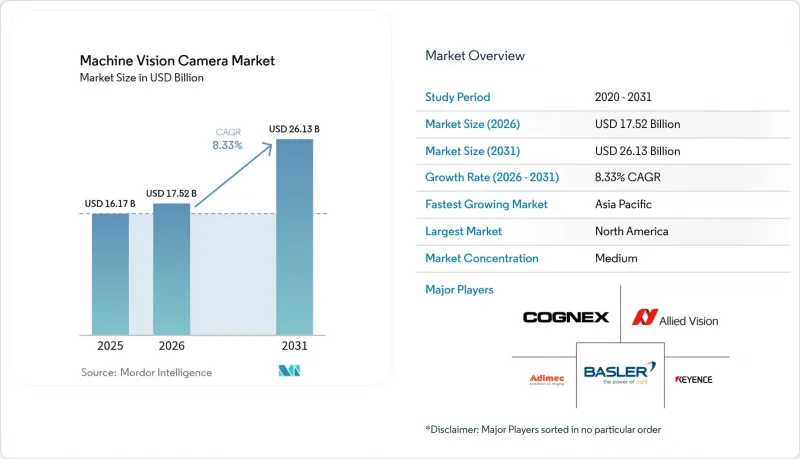
Mordor Intelligence에 의하면, 머신 비전 카메라 시장 규모는 2025년 161억 7,000만 달러로 평가되었고, 2026년에는 175억 2,000만 달러로 추정되고, 2026-2031년 CAGR 8.33%로 성장을 지속할 전망이며, 2031년까지 261억 3,000만 달러에 이를 것으로 예측됩니다.
본 보고서는 유형별(에리어 스캔 및 라인 스캔), 인터페이스 표준별(USB3 Vision 등), 센서 기술별(세계 셔터 CMOS 등), 최종 사용자 산업별(일렉트로믹스 및 반도체, 자동차·EV 배터리 등), 용도별(품질 검사·결함 감지 등), 지역별로 분류되어 있습니다. 시장 예측은 금액(달러) 단위로 표시되어 있습니다.
세계의 머신 비전 카메라 시장 동향 및 인사이트
공장 현장의 급속한 자동화 물결
인력 부족과 품질 균일화라는 목표에 따라, 각 제조업체들은 비전 유도형 로봇의 도입을 대규모로 추진하고 있습니다. 대만 반도체 제조 회사(TSMC)는 2024년에 자동 광학 검사(AOI) 대상을 16개 팹으로 확대하여 10nm 이하 노드에서 피드백 루프를 단축했습니다. 식품 가공업체들도 더욱 엄격해진 안전 기준을 준수하기 위해 이물질 선별을 비전 기술에 의존하고 있습니다. 소형 카메라와 결합된 협동 로봇이 설비 전환으로 인한 손실을 줄여주기 때문에 소량 생산 업체들도 이러한 흐름에 동참하고 있습니다. 이러한 광범위한 도입으로 인해 대량 생산 라인과 맞춤형 생산 라인 모두에서 머신 비전 카메라 시장이 확대되고 있습니다.
CMOS 및 USB3 채택에 따른 카메라 평균 판매 가격(ASP) 하락
세계 셔터 CMOS 카메라의 출하 대수는 급속히 증가하고 있으며, 2024년 이후 연간 15-20%의 가격 하락을 주도하고 있습니다. 표준화된 USB3 Vision 커넥터 덕분에 프레임 그래버 비용이 불필요해지고 배선도 간소화되어, 중규모 공장에서도 엔트리 레벨 도입이 가능해졌습니다. 동남아시아에서는 처음 도입하는 기업들이 800달러 미만의 USB 3.0 카메라를 SMT 라인에 도입하고 있습니다. 이익률 압박으로 인해 기존 브랜드들은 단순한 하드웨어 그 자체뿐만 아니라, 디바이스 측의 AI나 특수 광학 시스템을 통해 차별화를 꾀하고 있습니다.
숙련된 머신 비전 엔지니어 부족
북미 및 유럽에서는 고도의 비전 관련 직종의 공석률이 40%를 초과하고 있습니다. 대학 측에서는 광학, AI 프레임워크, 실시간 프로토콜 스택을 융합한 커리큘럼 업데이트에 어려움을 겪고 있습니다. 그 결과, 공장 측은 프로젝트를 턴키 통합 업체에 외주화하여, 유연성을 희생하더라도 신속한 도입을 도모하고 있습니다. SWIR 분광법이나 3D 비행시간법(ToF)과 같은 신흥 분야에서는 인력 부족이 더욱 심각하여, 프로젝트 일정이 장기화되고 있으며, 이는 머신 비전 카메라 시장 전체의 성장을 둔화시키고 있습니다.
부문 분석
라인 스캔 카메라는 압연 강재, 섬유, 태양광 발전용 리본 등 연속 소재에 대응하며, 2031년까지 연평균 성장률(CAGR) 9.27%를 나타낼 것으로 예측됩니다. 고해상도 어레이와 다중 스펙트럼 필터를 결합함으로써, 블리스터 팩 제조 시 표면 아래의 결함이나 의약품 정제의 입자 수준의 이상을 감지할 수 있게 됩니다. 과거에는 스트로브 조명에 의존했던 연속 웹 가공 공정도 현재는 분당 500미터를 넘는 컨베이어 속도에 대응하는 고속 라인 레이트를 활용하고 있으며, 이는 보다 광범위한 머신 비전 카메라 시장 내에서 이 틈새 분야가 성장하고 있는 이유를 여실히 보여줍니다.
에리어 스캔 유닛은 2025년 매출의 63.88%를 계속 차지했습니다. 최근 센서의 세계 셔터 방식 전환으로 인해 모션 블러가 해소되어, 고속으로 이동하는 병 뚜껑, PCB의 솔더 접합부, EV용 파워 모듈의 리드선을 검사할 수 있게 되었습니다. 편광 필터를 통합함으로써 성형 플라스틱 내의 응력 패턴을 감지할 수 있게 되었으며, 내장형 비행 시간(ToF) 모듈을 통해 기본적인 3D 측정 기능도 확장되었습니다. 이를 통해 각 벤더들은 라인 스캔 방식의 채택이 확대되는 상황에서도 에어리어 스캔 방식의 중요성을 유지하고 있습니다.
USB3 Vision은 PC와의 보편적인 호환성 덕분에 2025년 출하 대수의 41.08%를 차지했습니다. 저비용 전자기기 조립의 경우, 플러그 앤 플레이를 지원하는 드라이버 스택과 Power-over-Cable(PoC) 구성을 통해 설치 시간이 대폭 단축됩니다. 가격에 민감한 구매자들은 표준 USB 부품을 유지보수 용이성과 동일시하고 있으며, 이것이 머신 비전 카메라 시장에서 이 인터페이스의 출하 대수를 높은 수준으로 유지하는 한 요인이 되고 있습니다.
CoaXPress는 대역폭 스펙트럼의 반대쪽을 지원하며, 연평균 성장률(CAGR) 9.05%로 성장하고 있습니다. 현재 단일 케이블 링크로 25Gbps의 데이터를 전송하면서 65 MP 센서에 전원을 공급할 수 있게 되었으며, 이는 첨단 PCB의 마이크로 비아 직경을 검사하는 데 필수적입니다. 자동차 배터리 셀 공장에서는 CoaXPress를 채택하여 700 fps로 전극 코팅을 촬영하고 있으며, 이는 USB3의 성능을 능가하는 것입니다. 한편, GigE Vision 및 그 5Gig, 10Gig 변형은 공장 내에 이더넷 백본이 이미 구축된 환경에서 여전히 유용하며, 프레임 속도의 저하를 대가로 네트워크 라우팅의 용이성을 실현하고 있습니다.
지역별 분석
북미는 항공우주, 의료기기, 첨단 운전자 보조 시스템(ADAS) 분야의 조기 도입을 배경으로 2025년 매출의 39.32%를 차지했습니다. 국내 반도체 팹에 대한 연방 정부의 장려책에 힘입어 300mm 웨이퍼의 균일성을 검증하기 위한 카메라 업데이트가 계속되고 있습니다. 자동차 제조업체들이 현지 배터리 셀 생산 라인으로의 전환을 추진함에 따라, 해당 지역의 머신 비전 카메라 시장 규모도 이에 발맞추어 확대될 것으로 예측됩니다.
아시아태평양은 중국의 스마트 제조에 대한 보조금과 한국의 반도체 클린룸 확장에 힘입어 연평균 성장률(CAGR) 8.93%로 성장하고 있습니다. 아세안(ASEAN) 국가들의 중소기업 디지털화를 촉진하는 지원 정책이 고객 기반을 확대하는 한편, 일본은 3D IC 검사를 위한 고속 CoaXPress 카메라에 대한 투자를 강화하고 있습니다. 부품 공급업체, 시스템 통합사업자, 학술 연구 기관에 의한 클러스터 효과가 시범 프로젝트의 사이클 타임을 단축하고 집합적인 노하우를 강화함으로써 머신 비전 카메라 시장의 보급을 더욱 심화시키고 있습니다.
유럽에서는 엄격한 규제 체계에 기반한 균형 잡힌 성장세가 유지되고 있습니다. 제약 공장에서는 EU 위조 의약품 지침 개정에 대응하기 위해 일련번호 인식 카메라를 도입하고 있으며, 자동차 제조업체는 배터리 케이스의 레이저 용접 이음매를 검증하기 위해 2D와 3D를 결합한 검사 스테이션을 도입하고 있습니다. 지속가능성 목표는 금속 재활용 분야에서 비전 기반의 스크랩 선별을 촉진하고 있으며, 환경 보호 의무가 부차적인 촉진요인으로 작용하고 있음을 부각시키고 있습니다. 남미 및 중동의 신흥 경제국에서는 비전 기술을 활용한 물류 허브 도입이 시작되었으며, 제조업의 주요 거점 지역을 넘어 단계적인 확장이 예상됩니다.
기타 혜택 :
- 엑셀 형식 시장 예측(ME) 시트
- 3개월간의 애널리스트 지원
자주 묻는 질문
목차
제1장 서론
제2장 조사 방법
제3장 주요 요약
제4장 시장 구도
제5장 시장 규모 및 성장 예측
제6장 경쟁 구도
제7장 시장 기회 및 향후 전망
AJY 26.08.26According to Mordor Intelligence, the machine vision camera market size is expected to grow from USD 16.17 billion in 2025 to USD 17.52 billion in 2026 and is forecast to reach USD 26.13 billion by 2031 at 8.33% CAGR over 2026-2031.
This report is Segmented by Type (Area Scan and Line Scan), Interface Standard (USB3 Vision, and More), Sensor Technology (Global-Shutter CMOS, and More), End-User Industry (Electronics and Semiconductor, Automotive and EV Battery, and More), Application (Quality Inspection and Defect Detection, and More), and Geography. The Market Forecasts are Provided in Terms of Value (USD).
Global Machine Vision Camera Market Trends and Insights
Rapid Factory-Floor Automation Wave
Labor shortages and uniform-quality goals are pushing manufacturers to adopt vision-guided robotics at scale. Taiwan Semiconductor Manufacturing Company broadened automated optical inspection to 16 fabs in 2024, shortening feedback loops for sub-10 nm nodes. Food processors now rely on vision to isolate contaminants, aligning with stricter safety codes. Small-batch producers are also moving in, as collaborative robots paired with compact cameras cut changeover losses. This breadth of adoption lifts the machine vision camera market across both high-volume and custom production lines.
Falling Camera ASPs with CMOS and USB3 Adoption
Global-shutter CMOS output has grown quickly, driving 15-20% annual price drops since 2024. Standardized USB3 Vision connectors remove frame-grabber fees and simplify cabling, making entry-level deployments viable for mid-tier factories. In Southeast Asia, first-time buyers are equipping SMT lines with USB3 cameras priced below USD 800. Margin pressure is steering legacy brands toward differentiating through device-side AI and specialty optics rather than raw hardware.
Shortage of Skilled Machine-Vision Engineers
Vacancy rates for advanced vision roles top 40% in North America and Europe. Universities struggle to update curricula that merge optics, AI frameworks, and real-time protocol stacks. As a result, plants outsource projects to turnkey integrators, trading flexibility for quicker deployment. The talent gap is more acute in emerging fields like SWIR spectroscopy and 3D time-of-flight, lengthening project schedules and dampening the overall machine vision camera market growth.
Other drivers and restraints analyzed in the detailed report include:
- Tightening Quality-Control Mandates in 3C and EV
- Edge-AI Cameras Slashing Bandwidth Costs
- Fragmented Interface Standards Inflate BOM
For complete list of drivers and restraints, kindly check the Table Of Contents.
Segment Analysis
Line scan cameras address continuous materials such as rolled steel, textiles, and photovoltaic ribbons and are forecast to compound at 9.27% through 2031. High-resolution arrays paired with multi-spectral filters uncover sub-surface defects during blister-pack production and grain-level anomalies in pharmaceutical tablets. Continuous web processes, once reliant on stroboscopic lighting, now leverage faster line rates that match conveyor speeds above 500 m per minute, underscoring why this niche is climbing inside the broader machine vision camera market.
Area scan units still command 63.88% of 2025 revenue. Recent sensor shifts to global-shutter exposure removed motion-blur, unlocking inspection of fast-moving bottle caps, PCB solder joints, and EV power-module leads. Integrating polarizing filters enables detection of stress patterns in molded plastic, while embedded time-of-flight modules extend capability into basic 3D gauging. Vendors thereby safeguard area scan relevance even as line scan adoption widens.
USB3 Vision delivers 41.08% of 2025 shipments owing to universal PC compatibility. In low-cost electronics assembly, plug-and-play driver stacks and power-over-cable set-ups slash installation hours. Price-sensitive buyers equate standard USB components with serviceability, which helps sustain top-line volume for this interface within the machine vision camera market size.
CoaXPress addresses the opposite end of the bandwidth spectrum and is rising at 9.05% CAGR. Single-cable links now stream 25 Gbps while powering a 65 MP sensor, crucial for inspecting micro-via diameters on advanced PCBs. Automotive battery cell plants adopt CoaXPress to image electrode coatings at 700 fps, a feat beyond USB3. Meanwhile, GigE Vision and its 5 Gig and 10 Gig variants remain relevant where in-plant Ethernet backbones already exist, trading lower frame rates for easy network routing.
Complete Report Scope:
- By Type
- Area Scan
- Line Scan
- By Interface Standard
- USB3 Vision
- GigE / 5-10 GigE Vision
- Camera Link / HS
- CoaXPress
- Other / Emerging (MIPI, Thunderbolt)
- By Sensor Technology
- Global-shutter CMOS
- Rolling-shutter CMOS
- CCD
- SWIR / MWIR
- Time-of-Flight 3D
- By End-user Industry
- Electronics and Semiconductor
- Automotive and EV Battery
- Healthcare and Life-science
- Food and Beverage Processing
- Aerospace and Defence
- Logistics and Warehousing
- Other Industries
- By Application
- Quality Inspection and Defect Detection
- Measurement and Metrology
- Identification / OCR and Traceability
- Vision-Guided Robotics
- Predictive / Condition Monitoring
- By Geography
- North America
- South America
- Europe
- Asia Pacific
- Middle East and Africa
Geography Analysis
North America recorded 39.32% of 2025 revenue, capitalizing on early adoption in aerospace, medical devices, and advanced driver-assistance systems. Federal incentives for domestic semiconductor fabs sustain camera retrofits that verify 300 mm wafer uniformity. The machine vision camera market size in the region is projected to keep pace as carmakers shift to local battery cell production lines.
Asia Pacific is advancing at a 8.93% CAGR, underpinned by China's smart-manufacturing subsidies and South Korea's semiconductor clean-room expansions. ASEAN incentives for SME digitization broaden the customer base, while Japan doubles down on high-speed CoaXPress cameras for 3D IC inspection. The cluster effect of component suppliers, integrators, and academic labs accelerates cycle times for pilot projects and bolsters collective know-how, deepening the machine vision camera market penetration.
Europe maintains balanced momentum rooted in stringent regulatory frameworks. Pharma plants install serialization-ready cameras to meet EU Falsified Medicines Directive renewal, and automakers roll out combined 2D-plus-3D stations to validate laser-weld seams on battery enclosures. Sustainability targets spur vision-based scrap sorting in metal recycling, underscoring green mandates as a secondary driver. Emerging economies in South America and the Middle East begin to deploy vision-aided logistics hubs, foreshadowing gradual expansion beyond core manufacturing heartlands.
- Allied Vision Technologies GmbH
- Basler AG
- Cognex Corporation
- Keyence Corporation
- Teledyne DALSA Inc.
- Omron Microscan Systems, Inc.
- SICK AG
- LMI Technologies Inc.
- Adimec Advanced Image Systems BV
- JAI A/S
- IDS Imaging Development Systems GmbH
- FLIR Systems LLC
- Sony Semiconductor Solutions Corp.
- Hikrobot Technology Co., Ltd.
- Daheng Imaging Co., Ltd.
- Baumer Optronic GmbH
- Matrox Imaging, a division of Matrox Electronic Systems Ltd.
- Zebra Technologies Corp. (Machine-Vision Division)
- ISRA Vision AG
- TKH Group NV (Allied Vision and NET)
- Tordivel AS
- STEMMER IMAGING AG
- Opt Machine Vision Tech Co., Ltd.
- Datalogic S.p.A.
Additional Benefits:
- The market estimate (ME) sheet in Excel format
- 3 months of analyst support
TABLE OF CONTENTS
1 INTRODUCTION
- 1.1 Study Assumptions and Market Definition
- 1.2 Scope of the Study
2 RESEARCH METHODOLOGY
3 EXECUTIVE SUMMARY
4 MARKET LANDSCAPE
- 4.1 Market Overview
- 4.2 Market Drivers
- 4.2.1 Rapid factory-floor automation wave
- 4.2.2 Falling camera ASPs with CMOS and USB3 adoption
- 4.2.3 Tightening quality-control mandates in 3C and EV
- 4.2.4 Edge-AI cameras slashing bandwidth costs
- 4.2.5 Subsidised "smart factory" loans in ASEAN
- 4.2.6 On-robot SWIR vision for lithium-battery QC
- 4.3 Market Restraints
- 4.3.1 Shortage of skilled machine-vision engineers
- 4.3.2 Fragmented interface standards inflate BOM
- 4.3.3 Rising export controls on high-speed sensors
- 4.3.4 Thermal design limits for onboard AI SoCs
- 4.4 Industry Value Chain Analysis
- 4.5 Regulatory Landscape
- 4.6 Technological Outlook
- 4.7 Porter's Five Forces Analysis
- 4.7.1 Threat of New Entrants
- 4.7.2 Bargaining Power of Buyers
- 4.7.3 Bargaining Power of Suppliers
- 4.7.4 Threat of Substitutes
- 4.7.5 Intensity of Competitive Rivalry
5 MARKET SIZE AND GROWTH FORECASTS (VALUE)
- 5.1 By Type
- 5.1.1 Area Scan
- 5.1.2 Line Scan
- 5.2 By Interface Standard
- 5.2.1 USB3 Vision
- 5.2.2 GigE / 5-10 GigE Vision
- 5.2.3 Camera Link / HS
- 5.2.4 CoaXPress
- 5.2.5 Other / Emerging (MIPI, Thunderbolt)
- 5.3 By Sensor Technology
- 5.3.1 Global-shutter CMOS
- 5.3.2 Rolling-shutter CMOS
- 5.3.3 CCD
- 5.3.4 SWIR / MWIR
- 5.3.5 Time-of-Flight 3D
- 5.4 By End-user Industry
- 5.4.1 Electronics and Semiconductor
- 5.4.2 Automotive and EV Battery
- 5.4.3 Healthcare and Life-science
- 5.4.4 Food and Beverage Processing
- 5.4.5 Aerospace and Defence
- 5.4.6 Logistics and Warehousing
- 5.4.7 Other Industries
- 5.5 By Application
- 5.5.1 Quality Inspection and Defect Detection
- 5.5.2 Measurement and Metrology
- 5.5.3 Identification / OCR and Traceability
- 5.5.4 Vision-Guided Robotics
- 5.5.5 Predictive / Condition Monitoring
- 5.6 By Geography
- 5.6.1 North America
- 5.6.2 South America
- 5.6.3 Europe
- 5.6.4 Asia Pacific
- 5.6.5 Middle East and Africa
6 COMPETITIVE LANDSCAPE
- 6.1 Market Concentration
- 6.2 Strategic Moves
- 6.3 Market Share Analysis
- 6.4 Company Profiles (includes Global level Overview, Market level overview, Core Segments, Financials as available, Strategic Information, Market Rank/Share for key companies, Products and Services, and Recent Developments)
- 6.4.1 Allied Vision Technologies GmbH
- 6.4.2 Basler AG
- 6.4.3 Cognex Corporation
- 6.4.4 Keyence Corporation
- 6.4.5 Teledyne DALSA Inc.
- 6.4.6 Omron Microscan Systems, Inc.
- 6.4.7 SICK AG
- 6.4.8 LMI Technologies Inc.
- 6.4.9 Adimec Advanced Image Systems BV
- 6.4.10 JAI A/S
- 6.4.11 IDS Imaging Development Systems GmbH
- 6.4.12 FLIR Systems LLC
- 6.4.13 Sony Semiconductor Solutions Corp.
- 6.4.14 Hikrobot Technology Co., Ltd.
- 6.4.15 Daheng Imaging Co., Ltd.
- 6.4.16 Baumer Optronic GmbH
- 6.4.17 Matrox Imaging, a division of Matrox Electronic Systems Ltd.
- 6.4.18 Zebra Technologies Corp. (Machine-Vision Division)
- 6.4.19 ISRA Vision AG
- 6.4.20 TKH Group NV (Allied Vision and NET)
- 6.4.21 Tordivel AS
- 6.4.22 STEMMER IMAGING AG
- 6.4.23 Opt Machine Vision Tech Co., Ltd.
- 6.4.24 Datalogic S.p.A.
7 MARKET OPPORTUNITIES AND FUTURE OUTLOOK
- 7.1 White-space and Unmet-need Assessment


