

|
시장보고서
상품코드
2114432
액체 처리 시스템 시장 : 시장 점유율 분석, 업계 동향 및 통계, 성장 예측(2026-2031년)Liquid Handling System - Market Share Analysis, Industry Trends & Statistics, Growth Forecasts (2026 - 2031) |
||||||
 Mordor Intelligence
Mordor Intelligence에 의하면, 2026년 액체 처리 시스템 시장 규모는 59억 달러로 추정되고, 2025년 54억 6,000만 달러에서 확대해, 2031년에는 86억 8,000만 달러에 이를 것으로 예측됩니다.
2026-2031년 연평균 성장률(CAGR) 8.03%로 성장할 것으로 전망됩니다.
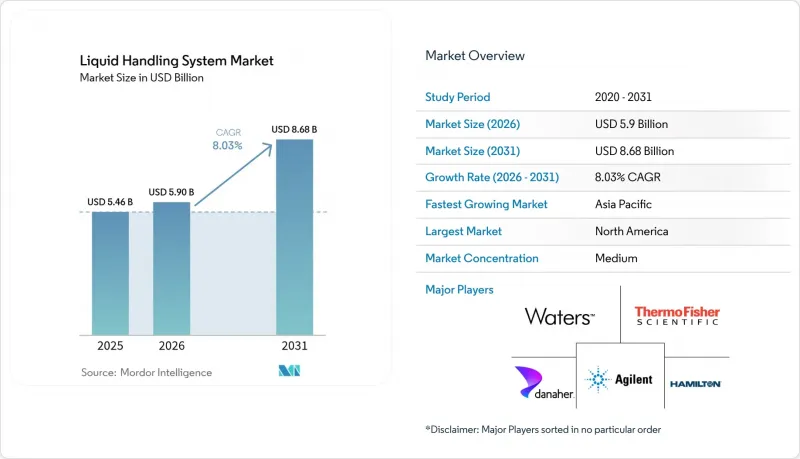
본 보고서는 유형별(수동식 액체 처리(에어 디스플레시먼트 피펫 등), 반자동식 액체 처리 등), 제품 유형별(자동 워크스테이션, 피펫(싱글 채널 등) 등), 용도별(신약 개발·HTS 등), 최종 사용자별(제약·바이오기술 기업 등), 그리고 지역별로 분류되어 있습니다. 시장 예측은 금액(달러) 기준으로 제시되어 있습니다.
세계의 액체 처리 시스템 시장 동향 및 인사이트
신약 개발 및 연구 개발에 대한 투자 확대
제약 업계의 연구개발비는 연간 2,000억 달러를 초과하며, 그 지출 중 복잡한 화합물 라이브러리를 스크리닝하기 위한 자동 액체 처리을 지원하는 비중이 증가하고 있습니다. 암 치료 및 희귀질환 프로그램에서는 수동 피펫팅으로는 달성할 수 없는 서브마이크로리터 단위의 정밀도가 요구되고 있으며, 이에 따라 AI를 활용한 스케줄링과 실시간 용적 검증을 결합한 로봇 워크스테이션의 도입이 연구실에서 진행되고 있습니다. 2024년 애질런트 테크놀로지스가 BIOVECTRA를 9억 2,500만 달러에 인수한 것은 자동 분주에 의존하는 통합형 바이오의약품 제조 자산을 확보하려는 업계의 움직임을 여실히 보여주고 있습니다. 제약 개발 기업들이 개발 기간 단축을 추구하는 가운데, 샘플 수준의 메타데이터를 수집하는 자동화 플랫폼은 현재 규제 당국에 대한 신청 시 규정 준수의 핵심 요소로 기능하고 있습니다. 따라서 기업들이 기존에 10-15년이 걸리던 신약 개발부터 승인까지의 주기를 단축하기 위해 경쟁하는 가운데, 투자 모멘텀이 액체 처리 시스템 시장을 지속적으로 뒷받침할 것으로 예측됩니다.
고속 스크리닝(HTS)에 대한 수요 증가
최신 HTS 플랫폼은 나노리터 단위의 정밀도를 유지하면서 하루에 10만 웰 이상을 처리할 수 있으며, 이는 대량의 데이터가 필요한 AI 신약 개발 엔진에 필수적인 기능입니다. 음향 분사 기술과 질량 분석법을 결합함으로써 펩타이드 바이오마커의 측정 시간이 1.5초로 단축되어, 역학 팀은 며칠 이내에 집단 규모의 샘플을 분석할 수 있게 되었습니다. 코닝(Corning) 및 유사한 공급업체들은 비접촉식 액적 처리에 최적화된 마이크로플레이트 포맷을 출시하고 있으며, 이를 통해 중규모 연구소도 대규모 인프라 투자 없이 대규모 프로그램에 참여할 수 있게 되었습니다. 오가노이드 및 3D 세포 모델의 채택이 진행됨에 따라, 며칠에 걸친 프로토콜에서 무균 및 자동화된 배지 교환에 대한 수요가 증가하고 있습니다. 그 결과, 제약 업계 및 학술 기관에서 기존의 피펫팅 헤드에서 음향 나노 스프레이 모듈로의 정기적인 업데이트 주기가 액체 처리 시스템 시장에서 나타나고 있습니다.
숙련된 자동화 엔지니어 부족
임상 및 바이오프로세스 연구소에서는 통합형 로봇 파이프라인의 프로그래밍, 교정, 유지보수를 수행할 수 있도록 훈련받은 과학자가 부족하다는 보고가 접수되고 있습니다. 캘리포니아주 공중보건국은 공중보건 미생물학자 채용 공고가 만성적으로 채워지지 않고 있음을 지적하고 있으며, 이러한 추세는 유럽의 GMP 시설에서도 마찬가지로 관찰됩니다. 현재 전문 지식은 파이썬, 감시 제어 소프트웨어, GMP 문서화까지 이르러 기존 교육 과정의 범위를 넘어섰습니다. 이에 따라 경영진은 수년에 걸친 경력 개발 프로그램과 유연한 근무 체제에 투자하고 있지만, 이러한 인센티브로는 이직을 부분적으로 막는 데 그칠 뿐이며, 고가의 장비가 충분히 활용되지 못하는 상황이 계속되고 있습니다.
부문 분석
연구소가 처리 능력과 비용 유연성의 균형을 모색하는 가운데, 2025년 매출의 32.85%를 반자동 시스템이 차지했습니다. 수동 피펫팅은 여전히 수작업 제어가 필요한 틈새 프로토콜의 기반이 되고 있지만, 인력 부족과 규정 준수 압박으로 인해 연평균 성장률(CAGR) 10.79%로 성장하고 있는 완전 자동 장비로의 전환이 가속화되고 있습니다. 자동 장비는 스케줄링,데크 분석, 원격 진단을 통합하고, 작업자가 자리를 비워도 작동하는 ‘워크어웨이(walk-away) 운영’을 실현함으로써 인체공학적 위험을 경감시킵니다. 이러한 전환은 새로운 LDT(실험실 개발 검사) 의무화에 대응하고, 제한된 바닥 면적을 최적화하려는 검사실을 뒷받침하고 있습니다. 통합 제어 소프트웨어를 통해 인큐베이터, 원심분리기, 액체 처리 장치를 연동하는 로봇 클러스터는 액체 처리 시스템 시장이 운영 모델을 재구축하고 있는 모습을 여실히 보여줍니다. 음향식 나노 디스펜서는 무균 기준을 한층 더 높이고, 소모품 교체를 최소화하며, 세포 치료 워크플로우의 총 분석 비용을 절감합니다. BD사와 해밀턴사의 단일 세포용 시약에 대한 공동 개발은 검증 주기를 단축하고, 더욱 엄격한 규제 하에서 현대화를 추진하는 실험실을 지원하는 로봇 호환 키트의 확산을 상징합니다.
완전 자동화된 워크스테이션은 데이터 허브 역할도 수행하며, 모든 흡입 및 분주를 실시간으로 기록함으로써 감사에 대응할 수 있는 추적성을 실현합니다. AI를 활용한 오류 감지 기능은 배치 실패 전에 교정 불량 채널을 감지하여, 후공정에서의 수정을 미연에 방지합니다. 선진적인 시설에서는 현재 부서 간 자원 부하를 균형 있게 조정하는 클라우드 서비스에 리퀴드 핸들러의 일정 관리를 맡기고 있습니다. 이러한 기능이 보급됨에 따라 자동화 플랫폼용 액체 처리 시스템 시장 규모는 격차를 더욱 벌릴 전망인 반면, 반자동화 라인은 교육용 실험실이나 소규모 특수 분석 분야로 전환될 것으로 예측됩니다.
2025년 매출액에서 자동 워크스테이션이 29.10%를 차지했으며, 다단계 분석의 핵심 인프라로서의 역할을 반영했습니다. 피펫팅, 그리퍼를 이용한 핸들링, 실시간 QC 카메라와 같은 기능의 통합으로 통합 부담이 경감되고, 연구 개발(R&D)에서 품질 관리(QC) 실험실로 프로토콜 전환이 가속화됩니다. 연평균 성장률(CAGR) 10.21%를 기록하며 성장하고 있는 음향식 이젝터는 소형화가 진행되는 오믹스 분야에 발맞추어, 비접촉식 나노리터 단위 분주에 대한 증가하는 수요를 충족시키고 있습니다. 동 기간 동안 피펫은 신속한 처리가 요구되는 작업에서 여전히 필수적인 존재이며, 해밀턴(Hamilton)사의 CO-RE II 메커니즘은 재현성을 높이고, 검증된 워크플로우에서 팁 재사용률 92%를 유지하는 데 기여하고 있습니다.
소프트웨어 모듈은 구매의 결정적인 기준이 되고 있습니다. 해밀턴의 ‘VENUS’와 테칸의 ‘Veya’는 그래프 기반의 워크플로우 설계를 기계 코드로 변환하여, 코딩 지식이 없는 기술자도 분석 설계를 반복할 수 있게 해줍니다. Formulatrix사가 조만간 출시할 예정인 ‘STACK’ 시리즈와 같은 모듈식 스택을 통해 고객은 인큐베이터나 플레이트 리더를 단계적으로 추가할 수 있게 되어, 예산 승인이 용이해집니다. 이러한 변화는 연구소가 라이선싱 및 구독 모델을 표준화해 나가는 과정에서 예측 기간 내 액체 처리 시스템 시장 규모에서 소프트웨어 및 통합 구성 요소의 성장률이 하드웨어를 능가할 가능성이 있음을 시사합니다.
지역별 분석
북미는 광범위한 제약 파이프라인, 조기 자동화 도입, 그리고 추적 가능한 워크플로우를 권장하는 FDA의 정책에 힘입어 2025년 매출의 39.30%를 차지했습니다. 합성 생물학에 대한 벤처 자금 조달에 더해, 서모피셔의 41억 달러 규모의 여과 사업 인수와 같은 기업 통합이 지속적인 플랫폼 업그레이드를 뒷받침하고 있습니다. 유럽은 이에 근소한 차이로 뒤를 이으며, 숙련된 인력 부족을 보완하고 향후 시행될 IVDR(체외진단의료기기규정) 개정에 대응하기 위해 자동화를 위한 민관 자금을 활용하고 있습니다. 또한, 지속가능성 목표 역시 유럽의 구매자들을 플라스틱 소비량과 에너지 소비를 최소화하는 워크스테이션으로 이끌고 있습니다.
아시아태평양은 2031년까지 연평균 성장률(CAGR) 10.47%를 기록하며 가장 빠른 성장 궤도를 그리고 있습니다. 중국의 바이오 제조 거점 확충과 인도의 CDMO 사업 확대가 기초 수요를 끌어올리고 있는 반면, 일본의 연구소에서는 오가노이드 분석을 자동화하기 위한 음향 시스템이 도입되고 있습니다. 정부 보조금과 SPT Labtech의 중국 구조생물학 분야 제휴와 같은 해외 합작 사업이 지식 이전을 가속화하고 있습니다.
중동 및 아프리카 및 남미는 각국의 보건 프로그램에 힘입어 진단 역량이 확대되고 있어, 아직 발전 단계에 있지만 미래성이 있는 시장입니다. 예산 제약으로 인해 턴키 방식 도입이 어려운 경우, 모듈식이며 클라우드 기반으로 관리되는 액체 핸들러가 주목받고 있습니다. 원격 지원 서비스를 구독 요금에 포함시킨 공급업체는 이러한 신흥 시장에서 장기적인 입지를 다질 수 있을 것입니다.
기타 혜택 :
- 엑셀 형식 시장 예측(ME) 시트
- 3개월간의 애널리스트 지원
자주 묻는 질문
목차
제1장 서론
제2장 조사 방법
제3장 주요 요약
제4장 시장 구도
제5장 시장 규모 및 성장 예측
제6장 경쟁 구도
제7장 시장 기회 및 향후 전망
AJY 26.08.26According to Mordor Intelligence, liquid handling system market size in 2026 is estimated at USD 5.9 billion, growing from 2025 value of USD 5.46 billion with 2031 projections showing USD 8.68 billion, growing at 8.03% CAGR over 2026-2031.
This report is Segmented by Type (Manual Liquid Handling [Air Dispalcement Pipettes and More], Semi-Automated Liquid Handling and More), Product (Automated Workstations, Pipettes [Single-Channel and More] and More), Application (Drug Discovery & HTS, and More), End-User (Pharmaceutical and Biotechnology Companies and More), and Geography. The Market Forecasts are Provided in Terms of Value (USD).
Global Liquid Handling System Market Trends and Insights
Rising Investment in Drug Development & Research
Pharmaceutical R&D spending has surpassed USD 200 billion annually, and a growing share of that outlay supports automated liquid handling to screen complex compound libraries. Oncology and rare-disease programs demand sub-microliter accuracy that manual pipetting cannot match, prompting labs to adopt robotic workstations that combine AI-guided scheduling with real-time volume verification. Agilent Technologies' USD 925 million purchase of BIOVECTRA in 2024 highlights industry moves to secure integrated biologics production assets that depend on automated dispensing. As drug developers pursue compressed timelines, automated platforms that capture sample-level metadata now serve as compliance anchors for regulatory submissions. Investment momentum is therefore expected to sustain the liquid handling system market as firms race to shorten the traditional 10-15-year discovery-to-approval cycle.
Growing Demand for High-Throughput Screening (HTS)
Modern HTS platforms process more than 100,000 wells per day while maintaining nanoliter precision, a capability essential for data-hungry AI discovery engines. Acoustic ejection coupled with mass spectrometry has reduced peptide biomarker read times to 1.5 seconds, allowing epidemiology teams to analyze population-scale samples within days. Corning and similar suppliers are rolling out microplate formats optimized for contactless droplet handling so medium-sized labs can join large-scale programs without extensive infrastructure investments. Adoption of organoid and 3D cell models intensifies demand for sterile, automated media exchanges over multi-day protocols. As a result, the liquid handling system market is witnessing recurrent replacement cycles from conventional pipetting heads to acoustic nanospray modules across pharmaceutical and academic sites.
Shortage of Skilled Automation Engineers
Clinical and bioprocess labs report deficits in scientists trained to program, calibrate and maintain integrated robotic pipelines. The California Department of Public Health notes persistent vacancies for public-health microbiologists, a trend mirrored in European GMP facilities. Expertise now spans Python, supervisory control software and GMP documentation, stretching traditional curricula. Managers therefore invest in multi-year career development tracks and flexible scheduling, yet those incentives only partially staunch attrition, leaving expensive equipment under-utilized.
Other drivers and restraints analyzed in the detailed report include:
- Rapid Advances in Robotic & Acoustic Liquid Handling
- Adoption of Micro-Fluidic Nano-Dispensing Platforms
- High Capital Cost & Workflow Complexity
For complete list of drivers and restraints, kindly check the Table Of Contents.
Segment Analysis
Semi-automated systems captured 32.85% of 2025 revenue as laboratories balanced throughput with cost flexibility. Manual pipetting still anchors niche protocols demanding hands-on control, yet staff shortages and compliance pressures are accelerating transitions to fully automated rigs growing at 10.79% CAGR. Automated rigs integrate scheduling, deck analytics and remote diagnostics, delivering walk-away operation that mitigates ergonomic risk. The pivot supports laboratories striving to align with emerging LDT mandates and to optimize limited square footage. Robotic clusters that chain incubators, centrifuges and liquid handlers through unified control software illustrate how the liquid handling system market is recalibrating operating models. Acoustic nano-dispensers further elevate sterility standards, minimizing consumable swaps and reducing total assay cost in cell-therapy workflows. BD and Hamilton's single-cell reagent collaboration exemplifies the push toward robotics-ready kits that shorten validation cycles and support laboratories modernizing under stricter regulations.
Fully automated workstations double as data hubs, capturing every aspirate and dispense in real time for audit-ready provenance. AI-enhanced error detection flags mis-calibrated channels before batch failure, preventing downstream rework. Progressive facilities now assign liquid handler scheduling to cloud services that balance resource loads across departments. As these capabilities proliferate, the liquid handling system market size for automated platforms is projected to widen its lead, while semi-automated lines migrate to teaching labs and low-volume specialty assays.
Automated workstations dominated 2025 revenue at 29.10%, reflecting their role as backbone infrastructure for multi-step assays. Feature convergence-pipetting, gripper handling and real-time QC cameras-lowers the integration burden and accelerates protocol transfer from R&D to QC labs. Acoustic ejectors, climbing at 10.21% CAGR, answer growing calls for contactless, nanoliter dispensing that aligns with miniaturized omics. Over the same period, pipettes remain indispensable for quick turn tasks; Hamilton's CO-RE II mechanism raises repeatability, which helps maintain a 92% recycling rate for tips in validated workflows.
Software modules have become decisive purchase criteria. Hamilton's VENUS and Tecan's Veya translate graph-based workflow design into machine code, enabling technicians without coding backgrounds to iterate assay designs. Modular stacks such as Formulatrix's upcoming STACK line let customers add incubators or plate readers incrementally, easing budget approvals. These shifts underscore that the liquid handling system market size for software and integration components could outpace hardware within the forecast horizon as laboratories standardize on licensing and subscription models.
Complete Report Scope:
- By Type
- Manual Liquid Handling
- Air-displacement pipettes
- Positive-displacement pipettes
- Semi-Automated Liquid Handling
- Automated Liquid Handling
- Robotic workstations
- Acoustic droplet ejectors
- Contactless nano-dispensers
- Manual Liquid Handling
- By Product
- Automated Workstations
- Pipettes
- Single-channel
- Multi-channel
- Dispensers
- Burettes & Dilutors
- Consumables (tips, plates, reservoirs)
- Software & Integration Modules
- By Application
- Drug Discovery & HTS
- Genomics & Proteomics
- Clinical Diagnostics
- Cell & Gene Therapy Manufacturing
- Synthetic Biology
- Other Applications
- By End User
- Pharmaceutical & Biotechnology Companies
- Contract Research & Manufacturing Organizations
- Academic & Research Institutes
- Clinical & Diagnostic Laboratories
- Core Facilities & Service Providers
- By Geography
- North America
- United States
- Canada
- Mexico
- Europe
- Germany
- United Kingdom
- France
- Italy
- Spain
- Rest of Europe
- Asia-Pacific
- China
- Japan
- India
- Australia
- South Korea
- Rest of Asia-Pacific
- Middle East and Africa
- GCC
- South Africa
- Rest of Middle East and Africa
- South America
- Brazil
- Argentina
- Rest of South America
- North America
Geography Analysis
North America commanded 39.30% of 2025 sales underpinned by extensive pharma pipelines, early automation uptake and FDA policies that favor traceable workflows. Venture financing for synthetic biology plus corporate consolidation-such as Thermo Fisher's USD 4.1 billion filtration deal-fuels ongoing platform upgrades. Europe follows closely, leveraging public-private funding for automation to offset skilled-labor shortages and to align with forthcoming IVDR adjustments. Sustainability targets also steer European buyers toward workstations that minimize plastic consumption and energy draw.
Asia-Pacific posts the fastest trajectory at 10.47% CAGR through 2031. China's biomanufacturing build-out and India's growing CDMO footprint lift baseline demand, while Japanese labs implement acoustic systems to automate organoid assays. Government grants and foreign joint ventures, such as SPT Labtech's structural-biology collaboration in China, accelerate knowledge transfer.
Middle East & Africa and South America remains nascent yet promising as national health programs expand diagnostics capacity. Modular, cloud-managed liquid handlers appeal where budgets limit turnkey deployments. Vendors that bundle remote support with subscription pricing are positioned to cultivate long-term footholds across these emerging zones.
- Thermo Fisher Scientific
- Danahar
- Tecan Group
- Hamilton Company
- Agilent Technologies
- Bio-Rad Laboratories
- Corning
- Revvity
- Promega
- SPT Labtech
- Formulatrix
- HighRes Biosolutions
- Opentrons Labworks
- Hudson Robotics
- Gilson
- Integra Biosciences
- Analytik Jena
- Waters Corporation
- Mettler Toledo (Rainin)
Additional Benefits:
- The market estimate (ME) sheet in Excel format
- 3 months of analyst support
TABLE OF CONTENTS
1 Introduction
- 1.1 Study Assumptions and Market Definition
- 1.2 Scope of the Study
2 Research Methodology
3 Executive Summary
4 Market Landscape
- 4.1 Market Overview
- 4.2 Market Drivers
- 4.2.1 Rising Investment In Drug Development & Research
- 4.2.2 Growing Demand For High-Throughput Screening (HTS)
- 4.2.3 Rapid Advances In Robotic & Acoustic Liquid Handling
- 4.2.4 Adoption Of Micro-Fluidic Nano-Dispensing Platforms
- 4.2.5 Expansion Of Synthetic-Biology & Lab-On-Chip Start-Ups
- 4.2.6 Stringent IVD & LDT Regulations Mandate Traceable, Automated Workflows
- 4.3 Market Restraints
- 4.3.1 Shortage Of Skilled Automation Engineers
- 4.3.2 High Capital Cost & Workflow Complexity
- 4.3.3 Cross-Contamination Risk In Acoustic Systems
- 4.3.4 Long Lead-Times For Precision Consumables
- 4.4 Value / Supply-Chain Analysis
- 4.5 Regulatory Landscape
- 4.6 Technology Outlook
- 4.7 Porter's Five Forces Analysis
- 4.7.1 Bargaining Power of Suppliers
- 4.7.2 Bargaining Power of Buyers
- 4.7.3 Threat of New Entrants
- 4.7.4 Threat of Substitutes
- 4.7.5 Intensity of Competitive Rivalry
5 Market Size and Growth Forecasts (Value-USD)
- 5.1 By Type
- 5.1.1 Manual Liquid Handling
- 5.1.1.1 Air-displacement pipettes
- 5.1.1.2 Positive-displacement pipettes
- 5.1.2 Semi-Automated Liquid Handling
- 5.1.3 Automated Liquid Handling
- 5.1.3.1 Robotic workstations
- 5.1.3.2 Acoustic droplet ejectors
- 5.1.3.3 Contactless nano-dispensers
- 5.1.1 Manual Liquid Handling
- 5.2 By Product
- 5.2.1 Automated Workstations
- 5.2.2 Pipettes
- 5.2.2.1 Single-channel
- 5.2.2.2 Multi-channel
- 5.2.3 Dispensers
- 5.2.4 Burettes & Dilutors
- 5.2.5 Consumables (tips, plates, reservoirs)
- 5.2.6 Software & Integration Modules
- 5.3 By Application
- 5.3.1 Drug Discovery & HTS
- 5.3.2 Genomics & Proteomics
- 5.3.3 Clinical Diagnostics
- 5.3.4 Cell & Gene Therapy Manufacturing
- 5.3.5 Synthetic Biology
- 5.3.6 Other Applications
- 5.4 By End User
- 5.4.1 Pharmaceutical & Biotechnology Companies
- 5.4.2 Contract Research & Manufacturing Organizations
- 5.4.3 Academic & Research Institutes
- 5.4.4 Clinical & Diagnostic Laboratories
- 5.4.5 Core Facilities & Service Providers
- 5.5 By Geography
- 5.5.1 North America
- 5.5.1.1 United States
- 5.5.1.2 Canada
- 5.5.1.3 Mexico
- 5.5.2 Europe
- 5.5.2.1 Germany
- 5.5.2.2 United Kingdom
- 5.5.2.3 France
- 5.5.2.4 Italy
- 5.5.2.5 Spain
- 5.5.2.6 Rest of Europe
- 5.5.3 Asia-Pacific
- 5.5.3.1 China
- 5.5.3.2 Japan
- 5.5.3.3 India
- 5.5.3.4 Australia
- 5.5.3.5 South Korea
- 5.5.3.6 Rest of Asia-Pacific
- 5.5.4 Middle East and Africa
- 5.5.4.1 GCC
- 5.5.4.2 South Africa
- 5.5.4.3 Rest of Middle East and Africa
- 5.5.5 South America
- 5.5.5.1 Brazil
- 5.5.5.2 Argentina
- 5.5.5.3 Rest of South America
- 5.5.1 North America
6 Competitive Landscape
- 6.1 Market Concentration
- 6.2 Market Share Analysis
- 6.3 Company profiles (includes Global level Overview, Market level overview, Core Segments, Financials as available, Strategic Information, Market Rank/Share for key companies, Products and Services, and Recent Developments)
- 6.3.1 Thermo Fisher Scientific Inc.
- 6.3.2 Danahar
- 6.3.3 Tecan Group Ltd.
- 6.3.4 Hamilton Company
- 6.3.5 Agilent Technologies
- 6.3.6 Bio-Rad Laboratories
- 6.3.7 Corning Incorporated
- 6.3.8 Revvity
- 6.3.9 Promega Corporation
- 6.3.10 SPT Labtech
- 6.3.11 Formulatrix
- 6.3.12 HighRes Biosolutions
- 6.3.13 Opentrons Labworks
- 6.3.14 Hudson Robotics
- 6.3.15 Gilson Inc.
- 6.3.16 Integra Biosciences
- 6.3.17 Analytik Jena AG
- 6.3.18 Waters
- 6.3.19 Mettler Toledo (Rainin)
7 Market Opportunities & Future Outlook
- 7.1 White-space & Unmet-Need Assessment


