

|
시장보고서
상품코드
2114433
관류 시스템 시장 : 시장 점유율 분석, 업계 동향 및 통계, 성장 예측(2026-2031년)Perfusion System - Market Share Analysis, Industry Trends & Statistics, Growth Forecasts (2026 - 2031) |
||||||
 Mordor Intelligence
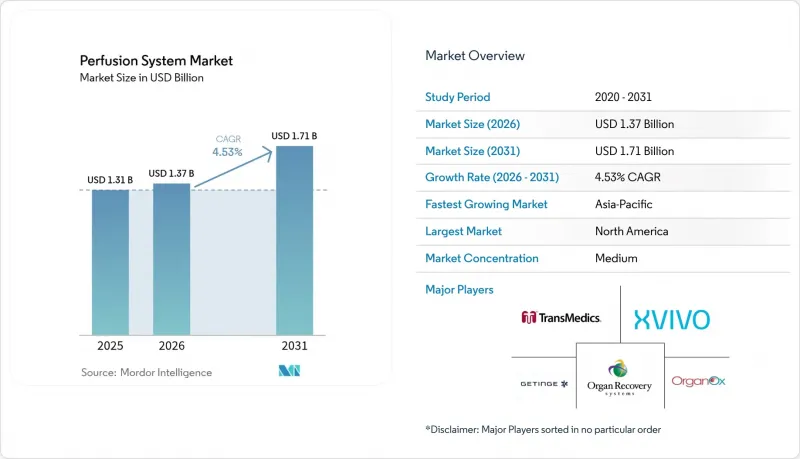
Mordor Intelligence에 의하면, 관류 시스템 시장 규모는 2025년에 13억 1,000만 달러로 평가되었고, 2026년 13억 7,000만 달러에서 2031년까지 17억 1,000만 달러에 이를 것으로 예측되며, 예측 기간(2026-2031년) CAGR은 4.53%를 나타낼 전망입니다.
본 보고서는 기술별(상온 기계 관류, 저체온 기계 관류 등), 장기별(심장, 폐, 신장, 간, 췌장 등), 최종 사용자별(이식 센터, 병원, 학술·연구 기관), 지역별(북미, 유럽, 아시아태평양, 중동 및 아프리카, 남미)로 분류되어 있습니다. 시장 예측은 금액(달러) 기준으로 제시되어 있습니다.
세계의 관류 시스템 시장 동향 및 인사이트
장기 이식에 대한 수요 증가
미국에서는 10만 3,000명 이상이 이식 대기자 명단에 등록되어 있으며, 8분마다 새로운 등록이 이루어지고 있어 기계 관류가 해소하고자 하는 수요 및 공급 간의 끊임없는 격차가 부각되고 있습니다. 만성 질환 증가로 인해 이식 대상자의 수가 기증자 수 증가 속도를 앞지르는 속도로 확대되고 있어, 장기 부족에 대한 압박은 더욱 커지고 있습니다. ‘장기 이식 접근성 확대 모델’에 따라 미국 병원들은 수술 건수를 늘릴 인센티브를 얻고 있으며, 관류 기술이 일상적인 프로토콜에 통합되고 있습니다. 이러한 요인들로 인해 첨단 시스템에 대한 장기적인 수요는 높으며 안정적인 상태를 유지하고 있습니다.
심혈관 질환 및 호흡기 질환 유병률 증가
간경변, 만성 폐쇄성 폐질환(COPD), 심부전의 발생률이 급증함에 따라 이식 대기자 명단은 늘어나고 있으며, 기증 장기의 품질 확보는 더욱 어려워지고 있습니다. 아시아태평양은 전 세계 만성 B형 간염 감염자의 약 75%를 차지하고 있으며, 이것이 간 이식 수요 공급원이 되고 있습니다. 기계적 관류를 통해 보존 중인 장기의 대사 상태를 평가할 수 있게 되어, 외과의사는 과거에는 정적 냉각 기준을 충족하지 못했던 경계 영역의 간, 심장, 폐를 수용할 수 있게 되었습니다. 주요 의료 센터에서 AI 알고리즘을 통합함으로써 생존 가능성 판단이 더욱 정교해지고, 폐기율이 낮아지며, 유효한 기증자 후보 풀이 확대됩니다.
관류 장치 및 이식 수술의 높은 비용
미국에서 신장 적출에 드는 비용은 평균 3만 5,427달러이며, 그 총액의 60% 이상이 간접비로 차지하고 있습니다. 첨단 장비의 경우, 일회용 회로 및 장비 가동 시간 연장으로 인해 비용이 더욱 상승합니다. 간 이식 비용은 관류 프로토콜에 따른 추가 물류 비용 및 인건비를 반영하여 지속적으로 상승하고 있습니다. 라틴아메리카, 아프리카 및 아시아의 일부 지역에서는 예산에 민감한 의료 기관들이 자본 보조금이나 기증자 프로그램을 통해 지출이 상쇄될 때까지 도입을 미루고 있습니다.
부문 분석
저체온 인공순환은 2025년 총 매출의 53.62%를 차지하며, 그 확고한 임상적 기반과 다기관에서의 유효성이 입증되었습니다. 전통적으로 신장 및 간 이식에서 선호되어 온 저체온 프로토콜은 이식편 기능 지연을 완화하고 중환자실(ICU) 입원 기간을 단축하기 때문에 병원이 투자의 정당성을 입증하는 데 도움이 되고 있습니다. 순환 보조 시스템 시장에서는 의사가 젖산, 담즙 생성 및 혈역학을 실시간으로 모니터링할 수 있다는 점을 중요하게 여기기 때문에 상온 프로토콜 플랫폼이 연평균 성장률(CAGR) 6.95%로 확대되고 있습니다. 미국의 주요 의료 기관에서 제공한 초기 데이터에 따르면, 상온 프로토콜을 도입한 후 연간 간 이식 건수가 14% 증가할 가능성이 있는 것으로 나타나, 더 광범위한 임상적 영향이 기대됩니다. 항공 운송 중 생리적 체온을 유지하는 휴대용 시스템 덕분에 심장 이식 시 6시간의 운송 제한이 해소되어, 외과의사는 더 먼 곳에서 온 이식편을 수용할 수 있게 되었으며, 그로 인해 도시와 지방 간의 접근성 격차가 완화됩니다.
클리블랜드 클리닉에서는 과거 부적격으로 판정되었던 간 21개 중 15개의 이식을 성공적으로 수행하여, 장기 수율 면에서 실질적인 향상을 입증했습니다. 동시에, 저체온 산소화 관류(HOPE)법을 통해 폐는 최대 20시간까지 생존할 수 있었으며, 파일럿 코호트에서는 거부 반응이 보고되지 않았습니다. 각 공급업체가 두 가지 모드를 모두 지원하는 듀얼 온도 콘솔을 출시하는 가운데, 조달 위원회는 단일 기기가 제공하는 유연성과 높은 초기 비용 간의 균형을 검토하고 있습니다. 향후 5년 동안, 특히 매일 여러 유형의 장기를 다루는 이식 건수가 많은 거점에서는 하이브리드 콘솔의 점유율이 확대될 전망입니다.
지역별 분석
북미는 2025년에 전 세계 매출의 34.55%를 차지한 것으로 평가되었으며, 견실한 환급 제도와 2026년까지 6만 건의 수술을 목표로 하는 ‘장기 조달 및 이식 네트워크(OPTN)’의 노력의 혜택을 받고 있습니다. 이 지역의 관류 시스템 시장 규모는 수술 건수 증가에 대해 보상을 제공하는 메디케어 모델에 힘입어 레벨 I 센터에서 거의 전면적인 도입을 촉진하고 있습니다. TransMedics사의 ‘Organ Care System’은 이러한 급속한 성장의 상당 부분을 뒷받침하고 있으며, 기업 수익은 전년 대비 64% 증가했고, 2028년까지 미국에서 연간 1만 대 도입을 달성하겠다는 목표를 세웠습니다.
유럽에서는 FOEDUS 포털을 통한 국경을 초월한 정보 공유가 장기 유통을 원활하게 하고 있으며, MDR 이행 규정은 복잡하지만 궁극적으로 27개 회원국에서 기술 문서의 조화를 가져올 것이기 때문에 도입은 착실히 진행되고 있습니다. 또한, 유럽 장기 이식 학회(ESOT)의 첨단 치료 로드맵 역시 복합 제품에 대한 모호함을 해소하고, 공급업체에 더 명확한 지침을 제공합니다. Paragonix나 OrganOx와 같은 기업들은 CE 마크 및 캐나다 보건부의 승인을 획득한 후, 중앙 조달 기관이 설비 투자를 자금 지원하고 있는 독일, 프랑스, 북유럽 국가에서 상업적 진출을 시작하고 있습니다.
아시아태평양은 각국 정부가 이식 체계를 정비하고, 질병 유병률의 상승으로 이식 대기자 명단이 확대됨에 따라 2031년까지 연평균 성장률(CAGR) 7.79%로 가장 높은 성장률을 기록하고 있습니다. 인도는 2023년에 전 세계에서 세 번째로 많은 수술 건수를 달성했으나, 신장 수요의 10% 미만을 충족하고 있을 뿐이어서, 한계가 있는 이식편을 효과적으로 활용하는 기술의 필요성이 부각되고 있습니다. 중국, 일본, 한국에서는 임상적으로 허용되는 시간 범위 내에서 지방의 기증자 병원과 도시 지역의 이식 센터를 연결하는 휴대용 관류 장치의 도입에 대한 투자가 진행되고 있습니다. AI를 활용한 분석 기능과 통합된 호주의 ‘전국 장기 매칭 시스템’ 역시 배정을 최적화하기 위해 실시간 관류 데이터에 의존하고 있습니다. 동남아시아에서는 민관 파트너십을 통한 시범 사업이 장비 임대 비용을 지원하고 있어, 3차 의료기관에서의 첫 도입이 가속화되고 있습니다.
기타 혜택 :
- 엑셀 형식 시장 예측(ME) 시트
- 3개월간의 애널리스트 지원
자주 묻는 질문
목차
제1장 서론
제2장 조사 방법
제3장 주요 요약
제4장 시장 구도
제5장 시장 규모 및 성장 예측
제6장 경쟁 구도
제7장 시장 기회 및 향후 전망
AJY 26.08.26According to Mordor Intelligence, the perfusion system market size was valued at USD 1.31 billion in 2025 and estimated to grow from USD 1.37 billion in 2026 to reach USD 1.71 billion by 2031, at a CAGR of 4.53% during the forecast period (2026-2031).
This report is Segmented by Technology (Normothermic Machine Perfusion, Hypothermic Machine Perfusion and More), Organ Type (Heart, Lung, Kidney, Liver, Pancreas and More), End User (Transplant Centers, Hospitals and Academic & Research Institutes) and Geography (North America, Europe, Asia Pacific, Middle East and Africa, South America). The Market Forecasts are Provided in Terms of Value (USD).
Global Perfusion System Market Trends and Insights
Rising demand for organ transplantation
More than 103,000 people remain on the U.S. transplant waiting list, with a new registration every 8 minutes, underscoring the relentless supply-demand gap that machine perfusion aims to close.Organ shortage pressures mount further as chronic diseases enlarge the eligible recipient pool faster than donor numbers can keep up. The Increasing Organ Transplant Access Model incentivizes U.S. hospitals to scale surgery volumes, embedding perfusion technology into routine protocols.These factors keep long-term demand for advanced systems high and stable.
Increasing prevalence of cardiovascular & respiratory diseases
Escalating rates of liver cirrhosis, chronic obstructive pulmonary disease and heart failure expand candidate lists and complicate donor organ quality. Asia-Pacific carries roughly 75% of global chronic Hepatitis B infections, feeding a pipeline of liver transplant demand. Machine perfusion allows metabolic assessment during storage, enabling surgeons to accept marginal livers, hearts and lungs that once failed static cold criteria. Integration of AI algorithms by leading centers further sharpens viability decisions, reducing discard rates and enlarging the effective donor pool.
High cost of perfusion devices & transplantation procedures
A kidney procurement in the United States averages USD 35,427 with overhead exceeding 60% of that total; advanced devices raise costs further through single-use circuits and longer machine times.Liver transplant charges continue to climb, reflecting extra logistics and staffing tied to perfusion protocols. Budget-sensitive centers in Latin America, Africa and parts of Asia delay adoption until capital grants or donor programs offset outlays.
Other drivers and restraints analyzed in the detailed report include:
- Rising government & NGO initiatives for organ donation
- Adoption of perfusion for marginal/extended-criteria donor organs
- Diverse regulatory & reimbursement barriers
For complete list of drivers and restraints, kindly check the Table Of Contents.
Segment Analysis
Hypothermic machine perfusion generated 53.62% of total 2025 revenue, underlining its deep clinical roots and multi-organ validation. Historically favored for kidneys and livers, hypothermic protocols cut delayed graft function and shorten ICU stays, helping hospitals justify the investment. The perfusion system market sees normothermic platforms accelerating at a 6.95% CAGR as physicians value the chance to monitor lactate, bile production and hemodynamics in real time. Early data from a leading U.S. center indicate a potential 14% rise in annual liver transplant volume after integrating normothermic protocols, hinting at broader clinical impact. Portable systems that maintain physiologic temperature during air transport remove the six-hour heart-transport ceiling, letting surgeons accept grafts from farther afield and thereby easing urban-rural access disparities.
The Cleveland Clinic successfully transplanted 15 out of 21 livers once deemed unsuitable, demonstrating practical gains in organ yield. Simultaneously, hypothermic oxygenated perfusion (HOPE) shows lungs can remain viable up to 20 hours with no rejections reported in pilot cohorts. As vendors release dual-temperature consoles capable of both modes, purchasing committees weigh one-machine flexibility against higher upfront price tags. Over the next five years, hybrid consoles are likely to capture share, especially at high-volume transplant hubs that process multiple organ types daily.
Complete Report Scope:
- By Technology
- Normothermic Machine Perfusion
- Hypothermic Machine Perfusion
- Normothermic Regional Perfusion
- Next-gen Portable Perfusion Platforms
- By Organ Type
- Heart
- Lung
- Kidney
- Liver
- Pancreas
- Composite Tissue (VCA)
- By End User
- Transplant Centers
- Hospitals
- Academic & Research Institutes
- By Geography
- North America
- United States
- Canada
- Mexico
- Europe
- Germany
- United Kingdom
- France
- Italy
- Spain
- Rest of Europe
- Asia-Pacific
- China
- Japan
- India
- Australia
- South Korea
- Rest of Asia-Pacific
- Middle East and Africa
- GCC
- South Africa
- Rest of Middle East and Africa
- South America
- Brazil
- Argentina
- Rest of South America
- North America
Geography Analysis
North America commanded 34.55% of global revenue in 2025, benefiting from a robust reimbursement ecosystem and the Organ Procurement and Transplantation Network's target of 60,000 procedures by 2026. The perfusion system market size for the region is supported by Medicare models that reward volume growth and drive near-universal adoption at Level I centers. TransMedics' Organ Care System underpins much of this surge, with company revenue up 64% year-on-year and ambitions to reach 10,000 U.S. deployments annually by 2028.
Europe maintains consistent uptake as cross-border sharing via the FOEDUS portal eases organ flow, and MDR transitional rules, though complex, ultimately harmonize technical dossiers across 27 member states. The European Society for Organ Transplantation's advanced-therapy roadmap likewise removes ambiguity for combination products, giving vendors clearer guidance. Companies such as Paragonix and OrganOx secure CE marks and Health Canada approvals, then roll out commercial launches in Germany, France and the Nordics where centralized procurement agencies fund capital upgrades.
Asia-Pacific registers the fastest 7.79% CAGR through 2031 as governments build transplant capacity and disease prevalence swells the candidate list. India completed the world's third-largest number of surgeries in 2023 but could meet less than 10% of its kidney demand, underlining the need for technologies that salvage marginal grafts. China, Japan and South Korea invest in portable perfusion fleets that connect rural donor hospitals to urban transplant centers within clinically acceptable timelines. Australia's National Organ Matching System, integrated with AI-enabled analytics, likewise depends on real-time perfusion data to optimize allocation. In Southeast Asia, pilot public-private partnerships subsidize device leases, accelerating first-time adoption at tertiary hospitals.
- TransMedics Group Inc.
- Organ Recovery Systems
- Xvivo Perfusion
- Organox
- Getinge (Paragonix Technologies Inc.)
- Bridge to Life Ltd.
- Organ Assist BV
- Waters Medical Systems
- Preservation Solutions Inc.
- Institut Georges Lopez (ISOT) SA
- EBERS Medical Technology SL
- Shenzhen Lifotronic Technology Co. Ltd.
- Genus Medical Technologies LLC
- Terumo
- Medtronic
- LivaNova
- Nanjing Biolight Meditech Co., Ltd.
Additional Benefits:
- The market estimate (ME) sheet in Excel format
- 3 months of analyst support
TABLE OF CONTENTS
1 Introduction
- 1.1 Study Assumptions and Market Definition
- 1.2 Scope of the Study
2 Research Methodology
3 Executive Summary
4 Market Landscape
- 4.1 Market Overview
- 4.2 Market Drivers
- 4.2.1 Rising Demand For Organ Transplantation
- 4.2.2 Increasing Prevalence Of Cardiovascular & Respiratory Diseases
- 4.2.3 Rising Government & NGO Initiatives For Organ Donation
- 4.2.4 Adoption Of Perfusion For Marginal/Extended-Criteria Donor Organs
- 4.2.5 AI-Driven Real-Time Perfusion Analytics Improving Organ Utilization
- 4.2.6 Inclusion Of Normothermic And Hypothermic Machine Perfusion In Emerging International Transplant-Care Guidelines
- 4.3 Market Restraints
- 4.3.1 High Cost Of Perfusion Devices & Transplantation Procedures
- 4.3.2 Diverse Regulatory & Reimbursement Barriers
- 4.3.3 Cross-Border Organ-Logistics Bottlenecks
- 4.3.4 Scarcity Of Specialized Perfusionists And 24/7 Transplant-Team Staffing
- 4.4 Value / Supply-Chain Analysis
- 4.5 Regulatory Landscape
- 4.6 Technology Outlook
- 4.7 Porter's Five Forces Analysis
- 4.7.1 Bargaining Power of Suppliers
- 4.7.2 Bargaining Power of Buyers
- 4.7.3 Threat of New Entrants
- 4.7.4 Threat of Substitutes
- 4.7.5 Intensity of Competitive Rivalry
5 Market Size and Growth Forecasts (Value-USD)
- 5.1 By Technology
- 5.1.1 Normothermic Machine Perfusion
- 5.1.2 Hypothermic Machine Perfusion
- 5.1.3 Normothermic Regional Perfusion
- 5.1.4 Next-gen Portable Perfusion Platforms
- 5.2 By Organ Type
- 5.2.1 Heart
- 5.2.2 Lung
- 5.2.3 Kidney
- 5.2.4 Liver
- 5.2.5 Pancreas
- 5.2.6 Composite Tissue (VCA)
- 5.3 By End User
- 5.3.1 Transplant Centers
- 5.3.2 Hospitals
- 5.3.3 Academic & Research Institutes
- 5.4 By Geography
- 5.4.1 North America
- 5.4.1.1 United States
- 5.4.1.2 Canada
- 5.4.1.3 Mexico
- 5.4.2 Europe
- 5.4.2.1 Germany
- 5.4.2.2 United Kingdom
- 5.4.2.3 France
- 5.4.2.4 Italy
- 5.4.2.5 Spain
- 5.4.2.6 Rest of Europe
- 5.4.3 Asia-Pacific
- 5.4.3.1 China
- 5.4.3.2 Japan
- 5.4.3.3 India
- 5.4.3.4 Australia
- 5.4.3.5 South Korea
- 5.4.3.6 Rest of Asia-Pacific
- 5.4.4 Middle East and Africa
- 5.4.4.1 GCC
- 5.4.4.2 South Africa
- 5.4.4.3 Rest of Middle East and Africa
- 5.4.5 South America
- 5.4.5.1 Brazil
- 5.4.5.2 Argentina
- 5.4.5.3 Rest of South America
- 5.4.1 North America
6 Competitive Landscape
- 6.1 Market Concentration
- 6.2 Market Share Analysis
- 6.3 Company profiles (includes Global level Overview, Market level overview, Core Segments, Financials as available, Strategic Information, Market Rank/Share for key companies, Products and Services, and Recent Developments)
- 6.3.1 TransMedics Group Inc.
- 6.3.2 Organ Recovery Systems Inc.
- 6.3.3 XVIVO Perfusion AB
- 6.3.4 OrganOx Limited
- 6.3.5 Getinge (Paragonix Technologies Inc.)
- 6.3.6 Bridge to Life Ltd.
- 6.3.7 Organ Assist BV
- 6.3.8 Waters Medical Systems LLC
- 6.3.9 Preservation Solutions Inc.
- 6.3.10 Institut Georges Lopez (ISOT) SA
- 6.3.11 EBERS Medical Technology SL
- 6.3.12 Shenzhen Lifotronic Technology Co. Ltd.
- 6.3.13 Genus Medical Technologies LLC
- 6.3.14 Terumo Corporation
- 6.3.15 Medtronic PLC
- 6.3.16 LivaNova PLC
- 6.3.17 Nanjing Biolight Meditech Co., Ltd.
7 Market Opportunities and Future Outlook
- 7.1 White-Space and Unmet-Need Assessment


