

|
시장보고서
상품코드
2114436
녹내장 치료 시장 : 시장 점유율 분석, 업계 동향 및 통계, 성장 예측(2026-2031년)Glaucoma Treatment - Market Share Analysis, Industry Trends & Statistics, Growth Forecasts (2026 - 2031) |
||||||
 Mordor Intelligence
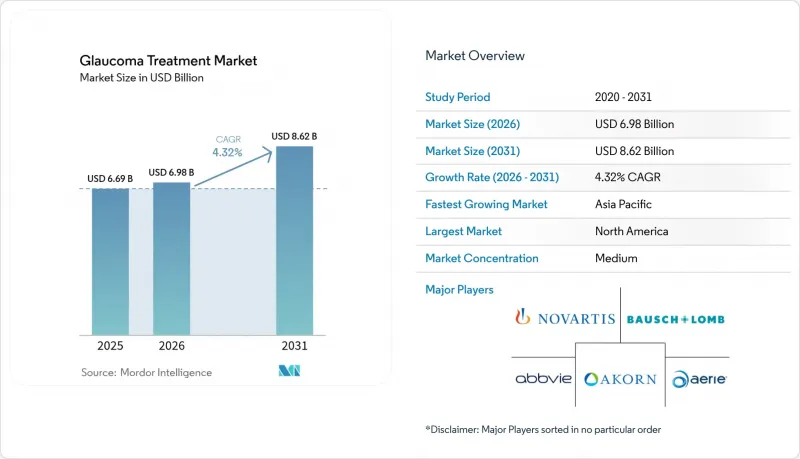
Mordor Intelligence에 의하면, 녹내장 치료 시장 규모는 2025년에 66억 9,000만 달러로 평가되었고, 2026년 69억 8,000만 달러에서 2031년까지 86억 2,000만 달러에 이를 것으로 예측되며, 예측 기간(2026-2031년) CAGR은 4.32%를 나타낼 전망입니다.
본 보고서는 적응증별(개방각 녹내장, 폐쇄각 녹내장, 이차성 녹내장 등), 약물 분류별(프로스타글란딘 유사체, β-차단제, α-작용제, 탄산탈수효소 억제제 등), 지역별(북미, 유럽,아시아태평양, 중동 및 아프리카, 남미)로 분류되어 있습니다. 시장 전망은 금액(달러) 기준으로 제시되어 있습니다.
세계의 녹내장 치료 시장 동향 및 인사이트
녹내장 유병률 증가
2024년, 40-79세 성인의 녹내장 발생률은 1만 명당 연 23.46으로 상승했으며, 75-79세 연령대에서는 64.36으로 정점을 기록했습니다. 도시화에 따른 근시 증가가 현재 아시아태평양의 위험을 가속화하고 있으며, 이 지역의 환자 수는 2040년까지 8,000만 건에 달할 것으로 예측됩니다. 사하라 이남 아프리카는 여전히 지역별 유병률이 가장 높은 수준을 기록하고 있으나, 치료 효과를 제한하는 진행 단계에서야 진료를 받는 문제에 직면해 있습니다. 이러한 인구통계학적 및 역학적 요인들이 결합되어 녹내장 치료 시장의 지속적인 수요를 뒷받침하고 있습니다.
인식 제고 및 선별 검사 노력
AI를 활용한 안저 영상 분석은 93.52%의 민감도와 95%의 특이도를 달성하여, 안과 의사가 부족한 환경에서도 신뢰할 수 있는 집단 검진을 가능하게 하고 있습니다. 오프라인 알고리즘과 연동된 스마트폰 카메라가 최소한의 통신 환경 조건만으로도 농촌 지역의 지원 프로그램을 뒷받침하고 있습니다. WHO의 ‘비전 2020’에 부합하는 전국적인 원격 안과 플랫폼은 자원이 부족한 지역의 진단 적용 범위를 확대되고 있습니다. 이러한 노력을 통해 발견률이 향상되어 새로운 환자들이 녹내장 치료 시장으로 유입되고 있습니다.
안구 및 전신 이상반응
FDA의 이상반응 보고 시스템(AERS)에 따른 의약품 안전성 모니터링 검토에 따르면, 프로스타글란딘 유사제의 두드러진 신호로 결막 충혈 및 안와 주위의 색소 침착 변화가 지적되고 있습니다. 네탈스딜로 인한 안구 염증의 발병 중앙값은 1일 이내이며, 고령층에서는 발생률이 높아지는 경향이 있습니다. 녹내장 환자의 안구건조증 유병률은 5%에서 50% 사이이며, 벤잘코늄 클로라이드를 포함한 방부제로 인해 증상이 악화되는 경우가 빈번합니다. 전신성 β-차단제의 투여는 민감도가 높은 환자에서 심혈관계 및 호흡기계 합병증을 유발할 가능성이 있습니다. 이러한 안전성 문제는 치료 중단이나 규제 당국의 면밀한 조사를 초래함으로써, 녹내장 치료 시장의 연평균 성장률(CAGR)에 하방 압력을 가하고 있습니다.
부문 분석
2025년 녹내장 치료 시장에서 개방각 녹내장은 71.03%의 점유율을 차지했으며, 대부분의 선별 검사 프로그램에서 이 유형이 가장 조기에 발견되기 때문에 임상적 관심의 중심이 되었습니다. 이 부문의 매출은 점안액, SLT, MIGS, 서방형 임플란트 등 단계적으로 치료를 강화하는 종합적인 치료 연속성으로부터 혜택을 받고 있습니다. 예측 기간 동안 신경 보호제의 채택이 점진적으로 확대됨에 따라, 이 광범위한 적응증 분야에서 가치 창출이 더욱 강화될 것으로 예측됩니다.
이차성 녹내장은 스테로이드 유발성, 가성 박리성, 외상 관련 병인에 대한 인식이 높아지는 것을 배경으로 연평균 성장률(CAGR) 8.78%로 확대되고 있습니다. 질환의 복잡성이 높기 때문에 병용 요법이나 전문적인 처치가 필요한 경우가 많아, 환자 1인당 수익이 평균을 상회하며, 진행기 부문에서 녹내장 치료 시장 규모 확대에 기여하고 있습니다.
지역별 분석
북미는 2025년 매출의 37.05%를 차지했으며, 이는 1차 선택 약물에 대한 보편적인 보험 적용과 광범위한 수술 비용에 대한 보험 환급을 반영한 것입니다. SLT(선택적 사다리꼴 절제술)의 채택이 주류를 이루고 있으며, 메디케어 적용 범위가 안정됨에 따라 MIGS(최소 침습 녹내장 수술)의 성장도 가속화되고 있지만, 제네릭 의약품의 부상으로 브랜드 의약품의 판매량은 정체되고 있습니다. 캐나다는 미국의 진료 패턴을 따르고 있지만, 비용 대비 효과 기준은 더 엄격하게 설정되어 있습니다. 한편, 멕시코에서는 급성장하는 민간 보험 시장으로 인해 수요가 고급 임플란트로 이동하고 있습니다. 전반적으로 이 지역은 녹내장 치료 시장에 있어 여전히 높은 가치를 지닌 기반을 형성하고 있지만, 가장 빠르게 성장하는 동력은 아닙니다.
아시아태평양은 중국이 의약품 승인 절차를 자유화하고, 인도가 AI를 활용한 선별 검사 인프라를 확충함에 따라 지역별 최고 연평균 성장률(CAGR) 7.86%를 달성할 것으로 예측됩니다. 일본은 탄탄한 시판 후 조사를 통해 MIGS의 보급을 유지하고 있는 반면, 한국에서는 국민건강보험의 상환 제도에 힘입어 서방형 기기의 조기 도입이 진행되고 있습니다. 호주는 1차 진료 분야에서 AI 트리아지(triage)의 모범 사례를 보여주고 있으며, 이는 다른 의료 시스템으로도 파급될 것으로 예측됩니다. 이 지역의 높은 미충족 의료 수요와 기술 도입 가속화가 결합되어, 향후 녹내장 치료 시장 성장에 이 지역이 지대한 기여를 할 것으로 보입니다.
유럽에서는 보편적인 접근성과 방부제 무첨가 제제에 대한 강한 선호로 인해 꾸준한 성장이 예상됩니다. 각국의 보험사는 비용 대비 효과가 높은 SLT나 제네릭 의약품을 권장하는 한편, 장기적인 가치를 뒷받침하는 추가적인 근거가 있는 경우에는 MIGS에 대한 보험 적용도 실시했습니다. 중동에서는 석유 수입에 힘입은 의료 예산을 안과 센터 확충에 투입하고 있습니다. 한편, 사하라 이남 아프리카에서는 높은 유병률과 재정적 제약이 겹쳐, 국제적인 지원 프로그램이 있음에도 불구하고 고급 인공수정체의 보급이 제한되고 있습니다. 남미에서는 선택적인 진전이 나타나고 있습니다. 브라질의 공적 의료 제도에서는 SLT의 비용 대비 효과가 입증되었으며, 민간 체인에서는 서방형 인공수정체의 시범 도입이 진행되고 있습니다.
기타 혜택 :
- 엑셀 형식 시장 예측(ME) 시트
- 3개월간의 애널리스트 지원
자주 묻는 질문
목차
제1장 서론
제2장 조사 방법
제3장 주요 요약
제4장 시장 구도
제5장 시장 규모 및 성장 예측
제6장 경쟁 구도
제7장 시장 기회 및 향후 전망
AJY 26.08.26According to Mordor Intelligence, the glaucoma treatment market size was valued at USD 6.69 billion in 2025 and estimated to grow from USD 6.98 billion in 2026 to reach USD 8.62 billion by 2031, at a CAGR of 4.32% during the forecast period (2026-2031).
This report is Segmented by Indication (Open-Angle Glaucoma, Closed-Angle Glaucoma, Secondary Glaucoma, and More), Drug Class (Prostaglandin Analogs, Beta Blockers, Alpha Agonists, Carbonic Anhydrase Inhibitors, and More), and Geography (North America, Europe, Asia-Pacific, Middle East and Africa, and South America). The Market Forecasts are Provided in Terms of Value (USD).
Global Glaucoma Treatment Market Trends and Insights
Increasing prevalence of glaucoma
Glaucoma incidence climbed to 23.46 per 10,000 person-years among adults aged 40-79 in 2024, with rates peaking at 64.36 in the 75-79 cohort. Urbanization-driven myopia now accelerates risk in Asia-Pacific, where projected case counts may reach 80 million by 2040. Sub-Saharan Africa continues to register the highest regional prevalence yet struggles with late-stage presentation that limits therapeutic effectiveness. Collectively, these demographic and epidemiological forces build a sustained demand floor for the glaucoma treatment market.
Rising awareness & screening initiatives
AI-enabled fundus image analysis achieves 93.52% sensitivity and 95% specificity, allowing reliable mass screening in settings where ophthalmologists are scarce. Smartphone-based cameras tethered to offline algorithms support rural outreach programs with minimal connectivity requirements. National tele-ophthalmology platforms aligned with WHO Vision 2020 extend diagnostic reach in low-resource geographies. These initiatives raise detection rates and funnel new patients into the glaucoma treatment market.
Adverse ocular & systemic side-effects
Pharmacovigilance reviews of the FDA Adverse Event Reporting System show conjunctival hyperemia and periorbital pigmentary changes as prominent signals for prostaglandin analogs. Netarsudil's median onset of ocular inflammation occurs within 1 day, with incident rates skewing higher in the older population. Dry-eye disease prevalence among glaucoma patients ranges from 5% to 50% and is frequently aggravated by benzalkonium-chloride preservatives. Systemic beta-blocker exposure can trigger cardiovascular and respiratory complications in susceptible individuals. These safety issues exert downward pressure on the glaucoma treatment market CAGR by driving discontinuations and regulatory scrutiny.
Other drivers and restraints analyzed in the detailed report include:
- Technological advancements in ophthalmology
- Sustained-release implants improve adherence
- Stringent & lengthy regulatory approvals
For complete list of drivers and restraints, kindly check the Table Of Contents.
Segment Analysis
Open-angle glaucoma commanded 71.03% of the 2025 glaucoma treatment market share, underpinning the dominant clinical focus because most screening programs identify this form earliest. Segment revenues benefit from a full continuum of care, including topical drugs, SLT, MIGS and sustained-release implants that escalate therapy in graduated steps. Over the forecast horizon, incremental uptake of neuroprotective agents is expected to reinforce value capture in this broad indication.
Secondary glaucoma is expanding at a 8.78% CAGR, driven by better recognition of steroid-induced, pseudoexfoliative and trauma-related etiologies. Higher disease complexity often necessitates combination therapy and specialist procedures, generating above-average revenue per patient and boosting the glaucoma treatment market size for advanced segments.
Complete Report Scope:
- By Indication
- Open-Angle Glaucoma
- Closed-Angle Glaucoma
- Secondary Glaucoma
- Congenital Glaucoma
- Others
- By Drug Class
- Prostaglandin Analogs
- Beta Blockers
- Alpha Agonists
- Carbonic Anhydrase Inhibitors
- Fixed-Dose Combinations
- Rho-Kinase / NO-Donating PGAs
- Geography
- North America
- United States
- Canada
- Mexico
- Europe
- Germany
- United Kingdom
- France
- Italy
- Spain
- Rest of Europe
- Asia-Pacific
- China
- Japan
- India
- South Korea
- Australia
- Rest of Asia-Pacific
- Middle East and Africa
- GCC
- South Africa
- Rest of Middle East and Africa
- South America
- Brazil
- Argentina
- Rest of South America
- North America
Geography Analysis
North America generated 37.05% of 2025 sales, reflecting universal insurance coverage for first-line pharmaceuticals and wide procedural reimbursement. SLT adoption is mainstream, and MIGS growth accelerates as Medicare coverage stabilizes, though branded drop volumes are plateauing amid generic erosion. Canada mirrors U.S. practice patterns but exercises tighter cost-effectiveness thresholds, while Mexico's fast-growing private insurance market shifts demand toward premium implants. Overall, the region remains a high-value anchor for the glaucoma treatment market but is not the fastest-growth engine.
Asia-Pacific is projected to deliver an 7.86% CAGR, the highest regional pace, as China liberalizes drug-approval timelines and India scales AI-enabled screening infrastructure. Japan sustains MIGS uptake through robust post-marketing surveillance, whereas South Korea's national-insurance reimbursement unlocks early adoption of sustained-release devices. Australia demonstrates the template for primary-care AI triage, which is expected to ripple through other health systems. The region's mixture of high unmet need and accelerating technology adoption underpins its outsized contribution to future glaucoma treatment market growth.
Europe delivers steady growth through universal access and strong preference for preservative-free formulations. National payers encourage cost-effective SLT and generic options but also reimburse MIGS when incremental evidence supports long-term value. The Middle East is allocating oil-driven health budgets to expand ophthalmology centers, while Sub-Saharan Africa's high prevalence collides with fiscal constraints, limiting penetration of premium implants despite international aid programs. South America advances selectively: Brazil's public system validated SLT cost-effectiveness, and private chains are testing sustained-release implants.
- Aerie Pharmaceutical
- Abbvie
- Akorn
- Alcon
- Bausch + Lomb
- Glaukos
- Inotek (Rocket)
- Ivantis
- Johnson & Johnson
- Merck
- New World Medical
- Nicox
- Novartis
- Pfizer
- Santen
- Sun Pharmaceuticals Industries
- Teva Pharmaceutical Industries
- Valeant (Bausch Health)
- Glenmark Pharmaceuticals
- Acadia Pharmaceuticals
Additional Benefits:
- The market estimate (ME) sheet in Excel format
- 3 months of analyst support
TABLE OF CONTENTS
1 Introduction
- 1.1 Study Assumptions & Market Definition
- 1.2 Scope of the Study
2 Research Methodology
3 Executive Summary
4 Market Landscape
- 4.1 Market Drivers
- 4.1.1 Increasing Prevalence Of Glaucoma
- 4.1.2 Rising Awareness & Screening Initiatives
- 4.1.3 Technological Advancements In Ophthalmology
- 4.1.4 Sustained-Release Implants Improve Adherence
- 4.1.5 Adoption Of Minimally Invasive Glaucoma Surgery (MIGS) Devices
- 4.1.6 Pharmacogenetic-Led Precision Therapy
- 4.2 Market Restraints
- 4.2.1 Adverse Ocular & Systemic Side-Effects
- 4.2.2 Stringent & Lengthy Regulatory Approvals
- 4.2.3 Reimbursement Gaps For Premium Implants & MIGS
- 4.2.4 SLT & Laser Therapies Cannibalising Drug Demand
- 4.3 Porter's Five Forces
- 4.3.1 Threat of New Entrants
- 4.3.2 Bargaining Power of Buyers
- 4.3.3 Bargaining Power of Suppliers
- 4.3.4 Threat of Substitute Products
- 4.3.5 Intensity of Competitive Rivalry
5 Market Size & Growth Forecasts (Value, USD)
- 5.1 By Indication
- 5.1.1 Open-Angle Glaucoma
- 5.1.2 Closed-Angle Glaucoma
- 5.1.3 Secondary Glaucoma
- 5.1.4 Congenital Glaucoma
- 5.1.5 Others
- 5.2 By Drug Class
- 5.2.1 Prostaglandin Analogs
- 5.2.2 Beta Blockers
- 5.2.3 Alpha Agonists
- 5.2.4 Carbonic Anhydrase Inhibitors
- 5.2.5 Fixed-Dose Combinations
- 5.2.6 Rho-Kinase / NO-Donating PGAs
- 5.3 Geography
- 5.3.1 North America
- 5.3.1.1 United States
- 5.3.1.2 Canada
- 5.3.1.3 Mexico
- 5.3.2 Europe
- 5.3.2.1 Germany
- 5.3.2.2 United Kingdom
- 5.3.2.3 France
- 5.3.2.4 Italy
- 5.3.2.5 Spain
- 5.3.2.6 Rest of Europe
- 5.3.3 Asia-Pacific
- 5.3.3.1 China
- 5.3.3.2 Japan
- 5.3.3.3 India
- 5.3.3.4 South Korea
- 5.3.3.5 Australia
- 5.3.3.6 Rest of Asia-Pacific
- 5.3.4 Middle East and Africa
- 5.3.4.1 GCC
- 5.3.4.2 South Africa
- 5.3.4.3 Rest of Middle East and Africa
- 5.3.5 South America
- 5.3.5.1 Brazil
- 5.3.5.2 Argentina
- 5.3.5.3 Rest of South America
- 5.3.1 North America
6 Competitive Landscape
- 6.1 Market Concentration
- 6.2 Market Share Analysis
- 6.3 Company Profiles (includes Global level Overview, Market level overview, Core Segments, Financials as available, Strategic Information, Market Rank/Share for key companies, Products & Services, and Recent Developments)
- 6.3.1 Aerie Pharmaceuticals
- 6.3.2 AbbVie (Allergan)
- 6.3.3 Akorn, Inc.
- 6.3.4 Alcon Inc
- 6.3.5 Bausch + Lomb
- 6.3.6 Glaukos
- 6.3.7 Inotek (Rocket)
- 6.3.8 Ivantis
- 6.3.9 Johnson & Johnson
- 6.3.10 Merck & Co. Inc
- 6.3.11 New World Medical
- 6.3.12 Nicox
- 6.3.13 Novartis AG
- 6.3.14 Pfizer Inc
- 6.3.15 Santen
- 6.3.16 Sun Pharma
- 6.3.17 Teva
- 6.3.18 Valeant (Bausch Health)
- 6.3.19 Glenmark
- 6.3.20 Acadia Pharmaceuticals
7 Market Opportunities & Future Outlook
- 7.1 White-space & Unmet-need Assessment


