

|
시장보고서
상품코드
2114437
호흡기 의약품 시장 : 시장 점유율 분석, 업계 동향 및 통계, 성장 예측(2026-2031년)Pulmonary Drugs - Market Share Analysis, Industry Trends & Statistics, Growth Forecasts (2026 - 2031) |
||||||
 Mordor Intelligence
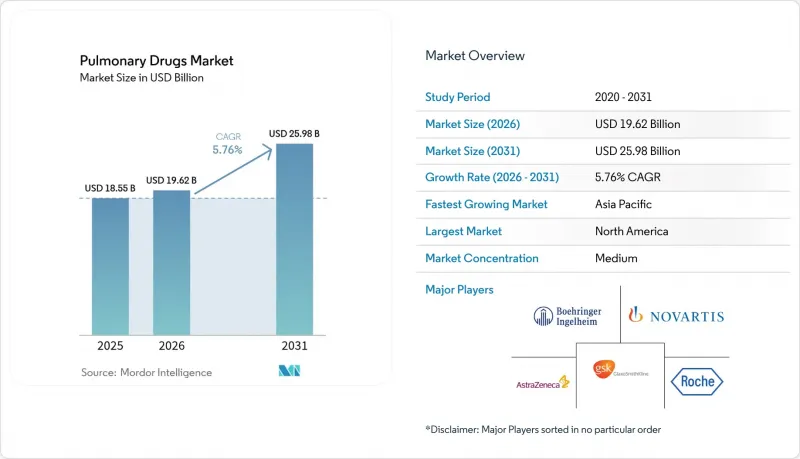
Mordor Intelligence에 의하면, 호흡기 의약품 시장 규모는 2025년에 185억 5,000만 달러로 평가되었고, 2026년 196억 2,000만 달러에서 2031년까지 259억 8,000만 달러에 이를 것으로 예측되며, 예측 기간(2026-2031년) CAGR은 5.76%를 나타낼 전망입니다.
본 보고서는 약물 분류별(β-2 작용제 등), 적응증별(천식, COPD 등), 투여 경로별(흡입, 경구 등), 유통 채널별(병원 약국 등), 지역별(북미, 유럽, 아시아태평양, 중동 및 아프리카, 남미)로 분류되어 있습니다. 시장 전망은 금액(달러) 기준으로 제시되어 있습니다.
세계의 호흡기 의약품 시장 동향 및 인사이트
호흡기 질환의 부담 증가
대기 오염은 이환율과 사망률 증가를 초래하여 전 세계적으로 매년 420만 명의 사망자를 발생시키고 있으며, 이는 COPD로 인한 사망자의 4분의 1을 차지합니다. 신흥 경제국에서는 산업 활동이 규제 감독을 종종 초과하기 때문에 가장 심각한 영향을 받고 있습니다. 생산성 저하와 입원율 상승을 통해 경제적 비용이 누적되고 있으며, 만성 질환에 대한 약물 치료를 통한 관리의 필요성이 높아지고 있습니다. 2020년 기준, 미국의 COPD 유병자 수는 1,250만 명에 달하며, 인종과 연령에 따라 현저한 편차가 나타납니다. 이러한 수요 증가로 인해 보험사들이 예방 의료 및 증상 악화 억제를 우선시하는 가운데, 호흡기 의약품 시장은 지속적인 확장을 이어가고 있습니다.
세계적인 고령화
고령자는 폐의 탄력성이 떨어지고 면역 반응도 약해지기 때문에 만성 호흡기 질환에 걸리기 쉽습니다. 미국에서는 성인의 51.4%가 여러 가지 만성 질환을 앓고 있으며, 호흡기 질환은 심혈관 질환이나 대사성 질환과 동반되는 경우가 많습니다. 이러한 동반 질환의 경향으로 인해, 복약 부담을 줄이고 치료 계획을 간소화하는 고정 용량 복합 흡입제의 사용이 촉진되고 있습니다. 선진국에서는 이미 급속한 인구 고령화가 진행되고 있지만, 신흥국도 그 뒤를 따르고 있어 향후 환자층은 더욱 확대될 전망입니다. 이러한 인구 통계학적 변화가 호흡기 의약품 시장의 장기적인 판매량 성장을 뒷받침하고 있습니다.
엄격한 규제 체계
의약품 안전성 감시가 강화됨에 따라 심사 주기가 장기화되고 있습니다. FDA는 최근 RSV 백신에 길랑-바레 증후군에 관한 경고를 추가함으로써, 호흡기 계통 제품에 대한 위험-이익 기준이 더욱 보수적으로 변하고 있음을 시사했습니다. 제조 감사도 강화되어, 여러 활성 성분 제조 공장에 품질 관련 시정 권고가 내려져 일시적인 생산 중단을 피할 수 없었습니다. 이러한 감시 체계는 환자를 보호하는 한편, 개발 비용을 증가시키고 제품 출시를 지연시킬 가능성이 있어, 특히 중소 혁신 기업이나 신흥 시장의 제조업체에 큰 영향을 미치고 있습니다. 대기업은 경쟁사 시장 진입이 억제되는 혜택을 누릴 수 있지만, 규정 준수 관련 지출은 계속 증가하고 있습니다.
부문 분석
2025년에는 병용 흡입제가 호흡기 의약품 시장 규모의 28.20%를 차지한 것으로 평가되었으며, 기류 제한에 대한 다중 기전 관리를 선호하는 임상의들의 경향이 더욱 강해졌습니다. Breztri와 같은 3제 병용 요법 제품은 2025년에 천식 3상 임상시험의 평가 변수를 달성하여, 적응증 확대 가능성과 보험 적용 목록에 더욱 깊이 침투할 가능성을 시사하고 있습니다. β-2 작용제 및 항콜린제는 이러한 고정 용량 플랫폼에서 핵심 성분으로서의 지위를 유지하며, 성숙한 수익 기반을 계속해서 뒷받침하고 있습니다. 단일 클론 항체는 현재 판매량은 적지만, 호산구성 COPD 및 중증 천식에 대한 승인을 발판 삼아 연평균 성장률(CAGR) 7.42%로 성장을 지속하고, 있습니다. 코르티코스테로이드 단독 요법은 안전성에 대한 우려로 인해 표적형 생물학적 제제에 대한 관심이 이동하고 있어 완만한 성장에 그치고 있습니다. 항류코트리엔제 및 항히스타민제는 소아 및 알레르기 관련 사례에서 틈새 시장을 유지하고 있지만, 새로운 염증 매개체를 표적으로 하는 파이프라인 의약품은 향후 경쟁 사이클을 예고하고 있습니다. 이러한 다양한 치료 옵션의 존재야말로 호흡기 의약품 시장이 여전히 치열한 경쟁을 벌이고 있는 한편, 풍부한 기회를 내포하고 있는 이유를 뒷받침합니다.
병용 요법의 주류화는 제조 투자 동향에도 영향을 미치고 있으며, 각사는 듀얼 캐니스터 및 3성분 드라이 파우더 블렌드에 대응하기 위해 충전 및 마무리 라인의 업그레이드를 추진하고 있습니다. 브랜드 의약품 선도 기업들은 투여 횟수 카운터나 복약 준수 추적기 등의 기기 혁신을 결합함으로써, 제네릭 의약품에 의한 시장 잠식 위험에 대비하고 있습니다. 한편, 단일클론 항체 제조업체들은 배치 오염 위험을 줄이고 진화하는 우수 제조 기준(GMP) 요건을 준수하기 위해 일회용 바이오리액터의 규모를 확대되고 있습니다. 저분자 흡입제와 주사용 바이오의약품의 전략적 조합으로 인해 구매자들은 처방약 목록에 따른 리베이트 대응에 쫓기고 있으며, 그 결과 복잡한 협상에 정통한 도매업체로 계약상의 우위가 이동하고 있습니다.
천식은 높은 유병률과 지침에서 의무화하고 있는 장기적인 조절 요법으로 인해 2025년 호흡기 의약품 시장 점유율의 42.18%를 차지했습니다. 제2형 염증을 치료하는 생물학적 제제는 이러한 기반을 바탕으로, 질환이 제대로 조절되지 않는 환자에게 단계적 치료 옵션을 제공합니다. COPD는 여전히 큰 시장 규모를 유지하고 있지만, 질병 수정 치료법에 대한 미충족 요구는 여전히 높으며, 이러한 격차는 2024년 엔시펜트린의 승인으로 부분적으로 메워졌습니다. 알레르기성 비염은 항히스타민 작용과 코르티코스테로이드 작용을 융합하여 증상을 신속하게 완화하는 복합 비강 스프레이에 힘입어 연평균 성장률(CAGR) 8.84%로 가장 빠르게 성장하고 있습니다. 폐동맥 고혈압은 환자 수는 적지만 프리미엄 가격 책정이 유지되고 있어, 불균형할 정도로 수익성이 높은 분야로 자리 잡고 있습니다. 낭포성 섬유증 치료제는 희귀질환 의약품으로서의 우대 조치의 혜택을 받고 있지만, 이 하위 부문에서 폐 질환 치료제 시장 규모는 환자 수가 적어 여전히 제한적입니다. 특발성 폐섬유증과 같은 새로운 적응증은 섬유화를 촉진하는 경로에 대한 연구가 진행됨에 따라 서서히 발전하고 있으며, 초기 단계의 벤처 자금을 유치하고 있습니다.
지역별 치료 양상은 서로 다릅니다. 미국이나 독일에서는 천식 치료용 바이오의약품의 채택이 꾸준히 증가하고 있는 반면, 만성폐쇄성폐질환(COPD)용 트리플 흡입제의 채택은 병원 주도 프로토콜에 따라 다른 지역보다 빠른 속도로 진행되고 있습니다. 아시아태평양에서는 도시 지역의 알레르기 유발 물질 노출 증가에 따라 비염 치료제 시장이 성장하고 있습니다. 이러한 지역별 미묘한 차이로 인해 제약사들은 지역별로 인식 제고 캠페인, 보험 급여 신청 서류, 공급망을 조정해야 할 필요에 직면해 있으며, 이는 호흡기 의약품 시장 내의 미묘한 세분화 상황을 반영하고 있습니다.
지역별 분석
북미는 바이오의약품의 높은 보급률과 유리한 보험 급여 구조에 힘입어 2025년 매출의 38.11%를 차지했습니다. 2025년을 목표로 한 미국 메디케어 제도 개편에서는 협상을 통한 상한가가 도입되어 지불 주체의 협상력이 강화되는 한편, 의약품이 협상 대상이 되면 보다 광범위하고 합리적인 가격으로 공급될 것으로 기대됩니다. 캐나다 각 주에서는 바이오의약품의 보험 적용 범위가 확대되고 있지만, 입찰 제도로 인해 순가격은 계속해서 압박을 받고 있습니다. 또한, 이 지역은 의료기기의 혁신을 주도하고 있으며, 스마트 흡입기에 대한 FDA의 데 노보 승인이 잇따르면서 임상 현장의 기대를 형성하고 있습니다.
유럽은 국민건강보험과 엄격한 비용 대비 효과 기준을 특징으로 하는 핵심 시장으로 자리매김하고 있습니다. 독일, 영국, 프랑스는 고령화 진행과 미세 먼지 배출 감축을 목표로 한 강력한 환경 정책에 힘입어, 지역 전체 지출에서 가장 큰 비중을 차지하고 있습니다. EU 전역에 걸친 노력으로 승인 절차가 간소화되어 여러 국가에서의 출시가 용이해졌으며, 시장 출시까지의 기간이 단축되고 있습니다. 그러나 참조 가격 제도로 인해 고가의 정가가 억제되고 있어, 특히 생물학적 제제의 경우 제조업체들이 성과 연계형 계약으로 유도되고 있습니다.
아시아태평양은 2031년까지 6.46%라는 가장 높은 연평균 성장률(CAGR)을 기록할 전망입니다. 급속한 도시화와 석탄에 의존한 발전으로 인해 대기질 지표가 악화되면서 환자층이 확대되고 있습니다. 중국은 수입 의존도를 낮추기 위해 흡입용 제네릭 의약품의 국내 생산에 투자하고 있지만, 고가의 바이오의약품에 대해서는 여전히 다국적 기업공급에 의존하고 있습니다. 인도의 국내 산업은 건식 분말 흡입기(DPI)의 생산 규모를 확대하며 수출과 국내 수요를 모두 뒷받침하고 있습니다. 일본의 지침에서는 삼중 요법의 적응증이 확대되어 처방 건수가 증가하고 있습니다. 한편, 호주에서는 지방의 COPD 환자를 지원하기 위해 원격 모니터링 시범 사업에 자금을 지원하고 있습니다. 동남아시아 국가들에서는 보험 환급 제도가 개선되고 있지만, 여전히 비용 부담이 장벽으로 작용하고 있어 호흡기 의약품 시장 전반에 걸쳐 단계적 가격 책정 전략을 적용할 여지가 남아 있습니다.
기타 혜택 :
- 엑셀 형식 시장 예측(ME) 시트
- 3개월간의 애널리스트 지원
자주 묻는 질문
목차
제1장 서론
제2장 조사 방법
제3장 주요 요약
제4장 시장 구도
제5장 시장 규모 및 성장 예측
제6장 경쟁 구도
제7장 시장 기회 및 향후 전망
AJY 26.08.26According to Mordor Intelligence, the pulmonary drugs market size was valued at USD 18.55 billion in 2025 and estimated to grow from USD 19.62 billion in 2026 to reach USD 25.98 billion by 2031, at a CAGR of 5.76% during the forecast period (2026-2031).
This report is Segmented by Drug Class (Beta-2 Agonists, and More), Indication (Asthma, COPD, and More), Route of Administration (Inhaled, Oral, and More), Distribution Channel (Hospital Pharmacies, and More), Geography (North America, Europe, Asia-Pacific, The Middle East and Africa, and South America). The Market Forecasts are Provided in Terms of Value (USD).
Global Pulmonary Drugs Market Trends and Insights
Growing Burden of Respiratory Diseases
Air pollution drives mounting morbidity and mortality, causing 4.2 million deaths each year worldwide and accounting for one-quarter of COPD fatalities. Emerging economies feel the heaviest impact because industrial activity often outpaces regulatory oversight. Economic costs accumulate through lost productivity and greater hospital utilization, heightening the need for chronic pharmacologic management. COPD prevalence reached 12.5 million cases in the United States by 2020, with marked variation by race and age. The resulting demand fuels sustained expansion of the pulmonary drugs market as payers prioritize preventive care and exacerbation reduction.
Aging Global Population
Older adults exhibit diminished lung elasticity and weaker immune response, making them prone to chronic respiratory conditions. In the United States, 51.4% of adults live with multiple chronic illnesses, and respiratory disease often overlaps cardiovascular and metabolic disorders. That comorbidity pattern encourages use of fixed-dose combination inhalers that limit pill burden and simplify regimens. Developed regions already experience rapid population aging, but emerging countries are following close behind, enlarging the future patient pool. This demographic wave underpins long-run volume growth for the pulmonary drugs market.
Stringent Regulatory Framework
Heightened pharmacovigilance has lengthened review cycles. The FDA recently attached Guillain-Barre warnings to RSV vaccines, signaling more conservative risk-benefit thresholds for respiratory products. Manufacturing audits also intensified; quality citations against multiple active-ingredient plants caused temporary production halts. While such vigilance protects patients, it increases development cost and can slow product launches, particularly affecting smaller innovators and emerging-market manufacturers. Larger firms may benefit from lower competitive entry, but their compliance spending continues to rise.
Other drivers and restraints analyzed in the detailed report include:
- Technological Advancements in Inhalation Therapies
- Rising Adoption of Biologic Therapies
- Patent Expiry and Generic Competition
For complete list of drivers and restraints, kindly check the Table Of Contents.
Segment Analysis
Combination inhalers generated 28.20% of pulmonary drugs market size in 2025, reinforcing clinician preference for multi-mechanism control of airflow limitation. Triple-therapy products like Breztri met Phase III asthma endpoints in 2025, signalling broader label opportunities and deeper formulary penetration. Beta-2 agonists and anticholinergics continue as backbone components inside these fixed-dose platforms, sustaining mature revenue bases. Monoclonal antibodies, though currently smaller in volume, clock a 7.42% CAGR, propelled by approvals in eosinophilic COPD and severe asthma. Corticosteroid monotherapies face modest growth as safety concerns shift interest toward targeted biologics. Anti-leukotrienes and antihistamines preserve niche use in pediatric and allergy-linked cases, while pipeline agents targeting novel inflammatory mediators foreshadow future competitive cycles. The diverse therapeutic arsenal underscores why the pulmonary drugs market remains competitive yet opportunity-rich.
Combination-therapy dominance also shapes manufacturing investment as firms upgrade fill-finish lines to accommodate dual canisters and triple-moiety dry-powder blends. Branded leaders hedge against generic erosion by bundling device innovations such as dose counters and adherence trackers. Meanwhile, monoclonal antibody producers scale up single-use bioreactors to reduce batch contamination risk and comply with evolving good-manufacturing-practice rules. The strategic mix of small-molecule inhalers and injectable biologics leaves purchasers juggling formulary rebates, which in turn shifts contracting power toward wholesalers well versed in complex negotiation.
Asthma contributed 42.18% of pulmonary drugs market share in 2025 due to its high prevalence and guideline-mandated long-term controller therapy. Biologics addressing Type 2 inflammation build on this base, offering step-up options for uncontrolled disease. COPD remains sizeable but still sees high unmet need for disease-modifying interventions, a gap partially closed by the 2024 approval of ensifentrine. Allergic rhinitis advances fastest at an 8.84% CAGR, supported by combo nasal sprays that merge antihistaminic and corticosteroid activity for rapid symptom relief. Pulmonary arterial hypertension commands premium pricing despite fewer patients, making it disproportionately lucrative. Cystic fibrosis treatments benefit from orphan incentives, though the overall pulmonary drugs market size in that subsegment stays limited by population. Emerging indications such as idiopathic pulmonary fibrosis inch forward as research unravels fibrosis-driving pathways, attracting early-stage venture funding.
Geographic treatment patterns differ: asthma biologic uptake climbs steadily in the United States and Germany, while COPD triple inhaler adoption outpaces elsewhere due to hospital-driven protocols. In Asia-Pacific, rhinitis therapy growth rides rising urban allergen exposure. Such regional nuances push manufacturers to tailor educational campaigns, reimbursement dossiers, and supply chains, reflecting the nuanced segmentation landscape inside the pulmonary drugs market.
Complete Report Scope:
- By Drug Class
- Beta-2 Agonists
- Anticholinergic Agents
- Oral & Inhaled Corticosteroids
- Anti-Leukotrienes
- Antihistamines
- Monoclonal Antibodies
- Combination Drugs
- Other Drug Classess
- By Indication
- Asthma
- COPD
- Allergic Rhinitis
- Pulmonary Arterial Hypertension
- Cystic Fibrosis
- Other Indications
- By Route of Administration
- Inhaled
- Oral
- Injectable/IV/Sub-Cutaneous
- Intranasal
- Other Route of Administrations
- By Distribution Channel
- Hospital Pharmacies
- Retail Pharmacies
- Other Distribution Channels
- Geography
- North America
- United States
- Canada
- Mexico
- Europe
- Germany
- United Kingdom
- France
- Italy
- Spain
- Rest of Europe
- Asia-Pacific
- China
- Japan
- India
- Australia
- South Korea
- Rest of Asia-Pacific
- Middle East & Africa
- GCC
- South Africa
- Rest of Middle East & Africa
- South America
- Brazil
- Argentina
- Rest of South America
- North America
Geography Analysis
North America retained 38.11% of 2025 revenue, buoyed by high biologic uptake and favorable reimbursement structures. U.S. Medicare redesigns for 2025 introduce negotiated ceiling prices, increasing payer leverage yet promising broader affordability once drugs qualify for negotiation. Canadian provinces expand biologic coverage, though tendering keeps net prices under pressure. The region also drives device innovation, with several FDA-de novo clearances for smart inhalers shaping clinical expectations.
Europe remains a core market characterized by universal coverage and stringent cost-effectiveness rules. Germany, the United Kingdom, and France collectively command the largest slice of regional spending, underpinned by aging demographics and strong environmental policies aimed at cutting particulate emissions. Pan-EU initiatives streamline approval pathways, easing multi-country launches and shortening time-to-market. However, reference-pricing frameworks limit high list prices, directing manufacturers toward outcomes-based contracts, particularly for biologics.
Asia-Pacific records the fastest 6.46% CAGR through 2031. Rapid urbanization and coal-heavy power generation worsen air-quality metrics, expanding the patient pool. China invests in local production of inhaled generics to curb import dependence, although premium biologics still rely on multinational supply. India's domestic industry scales up dry-powder inhaler output, supporting both export and local demand. Japanese guidelines widen indications for triple therapy, spurring prescription growth, while Australia funds remote-monitoring pilots to serve rural COPD patients. Southeast Asian countries improve reimbursement, yet affordability remains a hurdle, leaving room for tiered-pricing strategies across the pulmonary drugs market.
- AstraZeneca
- GlaxoSmithKline
- Boehringer Ingelheim
- Roche
- Novartis
- Pfizer
- Sanofi
- Merck
- Teva Pharmaceutical Industries
- Regeneron Pharmaceuticals
- Chiesi Farmaceutici
- Circassia Group Plc
- Sumitomo Dainippon Pharma
- Viatris
- Cipla
- Grifols
- Sunovion Pharmaceuticals
- Mylan
- Takeda Pharmaceuticals
- Vertex Pharmaceuticals Inc.
Additional Benefits:
- The market estimate (ME) sheet in Excel format
- 3 months of analyst support
TABLE OF CONTENTS
1 Introduction
- 1.1 Study Assumptions & Market Definition
- 1.2 Scope of the Study
2 Research Methodology
3 Executive Summary
4 Market Landscape
- 4.1 Market Overview
- 4.2 Market Drivers
- 4.2.1 Growing Burden of Respiratory Diseases
- 4.2.2 Aging Global Population
- 4.2.3 Technological Advancements in Inhalation Therapies
- 4.2.4 Increasing Environmental Risk Factors
- 4.2.5 Rising Adoption of Biologic Therapies
- 4.2.6 Expansion of Digital Health and Remote Monitoring Solutions
- 4.3 Market Restraints
- 4.3.1 Stringent Regulatory Framework
- 4.3.2 Adverse Effects and Safety Concerns
- 4.3.3 Escalating Pricing and Reimbursement Pressures
- 4.3.4 Patent Expiry and Generic Competition
- 4.4 Regulatory Landscape
- 4.5 Porter's Five Forces Analysis
- 4.5.1 Threat Of New Entrants
- 4.5.2 Bargaining Power Of Buyers
- 4.5.3 Bargaining Power Of Suppliers
- 4.5.4 Threat Of Substitutes
- 4.5.5 Competitive Rivalry
5 Market Size & Growth Forecasts (Value, USD)
- 5.1 By Drug Class
- 5.1.1 Beta-2 Agonists
- 5.1.2 Anticholinergic Agents
- 5.1.3 Oral & Inhaled Corticosteroids
- 5.1.4 Anti-Leukotrienes
- 5.1.5 Antihistamines
- 5.1.6 Monoclonal Antibodies
- 5.1.7 Combination Drugs
- 5.1.8 Other Drug Classess
- 5.2 By Indication
- 5.2.1 Asthma
- 5.2.2 COPD
- 5.2.3 Allergic Rhinitis
- 5.2.4 Pulmonary Arterial Hypertension
- 5.2.5 Cystic Fibrosis
- 5.2.6 Other Indications
- 5.3 By Route of Administration
- 5.3.1 Inhaled
- 5.3.2 Oral
- 5.3.3 Injectable/IV/Sub-Cutaneous
- 5.3.4 Intranasal
- 5.3.5 Other Route of Administrations
- 5.4 By Distribution Channel
- 5.4.1 Hospital Pharmacies
- 5.4.2 Retail Pharmacies
- 5.4.3 Other Distribution Channels
- 5.5 Geography
- 5.5.1 North America
- 5.5.1.1 United States
- 5.5.1.2 Canada
- 5.5.1.3 Mexico
- 5.5.2 Europe
- 5.5.2.1 Germany
- 5.5.2.2 United Kingdom
- 5.5.2.3 France
- 5.5.2.4 Italy
- 5.5.2.5 Spain
- 5.5.2.6 Rest of Europe
- 5.5.3 Asia-Pacific
- 5.5.3.1 China
- 5.5.3.2 Japan
- 5.5.3.3 India
- 5.5.3.4 Australia
- 5.5.3.5 South Korea
- 5.5.3.6 Rest of Asia-Pacific
- 5.5.4 Middle East & Africa
- 5.5.4.1 GCC
- 5.5.4.2 South Africa
- 5.5.4.3 Rest of Middle East & Africa
- 5.5.5 South America
- 5.5.5.1 Brazil
- 5.5.5.2 Argentina
- 5.5.5.3 Rest of South America
- 5.5.1 North America
6 Competitive Landscape
- 6.1 Market Concentration
- 6.2 Market Share Analysis
- 6.3 Company Profiles (includes Global level Overview, Market level overview, Core Business Segments, Financials, Headcount, Key Information, Market Rank, Market Share, Products and Services, and analysis of Recent Developments)
- 6.3.1 AstraZeneca PLC
- 6.3.2 GlaxoSmithKline PLC
- 6.3.3 Boehringer Ingelheim GmbH
- 6.3.4 F. Hoffmann-La Roche Ltd.
- 6.3.5 Novartis AG
- 6.3.6 Pfizer Inc.
- 6.3.7 Sanofi SA
- 6.3.8 Merck & Co., Inc.
- 6.3.9 Teva Pharmaceutical Industries Ltd.
- 6.3.10 Regeneron Pharmaceuticals Inc.
- 6.3.11 Chiesi Farmaceutici S.p.A.
- 6.3.12 Circassia Group Plc
- 6.3.13 Sumitomo Dainippon Pharma Co., Ltd.
- 6.3.14 Viatris Inc.
- 6.3.15 Cipla Ltd.
- 6.3.16 Grifols S.A.
- 6.3.17 Sunovion Pharmaceuticals Inc.
- 6.3.18 Mylan NV
- 6.3.19 Takeda Pharmaceutical Company Ltd.
- 6.3.20 Vertex Pharmaceuticals Inc.
7 Market Opportunities & Future Outlook
- 7.1 White-Space & Unmet-Need Assessment


