|
시장보고서
상품코드
2114446
원예용 조명 : 시장 점유율 분석, 업계 동향 및 통계, 성장 예측(2026-2031년)Horticulture Lighting - Market Share Analysis, Industry Trends & Statistics, Growth Forecasts (2026 - 2031) |
||||||
 Mordor Intelligence
Mordor Intelligence에 의하면, 원예용 조명 시장 규모는 2025년 98억 달러, 2026년 110억 2,000만 달러에서 2031년까지 196억 2,000만 달러로 확대되고, 2026-2031년 CAGR 12.23%를 나타낼 것으로 예측됩니다.
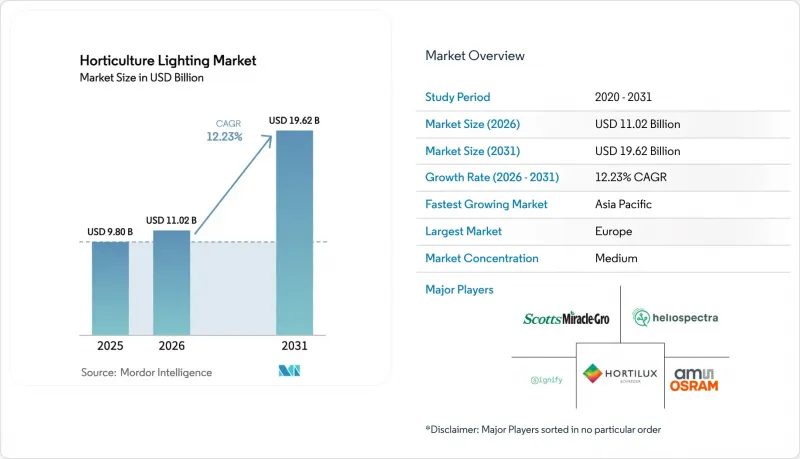
본 보고서는 조명 기술(LED, HID, 형광등, 플라즈마, 기타), 제공 형태(하드웨어, 소프트웨어, 서비스), 설치 유형별(신규 설치, 개조 설치), 재배 유형별(채소 및 과일, 잎채소, 베리류, 토마토 및 피망, 화초, 대마, 기타), 용도(온실, 기타), 지역별로 분류되어 있습니다. 시장 예측은 금액(달러) 기준으로 제시되어 있습니다.
전 세계 원예용 조명 시장 동향 및 인사이트
북미의 대마 재배에서 정밀하게 조정된 LED 스펙트럼이 칸나비노이드 수확량을 향상시키고 있습니다.
대마 재배업자들은 광대역 메탈 할라이드 램프에서 680-730nm의 원적외선 파장을 방출하는 LED 조명 기구로 전환하고 있으며, 이를 통해 THC와 CBD 농도가 12-18% 향상되고 폐열이 40-50% 감소하고 있습니다. 이 부문은 2025년에 15억 달러 규모 시장에 도달할 전망이며, 미국에서 의료용 및 성인용 대마초 판매를 합법화하는 주가 늘어남에 따라 연평균 15%의 성장률을 보이고 있습니다. 조명 기기 공급업체인 Fluence와 California LightWorks가 대규모 시설 시장을 장악하는 한편, Black Dog LED의 모듈식 시스템은 예산에 민감한 소규모 생산자들의 지지를 얻고 있습니다. 연방 정부의 대마 규제 분류 재검토로 인해 2028년 이후 여러 주에 걸친 시장 확대가 가속화될 가능성이 있습니다.
아시아 메가시티의 도시 지역 식량 안보 프로그램으로 인한 수직 농장 조명 수요 가속화
싱가포르는 ‘30 by 30’ 계획의 일환으로 식량 안보 강화와 수입 의존도 감소를 도모하기 위해 2024년에 2억 싱가포르 달러(1억 4,800만 달러)를 배정했습니다. 한편, 도쿄는 2025년 시내에서 지속 가능한 농업 실천을 촉진하기 위해 도시 농업 사업에 대한 보조금으로 50억 엔(3,300만 달러)을 편성했습니다. 서울의 스마트팜 혁신 센터는 3.1 마이크로미터 ol J-1이라는 놀라운 광효율을 자랑하는 삼성의 LM301H LED를 채택하여 12헥타르 규모의 완전 밀폐형 농장을 가동했습니다. 제곱미터당 150-250달러 상당의 조명 기구를 갖춘 이 첨단 농업 시스템은 연간 10-15회의 수확을 실현하고 있습니다. 이러한 높은 생산성 덕분에 조명 설비의 투자 회수 기간은 4년 이하로 단축되어, 이러한 기술에 대한 투자는 경제적으로도 실현 가능하고 효율적입니다.
알루미늄과 희토류의 급격한 가격 급등이 고출력 LED 조명 기구의 이익률을 압박
2025년에는 알루미늄의 평균 가격이 톤당 2,580달러까지 상승했으며, 이 급격한 가격 상승으로 인해 LED 조명 기구 1대당 부품 원가가 6-10달러 증가했습니다. 이러한 비용 급등으로 인해 제조업체의 매출 총이익률이 최대 12%나 축소되는 등 심각한 압박이 발생했습니다. 또한, 중국의 엄격한 수출 할당량 시행은 희토류 원소 시장에 큰 영향을 미쳤습니다. 이러한 규제로 인해 유로퓸 산화물과 테르븀 산화물의 가격이 30% 상승하여 LED 형광체 공급업체에 추가적인 압박을 가하고, 사업 운영을 더욱 복잡하게 만들었습니다.
부문별 분석
2025년, LED 시스템은 원예용 조명 시장에서 86.13%의 점유율을 차지할 것으로 예상되며, 이는 HID 램프에 비해 40-50%의 지속적인 에너지 절약 효과를 반영한 것입니다. 플라즈마 및 기타 대체 기술을 활용한 원예용 조명 시장 규모는 연구 기관들이 380-780nm의 연속 스펙트럼을 높이 평가하고 있는 만큼, 연평균 성장률(CAGR) 12.41%로 확대될 것으로 전망됩니다. LED 조명 기구의 비용은 1제곱미터당 80-150달러까지 하락했으며, 실리콘 기판 위의 질화갈륨(GaN-on-Si) 로드맵에 따르면 2028년까지 추가적인 가격 하락이 예상됩니다.
LED 기술 혁신은 10채널 조절형 어레이로 전환되고 있습니다. 그 대표적인 예가 2024년에 출시된 Heliospectra의 MITRA X 플랫폼으로, 1%의 스펙트럼 분해능으로 일출부터 일몰까지의 변화를 재현합니다. 대당 800-1,200달러에 달하는 플라즈마 시스템은 설비 투자 비용이 높음에도 불구하고, 수익성이 높은 대마초 및 절화 재배 사업에 점차 보급되고 있습니다. 구형 온실에서는 여전히 8-10%의 점유율을 유지하고 있는 HID 램프이지만, EU의 에코디자인 규제로 인해 전구 공급이 부족해지면서 인기가 떨어지고 있습니다.
2025년 매출에서 하드웨어가 차지하는 비중은 71.52%였으나, LED 패키지 가격 하락으로 인해 평균 판매 가격은 연간 6-8%씩 하락하고 있습니다. LumiGrow의 smartPAR Cloud와 같은 플랫폼이 광자 효율 최적화에 대해 1제곱미터당 연간 2-5달러를 과금하고 있어, 소프트웨어 및 서비스 부문은 연평균 성장률(CAGR) 12.53%로 확대되고 있습니다. 이러한 SaaS 이용료는 새로운 수직 농장 프로젝트에서 이미 프로젝트 총액의 12-18%를 차지하고 있습니다.
드라이버 전자 기기에는 현재 Bluetooth LE 및 Zigbee 무선 기능이 내장되어 있어 유선식 DALI 인프라가 불필요해졌으며, 설치 비용이 1미터당 8-12달러 절감되고 있습니다. Deere Infinite Vertical이 선구적으로 도입한 Energy-savings-as-a-Service 모델 덕분에 조명 기기는 생산자의 대차대조표에 계상되지 않게 되었지만, 측정 및 검증과 관련된 법적 복잡성으로 인해 이 모델의 채택은 연간 매출 1,000만 달러 이상의 사업자에 국한되고 있습니다.
지역별 분석
2025년에는 유럽이 32.94%의 점유율을 차지하며 주도적인 위치를 확립했습니다. 이는 독일이나 프랑스 등 국가에서 ‘Fit-for-55’ 보조금을 통해 LED로 개조하는 데 드는 설비 투자의 40%가 지원되고 있기 때문입니다. 네덜란드의 10,000헥타르에 달하는 난방 온실은 2024년에 4.5TWh의 전력을 소비했으며, LED를 통한 40-50%의 에너지 절감 효과는 경제적으로 매우 매력적입니다. 스페인 알메리아의 플라스틱 하우스 재배 부문은 연중 자연광만으로도 충분하기 때문에 도입 속도가 완만하지만, LED와 기후 제어를 결합한 파일럿 알고리즘을 통해 18개월 만에 투자 회수가 가능해졌습니다.
아시아태평양은 연평균 성장률(CAGR) 13.42%를 기록하며 가장 빠르게 성장하는 지역이 될 전망입니다. 중국에서는 120만 헥타르에 달하는 보호 재배 원예 분야에서 토지 제약을 보완하기 위해 LED 도입을 확대하고 있는 반면, 싱가포르에서는 2024년 이후 수직 농장에 2억 싱가포르 달러(1억 4,800만 달러)를 투자하고 있습니다. 일본의 도시형 농장에는 연간 50억 엔(3,300만 달러)의 보조금이 지급되고 있으며, 인도의 25% 관세는 0-5%의 관세율을 적용하는 아세안(ASEAN) 인근 국가들에 비해 비용을 상승시키고 있습니다. 호주가 중국산 드라이버에 부과하고 있는 반덤핑 관세로 인해, 주문은 12-18%의 가격 할증이 적용되는 한국 공급업체로 흘러가고 있습니다.
2025년에는 북미가 시장 점유율의 약 30%를 차지했습니다. 같은 해 미국의 대마초 재배용 조명 시장은 15억 달러에 달했으며, 캐나다에서는 2,800헥타르 규모의 온실에서 천연가스 가격 변동에 따라 LED로의 급속한 전환이 진행되고 있습니다. 멕시코의 1,800헥타르 규모 토마토 온실에서는 2024년부터 2025년에 걸쳐 인터라이팅이 도입되어 수확량이 18-25% 증가했습니다. 사우디아라비아, 아랍에미리트, 카타르는 수입 의존도를 85-90% 줄이기 위해 태양광 발전식 LED 농장에 총 3억 2,000만 달러를 투자했습니다.
기타 혜택
- 엑셀 형식 시장 예측(ME) 시트
- 3개월간의 애널리스트 지원
자주 묻는 질문
목차
제1장 서론
제2장 조사 방법
제3장 주요 요약
제4장 시장 구도
제5장 시장 규모와 성장 예측
제6장 경쟁 구도
제7장 시장 기회와 향후 전망
LSH 26.08.26According to Mordor Intelligence, the horticultural lighting market size is projected to expand from USD 9.80 billion in 2025 and USD 11.02 billion in 2026 to USD 19.62 billion by 2031, registering a 12.23% CAGR between 2026 and 2031.
This report is Segmented by Lighting Technology (LED, HID, Fluorescent, Plasma, and More), Offering (Hardware, Software and Services), Installation Type (New, and Retrofit), Cultivation (Vegetables and Fruits, Leafy Greens, Berries, Tomatoes and Peppers, Flowers, Cannabis, and More), Application (Greenhouses, and More), and Geography. Market Forecasts are Provided in Terms of Value (USD).
Global Horticulture Lighting Market Trends and Insights
Precision-Tuned LED Spectra Raising Cannabinoid Yield In North American Cannabis Grows
Cannabis growers are shifting from broad-spectrum metal-halide lamps to LED fixtures emitting 680-730 nm far-red wavelengths, boosting THC and CBD concentrations by 12-18 percent and cutting waste heat by 40-50 percent. The segment, valued at USD 1.5 billion in 2025, is growing at 15% annually as additional U.S. states legalize medical and adult-use sales. Fixture vendors Fluence and California LightWorks dominate large facilities, while modular systems from Black Dog LED are winning budget-sensitive craft operators. Federal rescheduling could accelerate multi-state expansion beyond 2028.
Urban Food-Security Programs Accelerating Vertical-Farm Lighting Demand Across Asian Megacities
Under its "30 by 30" plan, Singapore allocated SGD 200 million (USD 148 million) in 2024 to enhance its food security and reduce reliance on imports. Meanwhile, in 2025, Tokyo set aside JPY 5 billion (USD 33 million) to subsidize urban agriculture initiatives, aiming to promote sustainable farming practices within the city. Seoul's Smart Farm Innovation Center rolled out 12 hectares of fully enclosed farms, utilizing Samsung's LM301H LEDs, which boast an impressive efficacy of 3.1 µmol J-1. These advanced farming systems, equipped with lighting fixtures priced between USD 150-250 m2, achieve 10-15 harvests annually. This high productivity ensures a lighting payback period of under four years, making the investment in such technology economically viable and efficient.
Acute Aluminium And Rare-Earth Cost Inflation Squeezing High-Power LED Fixture Margins
In 2025, average aluminium prices climbed to USD 2,580 per tonne, marking a significant increase that led to a rise of USD 6-10 in fixture bills of materials per unit. This surge in costs resulted in a notable compression of manufacturers' gross margins, reducing them by as much as 12 percentage points. Furthermore, the implementation of stringent export quotas by China significantly impacted the market for rare earth elements. These restrictions drove prices of europium and terbium oxides up by 30 percent, thereby exerting additional pressure on suppliers of LED phosphors and further complicating their operational dynamics.
Other drivers and restraints analyzed in the detailed report include:
- EU Fit-for-55 Energy Directives Incentivising LED Retrofits In Heated Glass Greenhouses
- Surge In Off-Grid Micro-Powered CEA Solutions For Desert Farming In GCC Countries
- Fragmented Regional Import Tariffs Complicating Fixture Price Parity For Asia-Pacific Growers
For complete list of drivers and restraints, kindly check the Table Of Contents.
Segment Analysis
LED systems held 86.13% of horticultural lighting market share in 2025, reflecting sustained 40-50 percent energy savings versus HID lamps. The horticultural lighting market size for plasma and other alternatives is projected to advance at a 12.41% CAGR as research facilities value their continuous 380-780 nm spectra. LED fixture costs have declined to USD 80-150 m-2, and gallium-nitride-on-silicon roadmaps suggest further price drops by 2028.
LED innovation is shifting toward 10-channel tunable arrays, typified by Heliospectra's MITRA X platform released in 2024, which recreates sunrise-to-sunset transitions with 1 percent spectral granularity. Plasma systems priced at USD 800-1 200 per unit are penetrating high-margin cannabis and cut-flower operations despite higher capex. HID lamps, still clinging to 8-10 percent share in older greenhouses, are falling out of favor as bulb supply tightens under EU Ecodesign rules.
Hardware contributed 71.52% of 2025 revenue, yet falling LED package prices are shrinking average selling prices by 6-8 percent yearly. Software and services are expanding at 12.53% CAGR as platforms such as LumiGrow smartPAR Cloud charge USD 2-5 m-2 yr-1 for photon efficacy optimization. These SaaS fees already represent 12-18 percent of total project value in new vertical farms.
Driver electronics now embed Bluetooth LE and Zigbee radios, eliminating hard-wired DALI infrastructure and reducing installation labor USD 8-12 per linear meter. Energy-savings-as-a-service models pioneered by Deere Infinite Vertical keep fixtures off growers' balance sheets, although legal complexities around measurement and verification confine adoption to operators above USD 10 million annual revenue.
Complete Report Scope:
- By Lighting Technology
- LED
- HID
- Fluorescent
- Plasma and Others
- By Offering
- Hardware (Fixtures, Drivers, Controls)
- Software and Services
- By Installation Type
- New Installations
- Retrofit Installations
- By Cultivation
- Vegetables and Fruits
- Leafy Greens and Micro-Greens
- Berries
- Tomatoes and Peppers
- Flowers and Ornamentals
- Cannabis and Specialty Crops
- Other Crops
- By Application
- Greenhouses
- Indoor and Vertical Farms
- Research/Academic Facilities
- Aquaponics and Container Farms
- By Geography
- North America
- United States
- Canada
- Mexico
- South America
- Brazil
- Argentina
- Rest of South America
- Europe
- Germany
- United Kingdom
- France
- Italy
- Spain
- Rest of Europe
- Asia Pacific
- China
- Japan
- South Korea
- India
- Australia
- New Zealand
- Rest of Asia-Pacific
- Middle East and Africa
- Middle East
- United Arab Emirates
- Saudi Arabia
- Turkey
- Rest of Middle East
- Africa
- South Africa
- Nigeria
- Kenya
- Rest of Africa
- Middle East
- North America
Geography Analysis
Europe dominated with 32.94 percent share in 2025 as Fit-for-55 subsidies cover 40 percent of LED retrofit capex in countries such as Germany and France. Netherlands' 10 000 ha of heated glasshouses consumed 4.5 TWh in 2024, making energy savings of 40-50 percent through LEDs financially compelling. Spain's Almeria plastics sector is less aggressive because natural light suffices most of the year, but pilot LED-climate algorithms delivered 18-month paybacks.
Asia-Pacific will be the fastest-growing region at 13.42% CAGR. China's 1.2 million ha of protected horticulture is scaling LEDs to offset land limits, while Singapore pumped SGD 200 million (USD 148 million) into vertical farms since 2024. Japanese urban farms receive JPY 5 billion (USD 33 million) in annual subsidies, and India's 25 percent tariff raises costs versus ASEAN neighbors with 0-5 percent duties. Australia's anti-dumping tariffs on Chinese drivers divert orders to Korean suppliers at 12-18 percent mark-ups.
North America accounted for roughly 30 percent share in 2025. United States cannabis lighting reached USD 1.5 billion that year, and Canada's 2 800 ha of glasshouses are rapidly retrofitting LEDs under volatile natural-gas prices. Mexico's 1 800 ha of tomato greenhouses fitted interlighting in 2024-2025, gaining 18-25 percent yield bumps. Saudi Arabia, UAE, and Qatar together invested USD 320 million in solar-powered LED farms to cut 85-90 percent import dependence.
- Signify Holding
- ams OSRAM AG
- Fluence Bioengineering (Scotts Miracle-Gro)
- Heliospectra AB
- Hortilux Schreder
- Gavita International BV
- Valoya Oy
- LumiGrow Inc.
- Samsung Electronics Co. Ltd.
- LG Innotek
- Cree LED (SMART Global)
- Current Lighting Solutions
- Everlight Electronics
- Hort Americas LLC
- B-Light Group
- California LightWorks
- Agrolux Nederland BV
- Illumitex Inc.
- Deere and Co. (Infinite Vertical)
- Nanolux Technology
Additional Benefits:
- The market estimate (ME) sheet in Excel format
- 3 months of analyst support
TABLE OF CONTENTS
1 INTRODUCTION
- 1.1 Study Assumptions and Market Definition
- 1.2 Scope of the Study
2 RESEARCH METHODOLOGY
3 EXECUTIVE SUMMARY
4 MARKET LANDSCAPE
- 4.1 Market Overview
- 4.2 Market Drivers
- 4.2.1 Precision-tuned LED Spectra Raising Cannabinoid Yield in North American Cannabis Grows
- 4.2.2 Urban Food-Security Programs Accelerating Vertical-Farm Lighting Demand Across Asian Megacities
- 4.2.3 EU "Fit-for-55" Energy Directives Incentivising LED Retrofits in Heated Glass Greenhouses
- 4.2.4 Surge in Off-Grid Micro-Powered CEA Solutions for Desert Farming in Gulf Cooperation Council Countries
- 4.2.5 Corporate ESG-Linked Green Bonds Funding Large-Scale Horticultural Greenhouse LED Roll-Outs
- 4.2.6 Cloud-Based Spectral Analytics Optimising Photosynthetic Photon Efficacy in Controlled-Environment Facilities
- 4.3 Market Restraints
- 4.3.1 Acute Aluminium and Rare-Earth Cost Inflation Squeezing High-Power LED Fixture Margins
- 4.3.2 Fragmented Regional Import Tariffs Complicating Fixture Price Parity for Asia-Pacific Growers
- 4.3.3 Photobiological Safety Compliance Costs Delaying Spectrum-Tuning Product Launches in EU
- 4.3.4 Limited DALI/KNX Interoperability Curbing Smart-Lighting Adoption in Legacy Greenhouses
- 4.4 Industry Value-Chain Analysis
- 4.5 Regulatory Landscape
- 4.6 Technological Outlook
- 4.7 Porter's Five Forces Analysis
- 4.7.1 Bargaining Power of Buyers
- 4.7.2 Bargaining Power of Suppliers
- 4.7.3 Threat of New Entrants
- 4.7.4 Threat of Substitutes
- 4.7.5 Competitive Rivalry
5 MARKET SIZE AND GROWTH FORECASTS (VALUE)
- 5.1 By Lighting Technology
- 5.1.1 LED
- 5.1.2 HID
- 5.1.3 Fluorescent
- 5.1.4 Plasma and Others
- 5.2 By Offering
- 5.2.1 Hardware (Fixtures, Drivers, Controls)
- 5.2.2 Software and Services
- 5.3 By Installation Type
- 5.3.1 New Installations
- 5.3.2 Retrofit Installations
- 5.4 By Cultivation
- 5.4.1 Vegetables and Fruits
- 5.4.2 Leafy Greens and Micro-Greens
- 5.4.3 Berries
- 5.4.4 Tomatoes and Peppers
- 5.4.5 Flowers and Ornamentals
- 5.4.6 Cannabis and Specialty Crops
- 5.4.7 Other Crops
- 5.5 By Application
- 5.5.1 Greenhouses
- 5.5.2 Indoor and Vertical Farms
- 5.5.3 Research/Academic Facilities
- 5.5.4 Aquaponics and Container Farms
- 5.6 By Geography
- 5.6.1 North America
- 5.6.1.1 United States
- 5.6.1.2 Canada
- 5.6.1.3 Mexico
- 5.6.2 South America
- 5.6.2.1 Brazil
- 5.6.2.2 Argentina
- 5.6.2.3 Rest of South America
- 5.6.3 Europe
- 5.6.3.1 Germany
- 5.6.3.2 United Kingdom
- 5.6.3.3 France
- 5.6.3.4 Italy
- 5.6.3.5 Spain
- 5.6.3.6 Rest of Europe
- 5.6.4 Asia Pacific
- 5.6.4.1 China
- 5.6.4.2 Japan
- 5.6.4.3 South Korea
- 5.6.4.4 India
- 5.6.4.5 Australia
- 5.6.4.6 New Zealand
- 5.6.4.7 Rest of Asia-Pacific
- 5.6.5 Middle East and Africa
- 5.6.5.1 Middle East
- 5.6.5.1.1 United Arab Emirates
- 5.6.5.1.2 Saudi Arabia
- 5.6.5.1.3 Turkey
- 5.6.5.1.4 Rest of Middle East
- 5.6.5.2 Africa
- 5.6.5.2.1 South Africa
- 5.6.5.2.2 Nigeria
- 5.6.5.2.3 Kenya
- 5.6.5.2.4 Rest of Africa
- 5.6.5.1 Middle East
- 5.6.1 North America
6 COMPETITIVE LANDSCAPE
- 6.1 Market Concentration
- 6.2 Strategic Moves
- 6.3 Market Share Analysis
- 6.4 Company Profiles (includes Global Level Overview, Market Level Overview, Core Segments, Financials as available, Strategic Information, Market Rank/Share, Products and Services, Recent Developments)
- 6.4.1 Signify Holding
- 6.4.2 ams OSRAM AG
- 6.4.3 Fluence Bioengineering (Scotts Miracle-Gro)
- 6.4.4 Heliospectra AB
- 6.4.5 Hortilux Schreder
- 6.4.6 Gavita International BV
- 6.4.7 Valoya Oy
- 6.4.8 LumiGrow Inc.
- 6.4.9 Samsung Electronics Co. Ltd.
- 6.4.10 LG Innotek
- 6.4.11 Cree LED (SMART Global)
- 6.4.12 Current Lighting Solutions
- 6.4.13 Everlight Electronics
- 6.4.14 Hort Americas LLC
- 6.4.15 B-Light Group
- 6.4.16 California LightWorks
- 6.4.17 Agrolux Nederland BV
- 6.4.18 Illumitex Inc.
- 6.4.19 Deere and Co. (Infinite Vertical)
- 6.4.20 Nanolux Technology
7 MARKET OPPORTUNITIES AND FUTURE OUTLOOK
- 7.1 White-Space and Unmet-Need Assessment