
|
시장보고서
상품코드
2114449
유지·보수·운영(MRO) : 시장 점유율 분석, 업계 동향 및 통계, 성장 예측(2026-2031년)Maintenance, Repair, And Operations (MRO) - Market Share Analysis, Industry Trends & Statistics, Growth Forecasts (2026 - 2031) |
||||||
 Mordor Intelligence
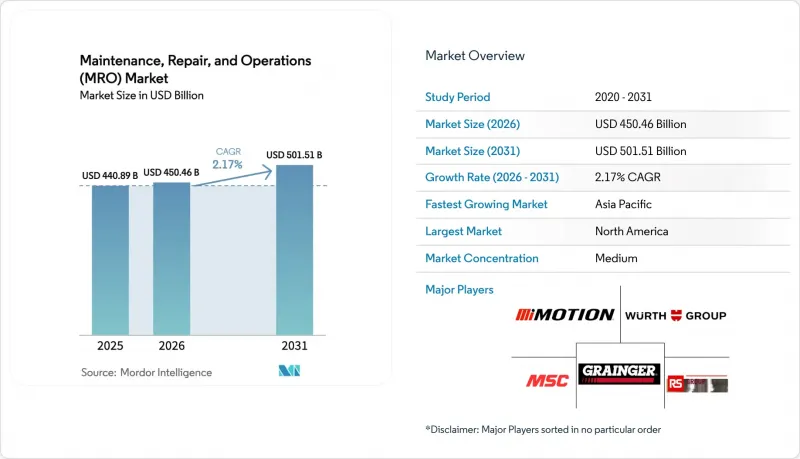
Mordor Intelligence에 의하면, 유지·보수·운영(MRO) 시장 규모는 2025년에 4,408억 9,000만 달러, 2026년에 4,504억 6,000만 달러에 이르고, 2031년까지 5,015억 1,000만 달러에 이를 것으로 예측되며, 2026-2031년 CAGR2.17%를 기록할 전망입니다.
본 보고서는 MRO 유형(산업, 전기, 기타), 최종 이용 산업(제조업, 에너지·유틸리티, 기타), 조달 모델(사내, 외부 위탁, 기타), 유지보수 방식(예방 유지보수, 시정 유지보수, 예측 유지보수), 유통 채널(오프라인, 온라인, 기타), 지역별로 분류되어 있습니다. 시장 전망은 금액(달러) 기준으로 제시되어 있습니다.
세계 유지보수·수리·운영(MRO) 시장 동향 및 인사이트
인더스트리 4.0을 활용한 스마트 팩토리 도입 확대
현재 자동화된 생산 라인에는 센서, 엣지 게이트웨이, 클라우드 분석이 통합되어 있어, 이들 기술은 사람의 개입 없이 유지보수 작업 지시를 실행합니다. 2025년 조사에 따르면, 북미와 유럽의 이산형 제조업체 중 62%가 적어도 하나의 예측 유지보수 솔루션을 도입하고 있으며, 투자 회수 기간의 중앙값은 14개월입니다. 자동차 및 반도체 제조 시설에서는 가동 중단으로 인한 시간당 비용이 50만 달러에서 200만 달러에 달할 것으로 추정되며, 그 결과 진동 센서, 열화상 카메라, 고급 분석 도구에 대한 수요가 증가하고 있습니다. 지멘스(Siemens)는 2025년 자사의 MindSphere 플랫폼에서 120만 건의 연결 자산을 보고했으며, 전체 사용자 사이트에서 평균 수리 시간을 18% 단축했습니다. 이러한 추세로 인해 유통업체에 대한 기술적 요구 사항이 높아지고 있으며, 범용 부품 외에도 통합 지원 제공이 요구되고 있습니다. 센서 밀도가 높아짐에 따라 MRO(유지보수·수리·운영) 시장은 정기적인 교체 및 교정 수요로 인해 꾸준한 호재를 누리고 있습니다.
공급망 회복탄력성 강화 노력에 따른 MRO 재고 확충
팬데믹 이후의 조달 전략에서는 안전 재고 수준 제고와 중요 예비 부품에 대한 복수 공급처와의 계약 체결이 중시되고 있습니다. 공급관리협회(ISM) 보고서에 따르면, 2024년에는 북미 제조업체의 58%가 현장 재고를 20-40% 증가시켰습니다. 그 결과, VMI(공급업체 관리 재고) 플랫폼을 보유한 유통업체들은 고객이 보유 비용을 대차대조표에서 제외하게 됨에 따라 계약 건수와 평균 주문액을 증가시켰습니다. W.W. 그레인저(W.W. Grainger)사의 ‘KeepStock’ 프로그램은 2025년에 고객 기반을 12% 확대하며, 회복탄력성에 대한 요구와 서비스 주도형 모델 간의 연관성을 부각시켰습니다. 현지 재고 보유와 신속한 주문 이행은 공장을 지정학적 충격으로부터 보호하는 역할도 수행하고 있으며, 지점망의 밀도와 디지털 예측 도구를 결합한 공급업체에 대한 고객의 선호도를 높이고 있습니다.
숙련 기술자의 만성적인 부족
미국 노동통계청의 조사에 따르면, 2025년 산업용 유지보수 작업원의 28%가 55세 이상인 반면, 25세 이하는 12% 미만이었습니다. 기술자의 임금 중앙값은 전년 대비 8% 상승하여 일반적인 임금 상승률을 상회하는 속도로 올랐기 때문에 유지보수 예산이 압박받고 있습니다. 인력 부족으로 인해 공장에서는 예방 유지보수 작업을 미룰 수밖에 없는 상황이 빈번하게 발생하고 있으며, 그 결과 고액의 사후 대응형 수리를 감수해야 할 뿐만 아니라, 예측 유지보수 플랫폼의 활용도 어려워지고 있습니다. PLC, VFD, IIoT 관련 기술을 습득하기 위한 양성 체계는 여전히 불충분하며, 이러한 제약은 장기적인 전망에서도 지속될 것으로 보입니다.
부문별 분석
산업용 부품은 2025년 매출의 44.12%를 차지하며, 유지보수·수리·운영(MRO) 시장의 핵심으로서의 역할을 확고히 했습니다. 베어링, 펌프, 기어박스, 유압 기기는 모든 중공업 부문에 걸쳐 있기 때문에 경기 침체기에도 베이스로드 수요는 견조한 추세를 보이고 있습니다. 애프터마켓에서의 펌프 재제조 및 컨베이어 체인 교체가 재구매를 견인한 한편, 광업 및 시멘트 제조업체와의 지역 밀착형 공급 계약을 통해 높은 수익률을 보이는 지속적인 서비스 수익이 창출되었습니다. 유통업체는 전문 수리 공장을 설립하고 사내 기계 가공 및 밸런스 조정이 가능하도록 함으로써, 단순한 부품 판매에 그치지 않는 고객 관계 구축을 실현했습니다. 한편, 전력 계통 사업자와 산업 단지가 개폐 장치, 변압기, 모터 제어 센터의 현대화를 추진하는 가운데, 전기 부품 시장은 연평균 성장률(CAGR) 3.91%로 성장하고 있습니다. 미국 에너지부는 2024년 현재 국내 전력 변압기의 70%가 25년 이상 경과했다고 지적하고 있으며, 이로 인해 고장 위험이 높아지고 교체 주기가 단축되고 있습니다. 재생에너지의 통합으로 인해 아크 플래시 대응 장비, 인버터용 케이블, 상태 모니터링용 릴레이에 대한 수요가 더욱 높아지고 있습니다.
시설의 MRO용 필터, 조명, 청소 용품은 경기 침체기에 생산 가동 시간을 저해하지 않고 지출을 미룰 수 있기 때문에 필수적이긴 하지만 성장 속도는 비교적 완만합니다. 안전 장비 및 개인보호구(PPE)는 열 위험 완화 계획을 의무화하는 새로운 ‘국가 중점 프로그램(NEP)’ 지침을 포함한 더욱 엄격해진 노동 규정의 혜택을 받고 있습니다. 판매업체들은 진동 센서 패키지에 정렬 도구 및 특수 윤활제를 결합한 것 등 여러 카테고리에 걸친 키트를 묶음 판매하는 사례가 증가하고 있으며, 이를 통해 구매 단위의 규모를 확대하고 조달 프로세스의 복잡성을 최소화하고 있습니다.
자동차, 식음료, 항공우주 각 생산 라인의 24시간 가동으로 인해 제조업은 2025년 총 소비액의 31.28%를 차지했습니다. 로봇 도입 확대와 자동화 밀도 향상에 따라 서보 모터, 비전 시스템, 로봇용 기어박스용 예비 부품 재고가 증가하고 있습니다. 한편, 의료 분야의 지출은 연평균 성장률(CAGR) 4.73%로 증가하고 있습니다. 병원 확장 및 외래수술센터(ASC) 개설에 따라 최신 감염 관리 기준을 준수하는 새로운 공조(HVAC), 여과, 멸균 시스템이 요구되고 있습니다. 2000년 이전에 건설된 노후화된 시설에서는 공조 장치 개보수, HEPA 필터 도입, UV-C 조명 설치가 이루어지고 있으며, 이에 따라 필터와 벨트의 정기적인 유지보수 주기가 연장되고 있습니다.
터빈의 대수리나 변전소 개보수는 필수적이기 때문에 에너지·유틸리티 부문의 구매는 견조한 추세를 보이고 있습니다. 항공우주 및 방위 부문의 애프터마켓 수요는 호조를 보이고 있습니다. 이는 군용기가 대규모 구조 보수를 통해 기체의 수명을 연장하는 한편, 민간 항공사가 노후된 협폭기체를 객실 개조 프로그램의 대상으로 삼고 있기 때문입니다. 인프라 정비에 대한 경기 부양책을 호재로 삼고 있는 건설사들은 유압 호스 키트와 절삭 공구의 신속한 납기를 중시하고 있으며, 이러한 제품들은 대개 현지 지사에서 현장에서 조립하고 있습니다.
지역별 분석
북미는 2025년 전 세계 매출의 34.86%를 차지했습니다. 이는 다양화된 산업 기반, 견고한 에너지 인프라, 그리고 대부분의 공장에 당일 배송을 가능하게 하는 지점망의 밀도가 뒷받침한 결과입니다. ‘CHIPS·과학법’과 ‘인플레이션 억제법’에 따라 반도체 및 청정 에너지 부문에 4,200억 달러가 넘는 투자가 유치되었으며, 공장 건설 시에는 건설용 MRO(유지보수·수리·운영)에 대한 새로운 수요가 발생하고, 생산이 본격화되면 전기 부품 예비품에 대한 수요가 증가하고 있습니다. 그러나 숙련된 노동력 부족은 심각한 수준이며, 이는 임금 상승을 초래할 뿐만 아니라 자동화를 지원하는 유지보수 도구에 대한 투자를 촉진하고 있습니다.
2025년 지출 중 약 28%를 유럽이 차지했으며, 독일, 프랑스, 영국이 이를 주도했습니다. ‘기업 지속가능성 보고 지침(CSRD)’의 규정에 따라 기업은 에너지 소비량과 스코프 1-3 배출량을 정량화해야 할 의무가 있으며, 이에 따라 모터, 조명, HVAC 시스템의 개조가 가속화되고 있습니다. 2022년 이후의 제재 조치로 인해 공급 경로가 러시아에서 전환되면서, 튀르키예와 중동의 현지 재고에 대한 수요가 증가했습니다. 폴란드와 루마니아를 포함한 동유럽에서는 새로운 자동차 및 전자기기 공장이 유치되고 있어, 지역 MRO 유통업체에 힘을 실어주고 있습니다.
아시아태평양은 연평균 성장률(CAGR) 5.86%를 기록하며 가장 빠르게 성장하고 있는 지역입니다. 중국 공업정보화부는 2025년에 42만 건의 반도체 제조 장비 설치를 기록했으며, 이는 초순수용 막, 클린룸용 필터, 약액 공급 호스의 구매를 촉진하고 있습니다. 인도의 1조 4,000억 달러 규모의 ‘국가 인프라 계획’에 힘입어 중장비의 가동은 유지되고 있으며, 동남아시아에서는 비용이 높은 지역에서의 전자기기 조립 이전이 호재로 작용하고 있습니다. 일본과 한국의 고도화된 자동화 도입이 상태 모니터링 시장 수요를 뒷받침하는 한편, 호주의 광업 부문은 고부하용 유압 부품 및 동력 전달 부품에 의존하고 있습니다.
중동 및 아프리카는 절대적인 규모로는 여전히 작지만, 현지 공급이 제한적이기 때문에 매력적인 수익률을 제공합니다. 사우디아라비아의 공공투자기금은 산업 다각화를 위해 1,000억 달러의 예산을 편성했으며, 이로 인해 공정용 펌프 및 전기 기기 예비 부품에 대한 수요가 견인되고 있습니다. 남아프리카의 지하 광업은 내마모성 밸브와 컨베이어 롤러에 대한 안정적인 수요를 창출하고 있는 반면, 케냐의 인프라 구축 지연은 콘크리트 배치 플랜트용 예비 부품의 급속한 판매를 뒷받침하고 있습니다. 라틴아메리카의 물량은 적지만, 상품 주기의 변동이나 환율 변동의 영향을 받기 쉬워 변동이 심한 경향이 있습니다. 브라질의 유통업체는 통화 약세 위험을 줄이기 위해 재고 헤지 수단으로 달러 표시 계약을 체결하는 경우가 많습니다.
기타 혜택
- 엑셀 형식 시장 예측(ME) 시트
- 3개월간의 애널리스트 지원
자주 묻는 질문
목차
제1장 서론
제2장 조사 방법
제3장 주요 요약
제4장 시장 구도
제5장 시장 규모와 성장 예측
제6장 경쟁 구도
제7장 시장 기회와 향후 전망
LSH 26.08.26According to Mordor Intelligence, the maintenance, repair, and operations market size is projected to be USD 440.89 billion in 2025, USD 450.46 billion in 2026, and reach USD 501.51 billion by 2031, growing at a CAGR of 2.17% from 2026 to 2031.
This report is Segmented by MRO Type (Industrial, Electrical, and More), End-Use Industry (Manufacturing, Energy and Utilities, and More), Sourcing Model (In-House, Outsourced, and More), Maintenance Approach (Preventive, Corrective, and Predictive), Distribution Channel (Offline, Online, and More), and Geography. The Market Forecasts are Provided in Terms of Value (USD).
Global Maintenance, Repair, And Operations (MRO) Market Trends and Insights
Rising Adoption of Industry 4.0-Enabled Smart Factories
Automated production lines now integrate sensors, edge gateways, and cloud analytics that trigger maintenance work orders without human intervention. A 2025 survey revealed that 62% of discrete manufacturers in North America and Europe have at least one predictive-maintenance deployment, with a median payback period of 14 months. Automotive and semiconductor facilities view downtime as incurring an hourly cost of USD 500,000 to USD 2 million, resulting in a rising demand for vibration sensors, thermal cameras, and advanced analytics. Siemens reported 1.2 million connected assets on its MindSphere platform in 2025, cutting mean time to repair by 18% across user sites. These dynamics raise the technical requirements for distributors, who must provide integration support in addition to commodity parts. As sensor density climbs, the maintenance, repair, and operations market gains a steady tailwind from recurring replacement and calibration needs.
Supply-Chain Resiliency Programs Boosting MRO Stocking
Post-pandemic procurement strategies emphasize higher safety-stock levels and multisource contracts for critical spares. The Institute for Supply Management reported that 58% of North American manufacturers lifted on-site inventories by 20-40% in 2024. Distributors with vendor-managed inventory platforms consequently grew contract counts and average order values as clients shifted carrying costs off the balance sheet. W.W. Grainger's KeepStock program expanded its customer base 12% in 2025, underscoring the linkage between resiliency mandates and service-based models. Local stocking and faster fulfillment also insulate plants from geopolitical shocks, reinforcing client preference for suppliers that blend branch density with digital forecasting tools.
Persistent Skilled-Technician Shortages
The U.S. Bureau of Labor Statistics found that 28% of industrial maintenance workers were 55 years or older in 2025, while fewer than 12% were under 25. Median wages for technicians rose 8% year-over-year, outpacing broader pay trends and eroding maintenance budgets. Unfilled roles often force plants to defer preventive tasks, exposing them to expensive reactive repairs and making it harder to capitalize on predictive-maintenance platforms. Training pipelines for PLC, VFD, and IIoT competencies remain constrained, extending this restraint into the long-term horizon.
Other drivers and restraints analyzed in the detailed report include:
- Shift Toward Predictive Maintenance and IIoT Sensors
- E-Commerce Penetration in B2B MRO Distribution
- Inflation-Driven Price Volatility of Industrial Inputs
For complete list of drivers and restraints, kindly check the Table Of Contents.
Segment Analysis
Industrial components generated 44.12% of 2025 revenue, cementing their role as the backbone of the maintenance, repair, and operations market. Bearings, pumps, gearboxes, and hydraulics span every heavy-industrial vertical, so base-load demand remains sticky even during economic slowdowns. Aftermarket pump rebuilds and conveyor-chain replacements drove repeat sales, while localized supply agreements with mining and cement producers created high-margin service annuities. Distributors built specialized repair shops, enabling in-house machining and balancing that anchor customer relationships beyond simple parts sales. Meanwhile, electrical parts are growing at a 3.91% CAGR as grid operators and industrial campuses modernize their switchgear, transformers, and motor control centers. The U.S. Department of Energy noted that 70% of domestic power transformers were over 25 years old in 2024, thereby elevating the failure risk and triggering accelerated replacement cycles. Renewable-energy integration further lifts demand for arc-flash-rated gear, inverter-grade cabling, and condition-monitoring relays.
Facility MRO filters, lighting, and janitorial supplies play an indispensable but slower-growing role, as spending can be postponed during downturns without jeopardizing production uptime. Safety and personal-protective equipment benefit from stricter occupational rules, including new National Emphasis Program guidelines that mandate heat-hazard mitigation plans. Distributors increasingly bundle multi-category kits, such as vibration-sensor packages paired with alignment tools and specialty lubricants, to lift basket size and minimize procurement complexity.
Manufacturing absorbed 31.28% of 2025 consumption thanks to round-the-clock operations in automotive, food and beverage, and aerospace lines. Robotics additions and higher automation densities result in larger spare-part inventories for servomotors, vision systems, and robot gearboxes. Healthcare spending, however, is climbing at a 4.73% CAGR. Hospital expansions and outpatient surgery centers require new HVAC, filtration, and sterilization systems that comply with recent infection control standards. Aging facilities built before 2000 are retrofitting their air-handling units, incorporating HEPA filtration, and installing UV-C lighting, which raises recurring service intervals for filters and belts.
Energy and utilities purchasing remains steady as turbine overhauls and substation refurbishments are nondiscretionary. Aerospace and defense aftermarket demand is buoyant because military fleets are extending airframe life through heavy structural repairs, whereas commercial airlines are cycling older narrow-body aircraft through cabin refresh programs. Construction companies, riding infrastructure stimulus, rely on rapid turnaround for hydraulic-hose kits and cutting tools, which offline branches often assemble on site.
Complete Report Scope:
- By MRO Type
- Industrial MRO
- Electrical MRO
- Facility MRO
- Other MRO Types
- By End-Use Industry
- Manufacturing
- Energy and Utilities
- Aerospace and Defense
- Construction
- Healthcare
- Other End-Use Industries
- By Sourcing Model
- In-House
- Outsourced (3rd-Party / IFM)
- Integrated Supply (VMI / Integrated-MRO)
- By Maintenance Approach
- Preventive / Scheduled
- Corrective / Reactive
- Predictive / Condition-Based
- By Distribution Channel
- Offline Distributors
- Online / E-Commerce
- Direct from OEM
- By Geography
- North America
- United States
- Canada
- Mexico
- South America
- Brazil
- Argentina
- Rest of South America
- Europe
- Germany
- United Kingdom
- France
- Italy
- Spain
- Russia
- Rest of Europe
- Asia Pacific
- China
- Japan
- South Korea
- India
- Australia
- New Zealand
- Rest of Asia Pacific
- Middle East
- United Arab Emirates
- Saudi Arabia
- Turkey
- Rest of Middle East
- Africa
- South Africa
- Nigeria
- Kenya
- Rest of Africa
- North America
Geography Analysis
North America held 34.86% of global revenue in 2025, anchored by a diversified industrial base, robust energy infrastructure, and branch density that offers same-day delivery to most plants. The CHIPS and Science Act plus the Inflation Reduction Act unleashed more than USD 420 billion in semiconductor and clean-energy investments, driving fresh demand for construction MRO during plant builds and electrical spares once production ramps up. Skilled-labor scarcity, however, is acute, forcing wage premiums and sparking investment in automation-supported maintenance tools.
Europe accounted for approximately 28% of 2025 spending, led by Germany, France, and the United Kingdom. The Corporate Sustainability Reporting Directive rules oblige firms to quantify their energy and Scope 1-3 emissions, prompting accelerated retrofits of motors, lighting, and HVAC systems. Sanctions after 2022 redirected supply routes away from Russia, increasing demand for localized inventories in Turkey and the Middle East. Eastern Europe, including Poland and Romania, is attracting new automotive and electronics plants, boosting regional MRO distributors.
Asia Pacific is the fastest-growing cluster with a 5.86% CAGR. China's Ministry of Industry and Information Technology logged 420,000 semiconductor-equipment installations in 2025, fueling purchases of ultrapure-water membranes, cleanroom filters, and chemical-delivery hoses. India's USD 1.4 trillion National Infrastructure Pipeline keeps heavy machinery fleets running, and Southeast Asia benefits from electronics assembly migrating from higher-cost geographies. High automation adoption in Japan and South Korea sustains condition-monitoring markets, while Australia's mining sector relies on heavy-duty hydraulic and power-transmission parts.
The Middle East and Africa remain smaller in absolute terms but deliver attractive margins due to limited local supply. Saudi Arabia's Public Investment Fund budgeted USD 100 billion for industrial diversification, generating pull-through for process-pump and electrical-gear spares. South Africa's underground mining creates steady demand for abrasion-resistant valves and conveyor rollers, whereas Kenya's infrastructure backlog fuels rapid sales of concrete-batch-plant spares. Latin America's volumes are modest but volatile, tied to commodity cycles and currency fluctuations; Brazilian distributors often hedge inventory with U.S.-dollar contracts to mitigate depreciation risk.
- W.W. Grainger Inc.
- Wurth Group
- MSC Industrial Direct Co. Inc.
- Motion Industries (Genuine Parts Co.)
- RS Group plc (RS Components)
- Fastenal Company
- HD Supply (Home Depot)
- Ferguson plc
- Sonepar SA
- WESCO International Inc.
- Airgas Inc. (Air Liquide)
- Applied Industrial Technologies
- Rubix Ltd.
- ERIKS N.V.
- Hayley Group Ltd.
- McMaster-Carr
- Amazon Business
- Rexel SA
- Cromwell Group (Industrial)
- Anixter (WESCO)
- VEVOR
Additional Benefits:
- The market estimate (ME) sheet in Excel format
- 3 months of analyst support
TABLE OF CONTENTS
1 INTRODUCTION
- 1.1 Study Assumptions and Market Definition
- 1.2 Scope of the Study
2 RESEARCH METHODOLOGY
3 EXECUTIVE SUMMARY
4 MARKET LANDSCAPE
- 4.1 Market Overview
- 4.2 Market Drivers
- 4.2.1 Rising Adoption of Industry 4.0-Enabled Smart Factories
- 4.2.2 Supply-Chain Resiliency Programs Boosting MRO Stocking
- 4.2.3 Shift Toward Predictive Maintenance and IIoT Sensors
- 4.2.4 E-Commerce Penetration in B2B MRO Distribution
- 4.2.5 Near-Shoring of Manufacturing in North America and Europe
- 4.2.6 Surge in Energy-Efficiency Retrofits of Aging Facilities
- 4.3 Market Restraints
- 4.3.1 Persistent Skilled-Technician Shortages
- 4.3.2 Fragmented SKU Universe Inflating Inventory Costs
- 4.3.3 Cyber-Security Risks in Connected Maintenance Systems
- 4.3.4 Inflation-Driven Price Volatility of Industrial Inputs
- 4.4 Impact of Macroeconomic Factors on the Market
- 4.5 Industry Value Chain Analysis
- 4.6 Regulatory Landscape
- 4.7 Technological Outlook (AI, IIoT, Digital Twins)
- 4.8 Porter's Five Forces Analysis
- 4.8.1 Bargaining Power of Suppliers
- 4.8.2 Bargaining Power of Buyers
- 4.8.3 Threat of New Entrants
- 4.8.4 Threat of Substitutes
- 4.8.5 Intensity of Competitive Rivalry
5 MARKET SIZE AND GROWTH FORECASTS (VALUE)
- 5.1 By MRO Type
- 5.1.1 Industrial MRO
- 5.1.2 Electrical MRO
- 5.1.3 Facility MRO
- 5.1.4 Other MRO Types
- 5.2 By End-Use Industry
- 5.2.1 Manufacturing
- 5.2.2 Energy and Utilities
- 5.2.3 Aerospace and Defense
- 5.2.4 Construction
- 5.2.5 Healthcare
- 5.2.6 Other End-Use Industries
- 5.3 By Sourcing Model
- 5.3.1 In-House
- 5.3.2 Outsourced (3rd-Party / IFM)
- 5.3.3 Integrated Supply (VMI / Integrated-MRO)
- 5.4 By Maintenance Approach
- 5.4.1 Preventive / Scheduled
- 5.4.2 Corrective / Reactive
- 5.4.3 Predictive / Condition-Based
- 5.5 By Distribution Channel
- 5.5.1 Offline Distributors
- 5.5.2 Online / E-Commerce
- 5.5.3 Direct from OEM
- 5.6 By Geography
- 5.6.1 North America
- 5.6.1.1 United States
- 5.6.1.2 Canada
- 5.6.1.3 Mexico
- 5.6.2 South America
- 5.6.2.1 Brazil
- 5.6.2.2 Argentina
- 5.6.2.3 Rest of South America
- 5.6.3 Europe
- 5.6.3.1 Germany
- 5.6.3.2 United Kingdom
- 5.6.3.3 France
- 5.6.3.4 Italy
- 5.6.3.5 Spain
- 5.6.3.6 Russia
- 5.6.3.7 Rest of Europe
- 5.6.4 Asia Pacific
- 5.6.4.1 China
- 5.6.4.2 Japan
- 5.6.4.3 South Korea
- 5.6.4.4 India
- 5.6.4.5 Australia
- 5.6.4.6 New Zealand
- 5.6.4.7 Rest of Asia Pacific
- 5.6.5 Middle East
- 5.6.5.1 United Arab Emirates
- 5.6.5.2 Saudi Arabia
- 5.6.5.3 Turkey
- 5.6.5.4 Rest of Middle East
- 5.6.6 Africa
- 5.6.6.1 South Africa
- 5.6.6.2 Nigeria
- 5.6.6.3 Kenya
- 5.6.6.4 Rest of Africa
- 5.6.1 North America
6 COMPETITIVE LANDSCAPE
- 6.1 Market Concentration
- 6.2 Strategic Moves
- 6.3 Market Share Analysis
- 6.4 Company Profiles (includes Global Level Overview, Market Level Overview, Core Segments, Financials as available, Strategic Information, Market Rank/Share for key companies, Products and Services, and Recent Developments)
- 6.4.1 W.W. Grainger Inc.
- 6.4.2 Wurth Group
- 6.4.3 MSC Industrial Direct Co. Inc.
- 6.4.4 Motion Industries (Genuine Parts Co.)
- 6.4.5 RS Group plc (RS Components)
- 6.4.6 Fastenal Company
- 6.4.7 HD Supply (Home Depot)
- 6.4.8 Ferguson plc
- 6.4.9 Sonepar SA
- 6.4.10 WESCO International Inc.
- 6.4.11 Airgas Inc. (Air Liquide)
- 6.4.12 Applied Industrial Technologies
- 6.4.13 Rubix Ltd.
- 6.4.14 ERIKS N.V.
- 6.4.15 Hayley Group Ltd.
- 6.4.16 McMaster-Carr
- 6.4.17 Amazon Business
- 6.4.18 Rexel SA
- 6.4.19 Cromwell Group (Industrial)
- 6.4.20 Anixter (WESCO)
- 6.4.21 VEVOR
7 MARKET OPPORTUNITIES AND FUTURE OUTLOOK
- 7.1 White-Space and Unmet-Need Assessment