

|
시장보고서
상품코드
2114452
지능형 조명 시장: 시장 점유율 분석, 업계 동향 및 통계, 성장 예측(2026-2031년)Intelligent Lighting - Market Share Analysis, Industry Trends & Statistics, Growth Forecasts (2026 - 2031) |
||||||
 Mordor Intelligence
에 의하면, 지능형 조명 시장 규모는 2025년 50억 달러로 평가되었고, 2026년에는 53억 9,000만 달러로 추정되고, 2026-2031년 CAGR 7.71%로 성장을 지속할 전망이며, 2031년까지 78억 1,000만 달러에 이를 것으로 예측됩니다.
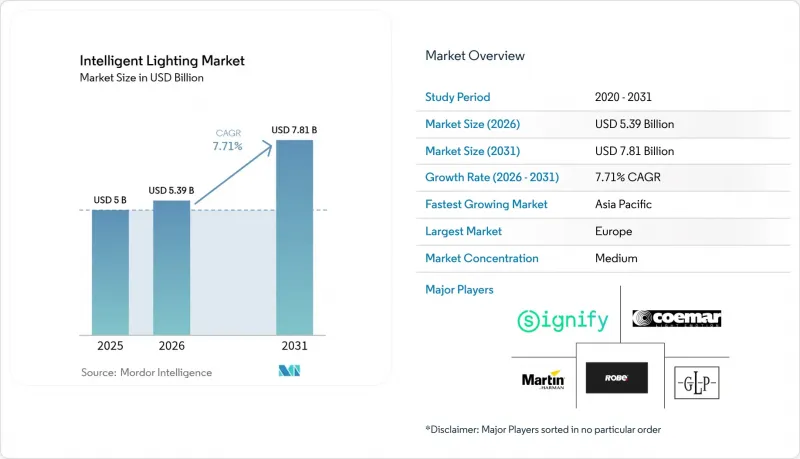
본 보고서는 광원별(LED, HID 등), 조명 기구 유형별(프로파일 라이트, 스포트라이트 등), 제어 프로토콜별(DMX-512, Art-Net/SACN 등), 용도별(실내 행사장 및 실외(경기장, 콘서트)), 최종 사용자별(극장·콘서트, TV 스튜디오·방송 등), 지역별로 분류되어 있습니다. 시장 예측은 금액(달러) 기준으로 제시되어 있습니다.
세계의 지능형 조명 시장 동향 및 인사이트
라이브 이벤트 및 페스티벌의 급속한 확대
세계 티켓 매출은 팬데믹 이전 수준으로 회복되었으며, 행사장 운영자들은 현재 프로그래밍 가능한 조명을 프리미엄 가격 책정을 뒷받침하는 수익원으로 간주하고 있습니다. 프로모터들이 재설치 작업 없이 록 콘서트부터 기업 갈라 파티까지 대응할 수 있는 조명 기구를 지정함에 따라, 렌탈 업체들은 무빙 헤드 LED 보유 대수를 확대되고 있습니다. 주요 제작사는 네트워크 지원 조명을 쇼 패키지에 통합하여 크리에이티브 디렉터가 실시간으로 조명 효과를 조정할 수 있도록 하고 있습니다. 페스티벌에서 임시 마이크로그리드로 가동 가능한 저전력 기기가 요구됨에 따라 지능형 조명 시장은 혜택을 볼 것입니다. 유통업체들은 교체 부품의 당일 배송을 보장하기 위해 체계를 강화하고 있으며, 이는 투어 시즌 중 혼잡한 시기의 가동률 향상에 기여하고 있습니다.
LED 비용 하락 및 에너지 효율 규제
2025년에는 웨이퍼 수율이 향상되고 갈륨 질화물(GaN) 소자가 6인치 기판으로 전환됨에 따라 LED 부품의 평균 가격이 8% 가까이 하락했습니다. 미국 에너지 정보국(EIA)은 비용 하락에 따라 LED 효율 개선이 지속될 것으로 전망하며, 연방 정부의 효율 기준이 일반 조명 분야의 발전을 주도하고, 이것이 전문 용도로도 파급될 것으로 예상하고 있습니다. 현재 시설 관리자들은 에너지 비용 절감과 대개 3년 미만의 짧은 투자 회수 기간을 연계하여 설비 교체의 정당성을 설명하고 있습니다. 에너지 개조에 대한 정부의 보조금 덕분에 기존 조명 설비와의 총 소유 비용 차이는 더욱 줄어들고 있습니다. 다이오드 가격 하락으로 인해 중가대 제품군이 보급되면서 지능형 조명 시장 전체에서 구매자의 선택 폭이 넓어지고 있습니다.
높은 초기 투자 비용(CAPEX)으로 인해 사용자들이 임대 모델로 전환하고 있습니다.
2,000석 규모의 극장에서 노후화된 조명 설비를 네트워크 지원 LED 무빙 라이트 및 콘솔로 교체할 때, 120만 달러의 비용이 드는 경우가 흔합니다. 소규모 운영 사업자는 재정적 여유가 없기 때문에 이벤트 일정에 맞추어 비용을 분산할 수 있는 렌탈 패키지를 선택합니다. 렌탈 회사는 가동률 향상의 혜택을 누릴 수 있지만, 최신 상태를 유지하기 위해 3년마다 재고를 갱신해야 하므로 자사의 자본 수요가 증가합니다. 이에 반해, 조명 기구 OEM 제조업체들은 예측 유지보수를 결합한 종량제 프로그램을 도입했으나, 북미와 유럽 이외 지역에서의 도입은 여전히 더딘 실정입니다. 이러한 추세로 인해 이미 도입된 설비의 가동률은 유지되는 반면, 출하 대수는 일시적으로 억제되고 있습니다.
부문 분석
2025년에는 LED 기술이 77.35%의 시장 점유율을 차지한 것으로 평가되었습니다. 이는 뛰어난 에너지 효율, 프로그래밍 가능한 제어 기능, 그리고 비용 절감을 통해 지능형 조명 용도 분야에서 확고한 입지를 다지고 있음을 반영합니다. 그러나 대규모 행사장이나 실외 설치에서 극도로 높은 휘도 수준과 정밀한 빔 제어가 필요한 용도에 힘입어, 레이저 기반 시스템이 2031년까지 연평균 성장률(CAGR) 16.9%를 기록하며 가장 빠르게 성장하는 부문으로 부상하고 있습니다. HID 시스템은 연색성이나 휘도 요구 사항이 현재 LED의 성능을 능가하는 특정 고출력 용도에서 여전히 중요성을 유지하고 있지만, LED 기술의 발전에 따라 시장 점유율은 계속 하락하고 있습니다. 레이저 부문은 고체 레이저 설계의 혁신과 사람이 머무는 공간에 도입을 가능하게 하는 안전 시스템의 개선이라는 혜택을 받고 있습니다.
특허 동향을 통해 레이저 채택을 뒷받침하는 기술의 고도화가 엿보입니다. 예를 들어, ams OSRAM사의 ‘SPL S8L91A_3 A01’은 QFN 패키지를 채택한 고성능 8채널 915nm SMT 펄스 레이저로, LiDAR 용도를 위해 1000와트의 피크 광출력을 실현하며, 레이저 기술을 통해 가능한 정밀 제어를 입증하고 있습니다. 레이저 기술과 지능형 제어 시스템의 융합은 고휘도와 정밀한 공간 제어를 모두 필요로 하는 용도에 새로운 가능성을 창출하고 있습니다. 레이저 다이오드의 효율 및 열 관리 분야의 제조 기술 발전은 레이저 기반 지능형 조명 시스템의 목표 시장을 확대되고 있습니다. 이 부문의 성장 추세는 가혹한 환경에서 성능 특성을 최적화하는 용도 특화형 솔루션으로 업계가 진화하고 있음을 반영합니다.
2025년에도 프로파일 라이트는 조명 기구 유형 중 최대 시장 점유율을 유지하고 있으며, 연극 및 건축 용도에 필수적인 정밀한 빔 형상과 패턴을 창출할 수 있는 범용성이 높이 평가되고 있습니다. 스포트라이트는 강렬하고 집광성이 높은 조명이 필요한 특수한 용도에 대응하는 반면, 워시라이트는 일반적인 영역 조명의 요구를 충족시키는 광범위하고 균일한 조명을 제공합니다. 빔 라이트와 하이브리드 라이트는 가장 빠르게 성장하는 조명 기구 카테고리로, 여러 조명 기능을 단일 유닛에 통합함으로써 행사장 운영자의 설치 복잡성과 설비 비용을 절감합니다. 이러한 하이브리드 접근 방식은 대규모 장비 교체를 필요로 하지 않으면서도 다양한 조명 요구 사항에 적응할 수 있는 유연한 시스템을 원하는 사용자의 의향을 반영한 것입니다.
조명 기구 설계의 기술 혁신에서는 모듈성과 프로그래밍 가능성이 중시되고 있으며, 각 제조업체는 여러 광원과 제어 기구를 콤팩트한 케이스에 통합한 시스템을 개발하고 있습니다. ams OSRAM의 ‘EVIYOS 2.0’은 이러한 추세를 상징하는 제품으로, 자동차 용도로 2만 5,600개의 개별 제어 가능한 LED를 탑재하고 있습니다. 고도의 광학 시스템을 통해 기존에는 여러 개의 조명 기구가 필요했던 정밀한 빔 제어 및 색상 혼합이 가능해져, 설치 효율이 향상되고 유지보수 부담도 경감됩니다. 조명 기구 유형의 진화는 물리적 설치 면적과 소비 전력을 최소화하면서 기능성을 극대화하는 통합 솔루션으로의 업계 동향을 반영하고 있습니다.
지역별 분석
유럽은 2025년에 32.70%의 점유율로 시장 주도권을 유지하고 있습니다. 이는 엄격한 에너지 효율 규제와, 지능형 LED 시스템으로의 대대적인 교체 수요를 유발하는 수은 함유 램프의 단계적 폐지가 원동력이 되고 있습니다. 이 지역의 성숙한 엔터테인먼트 인프라와 에너지 효율이 높은 기술을 지원하는 규제 체계가 첨단 조명 솔루션에 대한 안정적인 수요를 창출하고 있습니다. 독일은 강력한 자동차 및 엔터테인먼트 산업을 바탕으로 유럽 내 도입을 주도하고 있는 반면, 영국은 조명의 품질과 유연성을 중시하는 확립된 극장 및 방송 부문의 혜택을 받고 있습니다. 2020년 기준 유럽 전역에서 사용되고 있는 약 110억 개의 램프를 대상으로 하는 EU의 광원 관련 에코디자인 요건은 시장이 LED 기술로 전환됨에 따라 지속적인 교체 기회를 창출하고 있습니다.
아시아태평양은 2031년까지 연평균 성장률(CAGR)이 9.7%에 달하며 가장 빠르게 성장하는 지역으로 부상하고 있는데, 이는 중국, 일본, 인도에서의 급속한 인프라 개발과 오락 시설 건설 증가를 반영한 것입니다. 중국에서는 2024년 1월부터 독서등 성능 요건 및 형광등 에너지 효율 기준을 포함한 8개의 새로운 조명 기준이 시행될 예정이며, 이는 시장 확대를 뒷받침하는 규제적 지원이 마련되었음을 보여줍니다. 일본의 조명 용도에는 지능형 조명 시스템을 도입한 스마트 시티 용도가 포함될 것으로 예상되며, 이것이 수요를 견인할 것으로 전망됩니다. 이 지역은 강력한 제조 능력과 오락 시설 및 상업시설용 조명에 대한 국내 수요 증가의 혜택을 받고 있습니다.
북미는 시설 현대화 및 에너지 효율이 높은 기술 도입에 힘입어 성장하는 중요한 시장 부문이지만, 시장이 성숙기에 접어들었기 때문에 아시아태평양에 비해 성장률은 완만합니다. 이 지역의 엔터테인먼트 업계 리더십과 지능형 조명 기술의 조기 도입이 첨단 시스템에 대한 안정적인 수요를 창출하고 있습니다. NYPA가 시그니파이와 제휴하여 50만 개의 가로등을 네트워크로 연결하기로 한 전략적 제휴는 지능형 조명 시스템을 도입한 인프라 현대화 프로젝트의 규모를 여실히 보여주고 있습니다. 그러나 무역 마찰과 관세 도입으로 인해 비용 압박이 발생하고 있으며, 기업들이 관세의 영향을 완화하기 위해 공급망 전략을 조정함에 따라 성장률이 둔화될 가능성이 있습니다.
기타 혜택 :
- 엑셀 형식 시장 예측(ME) 시트
- 3개월간의 애널리스트 지원
자주 묻는 질문
목차
제1장 서론
제2장 조사 방법
제3장 주요 요약
제4장 시장 구도
제5장 시장 규모 및 성장 예측
제6장 경쟁 구도
제7장 시장 기회 및 향후 전망
AJY 26.08.26According to Mordor Intelligence, the intelligent lighting market size is expected to grow from USD 5 billion in 2025 to USD 5.39 billion in 2026 and is forecast to reach USD 7.81 billion by 2031 at 7.71% CAGR over 2026-2031.
This report is Segmented by Light Source (LED, HID, and More), Fixture Type (Profile Lights, Spot Lights, and More), Control Protocol (DMX-512, Art-Net / SACN, and More), Application (Indoor Venues and Outdoor (stadia, Concerts)), End-User (Theatres and Concerts, TV Studios and Broadcasting, and More), and Geography. The Market Forecasts are Provided in Terms of Value (USD).
Global Intelligent Lighting Market Trends and Insights
Rapid Proliferation of Live Events and Festivals
Global ticket sales rebounded to pre-pandemic levels, and venue operators now view programmable lighting as a revenue lever that supports premium pricing. Rental houses expand fleets of moving-head LEDs because promoters specify fixtures that can pivot from rock concerts to corporate galas without re-rigging. Large production companies embed networkable lighting into show packages, enabling creative directors to adjust looks in real time. The intelligent lighting market benefits when festivals demand power-efficient gear that can run on temporary microgrids. Distributors consolidate to guarantee same-day delivery of replacement parts, improving uptime during congested tour seasons.
LED Cost Declines and Energy-Efficiency Mandates
Average LED component prices declined by nearly 8% in 2025 as wafer yields improved and gallium-nitride devices transitioned to 6-inch substrates. The U.S. Energy Information Administration projects that LED efficiency improvements will continue as costs decline, with federal efficiency standards driving advancements in general service lighting that translate to professional applications. Venue managers now justify upgrades by linking utility savings to shorter payback periods, often under three years. Government subsidies for energy retrofits further narrow the total cost of ownership gap against conventional rigs. Falling diode prices unlock mid-tier product lines, broadening buyer access throughout the intelligent lighting market.
High Up-Front CAPEX Shifts Users to Rental Models
A 2,000-seat theatre often faces a USD 1.2 million bill to replace its aging rig with networkable LED moving lights and consoles. Smaller operators lack balance-sheet capacity, so they choose rental packages that spread expense over an event calendar. Rental companies enjoy higher utilization but must refresh inventory every three years to stay current, which raises their own capital needs. Fixture OEMs respond by launching pay-per-use programs bundled with predictive maintenance, yet adoption remains slow outside North America and Europe. The shift temporarily suppresses unit shipments even as it sustains utilization of installed bases.
Other drivers and restraints analyzed in the detailed report include:
- Integration of DMX and IP-Based Control Protocols
- Government Phase-Out of Discharge Lamps
- Semiconductor/Optics Supply-Chain Volatility Constrains Production
For complete list of drivers and restraints, kindly check the Table Of Contents.
Segment Analysis
LED technology commands 77.35% market share in 2025, reflecting its established position in intelligent lighting applications through superior energy efficiency, programmable control capabilities, and declining costs. However, laser-based systems emerge as the fastest-growing segment with 16.9% CAGR through 2031, driven by applications requiring extreme brightness levels and precise beam control in large venues and outdoor installations. HID systems maintain relevance in specific high-output applications where color rendering and intensity requirements exceed current LED capabilities, though their market share continues declining as LED technology advances. The laser segment benefits from innovations in solid-state laser design and improved safety systems that enable deployment in occupied spaces.
Patent developments demonstrate the technological sophistication driving laser adoption, with ams OSRAM's SPL S8L91A_3 A01, a high-performance 8-channel 915nm SMT pulsed laser in a QFN package, delivering 1000 watts peak optical power for LiDAR applications, showcasing the precision control possible with laser technology. The convergence of laser technology with intelligent control systems creates opportunities for applications requiring both high brightness and precise spatial control. Manufacturing advances in laser diode efficiency and thermal management expand the addressable market for laser-based intelligent lighting systems. The segment's growth trajectory reflects the industry's evolution toward application-specific solutions that optimize performance characteristics for demanding environments.
Profile lights maintain the largest market share among fixture types in 2025, valued for their versatility in creating precise beam shapes and patterns essential for theatrical and architectural applications. Spotlights serve specialized applications requiring intense, focused illumination, while wash lights provide broad, even coverage for general area lighting needs. Beam and hybrid lights represent the fastest-growing fixture category, combining multiple lighting functions in single units that reduce installation complexity and equipment costs for venue operators. The hybrid approach reflects user preferences for flexible systems that adapt to diverse lighting requirements without extensive equipment changes.
Technological innovations in fixture design emphasize modularity and programmability, with manufacturers developing systems that combine multiple light sources and control mechanisms in compact form factors. The EVIYOS 2.0 from ams OSRAM exemplifies this trend, offering 25,600 individually controllable LEDs in automotive applications. Advanced optical systems enable precise beam control and color mixing that previously required multiple fixtures, improving installation efficiency and reducing maintenance requirements. The fixture type evolution reflects the industry's movement toward integrated solutions that maximize functionality while minimizing physical footprint and power consumption.
Complete Report Scope:
- By Light Source
- LED
- HID
- Laser
- By Fixture Type
- Profile lights
- Spot lights
- Wash lights
- Beam and hybrid lights
- By Control Protocol
- DMX-512
- Art-Net / sACN
- Ethernet-based proprietary
- By Application
- Indoor venues
- Outdoor (stadia, concerts)
- By End-user
- Theatres and concerts
- TV studios and broadcasting
- Commercial and architectural spaces
- Other End-user
- By Geography
- North America
- United States
- Canada
- Mexico
- South America
- Brazil
- Argentina
- Rest of South America
- Europe
- United Kingdom
- Germany
- France
- Italy
- Spain
- Rest of Europe
- Asia Pacific
- China
- Japan
- India
- South Korea
- Australia and New Zealand
- Southeast Asia
- Rest of Asia Pacific
- Middle East and Africa
- Middle East
- Saudi Arabia
- United Arab Emirates
- Turkey
- Rest of Middle East
- Africa
- South Africa
- Nigeria
- Kenya
- Rest of Africa
- Middle East
- North America
Geography Analysis
Europe maintains market leadership with 32.70% share in 2025, driven by stringent energy efficiency regulations and the phase-out of mercury-containing lamps that create substantial replacement demand for intelligent LED systems. The region's mature entertainment infrastructure and regulatory framework supporting energy-efficient technologies provide stable demand for advanced lighting solutions. Germany leads European adoption through its strong automotive and entertainment industries, while the UK benefits from its established theatre and broadcasting sectors that prioritize lighting quality and flexibility. The EU's Ecodesign requirements for light sources, covering nearly 11 billion lamps in use across Europe as of 2020, create sustained replacement opportunities as the market shifts toward LED technology.
Asia-Pacific emerges as the fastest-growing region with 9.7% CAGR through 2031, reflecting rapid infrastructure development and increasing entertainment venue construction across China, Japan, and India. China's implementation of 8 new lighting standards starting January 2024, including performance requirements for reading lamps and energy efficiency standards for fluorescent lamps, demonstrates the regulatory support driving market expansion. Japan's lighting applications are expected to includes smart city applications that incorporate intelligent lighting systems and drive its demand. The region benefits from strong manufacturing capabilities and growing domestic demand for entertainment and commercial lighting applications.
North America represents a significant market segment driven by venue modernization and the adoption of energy-efficient technologies, though growth rates moderate compared to Asia-Pacific due to market maturity. The region's entertainment industry leadership and early adoption of intelligent lighting technologies create stable demand for advanced systems. Strategic partnerships like NYPA's collaboration with Signify to connect half a million streetlights demonstrate the scale of infrastructure modernization projects that incorporate intelligent lighting systems. However, trade tensions and tariff implementations create cost pressures that may moderate growth rates as companies adjust supply chain strategies to mitigate tariff impacts.
- Signify
- Martin Professional
- Chauvet and Sons
- Robe Lighting
- GLP German Light Products
- Coemar Lighting
- High End Systems
- Clay Paky
- PR Lighting
- ADJ Products
- ETC Electronic Theatre Controls
- Avolites
- MA Lighting
- Guangzhou Guanghong Stage Lighting
- GTD Lighting
- Elation Professional
- Showtec
- Rosco Laboratories
- Vari-Lite
- Luxibel
Additional Benefits:
- The market estimate (ME) sheet in Excel format
- 3 months of analyst support
TABLE OF CONTENTS
1 INTRODUCTION
- 1.1 Study Assumptions and Market Definition
- 1.2 Scope of the Study
2 RESEARCH METHODOLOGY
3 EXECUTIVE SUMMARY
4 MARKET LANDSCAPE
- 4.1 Market Overview
- 4.2 Market Drivers
- 4.2.1 Rapid proliferation of live events and festivals post-pandemic
- 4.2.2 LED cost declines and energy-efficiency mandates
- 4.2.3 Integration of DMX and IP-based control protocols
- 4.2.4 Government phase-out of discharge lamps (RoHS, EU)
- 4.2.5 Drone-light-show companion fixtures demand
- 4.2.6 Esports arena build-outs needing immersive lighting
- 4.3 Market Restraints
- 4.3.1 High up-front CAPEX shifts users to rental
- 4.3.2 Semiconductor/optics supply-chain volatility
- 4.3.3 Blue-light hazard regulation caps lumen output
- 4.3.4 Programming-skills gap in emerging economies
- 4.4 Industry Value Chain Analysis
- 4.5 Regulatory Landscape
- 4.6 Technological Outlook
- 4.7 Porter's Five Forces
- 4.7.1 Threat of New Entrants
- 4.7.2 Bargaining Power of Buyers
- 4.7.3 Bargaining Power of Suppliers
- 4.7.4 Threat of Substitutes
- 4.7.5 Intensity of Competitive Rivalry
5 MARKET SIZE AND GROWTH FORECASTS (VALUE)
- 5.1 By Light Source
- 5.1.1 LED
- 5.1.2 HID
- 5.1.3 Laser
- 5.2 By Fixture Type
- 5.2.1 Profile lights
- 5.2.2 Spot lights
- 5.2.3 Wash lights
- 5.2.4 Beam and hybrid lights
- 5.3 By Control Protocol
- 5.3.1 DMX-512
- 5.3.2 Art-Net / sACN
- 5.3.3 Ethernet-based proprietary
- 5.4 By Application
- 5.4.1 Indoor venues
- 5.4.2 Outdoor (stadia, concerts)
- 5.5 By End-user
- 5.5.1 Theatres and concerts
- 5.5.2 TV studios and broadcasting
- 5.5.3 Commercial and architectural spaces
- 5.5.4 Other End-user
- 5.6 By Geography
- 5.6.1 North America
- 5.6.1.1 United States
- 5.6.1.2 Canada
- 5.6.1.3 Mexico
- 5.6.2 South America
- 5.6.2.1 Brazil
- 5.6.2.2 Argentina
- 5.6.2.3 Rest of South America
- 5.6.3 Europe
- 5.6.3.1 United Kingdom
- 5.6.3.2 Germany
- 5.6.3.3 France
- 5.6.3.4 Italy
- 5.6.3.5 Spain
- 5.6.3.6 Rest of Europe
- 5.6.4 Asia Pacific
- 5.6.4.1 China
- 5.6.4.2 Japan
- 5.6.4.3 India
- 5.6.4.4 South Korea
- 5.6.4.5 Australia and New Zealand
- 5.6.4.6 Southeast Asia
- 5.6.4.7 Rest of Asia Pacific
- 5.6.5 Middle East and Africa
- 5.6.5.1 Middle East
- 5.6.5.1.1 Saudi Arabia
- 5.6.5.1.2 United Arab Emirates
- 5.6.5.1.3 Turkey
- 5.6.5.1.4 Rest of Middle East
- 5.6.5.2 Africa
- 5.6.5.2.1 South Africa
- 5.6.5.2.2 Nigeria
- 5.6.5.2.3 Kenya
- 5.6.5.2.4 Rest of Africa
- 5.6.5.1 Middle East
- 5.6.1 North America
6 COMPETITIVE LANDSCAPE
- 6.1 Market Concentration
- 6.2 Strategic Moves
- 6.3 Market Share Analysis
- 6.4 Company Profiles (includes Global level Overview, Market level overview, Core Segments, Financials as available, Strategic Information, Market Rank/Share for key companies, Products and Services, and Recent Developments)
- 6.4.1 Signify
- 6.4.2 Martin Professional
- 6.4.3 Chauvet and Sons
- 6.4.4 Robe Lighting
- 6.4.5 GLP German Light Products
- 6.4.6 Coemar Lighting
- 6.4.7 High End Systems
- 6.4.8 Clay Paky
- 6.4.9 PR Lighting
- 6.4.10 ADJ Products
- 6.4.11 ETC Electronic Theatre Controls
- 6.4.12 Avolites
- 6.4.13 MA Lighting
- 6.4.14 Guangzhou Guanghong Stage Lighting
- 6.4.15 GTD Lighting
- 6.4.16 Elation Professional
- 6.4.17 Showtec
- 6.4.18 Rosco Laboratories
- 6.4.19 Vari-Lite
- 6.4.20 Luxibel
7 MARKET OPPORTUNITIES AND FUTURE OUTLOOK
- 7.1 White-space and unmet-need assessment


