|
시장보고서
상품코드
2114457
막 필터 : 시장 점유율 분석, 업계 동향 및 통계, 성장 예측(2026-2031년)Membrane Filters - Market Share Analysis, Industry Trends & Statistics, Growth Forecasts (2026 - 2031) |
||||||
 Mordor Intelligence
Mordor Intelligence에 의하면, 막 필터 시장 규모는 2026년에 86억 3,000만 달러로 추정되고 예측 기간(2026-2031년) CAGR 7.03%로 성장을 지속하여, 2031년에는 121억 2,000만 달러에 이를 전망입니다.
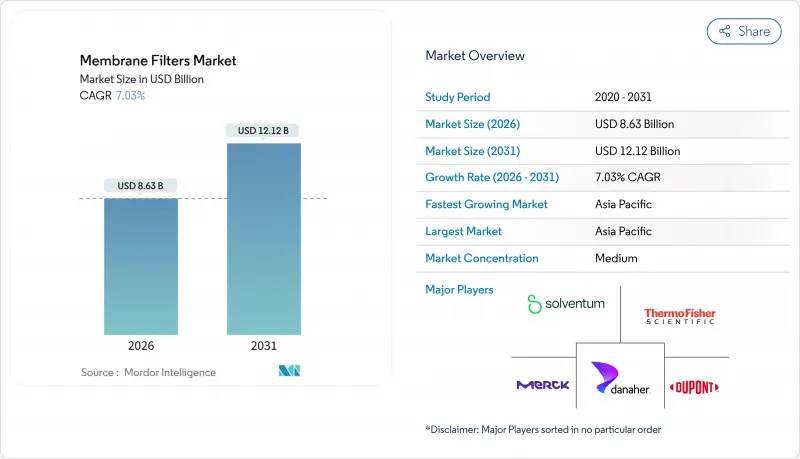
본 보고서는 기술별(정밀 여과, 한외 여과, 나노 여과, 역삼투, 막 크로마토그래피, 순삼투, 투석/헤모필터레이션용 막, 기타), 소재별(PES, PS, 기타), 모듈 구성별(나선형 권선, 기타),용도(상하수도 등), 지역(북미 등)별로 분류되어 있습니다. 시장 예측은 금액(미 달러) 기준으로 제시되어 있습니다.
세계의 막 필터 시장 동향 및 인사이트
도시 및 산업 폐수에 대한 엄격한 배출 기준
세계 각국의 규제 당국은 허용되는 오염 물질의 기준치를 낮추고 있으며, 이로 인해 상수도 유틸리티자와 공장은 막 생물 반응 장치 및 첨단 나노 여과 시스템의 개조를 강요받고 있습니다. 미국 환경보호청(EPA)은 2024년 4월, PFOA 및 PFOS의 상한치를 4 ppt로 설정하고 2029년까지 완전한 준수를 의무화했습니다. 인도 중앙공해관리위원회의 유사한 조치에 따라 2급 도시에서도 막 장치의 업그레이드가 진행되고 있습니다. 프로젝트 소유주들은 현재 열산화 및 증발 결정화 등의 농축액 처리 옵션에 대한 예산을 책정하고 있으며, 각각 사이트당 200만-1,000만 달러의 비용이 소요됩니다.
전 세계 바이오의약품 생산량 증가
바이오의약품 파이프라인은 저분자 의약품의 출시를 앞지르고 있으며, 바이러스 여과, 완충액 교환, 무균 정제에는 기공 크기 0.1-0.2μm의 막이 사용되고 있습니다. 2024년 1월 FDA가 발표한 Q5A(R2) 업데이트를 통해 바이러스 여과가 검증된 공정임이 재확인됨에 따라, 수탁 제조업체들은 대용량 일회용 스키드 도입을 추진하고 있습니다. 인도의 ‘생산 연계형 인센티브(PLI) 프로그램’에서는 국내 바이오의약품 생산 능력을 확대하기 위해 15,000 카롤 루피(18억 달러)가 배정되어, 대상인 막 필터 시장이 확대되고 있습니다.
막의 파울링 및 세척? 화학 약품 비용 부담
몇 주 만에 30-50%의 유량 저하가 발생하기 때문에 주간 또는 월간 CIP(정지 세척) 주기가 불가피하며, 그 비용은 모듈당 500-2,000달러에 달할 전망입니다. 5년의 수명 기간 동안 세척용 화학약품 비용은 막의 초기 투자액에 필적할 수 있습니다. Nanostone사의 CM-151과 같은 세라믹 초여과막은 세척 주기를 3개월로 연장하고 95%의 회수율을 달성하지만, 초기 투자 비용(CAPEX)이 높기 때문에 도입이 활발하지 않습니다.
부문별 분석
2025년, 미세여과는 막 필터 시장에서 33.62%의 점유율을 유지했습니다. 상수도 처리, 유단백질 분획, 바이오의약품 수확 공정에서의 폭넓은 활용이 수요의 기반이 되고 있으며, 0.1-10μm의 기공 크기로 인해 낮은 압력 손실이 보장됩니다. 나노여과는 1가 염을 통과시키면서 2가 이온이나 미량 오염 물질을 제거하고자 하는 사업자들에 의해 연평균 성장률(CAGR) 9.25%로 시장에서 가장 빠르게 성장하는 분야가 되었습니다. 기존의 응집 처리나 미디어 필터를 우회하는 직접 구성의 도입으로 인해, 나노여과에 할당되는 막 필터 시장 규모는 확대될 것으로 예측됩니다. NX Filtration사의 중공사막(기공 크기 1-2 nm)은 약품 투여량을 80% 절감하고, 에너지 수요를 20% 감소시킵니다. 역삼투(RO)는 해수 담수화 및 반도체용 초순수 분야에서 여전히 필수적이지만, 높은 회수율을 자랑하는 나노여과(NF) 전처리 시스템의 도입으로 RO 공정을 저압에서 가동할 수 있게 되어 필터 요소의 수명이 연장되고 있습니다.
나노 여과의 기세는 폐수 재이용, 공업용수 순환 이용, 그리고 PFAS(퍼플루오로알킬 물질) 정화 분야로도 확산되고 있습니다. EPA(미국 환경보호청)의 규제 준수를 위한 입찰에 참여하는 미국의 유틸리티자들은 고도 산화 처리와 결합할 경우 나노여과를 입상 활성탄에 대체할 수 있는 비용 경쟁력 있는 대안으로 보고 있습니다. 기수 탈염의 경우, 나노여과가 RO 단계 이전에 경도를 제거함으로써 전체 회수율을 85% 이상으로 높입니다. 또한, 리튬 염수 후처리 분야에서도 성장이 나타나고 있으며, NF를 통해 마그네슘과 황산염을 제거함으로써 하류 단계의 이온 교환 비드를 보호하고 있습니다. 비용 곡선이 하락함에 따라, 나노 여과는 저압 RO 분야로도 진출할 가능성이 있으며, 전처리 라인에서 미세 여과 시장 점유율을 잠식할 우려가 있습니다.
폴리에테르설폰(PES)은 180°C의 내열성과 pH 내성을 갖추고 있으며, 일회용 바이오프로세스용 카세트에 채택됨에 따라 2025년에는 매출 점유율 28.37%를 기록했습니다. PES의 장점에 기인한 막 필터 시장 규모는 감마선 멸균에 대한 적합성과 긴 보관 기간에 의해 뒷받침되고 있습니다. 연평균 성장률(CAGR) 8.24%로 성장하고 있는 세라믹 및 금속 막은 고형분 함량이 높거나 고온의 유체 분야에서 폴리머의 우위를 위협하고 있습니다. 알루미나 및 실리콘 카바이드 등급의 막은 가혹한 알칼리 세척을 견디며, 광업 및 펄프·제지 산업의 루프에서 10년 이상의 수명을 실현하고 있습니다. LiqTech사의 실리콘 카바이드 유닛은 온도가 80℃를 초과하는 오일 샌드 사업에서 공정수를 회수하고 있습니다.
세라믹 유닛에 대한 수요가 가장 높은 분야는 가동 중단으로 인한 손실이 초기 투자 비용(CAPEX)을 훨씬 상회하는 분야입니다. 반도체 공장이나 해양 담수화 시설에서는 가동 중단 1분 1초가 매우 중요하게 여겨집니다. 그렇긴 하지만, 교체 주기가 1년 미만인 일회용 카트리지의 경우, PVDF나 폴리설폰 등의 폴리머 필름이 여전히 비용 면에서 우위를 점하고 있습니다. 향후 소재 구성의 분기점은 내구성과 내화학성을 중시하는 수명 주기 비용 모델에 따라 결정될 것입니다.
지역별 분석
아시아태평양은 2025년에 막 필터 시장의 38.14%를 차지했으며, 2031년까지 연평균 성장률(CAGR) 9.01%로 성장할 전망입니다. 중국에서는 SMIC가 12인치 팹의 생산 능력을 확대하는 가운데, 국산화 추진 움직임에 따라 국내에서 한외여과(UF) 및 역삼투(RO) 장치의 조달이 증가하고 있습니다. 인도의 15,000 카롤 루피 규모의 인센티브 정책은 바이오의약품 수출용 무균 카트리지 구매를 촉진하고 있으며, 한국에서는 첨단 노드에서 TOC(총 유기탄소) 농도를 1 ppb 미만으로 억제하기 위한 노력이 진행되고 있습니다. 일본공급업체들은 지역적 연계를 활용하고 있으며, 도레이는 2025년에 대만에 연구개발 센터를 개설하고 CO2 배출량을 30% 감축하는 한외여과 필름을 납품했습니다.
북미는 EPA의 PFAS 규제, 반도체 리쇼어링, 초기 단계의 리튬 추출을 배경으로 2위를 차지했습니다. 인텔의 ‘넷 포지티브 워터(Net Positive Water)’ 구상이 대규모 다단식 RO 수주를 뒷받침하고 있는 반면, 엑슨모빌의 아칸소주 염수 프로젝트에서는 저수지를 우회하기 위해 직접 나노 여과가 통합되어 있습니다. 캐나다에서는 한랭지용 막 생물 반응 장치(MBR)의 현대화가 진행되고 있으며, 멕시코의 유제품 제조업체는 수출 감사 요건을 충족하기 위해 UF 모듈을 도입하고 있습니다.
유럽에서는 ‘도시 폐수 처리 지침’에 따라 영양염류 및 미량 오염 물질에 대한 엄격한 배출 상한선이 시행되고 있으며, 이것이 MBR 개조를 촉진하고 있습니다. 독일과 프랑스가 생명공학 분야 수요를 뒷받침하고 있으며, 스페인은 연안 도시를 위한 해수 담수화를 확대되고 있습니다. 스칸디나비아 국가들에서는 펄프 및 제지 산업의 공정용수를 위해 세라믹 막의 시범 운영이 진행되고 있습니다. 중동에서는 대규모 해수 담수화가 진행되고 있으며, 두바이의 하시얀 및 NEOM 시범 프로젝트는 염분 제거율 99.5%의 박막 복합막에 의존하고 있습니다. 남미의 리튬 트라이앵글 지역에서는 증발 공정을 줄이기 위해 막 기술이 채택되고 있습니다.
기타 혜택 :
- 엑셀 형식 시장 예측(ME) 시트
- 3개월간 애널리스트 지원
자주 묻는 질문
목차
제1장 서론
제2장 조사 방법
제3장 주요 요약
제4장 시장 구도
제5장 시장 규모 및 성장 예측
제6장 경쟁 구도
제7장 시장 기회 및 향후 전망
KTH 26.08.28According to Mordor Intelligence, the membrane filters market size is estimated at USD 8.63 billion in 2026, and is expected to reach USD 12.12 billion by 2031, at a CAGR of 7.03% during the forecast period (2026-2031).
This report is Segmented by Technology (Microfiltration, Ultrafiltration, Nanofiltration, Reverse Osmosis, Membrane Chromatography, Forward Osmosis, Dialysis/Hemofiltration Membranes, Others), Material (PES, PS, and More), Module Configuration (Spiral Wound, and More), Application (Water & Wastewater, and More), and Geography (North America, and More). Market Forecasts are Provided in Terms of Value (USD).
Global Membrane Filters Market Trends and Insights
Strict Discharge Norms For Municipal & Industrial Wastewater
Regulators worldwide are lowering allowed contaminant thresholds, compelling utilities and factories to retrofit membrane bioreactors and advanced nanofiltration trains. The U.S. Environmental Protection Agency capped PFOA and PFOS at 4 ppt in April 2024, requiring full compliance by 2029. Similar moves by India's Central Pollution Control Board are pushing tier-2 cities toward membrane upgrades. Project owners now budget for concentrate management options such as thermal oxidation or evaporative crystallization, each costing USD 2 million-10 million per site.
Rising Biopharma Production Volumes Globally
Biologic pipelines outstrip small-molecule launches, and virus filtration, buffer exchange, and sterile polishing rely on 0.1-0.2 µm pore-size membranes. FDA's Q5A(R2) update in January 2024 reaffirmed virus filtration as a validated step, nudging contract manufacturers toward higher-capacity single-use skids. India's Production Linked Incentive program earmarked INR 15,000 crore (USD 1.8 billion) to expand domestic biologics capacity, widening the addressable membrane filters market.
Membrane Fouling & Cleaning-Chemical Cost Burden
Flux loss of 30-50% within weeks forces weekly or monthly clean-in-place cycles that cost USD 500-2,000 per module. Over a five-year life, cleaning chemicals can equal initial membrane capital. Ceramic ultrafiltration, such as Nanostone's CM-151, extends cleaning intervals to three months and achieves 95% recovery, yet higher CAPEX slows adoption.
Other drivers and restraints analyzed in the detailed report include:
- Food-Grade Filtration Mandates In Emerging Economies
- CAPEX Incentives For Desalination Projects (MENA)
- Validation Delays For GMP Upgrades In Pharma
For complete list of drivers and restraints, kindly check the Table Of Contents.
Segment Analysis
In 2025, microfiltration retained 33.62% share of the membrane filters market. Its broad use in municipal clarification, dairy protein fractionation, and biopharma harvest steps anchors demand, with pore sizes from 0.1 to 10 µm ensuring low pressure drops. Nanofiltration has become the fastest-growing slice at 9.25% CAGR as operators seek divalent-ion and micropollutant rejection while passing monovalent salts. The membrane filters market size allocated to nanofiltration is forecast to widen as direct configurations bypass conventional coagulation and media filters. NX Filtration's hollow-fiber 1-2 nm pores cut chemical dosing by 80% and lower energy needs by 20%. Reverse osmosis remains mission-critical for seawater desalination and semiconductor ultrapure water, yet the entry of high-recovery NF pretreatment trains allows RO stages to run at lower pressures, extending element life.
Nanofiltration's momentum spills into wastewater reuse, industrial water loops, and PFAS remediation. U.S. utilities bidding on EPA compliance view NF as a cost-competitive alternative to granular activated carbon when paired with advanced oxidation. In brackish-water desalination, NF lifts overall recovery to >85% by shedding hardness before RO. Growth also tracks lithium brine polishing, where NF removes magnesium and sulfate to protect downstream ion-exchange beads. As cost curves fall, nanofiltration may edge into low-pressure RO domains, eroding microfiltration's share in pretreatment lines.
Polyethersulfone posted 28.37% revenue share in 2025 owing to 180 °C heat tolerance and pH resilience, serving single-use bioprocess cassettes. The membrane filters market size tied to PES benefits from compatibility with gamma sterilization and long shelf life. Ceramic and metallic membranes, advancing at an 8.24% CAGR, threaten polymer dominance in high-solids or high-temperature fluids. Alumina and silicon-carbide grades survive aggressive caustic washes, facilitating >10-year service life in mining and pulp-and-paper loops. LiqTech's silicon-carbide units reclaim process water in oil-sands operations that push temperatures beyond 80 °C.
Demand for ceramic units is strongest where downtime penalties dwarf upfront CAPEX-semiconductor fabs and offshore desalination rigs count every minute of outage. Still, polymer films such as PVDF and polysulfone remain cost winners in disposable cartridges where replacement intervals fall under one year. Future material splits will hinge on lifecycle costing models rewarding durability and chemical resistance.
Complete Report Scope:
- By Technology
- Microfiltration
- Ultrafiltration
- Nanofiltration
- Reverse Osmosis
- Membrane Chromatography
- Forward Osmosis
- Dialysis / Hemofiltration Membranes
- Others
- By Material
- Polyethersulfone (PES)
- Polysulfone (PS)
- Cellulose-based
- Polyvinylidene Fluoride (PVDF)
- Polytetrafluoroethylene (PTFE)
- Polyacrylonitrile (PAN)
- Polypropylene (PP)
- Ceramic & Metallic
- Others
- By Module Configuration
- Spiral Wound
- Hollow Fiber
- Tubular
- Plate & Frame
- Capsule / Cartridge
- By Application
- Water & Wastewater Treatment
- Food & Beverage Processing
- Pharmaceutical & Biotechnology
- Chemical & Petrochemical
- Micro-electronics
- Mining & Metallurgy
- Others
- By Geography
- North America
- United States
- Canada
- Mexico
- Europe
- Germany
- France
- United Kingdom
- Italy
- Spain
- Rest of Europe
- Asia-Pacific
- China
- Japan
- India
- South Korea
- Australia
- Rest of Asia-Pacific
- Middle East & Africa
- GCC
- South Africa
- Rest of Middle East & Africa
- South America
- Brazil
- Argentina
- Rest of South America
- North America
Geography Analysis
Asia-Pacific held 38.14% of the membrane filters market in 2025 and is poised for a 9.01% CAGR to 2031. China's domestic-substitution push lifts local ultrafiltration and RO procurement as fabs expand 12-inch capacity at SMIC. India's INR 15,000 crore incentive scheme spurs sterile cartridge purchases for biologics exports, and South Korea's advanced nodes chase TOC limits under 1 ppb. Japanese suppliers leverage regional links; Toray opened a Taiwan R&D center in 2025 and delivered an ultrafiltration film that trims CO2 emissions by 30%.
North America ranks second on the back of EPA PFAS rules, semiconductor reshoring, and early-stage lithium extraction. Intel's net-positive water drive underpins large multistage RO orders, while ExxonMobil's Arkansas brine project integrates direct nanofiltration to bypass ponds. Canada modernizes cold-climate membrane bioreactors, and Mexican dairies adopt UF modules to meet export audits.
Europe enforces stringent nutrient and micropollutant caps under the Urban Wastewater Treatment Directive, fueling MBR retrofits. Germany and France anchor biotech demand, and Spain expands desalination for coastal cities. Scandinavia pilots ceramic membranes for pulp-and-paper process water. The Middle East rides mega-desalination: Dubai's Hassyan and NEOM's pilot hinge on 99.5% salt-rejection thin-film composites. South America's lithium triangle adopts membrane routes to cut evaporation.
- Advanced Microfiltration Systems (AMS)
- Alfa Laval AB
- Asahi Kasei
- CITIC Envirotech Ltd.
- Danaher
- DuPont
- GEA Group
- LiqTech International
- Koch Separation Solutions
- Membranium (RM Nanotech)
- Merck KGaA (MilliporeSigma)
- Nanostone Water
- NX Filtration
- Parker Hannifin
- Pentair plc
- Porvair plc
- Synder Filtration
- ThermoFisher Scientific Inc
- Toray Industries, Inc.
Additional Benefits:
- The market estimate (ME) sheet in Excel format
- 3 months of analyst support
TABLE OF CONTENTS
1 Introduction
- 1.1 Study Assumptions & Market Definition
- 1.2 Scope of the Study
2 Research Methodology
3 Executive Summary
4 Market Landscape
- 4.1 Market Overview
- 4.2 Market Drivers
- 4.2.1 Strict Discharge Norms for Municipal & Industrial Wastewater
- 4.2.2 Rising Biopharma Production Volumes Globally
- 4.2.3 Food-Grade Filtration Mandates in Emerging Economies
- 4.2.4 CAPEX Incentives for Desalination Projects (MENA)
- 4.2.5 Rapid Uptake of Single-Use Tangential-Flow Skids
- 4.2.6 Lithium-Extraction by Direct-Lithiation Membranes
- 4.3 Market Restraints
- 4.3.1 Membrane Fouling & Cleaning-Chem Cost Burden
- 4.3.2 Validation Delays for GMP Upgrades in Pharma
- 4.3.3 Per- And Poly-Fluoroalkyl Substance (PFAS) Disposal Risk
- 4.3.4 Supply-Chain Crunch for High-Grade PES Resin
- 4.4 Value / Supply-Chain Analysis
- 4.5 Regulatory Landscape
- 4.6 Technological Outlook
- 4.7 Porter's Five Forces Analysis
- 4.7.1 Threat of New Entrants
- 4.7.2 Bargaining Power of Buyers
- 4.7.3 Bargaining Power of Suppliers
- 4.7.4 Threat of Substitute Products
- 4.7.5 Intensity of Competitive Rivalry
5 Market Size & Growth Forecasts (Value in USD)
- 5.1 By Technology
- 5.1.1 Microfiltration
- 5.1.2 Ultrafiltration
- 5.1.3 Nanofiltration
- 5.1.4 Reverse Osmosis
- 5.1.5 Membrane Chromatography
- 5.1.6 Forward Osmosis
- 5.1.7 Dialysis / Hemofiltration Membranes
- 5.1.8 Others
- 5.2 By Material
- 5.2.1 Polyethersulfone (PES)
- 5.2.2 Polysulfone (PS)
- 5.2.3 Cellulose-based
- 5.2.4 Polyvinylidene Fluoride (PVDF)
- 5.2.5 Polytetrafluoroethylene (PTFE)
- 5.2.6 Polyacrylonitrile (PAN)
- 5.2.7 Polypropylene (PP)
- 5.2.8 Ceramic & Metallic
- 5.2.9 Others
- 5.3 By Module Configuration
- 5.3.1 Spiral Wound
- 5.3.2 Hollow Fiber
- 5.3.3 Tubular
- 5.3.4 Plate & Frame
- 5.3.5 Capsule / Cartridge
- 5.4 By Application
- 5.4.1 Water & Wastewater Treatment
- 5.4.2 Food & Beverage Processing
- 5.4.3 Pharmaceutical & Biotechnology
- 5.4.4 Chemical & Petrochemical
- 5.4.5 Micro-electronics
- 5.4.6 Mining & Metallurgy
- 5.4.7 Others
- 5.5 By Geography
- 5.5.1 North America
- 5.5.1.1 United States
- 5.5.1.2 Canada
- 5.5.1.3 Mexico
- 5.5.2 Europe
- 5.5.2.1 Germany
- 5.5.2.2 France
- 5.5.2.3 United Kingdom
- 5.5.2.4 Italy
- 5.5.2.5 Spain
- 5.5.2.6 Rest of Europe
- 5.5.3 Asia-Pacific
- 5.5.3.1 China
- 5.5.3.2 Japan
- 5.5.3.3 India
- 5.5.3.4 South Korea
- 5.5.3.5 Australia
- 5.5.3.6 Rest of Asia-Pacific
- 5.5.4 Middle East & Africa
- 5.5.4.1 GCC
- 5.5.4.2 South Africa
- 5.5.4.3 Rest of Middle East & Africa
- 5.5.5 South America
- 5.5.5.1 Brazil
- 5.5.5.2 Argentina
- 5.5.5.3 Rest of South America
- 5.5.1 North America
6 Competitive Landscape
- 6.1 Market Concentration
- 6.2 Market Share Analysis
- 6.3 Company Profiles (includes Global level Overview, Market level overview, Core Segments, Financials as available, Strategic Information, Market Rank/Share for key companies, Products & Services, and Recent Developments)
- 6.3.1 Advanced Microfiltration Systems (AMS)
- 6.3.2 Alfa Laval AB
- 6.3.3 Asahi Kasei Corporation
- 6.3.4 CITIC Envirotech Ltd.
- 6.3.5 Danaher
- 6.3.6 DuPont de Nemours, Inc.
- 6.3.7 GEA Group AG
- 6.3.8 LiqTech International
- 6.3.9 Koch Separation Solutions
- 6.3.10 Membranium (RM Nanotech)
- 6.3.11 Merck KGaA (MilliporeSigma)
- 6.3.12 Nanostone Water
- 6.3.13 NX Filtration
- 6.3.14 Parker Hannifin Corporation
- 6.3.15 Pentair plc
- 6.3.16 Porvair plc
- 6.3.17 Synder Filtration
- 6.3.18 ThermoFisher Scientific Inc
- 6.3.19 Toray Industries, Inc.
7 Market Opportunities & Future Outlook
- 7.1 White-space & Unmet-Need Assessment