|
시장보고서
상품코드
2114462
경피증 치료제 : 시장 점유율 분석, 업계 동향 및 통계, 성장 예측(2026-2031년)Scleroderma Therapeutics - Market Share Analysis, Industry Trends & Statistics, Growth Forecasts (2026 - 2031) |
||||||
 Mordor Intelligence
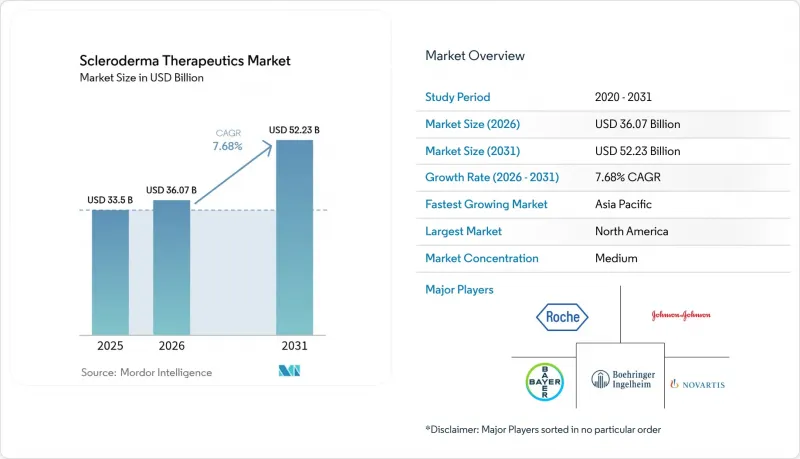
Mordor Intelligence에 의하면, 2026년 경피증 치료제 시장 규모는 360억 7,000만 달러로 추정되고 2025년 335억 달러에서 확대해, 2031년에는 522억 3,000만 달러에 이를 것으로 예측됩니다.
2026년부터 2031년까지의 연평균 성장률(CAGR)은 7.68%를 나타낼 것으로 전망됩니다.
본 보고서는 질환 유형(전신성 경피증 및 국소성 경피증), 약물 분류(PDE-5 억제제, 프로스타사이클린 유사체 등), 투여 경로(경구, 정맥 내 등), 유통 채널(병원 약국 등), 지역(북미 등)별로 분류되어 있습니다. 시장 전망은 금액(달러) 기준으로 제시되어 있습니다.
세계의 경피증 치료제 시장 동향 및 인사이트
증가하는 질병 부담과 미충족 의료 수요
전신성 진행률은 여전히 높으며, 발병 직후 환자의 65.6%가 5년 이내에 중대한 합병증을 발병하고 있어 조기 개입에 대한 수요가 높아지고 있습니다. 간질성 폐질환이 주요 사망 원인이 되고 있으며, 혈액 악성 종양의 발생률은 일반인 집단에 비해 2배에 달하여 다기관에 걸친 위험이 부각되고 있습니다. 신규 진단 환자 중 첫해에 면역조절제를 투여받는 비율은 고작 30.8%에 그쳐, 치료상의 격차가 두드러지고 있습니다. 기존 약물의 효능이 제한적이기 때문에 증상을 가리는 것이 아니라 섬유화 경로 자체를 억제하는 질환 수정 요법에 대한 요구가 높아지고 있으며, 이것이 경피증 치료제 시장의 성장을 뒷받침하고 있습니다.
표적 치료 및 질환 수정 치료의 선택지 확대
RESET-SSc 임상시험에서 CD19를 표적으로 한 CAR-T 세포는 B 세포의 현저한 감소를 달성하여, 중증 환자에서 약물 없이도 완치를 가능하게 했습니다. 이소형 선택적 TGF-β3 억제 및 TAK1 억제는 개발 파이프라인을 확대하고 있으며, 2024년 EULAR 가이드라인에서는 전신성 질환에 대한 릿룩시맙이 최상위 권고 등급으로 상향 조정되었습니다. FT011에 대한 FDA의 패스트 트랙 지정은 획기적인 후보 약물의 승인을 가속화하려는 규제 당국의 태도를 여실히 보여주고 있습니다. 정밀의료 플랫폼을 통해 치료가 자가항체의 하위 집합이나 혈관 병변에 맞추어 조정되면서, 진료는 개인 맞춤형 치료 방식으로 전환되고 있습니다.
고액의 치료비와 경제적 부담 문제
중증 다기관 병변 환자의 경우 연간 치료비가 5만 달러를 초과할 가능성이 있으며, 보험 적용 범위가 제한적인 시장에서는 CAR-T 요법의 본인 부담금이 10만 달러에 달할 우려가 있습니다. 2024년에는 총액 가격과 실제 지불액 간의 가격 왜곡이 3,340억 달러에 달하고,, 환자들의 접근을 어렵게 만들고 있습니다. 특히 신흥국의 인프라 제약으로 인해 정맥 주사 투여에 의존하는 치료법의 도입이 저해되어, 경피증 치료제 시장의 잠재적 확산이 둔화되고 있습니다.
부문별 분석
2025년, 전신성 질환은 경피증 치료제 시장의 72.10%를 차지했으며, 이는 다기관에 가해지는 부담과 약물 사용량의 많음을 반영합니다. 국소형은 유병률은 낮지만, 인식 제고와 조기 치료로 인해 8.35%라는 가장 높은 연평균 성장률(CAGR)을 기록하고 있습니다. 전신성 피부경화증 환자는 많은 경우 3-4가지 약물을 병용하는 치료를 받고 있어 매출 집중도가 더욱 높아지고 있습니다. 국소형 질환에 대한 조기 개입을 통해 사례의 15%에서 전신형으로의 진행을 막을 수 있다는 증거가 치료법 채택을 확대되고 있습니다. 전신성 경피증 관련 간질성 폐질환에 대한 닌테다니브 등의 규제 당국 승인은 전신형 부문의 우위를 더욱 공고히 했습니다. 바이오마커 기반 치료법의 혁신은 현재 국소형 질환으로도 확산되고 있어, 해당 부문의 성장세를 뒷받침하고 있습니다.
치료제 연구 개발은 전신성 합병증, 특히 질환으로 인한 사망의 70%를 차지하는 폐섬유증 및 폐동맥 고혈압에 중점을 두고 있습니다. 항섬유화제, 혈관 보호제, 면역 조절제가 시판됨에 따라 전신 증상을 대상으로 하는 경피증 치료제 시장 규모는 꾸준히 확대될 것으로 예측됩니다. 국소성 사례에서는 국소 치료에서 전신 치료로의 단계적 전환 모델이 유효하며, 전신성 경피증 치료제 시장 전체에서 치료 경로의 통합이 진행되고 있는 것으로 나타났습니다.
2025년에는 엔도세린 수용체 길항제가 매출의 28.10%를 차지했으며, 그 중심에는 보센탄과 새로운 이중 표적 약물이 있었습니다. 특허 만료와 바이오시밀러의 등장으로 이러한 기반이 위협받고 있는 반면, 세포 및 유전자 치료는 연평균 성장률(CAGR) 8.78%를 기록하며 가장 빠르게 성장하는 치료 분야가 되었습니다. CD19-CAR-T 후보 약물인 KYV-101은 치료를 받은 환자의 70%에서 약물을 사용하지 않고도 지속적인 관해를 가져와 임상적 기대치를 재정의했습니다. 티로신 키나제 억제제인 닌테다니브는 폐섬유증 이외의 적응증 영역으로 확대되며, 이 약제군의 다양화를 보여주고 있습니다.
병용 요법에서는 세포 치료로 이어지는 가교 역할로 면역억제제가 포함되어 있으며, 현재의 수익을 유지하면서 지속적인 치료법으로의 전환이 진행되고 있습니다. 데이터가 축적됨에 따라 피부경화증 치료 시장에서 세포 치료 시장 규모는 확대될 것으로 예측되며, 이는 기존 기업들에게 과제를 안겨주고 장기적인 경쟁 환경을 변화시킬 것입니다.
지역별 분석
북미는 2025년에 매출의 44.20%를 차지했으며, FDA의 신속 승인, 강력한 보험사의 급여 범위, 그리고 집중적인 세포 치료 연구 개발을 활용하게 되었습니다. Kyverna Therapeutics나 노바티스와 같은 미국 기업들이 임상시험 활동을 주도하는 한편, 캐나다의 공적 보험 제도는 희귀질환 치료제의 보급을 촉진하고 있습니다. 시장의 성숙화로 인해 성장은 둔화되고 있지만, 정밀 치료제의 지속적인 출시가 성장 동력을 유지하고 있습니다.
유럽은 EMA(유럽의약품청)의 중앙 승인 제도와 학계 및 산업계의 견고한 협력에 힘입어 38.60%의 시장 점유율을 확보했습니다. 독일은 2024년 1월 KYV-101의 1/2상 임상시험 승인을 획득하며 임상시험 개시를 주도하고 있습니다. EULAR 2024 가이드라인에 따라 치료가 표준화되면서 국경을 초월한 도입이 촉진되고 있습니다. 브렉시트 이후의 규제 차이는 영국의 일정에 다소 영향을 미치고 있지만, 학계와의 협력 관계는 유지되고 있습니다.
아시아태평양은 2031년까지 연평균 성장률(CAGR)이 8.45%로 가장 빠른 성장이 예상됩니다. 일본에서는 희귀질환 의약품 사전 상환 제도를 통해 세포 치료제 시장 진입이 가속화되고 있으며, 중국에서는 규제상의 장벽이 남아 있음에도 불구하고 개혁을 통해 생물학적 제제에 대한 접근성이 확대되고 있습니다. 호주의 임상시험 시설은 전 세계 임상시험에 기여하고 있지만, 지역 전체적으로 의료 기술 벤처에 대한 자금 조달이 줄어들면서 현지 혁신을 저해하는 과제로 대두되고 있습니다. 그럼에도 불구하고 인구 증가와 인프라 확충이 경피증 치료제 시장에서 이 지역의 높은 성장을 뒷받침하고 있습니다.
기타 혜택 :
- 엑셀 형식 시장 예측(ME) 시트
- 3개월간의 애널리스트 지원
자주 묻는 질문
목차
제1장 서론
제2장 조사 방법
제3장 주요 요약
제4장 시장 구도
제5장 시장 규모 및 성장 예측
제6장 경쟁 구도
제7장 시장 기회 및 향후 전망
KTH 26.08.28According to Mordor Intelligence, the scleroderma therapeutics market size in 2026 is estimated at USD 36.07 billion, growing from 2025 value of USD 33.50 billion with 2031 projections showing USD 52.23 billion, growing at 7.68% CAGR over 2026-2031.
This report is Segmented by Disease Type (Systemic Scleroderma and Localized Scleroderma), Drug Class (PDE-5 Inhibitors, Prostacyclin Analogues, and More), Route of Administration (Oral, Intravenous, and More), Distribution Channel (Hospital Pharmacies, and More), Geography (North America, and More). The Market Forecasts are Provided in Terms of Value (USD).
Global Scleroderma Therapeutics Market Trends and Insights
Growing Disease Burden And Unmet Clinical Needs
Systemic progression remains high, with 65.6% of very-early patients developing significant complications within five years, reinforcing demand for earlier intervention. Interstitial lung disease leads mortality and hematologic malignancy incidence doubles versus healthy cohorts, underscoring multi-organ risk. Only 30.8% of newly diagnosed patients receive immunomodulators within the first year, highlighting therapy gaps. Limited efficacy of legacy agents amplifies the call for disease-modifying solutions that suppress fibrotic pathways rather than mask symptoms, propelling the scleroderma therapeutics market.
Expansion Of Targeted And Disease-Modifying Treatment Options
CD19-targeted CAR-T cells in the RESET-SSc trial achieved deep B-cell depletion, enabling drug-free remission in severe cases. Isoform-selective TGF-B3 inhibition and TAK1 blockade broaden the pipeline, while 2024 EULAR guidance elevated rituximab to top-tier status for systemic disease. FDA Fast Track status for FT011 exemplifies regulator willingness to expedite transformative candidates. Precision platforms align treatment to autoantibody subsets and vascular pathology, shifting practice toward individualized regimens.
High Therapy Costs And Affordability Challenges
Annual care for severe multisystem cases can exceed USD 50,000, and CAR-T out-of-pocket liability may top USD 100,000 in markets with limited coverage. Gross-to-net pricing distortions reached USD 334 billion in 2024, complicating patient access. Infrastructure limits, especially in emerging economies, hinder adoption of infusion-dependent therapies, slowing potential uptake within the scleroderma therapeutics market.
Other drivers and restraints analyzed in the detailed report include:
- Favorable Orphan-Drug Designations And Reimbursement Frameworks
- Increasing Specialist Awareness And Earlier Diagnosis Rates
- Stringent Regulatory And Clinical Trial Complexities
For complete list of drivers and restraints, kindly check the Table Of Contents.
Segment Analysis
Systemic disease controlled 72.10% of the scleroderma therapeutics market in 2025, reflecting multi-organ burden and higher drug utilization. Localized forms, though less prevalent, post the fastest 8.35% CAGR on improved recognition and early treatment. Systemic scleroderma patients often receive triple or quadruple therapy, reinforcing revenue concentration. Evidence that early localized intervention can avert systemic progression in 15% of cases widens therapy adoption. Regulatory approvals such as nintedanib for systemic sclerosis-associated interstitial lung disease have strengthened systemic segment lead. Innovations in biomarker-guided regimens now spill into localized disease, boosting segment momentum.
Therapeutic R&D gravitates toward systemic complications, especially lung fibrosis and pulmonary arterial hypertension, which drive 70% of disease mortality. The scleroderma therapeutics market size for systemic manifestations is projected to grow steadily as antifibrotic, vasculoprotective, and immunologic agents enter commercial lines. Localized cases gain from topical-to-systemic treatment escalation models, underscoring convergence of care pathways within the broader scleroderma therapeutics market.
Endothelin receptor antagonists held 28.10% revenue in 2025, anchored by bosentan and newer dual-target agents. Patent expirations and biosimilars threaten this base, while cell and gene therapies register a 8.78% CAGR-the fastest class growth. CD19-CAR-T candidate KYV-101 induced durable drug-free remission in 70% of treated patients, redefining clinical expectations. Nintedanib, a tyrosine kinase inhibitor, expanded beyond pulmonary fibrosis, illustrating class diversification.
Combination regimens integrate immunosuppressants as bridges to cellular therapies, preserving current revenue yet pivoting toward durable solutions. As data mature, the scleroderma therapeutics market size for cell therapies is forecast to climb, challenging incumbents and altering long-term competitive dynamics.
Complete Report Scope:
- By Disease Type
- Systemic Scleroderma
- Localized Scleroderma
- By Drug Class
- PDE-5 Inhibitors
- Prostacyclin Analogues
- Endothelin Receptor Antagonists
- Immunosuppressants
- Tyrosine-Kinase / Anti-fibrotic Agents
- Cell & Gene Therapies
- Other Drug Class
- By Route of Administration
- Oral
- Intravenous
- Sub-cutaneous
- Transdermal / Topical
- By Distribution Channel
- Hospital Pharmacies
- Retail Pharmacies
- Online Pharmacies
- Geography
- North America
- United States
- Canada
- Mexico
- Europe
- Germany
- United Kingdom
- France
- Italy
- Spain
- Rest of Europe
- Asia-Pacific
- China
- Japan
- India
- Australia
- South Korea
- Rest of Asia-Pacific
- Middle East & Africa
- GCC
- South Africa
- Rest of Middle East & Africa
- South America
- Brazil
- Argentina
- Rest of South America
- North America
Geography Analysis
North America commanded 44.20% revenue in 2025, leveraging FDA accelerated approval, strong payer coverage, and concentrated cell-therapy R&D. U.S. firms such as Kyverna Therapeutics and Novartis drive trial activity, while Canadian public insurance facilitates orphan-drug uptake. Market maturity tempers growth, but ongoing launches of precision therapies sustain momentum.
Europe secured 38.60% share, supported by EMA centralized approvals and robust academic-industry alliances. Germany leads trial initiation, having cleared Phase 1/2 study of KYV-101 in January 2024. EULAR 2024 guidelines standardize treatment, enhancing cross-border adoption. Post-Brexit regulatory divergence modestly impacts UK timelines yet academic partnerships remain intact.
Asia-Pacific represents the fastest lane at an 8.45% CAGR to 2031. Japan's advanced reimbursement of orphan drugs speeds cell therapy entry, and China's reforms widen biologic access though regulatory hurdles persist. Australian sites contribute to global trials, while region-wide medtech venture funding contraction challenges local innovation. Nevertheless, demographic expansion and infrastructure upgrades underpin high regional growth within the scleroderma therapeutics market.
- Boehringer Ingelheim
- Roche
- Johnson & Johnson Services Inc. (Actelion)
- Bayer
- Novartis
- GlaxoSmithKline
- Bristol Myers Squibb Co. (Celgene)
- Sanofi S.A. (Kadmon)
- Corbus Pharmaceuticals Holdings Inc.
- Emerald Health Pharmaceuticals
- Prometic Life Sciences
- Cytori Therapeutics
- argenx SE
- Mallinckrodt plc
- Eiger BioPharmaceuticals Inc.
- Pfizer
- AstraZeneca
- Bristol Myers Squibb - Nogra Pharma (ETX-01)
- United Therapeutics Corp.
- Galapagos NV
Additional Benefits:
- The market estimate (ME) sheet in Excel format
- 3 months of analyst support
TABLE OF CONTENTS
1 Introduction
- 1.1 Study Assumptions & Market Definition
- 1.2 Scope of the Study
2 Research Methodology
3 Executive Summary
4 Market Landscape
- 4.1 Market Overview
- 4.2 Market Drivers
- 4.2.1 Growing Disease Burden and Unmet Clinical Needs
- 4.2.2 Expansion of Targeted and Disease-Modifying Treatment Options
- 4.2.3 Favorable Orphan-Drug Designations and Reimbursement Frameworks
- 4.2.4 Increasing Specialist Awareness and Earlier Diagnosis Rates
- 4.2.5 Rising Investments in Rare-Disease Research and Development
- 4.2.6 Advances in Biomarker-Driven Precision Medicine Platforms
- 4.3 Market Restraints
- 4.3.1 High Therapy Costs and Affordability Challenges
- 4.3.2 Stringent Regulatory and Clinical Trial Complexities
- 4.3.3 Limited Patient Pool Constraining Large-Scale Studies
- 4.3.4 Adverse Event Profiles Impacting Long-Term Adherence
- 4.4 Regulatory Landscape
- 4.5 Porter's Five Forces Analysis
- 4.5.1 Threat of New Entrants
- 4.5.2 Bargaining Power of Buyers
- 4.5.3 Bargaining Power of Suppliers
- 4.5.4 Threat of Substitute Products
- 4.5.5 Intensity of Competitive Rivalry
5 Market Size & Growth Forecasts (Value, USD)
- 5.1 By Disease Type
- 5.1.1 Systemic Scleroderma
- 5.1.2 Localized Scleroderma
- 5.2 By Drug Class
- 5.2.1 PDE-5 Inhibitors
- 5.2.2 Prostacyclin Analogues
- 5.2.3 Endothelin Receptor Antagonists
- 5.2.4 Immunosuppressants
- 5.2.5 Tyrosine-Kinase / Anti-fibrotic Agents
- 5.2.6 Cell & Gene Therapies
- 5.2.7 Other Drug Class
- 5.3 By Route of Administration
- 5.3.1 Oral
- 5.3.2 Intravenous
- 5.3.3 Sub-cutaneous
- 5.3.4 Transdermal / Topical
- 5.4 By Distribution Channel
- 5.4.1 Hospital Pharmacies
- 5.4.2 Retail Pharmacies
- 5.4.3 Online Pharmacies
- 5.5 Geography
- 5.5.1 North America
- 5.5.1.1 United States
- 5.5.1.2 Canada
- 5.5.1.3 Mexico
- 5.5.2 Europe
- 5.5.2.1 Germany
- 5.5.2.2 United Kingdom
- 5.5.2.3 France
- 5.5.2.4 Italy
- 5.5.2.5 Spain
- 5.5.2.6 Rest of Europe
- 5.5.3 Asia-Pacific
- 5.5.3.1 China
- 5.5.3.2 Japan
- 5.5.3.3 India
- 5.5.3.4 Australia
- 5.5.3.5 South Korea
- 5.5.3.6 Rest of Asia-Pacific
- 5.5.4 Middle East & Africa
- 5.5.4.1 GCC
- 5.5.4.2 South Africa
- 5.5.4.3 Rest of Middle East & Africa
- 5.5.5 South America
- 5.5.5.1 Brazil
- 5.5.5.2 Argentina
- 5.5.5.3 Rest of South America
- 5.5.1 North America
6 Competitive Landscape
- 6.1 Market Concentration
- 6.2 Market Share Analysis
- 6.3 Company Profiles (includes Global level Overview, Market level overview, Core Business Segments, Financials, Headcount, Key Information, Market Rank, Market Share, Products and Services, and analysis of Recent Developments)
- 6.3.1 Boehringer Ingelheim International GmbH
- 6.3.2 F. Hoffmann-La Roche Ltd (Genentech)
- 6.3.3 Johnson & Johnson Services Inc. (Actelion)
- 6.3.4 Bayer AG
- 6.3.5 Novartis AG
- 6.3.6 GlaxoSmithKline plc
- 6.3.7 Bristol Myers Squibb Co. (Celgene)
- 6.3.8 Sanofi S.A. (Kadmon)
- 6.3.9 Corbus Pharmaceuticals Holdings Inc.
- 6.3.10 Emerald Health Pharmaceuticals
- 6.3.11 Prometic Life Sciences Inc.
- 6.3.12 Cytori Therapeutics Inc.
- 6.3.13 argenx SE
- 6.3.14 Mallinckrodt plc
- 6.3.15 Eiger BioPharmaceuticals Inc.
- 6.3.16 Pfizer Inc.
- 6.3.17 AstraZeneca plc
- 6.3.18 Bristol Myers Squibb - Nogra Pharma (ETX-01)
- 6.3.19 United Therapeutics Corp.
- 6.3.20 Galapagos NV
7 Market Opportunities & Future Outlook
- 7.1 White-space & Unmet-need Assessment