
|
시장보고서
상품코드
2114466
핵산 증폭 검사(NAAT) : 시장 점유율 분석, 업계 동향 및 통계, 성장 예측(2026-2031년)Nucleic Acid Amplification Testing (NAAT) - Market Share Analysis, Industry Trends & Statistics, Growth Forecasts (2026 - 2031) |
||||||
 Mordor Intelligence
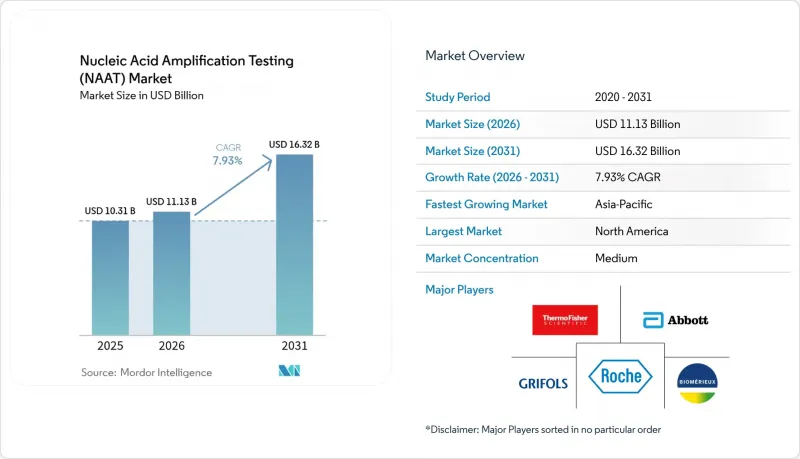
Mordor Intelligence에 의하면, 핵산 증폭 검사(NAAT) 시장 규모는 2025년에 103억 1,000만 달러로 평가되었습니다. 2026년 111억 3,000만 달러에서 2031년까지 연평균 복합 성장률(CAGR) 7.93%로 성장하여 163억 2,000만 달러에 이를 것으로 추정되고 있습니다.
본 보고서는 제품별(소모품(시약 등) 등), 기술별(중합효소 연쇄반응(PCR) 등), 용도별(감염병(결핵 등), 종양학 등), 최종 사용자별(병원 등), 지역별(북미, 유럽, 아시아태평양 등)로 분류되어 있습니다. 시장 예측은 금액(달러) 기준으로 제공됩니다.
세계의 핵산 증폭 검사(NAAT) 시장 동향 및 인사이트
다중 호흡기 병원체 패널에 대한 수요 증가
증후군별 호흡기 패널을 통해 임상의는 한 번의 검사로 여러 바이러스와 세균을 검출할 수 있어, 진단의 불확실성을 줄이고 몇 시간 이내에 표적 치료에 대한 지침을 제공합니다. 병원 측에서는 입원 일수 단축 및 경험적 항생제 사용 감소가 보고되고 있으며, 이는 가치 기반 지불 모델과 부합하는 이점입니다. 검사실 관리자들도 계절적 환자 급증 시 직원들의 부담을 줄여주는 효율적인 워크플로우를 높이 평가했습니다. 이러한 패널의 대부분은 카트리지 방식이므로 기존 분석 장비와 원활하게 통합될 수 있어, 검사실이 설비 투자 정당성을 입증하는 데 도움이 됩니다. 전반적으로, 이러한 검사의 도입으로 인해 핵산 증폭 검사 시장은 응급 의료 및 외래 진료 현장에 더욱 깊이 침투하고 있습니다.
분산형 검사를 위한 등온 루프 매개 증폭 플랫폼의 급속한 보급
루프 매개 증폭(LAMP) 기술을 통해 열 사이클링이 필요 없어지므로, 스마트폰 크기의 장치로도 진료소, 약국, 현장 등에서 고감도 검출이 가능해집니다. LAMP 및 RPA에 관한 논문 수는 2013년부터 2024년에 걸쳐 꾸준히 증가하고 있으며, 이는 이 기술이 성숙 단계에 접어들고 있음을 보여줍니다. 마이크로플루이딕스 칩과 결합함으로써, 이러한 화학 반응은 실험대가 필요 없는 ‘검체에서 결과까지’의 검사 방식을 실현합니다. 신흥 시장이 감염병 감시에 투자하는 가운데, 등온법을 활용한 검사 도구는 PCR 시스템 도입이 현실적으로 어려운 농촌 지역에도 보급되어, 핵산 증폭 검사 시장의 적용 범위를 확대되고 있습니다.
자격을 갖춘 분자 검사 기술자 부족
2024년에는 공중보건 및 임상 실험실의 결원율이 상승하여 초과근무 수당 증가와 배치 처리 제한으로 이어졌습니다. 인재 양성 체계는 수요를 따라가지 못하고 있으며, 지방 시설에서는 경쟁력 있는 급여를 제시하는 데 어려움을 겪고 있습니다. 그 결과, 각 벤더사는 전문 지식을 최소화한 ‘플러그 앤 플레이(plug-and-play)’ 방식의 설계를 중시하고 있으며, 이를 통해 인력 부족에도 불구하고 핵산 증폭 검사 시장은 여전히 성장을 지속할 수 있게 되었습니다.
부문별 분석
소모품은 2025년 매출의 56.78%를 차지하며, 검사 건수와 직결되는 확실하고 지속적인 매출을 통해 핵산 증폭 검사 시장의 기반을 지탱했습니다. 시약 키트, 프로브 혼합액, 일회용 카트리지는 검사실 예산의 주축을 이루고 있습니다. 다년간의 조달 계약은 구매자를 가격 변동으로부터 보호하고 제조업체에는 예측 가능한 가동률을 보장하므로, 이 부문의 예상 연평균 성장률(CAGR) 9.28%를 뒷받침하고 있습니다. 한편, RFID 태그가 내장된 스마트 패키지는 재고의 자동 추적을 지원하여 품절 위험을 해소하는 동시에, 검사실이 인증 요건을 충족하는 데 도움을 주고 있습니다. 포인트 오브 케어(PoC) 플랫폼이 보급됨에 따라 일회용 카트리지가 소모품의 주류가 되어, 핵산 증폭 검사 시장 내 소모품 시장 규모를 더욱 확대시키고 있습니다.
장비 및 시스템은 구매 빈도는 낮지만 검사 항목의 확대를 촉진합니다. PCR과 등온 반응 모두를 지원하는 모듈형 분석 장치는 설비 투자를 보호하고 실험실의 미래 경쟁력을 확보합니다. 시설들이 클라우드 분석 및 예방적 유지보수 패키지를 계약함에 따라 소프트웨어 및 서비스 수익이 증가하고 있습니다. 증폭 곡선을 실시간으로 분류하는 머신러닝 기반 업그레이드는 연간 라이선스로 판매될 수 있으며, 이는 공급업체에게 핵산 증폭 검사 시장에서 소모품에 필적하는 지속적인 매출 성장을 가져다줍니다.
PCR은 수십 년에 걸친 검증 실적, 견고한 공급망, 그리고 방대한 도입 실적을 바탕으로 2025년에는 핵산 증폭 검사 시장에서 67.12%의 점유율을 차지했습니다. 각 벤더사는 최대 30개의 표적을 검출할 수 있는 멀티플렉스 키트를 개선하고 있으며, 이를 통해 PCR 패널은 새로운 증후군별 어레이와 경쟁할 수 있는 수준에 도달했습니다. 고속 열 사이클러는 현재 45사이클을 20분 이내에 완료하기 때문에 신속한 결과가 필수적인 경우에도 PCR의 유용성은 유지되고 있습니다.
등온 핵산 증폭 기술은 연평균 성장률(CAGR) 9.94%를 나타낼 것으로 예측되며, 이는 핵산 증폭 검사 시장에서 가장 높은 성장률입니다. LAMP의 6-프라이머 구조는 뛰어난 특이성을 발휘하며, 비색법 검출을 통해 형광 광학 시스템이 필요하지 않으므로 하드웨어 비용을 절감할 수 있습니다. 리콤비나제-폴리메라제 증폭법은 체온에서 작동하므로 휴대용 장치의 히터 설계가 단순화됩니다. 이러한 특성 덕분에 등온법을 이용한 기기는 현장 진단, 국경 검역, 응급 분류에 적합합니다. 리가아제 연쇄반응은 틈새 분야이긴 하지만, 표적형 종양학 분석에서 단일 염기 다형성(SNV)을 확인하는 데 여전히 필수적이며, 핵산 증폭 검사 시장에서 규모는 작지만 안정적인 점유율을 확보하고 있습니다.
지역별 분석
북미는 성숙한 보험 환급 제도, 지속적인 혁신, 그리고 디지털 헬스 통합의 조기 도입에 힘입어 2025년에는 전 세계 매출의 43.10%를 차지했습니다. 정밀 종양학 프로그램은 분자 검사 건수를 증가시켰으며, 정액제 모델은 더 신속하고 정확한 진단을 장려하고 있습니다. 클라우드 기반 결과 포털을 통해 지방의 임상의들도 전문적인 분자 데이터에 접근할 수 있게 되어, 3차 의료기관 이외의 장소에서도 전문 의료 서비스가 제공되고 있습니다. 이러한 추세가 심화됨에 따라, 핵산 증폭 검사 시장은 꾸준한 속도로 확대될 것으로 예측됩니다.
아시아태평양은 의료 예산 증가와 국내 생산 확대에 힘입어 9.88%라는 가장 높은 연평균 성장률(CAGR)을 보일 것으로 전망됩니다. 중국의 성(省) 차원 조달 제도는 중국산 장비를 우선적으로 선정하여 현지 도입을 가속화하고 있습니다. 인도의 민관 협력 검사 네트워크는 결핵 및 HIV 프로그램에서 분자 검사 항목을 확대하고 있어, 공급업체에 규모의 경제를 가져다주고 있습니다. 휴대용 등온 시스템은 동남아시아의 인프라 장벽을 제거하여 핵산 증폭 검사 시장을 더욱 확대시키고 있습니다.
유럽은 8.01%의 연평균 성장률(CAGR)이 예상되며, 상당한 시장 점유율을 차지하고 있습니다. 엄격한 품질 규제로 인해 표준화된 결과 보고가 의무화됨에 따라, 감사 추적 기능이 내장된 기기에 대한 수요가 증가하고 있습니다. EU4Health 프로그램과 같은 자금 지원 이니셔티브를 통해 회원국 전반에 걸쳐 분자진단의 업그레이드에 자금이 지원되면서 성장이 지속되고 있습니다. 중동 및 아프리카는 9.52%의 연평균 성장률(CAGR)로 성장할 것으로 전망됩니다. 걸프 국가들은 분자진단 전체 라인업을 갖춘 세계적 수준의 병원 복합 단지에 투자하고 있는 반면, 기부금으로 운영되는 프로그램에서는 더 광범위한 질병 패널을 처리할 수 있도록 GeneXpert 시스템의 개량이 진행되고 있습니다. 남미는 연평균 성장률(CAGR) 8.97%가 예상되는데, 이는 브라질과 콜롬비아가 국민건강보험을 확대하고 지카열, 뎅기열, 그리고 코로나19와 인플루엔자의 복합 감염에 대한 신속 분자진단을 도입하고 있기 때문입니다. 이러한 지역들이 합쳐져 전 세계적인 보급을 촉진하며, 핵산 증폭 검사 시장을 견인하고 있습니다.
기타 혜택 :
- 엑셀 형식 시장 예측(ME) 시트
- 3개월간의 애널리스트 지원
자주 묻는 질문
목차
제1장 서론
제2장 조사 방법
제3장 주요 요약
제4장 시장 구도
제5장 시장 규모 및 성장 예측
제6장 경쟁 구도
제7장 시장 기회 및 향후 전망
KTH 26.08.28According to Mordor Intelligence, the nucleic acid amplification testing (NAAT) market size was valued at USD 10.31 billion in 2025 and estimated to grow from USD 11.13 billion in 2026 to reach USD 16.32 billion by 2031, at a CAGR of 7.93% during the forecast period (2026-2031).
This report is Segmented by Product (Consumables [Reagents and More] and More), Technology (Polymerase Chain Reaction (PCR) and More), Application (Infectious Disease [Tuberculosis and More], Oncology, and More), End-User (Hospitals and More) and Geography (North America, Europe, Asia-Pacific, and More). The Market Forecasts are Provided in Terms of Value (USD).
Global Nucleic Acid Amplification Testing (NAAT) Market Trends and Insights
Escalating Demand for Multiplex Respiratory Pathogen Panels
Syndromic respiratory panels allow clinicians to detect several viruses and bacteria in one run, cutting diagnostic uncertainty and guiding targeted therapy within hours. Hospitals report shorter lengths of stay and reduced empiric antibiotic use, advantages that align with value-based payment models. Laboratory managers also appreciate streamlined workflows that ease staffing pressure during seasonal surges. Because many of these panels are cartridge-based, they integrate smoothly with existing analyzers and help laboratories justify capital upgrades. Overall, their adoption is pushing the nucleic acid amplification testing market deeper into urgent-care and outpatient settings.
Rapid Adoption of Isothermal Loop-Mediated Platforms for Decentralized Testing
Loop-mediated amplification eliminates thermal cycling, enabling devices the size of a smartphone to perform sensitive detection in clinics, pharmacies, and field sites. Publication volume on LAMP and RPA rose steadily from 2013-2024, signalling maturing science. Coupled with microfluidic chips, these chemistries support sample-to-answer formats that require no lab bench. As emerging markets invest in infectious-disease surveillance, isothermal tools can reach rural zones where PCR systems are impractical, broadening the nucleic acid amplification testing market footprint.
Shortage of Qualified Molecular Technologists
Vacancy rates in public-health and clinical labs climbed in 2024, increasing overtime costs and limiting batch runs. Training pipelines lag behind demand, and rural facilities struggle to offer competitive salaries. Consequently, vendors emphasize plug-and-play designs that require minimal expertise, ensuring the nucleic acid amplification testing market can still grow despite labor shortages.
Other drivers and restraints analyzed in the detailed report include:
- Integration of NAAT with Automated Sample-to-Answer Cartridges
- Inclusion of NAAT in Blood-Screening Mandates
- High Per-Test Cost of Proprietary Cartridge Systems
For complete list of drivers and restraints, kindly check the Table Of Contents.
Segment Analysis
Consumables represented 56.78% of 2025 revenue, anchoring the nucleic acid amplification testing market with dependable, repeat sales tied directly to test volumes. Reagent kits, probe mixtures, and disposable cartridges form the backbone of laboratory budgets. Multi-year procurement contracts shield buyers from price swings and assure manufacturers of predictable run-rates, reinforcing the segment's projected 9.28% CAGR. Meanwhile, smart packaging that embeds RFID tags supports automated inventory tracking, addressing stock-out risk and helping laboratories meet accreditation requirements. As point-of-care platforms proliferate, single-use cartridges become the dominant consumable form factor, further scaling the nucleic acid amplification testing market size for consumables.
Instruments and systems, although purchased less frequently, catalyze assay expansion. Modular analyzers that accept both PCR and isothermal chemistries protect capital investment and future-proof laboratories. Software and services revenue rises as facilities subscribe to cloud analytics and preventive-maintenance packages. Machine-learning upgrades that classify amplification curves in real time can be sold as annual licenses, giving vendors recurring top-line growth that rivals consumables within the nucleic acid amplification testing market.
PCR held 67.12% nucleic acid amplification testing market share in 2025, leveraging decades of validation, robust supply chains, and a vast installed base. Vendors refine multiplex kits to detect up to 30 targets, making PCR panels competitive with newer syndromic arrays. High-speed thermal cyclers now complete 45-cycle runs in under 20 minutes, keeping PCR relevant even when rapid results are mandatory.
Isothermal nucleic-acid amplification technology is projected to post a 9.94% CAGR, the fastest in the nucleic acid amplification testing market. LAMP's six-primer architecture confers exceptional specificity, and colorimetric readouts remove the need for fluorescence optics, cutting hardware costs. Recombinase polymerase amplification operates at body temperature, simplifying heater design for portable devices. These attributes position isothermal tools for field diagnostics, border-screening, and emergency triage. Ligase chain reaction, albeit niche, remains indispensable for single-nucleotide variant confirmation in targeted oncology assays, securing a small but stable slice of the nucleic acid amplification testing market.
Complete Report Scope:
- By Product
- Consumables
- Reagents
- Assay Kits
- Other Consumables
- Instruments & Systems
- Software & Services
- Consumables
- By Technology
- Polymerase Chain Reaction (PCR)
- Isothermal Nucleic Acid Amplification Technology (INAAT)
- Ligase Chain Reaction (LCR)
- By Application
- Infectious Disease
- COVID-19
- Sexually Transmitted Infections
- Mosquito Borne
- Gastrointestinal Infections
- Tuberculosis
- Hepatitis
- Other Infectious Diseases
- Oncology
- Genetic & Mitochondrial Disorder Testing
- Others
- Infectious Disease
- By End-User
- Hospitals
- Independent & Reference Laboratories
- Other End-Users
- By Geography (Value)
- North America
- United States
- Canada
- Mexico
- Europe
- Germany
- United Kingdom
- France
- Italy
- Spain
- Rest of Europe
- Asia-Pacific
- China
- India
- Japan
- Australia
- South Korea
- Rest of Asia-Pacific
- Middle East & Africa
- GCC
- South Africa
- Rest of Middle East & Africa
- South America
- Brazil
- Argentina
- Rest of South America
- North America
Geography Analysis
North America retained 43.10% of global revenue in 2025, supported by mature reimbursement, continuous innovation, and early adoption of digital-health integrations. Precision-oncology programs bolster molecular volumes, and capitated payment models reward faster, more accurate diagnoses. Cloud-based result portals allow rural clinicians to access expert molecular data, extending specialty care beyond tertiary hospitals. The nucleic acid amplification testing market is expected to advance at a steady pace as these dynamics deepen.
Asia-Pacific is projected for the fastest 9.88% CAGR, propelled by rising health budgets and domestic manufacturing. China's provincial procurement schemes favor made-in-China instruments, accelerating local adoption. India's public-private laboratory networks are expanding molecular menus in tuberculosis and HIV programs, offering vendors scale. Portable isothermal systems remove infrastructure barriers in Southeast Asia, further enlarging the nucleic acid amplification testing market.
Europe commands a significant share with an 8.01% CAGR outlook. Stringent quality regulations mandate standardized result reporting, boosting demand for instruments with built-in audit trails. Funding initiatives such as the EU4Health program finance molecular upgrades across member states, sustaining growth. The Middle East & Africa will grow at 9.52% CAGR; Gulf countries invest in world-class hospital complexes featuring full molecular suites, while donor-funded programs retrofit GeneXpert systems for broader disease panels. South America is set for 8.97% CAGR as Brazil and Colombia expand universal-health coverage and adopt rapid molecular diagnostics for Zika, dengue, and COVID-flu combos. Together, these regions deepen global penetration, lifting the nucleic acid amplification testing market.
- Abbott Laboratories
- Beckton Dickinson
- BGI Genomics Co. Ltd.
- bioMerieux
- Bio-Rad Laboratories
- Bruker
- Danaher
- Diasorin S.p.A.
- Roche
- Grifols
- Hologic
- Molbio Diagnostics Pvt. Ltd.
- Mylab Discovery Solutions
- Pfizer Inc (Lucira Health)
- QuidelOrtho Corp.
- Randox Laboratories
- Sansure Biotech Inc.
- Seegene
- Siemens Healthineers
- Thermo Fisher Scientific
Additional Benefits:
- The market estimate (ME) sheet in Excel format
- 3 months of analyst support
TABLE OF CONTENTS
1 Introduction
- 1.1 Study Assumptions & Market Definition
- 1.2 Scope of the Study
2 Research Methodology
3 Executive Summary
4 Market Landscape
- 4.1 Market Overview
- 4.2 Market Drivers
- 4.2.1 Escalating Demand for Multiplexed Respiratory Pathogen Panels
- 4.2.2 Rapid Adoption of Isothermal Loop-Mediated Platforms for Decentralized Testing
- 4.2.3 Integration of NAAT with Automated Sample-to-Answer Cartridges
- 4.2.4 Inclusion of NAAT in Blood-Screening Mandates
- 4.2.5 Growth of ctDNA NAAT Companion Diagnostics in Oncology
- 4.2.6 Private Investment Surge in Portable CRISPR-Based NAAT Solutions
- 4.3 Market Restraints
- 4.3.1 Shortage of Qualified Molecular Technologists
- 4.3.2 High Per-Test Cost of Proprietary Cartridge Systems
- 4.3.3 Primer Redesign Needs Owing to Pathogen Mutations
- 4.3.4 Reagent Supply-Chain Vulnerabilities During Demand Surges
- 4.4 Supply-Chain Analysis
- 4.5 Technological Outlook
- 4.6 Porter's Five Forces Analysis
- 4.6.1 Threat of New Entrants
- 4.6.2 Bargaining Power of Buyers
- 4.6.3 Bargaining Power of Suppliers
- 4.6.4 Threat of Substitutes
- 4.6.5 Competitive Rivalry Intensity
5 Market Size & Growth Forecasts (Value)
- 5.1 By Product
- 5.1.1 Consumables
- 5.1.1.1 Reagents
- 5.1.1.2 Assay Kits
- 5.1.1.3 Other Consumables
- 5.1.2 Instruments & Systems
- 5.1.3 Software & Services
- 5.1.1 Consumables
- 5.2 By Technology
- 5.2.1 Polymerase Chain Reaction (PCR)
- 5.2.2 Isothermal Nucleic Acid Amplification Technology (INAAT)
- 5.2.3 Ligase Chain Reaction (LCR)
- 5.3 By Application
- 5.3.1 Infectious Disease
- 5.3.1.1 COVID-19
- 5.3.1.2 Sexually Transmitted Infections
- 5.3.1.3 Mosquito Borne
- 5.3.1.4 Gastrointestinal Infections
- 5.3.1.5 Tuberculosis
- 5.3.1.6 Hepatitis
- 5.3.1.7 Other Infectious Diseases
- 5.3.2 Oncology
- 5.3.3 Genetic & Mitochondrial Disorder Testing
- 5.3.4 Others
- 5.3.1 Infectious Disease
- 5.4 By End-User
- 5.4.1 Hospitals
- 5.4.2 Independent & Reference Laboratories
- 5.4.3 Other End-Users
- 5.5 By Geography (Value)
- 5.5.1 North America
- 5.5.1.1 United States
- 5.5.1.2 Canada
- 5.5.1.3 Mexico
- 5.5.2 Europe
- 5.5.2.1 Germany
- 5.5.2.2 United Kingdom
- 5.5.2.3 France
- 5.5.2.4 Italy
- 5.5.2.5 Spain
- 5.5.2.6 Rest of Europe
- 5.5.3 Asia-Pacific
- 5.5.3.1 China
- 5.5.3.2 India
- 5.5.3.3 Japan
- 5.5.3.4 Australia
- 5.5.3.5 South Korea
- 5.5.3.6 Rest of Asia-Pacific
- 5.5.4 Middle East & Africa
- 5.5.4.1 GCC
- 5.5.4.2 South Africa
- 5.5.4.3 Rest of Middle East & Africa
- 5.5.5 South America
- 5.5.5.1 Brazil
- 5.5.5.2 Argentina
- 5.5.5.3 Rest of South America
- 5.5.1 North America
6 Competitive Landscape
- 6.1 Product Portfolio Analysis
- 6.2 Market Share Analysis
- 6.3 Company Profiles (includes Global level Overview, Market level overview, Core Segments, Financials as available, Strategic Information, Market Rank/Share for key companies, Products & Services, and Recent Developments)
- 6.3.1 Abbott Laboratories
- 6.3.2 Becton, Dickinson and Company
- 6.3.3 BGI Genomics Co. Ltd.
- 6.3.4 bioMerieux SA
- 6.3.5 Bio-Rad Laboratories Inc.
- 6.3.6 Bruker Corporation
- 6.3.7 Danaher Corporation
- 6.3.8 Diasorin S.p.A.
- 6.3.9 F. Hoffmann-La Roche AG
- 6.3.10 Grifols SA
- 6.3.11 Hologic Inc.
- 6.3.12 Molbio Diagnostics Pvt. Ltd.
- 6.3.13 Mylab Discovery Solutions
- 6.3.14 Pfizer Inc (Lucira Health)
- 6.3.15 QuidelOrtho Corp.
- 6.3.16 Randox Laboratories Ltd.
- 6.3.17 Sansure Biotech Inc.
- 6.3.18 Seegene Inc.
- 6.3.19 Siemens Healthineers AG
- 6.3.20 Thermo Fisher Scientific Inc.
7 Market Opportunities & Future Outlook
- 7.1 White-Space & Unmet-Need Assessment