|
시장보고서
상품코드
2114469
레이저 클리닝 : 시장 점유율 분석, 업계 동향 및 통계, 성장 예측(2026-2031년)Laser Cleaning - Market Share Analysis, Industry Trends & Statistics, Growth Forecasts (2026 - 2031) |
||||||
 Mordor Intelligence
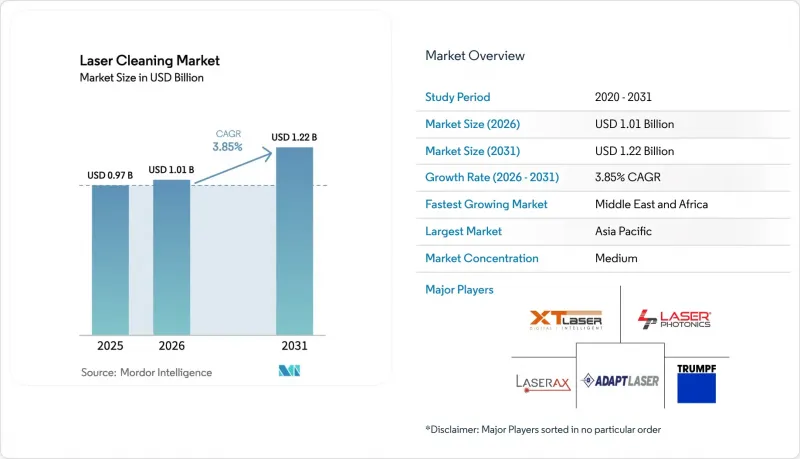
Mordor Intelligence에 의하면, 레이저 클리닝 시장 규모는 2025년 9억 7,000만 달러로 평가되었습니다. 2026년에는 10억 1,000만 달러로 확대되어 2031년까지 12억 2,000만 달러에 이를 것으로 예상되고 2026년부터 2031년에 걸쳐 CAGR 3.85%로 성장할 전망입니다.
본 보고서는 레이저 유형(파이버, 고체, CO₂, 초단펄스), 출력 범위(고출력, 중출력, 저출력),휴대성(핸드헬드, 벤치탑, 로봇), 펄스 폭(연속파, 나노초, 초단펄스), 용도(도료 제거 등), 최종 사용자 산업(자동차, 항공우주 등), 지역별로 분류되어 있습니다. 시장 전망은 금액(미 달러) 기준으로 제시되어 있습니다.
세계의 레이저 클리닝 시장 동향 및 인사이트
화학 용제를 대체하는 엄격한 환경 규제
유럽연합(EU)의 VOC 지침 및 캘리포니아주의 유사한 규제로 인해, 많은 금속 가공업체에게 용제 탱크의 사용은 경제적으로 타당하지 않게 되었습니다. 독일에서는 폐기물 처리 비용이 드럼 1개당 200달러를 초과하기 때문에 1차 자동차 부품 공급업체들은 잔류물을 전혀 남기지 않는 500W 파이버 레이저로 설비를 개조하고 있습니다. 에어버스(Airbus)는 함부르크 공장에서 복합재 공구의 유지보수를 레이저 클리닝으로 전환한 결과, VOC 배출량을 85% 감축했다고 보고했습니다. 2025년 OSHA가 메틸렌 클로라이드의 노출 한도치를 강화함에 따라 미국 시설에서도 유사한 움직임이 나타나는 한편, 다국적 OEM 기업들은 현재 아시아태평양의 하청업체에 대해 통일된 환경 기준을 적용하고 있습니다. 폴란드와 체코 공화국의 수탁 제조업체들은 자동차 관련 계약을 유지하기 위해 레이저 도장 박리 라인을 도입하고 있으며, 이는 규제가 얼리 어답터를 넘어 기술의 보급을 어떻게 가속화하고 있는지를 보여줍니다.
비접촉 표면 처리에 대한 자동화 수요 증가
조립 공장에서는 화이트 바디의 용접 케이지 내에서 1.5kW 파이버 레이저와 6축 로봇을 결합하여 사용하고 있습니다. 프라운호퍼 ILT의 조사에 따르면, 레이저 클리닝을 거친 알루미늄 패널은 화학 처리를 거친 샘플에 비해 용접 강도가 40% 더 높은 것으로 나타났습니다. 수작업으로 진행하던 닦아내기 공정을 생략함으로써 차체 1대당 25초를 단축할 수 있으며, 연간 30만 대를 생산하는 라인에서는 연간 수백만 달러 상당의 이익으로 이어집니다. 독일공급업체들은 인력 부족과 더욱 엄격해진 공차 목표가 겹치면서 2025년에는 로봇이 장착된 레이저 셀 도입이 22% 증가했습니다. 중국의 전기차 제조업체들도 배터리 팩 하우징을 위해 자동 레이저 처리 장비를 도입하여 접착 불량으로 인한 보증 청구 건수를 줄이고 있습니다.
개발도상국에서의 고출력 시스템에 대한 막대한 설비 투자
1kW를 초과하는 시스템의 가격은 여전히 15만 달러 이상입니다. 배연 장치나 클래스 4 인클로저가 추가되면 프로젝트 예산이 2배로 늘어날 수도 있습니다. 인도나 브라질의 중소기업에게 이러한 금액은 10분의 1 비용으로 해결되는 그라인더 기반 생산 라인과 비교할 때 감당하기 어려운 수준으로 여겨집니다. 아프리카와 라틴아메리카에서는 서비스 네트워크가 부족하여 임대 업체의 의욕이 제한되고 있으며, 장비 임대 솔루션은 여전히 제한적입니다. 이 문제는 고출력 로봇에서 특히 심각하지만, 반면 약 2만 5,000달러에 판매되는 200W 핸드헬드 모델은 제한적인 수요만 얻고 있습니다.
부문별 분석
파이버 장치는 30% 이상의 벽면 콘센트 효율과 낮은 유지보수 비용 덕분에 2025년 레이저 세정 시장에서 46.18%의 점유율을 차지했습니다. 조선소, 배터리 공장, 금형 공장 등이 극도의 정밀도보다 처리 능력을 중시함에 따라, 파이버 유닛을 이용한 레이저 세정 시장 규모는 꾸준히 확대될 것입니다. 피코초 및 펨토초 광원은 2031년까지 연평균 성장률(CAGR) 4.55%를 유지하며, 항공우주용 복합재료나 박물관 소장품과 같은 섬세한 작업 분야에서 수요를 확보해 나갈 것입니다. 고체 Nd : YAG 레이저는 여전히 기존 군사 시설에서 사용되고 있지만, 파이버 레이저의 빔 품질이 향상됨에 따라 시장 점유율은 감소하고 있습니다. 콘크리트 도장 박리 작업에 널리 사용되고 있는 CO₂ 레이저는 부피가 큰 3상 전원을 필요로 하기 때문에 여전히 시장 점유율이 제한적입니다.
IPG Photonics사는 자동차 업계 수요를 바탕으로 2025년 세정용 파이버 유닛 출하 대수가 2024년 대비 15% 증가했습니다. TRUMPF사의 2kW ‘TruPulse Clean’ 플랫폼은 2026년에 출시될 예정이며, 구형 초고속 레이저 장비에 필적하는 빔 품질 지표를 갖추면서도 파이버 레이저 수준의 경제성을 실현합니다. Coherent사가 2024년에 EKSMA Optics를 인수한 것은 이 회사가 초고속 레이저 분야로의 진출을 추진하고 있음을 나타내며, 많은 대기업이 채택하고 있는 이중 전략을 부각시키고 있습니다.
100W에서 1kW의 중출력 시스템은 2025년 매출의 38.43%를 차지했습니다. 이러한 시스템은 시간당 5-8제곱미터의 속도로 녹을 제거하고, 사출 성형 공장에서 허용 가능한 사이클 타임으로 금형을 세척할 수 있기 때문에 위탁 가공 업체에게 표준적인 선택지가 되고 있습니다. 1kW를 초과하는 고출력 모델은 2031년까지 연평균 성장률(CAGR) 4.82%를 나타낼 것으로 예측됩니다. 이는 차체 공장에서 로봇 용접 아일랜드가 증가함에 따라 인라인 세척이 가능한 1.5kW-3kW 헤드에 대한 새로운 수요가 발생하기 때문입니다.
Laserax사는 캐나다의 프레스 가공 공장에서 수작업 연마를 불필요하게 만든 1.5kW 로봇 셀에 대해 9개월 만에 투자 회수를 달성했습니다. 대조적으로, 100W 미만의 저출력 유닛은 작업자가 휴대용 장비의 안전성과 휴대성을 중시하는 보석 수리나 미세 부품의 버 제거와 같은 분야에서 여전히 틈새 시장으로 남아 있습니다.
지역별 분석
아시아태평양은 2025년 전 세계 매출의 36.29%를 차지했습니다. 이는 2025년 VOC 배출 상한선을 충족하기 위해 비접촉 세척을 의무화하는 중국의 개조 프로그램이 주도한 결과입니다. 한국의 기가팩토리에서는 전극 가공용으로 IPG 사의 1.5 kW 시스템 50대를 도입하고 있으며, 이는 이 지역의 배터리 산업의 깊이를 보여줍니다. 일본의 설비 철거 예산으로 인해 원격 조작형 파이버 툴에 대한 장기적인 수요가 확보된 반면, 인도의 PLI(생산 연계형 인센티브) 제도에 따라 2027년 이후에는 반도체 분야에서의 도입이 확대될 전망입니다.
유럽은 독일의 자동차용 로봇 셀과 이탈리아의 역사적 건축물 복원 사업을 배경으로 시장 점유율을 유지하고 있습니다. 이 지역은 정책적 지원과 성숙한 서비스 네트워크의 혜택을 받고 있습니다. 이어 북미에서는 미국의 항공우주 정비 거점과 캐나다의 파이프라인 정비 거점이 수천 대의 핸드헬드 장비를 흡수하고 있습니다.
중동은 사우디아라비아의 NEOM 메가 프로젝트와 건조한 환경에서 폐기물이 적은 제염 도구가 필요한 UAE의 바라카 발전소 덕분에 연평균 성장률(CAGR) 5.15%로 이 지역에서 가장 빠른 성장을 기록할 전망입니다. 아프리카와 남미는 자금 면에서의 제약으로 인해 뒤처지고 있지만, 브라질의 해양 시추 설비와 남아프리카공화국의 광산 설비 개조 라인 덕분에 휴대용 레이저에 대한 국지적인 수요가 발생하고 있습니다.
기타 혜택 :
- 엑셀 형식 시장 예측(ME) 시트
- 3개월간의 애널리스트 지원
자주 묻는 질문
목차
제1장 서론
제2장 조사 방법
제3장 주요 요약
제4장 시장 구도
제5장 시장 규모 및 성장 예측
제6장 경쟁 구도
제7장 시장 기회 및 향후 전망
KTH 26.08.28According to Mordor Intelligence, the laser cleaning market size is expected to increase from USD 0.97 billion in 2025 to USD 1.01 billion in 2026 and reach USD 1.22 billion by 2031, growing at a CAGR of 3.85% over 2026-2031.
This report is Segmented by Laser Type (Fiber, Solid-State, CO2, and Ultrashort-Pulse), Power Range (High, Medium, and Low), Portability (Handheld, Benchtop, and Robotic), Pulse Duration (Continuous-Wave, Nanosecond, and Ultrashort-Pulse), Application (Paint Removal, and More), End-User Industry (Automotive, Aerospace, and More), and Geography. The Market Forecasts are Provided in Terms of Value (USD).
Global Laser Cleaning Market Trends and Insights
Stringent Environmental Regulations Replacing Chemical Solvents
The European Union's VOC Directive and parallel restrictions in California have made solvent baths economically untenable for many metal fabricators. Waste-disposal fees exceed USD 200 per drum in Germany, prompting tier-one automotive suppliers to retrofit 500 W fiber lasers that leave zero residue. Airbus documented an 85% cut in VOC output after switching to laser cleaning for composite-tool maintenance at its Hamburg plant. OSHA's tighter exposure limits for methylene chloride in 2025 spurred similar moves in U.S. facilities, while multinational OEMs now impose uniform green standards on Asia-Pacific subcontractors. Contract manufacturers in Poland and the Czech Republic have adopted laser paint-stripping lines to hold on to automotive contracts, showing how regulation accelerates technology diffusion beyond early adopters.
Rising Automation Demand for Non-contact Surface Preparation
Assembly plants are pairing 1.5 kW fiber lasers with six-axis robots inside body-in-white welding cages. Fraunhofer ILT found that laser-cleaned aluminium panels deliver 40% higher weld strength than chemically prepared samples. Removing the manual wiping stage trims 25 seconds per vehicle body, a gain worth millions of dollars per year in a line rated at 300,000 units. German suppliers showed 22% growth in robotic laser-cell installations in 2025 as labour scarcity collided with stricter tolerance goals. Chinese EV producers are also adopting automated laser chambers for battery-pack housings, cutting warranty claims linked to poor adhesive bonding.
High Capital Expenditure for High-power Systems in Developing Economies
Systems above 1 kW still list for more than USD 150,000. When fume extraction and Class 4 enclosures are added, project budgets can double. Indian and Brazilian SMEs view such sums as prohibitive relative to grinder-based lines that cost one-tenth as much. Equipment-leasing solutions remain scarce because service networks in Africa and Latin America are thin, limiting lessor appetite. The issue is acute for high-power robots, while handheld 200 W models selling around USD 25,000 are gaining limited traction.
Other drivers and restraints analyzed in the detailed report include:
- EV Battery Production Lines Needing Residue-free Electrode Cleaning
- Investments in Nuclear Facility Decommissioning
- Scarcity of Certified Laser Cleaning Technicians in Emerging Markets
For complete list of drivers and restraints, kindly check the Table Of Contents.
Segment Analysis
Fiber devices delivered 46.18% laser cleaning market share in 2025, thanks to wall-plug efficiency above 30% and low maintenance overhead. The laser cleaning market size for fiber units will climb steadily as shipyards, battery plants, and mold shops value throughput over extreme precision. Picosecond and femtosecond sources will keep a 4.55% CAGR by 2031, winning delicate jobs in aerospace composites and museum artifacts. Solid-state Nd:YAG holdings persist in legacy military depots but are sliding as fiber beam-quality improves. CO2 lasers, anchored in concrete paint removal, remain marginal because of bulky three-phase power supplies.
IPG Photonics shipped 15% more fiber units for cleaning in 2025 than in 2024, citing automotive demand. TRUMPF's 2 kW TruPulse Clean platform arrives in 2026 with beam-quality metrics rivalling older ultrafast machines yet at fiber-level economics. Coherent's 2024 purchase of EKSMA Optics signals its push into ultrafast domains, highlighting the split strategy most majors are adopting.
Medium-power systems between 100 W and 1 kW held 38.43% of 2025 revenue. They remove rust at 5-8 square meters per hour and clean molds in cycle times acceptable to injection shops, making them the default selection for contract fabricators. High-power models above 1 kW will grow at a 4.82% CAGR through 2031 as robotic welding islands multiply in body shops, generating fresh demand for 1.5 kW to 3 kW heads capable of inline cleaning.
Laserax recorded a nine-month payback on a 1.5 kW robotic cell at a Canadian stamping plant that eliminated manual grinding. By contrast, low-power units under 100 W remain niche in jewelry repair and micro-part deburring, where operators prioritize handheld safety and portability.
Complete Report Scope:
- By Laser Type
- Fiber Lasers
- Solid-state (Nd:YAG/Yb:YAG) Lasers
- CO2 Lasers
- Ultrashort-Pulse (Picosecond/Femtosecond) Lasers
- By Power Range
- High Power (Greater than 1 kW)
- Medium Power (100 W-1 kW)
- Low Power (Less than 100 W)
- By Portability
- Handheld/Portable Systems
- Benchtop/Stationary Systems
- Robotic/Automated Integrated Cells
- By Pulse Duration
- Continuous-Wave
- Nanosecond Pulsed
- Ultrashort-Pulse (Ps/Fs)
- By Application
- Paint and Coating Removal
- Rust and Oxide Removal
- Surface Pretreatment and Welding Preparation
- Mold Cleaning and Tooling Maintenance
- Cultural Heritage and Artwork Restoration
- Micro-electronics and Precision Cleaning
- Nuclear Decontamination
- By End-user Industry
- Automotive and Transport
- Aerospace and Defense
- Shipbuilding and Marine
- Infrastructure and Construction
- Energy and Power
- Oil and Gas
- Nuclear
- Renewables
- Electronics and Semiconductor
- Cultural Heritage Institutions
- Manufacturing and Industrial Machinery
- By Geography
- North America
- United States
- Canada
- Mexico
- South America
- Brazil
- Rest of South America
- Europe
- Germany
- United Kingdom
- France
- Italy
- Spain
- Rest of Europe
- Asia Pacific
- China
- Japan
- South Korea
- India
- South-East Asia
- Australia
- Rest of Asia Pacific
- Middle East
- United Arab Emirates
- Saudi Arabia
- Rest of Middle East
- Africa
- South Africa
- Rest of Africa
- North America
Geography Analysis
Asia Pacific generated 36.29% of global 2025 turnover, led by China's retrofit program mandating non-contact cleaning to meet 2025 VOC caps. South Korea's gigafactories line up 50 units of IPG 1.5 kW systems for electrode work, showing the region's depth in batteries. Japanese decommissioning budgets ensure long-term demand for remote fiber tools, while India's PLI incentives will lift semiconductor adoption after 2027.
Europe sustained share on the back of Germany's automotive robotic cells and Italy's heritage-stone restorations. The region benefits from policy push and mature service networks. North America follows, with U.S. aerospace depots and Canadian pipeline yards absorbing thousands of handheld units.
The Middle East will post the fastest regional growth, a 5.15% CAGR, thanks to Saudi Arabia's NEOM megaproject and the UAE's Barakah plant requiring low-waste decontamination tools in arid sites. Africa and South America trail because of capital constraints, though Brazil's offshore rigs and South Africa's mining refurb lines create pockets of portable laser demand.
- TRUMPF Group
- IPG Photonics Corporation
- Clean-Lasersysteme GmbH
- Laser Photonics Corporation
- P-Laser NV
- Laserax Inc.
- Adapt Laser Systems LLC
- Jinan Xintian Technology Co. Ltd (XT Laser)
- HGLaser Engineering Co. Ltd
- Han's Laser Technology Industry Group Co. Ltd
- Coherent Corp.
- Scantech Laser Pvt. Ltd
- Anilox Roll Cleaning Systems
- Shenzhen Riselaser Technology Co. Ltd
- Sukjin Laser Co.
- Allied Scientific Pro
- CyCleanLaser GmbH
- PharosQuartz (Light Conversion)
- Suresh Industech Pvt. Ltd
- RMA Technik GmbH
- Jinan Vmade CNC Machine Co. Ltd
- Shanghai Mactron Technology Co. Ltd
- Lynton Lasers Ltd
Additional Benefits:
- The market estimate (ME) sheet in Excel format
- 3 months of analyst support
TABLE OF CONTENTS
1 INTRODUCTION
- 1.1 Study Assumptions and Market Definition
- 1.2 Scope of the Study
2 RESEARCH METHODOLOGY
3 EXECUTIVE SUMMARY
4 MARKET LANDSCAPE
- 4.1 Market Overview
- 4.2 Market Drivers
- 4.2.1 Stringent Environmental Regulations Replacing Chemical Solvents in EU and North America
- 4.2.2 Rising Automation Demand for Non-contact Surface Preparation in Automotive Body Shops
- 4.2.3 Growth in Restoration Projects of Historical Monuments in Europe and Asia
- 4.2.4 Investments in Nuclear Facility Decommissioning Requiring Remote Laser Decontamination
- 4.2.5 EV Battery Production Lines Necessitating Residue-free Electrode Cleaning
- 4.2.6 Falling Cost-per-Watt of Fiber Lasers Broadening SME Adoption in Asia
- 4.3 Market Restraints
- 4.3.1 High Capital Expenditure for High-power Systems in Developing Economies
- 4.3.2 Limited Field Portability for Offshore Maintenance
- 4.3.3 Substrate Thermal Damage Risk on Heat-Sensitive Materials
- 4.3.4 Scarcity of Certified Laser Cleaning Technicians in Emerging Markets
- 4.4 Industry Value-Chain Analysis
- 4.5 Technological Outlook
- 4.5.1 Advances in Ultrashort-Pulse (Ps/Fs) Sources
- 4.5.2 Integration with Collaborative Robots
- 4.6 Regulatory Outlook
- 4.6.1 Global VOC and Hazardous-Chemical Directives
- 4.6.2 OSHA and IEC Laser-Safety Standards
- 4.7 Impact of Macroeconomic Factors on the Market
- 4.8 Porter's Five Forces Analysis
- 4.8.1 Bargaining Power of Suppliers
- 4.8.2 Bargaining Power of Buyers
- 4.8.3 Threat of New Entrants
- 4.8.4 Threat of Substitutes
- 4.8.5 Intensity of Competitive Rivalry
5 MARKET SIZE AND GROWTH FORECASTS (VALUE)
- 5.1 By Laser Type
- 5.1.1 Fiber Lasers
- 5.1.2 Solid-state (Nd:YAG/Yb:YAG) Lasers
- 5.1.3 CO2 Lasers
- 5.1.4 Ultrashort-Pulse (Picosecond/Femtosecond) Lasers
- 5.2 By Power Range
- 5.2.1 High Power (Greater than 1 kW)
- 5.2.2 Medium Power (100 W-1 kW)
- 5.2.3 Low Power (Less than 100 W)
- 5.3 By Portability
- 5.3.1 Handheld/Portable Systems
- 5.3.2 Benchtop/Stationary Systems
- 5.3.3 Robotic/Automated Integrated Cells
- 5.4 By Pulse Duration
- 5.4.1 Continuous-Wave
- 5.4.2 Nanosecond Pulsed
- 5.4.3 Ultrashort-Pulse (Ps/Fs)
- 5.5 By Application
- 5.5.1 Paint and Coating Removal
- 5.5.2 Rust and Oxide Removal
- 5.5.3 Surface Pretreatment and Welding Preparation
- 5.5.4 Mold Cleaning and Tooling Maintenance
- 5.5.5 Cultural Heritage and Artwork Restoration
- 5.5.6 Micro-electronics and Precision Cleaning
- 5.5.7 Nuclear Decontamination
- 5.6 By End-user Industry
- 5.6.1 Automotive and Transport
- 5.6.2 Aerospace and Defense
- 5.6.3 Shipbuilding and Marine
- 5.6.4 Infrastructure and Construction
- 5.6.5 Energy and Power
- 5.6.5.1 Oil and Gas
- 5.6.5.2 Nuclear
- 5.6.5.3 Renewables
- 5.6.6 Electronics and Semiconductor
- 5.6.7 Cultural Heritage Institutions
- 5.6.8 Manufacturing and Industrial Machinery
- 5.7 By Geography
- 5.7.1 North America
- 5.7.1.1 United States
- 5.7.1.2 Canada
- 5.7.1.3 Mexico
- 5.7.2 South America
- 5.7.2.1 Brazil
- 5.7.2.2 Rest of South America
- 5.7.3 Europe
- 5.7.3.1 Germany
- 5.7.3.2 United Kingdom
- 5.7.3.3 France
- 5.7.3.4 Italy
- 5.7.3.5 Spain
- 5.7.3.6 Rest of Europe
- 5.7.4 Asia Pacific
- 5.7.4.1 China
- 5.7.4.2 Japan
- 5.7.4.3 South Korea
- 5.7.4.4 India
- 5.7.4.5 South-East Asia
- 5.7.4.6 Australia
- 5.7.4.7 Rest of Asia Pacific
- 5.7.5 Middle East
- 5.7.5.1 United Arab Emirates
- 5.7.5.2 Saudi Arabia
- 5.7.5.3 Rest of Middle East
- 5.7.6 Africa
- 5.7.6.1 South Africa
- 5.7.6.2 Rest of Africa
- 5.7.1 North America
6 COMPETITIVE LANDSCAPE
- 6.1 Market Concentration
- 6.2 Strategic Moves
- 6.3 Market Share Analysis
- 6.4 Company Profiles (includes Global level Overview, Market level overview, Core Segments, Financials as available, Strategic Information, Market Rank/Share for key companies, Products and Services, and Recent Developments)
- 6.4.1 TRUMPF Group
- 6.4.2 IPG Photonics Corporation
- 6.4.3 Clean-Lasersysteme GmbH
- 6.4.4 Laser Photonics Corporation
- 6.4.5 P-Laser NV
- 6.4.6 Laserax Inc.
- 6.4.7 Adapt Laser Systems LLC
- 6.4.8 Jinan Xintian Technology Co. Ltd (XT Laser)
- 6.4.9 HGLaser Engineering Co. Ltd
- 6.4.10 Han's Laser Technology Industry Group Co. Ltd
- 6.4.11 Coherent Corp.
- 6.4.12 Scantech Laser Pvt. Ltd
- 6.4.13 Anilox Roll Cleaning Systems
- 6.4.14 Shenzhen Riselaser Technology Co. Ltd
- 6.4.15 Sukjin Laser Co.
- 6.4.16 Allied Scientific Pro
- 6.4.17 CyCleanLaser GmbH
- 6.4.18 PharosQuartz (Light Conversion)
- 6.4.19 Suresh Industech Pvt. Ltd
- 6.4.20 RMA Technik GmbH
- 6.4.21 Jinan Vmade CNC Machine Co. Ltd
- 6.4.22 Shanghai Mactron Technology Co. Ltd
- 6.4.23 Lynton Lasers Ltd
7 MARKET OPPORTUNITIES AND FUTURE OUTLOOK
- 7.1 White-space and Unmet-need Assessment