

|
시장보고서
상품코드
2114474
골밀도 측정기 시스템 : 시장 점유율 분석, 업계 동향 및 통계, 성장 예측(2026-2031년)Bone Densitometer Systems - Market Share Analysis, Industry Trends & Statistics, Growth Forecasts (2026 - 2031) |
||||||
 Mordor Intelligence
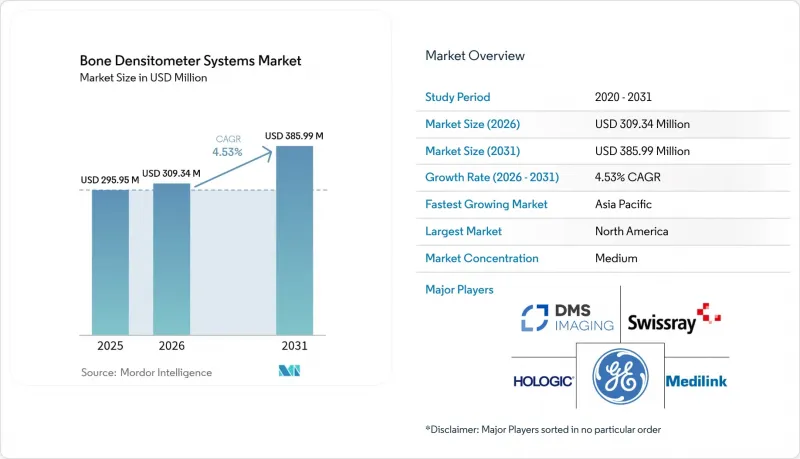
에 의하면, 2026년 골밀도 측정기 시스템 시장 규모는 3억 934만 달러로 추정되고 2025년 2억 9,595만 달러에서 확대해, 2031년에는 3억 8,599만 달러에 이를 것으로 예측됩니다.
2026년부터 2031년까지 연평균 성장률(CAGR) 4.53%로 성장할 것으로 전망됩니다.
본 보고서는 기술별(축방향 {DEXA, QCT} 및 말초 {SEXA 등}), 최종 사용자별(병원 등),용도(골다공증 진단 등), 휴대성(고정식/실내 설치형 시스템 등), 구성 요소(하드웨어, 소프트웨어·분석, 소모품·부속품), 지역(북미, 유럽 등)별로 분류되어 있습니다. 시장 규모 및 전망은 금액(달러) 기준으로 제시되어 있습니다.
세계의 골밀도 측정기 시스템 시장 동향 및 인사이트
골다공증 및 비타민 D 결핍증 발생률의 급증
현재 골다공증으로 고통받는 사람은 약 5억 명에 달할 것으로 추정되며, 역학 전문가들은 2050년까지 전체 취약성 골절의 절반 이상이 아시아에서 발생할 것으로 예측했습니다. 중국에서만 성인 인구의 13.54%가 DXA 검사로 정의되는 골다공증을 보이며, 이는 약 1억 4,586만 명에 해당합니다. 비타민 D 결핍은 골절 위험을 높이고, 폐경 후 여성의 골밀도 감소를 늦추는 FDA 승인 웨어러블 기기 ‘Osteoboost’ 등 의료기기 혁신을 촉진하고 있습니다. 의료 시스템 비용은 여전히 높습니다. 2016년, 메디케어는 골다공증성 골절에 57억 달러를 지출했지만, 골절이 발생한 여성 중 6개월 이내에 후속 DXA 검사를 받은 비율은 9%에 불과하여, 선별 검사에서 여전히 격차가 존재함을 보여줍니다. 충족되지 않은 수요가 높기 때문에 병원, 영상 진단센터 및 약국을 거점으로 한 새로운 프로그램 전반에 걸쳐 골밀도 측정기 시스템 시장에 대한 수요가 뒷받침되고 있습니다.
급속한 고령화
65세 이상 성인 인구는 2050년까지 전 세계적으로 2배로 증가할 것으로 예상되며, 이에 따라 선별 검사 수요는 더욱 높아질 것입니다. 메디케어는 이미 골질환 및 관절염을 대상으로 골밀도 측정 보험 적용 범위를 확대하고, 검진율 향상을 위해 본인 부담금 규제를 완화하고 있습니다. (65세 이상 인구가 전체 인구의 4분의 1을 차지하는 일본이나 한국 등의 국가에서는 지역 밀착형 DXA 프로그램을 확대하고, 원격 판독의 시범 도입을 추진하고 있습니다. 한편, 인력 공급이 수요를 따라가지 못하고 있어 2023년에는 방사선사 결원율이 6.9%에 달했기 때문에 의료기관은 서비스 수준을 유지하기 위해 AI를 활용한 트리아지 및 원격 판독 도입을 어쩔 수 없이 추진하고 있습니다. 골절 발생률이 상승하는 가운데, 대퇴골 경부 골절만 해도 남성은 310%, 여성은 240% 증가할 가능성이 있습니다. 2050년까지 비용 절감을 위해서는 누구나 이용할 수 있는 촬영 체계의 구축이 필수적입니다.
연속 촬영에 따른 방사선 및 안전상의 우려
DXA 검사의 피폭 선량은 0.001-0.01 mSv에 그치며, 이는 1일 분량의 자연 피폭량에 해당하지만, 수십 년에 걸친 누적 선량에 대해서는 임상의와 젊은 환자들 사이에서 우려가 확산되고 있습니다. 이에 대응하여 규제 당국은 제조업체에 최적화 알고리즘 탑재 및 차폐 강화 의무를 부과하는 개정된 선량 관리 지침을 마련했습니다. 이러한 움직임으로 인해 방사선을 사용하지 않는 REMS나 초음파 검사에 대한 수요가 높아지는 한편, 초저선량 DXA에 대한 연구도 촉진되고 있습니다. 의료 서비스 제공업체들은 ALARA 원칙을 점점 더 적극적으로 적용하는 동시에, 중요한 검사 실시를 지연시킬 수 있는 오해를 해소하기 위해 환자 교육 캠페인을 전개하고 있습니다.
부문별 분석
골밀도 측정기 시스템 시장은 여전히 DXA가 중심을 차지하고 있으며, 확립된 임상 지침과 광범위한 보험 적용 범위 덕분에 2025년에는 매출의 63.55%를 차지했습니다. 그러나 정량적 초음파는 두 자릿수의 CAGR로 빠르게 성장하고 있으며, 의료 서비스 제공업체들이 방사선을 사용하지 않는 워크플로로 전환함에 따라 DXA의 우위를 위협할 가능성이 있습니다. 정량적 컴퓨터 단층촬영(QCT)은 3차원 및 골주(骨梁)에 초점을 맞춘 조사에서 일정한 위치를 유지하고 있지만, 일상적인 평가에는 비용이 너무 높습니다. 초음파 기반 검사법인 REMS는 소매 클리닉이나 병상 현장에서 운용 가능한 휴대용 AI 지원 기기로의 비약적인 진화를 상징합니다.
각 제조업체는 검출기의 감도 향상, 팬텀 보정의 자동화, 그리고 골절 위험 점수를 실시간으로 산출하는 머신러닝 기능의 통합을 위해 경쟁적으로 노력하고 있습니다. 현재 일부 시스템은 전자 건강 기록과 직접 연동되어 T-스코어가 모니터링 기준치 이하로 떨어질 경우 경고를 전송하도록 되어 있습니다. 이러한 통합을 통해 측정값이 만성 질환 대시보드에 통합됨으로써 골밀도 측정기 시스템 시장의 유지에 기여하고 있습니다. 한편, 기회적 선별 검사용 소프트웨어는 보관된 CT 스캔을 분석하고 있으며, 이러한 워크플로우를 통해 하드웨어에 대한 추가 투자 없이 골밀도 측정기 시스템 시장 규모를 확대되고 있습니다. 방사선을 사용하지 않는 검사법이 지침에서 허용됨에 따라, 구매자들은 장비 교체 시 총 소유 비용, 처리 능력, AI 지원 기능을 비교 검토하고 있습니다.
병원은 여전히 골밀도 측정기 시스템 시장의 중심이며, 2025년에는 검사 건수의 52.85%를 차지했습니다. 이러한 우위는 통합된 전자 진료 기록, 병원 내 전문의, 그리고 골절 관리 경로에 대한 종합적인 보험 환급에 의해 뒷받침되고 있습니다. 그럼에도 불구하고 외래 환자 수요가 증가하고, 보험사가 복잡성이 낮은 스캔을 비용 효율적인 시설로 유도함에 따라 영상 진단센터는 연평균 성장률(CAGR) 9.77%로 확대되고 있습니다. 약사가 운영하는 프로그램과 정형외과 클리닉은 설치 공간이 작고 차폐 필요성이 제한적인 소형 초음파 장비 및 REMS 장치를 활용하여 제3의 축을 형성하고 있습니다.
인력 부족에 대처하기 위해 병원에서는 2차 판독을 텔레라디오로지 풀에 외주하는 사례가 증가하는 한편, 영상진단센터에서는 정상 검사 영상을 사전에 선별하는 AI 트리아지를 도입하여 기술자의 업무 부담을 줄이고 있습니다. 전용 스캐너 도입이 경제적으로 타당하지 않은 지방 시설에서는 순회형 모바일 서비스와 계약을 맺고 있습니다. 이 모델을 통해 골밀도 측정기 시스템 시장이 새로운 우편번호 구역으로 확대되고 있습니다. 원격 판독과 자동화된 품질 관리를 결합한 의료 기관은 인력이 제한적인 경우에도 ISO 규정을 준수할 수 있습니다. 인구 동향의 변화에 따라 골절 위험 곡선이 가파르게 상승하는 가운데, 이러한 분산형 의료 체계야말로 성장을 지속시키는 열쇠가 될 것입니다.
지역별 분석
북미는 확립된 보험 급여 제도, 골다공증에 대한 높은 인식, 그리고 DXA 장비 도입 기반이 잘 갖춰져 있어 2025년 골밀도 측정기 시스템 시장에서 24.32%의 점유율을 차지했습니다. CMS(미국 의료보험의료서비스센터)가 예방 검사에 대한 환자 본인 부담금을 면제하기로 결정함에 따라 정기 검진은 유지되고 있지만, 진료비 인하로 인해 외래 진료의 이익률은 압박을 받고 있습니다. 검사 기술자 부족(결원율이 6.9%에 달함)으로 인해 의료 기관은 처리 능력을 유지하기 위해 AI 및 원격 판독 모델을 도입할 수밖에 없는 상황입니다. 지방 지역의 선별 검사는 여전히 미흡하여, 고위험군 고령자에게 스캐너를 가까이에서 이용할 수 있게 해주는 이동식 검사 차량 및 약국 프로그램의 성장을 뒷받침하고 있습니다.
아시아태평양은 연평균 성장률(CAGR) 8.19%를 기록하며 향후 성장의 원동력이 되고 있습니다. 중국만 해도 골다공증 성인 환자가 1억 4,600만 명에 육박하며, 이처럼 높은 유병률로 인해 각 성의 보건 예산이 지역 밀착형 DXA 검사실 지원에 사용되고 있습니다. 일본에서는 고령자 대상 ‘건강검진’에 DXA 검사가 의무화되어 있으며, 한국에서는 2025년에 국민건강보험이 휴대용 REMS 코드를 추가했습니다. DMS 그룹 등의 벤더는 2024년 아시아 지역에서 68%의 매출 성장을 기록했으며, 이는 이 지역에서 스마트하고 공간 절약형 장비에 대한 수요가 높다는 점을 여실히 보여주고 있습니다.
유럽에서는 통일된 지침과 충실한 골절 리어슨 서비스에 힘입어 안정적인 한 자릿수 중반대의 성장이 나타나고 있습니다. 이탈리아는 2024년에 REMS를 공식 승인하여 방사선을 사용하지 않는 스캔에 대한 보험 적용이 가능해졌습니다. 유럽 척추 팬텀은 다국적 네트워크 전반에 걸쳐 교정의 일관성을 확보하여 신뢰할 수 있는 시계열 비교를 가능하게 합니다. 중동 및 아프리카 및 남미에서는 도입이 늦어지고 있지만, 모바일 장비나 공유 서비스의 리스를 통해 예산 제약이나 전문의 부족을 보완할 수 있는 미개척 시장이며, 전 세계 골밀도 측정기 시스템 시장의 확대에 기여하고 있습니다.
기타 혜택 :
- 엑셀 형식 시장 예측(ME) 시트
- 3개월간의 애널리스트 지원
자주 묻는 질문
목차
제1장 서론
제2장 조사 방법
제3장 주요 요약
제4장 시장 구도
제5장 시장 규모 및 성장 예측
제6장 경쟁 구도
제7장 시장 기회 및 향후 전망
KTH 26.08.28According to Mordor Intelligence, the bone densitometry systems market size in 2026 is estimated at USD 309.34 million, growing from 2025 value of USD 295.95 million with 2031 projections showing USD 385.99 million, growing at 4.53% CAGR over 2026-2031.
This report is Segmented by Technology (Axial {DEXA, QCT} and Peripheral {SEXA, and More}), End User (Hospitals, and More), Application (Osteoporosis Diagnosis, and More), Portability (Fixed/In-room Systems and More), Component (Hardware, Software & Analytics, Consumables & Accessories), and Geography (North America, Europe, and More). The Market Sizes and Forecasts are Provided in Terms of Value (USD).
Global Bone Densitometer Systems Market Trends and Insights
Surge in Incidence of Osteoporosis & Vitamin D Deficiency
The osteoporosis burden now touches an estimated 500 million individuals, and epidemiologists forecast that more than half of all fragility fractures will occur in Asia by 2050. In China alone, 13.54% of adults show DXA-defined osteoporosis, equating to roughly 145.86 million people.Vitamin D deficiency compounds fracture risk and has catalyzed device innovation, such as the FDA-cleared Osteoboost wearable that slows bone loss in post-menopausal women. Health-system costs remain steep: Medicare spent USD 5.7 billion on osteoporotic fractures in 2016, yet only 9% of women with a fracture received a follow-up DXA scan within six months, illustrating persistent screening gaps. High unmet need sustains demand for the bone densitometry systems market across hospitals, imaging centers, and new pharmacy-based programs.
Rapidly Ageing Population Base
Adults aged 65 years or older are set to double globally by 2050, intensifying screening requirements. Medicare has already expanded bone-mass-measurement coverage to include bone-disease-arthritis and relaxed copay rules to boost uptake.[ Countries such as Japan and South Korea, where one-quarter of citizens surpass age 65, are scaling community DXA programs and piloting remote read-outs. Workforce supply lags; technologist vacancy rates reached 6.9% in 2023, pushing providers to adopt AI triage and tele-interpretation to maintain service levels. As fracture incidence rises, hip fractures alone may climb 310% in men and 240% in women. As 2050 accessible scanning becomes an imperative for cost-containment.
Radiation & Safety Concerns with Serial Scans
Although a DXA exam emits only 0.001-0.01 mSv-similar to one day of background exposure-cumulative doses over decades worry clinicians and younger patients. Regulators responded with refreshed dose-control guidance that obliges manufacturers to embed optimization algorithms and heightened shielding. The attention is steering demand toward radiation-free REMS and ultrasound, while also spurring ultra-low-dose DXA research. Providers increasingly apply ALARA principles and run patient-education campaigns to counter misconceptions that may delay vital scans.
Other drivers and restraints analyzed in the detailed report include:
- Wider Adoption of Densitometers in Primary-Care Settings
- Continuous DXA & QUS Technology Upgrades
- High Capital & Lifecycle Cost of DXA Systems
For complete list of drivers and restraints, kindly check the Table Of Contents.
Segment Analysis
The bone densitometry systems market remains anchored by DXA, which secured 63.55% revenue in 2025 thanks to entrenched clinical guidelines and broad payer coverage. Yet quantitative ultrasound is rising quickly with a double-digit CAGR and threatens to erode DXA's dominance as providers migrate to radiation-free workflows. Quantitative computed tomography retains a foothold for three-dimensional, trabecular-focused research but is too costly for routine assessment. REMS, an ultrasound-derived modality, exemplifies the leap toward portable, AI-ready devices that can operate in retail clinics or bedside settings.
Manufacturers are racing to enhance detector sensitivity, automate phantom calibration, and embed machine learning that generates fracture-risk scores in real time. Several systems now link directly to electronic health records, routing alerts when T-scores drop beyond monitored thresholds. Such integrations help sustain the bone densitometry systems market by embedding measurements into chronic-disease dashboards. Meanwhile, opportunistic screening software mines archived CT scans, a workflow that expands the bone densitometry systems market size without any hardware outlay. As radiation-free modalities gain guideline recognition, buyers weigh total cost-of-ownership, throughput, and AI support when upgrading fleets.
Hospitals still anchor the bone densitometry systems market, holding 52.85% of study volumes in 2025. Their dominance rests on integrated electronic records, on-site specialists, and bundled reimbursement for fracture management pathways. Nonetheless, imaging centers are advancing at 9.77% CAGR as outpatient demand rises and insurers steer low-complexity scans toward cost-efficient settings. Pharmacist-run programs and orthopedic clinics form a third pillar, leveraging compact ultrasound or REMS units that fit small footprints and need limited shielding.
To counter workforce deficits, hospitals increasingly outsource secondary reads to teleradiology pools, while imaging centers deploy AI triage that pre-sorts normal studies, shortening technologist workloads. Rural facilities, unable to justify dedicated scanners, contract rotating mobile services-a model that extends the bone densitometry systems market into new ZIP codes. Providers that blend remote read-outs with automated quality control can maintain ISO compliance even with lean staffing. This distributed care fabric is central to sustaining growth as demographics steepen fracture risk curves.
Complete Report Scope:
- By Technology
- Axial Bone Densitometry
- Dual-Energy X-ray Absorptiometry (DEXA)
- Quantitative Computed Tomography (QCT)
- Peripheral Bone Densitometry
- Single-Energy X-ray Absorptiometry (SEXA)
- Peripheral DEXA (pDEXA)
- Radiographic Absorptiometry (RA)
- Quantitative Ultrasound (QUS)
- Peripheral QCT (pQCT)
- Axial Bone Densitometry
- By End User
- Hospitals
- Specialty & Orthopaedic Clinics
- Diagnostic Imaging Centers
- Others
- By Application
- Osteoporosis Diagnosis
- Body Composition Analysis
- Paediatric Bone Health
- Sports Medicine & Performance
- By Portability
- Fixed / In-room Systems
- Portable & Cart-based Systems
- By Component
- Hardware
- Software & Analytics
- Consumables & Accessories
- Geography
- North America
- United States
- Canada
- Mexico
- Europe
- Germany
- United Kingdom
- France
- Italy
- Spain
- Rest of Europe
- Asia Pacific
- China
- Japan
- India
- South Korea
- Australia
- Rest of Asia Pacific
- Middle East & Africa
- GCC
- South Africa
- Rest of Middle East & Africa
- South America
- Brazil
- Argentina
- Rest of South America
- North America
Geography Analysis
North America commanded 24.32% of the bone densitometry systems market in 2025 due to well-established reimbursement, high osteoporosis awareness, and deep installed DXA bases. CMS's decision to waive patient copays for preventive scans sustains routine testing, although declining fee schedules squeeze outpatient margins. Technologist shortages-vacancies hit 6.9%-push providers to embrace AI and remote read models to maintain throughput. Rural screening remains patchy, fueling growth in mobile vans and pharmacy programs that bring scanners closer to at-risk seniors.
Asia Pacific is the engine of future expansion, clocking an 8.19% CAGR. China alone counts nearly 146 million osteoporotic adults, a prevalence that drives provincial health budgets to subsidize community DXA rooms. Japan mandates DXA in its "Checkup Kensa" for seniors, while South Korea's national insurance added portable REMS codes in 2025. Vendors such as DMS Group posted 68% sales growth in Asia during 2024, underscoring the region's appetite for smart, space-saving units
Europe delivers steady, mid-single-digit growth behind harmonized guidelines and robust fracture-liaison services. Italy officially endorsed REMS in 2024, unlocking reimbursement for radiation-free scans. The European Spine Phantom anchors calibration consistency across multination networks, supporting reliable longitudinal comparisons. Middle East & Africa and South America trail in adoption but represent white-space where mobile units and shared-service leasing offset budget constraints and specialist scarcity, broadening the global bone densitometry systems market.
- GE Healthcare
- Hologic
- BeamMed Ltd.
- DMS Imaging (France)
- Swissray International Inc.
- Medilink Global
- Osteometer MediTech
- CompuMed
- Echolight S.p.A
- Eurotec Medical Systems Srl
- Xingaoyi Medical Equipment
- Trivitron Healthcare
- Scanflex Healthcare
- Medonica
- OsteoSys Corp.
- Fujifilm Holdings Corp.
- Hitachi Ltd. (Healthcare)
- Stratec Medizintechnik GmbH
- Furuno Electric Co. Ltd.
- Nipro
Additional Benefits:
- The market estimate (ME) sheet in Excel format
- 3 months of analyst support
TABLE OF CONTENTS
1 Introduction
- 1.1 Study Assumptions & Market Definition
- 1.2 Scope of the Study
2 Research Methodology
3 Executive Summary
4 Market Landscape
- 4.1 Market Overview
- 4.2 Market Drivers
- 4.2.1 Surge In Incidence Of Osteoporosis & Vitamin-D Deficiency
- 4.2.2 Rapidly Ageing Population Base
- 4.2.3 Wider Adoption Of Densitometers In Primary Care Settings
- 4.2.4 Continuous DXA & QUS Technology Upgrades
- 4.2.5 Point-Of-Care Portable DXA Roll-Out In Pharmacies
- 4.2.6 AI-Enabled Opportunistic BMD Reading From CT Archives
- 4.3 Market Restraints
- 4.3.1 Radiation & Safety Concerns With Serial Scans
- 4.3.2 High Capital & Lifecycle Cost Of DXA Systems
- 4.3.3 Shortage Of Trained DXA Technologists
- 4.3.4 Slow Harmonisation Of ISO-10012 Calibration Standards
- 4.4 Supply-Chain Analysis
- 4.5 Regulatory Landscape
- 4.6 Technological Outlook
- 4.7 Porter's Five Forces Analysis
- 4.7.1 Threat of New Entrants
- 4.7.2 Bargaining Power of Buyers
- 4.7.3 Bargaining Power of Suppliers
- 4.7.4 Threat of Substitutes
- 4.7.5 Competitive Rivalry
5 Market Size & Growth Forecasts (Value)
- 5.1 By Technology
- 5.1.1 Axial Bone Densitometry
- 5.1.1.1 Dual-Energy X-ray Absorptiometry (DEXA)
- 5.1.1.2 Quantitative Computed Tomography (QCT)
- 5.1.2 Peripheral Bone Densitometry
- 5.1.2.1 Single-Energy X-ray Absorptiometry (SEXA)
- 5.1.2.2 Peripheral DEXA (pDEXA)
- 5.1.2.3 Radiographic Absorptiometry (RA)
- 5.1.2.4 Quantitative Ultrasound (QUS)
- 5.1.2.5 Peripheral QCT (pQCT)
- 5.1.1 Axial Bone Densitometry
- 5.2 By End User
- 5.2.1 Hospitals
- 5.2.2 Specialty & Orthopaedic Clinics
- 5.2.3 Diagnostic Imaging Centers
- 5.2.4 Others
- 5.3 By Application
- 5.3.1 Osteoporosis Diagnosis
- 5.3.2 Body Composition Analysis
- 5.3.3 Paediatric Bone Health
- 5.3.4 Sports Medicine & Performance
- 5.4 By Portability
- 5.4.1 Fixed / In-room Systems
- 5.4.2 Portable & Cart-based Systems
- 5.5 By Component
- 5.5.1 Hardware
- 5.5.2 Software & Analytics
- 5.5.3 Consumables & Accessories
- 5.6 Geography
- 5.6.1 North America
- 5.6.1.1 United States
- 5.6.1.2 Canada
- 5.6.1.3 Mexico
- 5.6.2 Europe
- 5.6.2.1 Germany
- 5.6.2.2 United Kingdom
- 5.6.2.3 France
- 5.6.2.4 Italy
- 5.6.2.5 Spain
- 5.6.2.6 Rest of Europe
- 5.6.3 Asia Pacific
- 5.6.3.1 China
- 5.6.3.2 Japan
- 5.6.3.3 India
- 5.6.3.4 South Korea
- 5.6.3.5 Australia
- 5.6.3.6 Rest of Asia Pacific
- 5.6.4 Middle East & Africa
- 5.6.4.1 GCC
- 5.6.4.2 South Africa
- 5.6.4.3 Rest of Middle East & Africa
- 5.6.5 South America
- 5.6.5.1 Brazil
- 5.6.5.2 Argentina
- 5.6.5.3 Rest of South America
- 5.6.1 North America
6 Competitive Landscape
- 6.1 Market Concentration
- 6.2 Market Share Analysis
- 6.3 Company Profiles (includes Global level Overview, Market level overview, Core Segments, Financials as available, Strategic Information, Market Rank/Share for key companies, Products & Services, and Recent Developments)
- 6.3.1 GE HealthCare
- 6.3.2 Hologic Inc.
- 6.3.3 BeamMed Ltd.
- 6.3.4 DMS Imaging (France)
- 6.3.5 Swissray International Inc.
- 6.3.6 Medilink Global
- 6.3.7 Osteometer MediTech
- 6.3.8 CompuMed Inc.
- 6.3.9 Echolight S.p.A
- 6.3.10 Eurotec Medical Systems Srl
- 6.3.11 Xingaoyi Medical Equipment Co. Ltd
- 6.3.12 Trivitron Healthcare
- 6.3.13 Scanflex Healthcare AB
- 6.3.14 Medonica Co. Ltd
- 6.3.15 OsteoSys Corp.
- 6.3.16 Fujifilm Holdings Corp.
- 6.3.17 Hitachi Ltd. (Healthcare)
- 6.3.18 Stratec Medizintechnik GmbH
- 6.3.19 Furuno Electric Co. Ltd.
- 6.3.20 Nipro Corporation
7 Market Opportunities & Future Outlook
- 7.1 White-space & Unmet-Need Assessment


