
|
시장보고서
상품코드
2114477
군집 지능 : 시장 점유율 분석, 업계 동향 및 통계, 성장 예측(2026-2031년)Swarm Intelligence - Market Share Analysis, Industry Trends & Statistics, Growth Forecasts (2026 - 2031) |
||||||
 Mordor Intelligence
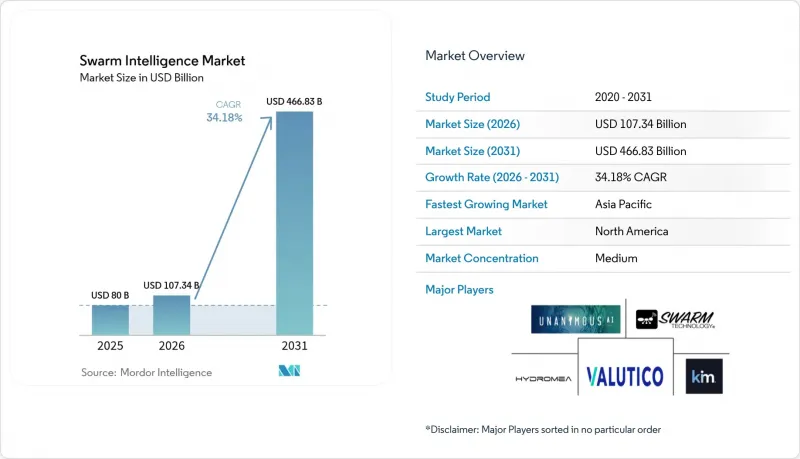
Mordor Intelligence에 의하면, 군집 지능 시장 규모는 2025년에 8,000만 달러로 평가되었습니다. 2026년 1억 734만 달러에서 2031년까지 4억 6,683만 달러에 이를 것으로 예상되며, 예측 기간(2026-2031년) CAGR은 34.18%를 나타낼 전망입니다.
본 보고서는 알고리즘 유형(개미 군집 최적화법(ACO), 입자 군집 최적화법(PSO) 등),최종 사용자 산업(운송 및 물류, 국방·보안 등), 플랫폼 유형(UAV 스웜, UGV 스웜, USV 스웜 등), 도입 방식(엣지/온디바이스, 클라우드, 하이브리드), 지역별로 분류되어 있습니다. 시장 예측은 금액(달러) 기준으로 제시되어 있습니다.
세계의 군집 지능 시장 동향 및 인사이트
물류 및 창고 자동화 분야의 스웜 로보틱스 도입 확대
다중 로봇 스웜이 동적 경로 계획을 수행할 경우, 창고 운영자는 단일 에이전트 시스템에 비해 최대 40%의 비용 절감을 실현할 수 있습니다. MIT의 실험에서는 작업 완료 속도가 4배 향상되고, 작업자의 업무 부하가 50.9% 감소하며, 심각한 인력 부족을 완화하는 처리량 향상이 확인되었습니다. 독일의 Cellumation사가 개발한 ‘Celluveyor’는 자가 조직화되는 육각형 셀을 이용하여 시간당 5,200개의 소포를 운반하고 있으며, 모듈식이며 확장성이 뛰어난 군집 로봇 컨베이어 설계의 유효성이 입증되었습니다. 풀필먼트 처리량이 지속적으로 증가하는 가운데, 이러한 경제적 이점으로 인해 전 세계 물류 허브에서의 도입이 가속화되고 있습니다. 엣지 기반의 협업 제어를 통해 클라우드 중심 제어에서 흔히 발생하는 지연으로 인한 병목 현상이 더욱 해소되어, 군집 지능 시장의 비즈니스 사례가 강화되고 있습니다.
방위 감시 및 재난 대응 분야에서의 UAV 스웜 도입 확대
체코에서 개발된 자율형 키네틱 드론 ‘인터셉터’와 같은 군사 프로그램은 대역폭 경쟁 구도에서 협력하는 군집이 적대적인 공중 표적을 무력화하는 방법을 입증하고 있습니다. 상파울루 대학교의 재난 구호 조사에서는 드론 무리가 통신 두절 시에도 작전을 유지하면서, 위성보다 신속하게 산불이나 온실가스 누출을 감지할 수 있음이 밝혀졌습니다. 정부의 조달 활동이 엣지 AI의 발전을 주도하고 있으며, 이 기술은 이후 민간 검사 및 긴급 대응 분야로 활용 사례가 확대됨에 따라 스웜 인텔리전스 시장의 적용 범위를 넓히고 있습니다.
학제적 군집 지능 알고리즘 엔지니어의 부족
생물학, 로보틱스, 분산 시스템에 정통한 전문가의 전 세계적 공급은 수요를 따라가지 못하고 있습니다. 『SAGE Open』 저널의 학술 분석에 따르면, 이러한 분야를 결합한 교육 과정은 드물어 고용주에게 역량 격차가 발생하고 있습니다. 기존 로봇공학 관련 직종에 비해 40% 이상 높은 급여를 제시해도 여전히 채용 공고를 채우지 못하고 있어, 자금력이 있는 기존 기업에 비해 스타트업은 불리한 입장에 놓여 있습니다. 이러한 인재 부족으로 인해 프로토타입에서 양산으로의 주기가 지연되고, 군집 지능 업계의 확장 속도가 제한되고 있습니다.
부문별 분석
2025년, 군집 지능 시장에서 개미 군집 최적화 기법이 36.65%라는 최대 점유율을 유지했습니다. 이는 이 기법의 확률론적 경로 탐색이 차량 경로 계획이나 창고 내 피킹 요구 사항에 적합하기 때문입니다. 한편, 꿀벌 군집 알고리즘은 분산형 자원 배분이 동적인 스마트 시티 서비스에 적합하기 때문에 2031년까지 연평균 성장률(CAGR) 34.75%를 나타낼 전망입니다. 입자 군집 최적화는 금융 서비스 분야에서 주목을 받고 있으며, 모델 학습을 통해 가상화폐 가격 예측에서 98%의 정확도를 달성했습니다. 텍사스 A&M 대학의 연구진이 적응형 농업 로봇을 통해 입증한 바와 같이, 하이브리드 프레임워크는 현재 상황에 따라 알고리즘을 실시간으로 전환하고 있습니다. 이처럼 구성 가능한 스택으로의 전환은 공급업체의 비즈니스 기회를 확대하는 동시에 소프트웨어의 차별화를 더욱 심화시키고 있습니다.
반딧불이, 빛을 내는 지렁이, 박테리아의 섭식 행동, 인공 물고기의 휴리스틱을 활용한 실험이 확대되고 있으며, 틈새 그리드, 센서 커버리지, 또는 에너지 수확의 최적화를 목표로 하고 있습니다. 초기 단계의 양자 가속형 집단 지능 프로토타입은 탐색 공간의 지수적 정리를 약속하며, 하드웨어가 성숙해지면 향후 획기적인 성과를 얻을 수 있음을 시사합니다. 도입 기업들이 일반적인 벤치마크가 아닌 성과 중심의 지표를 추구함에 따라, 다중 알고리즘 라이브러리를 통합할 수 있는 벤더들이 집단 지능 시장에서 더 큰 점유율을 확보하고 있습니다.
2025년, 운송 및 물류 분야는 소포 처리 능력 및 라스트 마일 경로 설정에서 즉각적인 효과를 얻을 수 있어 군집 지능 시장의 27.68% 점유율을 차지했습니다. eVTOL 택시의 협업 운영 및 적응형 교통망을 포함한 도시 모빌리티 구상은 스마트 시티 도입에서 39.28%의 연평균 성장률(CAGR)을 주도하고 있습니다. 국방 프로그램은 최첨단 군집 지능 연구에 자금을 지원하는 데 여전히 매우 중요한 역할을 하고 있으며, 그 성과는 이후 민간 인프라 점검에 활용됩니다. 의료 분야의 시범 프로젝트에서는 기밀 데이터를 보호하면서 진단에 분산 학습이 활용되고 있습니다. 농업 및 광업 분야에서는 위험 구역에 견고한 지상 및 공중 군집 지능 시스템이 도입되어 작업자의 안전성과 자산 활용도가 향상되고 있습니다. 소매업의 주문 처리 센터에서는 이용 사례가 운송에 그치지 않고 재고 감사에까지 확대되고 있으며, 유틸리티 분야에서는 전력망의 부하 분산을 위해 협업형 에이전트가 채택되고 있는데, 이는 집단 지능 시장의 분야를 초월한 확산을 뒷받침하고 있습니다.
지역별 분석
2025년, 북미는 군집 지능 시장의 33.72%를 차지했습니다. 미국 국방부(펜타곤)의 조달, 전자상거래 창고 자동화, 그리고 CHIPS법에 따른 79억 달러의 인센티브가 뉴로모픽 프로세서에 대한 초기 수요를 뒷받침하고 있습니다. 실리콘밸리에 벤처 캐피털이 집중되면서 스타트업 설립이 가속화되고 있지만, 노동 시장 경색으로 인해 중소기업이 학제 간 인재를 확보하기는 어려워지고 있습니다. 자율주행차를 위한 규제 샌드박스는 실증 시험을 더욱 촉진하고 있습니다.
아시아태평양은 2031년까지의 군집 지능 시장에서 35.90%라는 가장 높은 연평균 성장률(CAGR)을 나타낼 전망입니다. 중국이 2024년에 제정한 종합적인 무인항공기(UAV) 안전 규정에 따라 예측 가능한 인증 절차가 확립되었으며, 정부 주도의 도시 클러스터 프로그램을 통해 대규모 실증 구역이 조성되고 있습니다. 일본과 한국은 분자 로봇공학과 서비스 로봇공학의 통합에서 선구적인 역할을 하고 있는 반면, 이 지역의 반도체 제조 공장은 맞춤형 엣지 AI 칩공급 거점이 되고 있습니다. 소프트뱅크의 Skild AI에 대한 40억 달러 투자 등 기업들의 막대한 자금 지원은 투자자들의 관심이 높아지고 있음을 뒷받침하고 있습니다.
유럽에서는 위험 기반 운영 범주를 의무화하는 시행 규칙 2019/947에 기반한 통일된 드론 규제로 인해 성장이 유지되고 있습니다. ‘ROBOMINERS’ 이니셔티브는 군집 지능의 개념이 중공업 자동화에 어떻게 활용되고 있는지를 보여주고 있으며, 윤리적 AI 프레임워크는 책임과 투명성에 관한 이해관계자들의 우려를 완화하고 있습니다. 신중하고 체계적인 승인 절차가 국민의 신뢰를 지키고 있지만, 한편으로는 아시아태평양에 비해 도입 속도는 완만합니다.
기타 혜택 :
- 엑셀 형식 시장 예측(ME) 시트
- 3개월간의 애널리스트 지원
자주 묻는 질문
목차
제1장 서론
제2장 조사 방법
제3장 주요 요약
제4장 시장 구도
제5장 시장 규모 및 성장 예측
제6장 경쟁 구도
제7장 시장 기회 및 향후 전망
KTH 26.08.28According to Mordor Intelligence, the swarm intelligence market size was valued at USD 80 million in 2025 and estimated to grow from USD 107.34 million in 2026 to reach USD 466.83 million by 2031, at a CAGR of 34.18% during the forecast period (2026-2031).
This report is Segmented by Algorithm Type (Ant Colony Optimisation (ACO), Particle Swarm Optimisation (PSO), and More), End-User Industry (Transportation and Logistics, Defense and Security, and More), Platform Type (UAV Swarms, UGV Swarms, USV Swarms, and More), Deployment Mode (Edge / On-Device, Cloud, and Hybrid), and Geography. The Market Forecasts are Provided in Terms of Value (USD).
Global Swarm Intelligence Market Trends and Insights
Rising adoption of swarm robotics in logistics and warehouse automation
Warehouse operators gain up to 40% cost savings versus single-agent systems when multi-robot swarms handle dynamic routing. Experiments at MIT achieved 4 X faster task completion and cut operator workload by 50.9%, confirming throughput gains that mitigate acute labour shortages.Germany-based Cellumation's Celluveyor moves 5,200 parcels per hour with self-organising hexagonal cells, validating modular, easily scalable swarm conveyor designs. As fulfillment volumes keep rising, these economic incentives accelerate deployments across global logistics hubs. Edge-based coordination further eliminates the latency bottlenecks typical of cloud-centric control, strengthening the business case for the swarm intelligence market.
Growing deployment of UAV swarms for defense surveillance and disaster response
Military programmes such as the Czech-origin Interceptor autonomous kinetic drone illustrate how coordinated swarms neutralise hostile aerial targets under contested bandwidth. Disaster-relief research at the University of Sao Paulo shows drone collectives spotting wildfires and greenhouse-gas leaks faster than satellites while maintaining operations during communication blackouts. Government procurement drives edge-AI advances that later migrate into civil inspection and emergency-response use cases, broadening the addressable swarm intelligence market.
Shortage of cross-disciplinary swarm-algorithm engineers
Global supply of professionals fluent in biology, robotics, and distributed systems lags demand. Academic analysis in SAGE Open notes curricula seldom combine these domains, creating capability gaps for employers. Salary premiums that exceed 40% over conventional robotics roles still fail to close vacancies, leaving start-ups at a disadvantage against cash-rich incumbents. The talent constraint slows prototype-to-production cycles and limits scale-out speed in the swarm intelligence industry.
Other drivers and restraints analyzed in the detailed report include:
- Demand for decentralised optimisation in big-data IoT networks
- Collaborative AI platforms for large-scale brainstorming and decision-making
- Communication latency and reliability limits on real-time coordination
For complete list of drivers and restraints, kindly check the Table Of Contents.
Segment Analysis
Ant colony optimisation retained the largest 36.65% share of the swarm intelligence market in 2025 as its probabilistic path-finding fits vehicle routing and warehouse picking needs. Bee colony methods are set for a 34.75% CAGR to 2031 because their decentralised resource allocation suits dynamic smart-city services. Particle swarm optimisation gains traction in financial services where model training achieved 98% accuracy for cryptocurrency price prediction. Hybrid frameworks now switch algorithms in real time to match context, as Texas A&M researchers showed in adaptive agricultural robots. This pivot toward configurable stacks broadens supplier opportunities while deepening software differentiation.
Growing experimentation with firefly, glow-worm, bacterial foraging, and artificial fish heuristics targets niche grids, sensor coverage, or energy-harvest optimisation. Early quantum-accelerated swarm prototypes promise exponential search-space pruning, hinting at disruptive future gains once hardware matures. As adopters pursue outcome-specific metrics rather than general benchmarks, vendors capable of integrating multi-algorithm libraries capture a larger slice of the swarm intelligence market.
Transportation and logistics held 27.68% share of the swarm intelligence market in 2025 due to immediate paybacks in parcel throughput and last-mile routing. Urban-mobility schemes, including coordinated eVTOL taxis and adaptive traffic grids, propel a 39.28% CAGR in smart-city adoption. Defense programmes remain pivotal for funding leading-edge swarm research that later transitions to civil infrastructure inspection. Health-care pilots apply distributed learning for diagnostics while safeguarding sensitive data. Agriculture and mining deploy ruggedised ground and aerial swarms in hazardous zones, raising worker safety and asset utilisation. Retail fulfilment centres extend use cases beyond conveyance to inventory auditing, and utilities employ cooperative agents for grid load-balancing, attesting to the cross-sector depth of the swarm intelligence market.
Complete Report Scope:
- By Algorithm Type
- Ant Colony Optimisation (ACO)
- Particle Swarm Optimisation (PSO)
- Bee Colony / Honey-Bee Algorithms
- Firefly and Glow-worm Algorithms
- Bacterial Foraging, Artificial Fish and Others
- By End-user Industry
- Transportation and Logistics
- Defense and Security
- Robotics and Industrial Automation
- Healthcare and Life Sciences
- Agriculture and Mining
- BFSI and Financial Services
- Smart Cities and Mobility
- Retail and E-commerce
- Energy and Utilities
- By Platform Type
- UAV Swarms
- UGV Swarms
- USV Swarms
- UUV Swarms
- Software-Only Multi-Agent Systems
- By Deployment Mode
- Edge / On-Device
- Cloud
- Hybrid
- By Geography
- North America
- United States
- Canada
- Mexico
- South America
- Brazil
- Argentina
- Chile
- Rest of South America
- Europe
- Germany
- United Kingdom
- France
- Italy
- Spain
- Netherlands
- Russia
- Rest of Europe
- Asia Pacific
- China
- India
- Japan
- South Korea
- ASEAN
- Rest of Asia Pacific
- Middle East and Africa
- Middle East
- GCC (Saudi Arabia, UAE, Qatar, etc.)
- Turkey
- Rest of Middle East
- Africa
- South Africa
- Rest of Africa
- Middle East
- North America
Geography Analysis
North America contributed 33.72% of the swarm intelligence market in 2025. Pentagon procurement, e-commerce warehouse automation, and USD 7.9 billion in CHIPS Act incentives spur early demand for neuromorphic processors. Venture capital concentration in Silicon Valley accelerates start-up formation, yet tight labour markets make it harder for smaller firms to secure cross-disciplinary talent. Regulatory sandboxes for autonomous vehicles further encourage field trials.
Asia Pacific delivers the steepest 35.90% CAGR to 2031 for the swarm intelligence market. China's comprehensive 2024 UAV safety rules create predictable certification pathways, and governmental city-cluster programmes unlock large-scale demonstration zones. Japan and South Korea pioneer molecular and service-robotics integration, while regional semiconductor fabs anchor supply for bespoke edge AI chips. Substantial corporate funding, such as SoftBank's USD 4 billion injection into Skild AI, underscores rising investor appetite.
Europe sustains growth through harmonised drone regulations under Implementing Regulation 2019/947 that enforce risk-based operational categories. The ROBOMINERS initiative illustrates how swarm ideas feed heavy-industry automation, and ethical-AI frameworks reassure stakeholders about liability and transparency. A deliberate but methodical approval process protects public trust, albeit at a slower deployment cadence than Asia Pacific.
- Swarm Technology
- Unanimous AI
- Hydromea SA
- Sentien Robotics
- Dobots
- Brainalyzed Insight
- ConvergentAI Inc.
- Kim Technologies
- Swarm Systems Ltd.
- Power-Blox AG
- DJI
- Hewlett Packard Enterprise (HPE)
- IBM
- Intel
- Valutico UK Ltd
- HexaDrone
- AeroVironment
- Kratos Defense and Security
- Bluefin Robotics
- Marine AI
- Thales Group
Additional Benefits:
- The market estimate (ME) sheet in Excel format
- 3 months of analyst support
TABLE OF CONTENTS
1 INTRODUCTION
- 1.1 Study Assumptions and Market Definition
- 1.2 Scope of the Study
2 RESEARCH METHODOLOGY
3 EXECUTIVE SUMMARY
4 MARKET LANDSCAPE
- 4.1 Market Overview
- 4.2 Market Drivers
- 4.2.1 Rising adoption of swarm robotics in logistics and warehouse automation
- 4.2.2 Growing deployment of UAV swarms for defense surveillance and disaster response
- 4.2.3 Demand for decentralized optimisation in big-data IoT networks
- 4.2.4 Collaborative AI platforms for large-scale brainstorming and decision-making
- 4.2.5 Venture funding for bio-inspired edge-AI chips improving energy efficiency
- 4.2.6 APAC BVLOS drone-swarm regulatory green-lights accelerating urban air mobility pilots
- 4.3 Market Restraints
- 4.3.1 Shortage of cross-disciplinary swarm-algorithm engineers
- 4.3.2 Communication-latency and reliability limits on real-time coordination
- 4.3.3 Algorithmic-liability concerns in autonomous financial-trading swarms
- 4.3.4 Silicon supply constraints for neuromorphic edge nodes
- 4.4 Value Chain Analysis
- 4.5 Regulatory Landscape
- 4.6 Technological Outlook
- 4.7 Porter's Five Forces Analysis
- 4.7.1 Threat of New Entrants
- 4.7.2 Bargaining Power of Buyers
- 4.7.3 Bargaining Power of Suppliers
- 4.7.4 Threat of Substitutes
- 4.7.5 Intensity of Competitive Rivalry
5 MARKET SIZE AND GROWTH FORECASTS (VALUE)
- 5.1 By Algorithm Type
- 5.1.1 Ant Colony Optimisation (ACO)
- 5.1.2 Particle Swarm Optimisation (PSO)
- 5.1.3 Bee Colony / Honey-Bee Algorithms
- 5.1.4 Firefly and Glow-worm Algorithms
- 5.1.5 Bacterial Foraging, Artificial Fish and Others
- 5.2 By End-user Industry
- 5.2.1 Transportation and Logistics
- 5.2.2 Defense and Security
- 5.2.3 Robotics and Industrial Automation
- 5.2.4 Healthcare and Life Sciences
- 5.2.5 Agriculture and Mining
- 5.2.6 BFSI and Financial Services
- 5.2.7 Smart Cities and Mobility
- 5.2.8 Retail and E-commerce
- 5.2.9 Energy and Utilities
- 5.3 By Platform Type
- 5.3.1 UAV Swarms
- 5.3.2 UGV Swarms
- 5.3.3 USV Swarms
- 5.3.4 UUV Swarms
- 5.3.5 Software-Only Multi-Agent Systems
- 5.4 By Deployment Mode
- 5.4.1 Edge / On-Device
- 5.4.2 Cloud
- 5.4.3 Hybrid
- 5.5 By Geography
- 5.5.1 North America
- 5.5.1.1 United States
- 5.5.1.2 Canada
- 5.5.1.3 Mexico
- 5.5.2 South America
- 5.5.2.1 Brazil
- 5.5.2.2 Argentina
- 5.5.2.3 Chile
- 5.5.2.4 Rest of South America
- 5.5.3 Europe
- 5.5.3.1 Germany
- 5.5.3.2 United Kingdom
- 5.5.3.3 France
- 5.5.3.4 Italy
- 5.5.3.5 Spain
- 5.5.3.6 Netherlands
- 5.5.3.7 Russia
- 5.5.3.8 Rest of Europe
- 5.5.4 Asia Pacific
- 5.5.4.1 China
- 5.5.4.2 India
- 5.5.4.3 Japan
- 5.5.4.4 South Korea
- 5.5.4.5 ASEAN
- 5.5.4.6 Rest of Asia Pacific
- 5.5.5 Middle East and Africa
- 5.5.5.1 Middle East
- 5.5.5.1.1 GCC (Saudi Arabia, UAE, Qatar, etc.)
- 5.5.5.1.2 Turkey
- 5.5.5.1.3 Rest of Middle East
- 5.5.5.2 Africa
- 5.5.5.2.1 South Africa
- 5.5.5.2.2 Rest of Africa
- 5.5.5.1 Middle East
- 5.5.1 North America
6 COMPETITIVE LANDSCAPE
- 6.1 Market Concentration
- 6.2 Strategic Moves
- 6.3 Market Share Analysis
- 6.4 Company Profiles (includes Global level Overview, Market level overview, Core Segments, Financials as available, Strategic Information, Market Rank/Share for key companies, Products and Services, and Recent Developments)
- 6.4.1 Swarm Technology
- 6.4.2 Unanimous AI
- 6.4.3 Hydromea SA
- 6.4.4 Sentien Robotics
- 6.4.5 Dobots
- 6.4.6 Brainalyzed Insight
- 6.4.7 ConvergentAI Inc.
- 6.4.8 Kim Technologies
- 6.4.9 Swarm Systems Ltd.
- 6.4.10 Power-Blox AG
- 6.4.11 DJI
- 6.4.12 Hewlett Packard Enterprise (HPE)
- 6.4.13 IBM
- 6.4.14 Intel
- 6.4.15 Valutico UK Ltd
- 6.4.16 HexaDrone
- 6.4.17 AeroVironment
- 6.4.18 Kratos Defense and Security
- 6.4.19 Bluefin Robotics
- 6.4.20 Marine AI
- 6.4.21 Thales Group
7 MARKET OPPORTUNITIES AND FUTURE OUTLOOK
- 7.1 White-space and Unmet-need Assessment