

|
시장보고서
상품코드
2114484
3D 바이오프린팅 인체 조직 : 시장 점유율 분석, 업계 동향 및 통계, 성장 예측(2026-2031년)3D Bioprinted Human Tissue - Market Share Analysis, Industry Trends & Statistics, Growth Forecasts (2026 - 2031) |
||||||
 Mordor Intelligence
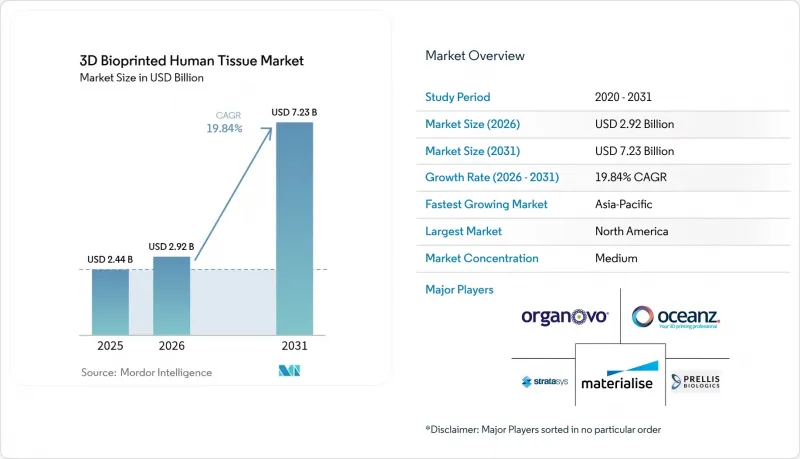
Mordor Intelligence에 의하면, 3D 바이오프린팅 인체 조직 시장 규모는 2025년에 24억 4,000만 달러로 평가되었습니다. 2026년 29억 2,000만 달러에서 2031년까지 72억 3,000만 달러에 이를 것으로 예상되며, 예측 기간(2026-2031년) CAGR은 19.84%를 나타낼 전망입니다.
본 보고서는 용도(조직 공학, 의약품 시험·개발 등), 기술(압출식, 하이브리드/4D 등), 소재/바이오잉크(생세포, 하이드로겔 등), 최종 사용자(제약·바이오기술 기업 등), 지역(북미, 유럽, 아시아태평양 등)별로 분류되어 있습니다. 시장 규모 및 전망은 금액(달러) 기준으로 제시되어 있습니다.
세계의 3D 바이오프린팅 인체 조직 시장 동향 및 인사이트
재생의료 솔루션에 대한 수요 증가
현재, 장기 부족으로 인해 미국에서는 10만 명 이상의 환자가 이식 대기자 명단에 등록되어 있으며, 이에 따라 규제 당국은 기능적인 조직 대체물을 창출할 수 있는 중개 연구의 추진을 뒷받침하고 있습니다. 2024년 12월, FDA가 혈관 외상용 무세포 조직 공학 혈관 ‘Symvess’를 승인한 것은 프린팅된 이식편으로의 이러한 전환을 뒷받침하는 것입니다. 이어 일본 교토 대학 병원은 자가 유래 ‘Bio 3D’ 신경관 이식 48주 후 감각이 100% 개선되었다고 보고했으며, 이는 완전히 3D 프린팅된 말초 신경 이식편에 대한 최초의 인체 임상시험이 되었습니다. 혈관 신생은 여전히 주요한 생물학적 과제이지만, 카네기 멜론 대학의 ‘FRESH’ 프린팅 기술은 장기 규모로 관류가 가능한 구조물을 구축할 수 있게 되어, 영양분의 확산과 세포 생존율을 대폭 향상시키고 있습니다. 규제 명확화가 진행되고 임상 성공 사례가 쌓여감에 따라, 재생의학은 향후 10년 동안 가장 강력한 성장 동력으로 자리매김할 것입니다.
바이오프린팅 연구 개발에 대한 투자 확대
시리즈 B 및 시리즈 C 자금 조달 라운드에서는 5,000만 달러를 초과하는 것이 일반화되고 있으며,그 선두에 서 있는 어스펙트 바이오시스템즈는 2025년 1월, 3D 프린팅 조직 치료제 개발을 위해 1억 6,500만 캐나다 달러(1억 2,000만 미 달러)를 조달했다고 발표했습니다. 누클레라(Nuclea)는 2024년 10월, 데스크톱형 단백질 바이오프린터 개발 자금으로 7,500만 달러를 조달했습니다. 이는 GMP 기준을 유지하면서 프린팅 플랫폼을 벤치탑 크기로 소형화하려는 더 광범위한 추세를 반영한 것입니다. 제약 기업과의 제휴를 통해 희석 효과가 없는 자본이 조달되고 있습니다. CN Bio와 Pharmaron이 수년에 걸쳐 진행하는 ‘장기 온 칩(organ-on-a-chip)’ 공동 연구를 통해, 프린팅된 간, 폐, 장 모델이 전 세계 신약 개발 워크플로우에 통합될 것으로 기대됩니다. 따라서 자본 집약성은 더 이상 민첩한 혁신가들에게 장벽이 되지 않지만, 규모 확대를 위한 자금 확보 여부가 현재 경쟁 우위를 결정짓는 요인이 되고 있습니다.
바이오프린팅 플랫폼의 높은 자본 비용과 운영 비용
산업용 프린터의 가격은 50만 달러에서 200만 달러 사이이지만, GMP 준수 클린룸에는 수백만 달러의 간접비가 추가되기 때문에 소규모 연구 기관의 진입이 제한되고 있습니다. 자체 개발한 바이오 잉크는 표준 배지에 비해 10-50배의 비용이 드는 경우가 많으며, 경험이 풍부한 조직 공학 과학자가 부족하여 인건비도 증가하고 있습니다. 설비 투자(CapEx)를 여러 고객이 분담하기 위해 위탁 개발·제조 기관(CDMO)이 등장하고 있으며, 그 예로 180만 달러 규모의 시드 라운드를 거쳐 출범한 Biological Lattice Industries사의 ‘프린트당 과금 모델’을 들 수 있습니다. 그럼에도 불구하고, 장비 대여형 서비스(Equipment-as-a-Service) 모델이 실질적인 가동률을 달성하기 전까지는 투자자들의 태도는 여전히 신중한 임베디드니다.
부문별 분석
의약품 시험·개발 분야는 2031년까지 연평균 성장률(CAGR) 27.85%를 기록하며, 여전히 가장 큰 절대 매출을 차지하는 조직 공학의 기존 우위를 서서히 잠식하고 있습니다. 제약 업계 사용자들 사이에서는 후기 임상시험의 실패율을 낮추기 위한 핵심 요소로 바이오 프린팅된 간 및 장 모델에 대한 관심이 점점 더 높아지고 있습니다. 이러한 변화는 동물 실험 축소를 요구하는 규제적 압력에 의해 더욱 가속화되고 있습니다. POSTECH의 인공 폐 모델은 프린팅된 구조체가 2차원 세포 배양보다 질병 상태를 더 충실하게 재현하여 항바이러스 연구를 가속화하고 있는 좋은 예입니다. 미용·재건 외과 분야에서의 응용은 CollPlant사가 200cc 유방 임플란트 프린트에 성공한 것을 계기로 탄력을 받았으며, 미용 목적의 적응증이 개념 단계에서 전임상 검증 단계로 넘어갔습니다. 식품 안전성 및 배양 단백질에 대한 응용은 여전히 소규모이지만, 2025년 7월 FDA가 세포 유래 식품에 관한 첫 시판 전 협의를 진행한 것을 계기로 큰 주목을 받고 있습니다.
약리학 분야에서의 채택 확대에 따라 공급업체의 로드맵이 재구성되었습니다. 많은 플랫폼 제공업체는 현재 CRO 및 제약 회사의 혁신 센터를 대상으로 프린터 하드웨어와 검증된 간, 심장, 신장용 바이오 잉크를 세트로 판매하고 있습니다. 이러한 최종 사용자들은 장기 시스템 전반에 걸쳐 독성, 대사, 효능을 병행하여 시험할 수 있는 다조직 어레이를 요구하고 있습니다. 한편, 재생의료 분야의 정형외과에서는 기증 부위의 합병증을 완화하는 프린팅된 연골 및 뼈 이식편이 정부로부터 요구되고 있어, 공공 보조금 확보가 계속되고 있습니다. 전반적으로 용도의 다양화가 폭넓은 수익 기반을 뒷받침하고 있지만, 단기적인 이익률 확대는 의약품 시험 수탁 서비스에 집중되어 있습니다.
압출식 프린터는 입증된 신뢰성, 폭넓은 재료 호환성, 그리고 유리한 총 소유 비용 덕분에 2025년 매출의 37.54%를 계속 차지했습니다. 그럼에도 불구하고, 하이브리드형 및 4D 구성은 압출 방식과 광경화 또는 음향 위치 결정 기술을 결합하여 마이크로 스케일의 정밀도로 여러 바이오 잉크를 증착하기 때문에 연간 30.15%의 성장률을 기록하고 있습니다. 스탠퍼드 대학교는 알고리즘으로 생성된 혈관 격자를 활용하여 인쇄 시간을 200배 단축하는 데 성공했으며, 하이브리드 플랫폼이 관류 가능한 조직 제작에 뛰어난 이유를 밝혔습니다. 잉크젯 방식은 여전히 고처리량 스크리닝에서 중요한 역할을 하는 반면, 레이저 지원 시스템은 각막 실질 등 20µm 미만의 해상도가 필요한 용도에서 주류를 이루고 있습니다.
캘리포니아 공과대학(Caltech)의 초음파 유도 적층과 같은 생체 내 프린팅 기술은 체외에서 이식편의 성숙 과정을 생략하고, 치료용 재료를 환자의 체내에서 직접 형성하는 미래를 예고하고 있습니다. 현재 프린터 OEM 업체들은 폐쇄 루프 이미지 처리와 AI 기반 피드백을 통합하여 적층 과정을 실시간으로 보정함으로써, 제작물의 정밀도를 높이고 배치 불량률을 줄이고 있습니다. 검증용 데이터 세트가 축적됨에 따라, 업계 분석가들은 2030년까지 하이브리드 프린터가 고부가가치 치료용 조직 분야에서 압출 성형을 추월할 것으로 예측하고 있지만, 복잡도가 낮은 스캐폴드나 교육 시장에서는 압출 성형이 여전히 우위를 유지할 것으로 보입니다.
지역별 분석
2025년, 북미는 전 세계 매출의 48.55%를 차지했습니다. 이는 프린팅된 의료기기에 대한 FDA의 적극적인 태도와 9자리 규모의 자금 조달 라운드가 일상적으로 이루어지는 벤처 생태계에 힘입은 결과입니다. 스탠퍼드 대학교, 카네기 멜론 대학교, 피츠버그 대학교 등 각 학술 기관이 지적 재산권 창출을 주도하는 한편, Redwire사와 같은 기업들은 국제우주정거장(ISS)의 미세 중력 환경에서 바이오 프린팅을 활용하여 장기 제조 시 혈관 형성 문제 해결에 매진하고 있습니다. 미국 국립보건원(NIH)의 연방 보조금이 민간 벤처 캐피털을 보완하고 있어, 운영 비용 및 인력 부족이 여전히 지속되는 상황에서도 균형 잡힌 자금 구성이 확보되어 있습니다.
유럽은 ATMP(첨단 치료 의약품) 심사 절차의 통일과 ‘호라이즌 유럽’을 통한 아낌없는 자금 지원 유도로 시장 규모 2위를 차지하고 있습니다. 독일의 공작기계 제조 전통은 산업용 생체의학 프린팅 도입을 가속화하고 있으며, 한편 영국의 브렉시트 이후 규제 체제는 시장 접근성을 유지하기 위해 EMA(유럽의약품청)의 품질 기준과의 일관성을 유지하고 있습니다. 스칸디나비아 국가들은 의료 제조 분야에서 순환형 경제 솔루션을 중시하는 EU의 ‘그린 딜’의 광범위한 목표를 반영하여, 지속 가능한 바이오 잉크를 추진하고 있습니다.
아시아태평양은 중국의 바이오 제조를 위한 ‘제14차 5개년 계획’의 장려책과 병원 내 프린팅 연구소의 신속한 인허가 절차에 힘입어, 2031년까지 연평균 성장률(CAGR)이 22.4%로 가장 높은 성장세를 보이고 있습니다. 일본에서는 고령화가 진행됨에 따라 연골 및 혈관 이식편에 대한 수요가 증가하고 있으며, 재료 과학 분야의 우수한 국내 기술이 활용되고 있습니다. 한국에서는 소비자용 전자기기의 정밀 기술을 데스크톱형 바이오 프린터에 응용하고 있는 반면, 인도는 비용 효율성을 중시하는 비임상시험 아웃소싱 거점으로 성장하고 있습니다. 지역적 과제로는 지적재산권 집행 상황에 편차가 있고, 윤리 지침이 국가마다 다르다는 점을 들 수 있지만, 상하이, 요코하마, 방갈로르를 중심으로 지역 밀착형 제조 클러스터가 부상하고 있습니다.
기타 혜택 :
- 엑셀 형식 시장 예측(ME) 시트
- 3개월간의 애널리스트 지원
자주 묻는 질문
목차
제1장 서론
제2장 조사 방법
제3장 개요
제4장 시장 구도
제5장 시장 규모 및 성장 예측
제6장 경쟁 구도
제7장 시장 기회 및 향후 전망
KTH 26.08.31According to Mordor Intelligence, the 3D bioprinted human tissue market size was valued at USD 2.44 billion in 2025 and estimated to grow from USD 2.92 billion in 2026 to reach USD 7.23 billion by 2031, at a CAGR of 19.84% during the forecast period (2026-2031).
This report is Segmented by Application (Tissue Engineering, Drug Testing & Development, and More), Technology (Extrusion-Based, IHybrid/4D, and More), Material/Bio-Ink (Living Cells, Hydrogels, and More), End User (Pharmaceutical & Biotechnology Companies, and More), and Geography (North America, Europe, Asia-Pacific, and More). The Market Sizes and Forecasts are Provided in Terms of Value (USD).
Global 3D Bioprinted Human Tissue Market Trends and Insights
Growing Demand for Regenerative Medicine Solutions
Organ shortages now leave more than 100,000 patients on US transplant waiting lists, prompting regulators to endorse translational research that can create functional tissue substitutes. The FDA's December 2024 clearance of Symvess, an acellular tissue-engineered vessel for vascular trauma, underscored this shift toward printed grafts. Japan's Kyoto University Hospital subsequently reported 100% sensory improvement 48 weeks after autologous Bio 3D nerve conduit implantation, marking the first human trial of a fully printed peripheral-nerve graft. Vascularization remains the main biological hurdle; Carnegie Mellon University's FRESH printing method now builds perfusable constructs at the organ scale, greatly improving nutrient diffusion and cell survival. As regulatory clarity rises and clinical success stories mount, regenerative medicine will remain the single most powerful growth catalyst over the next decade.
Escalating Investment in Bioprinting Research and Development
Series-B and Series-C funding rounds routinely surpass USD 50 million, led by Aspect Biosystems, which announced CAD 165 million (USD 120 million) for printed-tissue therapeutics in January 2025. Nuclera raised USD 75 million in October 2024 for its desktop protein bioprinter, reflecting a broader move to shrink printing platforms onto benchtops while maintaining GMP capabilities. Pharmaceutical alliances add non-dilutive capital; CN Bio's multi-year organ-on-chip collaboration with Pharmaron is expected to integrate printed liver, lung, and gut models into global discovery workflows. Capital intensity is therefore no longer a prohibitive barrier for agile innovators, but access to scale-up funds now determines competitive positioning.
High Capital and Operational Costs of Bioprinting Platforms
Industrial-grade printers range between USD 500,000 and USD 2 million, while GMP-compliant cleanrooms add multimillion-dollar overheads, limiting entry by small institutes. Proprietary bioinks often cost 10-50X standard media, and shortages of experienced tissue-engineering scientists inflate labor budgets. Contract development and manufacturing organizations (CDMOs) are emerging to spread CapEx across multiple clients, exemplified by Biological Lattice Industries' pay-per-print model launched after a USD 1.8 million seed round. Even so, investors remain cautious until equipment-as-a-service models achieve meaningful utilization rates.
Other drivers and restraints analyzed in the detailed report include:
- Advances in Stem-Cell and Biomaterial Technologies
- Increasing Strategic Collaborations and Industry Partnerships
- Regulatory and Ethical Uncertainty Surrounding Bioprinted Tissues
For complete list of drivers and restraints, kindly check the Table Of Contents.
Segment Analysis
Drug testing and development captured 27.85% CAGR through 2031, eroding the historical dominance of tissue engineering that still accounts for the largest absolute revenue pool. Pharmaceutical users increasingly cite bioprinted liver and gut models as key to cutting attrition in late-stage trials, a shift reinforced by regulatory pressure to reduce animal studies. POSTECH's artificial lung model exemplifies how printed constructs replicate disease states more faithfully than two-dimensional cell cultures, accelerating antiviral research. Cosmetic and reconstructive surgery applications gained momentum once CollPlant successfully printed 200 cc breast implants, moving aesthetic indications from concept to pre-clinical validation. Food safety and cultured-protein applications remain small but highly publicized following the FDA's first pre-market consultation on cell-based foods in July 2025.
Rising adoption in pharmacology has reshaped supplier roadmaps: many platform providers now bundle printer hardware with validated liver, cardiac, and kidney bioinks to target CROs and pharma innovation centers. These end-users demand multi-tissue arrays that allow parallel testing of toxicity, metabolism, and efficacy across organ systems. Meanwhile, regenerative orthopedics continues to secure public grants as governments seek printed cartilage and bone grafts that reduce donor-site morbidity. Collectively, application diversification supports a broad revenue base, though near-term margin expansion is concentrated in contract drug-testing services.
Extrusion printers still generated 37.54% of 2025 revenue because of proven reliability, broad material compatibility, and favorable cost-of-ownership. Nonetheless, hybrid and 4D configurations are growing 30.15% a year as they combine extrusion with light-based curing or acoustic positioning to deposit multiple bioinks with microscale precision. Stanford University used algorithm-generated vascular lattices to accelerate print times 200-fold, illustrating why hybrid platforms excel at perfusable tissues. Ink-jet modalities maintain relevance in high-throughput screening, while laser-assisted systems dominate applications requiring <20 µm resolution such as corneal stroma.
In vivo printing technologies, such as Caltech's ultrasound-guided deposition, highlight a future where therapeutic material is formed directly inside patients, bypassing graft maturation ex vivo. Printer OEMs now integrate closed-loop imaging and AI-driven feedback to correct deposition in real time, enhancing construct fidelity and reducing batch failure. As validation datasets accumulate, industry analysts expect hybrid printers to overtake extrusion for high-value therapeutic tissues before 2030, though extrusion retains an edge in low-complexity scaffolds and educational markets.
Complete Report Scope:
- By Application
- Tissue Engineering
- Drug Testing & Development
- Cosmetic & Reconstructive Surgery
- Food Safety & Novel Foods
- Other Applications
- By Technology
- Extrusion-based
- Ink-jet
- Laser-Assisted
- Microfluidic & Acoustic
- Magnetic Levitation
- Hybrid / 4D
- By Material
- Living Cells
- Hydrogels
- Extracellular-Matrix Components
- Synthetic Polymers
- Natural Polymers
- Others
- By End-User
- Pharmaceutical & Biotechnology Companies
- Academic & Research Institutes
- Hospitals & Surgical Centres
- Contract Research Organisations
- By Geography
- North America
- United States
- Canada
- Mexico
- Europe
- Germany
- United Kingdom
- France
- Italy
- Spain
- Rest of Europe
- Asia Pacific
- China
- Japan
- India
- South Korea
- Australia
- Rest of Asia Pacific
- Middle East & Africa
- GCC
- South Africa
- Rest of Middle East & Africa
- South America
- Brazil
- Argentina
- Rest of South America
- North America
Geography Analysis
North America contributed 48.55% of global revenue in 2025, underpinned by the FDA's proactive stance on printed devices and a venture ecosystem that routinely funds nine-digit rounds. Academic centers at Stanford, Carnegie Mellon, and the University of Pittsburgh anchor intellectual property output, while companies such as Redwire leverage microgravity bioprinting on the International Space Station to solve vascularization challenges in organ fabrication. Federal grants from the National Institutes of Health complement private venture capital, ensuring a balanced funding mix even as operational costs and talent shortages persist.
Europe ranks second in value thanks to a harmonized ATMP pathway and generous Horizon Europe funding calls. Germany's machine-tool heritage accelerates adoption in industrial biomedical printing, whereas the United Kingdom's post-Brexit regulatory regime maintains alignment with EMA quality benchmarks to preserve market access. Scandinavian nations champion sustainable bio-based inks, reflecting broader EU green-deal ambitions that favor circular-economy solutions in medical manufacturing.
Asia Pacific posts the fastest 22.4% CAGR through 2031, propelled by China's Five-Year Plan incentives for biomanufacturing and the rapid licensing of hospital-based printing labs. Japan's aging population drives demand for cartilage and vascular grafts, leveraging local excellence in materials science. South Korea applies consumer-electronics precision to desktop bioprinters, while India grows as an outsourcing hub for cost-sensitive pre-clinical testing. Regional challenges include patchy IP enforcement and varying ethical guidelines, yet localized manufacturing clusters are emerging around Shanghai, Yokohama, and Bengaluru.
- Organovo
- BICO (CELLINK)
- 3D Systems
- Stratasys
- Materialise
- Poietis
- Aspect Biosystems
- Allevi (Rokit Healthcare)
- REGENHU
- FluidForm
- Prellis Biologics
- CollPlant
- Cyfuse Biomedical
- Advanced Solutions LifeSciences
- FabRx
- 3D Bioprinting Solutions
- Inventia Life Science
- CELLuink
- Viscient Biosciences
- Xylyx Bio
Additional Benefits:
- The market estimate (ME) sheet in Excel format
- 3 months of analyst support
TABLE OF CONTENTS
1 Introduction
- 1.1 Study Assumptions & Market Definition
- 1.2 Scope of the Study
2 Research Methodology
3 Executive Summary
4 Market Landscape
- 4.1 Market Overview
- 4.2 Market Drivers
- 4.2.1 Growing Demand For Regenerative Medicine Solutions
- 4.2.2 Escalating Investment In Bioprinting Research And Development
- 4.2.3 Advancements In Stem Cell And Biomaterial Technologies
- 4.2.4 Increasing Strategic Collaborations And Industry Partnerships
- 4.2.5 Supportive Government Funding And Grant Initiatives
- 4.2.6 Rising Prevalence Of Chronic Diseases And Trauma Injuries
- 4.3 Market Restraints
- 4.3.1 High Capital And Operational Costs Of Bioprinting Platforms
- 4.3.2 Regulatory And Ethical Uncertainty Surrounding Bioprinted Tissues
- 4.3.3 Limited Scalability And Standardization Of Manufacturing Processes
- 4.3.4 Shortage Of Skilled Workforce In Bioprinting And Tissue Engineering
- 4.4 Supply-Chain Analysis
- 4.5 Regulatory Landscape
- 4.6 Technological Outlook
- 4.7 Porter's Five Forces Analysis
- 4.7.1 Threat of New Entrants
- 4.7.2 Bargaining Power of Buyers
- 4.7.3 Bargaining Power of Suppliers
- 4.7.4 Threat of Substitutes
- 4.7.5 Competitive Rivalry
5 Market Size & Growth Forecasts (Value)
- 5.1 By Application
- 5.1.1 Tissue Engineering
- 5.1.2 Drug Testing & Development
- 5.1.3 Cosmetic & Reconstructive Surgery
- 5.1.4 Food Safety & Novel Foods
- 5.1.5 Other Applications
- 5.2 By Technology
- 5.2.1 Extrusion-based
- 5.2.2 Ink-jet
- 5.2.3 Laser-Assisted
- 5.2.4 Microfluidic & Acoustic
- 5.2.5 Magnetic Levitation
- 5.2.6 Hybrid / 4D
- 5.3 By Material
- 5.3.1 Living Cells
- 5.3.2 Hydrogels
- 5.3.3 Extracellular-Matrix Components
- 5.3.4 Synthetic Polymers
- 5.3.5 Natural Polymers
- 5.3.6 Others
- 5.4 By End-User
- 5.4.1 Pharmaceutical & Biotechnology Companies
- 5.4.2 Academic & Research Institutes
- 5.4.3 Hospitals & Surgical Centres
- 5.4.4 Contract Research Organisations
- 5.5 By Geography
- 5.5.1 North America
- 5.5.1.1 United States
- 5.5.1.2 Canada
- 5.5.1.3 Mexico
- 5.5.2 Europe
- 5.5.2.1 Germany
- 5.5.2.2 United Kingdom
- 5.5.2.3 France
- 5.5.2.4 Italy
- 5.5.2.5 Spain
- 5.5.2.6 Rest of Europe
- 5.5.3 Asia Pacific
- 5.5.3.1 China
- 5.5.3.2 Japan
- 5.5.3.3 India
- 5.5.3.4 South Korea
- 5.5.3.5 Australia
- 5.5.3.6 Rest of Asia Pacific
- 5.5.4 Middle East & Africa
- 5.5.4.1 GCC
- 5.5.4.2 South Africa
- 5.5.4.3 Rest of Middle East & Africa
- 5.5.5 South America
- 5.5.5.1 Brazil
- 5.5.5.2 Argentina
- 5.5.5.3 Rest of South America
- 5.5.1 North America
6 Competitive Landscape
- 6.1 Market Concentration
- 6.2 Market Share Analysis
- 6.3 Company Profiles (includes Global level Overview, Market level overview, Core Segments, Financials as available, Strategic Information, Market Rank/Share for key companies, Products & Services, and Recent Developments)
- 6.3.1 Organovo
- 6.3.2 BICO (CELLINK)
- 6.3.3 3D Systems
- 6.3.4 Stratasys
- 6.3.5 Materialise
- 6.3.6 Poietis
- 6.3.7 Aspect Biosystems
- 6.3.8 Allevi (Rokit Healthcare)
- 6.3.9 RegenHU
- 6.3.10 FluidForm
- 6.3.11 Prellis Biologics
- 6.3.12 CollPlant
- 6.3.13 Cyfuse Biomedical
- 6.3.14 Advanced Solutions LifeSciences
- 6.3.15 FabRx
- 6.3.16 3D Bioprinting Solutions
- 6.3.17 Inventia Life Science
- 6.3.18 CELLuink
- 6.3.19 Viscient Biosciences
- 6.3.20 Xylyx Bio
7 Market Opportunities & Future Outlook
- 7.1 White-space & Unmet-Need Assessment


