

|
시장보고서
상품코드
2114501
레이더 시뮬레이터 : 시장 점유율 분석, 업계 동향 및 통계, 성장 예측(2026-2031년)Radar Simulators - Market Share Analysis, Industry Trends & Statistics, Growth Forecasts (2026 - 2031) |
||||||
 Mordor Intelligence
Mordor Intelligence에 의하면, 2026년 레이더 시뮬레이터 시장 규모는 26억 5,000만 달러로 추정되고 2025년 25억 달러에서 확대해, 2031년에는 35억 7,000만 달러에 이를 것으로 예측됩니다.
2026년부터 2031년까지 연평균 성장률(CAGR) 6.12%로 성장할 것으로 전망됩니다.
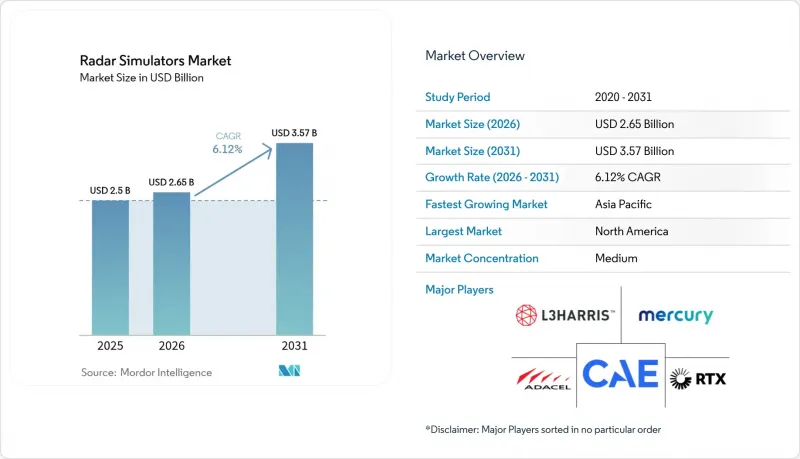
본 보고서는 구성 요소(하드웨어 및 소프트웨어), 플랫폼(지상형, 항공기 탑재형, 함정 탑재형),용도(민간 및 군사), 최종 사용자 부문(국방부 및 군, 항공우주 OEM 및 MRO, 민간 항공사 및 항공교통관제기관(ANSP)), 그리고 지역(북미, 유럽, 아시아태평양, 기타)별로 분류되어 있습니다. 시장 예측은 금액(달러) 기준으로 제시되어 있습니다.
세계의 레이더 시뮬레이터 시장 동향 및 인사이트
시뮬레이터를 활용한 레이더 훈련에 대한 국방 지출 증가
방위 예산은 지속적으로 증가하고 있으며, 소모품 지출 없이 실제 위협의 스펙트럼을 재현하는 훈련 생태계에 자금이 투입되고 있습니다. 2023년 동아시아의 군사비는 4,110억 달러에 달하고, 전년 대비 6.2% 증가했습니다. 그중 중국만 3,140억 달러로 추정되며, 연평균 7%의 성장률을 유지하고 있습니다. 일본의 2024년도 국방 예산은 21% 증가한 553억 달러로, 1952년 이래 최대 증가폭을 기록했습니다. 한국은 L-SAM II 레이더 프로그램에 5,677억 원(4억 477만 달러)을 편성했으며, 초기 단계부터 엔드투엔드 시뮬레이션을 도입하고 있습니다. 군 당국이 비용 대비 효과가 높고 상시 이용 가능한 가상 사격장을 우선시함에 따라, 이러한 투자가 레이더 시뮬레이션 시장 수요를 견인하고 있습니다. 첨단 훈련 시스템은 비행 시간 소모를 억제하고, 장비의 피로를 줄이며, 연중무휴 24시간 교육 과정 이수를 가능하게 하므로, 현대적인 전투 준비 계획에 있어 필수적인 요소로 자리 잡았습니다.
소프트웨어 정의 레이더 아키텍처의 채택 확대
소프트웨어 정의 레이더는 하드웨어 교체가 아닌 펌웨어 업데이트를 통해 파형을 재구성하므로, 통합 기간을 대폭 단축하고 위협 데이터의 배포를 가속화합니다. IEEE 2024에서 진행된 실증 실험에서는 범용 프로세서 상에서 실시간 펄스 압축을 실현하여, 맞춤형 ASIC 솔루션과 동등한 성능을 입증했습니다. 비행 중 송신을 최적화하는 인지 레이더 개념에는 적응형 로직의 신속한 루프백 테스트를 지원하는 시뮬레이터가 필요합니다. 방위연구소에서는 현재, 운영자가 지상 탐색, 사격 관제, 대포병 모드를 순차적으로 에뮬레이션할 수 있는 통합 워크스테이션을 도입하여 훈련 인프라의 점유 공간을 줄이고 있습니다. 이러한 유연성 덕분에 알고리즘 업데이트부터 실전 배치까지의 사이클 시간이 단축되어, 레이더 시뮬레이션 시장 전반에서 개방형 아키텍처 시뮬레이터에 대한 수요가 증가하고 있습니다.
고충실도 HIL 시뮬레이터의 높은 자본 비용
RF 프런트엔드, 차폐된 사격장, 그리고 마이크로초 단위의 타이밍을 재현하는 고속 FPGA로 구동되는 종합적인 하드웨어 인 더 루프(HIL) 벤치는 1,000만 달러를 초과할 수도 있습니다. 소규모 계약업체나 신흥국들은 이러한 설비 자금 조달에 어려움을 겪고 있으며, 많은 경우 시나리오의 폭을 제한하는 현실감 저하를 감수할 수밖에 없습니다. 클라우드 호스팅 방식의 소프트 루프 대안은 비용 면에서 매력적이지만, 많은 군는 여전히 전용 벤치만이 제공할 수 있는 신호 수준의 시뮬레이션 정확도를 요구하고 있습니다. 이러한 자본적 장벽으로 인해 조달 결정이 지연되면서, 레이더 시뮬레이션 시장의 일부가 여전히 충분히 충족되지 못한 상태가 지속되고 있습니다.
부문별 분석
2025년, 하드웨어는 레이더 시뮬레이션 시장 점유율의 63.95%를 차지하며, 실시간 RF 생성, 고정밀 타이밍 및 저지연 FPGA에 대한 지속적인 수요를 뒷받침했습니다. 그럼에도 불구하고, 알고리즘의 혁신성이 시나리오의 충실도를 결정하는 요인이 되면서 소프트웨어 매출은 연평균 성장률(CAGR) 8.20%로 증가하고 있습니다. SA-Radar와 같은 최신 프레임워크에서는 속성 제어 가능한 파형 라이브러리를 이용할 수 있으며, 사용자는 추가 회로 기판 없이도 드래그 앤 드롭 방식으로 이를 커리큘럼에 통합할 수 있습니다.
향후 5년 동안 주요 시스템 통합사업자들은 가상 비행 훈련의 동향과 마찬가지로, 구독형 소프트웨어 모델과 결합된 간소화된 모듈식 하드웨어로 전환할 것으로 보입니다. 이러한 전환을 통해 위협 라이브러리가 진화하더라도 최종 사용자는 시스템 전체의 전면적인 업데이트(포크리프트 업그레이드)를 피할 수 있게 될 것입니다. 이와 동시에, 개방형 API가 타사 플러그인을 촉진하여 부가가치가 높은 분석 도구, 자동 채점 엔진, AI 기반 강사 등의 생태계를 창출함으로써, 레이더 시뮬레이션 시장의 수익을 초기 하드웨어 납품 범위를 넘어 확대해 나갈 것입니다.
지상형 트레이너는 47.45%의 점유율을 차지하고 있습니다. 이는 고정 설치형인 경우, 크기 제한 없이 대형 안테나 어레이, 충분한 냉각 설비, 고출력 증폭기를 설치할 수 있기 때문입니다. 이러한 요소들은 승무원이 추적 융합, 영역 횡단 교전, 전자전 전술을 훈련하는 통합 방공·미사일 방어 학교에 여전히 필수적입니다.
한편, 연안 분쟁 및 접근 거부 전략으로 인해 함대가 복잡한 전자기 환경에 대응해야 하는 상황에 직면함에 따라, 함대 플랫폼은 7.15%라는 가장 높은 연평균 성장률(CAGR)을 기록하고 있습니다. 라인메탈사의 해상용 훈련 스위트는 해수면 클러터의 동태와 덕팅의 영향을 시뮬레이션하여 승조원이 실전에서의 감지 과제에 대비할 수 있도록 합니다. CAE사의 해군용 트레이너는 대잠, 방공, 대수상 공격 각 모듈을 휴대용 콘솔에 통합하여 함상에서의 배치를 효율화하고 있습니다. 항공기 탑재형 트레이너는 여전히 전투기 및 감시 분야에서 활용되고 있지만, 함재형 내장형 훈련 시스템의 보급으로 인해 외부 시뮬레이터 수요는 억제되고 있으며, 이 부문에서 레이더 시뮬레이션 시장 점유율은 안정적입니다.
지역별 분석
레이더 시뮬레이터 시장에서 북미의 우위는 견실한 국방 예산, 선진적인 연구 기관, 그리고 엄격한 항공 교통 안전 규제에 기인합니다. 미국 국방부(DoD)의 모델링·시뮬레이션 사령부는 실탄 사격 비용 절감을 목적으로 한 가상 훈련을 추진하고 있으며, 이를 통해 수년에 걸친 안정적인 조달을 확보하고 있습니다. 국내 주요 기업들은 미사일 방어, 전자전(EW), 우주 감시 모듈을 통합한 턴키 패키지를 제공하고 있으며, 이는 동맹국에 대한 대외 군사 판매를 촉진하여 지역 내 리더십을 더욱 공고히 하고 있습니다.
아시아태평양의 성장 궤적은 지정학적 긴장 지역과 급속한 능력 현대화에 좌우되고 있습니다. 중국의 7%라는 꾸준한 예산 증가는 대스텔스 레이더 여단을 지원하기 위한 디지털 훈련 투자를 뒷받침하고 있습니다. 일본과 한국은 해상 상황 인식을 최우선 과제로 삼고 있으며, 실제 해상 시험 비용을 상쇄하기 위해 레이더 시뮬레이터를 함대의 전투 시스템에 통합하고 있습니다. 호주는 인도-태평양 지역의 예기치 못한 사태에 대비한 공동 시뮬레이션에서 미국의 동맹국들과 협력하고 있는 반면, 인도는 노후화된 수입 자산을 대체하기 위해 국산 훈련기 생산을 확대되고 있습니다.
유럽에서는 안정적인 국방 지출과 레이더 시뮬레이터의 지속적인 성능 향상이 필수적인 엄격한 민간 항공 감독 간의 균형을 모색하고 있습니다. 탈레스(Thales)와 레오나르도(Leonardo)가 공급망의 핵심을 담당하며, EU의 사이버 보안 규정을 준수하는 소프트웨어 정의형 코어 개발을 추진하고 있습니다. 중동 국가들은 패트리어트나 THAAD 배터리와 연계된 종합적인 방공 훈련 시스템을 조달하고 있는 반면, 아프리카와 남미에서는 해상 보안 임무를 위한 연안 감시 레이더 훈련기 등, 예산 실정에 맞춘 틈새 솔루션이 채택되고 있습니다.
기타 혜택 :
- 엑셀 형식 시장 예측(ME) 시트
- 3개월간의 애널리스트 지원
자주 묻는 질문
목차
제1장 서론
제2장 조사 방법
제3장 개요
제4장 시장 구도
제5장 시장 규모 및 성장 예측
제6장 경쟁 구도
제7장 시장 기회 및 향후 전망
KTH 26.08.31According to Mordor Intelligence, radar simulators market size in 2026 is estimated at USD 2.65 billion, growing from 2025 value of USD 2.50 billion with 2031 projections showing USD 3.57 billion, growing at 6.12% CAGR over 2026-2031.
This report is Segmented by Component (Hardware and Software), Platform (Ground-Based, Airborne-Based, and Naval-Based), Application (Commercial and Military), End-User Sector (Defense Ministries and Armed Forces, Aerospace OEMs and MROs, and Commercial Airlines and ANSPs), and Geography (North America, Europe, Asia-Pacific, and More). The Market Forecasts are Provided in Terms of Value (USD).
Global Radar Simulators Market Trends and Insights
Growth in Defense Spending on Simulator-Based Radar Training
Defense allocations continue to rise, funneling funds toward training ecosystems replicating live threat spectra without consumable outlays. East Asia's military spending reached USD 411 billion in 2023, climbing 6.2% year-on-year, with China alone estimating USD 314 billion and sustaining 7% annual growth. Japan's 2024 defense budget jumped 21% to USD 55.3 billion, the largest increase since 1952. South Korea earmarked KRW 567.70 billion (USD 404.77 million) for its L-SAM II radar program, embedding end-to-end simulation from the outset. These investments fuel the radar simulation market demand because militaries prioritize cost-effective, always-available virtual ranges. Sophisticated trainers limit flight-hour consumption, defer equipment fatigue, and enable 24/7 curriculum delivery, making them indispensable in contemporary readiness planning.
Increasing Adoption of Software-Defined Radar Architectures
Software-defined radar reconfigures waveforms through firmware updates rather than hardware swaps, slashing integration timelines and expediting threat file rollout. IEEE 2024 demonstrations achieved real-time pulse compression on commodity processors, proving parity with custom ASIC solutions. Cognitive radar concepts, which optimize transmissions in flight, require simulators that support rapid loop-back testing of adaptive logic. Defense laboratories now field unified workstations where operators can sequentially emulate surface-search, fire-control, and counter-battery modes, cutting training infrastructure footprints. This flexibility accelerates cycle times between algorithm updates and live deployments, reinforcing demand for open-architecture simulators throughout the radar simulation market.
High Capital Cost of High-Fidelity HIL Simulators
A comprehensive hardware-in-the-loop bench, driven by RF front-ends, shielded ranges, and high-speed FPGAs replicating microsecond timing, can exceed USD 10 million. Small contractors and emergent nations struggle to finance such setups, often settling for reduced realism that limits scenario breadth. Although cloud-hosted soft-loop alternatives appeal on cost, many militaries still demand signal-level stimulation accuracy that only dedicated benches deliver. This capital barrier slows procurement decisions and keeps portions of the radar simulation market underserved.
Other drivers and restraints analyzed in the detailed report include:
- Demand for Affordable Multi-Mission Training Across Services
- Surge in AI-Enabled Cognitive Radar Test Requirements
- Stringent Export-Control and Cybersecurity Compliance
For complete list of drivers and restraints, kindly check the Table Of Contents.
Segment Analysis
Hardware retained 63.95% of the radar simulation market share in 2025, underscoring the enduring need for real-time RF generation, precise timing, and low-latency FPGAs. Nonetheless, software revenues are rising at an 8.20% CAGR because algorithmic ingenuity now dictates scenario fidelity. Modern frameworks like SA-Radar allow attribute-controllable waveform libraries that users can drag-and-drop into curricula without additional circuit boards.
In the next five years, leading integrators will likely shift toward slimmed-down modular hardware married to subscription-based software models, echoing trends in virtual flight training. This transition helps end-users avoid forklift upgrades as threat libraries evolve. In parallel, open APIs promote third-party plug-ins, spawning an ecosystem of value-added analytic tools, automated grading engines, and AI-based instructors, broadening the radar simulation market's revenue beyond initial hardware deliveries.
Ground-based trainers held a 47.45% share because fixed installations accommodate large antenna arrays, ample cooling, and high-power amplifiers without size constraints. They remain essential for integrated air-and-missile defense schools, where crews practice track fusion, cross-domain engagement, and electronic countermeasure tactics.
Naval platforms, meanwhile, deliver the fastest 7.15% CAGR as littoral conflicts and anti-access strategies force fleets to master complex electromagnetic environments. Rheinmetall's maritime suite simulates sea-clutter dynamics and ducting impacts, preparing crews for real-world detection challenges. CAE's naval trainer condenses anti-submarine, air-defense, and surface-strike modules into a portable console, streamlining shipboard deployment. Airborne trainers continue to serve fighter and surveillance communities, but on-board embedded training curbs external simulator growth, stabilizing the segment's radar simulation market share.
Complete Report Scope:
- By Component
- Hardware
- Software
- By Platform
- Ground-based
- Airborne-based
- Naval-based
- By Application
- Commercial
- Military
- By End-User Sector
- Defense Ministries and Armed Forces
- Aerospace OEMs and MROs
- Commercial Airlines and ANSPs
- By Geography
- North America
- United States
- Canada
- Mexico
- Europe
- United Kingdom
- France
- Germany
- Russia
- Rest of Europe
- Asia-Pacific
- China
- India
- Japan
- South Korea
- Rest of Asia-Pacific
- South America
- Brazil
- Rest of South America
- Middle East and Africa
- Middle East
- Saudi Arabia
- Israel
- United Arab Emirates
- Rest of Middle East
- Africa
- South Africa
- Rest of Africa
- Middle East
- North America
Geography Analysis
North America's dominance in the radar simulators market derives from robust defense allocations, advanced research institutions, and stringent air traffic safety regulations. The US DoD's modeling and simulation directive promotes virtual training to reduce live-fire costs, ensuring stable multi-year procurement. Domestic primes deliver turnkey packages integrating missile defense, electronic warfare (EW), and space surveillance modules, encouraging allied foreign military sales that further entrench regional leadership.
Asia-Pacific's growth trajectory pivots on geopolitical flashpoints and rapid capability modernization. China's steady 7% budget increase drives investment in digital training to support anti-stealth radar brigades. Japan and South Korea prioritize maritime domain awareness, integrating radar simulators into fleet combat systems to offset the expenses of live-sea trials. Australia collaborates with US allies on joint simulations for Indo-Pacific contingencies, while India scales indigenous trainer production to replace aging imported assets.
Europe balances steady defense outlays with rigorous civil-aviation oversight that necessitates continuous radar-simulator enhancements. Thales and Leonardo anchor the supplier base, advancing software-defined cores that comply with EU cyber mandates. Middle Eastern nations procure comprehensive air-defense training suites linked to Patriot and THAAD batteries, whereas Africa and South America adopt niche solutions aligned with budget realities, such as coastal-surveillance radar trainers for maritime security missions.
- L3Harris Technologies, Inc.
- RTX Corporation
- CAE Inc.
- Mercury Systems, Inc.
- Adacel Technologies Limited
- Applied Research International Pvt. Ltd.
- Buffalo Computer Graphics, Inc.
- Cambridge Pixel Ltd.
- Textron Systems Corporation (Textron Inc.)
- Cobham Ultra SeniorCo S.a r.l.
- Northrop Grumman Corporation
- Thales Group
- Leonardo DRS, Inc. (Leonardo S.p.A.)
- ANSYS, Inc.
- Keysight Technologies, Inc.
- HENSOLDT AG
Additional Benefits:
- The market estimate (ME) sheet in Excel format
- 3 months of analyst support
TABLE OF CONTENTS
1 INTRODUCTION
- 1.1 Study Assumptions and Market Definition
- 1.2 Scope of the Study
2 RESEARCH METHODOLOGY
3 EXECUTIVE SUMMARY
4 MARKET LANDSCAPE
- 4.1 Market Overview
- 4.2 Market Drivers
- 4.2.1 Growth in defense spending on simulator-based radar training
- 4.2.2 Increasing adoption of software-defined radar architectures
- 4.2.3 Demand for affordable multi-mission training across services
- 4.2.4 Surge in AI-enabled cognitive radar test requirements
- 4.2.5 Need for spectrum-coexistence testing with 5G/6G networks
- 4.2.6 Expansion of digital-twin frameworks in radar development
- 4.3 Market Restraints
- 4.3.1 High capital cost of high-fidelity HIL simulators
- 4.3.2 Stringent export-control and cybersecurity compliance
- 4.3.3 Shortage of validated real-world RF environment datasets
- 4.3.4 Real-time FPGA/GPU integration complexity
- 4.4 Value Chain Analysis
- 4.5 Regulatory Landscape
- 4.6 Technological Outlook
- 4.7 Porter's Five Forces Analysis
- 4.7.1 Threat of New Entrants
- 4.7.2 Bargaining Power of Suppliers
- 4.7.3 Bargaining Power of Buyers
- 4.7.4 Threat of Substitutes
- 4.7.5 Intensity of Competitive Rivalry
5 MARKET SIZE AND GROWTH FORECASTS (VALUE)
- 5.1 By Component
- 5.1.1 Hardware
- 5.1.2 Software
- 5.2 By Platform
- 5.2.1 Ground-based
- 5.2.2 Airborne-based
- 5.2.3 Naval-based
- 5.3 By Application
- 5.3.1 Commercial
- 5.3.2 Military
- 5.4 By End-User Sector
- 5.4.1 Defense Ministries and Armed Forces
- 5.4.2 Aerospace OEMs and MROs
- 5.4.3 Commercial Airlines and ANSPs
- 5.5 By Geography
- 5.5.1 North America
- 5.5.1.1 United States
- 5.5.1.2 Canada
- 5.5.1.3 Mexico
- 5.5.2 Europe
- 5.5.2.1 United Kingdom
- 5.5.2.2 France
- 5.5.2.3 Germany
- 5.5.2.4 Russia
- 5.5.2.5 Rest of Europe
- 5.5.3 Asia-Pacific
- 5.5.3.1 China
- 5.5.3.2 India
- 5.5.3.3 Japan
- 5.5.3.4 South Korea
- 5.5.3.5 Rest of Asia-Pacific
- 5.5.4 South America
- 5.5.4.1 Brazil
- 5.5.4.2 Rest of South America
- 5.5.5 Middle East and Africa
- 5.5.5.1 Middle East
- 5.5.5.1.1 Saudi Arabia
- 5.5.5.1.2 Israel
- 5.5.5.1.3 United Arab Emirates
- 5.5.5.1.4 Rest of Middle East
- 5.5.5.2 Africa
- 5.5.5.2.1 South Africa
- 5.5.5.2.2 Rest of Africa
- 5.5.5.1 Middle East
- 5.5.1 North America
6 COMPETITIVE LANDSCAPE
- 6.1 Market Concentration
- 6.2 Strategic Moves
- 6.3 Market Share Analysis
- 6.4 Company Profiles (includes Global level Overview, Market level overview, Core Segments, Financials as available, Strategic Information, Market Rank/Share for key companies, Products and Services, and Recent Developments)
- 6.4.1 L3Harris Technologies, Inc.
- 6.4.2 RTX Corporation
- 6.4.3 CAE Inc.
- 6.4.4 Mercury Systems, Inc.
- 6.4.5 Adacel Technologies Limited
- 6.4.6 Applied Research International Pvt. Ltd.
- 6.4.7 Buffalo Computer Graphics, Inc.
- 6.4.8 Cambridge Pixel Ltd.
- 6.4.9 Textron Systems Corporation (Textron Inc.)
- 6.4.10 Cobham Ultra SeniorCo S.a r.l.
- 6.4.11 Northrop Grumman Corporation
- 6.4.12 Thales Group
- 6.4.13 Leonardo DRS, Inc. (Leonardo S.p.A.)
- 6.4.14 ANSYS, Inc.
- 6.4.15 Keysight Technologies, Inc.
- 6.4.16 HENSOLDT AG
7 MARKET OPPORTUNITIES AND FUTURE OUTLOOK
- 7.1 White-space and Unmet-Need Assessment


