
|
시장보고서
상품코드
2114502
클라우드 청구 시장 : 시장 점유율 분석, 업계 동향 및 통계, 성장 예측(2026-2031년)Cloud Billing - Market Share Analysis, Industry Trends & Statistics, Growth Forecasts (2026 - 2031) |
||||||
 Mordor Intelligence
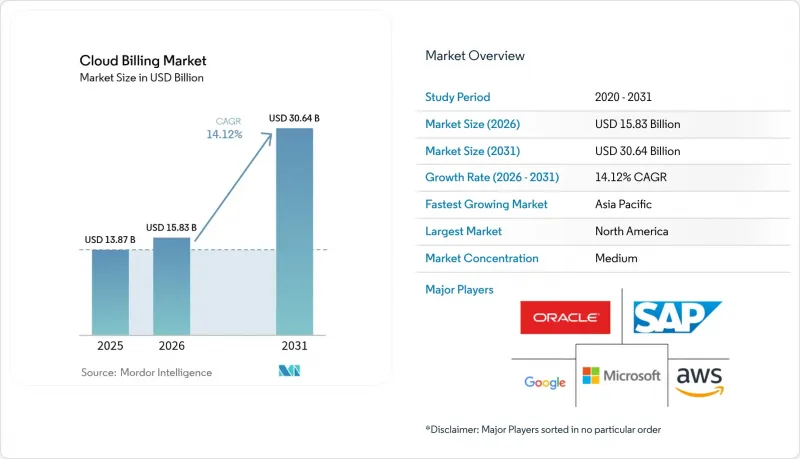
Mordor Intelligence에 의하면, 2026년 클라우드 청구 시장 규모는 158억 3,000만 달러로 추정되고, 2025년 138억 7,000만 달러에서 확대해, 2031년에는 306억 4,000만 달러에 이를 것으로 예측됩니다.
2026-2031년 연평균 성장률(CAGR) 14.12%로 성장할 것으로 전망됩니다.
본 보고서는 도입 형태별(퍼블릭 클라우드, 프라이빗 클라우드, 하이브리드 클라우드), 구성 요소별(플랫폼 및 서비스), 과금 모델별(구독형, 종량제, 하이브리드형), 클라우드 서비스 모델별(SaaS 과금, PaaS 과금, IaaS 과금), 조직 규모별(대기업 및 중소기업), 최종 사용자 산업별(BFSI 등), 그리고 지역별로 분류되어 있습니다. 시장 전망은 금액(달러) 기준으로 제시되어 있습니다.
세계의 클라우드 과금 시장 동향 및 인사이트
멀티클라우드 도입 가속화
조직이 복원력, 가격, 데이터 상주 요건의 균형을 맞추기 위해 워크로드를 분산함에 따라 멀티클라우드 전략이 확산되고 있습니다. Kubernetes 내의 정책 주도형 리소스 제어를 통해, 미세 조정된 자동 스케일링이 거버넌스를 유지하면서 예측 불가능한 지출을 억제한다는 사실이 입증되었습니다. 현재 과금 플랫폼은 서로 다른 가격표, 통화, 분류 체계를 실시간으로 조정하고, 단위 수준의 설명 책임을 촉진하는 차지백 보고서를 제공합니다. 하이퍼스케일러가 데이터 수집 주기를 단축하는 사용량 API를 공개하고, 기업들이 공급업체 다각화를 통해 단일 공급업체 위험을 완화함에 따라 클라우드 청구 시장은 탄력을 받고 있습니다. 이에 따라 수요는 멀티클라우드 텔레메트리 데이터를 표준화하고 통합 대시보드를 제공하는 청구 엔진에 집중되고 있습니다.
전자상거래에서의 구독 모델 확대
구독형 상거래는 더 이상 SaaS에만 국한되지 않습니다. 소매업체들은 복잡한 일할 계산, 단계별 추가 기능, 주기적인 프로모션이 필요한 실물 상품, 컨텐츠 번들, 하이브리드 멤버십 제도를 통합하고 있습니다. 플랫폼은 고객 행동에 따른 가격 조정을 관리하고, 국가별 결제 방식, PSD2 요건 및 GDPR(EU 개인정보보호규정) 의무에 맞추어 결제 과정을 현지화해야 합니다. 정기 결제형 커머스의 성장은 사용자 기반을 소프트웨어 공급업체에서 실물 상품을 배송하는 소매업체로 확대함으로써 클라우드 과금 시장을 강화하고 있습니다.
레거시 온프레미스 과금 시스템에서 전환함에 따른 복잡성
오랫동안 운영되어 온 온프레미스 청구 시스템에는 문서화되지 않은 비즈니스 로직이 포함되어 있는 경우가 많아, 데이터 매핑 및 규칙 변환이 어려워집니다. 규제가 엄격한 업계의 기업들은 시스템 마이그레이션 중에 PCI-DSS, SOX 또는 HIPAA 요건을 동시에 준수해야 하기 때문에 병행 운영 환경을 유지할 수밖에 없으며, 그 결과 프로젝트 예산이 부풀어 오르게 됩니다. 이러한 자원 측면의 부담으로 인해 완전한 마이그레이션을 주저하는 조직도 있어, 클라우드 과금 시장의 단기적인 성장 속도를 둔화시키고 있습니다.
부문 분석
조직이 온프레미스 자산과 하이퍼스케일 확장성을 결합함에 따라 하이브리드 환경은 연평균 성장률(CAGR) 15.81%로 성장을 지속하고 있습니다. 기업들은 데이터의 위치나 지연 시간에 민감한 처리를 희생하지 않고 워크로드를 마이그레이션할 수 있다는 점을 중요하게 생각하지만, 종종 비용 구조의 분절화에 직면하곤 합니다. 이에 대응하여 벤더들은 프라이빗 클라우드의 텔레메트리(telemetry)와 퍼블릭 클라우드의 요금표를 통합하는 어댑터를 출시하고 있습니다.
퍼블릭 클라우드 도입은 그 간편성과 광범위한 툴 생태계 덕분에 매출에서 66.10%의 선두를 유지하고 있습니다. 하지만 규정 준수 요건, 엣지 컴퓨팅 이용 사례, 지정학적 요인으로 인해 하이브리드 환경에서의 지출 거버넌스 중요성이 더욱 커지고 있습니다. 이에 따라 클라우드 청구 시장은 혼합 실효 요율을 산출하고, 거점 간 차이 보고서를 제시하는 통합 오케스트레이션 엔진으로 중심을 옮겨가고 있습니다.
기업들이 로드맵 수립, 통합 및 최적화를 아웃소싱함에 따라 서비스 매출은 연평균 성장률(CAGR) 16.62%로 증가하고 있습니다. 공급업체들은 신속한 투자 회수를 목표로 자문, 도입 및 관리형 운영을 묶어 제공합니다. 플랫폼은 60.10%의 점유율로 여전히 지배적이지만, 서비스 주도형 접근 방식은 맞춤형 통제가 필수적인 규제 대상 분야에서 입지를 다지고 있습니다.
클라우드 과금 시장이 혜택을 보고 있는 이유는 서비스 전문가들이 각 분야의 미묘한 차이를 구성의 기준선으로 반영하여 도입 위험을 낮추고 있기 때문입니다. 플랫폼 라이선스와 라이프사이클 서비스를 결합한 번들형 서비스는 계약 유지율을 높이고, 탄소 추적 및 파트너와의 결제와 같은 관련 비용 거버넌스 모듈로의 사업 확장을 가능하게 하고 있습니다.
지역별 분석
북미는 2025년 매출의 36.80%를 차지했으며, 하이퍼스케일러의 집적, 벤처 자금, FinOps 인력의 풍부함으로 인해 계속해서 혜택을 받고 있습니다. 이 지역에서는 SOX 및 주 차원의 개인정보 보호법 등 프레임워크를 준수하는 벤더가 우대받고 있습니다. AI 워크로드의 높은 이용률 또한 토큰 과금형 서비스 도입을 촉진하고, 실시간 과금에 대한 수요를 뒷받침하고 있습니다.
아시아태평양은 공공 부문의 디지털화, 모바일 우선 소비자층, 그리고 국가 주도의 AI 컴퓨팅 이니셔티브에 힘입어 연평균 성장률(CAGR) 16.28%라는 가장 높은 성장률을 기록하고 있습니다. 인도의 국가 GPU 프로그램은 정부 보조금이 클라우드 용량 확장을 촉진하고, 이것이 확장 가능한 과금을 통해 수익화되어야 함을 보여주는 좋은 예입니다. 일본의 탄소 연계형 배터리 네트워크는 비용과 환경 KPI를 통합하려는 지역의 의지를 여실히 보여주고 있습니다. 현지화와 언어 지원을 결합한 제공업체들이 조기에 입지를 다지고 있습니다.
유럽에서는 GDPR(EU 개인정보보호규정)에 대한 리더십과 새롭게 부상하는 디지털 주권 계획 간의 균형이 이루어지고 있습니다. 기업들은 현지 데이터센터와 투명성이 높은 데이터 처리 체인을 원하기 때문에 지역 내 데이터 보관을 보장하는 과금 플랫폼이 선호되고 있습니다. 탄소 의식이 높은 스케줄링을 장려하는 노력으로 인해, 클라우드 과금 시장은 환경 관련 차지백 보고서로 나아가고 있습니다. 국가별 규제가 세분화되면서 조달 주기는 길어지고 있지만, 한편으로는 신규 진입 장벽이 높아지고, 규정 준수의 미묘한 뉘앙스를 능숙하게 처리할 수 있는 벤더에 대한 충성도가 강화되고 있습니다.
기타 혜택 :
- 엑셀 형식 시장 예측(ME) 시트
- 3개월간의 애널리스트 지원
자주 묻는 질문
목차
제1장 서론
제2장 조사 방법
제3장 주요 요약
제4장 시장 구도
제5장 시장 규모 및 성장 예측
제6장 경쟁 구도
제7장 시장 기회 및 향후 동향
AJY 26.08.26According to Mordor Intelligence, cloud billing market size in 2026 is estimated at USD 15.83 billion, growing from 2025 value of USD 13.87 billion with 2031 projections showing USD 30.64 billion, growing at 14.12% CAGR over 2026-2031.
This report is Segmented by Deployment (Public Cloud, Private Cloud, and Hybrid Cloud), Component (Platform and Services), Billing Model (Subscription-Based, Usage-Based, and Hybrid), Cloud Service Model (SaaS Billing, Paas Billing, and IaaS Billing), Organization Size (Large Enterprises and SMEs), End-User Industry (BFSI, and More), and Geography. The Market Forecasts are Provided in Terms of Value (USD).
Global Cloud Billing Market Trends and Insights
Accelerating Multi-Cloud Adoption
Multi-cloud strategies are gaining popularity as organizations distribute workloads to balance resilience, pricing, and data-residency requirements. Policy-driven resource controls inside Kubernetes have demonstrated that finely tuned autoscaling curbs unpredictable spend while maintaining governance. Billing platforms now reconcile divergent price books, currencies, and taxonomies in real time and supply chargeback reports that promote unit-level accountability. The cloud billing market gains momentum as hyperscalers publish consumption APIs that shorten data ingestion cycles and as enterprises mitigate single-vendor risk by embracing provider diversity. Demand, therefore, concentrates on billing engines that normalise multi-cloud telemetry and present unified dashboards.
Expansion of E-Commerce Subscription Models
Subscription commerce no longer applies exclusively to SaaS. Retailers integrate physical goods, content bundles, and hybrid memberships that require intricate proration, tiered add-ons, and cyclical promotions. Platforms must orchestrate price adjustments triggered by customer behaviour and localise checkout in line with country-specific payment methods, PSD2 mandates, and GDPR obligations. Growth in recurring commerce strengthens the cloud billing market by broadening the user base from software publishers to merchants that ship tangible products.
Migration Complexities from Legacy On-Premises Billing
Long-standing on-prem billing stacks often carry undocumented business logic, making data mapping and rule translation difficult. Enterprises in regulated verticals simultaneously uphold PCI-DSS, SOX, or HIPAA mandates during cut-over, obliging dual-run environments that inflate project budgets. The resource burden deters some organisations from full transition and tempers the near-term expansion pace of the cloud billing market.
Other drivers and restraints analyzed in the detailed report include:
- Rising Demand for Real-Time Usage-Based Pricing
- Token-Based Cloud Consumption Models in Web3 Startups
- Data-Sovereignty and Cross-Border Compliance Costs
For complete list of drivers and restraints, kindly check the Table Of Contents.
Segment Analysis
Hybrid environments are recording a 15.81% CAGR as organisations pair on-prem assets with hyperscale elasticity. Enterprises value the ability to shift workloads without forfeiting data residency or latency-sensitive processing, yet they often encounter fragmented cost structures. Billing vendors respond by releasing adapters that harmonise private-cloud telemetry with public-cloud rate cards.
Public deployment maintains a 66.10% revenue lead due to its simplicity and broad tooling ecosystems. Nevertheless, compliance triggers, edge use cases, and geopolitics strengthen the case for hybrid spend governance. The cloud billing market, therefore, pivots toward unified orchestration engines that calculate blended effective rates and surface variance reports across locations.
Services revenue is climbing at 16.62% CAGR as enterprises outsource roadmap planning, integration, and optimisation. Providers bundle advisory, implementation, and managed operations that target rapid payback. Platforms continue to dominate with a 60.10% share, yet service-led engagement secures footholds in regulated domains where bespoke controls are pivotal.
The cloud billing market benefits because service specialists translate domain nuances into configuration baselines that shrink deployment risk. Bundled offerings that pair platform licences with lifecycle services foster stickier contracts and unlock expansion into adjacent cost-governance modules such as carbon tracing and partner settlement.
Complete Report Scope:
- By Deployment
- Public Cloud
- Private Cloud
- Hybrid Cloud
- By Component
- Platform
- Services
- By Billing Model
- Subscription-based
- Usage-based
- Hybrid (Subscription + Usage)
- By Cloud Service Model
- SaaS Billing
- PaaS Billing
- IaaS Billing
- By Organization Size
- Large Enterprises
- Small and Medium Enterprises (SMEs)
- By End-user Industry
- Retail and E-commerce
- BFSI
- Telecommunications
- Healthcare and Life Sciences
- Energy and Utilities
- Government and Public Sector
- Media and Entertainment
- Other End-user Industries
- By Geography
- North America
- United States
- Canada
- Mexico
- South America
- Brazil
- Argentina
- Chile
- Rest of South America
- Europe
- Germany
- United Kingdom
- France
- Italy
- Spain
- Russia
- Rest of Europe
- Asia Pacific
- China
- India
- Japan
- South Korea
- Singapore
- Malaysia
- Australia
- Rest of Asia Pacific
- Middle East and Africa
- Middle East
- United Arab Emirates
- Saudi Arabia
- Turkey
- Rest of Middle East
- Africa
- South Africa
- Nigeria
- Egypt
- Rest of Africa
- Middle East
- North America
Geography Analysis
North America generated 36.80% of 2025 revenue and continues to benefit from a concentration of hyperscalers, venture funding, and FinOps talent. The region rewards vendors that comply with frameworks such as SOX and state-level privacy statutes. High usage of AI workloads also catalyzes the adoption of token-metered services, reinforcing demand for real-time rating.
The Asia-Pacific region posts the fastest growth rate of 16.28% CAGR, driven by public-sector digitization, mobile-first consumer bases, and sovereign AI computing initiatives. India's national GPU programme exemplifies how government grants catalyse cloud capacity that must be monetised through scalable billing. Japan's carbon-linked battery network highlights regional appetite for merging cost with environmental KPIs. Providers that bundle localisation and language support gain early footholds.
Europe balances GDPR leadership with emerging digital sovereignty plans. Enterprises require local data centres and transparent data-processing chains, so billing platforms that guarantee regional residency gain preference. Initiatives encouraging carbon-aware scheduling drive the cloud billing market toward environmental chargeback reports. Fragmented national rules prolong procurement cycles, yet they also amplify barriers for newcomers and solidify loyalty to vendors adept at navigating compliance nuances.
- Amazon Web Services (AWS) Inc.
- Microsoft Corporation (Azure)
- Google Cloud Platform
- Oracle Corporation
- SAP SE
- Salesforce Inc. (Revenue Cloud)
- Zuora Inc.
- Aria Systems Inc.
- BillingPlatform LLC
- FinancialForce LLC
- IBM Corporation
- Comarch SA
- Tencent Cloud
- Huawei Cloud
- Alibaba Cloud
- CloudBlue (An Ingram Micro Co.)
- CloudHealth (Vmware)
- Chargebee Inc.
- Recurly Inc.
- Stripe Billing
- Paddle.com Market Ltd.
- ChargeOver LLC
- Vertex Inc.
- GoCardless Ltd.
- Orb Inc.
- SaaSOptics (An Ramped Co.)
- LogiSense Corp.
- Gotransverse LLC
- Rev.io Technologies
Additional Benefits:
- The market estimate (ME) sheet in Excel format
- 3 months of analyst support
TABLE OF CONTENTS
1 INTRODUCTION
- 1.1 Study Assumptions and Market Definition
- 1.2 Scope of the Study
2 RESEARCH METHODOLOGY
3 EXECUTIVE SUMMARY
4 MARKET LANDSCAPE
- 4.1 Market Overview
- 4.2 Market Drivers
- 4.2.1 Accelerating multi-cloud adoption
- 4.2.2 Expansion of e-commerce subscription models
- 4.2.3 Rising demand for real-time usage-based pricing
- 4.2.4 Token-based cloud consumption models in Web3 startups
- 4.2.5 Carbon-aware workload scheduling incentives
- 4.2.6 Integration of AI-driven cost optimization engines
- 4.3 Market Restraints
- 4.3.1 Migration complexities from legacy on-prem billing
- 4.3.2 Data-sovereignty and cross-border compliance costs
- 4.3.3 Rising FinOps tooling cannibalising native billing margins
- 4.3.4 Vendor lock-in and interoperability challenges
- 4.4 Industry Value Chain Analysis
- 4.5 Regulatory Landscape
- 4.6 Technological Outlook (Generative AI for automated invoicing)
- 4.7 Porter's Five Forces Analysis
- 4.7.1 Bargaining Power of Suppliers
- 4.7.2 Bargaining Power of Buyers
- 4.7.3 Threat of New Entrants
- 4.7.4 Threat of Substitutes
- 4.7.5 Intensity of Competitive Rivalry
- 4.8 Impact of Macroeconomic Factors on the Market
5 MARKET SIZE AND GROWTH FORECASTS (VALUES)
- 5.1 By Deployment
- 5.1.1 Public Cloud
- 5.1.2 Private Cloud
- 5.1.3 Hybrid Cloud
- 5.2 By Component
- 5.2.1 Platform
- 5.2.2 Services
- 5.3 By Billing Model
- 5.3.1 Subscription-based
- 5.3.2 Usage-based
- 5.3.3 Hybrid (Subscription + Usage)
- 5.4 By Cloud Service Model
- 5.4.1 SaaS Billing
- 5.4.2 PaaS Billing
- 5.4.3 IaaS Billing
- 5.5 By Organization Size
- 5.5.1 Large Enterprises
- 5.5.2 Small and Medium Enterprises (SMEs)
- 5.6 By End-user Industry
- 5.6.1 Retail and E-commerce
- 5.6.2 BFSI
- 5.6.3 Telecommunications
- 5.6.4 Healthcare and Life Sciences
- 5.6.5 Energy and Utilities
- 5.6.6 Government and Public Sector
- 5.6.7 Media and Entertainment
- 5.6.8 Other End-user Industries
- 5.7 By Geography
- 5.7.1 North America
- 5.7.1.1 United States
- 5.7.1.2 Canada
- 5.7.1.3 Mexico
- 5.7.2 South America
- 5.7.2.1 Brazil
- 5.7.2.2 Argentina
- 5.7.2.3 Chile
- 5.7.2.4 Rest of South America
- 5.7.3 Europe
- 5.7.3.1 Germany
- 5.7.3.2 United Kingdom
- 5.7.3.3 France
- 5.7.3.4 Italy
- 5.7.3.5 Spain
- 5.7.3.6 Russia
- 5.7.3.7 Rest of Europe
- 5.7.4 Asia Pacific
- 5.7.4.1 China
- 5.7.4.2 India
- 5.7.4.3 Japan
- 5.7.4.4 South Korea
- 5.7.4.5 Singapore
- 5.7.4.6 Malaysia
- 5.7.4.7 Australia
- 5.7.4.8 Rest of Asia Pacific
- 5.7.5 Middle East and Africa
- 5.7.5.1 Middle East
- 5.7.5.1.1 United Arab Emirates
- 5.7.5.1.2 Saudi Arabia
- 5.7.5.1.3 Turkey
- 5.7.5.1.4 Rest of Middle East
- 5.7.5.2 Africa
- 5.7.5.2.1 South Africa
- 5.7.5.2.2 Nigeria
- 5.7.5.2.3 Egypt
- 5.7.5.2.4 Rest of Africa
- 5.7.5.1 Middle East
- 5.7.1 North America
6 COMPETITIVE LANDSCAPE
- 6.1 Market Concentration
- 6.2 Strategic Moves
- 6.3 Market Share Analysis
- 6.4 Company Profiles (includes Global level Overview, Market level overview, Core Segments, Financials as available, Strategic Information, Market Rank/Share for key companies, Products and Services, and Recent Developments)
- 6.4.1 Amazon Web Services (AWS) Inc.
- 6.4.2 Microsoft Corporation (Azure)
- 6.4.3 Google Cloud Platform
- 6.4.4 Oracle Corporation
- 6.4.5 SAP SE
- 6.4.6 Salesforce Inc. (Revenue Cloud)
- 6.4.7 Zuora Inc.
- 6.4.8 Aria Systems Inc.
- 6.4.9 BillingPlatform LLC
- 6.4.10 FinancialForce LLC
- 6.4.11 IBM Corporation
- 6.4.12 Comarch SA
- 6.4.13 Tencent Cloud
- 6.4.14 Huawei Cloud
- 6.4.15 Alibaba Cloud
- 6.4.16 CloudBlue (An Ingram Micro Co.)
- 6.4.17 CloudHealth (Vmware)
- 6.4.18 Chargebee Inc.
- 6.4.19 Recurly Inc.
- 6.4.20 Stripe Billing
- 6.4.21 Paddle.com Market Ltd.
- 6.4.22 ChargeOver LLC
- 6.4.23 Vertex Inc.
- 6.4.24 GoCardless Ltd.
- 6.4.25 Orb Inc.
- 6.4.26 SaaSOptics (An Ramped Co.)
- 6.4.27 LogiSense Corp.
- 6.4.28 Gotransverse LLC
- 6.4.29 Rev.io Technologies
7 MARKET OPPORTUNITIES AND FUTURE TRENDS
- 7.1 White-Space and Unmet-Need Assessment