|
시장보고서
상품코드
2114505
심장 재활 시장 : 시장 점유율 분석, 업계 동향 및 통계, 성장 예측(2026-2031년)Cardiac Rehabilitation - Market Share Analysis, Industry Trends & Statistics, Growth Forecasts (2026 - 2031) |
||||||
 Mordor Intelligence
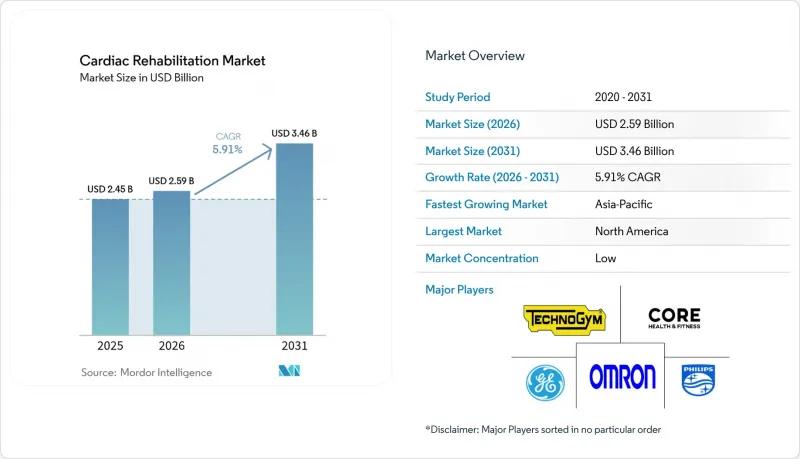
Mordor Intelligence에 의하면, 2026년 심장 재활 시장 규모는 25억 9,000만 달러로 추정되고, 2025년 24억 5,000만 달러에서 성장하여 2031년에는 34억 6,000만 달러에 이를 것으로 예측됩니다.
2026-2031년 연평균 성장률(CAGR) 5.91%로 성장할 것으로 전망됩니다.
본 보고서는 제품 유형별(러닝머신, 엘립티컬 트레이너, 안정화 볼, 로잉 머신, 혈압계, 심박수 모니터, 기타) 및 지역별(북미, 유럽, 아시아태평양, 중동 및 아프리카, 남미)로 분류되어 있습니다. 본 보고서에서는 상기 각 부문별 시장 규모(백만 달러)를 제시하고 있습니다.
세계의 심장 재활 시장 동향 및 인사이트
심장 재활(CR) 실험실에서의 네트워크 연결형 러닝머신 및 사이클 에르고미터 도입 확대
클라우드에 연결된 에르고미터가 심박수, 와트 수, 케이던스를 임상의의 대시보드로 실시간으로 전송함으로써, 실시간 데이터 수집이 감독 체제를 혁신적으로 변화시켰습니다. 의료진은 운동 부하를 즉시 조정할 수 있어, 각 세션을 다양한 동반 질환 프로파일에 맞춘 데이터 기반의 실험으로 전환하고 있습니다. 자동 업로드를 통해 인증 기준을 충족할 수 있고, 행정 업무가 줄어들어 직원들은 지도에 전념할 수 있게 되었습니다. 게임화 요소가 적용된 진행률 표시줄은 동기 부여를 높여주며, 시설 보고에 따르면 단일 기기를 사용하는 프로그램에 비해 준수율이 15% 더 높은 것으로 나타났습니다. 이러한 이점들이 결합되어, 연결형 유산소 운동 기기는 심장 재활실에서 새로운 표준으로 자리 잡고 있습니다.
재활 기기에 웨어러블 센서 및 원격 텔레메트리 통합
지속적인 심전도, 혈압, 맥박 산소 포화도 데이터가 기기의 원격 측정 기능과 통합되어, 임상의는 1초 단위로 생리학적 반응을 파악할 수 있게 되었습니다. 실시간 분석을 통해 부정맥이나 위험한 혈압 수치를 감지하고 세션을 자동으로 일시 중지할 수 있으므로, 고위험 환자군의 안전성이 향상됩니다. 원격 대시보드를 통해 재택 프로그램의 모니터링 범위가 확대되어, 임상적 엄격성을 유지하면서도 인력 부족 문제를 완화하는 데 기여합니다. 텔레메트리 기능을 도입한 시설에서는 프로그램 중도 탈락률이 23% 감소했으며, 목표 운동 부하에 더 빨리 도달하고 있는 것으로 보고되고 있습니다. 이러한 접근 방식은 클리닉에서의 시작과 원격 진행 관리를 융합한, 확장성이 뛰어난 하이브리드형 프로그램의 기반이 되고 있습니다.
병원 및 센터의 높은 설비 투자비 및 유지비
고성능 트레드밀, 텔레메트리 콘솔, 외골격 장치의 초기 도입 비용은 대당 5만-20만 달러에 달할 수 있어, 빠듯한 자본 예산에 부담을 주고 있습니다. 연간 유지보수 계약에는 구매 비용의 8-12%가 추가로 소요되며, 인력이 부족한 현장에서 생체의학 엔지니어도 필요합니다. 예산 압박으로 인해 34%의 병원이 제조업체의 권장 사항을 초과하여 교체 주기를 연장하고 있으며, 이로 인해 가동 중단 시간과 안전상의 위험이 증가하고 있습니다. 소규모 지역 의료시설의 상황은 특히 심각하여, 보상금은 감가상각비는커녕 운영비조차 거의 충당하지 못하는 실정입니다. 이러한 현실로 인해 명확한 임상적 이점이 있음에도 불구하고 장비 교체 주기가 지연되고, 단기적인 수요도 억제되고 있습니다.
부문 분석
2025년, 유산소 운동 기기는 매출의 34.12%를 차지했으며, 심장 치료 분야에서 그 기초적인 역할을 반영하고 있습니다. 러닝머신과 사이클 에르고미터는 광범위한 임상시험을 통해 기능 능력 향상과 사망률 감소가 입증되었기 때문에 여전히 첫 번째 선택 치료법으로 자리 잡고 있습니다. 근력 훈련 시스템은 유산소 운동 모드를 보완하는 한편, 업그레이드된 원격 측정 모듈은 전자 의료 기록과 직접 연동됩니다. 심장 재활 시장에서는 진단 기능과 운동 기기를 통합하는 기업이 계속해서 우위를 점하고 있습니다.
신기술 분야는 VR 스테이션과 로봇 외골격이 시범 프로그램에서 상용 규모로 전환됨에 따라 2031년까지 연평균 성장률(CAGR) 6.15%로 가장 높은 성장세를 보이고 있습니다. ‘CardioVR-ReTone’은 12자유도와 몰입감 있는 풍경을 결합하여 동기 부여를 유지하는 첨단 외골격 설계의 좋은 예입니다. 게임화 및 모션 캡처는 사용자 경험을 재정의하고, 공급업체가 새로운 보험 환급을 확보할 수 있도록 지원하는 동시에, 환자 참여도를 중시하는 기관 구매자들을 끌어들이고 있습니다.
2025년에는 고위험 환자군에 필요한 종합적인 모니터링 시스템, 응급 카트, 통합된 응급 대응 프로토콜 덕분에 고정형 기기가 매출의 70.62%를 차지했습니다. 의료 기관은 규모의 경제와 직원의 전문성을 활용하여 심장 재활 기기 시장에서 고정형 기기의 역할을 강화하고 있습니다.
휴대용 시스템은 기술의 소형화와 안전한 무선 통신 채널을 통해 거실에서도 임상적 모니터링이 가능해짐에 따라 연평균 성장률(CAGR) 7.05%로 성장을 지속하고, 있습니다. 원격 프로그램은 이동 및 일정 조정의 부담을 줄이면서도 대면 치료와 동등한 성과를 보여주었습니다. 현재 각 기업은 네트워크 연결형 사이클 에르고미터에 태블릿과 혈압계를 세트로 판매하고 있으며, 인력 부족 상황 속에서도 의료 제공업체가 참여 목표를 달성할 수 있도록 지원하고 있습니다.
지역별 분석
2025년, 북미는 매출의 39.05%를 차지했습니다. 가상 재활에 대한 메디케어의 보상 덕분에, 클리닉에서의 기준선 검사와 재택 후속 관리를 결합한 하이브리드 모델이 촉진되고 있습니다. Carda Health나 Movn Health와 같은 디지털 헬스 스타트업은 턴키 플랫폼을 제공하고 있지만, 그 효과가 입증되었음에도 불구하고 여성 및 흑인 고령자의 참여율은 여전히 낮은 수준을 유지하고 있습니다.
유럽에서는 90.9%의 국가에서 프로그램이 시행되고 있으며, 준수율이 85%에 달하는 등 탄탄한 인프라가 유지되고 있지만, 위험 요인의 개선은 기대에 미치지 못하는 상황입니다. EU의 노력으로 치료 성과 보고가 표준화되었으며, AI 통합을 통한 치료량의 개인화가 촉진되고 있습니다.
아시아태평양은 연평균 성장률(CAGR) 6.58%로 가장 빠른 성장세를 기록하고 있습니다. 일본에서는 엄격한 보험 환급 기준으로 인해 대상 환자의 3-7%에게만 혜택이 미치고 있습니다. 중국에서는 500곳 이상의 센터가 개설되었으나, 비용 및 거리 제약으로 인해 실제로 프로그램을 운영하고 있는 병원은 24%에 그치고 있습니다. 현재 지역 컨소시엄은 서비스 격차를 해소하기 위해 원격 재활 및 저비용 휴대용 키트의 도입을 추진하고 있습니다.
기타 혜택 :
- 엑셀 형식 시장 예측(ME) 시트
- 3개월간 애널리스트의 지원
자주 묻는 질문
목차
제1장 서론
제2장 조사 방법
제3장 주요 요약
제4장 시장 구도
제5장 시장 규모 및 성장 예측
제6장 경쟁 구도
제7장 시장 기회 및 향후 전망
AJY 26.08.26According to Mordor Intelligence, cardiac rehabilitation market size in 2026 is estimated at USD 2.59 billion, growing from 2025 value of USD 2.45 billion with 2031 projections showing USD 3.46 billion, growing at 5.91% CAGR over 2026-2031.
This report is Segmented by Product Type (Treadmill, Elliptical Trainer, Stabilization Ball, Rower, Blood Pressure Monitor, Heart Rate Monitor, and Others) and Geography (North America, Europe, Asia-Pacific, Middle East and Africa, and South America). The Report Offers the Value (in USD Million) for the Above Segments.
Global Cardiac Rehabilitation Market Trends and Insights
Growing installation of connected treadmills& cycle-ergometers in CR labs
Real-time data capture has reshaped supervision as cloud-linked ergometers stream heart-rate, wattage, and cadence to clinician dashboards. Teams adjust workloads instantly, turning each session into a data-driven experiment that fits diverse comorbidity profiles. Automated uploads satisfy accreditation metrics, trimming paperwork and freeing staff for coaching. Gamified progress bars boost motivation, and facilities report 15% higher adherence than programs that use standalone machines. Together, these benefits position connected aerobic devices as the new standard for cardiac rehabilitation laboratories.
Integration of wearable sensors& remote telemetry into rehab devices
Continuous ECG, blood-pressure, and pulse-ox feeds now merge with equipment telemetry, giving clinicians second-by-second insight into physiologic response. Real-time analytics flag arrhythmias or unsafe pressures and can pause sessions automatically, improving safety for high-risk cohorts. Remote dashboards extend oversight to home programs, easing staffing shortages while sustaining clinical rigor. Facilities that embed telemetry report 23% lower dropout and faster attainment of goal workloads. The approach underpins scalable hybrids that blend clinic initiation with remote progression.
High capital & maintenance costs for hospitals and centres
Up-front prices for advanced treadmills, telemetry consoles, and exoskeletons can reach USD 50,000-200,000 per unit, straining tight capital budgets. Annual maintenance contracts add 8-12% of purchase cost and need on-site biomedical engineers who are scarce. Budget pressures lead 34% of hospitals to extend replacement cycles beyond manufacturer guidance, raising downtime and safety risks. Smaller community facilities fare worst because reimbursement barely covers operating cost, let alone depreciation. These realities slow refresh cycles and temper near-term demand despite clear clinical benefits.
Other drivers and restraints analyzed in the detailed report include:
- Shift to low-impact pneumatic strength machines for frail patients
- AI-enabled feedback loops boosting utilisation of home-use devices
- Space constraints limit deployment of large equipment
For complete list of drivers and restraints, kindly check the Table Of Contents.
Segment Analysis
Aerobic training equipment retained 34.12% revenue in 2025, reflecting its foundational role in cardiac care. Treadmills and cycle-ergometers remain first-line interventions because extensive clinical trials prove gains in functional capacity and mortality reduction. Strength systems complement aerobic modalities, while upgraded telemetry modules link directly to electronic health records. The cardiac rehabilitation market continues to reward firms that integrate diagnostics with exercise hardware.
The emerging technologies subset posts the fastest 6.15% CAGR through 2031 as VR stations and robotic exoskeletons transition from pilot programs to commercial scale. CardioVR-ReTone exemplifies advanced exoskeleton design, combining 12 degrees of freedom with immersive scenery to sustain motivation. Gamification and motion capture redefine the user experience, helping vendors secure new reimbursements and attracting institutional buyers focused on patient engagement.
Fixed installations captured 70.62% revenue in 2025 thanks to full monitoring suites, crash carts, and integrated emergency protocols required for high-risk cohorts. Facilities capitalise on economies of scale and staff competencies, reinforcing the role of fixed units within the cardiac rehabilitation equipment market.
Portable systems register a 7.05% CAGR as technology miniaturisation and secure wireless channels bring clinical oversight to living rooms. Remote programs showed equivalent outcomes to on-site care at lower travel and scheduling burden. Firms now bundle connected cycle-ergometers with tablets and blood-pressure cuffs, helping providers meet participation goals during staffing shortages.
Complete Report Scope:
- By Product Type (Value)
- Aerobic Training Equipment
- Treadmills
- Upright / Recumbent Bikes
- Arm-Ergometers & Rowers
- Strength Training Equipment
- Pneumatic Weight Machines
- Resistance Bands & Training Balls
- Monitoring & Feedback Devices
- ECG/Telemetry Systems
- Blood-Flow & Metabolic Monitors
- Emerging Technologies
- VR-based Rehab Stations
- Robotics & Exoskeletons
- Aerobic Training Equipment
- By Portability (Value)
- Fixed (Facility-based)
- Portable / Home-use
- By End-User (Value)
- Hospitals
- Rehabilitation Centres
- Specialty Cardiac Clinics
- Home Settings
- By Region
- North America
- United States
- Canada
- Mexico
- Europe
- Germany
- United Kingdom
- France
- Italy
- Spain
- Russia
- Rest of Europe
- Asia-Pacific
- China
- Japan
- India
- South Korea
- Australia
- Rest of Asia-Pacific
- Middle East & Africa
- GCC
- South Africa
- Rest of Middle East & Africa
- South America
- Brazil
- Argentina
- Rest of South America
- North America
Geography Analysis
North America contributed 39.05% revenue in 2025. Medicare reimbursement for virtual rehabilitation encourages hybrid models combining in-clinic baseline testing with home follow-up. Digital health start-ups such as Carda Health and Movn Health supply turnkey platforms, yet participation remains lower among women and Black seniors despite proven benefit.
Europe sustains dense infrastructure, with 90.9% of countries hosting programs and adherence touching 85%, although risk-factor modification lags expectations. EU initiatives standardise outcome reporting and encourage AI integration to personalise dosing.
Asia Pacific records the swiftest 6.58% CAGR. Japan's strict reimbursement codes limit utilisation to 3-7% of eligible patients. China has opened more than 500 centres, yet only 24% of hospitals operate active programs, constrained by affordability and distance. Regional consortia now champion telerehabilitation and low-cost portable kits to bridge service gaps.
- Koninklijke Philips
- Medtronic
- GE Healthcare
- Core Health & Fitness (Star Trac)
- Johnson Health Tech (Matrix)
- Amer Sports (Precor)
- HUR Oy
- h/p/cosmos
- Shandong Baodelong Fitness
- LifeWatch / BioTelemetry
- Biotelemetry Philips (CardioSecur)
- Ergoline GmbH
- Schiller
- Lode BV
- Dynatronics
- Technogym
- Stryker (Physio-Control treadmills)
Additional Benefits:
- The market estimate (ME) sheet in Excel format
- 3 months of analyst support
TABLE OF CONTENTS
1 Introduction
- 1.1 Study Assumptions & Market Definition
- 1.2 Scope of the Study
2 Research Methodology
3 Executive Summary
4 Market Landscape
- 4.1 Market Overview
- 4.2 Market Drivers
- 4.2.1 Growing installation of connected treadmills & cycle-ergometers in CR labs
- 4.2.2 Integration of wearable sensors & remote telemetry into rehab devices
- 4.2.3 Shift to low-impact pneumatic strength machines for frail patients
- 4.2.4 AI-enabled feedback loops boosting utilisation of home-use devices *
- 4.2.5 Virtual-reality rehab stations creating a new product niche *
- 4.3 Market Restraints
- 4.3.1 High capital & maintenance costs for hospitals and centres
- 4.3.2 Space constraints limit deployment of large equipment
- 4.3.3 Shortage of biomedical engineers for device upkeep *
- 4.3.4 Lack of harmonised MDR/510(k) pathways for digital features *
- 4.4 Value / Supply-Chain Analysis
- 4.5 Regulatory Landscape
- 4.6 Technological Outlook
- 4.7 Porter's Five Forces
- 4.7.1 Threat of New Entrants
- 4.7.2 Bargaining Power of Suppliers
- 4.7.3 Bargaining Power of Buyers
- 4.7.4 Threat of Substitutes
- 4.7.5 Rivalry Among Existing Players
5 Market Size & Growth Forecasts
- 5.1 By Product Type (Value)
- 5.1.1 Aerobic Training Equipment
- 5.1.1.1 Treadmills
- 5.1.1.2 Upright / Recumbent Bikes
- 5.1.1.3 Arm-Ergometers & Rowers
- 5.1.2 Strength Training Equipment
- 5.1.2.1 Pneumatic Weight Machines
- 5.1.2.2 Resistance Bands & Training Balls
- 5.1.3 Monitoring & Feedback Devices
- 5.1.3.1 ECG/Telemetry Systems
- 5.1.3.2 Blood-Flow & Metabolic Monitors
- 5.1.4 Emerging Technologies
- 5.1.4.1 VR-based Rehab Stations
- 5.1.4.2 Robotics & Exoskeletons
- 5.1.1 Aerobic Training Equipment
- 5.2 By Portability (Value)
- 5.2.1 Fixed (Facility-based)
- 5.2.2 Portable / Home-use
- 5.3 By End-User (Value)
- 5.3.1 Hospitals
- 5.3.2 Rehabilitation Centres
- 5.3.3 Specialty Cardiac Clinics
- 5.3.4 Home Settings
- 5.4 By Region
- 5.4.1 North America
- 5.4.1.1 United States
- 5.4.1.2 Canada
- 5.4.1.3 Mexico
- 5.4.2 Europe
- 5.4.2.1 Germany
- 5.4.2.2 United Kingdom
- 5.4.2.3 France
- 5.4.2.4 Italy
- 5.4.2.5 Spain
- 5.4.2.6 Russia
- 5.4.2.7 Rest of Europe
- 5.4.3 Asia-Pacific
- 5.4.3.1 China
- 5.4.3.2 Japan
- 5.4.3.3 India
- 5.4.3.4 South Korea
- 5.4.3.5 Australia
- 5.4.3.6 Rest of Asia-Pacific
- 5.4.4 Middle East & Africa
- 5.4.4.1 GCC
- 5.4.4.2 South Africa
- 5.4.4.3 Rest of Middle East & Africa
- 5.4.5 South America
- 5.4.5.1 Brazil
- 5.4.5.2 Argentina
- 5.4.5.3 Rest of South America
- 5.4.1 North America
6 Competitive Landscape
- 6.1 Market Share Analysis
- 6.2 Company Profiles {(includes Global level Overview, Market level overview, Core Segments, Financials as available, Strategic Information, Market Rank/Share for key companies, Products & Services, and Recent Developments)}
- 6.2.1 Philips Healthcare
- 6.2.2 Medtronic
- 6.2.3 GE Healthcare
- 6.2.4 Core Health & Fitness (Star Trac)
- 6.2.5 Johnson Health Tech (Matrix)
- 6.2.6 Amer Sports (Precor)
- 6.2.7 HUR Oy
- 6.2.8 h/p/cosmos
- 6.2.9 Shandong Baodelong Fitness
- 6.2.10 LifeWatch / BioTelemetry
- 6.2.11 Biotelemetry Philips (CardioSecur)
- 6.2.12 Ergoline GmbH
- 6.2.13 Schiller AG
- 6.2.14 Lode BV
- 6.2.15 Dynatronics
- 6.2.16 Technogym
- 6.2.17 Stryker (Physio-Control treadmills)
7 Market Opportunities & Future Outlook
- 7.1 White-space & Unmet-Need Assessment