|
시장보고서
상품코드
2114509
항공기 오토파일럿 시스템 시장 : 시장 점유율 분석, 업계 동향 및 통계, 성장 예측(2026-2031년)Aircraft Autopilot System - Market Share Analysis, Industry Trends & Statistics, Growth Forecasts (2026 - 2031) |
||||||
 Mordor Intelligence
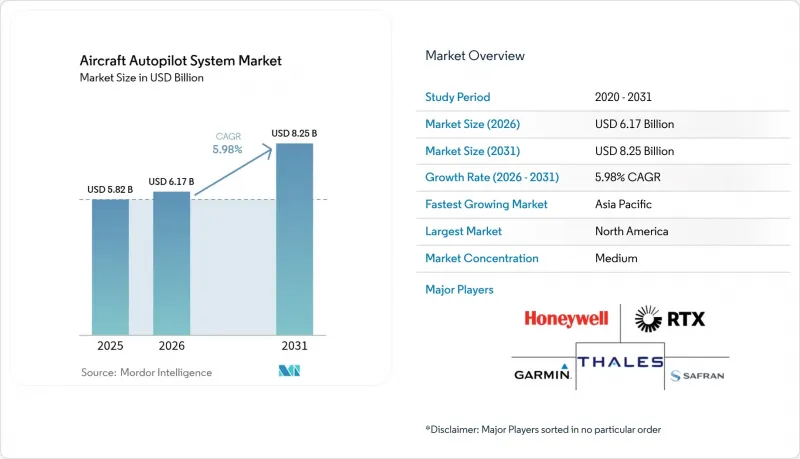
Mordor Intelligence에 의하면, 항공기 오토파일럿 시스템 시장 규모는 2025년에 58억 2,000만 달러로 평가되었고, 2026년 61억 7,000만 달러에서 2031년까지 82억 5,000만 달러에 이를 것으로 예측되며, 예측 기간(2026-2031년) CAGR은 5.98%를 나타낼 전망입니다.
본 보고서는 시스템별(자세·방위 참조 시스템, 비행 안내 시스템, 비행 제어 컴퓨터 등), 항공기 유형별(나로우드, 와이드바디, 비즈니스 제트기 등), 최종 사용자별(OEM 탑재 및 사후 장착), 지역별(북미, 유럽, 아시아태평양 등)로 분류되어 있습니다. 시장 예측은 금액(달러) 기준으로 제시되어 있습니다.
세계의 항공기 자동 조종 시스템 시장 동향 및 인사이트
상용 항공기 인도 대수 증가
보잉사가 B737의 월 생산 대수를 42대로 늘릴 계획이며, 에어버스사가 A320 패밀리의 월 생산 대수를 75대로 늘리겠다는 의향은 자동 조종 장치 탑재 대수를 끌어올리는 꾸준한 생산 확대의 기반이 되고 있습니다. 아시아태평양의 항공사들이 이러한 수주의 상당 부분을 차지하고 있어, 통합형 비행 관리 및 자동 조종 장치 세트가 여전히 초기 장비의 우선 순위임을 보장하고 있습니다. 각 공급업체들은 이러한 수요에 대응하기 위해 비행 제어 컴퓨터 및 서보 액추에이터의 생산 능력을 확대되고 있습니다. 모든 신규 장착되는 협폭기 및 광폭기에는 향후 소프트웨어 기능 확장을 위한 여지가 마련된 인증된 디지털 자동조종장치가 필수적이기 때문에 항공기 자동조종장치 시스템 시장은 직접적인 혜택을 받고 있습니다. 이러한 생산 전망에 힘입어 2030년까지 Tier 1 항공전자 장비 공급업체의 매출 전망이 안정적입니다.
고도화된 비행 자동화에 대한 수요 증가
FAA(미국 연방항공청)의 ‘More Pilots, More Aircraft, Simplified Certification(MOSAIC)’ 프레임워크는 제어 상실을 방지하기 위해 자동화 계층에 의존하는 항공기의 도입을 가능하게 하여, 고권한형 자동조종장치의 채택을 가속화하고 있습니다. 각 항공사는 혼잡한 노선에서 조종사의 업무 부담을 줄이기 위해 기상 연동 유도, 위성 기반 보강 기능, 통합 데이터 링크 기능을 사양으로 지정하고 있습니다. 학술 연구에서는 센서 데이터를 맥락에 맞추어 해석하고 실행 가능한 단서를 제시하는 디지털 비행 보조 시스템이 주목받고 있으며, 이는 자동화 강화를 통한 가치 제안을 뒷받침하고 있습니다. 이러한 기능 덕분에 구매자들이 기존의 속도 기반 시스템에서 자세 기반 AI 지원 솔루션으로 전환함에 따라 항공기 자동조종 시스템 시장은 확대되고 있습니다.
높은 인증 및 규정 준수 비용
FAA(미국 연방항공국)의 ‘시스템 안전 평가’ 규정에 따르면, 치명적 고장 확률이 비행 시간당 1×10⁻⁹ 미만으로 유지되도록 보장하기 위한 철저한 검증이 의무화되어 있으며, 이로 인해 소프트웨어 검증 예산은 프로그램당 500만-1,500만 달러 범위로 상승하고 있습니다. DO-178C 레벨 A 준수를 위해서는 여러 차례의 독립적인 검토와 완벽한 코드 커버리지가 필요하며, 이로 인해 일정이 최대 2년까지 연장됩니다. 항공기 자동 조종 시스템 업계의 중소규모 혁신 기업들은 이러한 장벽을 극복하기 위해 대기업과 제휴하는 경우가 많으며, 그 결과 시장 진입 장벽은 높게 유지되고, 기존 기업들에 의한 시장 점유율 집중이 진행되고 있습니다.
부문 분석
2025년, 비행 제어 컴퓨터는 항공기 자동 조종 시스템 시장 점유율의 36.10%를 계속 차지했습니다. 이는 모든 상업용 수송기 등급에서 피치, 롤, 요 및 속도 명령에 대해 3중 중복 처리가 의무화되어 있기 때문입니다. 한편, 자동 조종 소프트웨어 제품군은 운항 사업자가 기존 하드웨어 위에 예측 알고리즘을 중첩시키는 클라우드를 통해 업데이트 가능한 로직 번들로 전환함에 따라 연평균 성장률(CAGR) 9.02%로 확대되고 있습니다. 탈레스(Thales)의 ‘PureFlyt’ 플랫폼은 연료 소비와 소음을 줄이기 위해 실시간 비행 경로를 최적화함으로써 이러한 전환을 구현하고 있습니다. 소프트웨어 중심 솔루션 분야의 항공기 자동 조종 시스템 시장 규모는 항공우주 산업 전반에 걸친 디지털화의 확산을 반영하여 2031년까지 22억 8,000만 달러에 달할 것으로 예측됩니다. 서보 액추에이터나 자세 센서 등의 하드웨어 구성 요소는 여전히 필수적이지만, 수익성은 자체 개발 코드로 이동하고 있으며, 접근, 재이륙, 비상 모드 등 각 모드를 차별화하고 있습니다. 각 벤더는 인증 주기를 단축하고 AI 기능의 신속한 도입을 가능하게 하는 DevSecOps 파이프라인에 투자하고 있으며, 이로 인해 소프트웨어 로드맵의 경쟁적 중요성이 더욱 높아지고 있습니다.
항공사들은 처리 기능을 I/O 보드에서 분리된 ‘라인 교체 가능 유닛(LRU)’을 선호하고 있으며, 이를 통해 대규모 기계적 변경 없이도 기능 업그레이드가 가능해집니다. 방위 항공 분야의 FACE나 민간 운송 분야의 ARINC 653과 같은 개방형 아키텍처 표준은 벤더 간의 상호 운용성을 촉진하고, 틈새 시장 소프트웨어 개발자들에게 시장 규모를 확대되고 있습니다. 그 결과, 신규 진출기업들은 구독형 라이선싱 모델을 활용하는 한편, 기존 통합 업체들은 소프트웨어 보증을 연장 서비스 계약에 포함시키고 있습니다. 이러한 변화로 인해 항공기 자동 조종 시스템 시장은 Tier 1(Tier 1) 주계약업체와 민첩한 코드 전문 기업을 모두 아우르는 다층적인 생태계가 형성되고 있습니다.
지역별 분석
북미는 견조한 국방 예산과 국내 항공 여행의 급속한 회복에 힘입어 2025년 매출 점유율 42.90%로 항공기 자동 조종 시스템 시장을 주도했습니다. FAA(연방항공청)가 자동화 및 사이버 보안 규제에서 주도적인 역할을 수행하고 있는 만큼, 미국은 첨단 자동 조종 기능을 조기에 도입하여 국내 조달을 뒷받침하고 있습니다. 캐나다의 지역 제트기 기단 현대화와 멕시코의 협폭기 확대도 시장에 점차 기여하고 있습니다. 높은 가동률로 인해 비행 제어 컴퓨터의 교체 주기가 가속화되고 있어 기초적인 수요가 확보되고 있습니다. 허니웰, 콜린스 에어로스페이스, 가민 등 각 기업은 이 지역에 대규모 생산 및 엔지니어링 거점을 유지하며 고객의 요구 사항에 밀접하게 대응하고 있습니다.
아시아태평양은 가장 성장세가 두드러지는 지역으로, 2031년까지 연평균 성장률(CAGR) 7.75%로 확대되고 있습니다. 중국과 인도의 성장을 이끄는 주요 동력은 중산층의 항공 여행 확산과 국방 현대화 프로그램입니다. 에어버스는 2044년까지 전 세계 항공기 보유 대수가 2배인 5만 대에 달할 것으로 예측하고 있으며, 그 증가분의 대부분을 아시아태평양이 차지할 것으로 전망됩니다. COMAC 등 국내 OEM 업체들은 현지에서 개발된 자동 조종 서브시스템을 통합하고 있는 반면, 지역 항공사들은 성능 기반 항법(PBN) 요건을 충족하기 위해 대규모 개조 계약을 시작하고 있습니다. 일본과 한국은 자율형 UAM 생태계에 투자하고 있으며, 그 예로 태국에서 진행 중인 탈레스의 무인 교통 관리 테스트베드를 들 수 있습니다. 다양한 인증 제도는 맞춤화에 따른 부담을 야기하는 한편, 전 세계 주요 계약업체와 현지 시스템 하우스 간의 파트너십을 촉진하여 항공기 자동 조종 시스템 시장의 확대에 기여하고 있습니다.
유럽은 성숙해 가면서도 여전히 혁신 중심 시장으로 남아 있습니다. EASA가 킹에어 플랫폼에서 가민의 ‘오토랜드’를 승인한 것은 고도 자동화에 대한 규제 당국의 개방적인 태도를 뒷받침합니다. 탈레스, 사프란, BAE 시스템즈는 에어버스 및 유로파이터 각 프로그램을 위해 통합형 자동 조종 장치 및 비행 관리 패키지를 공급하고 있습니다. 유럽 방위 기금은 아비오닉스 버스를 사이버 침입으로부터 보호하는 AIDA 프로젝트 등, AI를 활용한 복원력 기능에 자원을 투입하고 있습니다. 중동 및 아프리카은 시장 규모는 작지만, 수송기 및 회전익기 기단을 갱신하는 걸프 지역 항공사 및 방위 기관으로부터 꾸준한 조달이 이루어지고 있습니다. 경제 상황이나 규제 대응 능력의 편차와 같은 장벽은 있지만, 와이드바디기 이용이 회복됨에 따라 이 지역은 항공기 자동조종 시스템 시장에 더 큰 부가가치를 창출하고 있습니다.
기타 혜택 :
- 엑셀 형식 시장 예측(ME) 시트
- 3개월간의 애널리스트 지원
자주 묻는 질문
목차
제1장 서론
제2장 조사 방법
제3장 개요
제4장 시장 구도
제5장 시장 규모 및 성장 예측
제6장 경쟁 구도
제7장 시장 기회 및 향후 전망
AJY 26.09.01According to Mordor Intelligence, the aircraft autopilot system market size was valued at USD 5.82 billion in 2025 and estimated to grow from USD 6.17 billion in 2026 to reach USD 8.25 billion by 2031, at a CAGR of 5.98% during the forecast period (2026-2031).
This report is Segmented by System (Attitude and Heading Reference Systems, Flight Director Systems, Flight Control Computers, and More), Aircraft Type (Narrowbody, Widebody, Business Jets, and More), End-User (OEM Fitment and Retrofit) and Geography (North America, Europe, Asia-Pacific, and More). The Market Forecasts are Provided in Terms of Value (USD).
Global Aircraft Autopilot System Market Trends and Insights
Rising Commercial Aircraft Deliveries
Boeing's plan to raise B737 output toward 42 jets a month and Airbus's intent to reach 75 A320-family units monthly underpin a steady production ramp that lifts autopilot installations. Asia-Pacific carriers drive a sizable share of these commitments, ensuring that integrated flight management and autopilot suites remain line-fit priorities. Suppliers expand manufacturing capacity for flight control computers and servo actuators to keep pace. The aircraft autopilot system market benefits directly because every forward-fit narrow-body or wide-body requires a certified digital autopilot with growth margins for future software features. The production outlook stabilizes revenue visibility for tier-one avionics vendors through 2030.
Growing Demand for Advanced Flight Automation
The FAA's More Pilots, More Aircraft, Simplified Certification (MOSAIC) framework paves the way for aircraft that rely on automation layers to guard against loss of control, accelerating the adoption of high-authority autopilots. Airlines specify weather-linked guidance, satellite-based augmentation, and integrated datalink functions to trim workload on congested routes. Academic research highlights digital flight assistants that contextualize sensor data and present actionable cues, reinforcing the value proposition of enhanced automation. These capabilities expand the aircraft autopilot system market as buyers transition from legacy rate-based systems to attitude-based, AI-supported solutions.
High Certification and Compliance Costs
The FAA's System Safety Assessments rule mandates exhaustive verification to ensure catastrophic failure probabilities remain below 1 X 10⁻⁹ per flight hour, driving software validation budgets into the USD 5-15 million range per program. DO-178C Level-A compliance requires multiple independent reviews and full code coverage, extending schedules by up to two years. Smaller innovators in the aircraft autopilot system industry often partner with primes to navigate these hurdles, which keeps market entry barriers high and consolidates share among incumbents.
Other drivers and restraints analyzed in the detailed report include:
- Fleet-wide Avionics Modernization Programs
- AI-enabled Contingency-management Autopilots
- Cyber-security Vulnerabilities in Flight-control Links
For complete list of drivers and restraints, kindly check the Table Of Contents.
Segment Analysis
Flight Control Computers retained 36.10% of the aircraft autopilot system market share in 2025 because every commercial transport class aircraft mandates triple-redundant processing for pitch, roll, yaw, and speed commands. Conversely, Autopilot Software Suites are expanding at a 9.02% CAGR as operators shift toward cloud-updateable logic bundles that overlay predictive algorithms on existing hardware. Thales's PureFlyt platform illustrates this pivot by optimizing real-time trajectories for fuel and noise benefits. The aircraft autopilot system market size for software-centric solutions is projected to reach USD 2.28 billion by 2031, mirroring broader aerospace digitalization. Hardware components like servo actuators and attitude sensors remain essential, yet margins migrate to proprietary code, differentiating approach, go-around, and emergency modes. Vendors invest in DevSecOps pipelines that shorten certification cycles and permit rapid deployment of AI functions, reinforcing the competitive importance of software road maps.
Airlines prefer line-replaceable units that isolate processing from I/O boards, allowing capability upgrades without deep mechanical changes. Open-architecture standards such as FACE in defense aviation and ARINC 653 in civil transport encourage cross-vendor interoperability, expanding addressable volume for niche software developers. As a result, new entrants leverage subscription-based licensing models, while established integrators bundle software warranties with extended service agreements. These shifts foster a layered ecosystem where the aircraft autopilot system market accommodates both tier-one primes and agile code specialists.
Complete Report Scope:
- By System
- Attitude and Heading Reference Systems
- Flight Director Systems
- Flight Control Computers
- Autothrottle and Thrust Management
- Air-data and Inertial Reference Units
- Servo Actuators
- Autopilot Software Suites
- By Aircraft Type
- Narrowbody Jets
- Widebody Jets
- Regional and Commuter Aircraft
- Business Jets
- Helicopters
- Unmanned Aerial Vehicles (UAVs)
- Urban Air Mobility/eVTOL
- By End-User
- OEM Fitment
- Retrofit/Aftermarket
- By Geography
- North America
- United States
- Canada
- Mexico
- Europe
- United Kingdom
- Germany
- France
- Italy
- Russia
- Rest of Europe
- Asia-Pacific
- China
- Japan
- India
- South Korea
- Australia
- Rest of Asia-Pacific
- South America
- Brazil
- Rest of South America
- Middle East and Africa
- Middle East
- United Arab Emirates
- Saudi Arabia
- Rest of Middle East
- Africa
- South Africa
- Rest of Africa
- Middle East
- North America
Geography Analysis
North America led the aircraft autopilot system market with 42.90% revenue share in 2025, supported by robust defense budgets and a quick rebound in domestic air travel. The FAA's automation and cybersecurity regulation leadership makes the United States an early adopter of advanced autopilot features, reinforcing domestic procurement. Canada's regional-jet fleet modernization and Mexico's narrow-body expansion contribute incrementally. High utilization rates accelerate replacement cycles for flight control computers, locking in baseline demand. Honeywell, Collins Aerospace, and Garmin all maintain substantial production and engineering centers in the region, ensuring close alignment with customer requirements.
Asia-Pacific is the fastest-growing territory, advancing at an 7.75% CAGR through 2031. Middle-class air-travel adoption and defense modernization programs centrally drive China and India. Airbus forecasts the global fleet will double to 50,000 aircraft by 2044, with Asia-Pacific supplying most of that increment. Domestic OEMs such as COMAC integrate locally developed autopilot subsystems, while regional airlines launch large retrofit contracts to meet performance-based navigation mandates. Japan and South Korea invest in autonomous UAM ecosystems, exemplified by Thales's unmanned traffic management testbed in Thailand. Varied certification regimes create customization overhead and foster partnerships between global primes and local system houses, widening the aircraft autopilot system market footprint.
Europe remains a mature yet innovation-centric market. EASA's acceptance of Garmin Autoland on King Air platforms underscores regulatory openness to high-authority automation. Thales, Safran, and BAE Systems supply integrated autopilot and flight management packages across Airbus and Eurofighter programs. The European Defense Fund channels resources into AI-enhanced resilience features, such as the AIDA project that shields avionics buses from cyber intrusions. Middle East and Africa, while smaller in volume, register steady procurement from Gulf carriers and defense agencies upgrading transport and rotary fleets. Barrier factors include uneven economic conditions and regulatory capacity, yet the region still adds incremental value to the aircraft autopilot system market as wide-body utilization rebounds.
- BAE Systems plc
- Safran SA
- Honeywell International Inc.
- Collins Aerospace (RTX Corporation)
- Garmin Ltd.
- Thales Group
- Moog Inc.
- Avidyne Corporation
- Dynon Avionics
- Genesys Aerosystems (Moog, Inc.)
- Lockheed Martin Corporation
- L3Harris Technologies, Inc.
- MicroPilot Inc.
- UAV Navigation S.L. (Grupo Oesia SL)
- Teledyne Technologies Incorporated
Additional Benefits:
- The market estimate (ME) sheet in Excel format
- 3 months of analyst support
TABLE OF CONTENTS
1 INTRODUCTION
- 1.1 Study Assumptions and Market Definition
- 1.2 Scope of the Study
2 RESEARCH METHODOLOGY
3 EXECUTIVE SUMMARY
4 MARKET LANDSCAPE
- 4.1 Market Overview
- 4.2 Market Drivers
- 4.2.1 Rising commercial aircraft deliveries
- 4.2.2 Growing demand for advanced flight automation
- 4.2.3 Fleet-wide avionics modernization programs
- 4.2.4 Expansion of UAV and UAM operations
- 4.2.5 AI-enabled contingency-management autopilots
- 4.2.6 Move toward single-pilot commercial ops
- 4.3 Market Restraints
- 4.3.1 High certification and compliance costs
- 4.3.2 Cyber-security vulnerabilities in flight-control links
- 4.3.3 Shortage of DO-178C qualified engineers
- 4.3.4 Supply-chain bottlenecks in MEMS/IMUs
- 4.4 Value Chain Analysis
- 4.5 Regulatory Landscape
- 4.6 Technological Outlook
- 4.7 Porter's Five Forces Analysis
- 4.7.1 Bargaining Power of Suppliers
- 4.7.2 Bargaining Power of Buyers
- 4.7.3 Threat of New Entrants
- 4.7.4 Threat of Substitutes
- 4.7.5 Intensity of Competitive Rivalry
5 MARKET SIZE AND GROWTH FORECASTS (VALUE)
- 5.1 By System
- 5.1.1 Attitude and Heading Reference Systems
- 5.1.2 Flight Director Systems
- 5.1.3 Flight Control Computers
- 5.1.4 Autothrottle and Thrust Management
- 5.1.5 Air-data and Inertial Reference Units
- 5.1.6 Servo Actuators
- 5.1.7 Autopilot Software Suites
- 5.2 By Aircraft Type
- 5.2.1 Narrowbody Jets
- 5.2.2 Widebody Jets
- 5.2.3 Regional and Commuter Aircraft
- 5.2.4 Business Jets
- 5.2.5 Helicopters
- 5.2.6 Unmanned Aerial Vehicles (UAVs)
- 5.2.7 Urban Air Mobility/eVTOL
- 5.3 By End-User
- 5.3.1 OEM Fitment
- 5.3.2 Retrofit/Aftermarket
- 5.4 By Geography
- 5.4.1 North America
- 5.4.1.1 United States
- 5.4.1.2 Canada
- 5.4.1.3 Mexico
- 5.4.2 Europe
- 5.4.2.1 United Kingdom
- 5.4.2.2 Germany
- 5.4.2.3 France
- 5.4.2.4 Italy
- 5.4.2.5 Russia
- 5.4.2.6 Rest of Europe
- 5.4.3 Asia-Pacific
- 5.4.3.1 China
- 5.4.3.2 Japan
- 5.4.3.3 India
- 5.4.3.4 South Korea
- 5.4.3.5 Australia
- 5.4.3.6 Rest of Asia-Pacific
- 5.4.4 South America
- 5.4.4.1 Brazil
- 5.4.4.2 Rest of South America
- 5.4.5 Middle East and Africa
- 5.4.5.1 Middle East
- 5.4.5.1.1 United Arab Emirates
- 5.4.5.1.2 Saudi Arabia
- 5.4.5.1.3 Rest of Middle East
- 5.4.5.2 Africa
- 5.4.5.2.1 South Africa
- 5.4.5.2.2 Rest of Africa
- 5.4.5.1 Middle East
- 5.4.1 North America
6 COMPETITIVE LANDSCAPE
- 6.1 Market Concentration
- 6.2 Strategic Moves
- 6.3 Market Share Analysis
- 6.4 Company Profiles (includes Global level Overview, Market level overview, Core Segments, Financials as available, Strategic Information, Market Rank/Share for key companies, Products and Services, and Recent Developments)
- 6.4.1 BAE Systems plc
- 6.4.2 Safran SA
- 6.4.3 Honeywell International Inc.
- 6.4.4 Collins Aerospace (RTX Corporation)
- 6.4.5 Garmin Ltd.
- 6.4.6 Thales Group
- 6.4.7 Moog Inc.
- 6.4.8 Avidyne Corporation
- 6.4.9 Dynon Avionics
- 6.4.10 Genesys Aerosystems (Moog, Inc.)
- 6.4.11 Lockheed Martin Corporation
- 6.4.12 L3Harris Technologies, Inc.
- 6.4.13 MicroPilot Inc.
- 6.4.14 UAV Navigation S.L. (Grupo Oesia SL)
- 6.4.15 Teledyne Technologies Incorporated
7 MARKET OPPORTUNITIES AND FUTURE OUTLOOK
- 7.1 White-space and Unmet-Need Assessment